Not every harmful relationship decision starts with obvious danger. Sometimes it starts with a message that says, "If you really cared, you would," or "Don't make this a big deal." That is why this topic matters: pressure can sound normal, flattering, romantic, or even caring when it is actually pushing you away from your real choice.
As you get older, you make more decisions about friendships, dating, texting, hanging out, physical affection, privacy, and trust. Those decisions should come from your values and comfort level, not from fear, confusion, guilt, or someone else's control. Learning to notice pressure early can protect your emotional well-being, your safety, and your ability to choose what is right for you.
Consent means a clear, informed, freely given yes. It is not real consent if someone feels scared, trapped, worn down, pressured, manipulated, or unable to say no.
Coercion is pressure used to force or push someone into a choice they do not want to make.
Manipulation is influencing someone in a deceptive or unfair way, often by targeting emotions such as guilt, fear, or insecurity.
Power dynamics are differences in influence, status, control, resources, or dependence that can affect how free a decision really is.
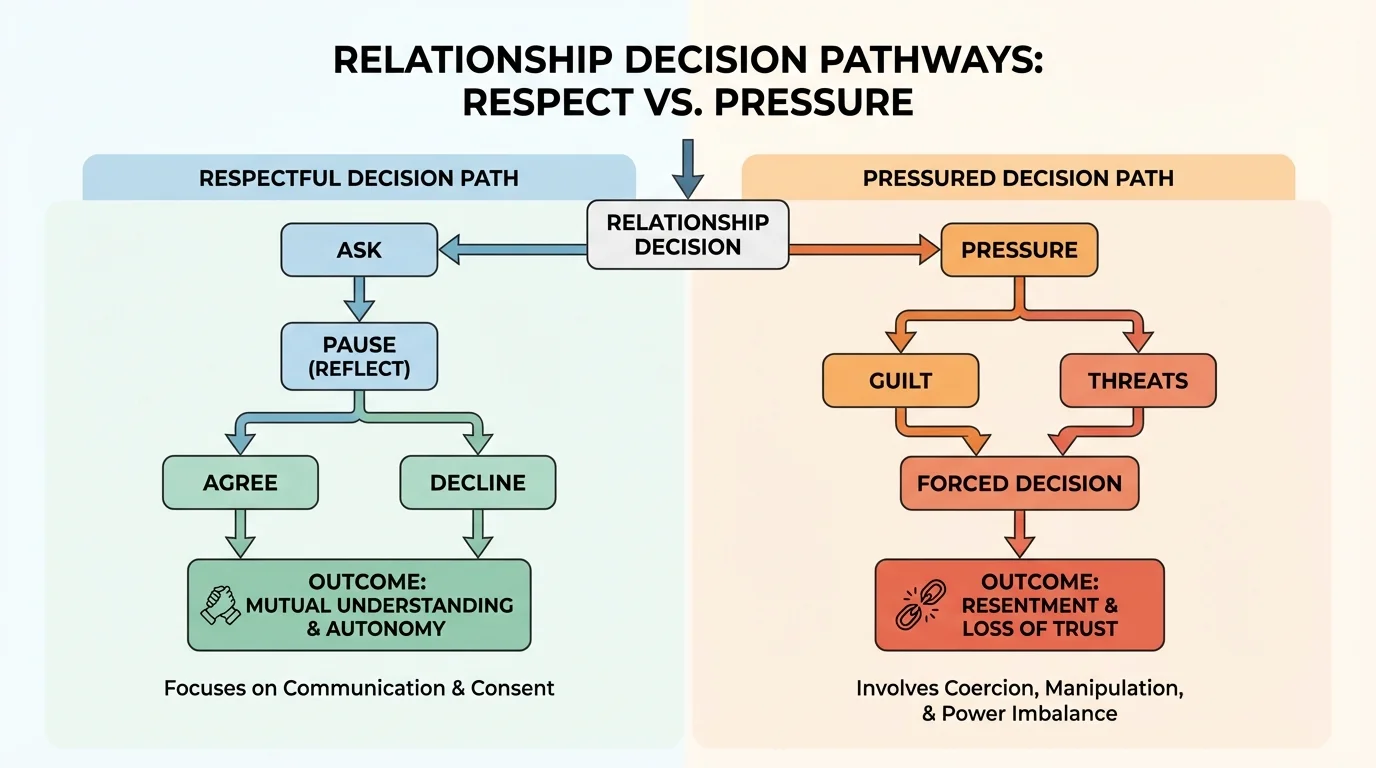
A healthy relationship decision requires real choice, not just the appearance of choice. A person might technically say yes while feeling they cannot safely say no. That is why freedom matters, as [Figure 1] shows in the difference between a respectful decision path and a pressured one. If one person is pushing, threatening, guilting, or using power to get a certain answer, the decision is not truly mutual.
In healthy relationships, both people can speak honestly, disagree safely, slow things down, and change their minds. There is space for questions. There is no punishment for saying no. That is the standard you should compare situations against.
One useful question is "If pressure disappeared, would I still want this?" If the answer is no, maybe, or "I'm not sure," that matters. A decision made under pressure is not the same as a decision made freely.
Coercion is not always dramatic. It can be direct, like "Do this or I'll break up with you," but it can also be subtle, like repeated begging after you already said no. The key idea is that someone is trying to wear down your choice instead of respecting it.
Here are common forms of coercion in relationships:
Notice that each example tries to make your discomfort less important than the other person's goal. Instead of hearing your boundary, the person treats your boundary as an obstacle to remove. That is a major warning sign.
Coercion can affect decisions about physical affection, sex, money, social plans, secrecy, online privacy, or who you talk to. It can also happen in friendships. For example, a friend might say, "If you hang out with them, don't talk to me again." That is still pressure aimed at controlling your choice.
Real-world case: repeated pressure over text
You tell someone you do not want to video chat late at night. They keep messaging: "Come on," "Just for five minutes," "Why are you being weird?" and then "I guess I know where I stand now."
Step 1: Name what is happening
This is not respectful asking anymore. It has become pressure and guilt.
Step 2: Check your freedom
If you are considering saying yes mainly to stop the messages, that is a sign your choice is being pushed.
Step 3: Respond clearly
You could say, "I already answered. Stop asking."
Step 4: Protect yourself if needed
Mute, block, save screenshots, and tell a trusted adult if the pressure continues or becomes threatening.
When coercion works, the person applying pressure often learns that persistence gets results. That can make the behavior more frequent and more serious over time. Stopping the pattern early matters.
Manipulation can be harder to spot than open threats because it often targets your emotions. Instead of saying, "Do this now," a manipulative person may create confusion, self-doubt, guilt, or dependency. These patterns can distort your judgment through common tactics and their effects.
[Figure 2] One tactic is gaslighting. Gaslighting happens when someone makes you question your memory, feelings, or reality. They might say, "That never happened," "You're too sensitive," or "You always twist things," even when your concern is reasonable. Over time, this can make you trust yourself less and rely on the other person more.
Another tactic is love-bombing. This means overwhelming someone with attention, praise, gifts, or intense promises early on to create fast emotional attachment. The attention may feel exciting, but if it quickly turns into control, jealousy, or pressure, that is a problem. Extreme intensity is not the same as genuine care.
Manipulation can also involve isolation. A person may criticize your friends, make you feel guilty for spending time with family, or act hurt whenever you talk to others. The goal is often to reduce outside perspectives so you become easier to control.
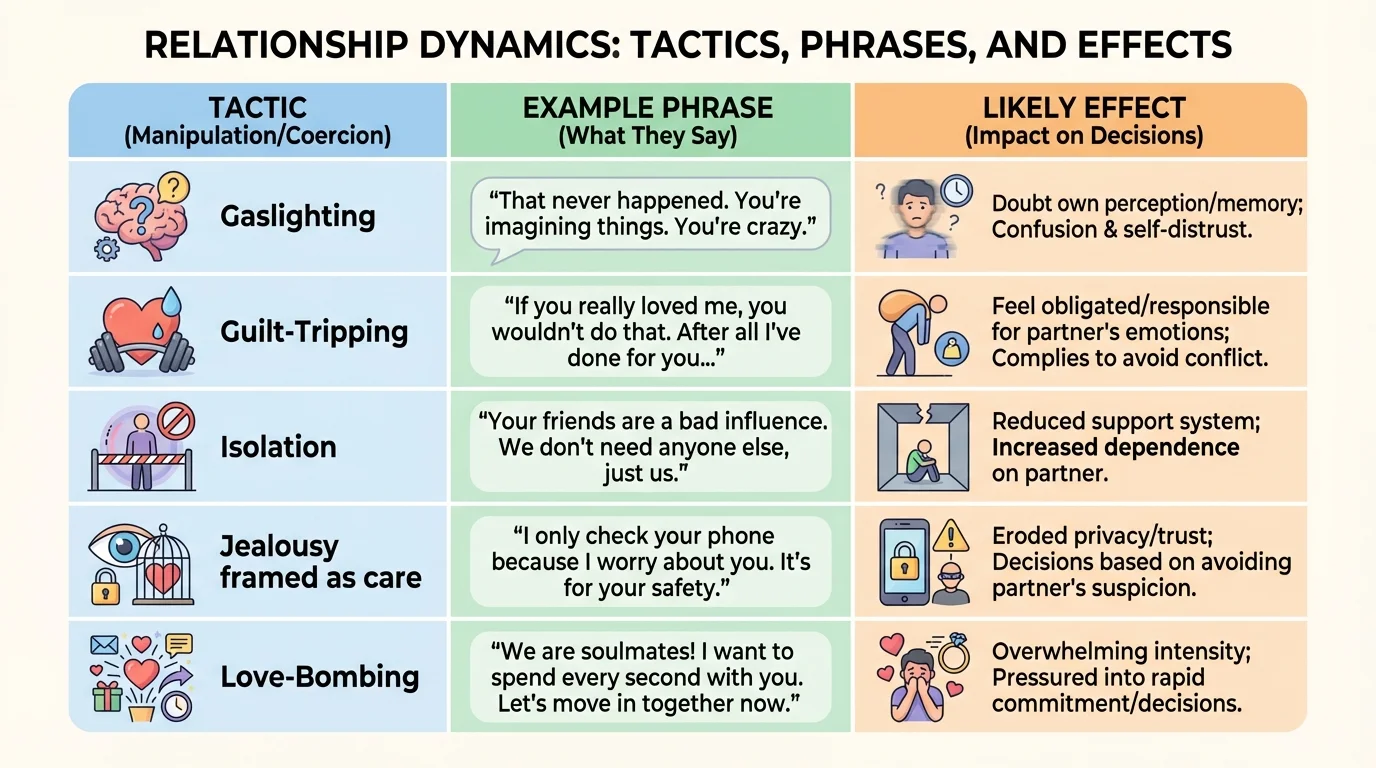
Jealousy is another area where manipulation can hide. Someone might say, "I'm only checking your location because I care," or "I only get mad when you talk to other people because I love you so much." Real care respects your independence. Control disguised as love is still control.
Later, when you feel confused about whether something is healthy, think back to the patterns in [Figure 2]. A single nice moment does not erase repeated manipulation. Look for the overall pattern, not just the apology or excuse that follows.
Power dynamics affect how free a decision really is. If one person has much more influence, resources, experience, status, or control, the other person may feel pressure even when no direct threat is spoken.
Power differences can include:
A power imbalance does not automatically mean a relationship is unhealthy, but it does mean you should pay closer attention to whether both people can truly speak freely. If one person fears consequences for disagreeing, the relationship is not operating on equal ground.
For example, suppose someone you like always pays for things, gives you rides, and has a much bigger social media presence. Later they say, "After everything I do for you, why won't you just do this one thing?" That is not generosity anymore. It is using resources and status to pressure a decision.
| Situation | Healthy use of influence | Unhealthy use of power |
|---|---|---|
| More dating experience | Explains things and respects your pace | Says you are immature for having boundaries |
| More money or resources | Offers help with no strings attached | Acts like you owe them access, time, or affection |
| Higher online status | Keeps your privacy safe | Threatens embarrassment, exposure, or rumors |
| Emotional closeness | Accepts honesty and limits | Uses guilt, panic, or blame to control you |
Table 1. Comparison of healthy influence and unhealthy power use in relationships.
As with the decision paths in [Figure 1], the big question is whether you can freely choose without fear of punishment, loss, or humiliation.
Pressure often appears in patterns. One message by itself may seem small, but repeated patterns tell the real story. Watch for statements like these:
Also pay attention to behavior: checking your location without real reason, demanding passwords, insulting your friends, monitoring when you are online, punishing you for taking space, or making your boundaries seem selfish. Healthy people may feel disappointed sometimes, but they do not use disappointment as a weapon.
Many controlling behaviors are easier to spot when you replace romantic language with plain language. "I need proof you care" often means "I want control." "I'm protecting us" may really mean "I want to monitor you."
One of the most useful skills you can build is translating emotional language into plain language. Ask yourself, "What is this person asking me to do, and what happens if I say no?" That question cuts through a lot of confusion.
When you are stressed, rushed, guilty, scared, or eager not to lose someone, your brain may focus on immediate relief instead of long-term well-being. You may choose the option that ends the discomfort fastest, even if it goes against your values.
This is why someone may later say, "I don't even know why I agreed." The answer is often not weakness. It is that the situation was built to create pressure, confusion, or fear. Recognizing this can reduce self-blame and help you respond more clearly next time.
Manipulation often creates self-doubt. You may begin asking, "Am I being unfair?" "Am I too sensitive?" or "Maybe this is normal." A respectful relationship should not require you to constantly talk yourself out of your own discomfort.
"A healthy relationship can handle the word no."
If saying no leads to anger, mockery, threats, humiliation, or relentless pressure, the problem is not your boundary. The problem is the other person's refusal to respect it.
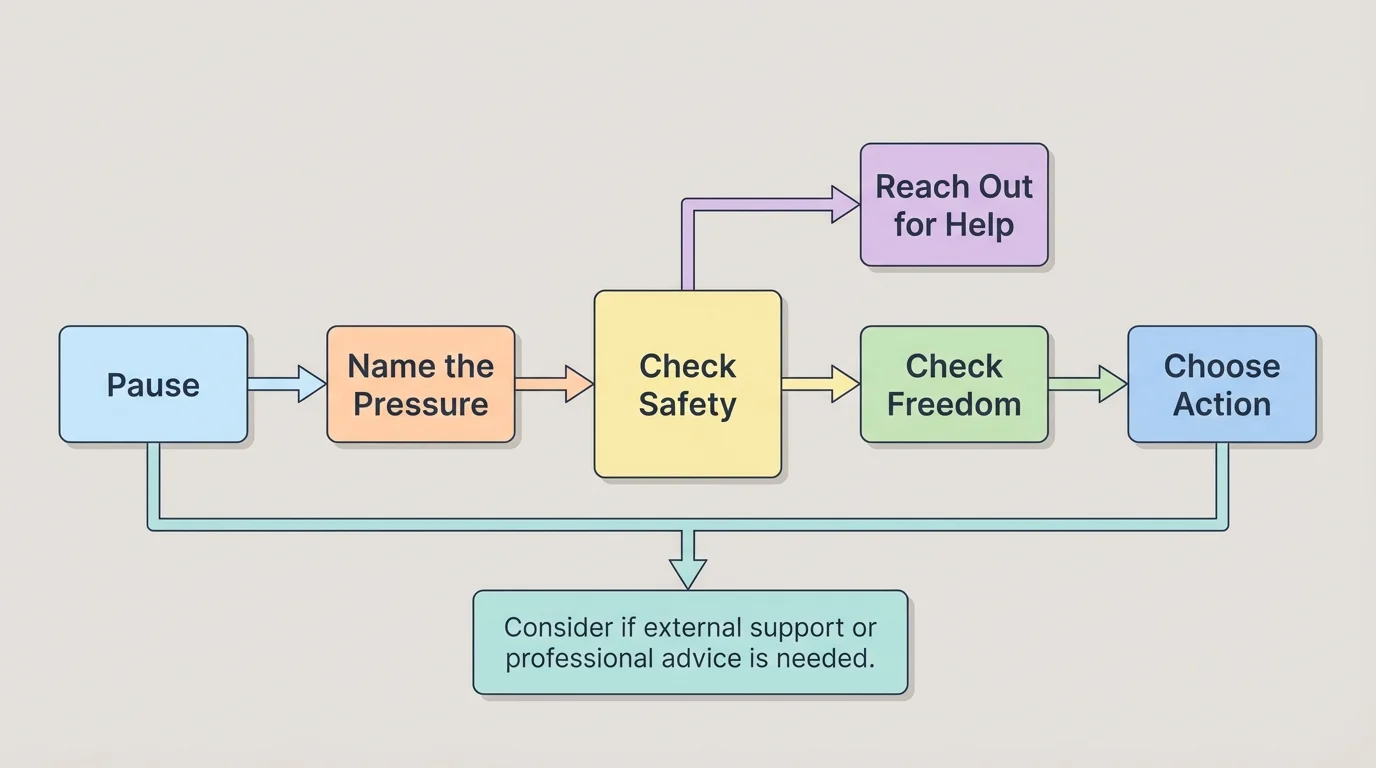
[Figure 3] When you feel pressured, use this five-part check. The process turns a confusing moment into a clearer decision: pause, name the pressure, check safety, check freedom, and choose your action. You do not need to answer immediately just because someone wants immediate access to you.
Pause. Slow the moment down. Do not reply while panicking.
Name the pressure. Ask: Is this a request, or is it guilt, persistence, threat, secrecy, or control?
Check safety. Will saying no put me at risk emotionally, socially, physically, or digitally?
Check freedom. If there were no consequences, would I still want this?
Choose your action. Say no, delay, leave, block, get help, or document what happened.
This tool is especially useful in online situations, where pressure can happen fast. You might get repeated messages, countdowns, threats to post something, or demands for a quick answer. Slowing down interrupts the pressure.
Using the decision-check tool
A person you are talking to online asks for a private image and says, "If you trust me, send it now. I won't ask again."
Step 1: Pause
You do not respond right away, even though the message feels urgent.
Step 2: Name the pressure
The phrase "If you trust me" is guilt pressure, and "send it now" adds urgency.
Step 3: Check safety
Once an image is sent, you lose control over where it might go. The risk is real.
Step 4: Check freedom
If there were no pressure, you would not want to send it.
Step 5: Choose action
You say, "No. Don't ask again." Then you block or save evidence if needed.
Later, if you are unsure whether a situation is serious enough to act on, the steps in [Figure 3] help you remember that confusion itself can be a sign to slow down, not a sign to give in.
A boundary is a limit that protects your safety, comfort, privacy, time, or values. Boundaries are not rude. They are part of healthy relationships.
You do not need a perfect speech to set one. Short, clear responses are often best:
If the person keeps pushing, shift from explaining to protecting yourself. You can stop replying, leave the call, block the account, tell a trusted adult, or save screenshots. You do not owe endless explanations to someone who ignores your limits.
Sometimes direct confrontation is not the safest option, especially if the person may retaliate. In that case, focus on safety first: reduce contact, avoid being alone with them, alert supportive adults, and keep evidence. Protecting yourself is more important than proving a point.
Boundary-setting is not negotiation under pressure. In a respectful relationship, a boundary is heard and accepted. In an unhealthy one, the other person may treat your boundary as the start of an argument. That reaction gives you useful information: they are focused on control, not mutual respect.
Notice how this connects back to manipulation patterns in [Figure 2]. If someone responds to your boundary by making you feel guilty, confused, or selfish, they are still trying to control the outcome.
If a situation feels unsafe or overwhelming, reach out to a trusted adult as soon as possible. This could be a parent, guardian, relative, coach, counselor, youth leader, or another adult who takes your concerns seriously. If there are threats, blackmail, stalking, or fear of harm, treat it as urgent.
You may hesitate because you feel embarrassed, afraid of drama, or worried you will get someone in trouble. But getting support is not overreacting. It is a smart response to pressure and control.
If a friend tells you they are being pressured, try these steps:
Helping a friend does not mean handling everything alone. Serious situations need adult support, especially when there are threats, image-based abuse, harassment, or fear of retaliation.
Healthy relationship decisions are based on respect, honesty, patience, and mutual choice. You can ask for what you want without trying to control the answer. You can hear no without punishing the other person. You can disagree without fear.
In a healthy relationship, trust grows through consistent respect. Privacy is protected. Boundaries are accepted. There is no need to prove love by giving up your safety, comfort, or independence. If someone cares about you, they will care whether you feel free.
That is the real test: not whether someone says the right words, but whether their actions leave room for your full, honest choice. If your decision only "works" when you are scared, guilty, rushed, isolated, or confused, it is time to step back and get support.
