One of the fastest ways to feel independent is also one of the fastest ways to get overwhelmed: making real-life decisions that affect where you live, how you get around, and what services keep your life running. A place that looks cheap online can become expensive once you add utilities and transportation. A ride that seems convenient can wreck your budget if you use it every day. A missed bill payment can shut off a service you rely on. Independent living is not just about having options. It is about judging which option actually works for your life.
When you make decisions about housing, transportation, and services, you are really deciding how your time, money, energy, and safety will be used each day. These systems shape whether you can get to work on time, whether you can afford groceries after paying rent, whether your phone works in an emergency, and whether daily life feels manageable or chaotic.
A strong decision is not always the fanciest or most exciting one. Usually, it is the choice that is stable, affordable, and realistic for your actual routine. If you choose well, life becomes easier. If you choose poorly, problems pile up. For example, living in a cheaper place far away might mean paying so much for transportation that you save almost nothing. Or choosing an unreliable phone plan might cause you to miss job calls, appointment reminders, or safety updates.
Affordable means a cost fits your budget without forcing you to skip essentials. Reliable means something works consistently when you need it. Service systems are the organized services people depend on in daily life, such as electricity, water, internet, transportation, healthcare, banking, and waste pickup.
The goal is not to find a perfect option. The goal is to find the best fit among real-world choices, each with tradeoffs.
When you look at housing, your first instinct may be to focus only on monthly rent. But housing decisions are broader than that. Your lease, location, utilities, roommates, building rules, commute, safety, and access to services all matter. The true cost of housing includes more than the listed rent, and that bigger picture is what makes a smart decision possible.
[Figure 1] Suppose one room rental costs $700 a month and another costs $850. The $700 option looks better at first. But if the cheaper place requires $160 in bus fare each month, $90 for utilities, and long travel times, while the $850 place includes utilities and is close enough to walk to a job or important errands, the comparison changes. The first option might cost $950 monthly, while the second may stay around $850. In plain numbers, that is \(\$700 + \$160 + \$90 = \$950\) for the first place, compared with \(\$850 + \$0 + \$0 = \$850\) for the second.
Housing choices also affect your stress level. A place can be affordable but unsafe. It can be clean but far from everything. It can be close to what you need but full of conflict if the roommate situation is bad. Good decision-making means looking at the whole living situation, not just one number.
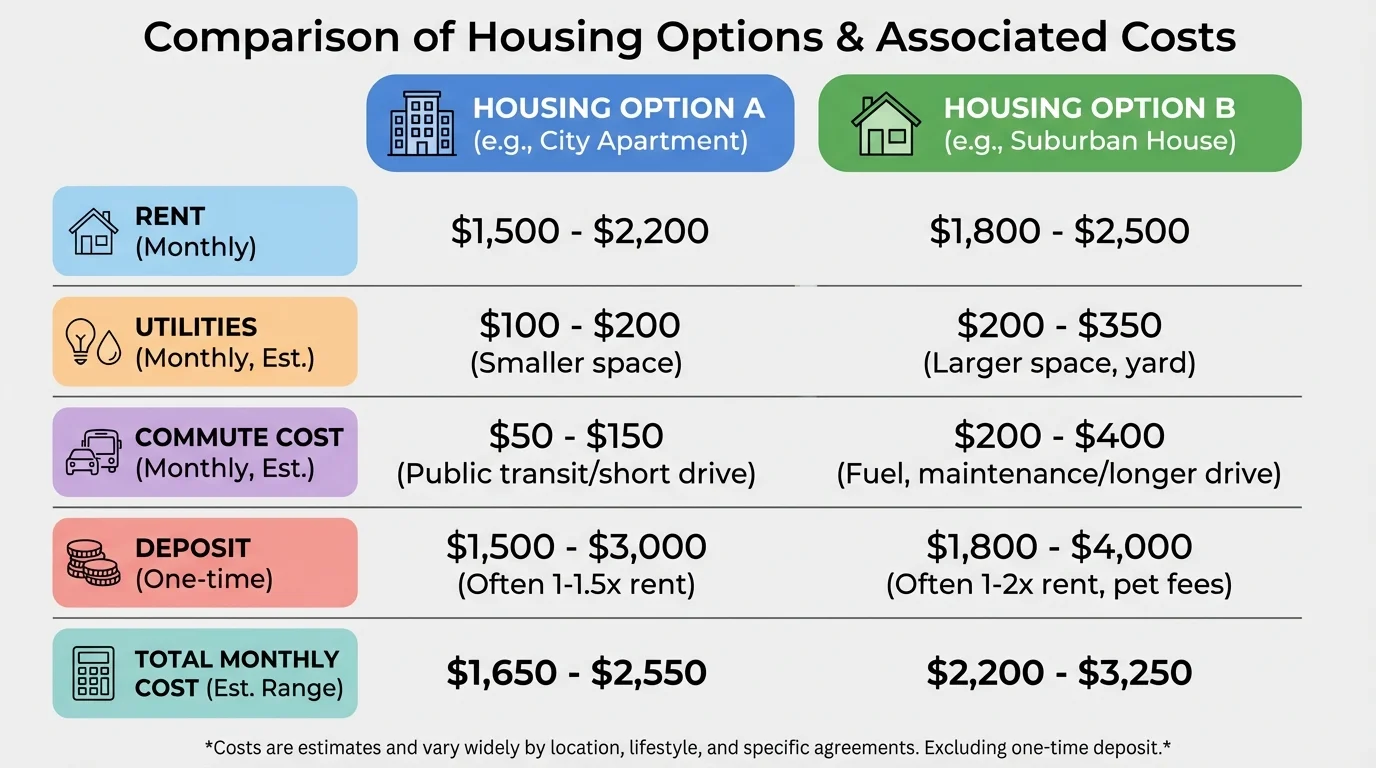
Important housing factors include:
A security deposit is especially important to understand. It is money paid up front in case the renter damages the property or breaks the agreement. If you move out responsibly and follow the rules, you may get it back. If you do not, you may lose part or all of it. That means a place with lower monthly rent may still be hard to afford if the move-in cost is high.
Total cost matters more than sticker price. A listing price is only the starting point. Good housing decisions compare the full monthly cost, the up-front move-in cost, and the effect on your daily life. A cheaper place that creates long commutes, unsafe conditions, or constant conflict can cost more in the long run.
Another major issue is the utility setup. Ask clearly: What is included? Some places include water and trash, but not electricity or internet. Some split bills among roommates. Some require you to start service accounts yourself. Never assume. If information is missing, ask before agreeing to anything.
Here is a practical way to assess housing choices.
Step 1: List all monthly costs. Write down rent plus every likely extra charge. Even rough estimates are better than guessing emotionally.
Step 2: List all move-in costs. This may include a deposit, fees, basic furniture, kitchen supplies, and transportation for moving.
Step 3: Check daily life fit. How long will it take to get where you need to go? Can you get groceries easily? Is there a safe way to arrive home after dark?
Step 4: Ask questions. Who handles repairs? When is rent due? What happens if a roommate leaves? Are there quiet hours? Is there a written agreement?
Step 5: Watch for red flags. These include pressure to pay immediately, unclear terms, no written agreement, unsafe conditions, or someone avoiding basic questions.
Housing comparison example
You are comparing two room rentals.
Step 1: Add monthly cost for Option A.
Rent is $650, utilities are $100, and bus fare is $80, so the total is \(\$650 + \$100 + \$80 = \$830\).
Step 2: Add monthly cost for Option B.
Rent is $760, utilities are included, and transportation is $20, so the total is \(\$760 + \$0 + \$20 = \$780\).
Step 3: Compare move-in costs.
Option A needs a $300 deposit. Option B needs a $500 deposit. Option B costs less each month but more at the start.
Step 4: Decide based on budget timing.
If you can manage the deposit, Option B may be better long term because it saves $50 each month.
This is a smart decision because it compares both short-term and long-term cost instead of focusing on rent alone.
Notice that the best answer depends on your current situation. If you only have enough savings for the lower deposit, Option A may be the only workable choice right now. Good decisions are not just about what is cheapest on paper. They are about what is possible without putting yourself in crisis.
Later, when you compare future options, returning to the cost breakdown in [Figure 1] helps you avoid the common mistake of ignoring transportation and utility costs.
Transportation is not simply about getting from one place to another. It affects punctuality, independence, job options, energy, and safety. The best transportation option depends on balancing cost, time, reliability, and flexibility rather than choosing only the fastest-looking route.
[Figure 2] Common transportation choices include walking, biking, public transit, rides from family or friends, rideshare apps, and owning or using a car. Each has benefits and limits. Walking is cheap but slow and weather-dependent. Biking is faster but requires safe routes and a secure place to store the bike. Public transit can be cost-effective but may run late or stop early. Rideshare is convenient but often expensive for regular use. Car ownership gives flexibility but comes with fuel, insurance, maintenance, registration, parking, and repair costs.
One hidden mistake is treating occasional transportation costs like they are small. Spending $18 on a rideshare once feels manageable. Spending $18 each weekday adds up fast. In one month of twenty weekday trips, that is \(\$18 \times 20 = \$360\). That amount could equal a utility bill, a phone bill, or a chunk of rent.
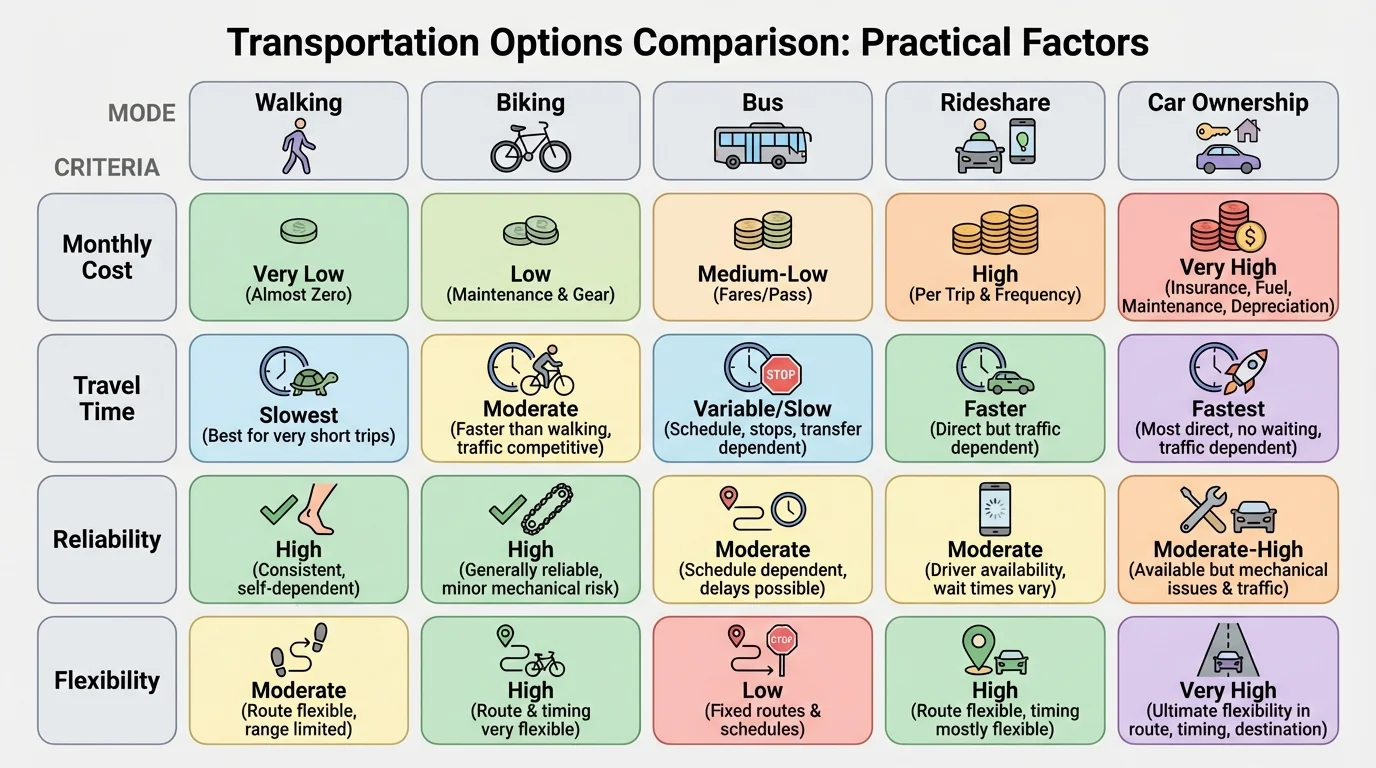
Transportation decisions should include these questions:
This is where public transit becomes a real planning skill, not just a bus ride. You need to know the route, the schedule, transfer points, delays, and backup options. If the bus comes every thirty minutes, missing one has a bigger effect than missing a bus that comes every five minutes.
A car is often treated like the ultimate symbol of independence, but for many people it is one of the most expensive monthly systems they manage. Insurance alone can make a car unrealistic for a new driver, even before fuel and repairs are added.
The right transportation decision also depends on your goals. If you need a job and reliable attendance matters, a slightly more expensive but predictable method may be smarter than a cheaper method that fails often. Being late repeatedly can cost more than the savings.
Try using a simple rating system. Give each option a score from 1 to 5 for cost, travel time, reliability, safety, and flexibility. Then compare the patterns. You do not need perfect math. You need a clear view of tradeoffs.
| Option | Cost | Time | Reliability | Safety | Flexibility |
|---|---|---|---|---|---|
| Walking | 5 | 2 | 4 | 3 | 3 |
| Bus | 4 | 3 | 3 | 4 | 2 |
| Rideshare | 1 | 4 | 4 | 4 | 5 |
| Car | 2 | 5 | 4 | 4 | 5 |
Table 1. Example transportation comparison using a simple scoring system, where higher scores represent a stronger fit in that category.
A table like this does not make the decision for you. It helps you think more clearly. For example, rideshare may look great except for cost. A bus may be the best overall choice if your route is dependable. If your job starts very early and buses do not run then, the bus stops being realistic no matter how cheap it is.
Transportation cost example
You are deciding between bus fare and rideshare for a part-time job.
Step 1: Calculate the monthly bus cost.
If a bus pass is $65 per month, that is your full transportation cost for work travel.
Step 2: Calculate monthly rideshare cost.
If one ride costs $14 and you need 20 rides, the total is \(\$14 \times 20 = \$280\).
Step 3: Compare the difference.
The rideshare option costs \(\$280 - \$65 = \$215\) more each month.
If the bus is reasonably reliable, it may be the better choice by a large margin.
As you continue making transportation decisions, the tradeoff chart in [Figure 2] helps you remember that the cheapest option is not always the most dependable, and the fastest option is not always affordable.
Most people notice service systems only when they stop working. But these systems quietly support daily life all the time. A service system is a network that provides an essential need, and housing connects with transportation, electricity, water, internet, banking, healthcare, phone service, and emergency support. These systems do not operate separately in your real life. They overlap constantly.
[Figure 3] If your internet goes down, online school, job applications, telehealth, and communication may all be affected. If your bank account is overdrawn, your phone autopay might fail. If your phone is shut off, transit alerts or work messages may not reach you. When one system breaks, others can be disrupted too.
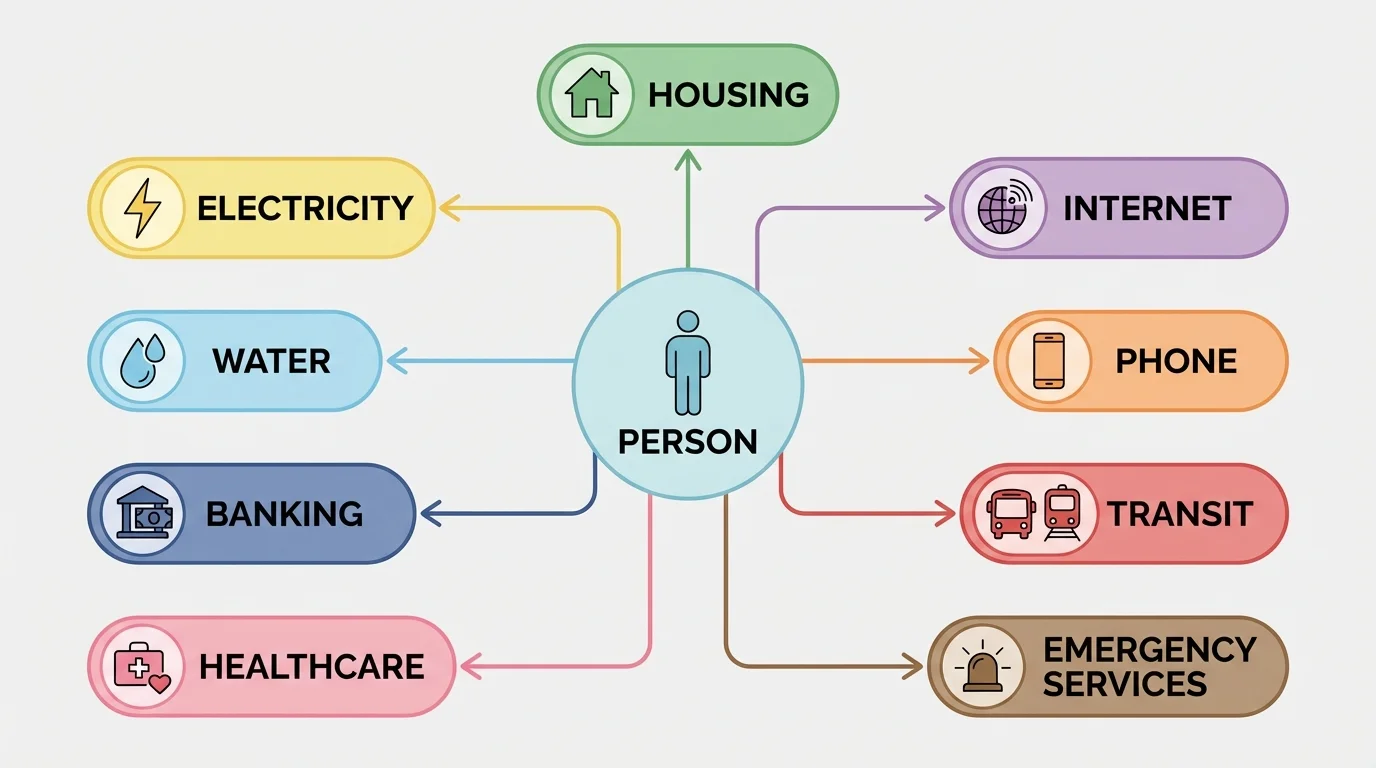
Important service systems for independent living include:
Understanding these systems means knowing how to use them, how to pay for them, and what to do when something goes wrong. For example, if a utility bill is due on the fifth of each month, that date matters. If your phone plan slows data after a certain limit, that matters too. If your clinic requires appointments booked online, internet access becomes part of healthcare access.
Systems thinking makes life easier. Instead of handling every problem as a surprise, you can ask: What does this service depend on? What depends on it? That question helps you prepare for disruptions and make stronger decisions.
Another useful term is autopay, which means a bill is paid automatically from your bank account or card on a scheduled date. Autopay can help prevent missed payments, but only if you know the money will be there. If not, it can trigger overdraft fees or declined payments. Convenience is helpful only when it is matched with planning.
Real life rarely runs exactly as planned. Buses are late. Wi-Fi goes out. A roommate pays late. A doctor appointment gets rescheduled. A billing error appears. Smart decision-making includes backup plans.
For housing, your backup plan might be knowing who to contact for repairs, keeping copies of important documents, and having a trusted adult or support person who knows your address and situation. For transportation, your backup might be knowing a second route, leaving earlier for important appointments, or keeping enough money for an emergency ride. For services, your backup might be writing down account numbers, saving customer service contacts, and using reminders for due dates.
One strong habit is to separate urgent problems from important but not urgent problems. No heat in winter is urgent. A confusing charge on a statement is important but may not be an emergency if you can address it promptly. This keeps you from panicking over every issue and helps you focus your energy wisely.
"Good decisions are rarely about control. They are about preparation."
It also helps to keep a small emergency cushion when possible. Even saving $10 at a time can build a buffer for transit, medicine, or temporary service problems. A small amount of preparation can prevent a much larger crisis.
When systems connect, the network in [Figure 3] becomes especially important. A transportation problem can affect job income. Job income affects housing and bills. Bills affect phone and internet. That is why practical decisions are not isolated choices. They are part of one life system.
If you are choosing between two housing options, do not ask only, "Which one is cheaper?" Ask, "Which one supports my daily life better after all costs and responsibilities are included?" If you are deciding how to travel regularly, do not ask only, "What is fastest today?" Ask, "What can I afford and depend on over time?" If you are setting up services, do not ask only, "What is convenient right now?" Ask, "What will still work next month if something changes?"
Here is a practical checklist you can use for almost any decision in this topic:
That last question matters a lot. Your ideal routine may involve waking up early, never missing a bus, always remembering due dates, and never needing help. Your real routine may include stress, bad weather, changing schedules, and occasional mistakes. Smart choices are built for real life.
Combined decision example
You are considering a low-rent room far from work and a higher-rent room near work.
Step 1: Compare monthly housing cost.
Far room: \(\$600 + \$110 = \$710\). Near room: \(\$760 + \$0 = \$760\).
Step 2: Compare transportation cost.
Far room requires $140 monthly transit. Near room requires $20 occasional transit. Totals become \(\$710 + \$140 = \$850\) and \(\$760 + \$20 = \$780\).
Step 3: Compare time and risk.
The far room adds long travel time and a greater chance of being late. The near room reduces travel stress and saves time.
Even though the near room has higher rent, it may be the better practical decision because the total cost is lower and the routine is more reliable.
Practical independence grows when you stop judging choices by appearances and start assessing them by total impact. That is the skill behind strong adult decisions.
