One missed message can delay an entire team. That is not an exaggeration. In online group projects, volunteer efforts, part-time jobs, gaming communities, and content creation teams, the biggest problems often are not lack of talent. They are unclear goals, vague responsibilities, and poor follow-through. When people know what they are doing, when each task is due, and how to speak up early, teams move faster and with less stress.
Team-based problem-solving is a practical life skill because you will use it far beyond school assignments. You may help run a community event, work with coworkers on a shift schedule, collaborate on a digital project, plan a fundraiser, or share responsibilities at home. In all of those situations, success depends on whether the group can work toward the same result without dropping important details.
Working with others is not just about being "nice" or "cooperative." It is about getting real things done. A team that solves problems well can meet deadlines, avoid wasted effort, reduce conflict, and recover quickly when something goes wrong. A team that does this poorly may miss opportunities, disappoint other people, damage trust, or create extra pressure for the most responsible member.
Think about a simple example: a group of teens is organizing an online donation drive for a local animal shelter. One person is supposed to make graphics, another writes posts, another tracks donation links, and another answers messages. If nobody confirms deadlines, two people may make the same graphic while nobody checks whether the link works. The team looks busy, but the result is weak. Being active is not the same as being organized.
Shared goal means the clear result the whole team is working toward.
Responsibility means a task or duty a specific person agrees to own.
Deadline means the time by which a task must be completed.
Accountability means being answerable for following through on what you said you would do.
When these four ideas are clear, a team becomes much easier to manage. When they are fuzzy, confusion spreads fast.
Team-based problem-solving means a group identifies a challenge, gathers useful information, agrees on a plan, divides the work, and adjusts as needed until the goal is met. It is not just talking about the problem. It is moving from problem to action.
Good teamwork does not mean every person does the exact same amount of the exact same type of work. Fair teamwork means the workload is visible, responsibilities are understood, and each person contributes in a way that fits the team's needs and their ability. Sometimes one person leads scheduling while another handles design or research. What matters is clarity, not sameness.
A strong team also understands that shared goals require shared ownership. Even if tasks are divided, everyone should care about the final outcome. If one part fails, the whole result suffers. That is why reliable teams do not say, "That is not my problem." They say, "How do we fix this together without ignoring individual responsibility?"
A lot of team problems start too early, at the goal-setting stage. If your team says, "Let's make something good," that is too vague. A better goal sounds like this: "Create and publish a three-minute awareness video for our community campaign by Friday at 6 p.m., with one final version approved by the whole team." That goal names the product, the purpose, and the deadline.
Clear goals usually answer four questions: What are we making or doing? Why does it matter? When is it due? How will we know it is done well? If a team cannot answer those questions, it is not ready to divide the work yet.
A useful goal is specific and visible. Teams work better when the goal can be checked against real evidence. Instead of "grow our page," use "post four pieces of content this week and reply to all direct messages within 24 hours." Instead of "plan the event," use "confirm speakers, publish the schedule, and send reminders by the stated dates." A visible goal reduces arguments because people can compare progress to something concrete.
It also helps to set a realistic timeline. If a final deadline is Friday, the team should not treat Friday as the day to begin finishing. Build in earlier checkpoints. For example, one draft might be due Wednesday and feedback due Thursday. That creates time to solve problems before the final deadline becomes a crisis.
Once the goal is clear, break it into parts. Ask, "What smaller tasks must happen for this goal to succeed?" A video project may need research, script writing, recording, editing, thumbnail design, caption writing, and publishing. A fundraiser may need outreach, promotion, budgeting, donation tracking, and thank-you messages.
This stage is where many teams either become efficient or messy. If tasks are too broad, people do not know where to start. If tasks are too tiny, the team wastes time managing details. Try to make each responsibility clear enough that one person can say, "Yes, I own this."
Role clarity matters because unclear ownership causes two major problems: duplication and neglect. Duplication means two people do the same job without realizing it. Neglect means everyone assumes someone else handled it. Both are common in online teamwork, especially when communication is scattered across group chats, email, and direct messages.
Assign responsibilities based on strengths when possible. If someone is organized, they may be the best person to track deadlines. If someone writes clearly, they may handle announcements. If someone is calm under pressure, they may be a good coordinator. But strengths do not excuse people from effort. A team should not overload one competent person while others drift.
It helps to state ownership in simple language: "Jordan will create the first draft of the post by Tuesday at 7 p.m." "Amina will review grammar by Tuesday at 9 p.m." "Luis will schedule the post for Wednesday morning." This is much stronger than saying, "Can someone do the post stuff?"
A useful team plan turns a goal into a trackable process, as [Figure 1] shows. Your team does not need a complicated project management system. It needs one shared place where everyone can see the tasks, owners, deadlines, and current status.
You can do this with a shared document, spreadsheet, notes app, or project board. The tool matters less than the habit of using it consistently. Every task should include three things: owner, due time, and status. A status can be as simple as "not started," "in progress," "waiting," or "done."
Here is a practical order for planning: first define the final goal, then list major tasks, then assign owners, then set mini-deadlines, then decide how updates will be shared. When teams skip one of these steps, they often end up trying to solve preventable confusion later.
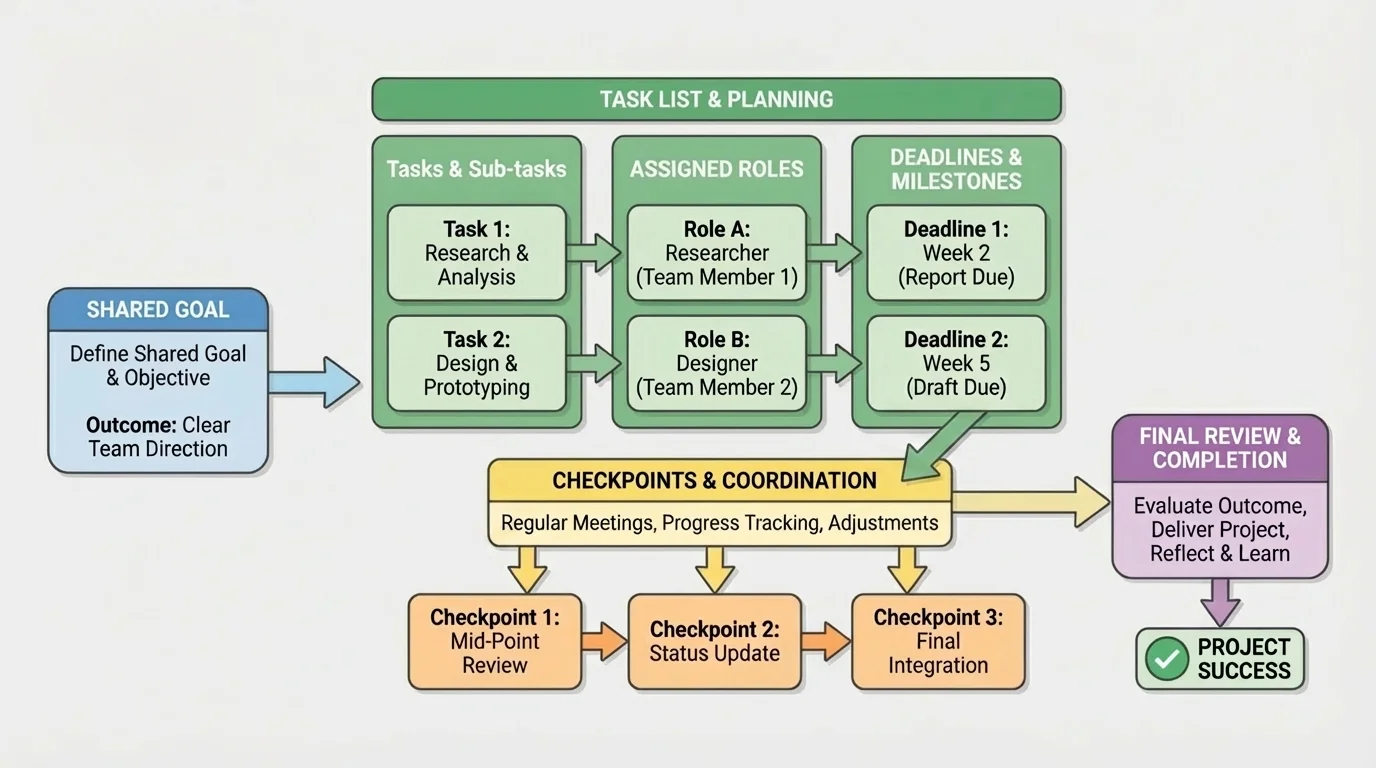
Mini-deadlines are especially important. They act like warning signals. If a team member misses an early checkpoint, the group still has time to adapt. Without checkpoints, the first sign of trouble may appear when the final deadline is already too close.
Checkpoint planning is simple: if the final task is due on day 5, decide what must be finished on day 2, day 3, and day 4. This breaks pressure into manageable parts. It also reduces the temptation to procrastinate until the deadline feels urgent.
| Planning Element | What to Decide | Helpful Question |
|---|---|---|
| Goal | Final result | What exactly are we trying to complete? |
| Tasks | Smaller action steps | What must happen first, next, and last? |
| Owner | Person responsible | Who is taking the lead on this? |
| Deadline | Due date and time | When must this be done? |
| Checkpoint | Progress review moment | When will we check whether we are on track? |
| Communication | Update method | Where will we post updates and questions? |
Table 1. Core parts of a simple team plan for shared goals and deadlines.
Even strong teams run into trouble. Someone gets sick. A file disappears. A person misunderstands the task. A deadline turns out to be unrealistic. The difference between a weak team and a strong one is not whether problems happen. It is whether the group responds calmly and early, as [Figure 2] illustrates.
When something goes wrong, use a basic problem-solving sequence. First, identify the issue clearly. Second, figure out how urgent it is. Third, communicate the problem to the team as soon as possible. Fourth, suggest one or two realistic fixes. Fifth, confirm the updated plan so everyone leaves with the same understanding.
For example, if you realize you cannot finish your task on time, do not wait until the deadline has already passed. Message the team early: "I'm behind on editing because the audio file was corrupted. I can finish by tomorrow at 3 p.m., or someone else can handle the final cut tonight if needed." That message is honest, specific, and solution-focused.
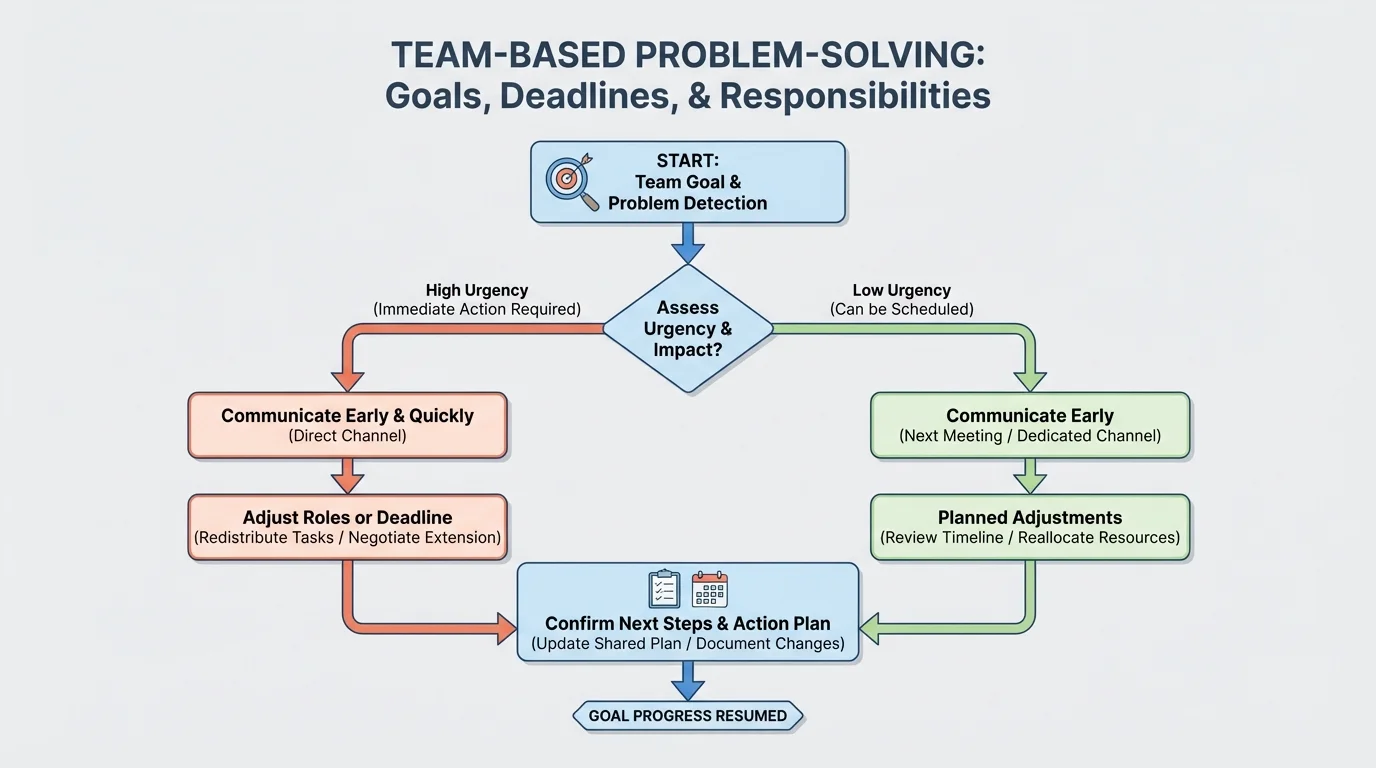
This is where accountability becomes real. Accountability is not blaming people in a dramatic way. It is the habit of owning your part, updating others honestly, and helping repair the problem. A teammate who admits an issue early is usually more helpful than one who stays silent to avoid looking bad.
Not every problem should be solved the same way. Some require reassigning tasks. Some require extending an internal deadline. Some require cutting nonessential parts of the project. Some require direct conversation because confusion or tension is blocking progress. Good teams focus on the current need, not on defending their pride.
Later, when the team reflects on what happened, [Figure 2] still matters because the same process works in many situations: identify, assess, communicate, adjust, confirm. The order keeps people from panicking or making random decisions.
Case study: missed deadline in a shared project
Your team is creating an online awareness campaign, and the graphic designer has not submitted the final images by the agreed time.
Step 1: Name the problem clearly
The team leader sends a direct message and group update: "The final graphics are still missing, and the first post is scheduled for tonight."
Step 2: Check urgency and impact
The team decides the first post cannot go live without the graphic, but the caption text is already ready.
Step 3: Offer realistic options
Option one: delay the post by 12 hours. Option two: use the draft version for the first post and improve the later ones.
Step 4: Confirm ownership
One teammate posts the caption, one teammate updates the schedule, and the designer finishes the revision by the new deadline.
The team still experiences a setback, but it avoids chaos because people respond with structure instead of blame.
A useful rule is this: bad news gets worse when it is delayed. In teamwork, early honesty protects the goal.
Strong communication is not about talking the most. It is about making it easy for other people to understand what is happening. Reliable teammates send messages that are clear, relevant, and timed well.
A helpful update often includes four parts: what is done, what is still in progress, any problem, and what happens next. For example: "The outreach list is finished. I'm still waiting on two replies from local groups. One contact email bounced back. I'll replace it and post the final list by 8 p.m." That saves everyone time.
You already know from everyday life that unclear communication creates avoidable stress. In teamwork, the stakes are higher because your confusion can affect other people's deadlines too.
Choose communication channels on purpose. Use one place for official updates. Use another for quick discussion if needed. If important decisions are made in a fast-moving chat and never written down elsewhere, people will miss them. Teams work better when final decisions are easy to find.
Online meetings also need structure. Start by naming the goal of the meeting. End by confirming who is doing what next and by when. If a meeting ends without clear next steps, it may feel productive while actually solving very little.
Respect matters too. You can be honest without being harsh. "I'm confused about who owns this task" is better than "Nobody knows what they're doing." Good teams protect both clarity and dignity.
Teams often get stuck not because they lack ideas, but because they lack a decision method. If every choice turns into endless debate, deadlines slip. Decide in advance how your group will make decisions.
Some decisions work well with quick consensus. Some need a vote. Some should be made by the person most responsible for that area after hearing feedback. For example, the person managing design may choose between two layouts, while the whole team may vote on the campaign theme.
Consensus means the group can support a decision, even if it is not every person's favorite option. That is different from total agreement. In real teamwork, waiting for perfect agreement can waste time. A good decision made on time is often better than a perfect decision made too late.
If a decision affects deadlines, budget, safety, or public communication, confirm it in writing. A short message such as "We agreed to move the launch to Saturday, and Maya will update the schedule" prevents future disputes.
Many managers say that one of the hardest skills to find is not technical talent but the ability to communicate clearly, solve problems with others, and follow through without constant reminders.
That matters because team decision-making is really trust-making. When people see that your team can choose a direction and stick to it, confidence grows.
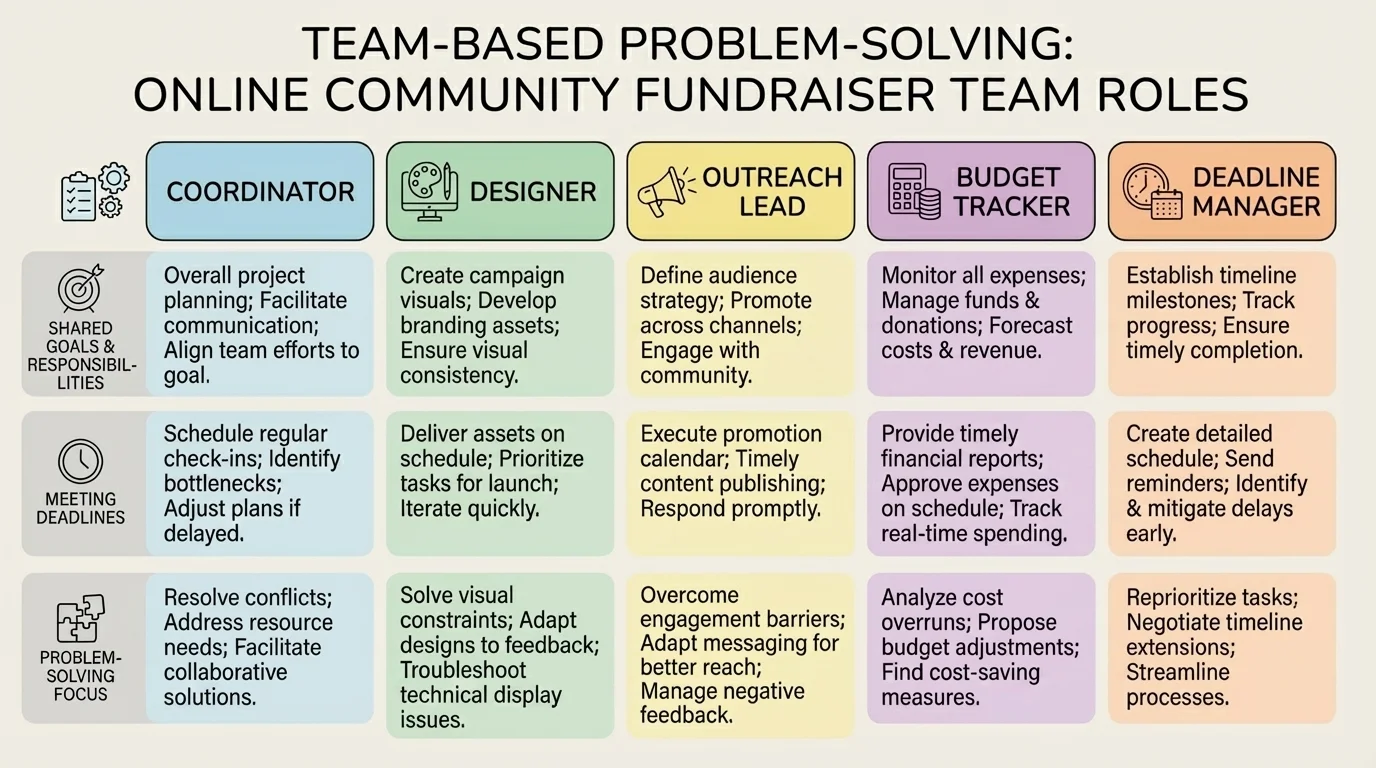
A community fundraiser is a strong example of teamwork because strong teams make responsibilities visible, as [Figure 3] demonstrates through role-based planning. Suppose your group wants to raise $500 online for a local shelter in one week. The final goal is clear: reach $500, post daily updates, and send thank-you messages to donors. From there, the team can divide roles such as coordinator, designer, outreach lead, budget tracker, and response manager.
If the outreach lead notices that donation traffic is slow halfway through the week, the team can review the numbers and adjust strategy. Maybe the posts need stronger wording, maybe the donation link is hard to find, or maybe supporters need a reminder. The point is not to panic. The point is to look at evidence and respond together.
Another example is running a small online content channel with friends. One person edits clips, one writes captions, one tracks upload times, and one monitors audience questions. If the editor suddenly becomes unavailable, the group must decide whether to delay the post, simplify the edit, or shift tasks. That decision depends on the goal, the deadline, and the team's available skills.
Team-based problem-solving also matters in part-time work. If you are helping with a family business, volunteering, or working a shift-based job, your reliability affects customers and coworkers. If you notice a scheduling problem early and offer a fix, you show initiative. That is leadership in action, even if you are not the official leader.
In the fundraiser example, [Figure 3] remains useful because it shows something many teams forget: roles may be different, but they all connect to the same goal. A team fails when members only protect their own task and ignore the whole system.
Case study: organizing a one-week online fundraiser
Step 1: Set the shared goal
The team agrees to raise $500 in seven days and publish one update each day.
Step 2: Assign responsibilities
One person handles graphics, one writes posts, one tracks donations, one answers questions, and one checks deadlines.
Step 3: Add checkpoints
The team reviews progress on day 2, day 4, and day 6 rather than waiting until the last day.
Step 4: Solve problems quickly
When donations slow down on day 4, the team changes the posting schedule and adds a short video message to increase interest.
The team reaches the goal because it stays organized and adapts before the deadline becomes impossible.
These examples show an important truth: teamwork is not just dividing labor. It is combining effort with awareness.
One common mistake is assuming everyone understands the plan without checking. Another is assigning tasks without assigning deadlines. Another is using vague phrases like "someone should do this." Another is letting one responsible person carry the whole team while others stay passive. These problems often look small at first but create serious pressure later.
Another mistake is confusing activity with progress. A busy group chat is not proof of good teamwork. What matters is whether tasks are actually moving toward the goal. If the answer is unclear, stop and review the plan.
Teams also struggle when they avoid difficult conversations. If a person is repeatedly late, disappearing, or not doing their share, ignoring it does not protect the team. Address the problem directly and respectfully. Name the issue, explain the impact, and ask for a workable solution.
| Common Problem | What It Looks Like | Better Response |
|---|---|---|
| Vague goal | "Let's do something good" | Define a specific result and deadline |
| Unclear ownership | Tasks are mentioned but not assigned | Name one responsible person per task |
| Late communication | Problems are hidden until the deadline | Report issues early with possible solutions |
| No checkpoints | Progress is only checked at the end | Set review points during the process |
| Poor follow-through | Promises are made but not completed | Use accountability and written updates |
Table 2. Frequent teamwork problems and practical responses.
You do not need an official title to show leadership. In a team, leadership often looks like noticing what needs to happen, helping the group stay organized, and speaking up when something is unclear. If you summarize the plan after a call, remind the team of deadlines, or offer help when someone is stuck, you are showing initiative.
Initiative matters because teams rarely succeed through instructions alone. Someone has to notice gaps and act before the problem grows. That does not mean controlling everyone. It means contributing energy, attention, and reliability.
"Trust is built when actions match words."
— Teamwork principle
Trust grows when people do what they said they would do. It also grows when they admit problems quickly, respond respectfully, and support the shared goal. If you become known as the person who communicates clearly and follows through, people will want you on their team in school, work, and community settings.
This skill also matters for your future. Employers, volunteer coordinators, coaches, and community leaders all value people who can work with others under deadlines. The ability to coordinate, solve problems, and stay accountable can open opportunities long before you have years of experience.
So when you are part of a team, think beyond just finishing your own task. Ask yourself: Do I understand the goal? Does everyone know who owns what? Are we checking progress early enough? Have we made it easy to raise problems before they become emergencies? Those questions can turn a struggling group into an effective one.
