A lot of major life outcomes begin with decisions that seem small at the time: copying one answer, forwarding one screenshot, staying quiet during one harmful conversation, or posting one joke that does not land the way you expected. At this stage of life, character is not a distant adult concern. It shows up in your daily routines, especially when no teacher, parent, coach, or friend is there to correct you in the moment.
When people talk about character, they usually mean the inner qualities that guide your actions. In real life, that includes what you do when you are stressed, tempted, embarrassed, left out, or trying to fit in. It affects how you handle schoolwork at home, how you treat friends in group chats, and how you behave online when something can be deleted from your screen but not from someone else's memory.
Character-based choices matter because they build trust. Trust is what makes people believe your work is your own, your word means something, and your presence is safe for others. Once trust is damaged, it can take a long time to rebuild. In online school and digital spaces, where much of your effort happens out of sight, your choices often speak louder than your explanations.
Strong character does not mean being perfect. It means being willing to choose what is right even when what is easy, popular, or private pushes in another direction. It also means owning your mistakes instead of hiding them. That is important because the real test of character is usually not whether you know the rule. It is whether you can apply your values in a messy, real situation.
Ethics are principles about what is right and wrong. Character is the set of qualities that shapes how you act, such as honesty, courage, fairness, self-control, and compassion. Responsibility means taking ownership of your choices and their effects. Accountability means being answerable for what you did and willing to repair harm when needed.
One important truth: your choices do not affect only you. They also affect your community. A dishonest shortcut can hurt fairness. A careless post can damage someone's sense of safety. A brave, respectful action can improve a whole group's culture. Character is personal, but its effects spread outward.
In everyday life, a character-based choice is a decision guided by values instead of impulse alone. It asks, "What kind of person am I being right now?" not just "Can I get away with this?" or "Will people approve?" That question matters in tough moments because feelings are real, but they are not always reliable leaders.
Some key values often involved in difficult choices include honesty, fairness, respect, compassion, courage, loyalty, self-control, and wisdom. These values do not always point to an easy answer. Sometimes two values pull in different directions. For example, loyalty to a friend may conflict with concern for someone's safety. Respecting privacy may conflict with the need to report serious harm.
That is why good judgment matters. Integrity means your actions match your values even when the situation is inconvenient. Empathy means you try to understand how your choice will affect other people, not just how it will affect your comfort or reputation. Accountability means you do not disappear from the consequences of your own behavior.
When a situation feels confusing, a clear process helps. A practical decision framework can slow you down enough to think clearly before you act. You do not need a perfect script. You need a repeatable method.
Step 1: Pause. [Figure 1] Most poor choices get stronger when you act fast. If you feel angry, pressured, excited, embarrassed, or afraid, stop for a moment. Even a pause of a few minutes can protect you from doing something you would not choose calmly.
Step 2: Get the facts. What actually happened? What do you know for sure? What are you assuming? Many bad decisions start with incomplete information, rumors, or one-sided stories.
Step 3: Name the values. Ask which values are involved: honesty, safety, kindness, fairness, loyalty, privacy, respect, or responsibility. If you cannot name the values, you may be choosing based only on emotion or pressure.
Step 4: Consider the impact. Who could be helped? Who could be harmed? What happens right away, and what happens later? Think beyond the next five minutes.
Step 5: List your options. Complex situations usually have more than two choices. For example, you might not have to choose between exposing someone publicly and staying silent. You may be able to speak privately, save evidence, ask an adult for help, or set a clear boundary.
Step 6: Choose the option you can defend. If you had to explain your choice to a trusted adult, future employer, younger sibling, or your future self, would it still make sense?
Step 7: Review afterward. Ask what happened and what you learned. Character gets stronger when you reflect, not just when you react.
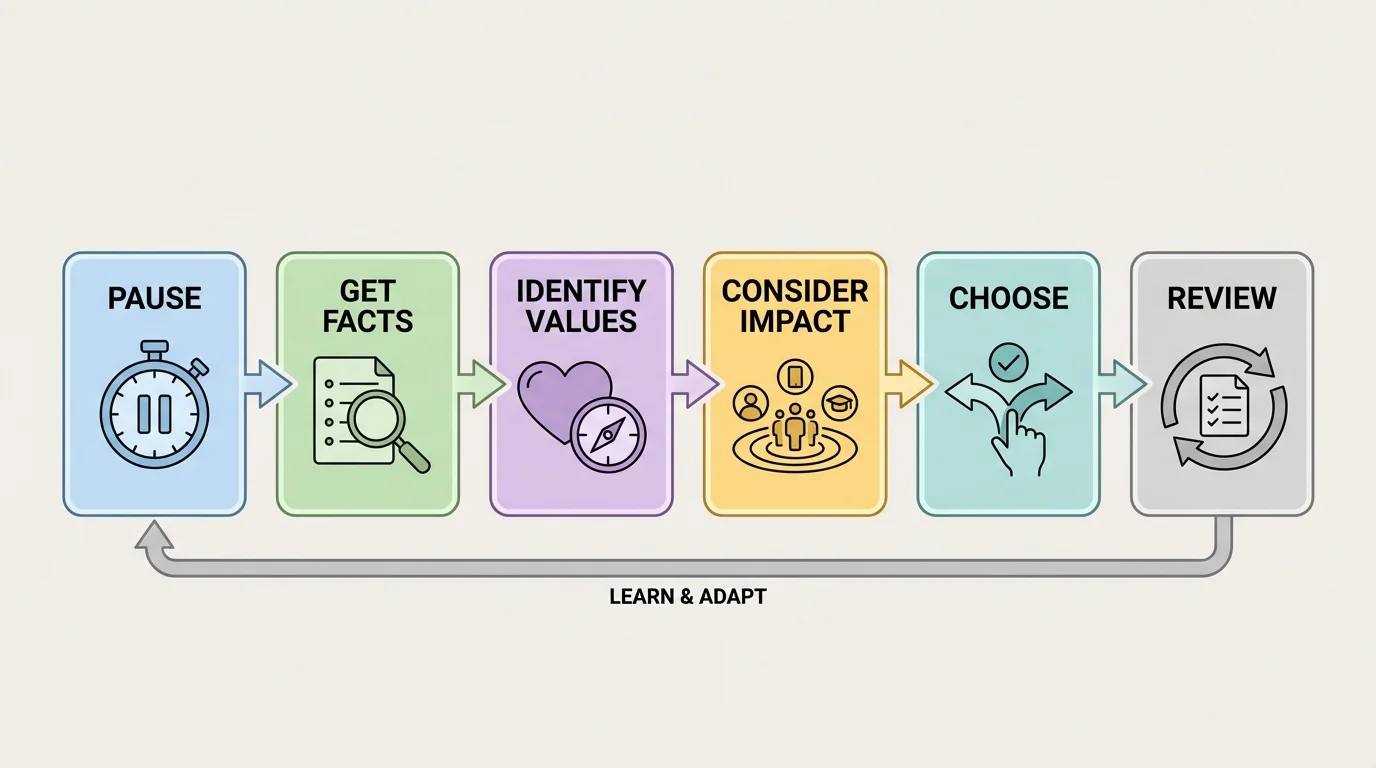
This framework is especially useful because hard moments often feel urgent when they are not. A rumor in a group chat can wait. A rude comment does not require an instant comeback. A late assignment is better handled with honesty than panic. Slowing down gives your values a chance to lead.
Good character is practiced, not improvised. People often think strong choices come from having naturally good instincts. More often, they come from building habits: pausing, checking facts, asking for advice, and choosing actions you can stand behind later. The more you practice these habits in smaller moments, the more likely you are to use them in high-pressure situations.
Later, when you face more serious choices, the same process from [Figure 1] still works. The situation may be more emotional, but the structure helps you stay grounded instead of getting pulled by panic or popularity.
Academic decisions are not only about rules. They are about who you are becoming. In online school, where much of your work happens independently, honesty is essential. If you submit work you did not really do, the damage is larger than one grade. You weaken your own learning and train yourself to avoid challenge instead of growing through it.
Plagiarism is presenting someone else's words, ideas, or work as your own. That can include copying from websites, pasting from another student, or using a tool to generate work and pretending it fully represents your own understanding. The issue is not just getting caught. The issue is dishonesty and the loss of real learning.
Character-based academic choices include asking for help early, admitting when you are behind, citing sources, following instructions honestly, and using tools in ways your course allows. If you are confused about what counts as acceptable help, the responsible move is to ask before submitting, not after being questioned.
Case study: You are behind on a major assignment
You have two hours left, you are overwhelmed, and you find a polished response online that you could easily submit.
Step 1: Pause and name the pressure.
You are stressed and afraid of a low grade. That feeling is real, but it does not make cheating a good option.
Step 2: Identify the values.
Honesty, responsibility, and self-respect matter here. So does perseverance.
Step 3: Choose a stronger action.
Email your teacher, explain the situation honestly, submit what you can do yourself, and ask what the next best step is.
This choice may still have consequences, but it protects your integrity and gives you a real chance to improve.
Group work creates another challenge. If one person does not contribute, it can feel tempting to lie for them, take over silently, or explode in frustration. A stronger response is direct, respectful communication: describe the problem, document what was agreed on, and involve the appropriate adult or platform tools if needed. Responsibility includes being fair to yourself as well as to others.
Try this: before submitting any assignment, ask yourself three quick questions. Is this honest? Is this really mine? Could I explain how I completed it? If the answer to any of those is no, stop and fix the problem.
Social decisions are often harder than academic ones because emotions and relationships are involved. You may care deeply about the people involved. You may fear losing a friendship, being excluded, or being misunderstood. That is exactly why character matters: pressure often reveals values more clearly than comfort does.
A common test is gossip. Sharing private information, mocking someone in a chat, or passing along a rumor can create quick social rewards, but it usually harms trust. Even if the target never sees the message, you are still shaping your own habits. Repeating cruel or careless talk makes it easier to keep doing it.
Another test is boundaries. Respect is not just being nice when things are easy. It includes accepting "no," not pressuring people to share personal details, not demanding instant replies, and not using someone's vulnerable moment for entertainment. Strong character notices power, privacy, and emotional safety.
Boundary means a limit that protects a person's time, privacy, safety, emotions, or body. Healthy relationships require boundaries. If someone sets one, respecting it is part of good character. If you need to set one yourself, doing it clearly and calmly is also a sign of maturity.
"Character is what you do when the crowd points one way and your conscience points another."
Sometimes loyalty is misunderstood. True loyalty is not helping a friend avoid every consequence. It is wanting what is actually good for them. Covering for harmful behavior, joining in bullying, or staying silent about serious risk is not loyalty. It is fear wearing loyalty's clothing.
Try this: if you are unsure whether something is respectful, imagine the person concerned is reading the message over your shoulder. If your tone, joke, or comment would instantly change, that is useful information.
[Figure 2] Digital choices often feel less real because they happen through screens. But digital actions can travel farther, faster, and longer than face-to-face comments. A message meant for one person can become a screenshot, a repost, a rumor, or part of your lasting digital footprint.
Your digital footprint is the trail of information connected to your online behavior: posts, comments, likes, usernames, photos, shared files, and even patterns in how you interact. Some parts are public. Some feel private until someone else shares them. That is why consent matters online. If something is not yours, private, or harmless, do not post it without permission.
Misinformation creates another character test. It is easy to repost something emotional or dramatic before checking whether it is true. But responsibility includes accuracy. Sharing false claims can mislead people, damage reputations, and fuel panic or cruelty. A strong digital habit is to verify before amplifying.
Cyberbullying does not always look obvious. It can involve repeated mocking, exclusion, fake accounts, humiliating edits, pressure campaigns, or encouraging others to pile on. Sometimes people excuse it as "just joking." A better question is whether the target is being disrespected, cornered, or harmed. Intention matters, but impact matters too.
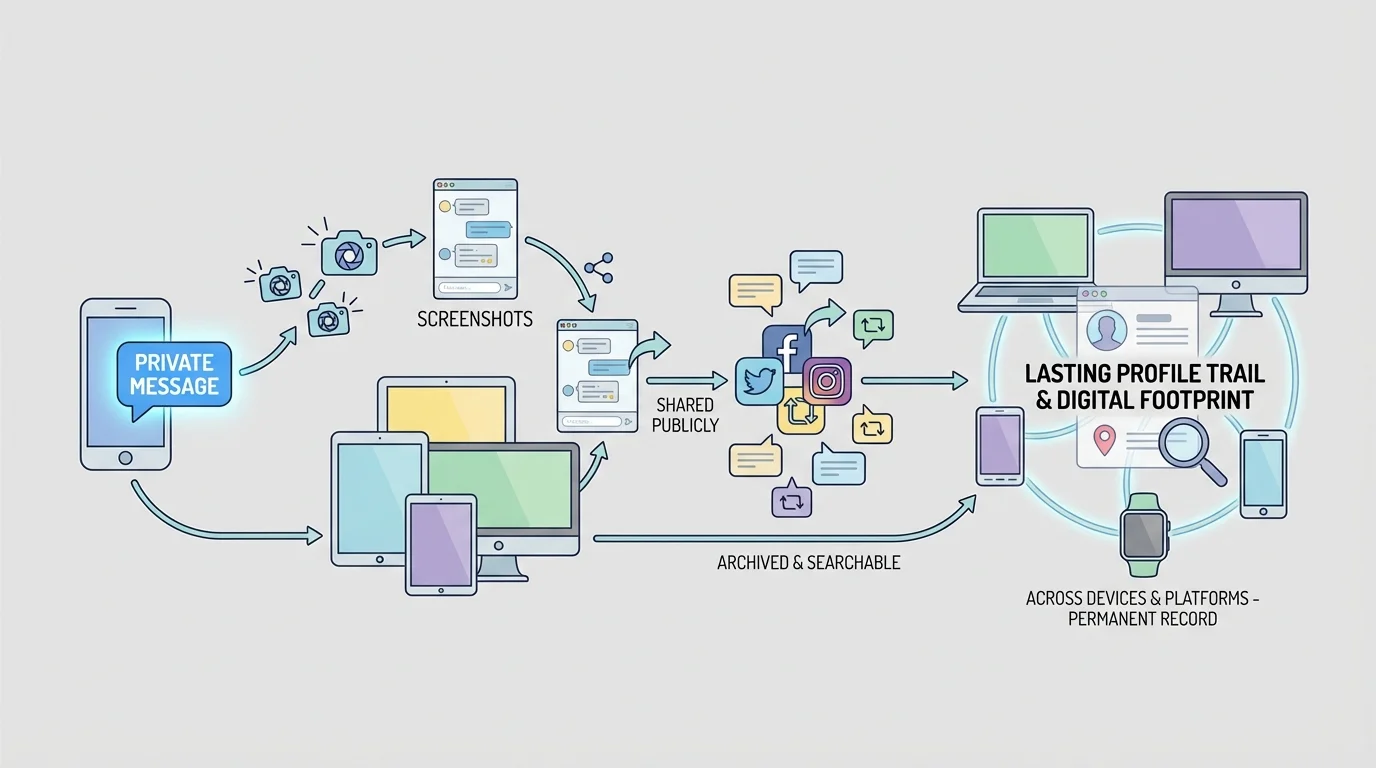
Privacy also includes your own safety. Do not overshare your location, routines, passwords, school login information, or personal documents. Character includes self-respect, and self-respect includes protecting your information. Being open is not the same thing as being careless.
When you see harmful behavior online, your options may include not joining in, saving evidence, reporting through the platform, checking on the targeted person privately, blocking accounts, or telling a trusted adult. The choice depends on the situation, but passively feeding harm is still a choice.
Much later, the lesson from [Figure 2] still matters: the audience for a digital action is almost never as small as it feels in the moment. If you would not want it attached to your name months from now, pause before posting.
Many colleges, employers, scholarship programs, and volunteer organizations review online behavior when evaluating applicants. A single post rarely defines a person, but repeated patterns can shape how others judge your judgment, reliability, and respect for others.
Try this: before sending or posting, use the three-check rule. Is it true? Is it necessary? Is it respectful? If one answer is no, rethink it.
[Figure 3] The hardest choices are not usually between obvious right and obvious wrong. They are often between values that both matter. You may need to weigh honesty against privacy, loyalty against safety, or kindness against fairness. These are gray areas, and they require mature judgment.
For example, suppose a friend tells you something serious and asks you not to tell anyone. If the information involves danger, abuse, self-harm, threats, or illegal activity, keeping the secret may protect the friendship in the short term but harm the person or others in the long term. In that case, safety becomes the priority. A character-based response may sound like this: "I care about you too much to keep this to myself. I need to get help."
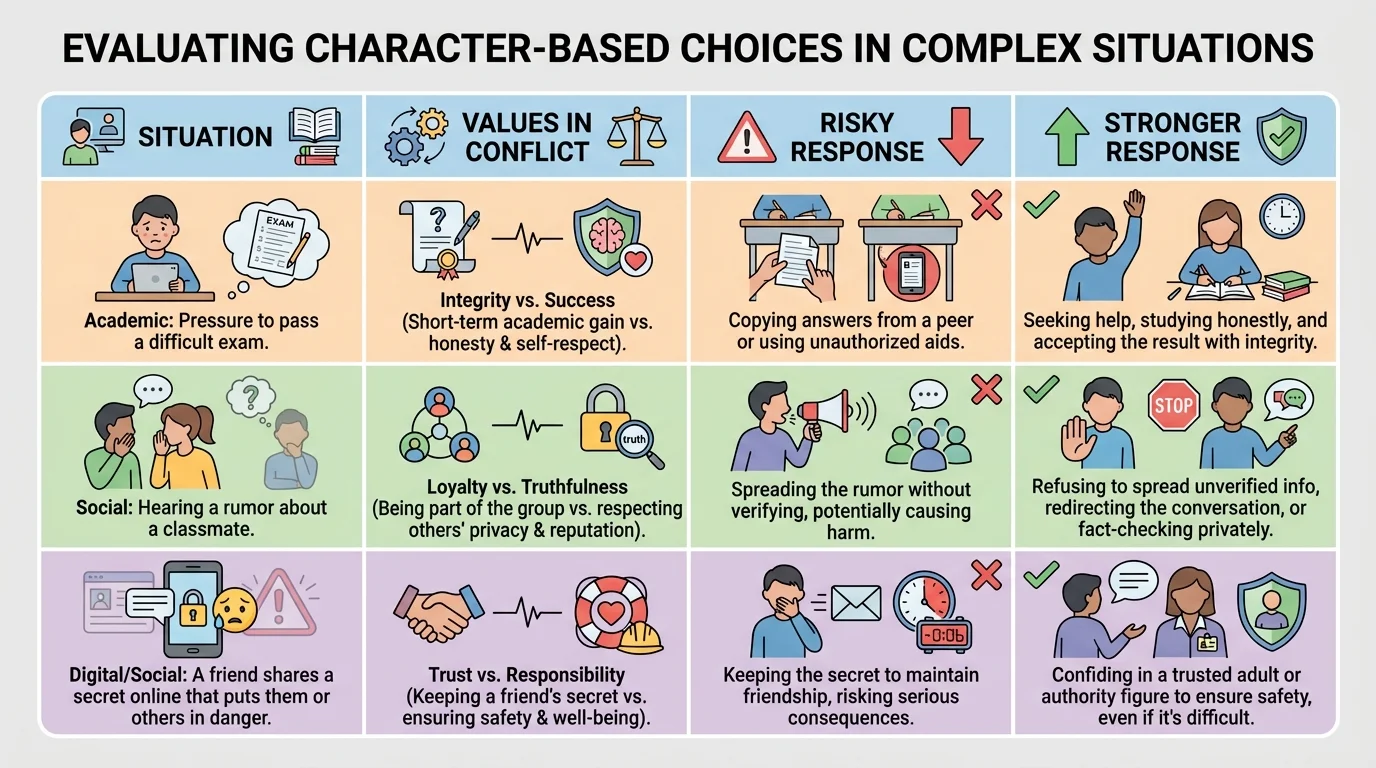
Or imagine you discover that a classmate is cheating because they are under huge pressure at home. Compassion matters. So does honesty. A mature response does not require cruelty. You might refuse to participate, encourage them to ask for help, and report the issue through the appropriate channel if necessary. Character is not harshness. It is principled care.
This comparison helps because it reminds you that gray areas still allow strong choices. The goal is not to remove complexity. The goal is to respond to complexity without abandoning your values.
| Situation | Values in Tension | Weak Response | Stronger Response |
|---|---|---|---|
| A friend shares a cruel rumor | Loyalty vs respect | Forward it to fit in | Do not share it; tell them it is not okay |
| You are late on schoolwork | Success vs honesty | Copy and submit | Be honest, ask for help, submit your own work |
| You receive a private screenshot | Curiosity vs privacy | Repost it | Delete it or keep it private and discourage sharing |
| A friend reveals a safety risk | Loyalty vs protection | Keep the secret no matter what | Get trusted adult support |
Table 1. Common situations where character-based choices require balancing competing values.
Good choices become more likely when your habits support them. If you wait until a high-pressure moment to decide who you are, you will usually fall back on whatever is fastest, loudest, or most socially rewarded. Building character means preparing in advance.
One habit is reflection. At the end of the day, ask: Where did I act with integrity? Where did I avoid responsibility? What would I change next time? This is not about guilt. It is about awareness. You cannot improve what you never examine.
Another habit is using scripts. In stressful moments, it helps to have words ready: "I am not comfortable with that." "Do not include me in this." "That is not mine to share." "I need time to think." "I think an adult needs to know." Simple sentences can protect your values when your emotions are high.
Practical scripts for real situations
Academic pressure: "I have not finished, and I do not want to submit work that is not really mine."
Group chat gossip: "I am not passing that around. It is disrespectful."
Unsafe secret: "I care about you, but this is too serious to keep hidden."
Impulsive posting: "I am waiting before I post this because I do not trust my mood right now."
You can also reduce temptation by shaping your environment. Keep source notes while researching so copying feels less likely. Turn off notifications when you need to focus. Avoid chat spaces that regularly pressure people into cruelty. Character is internal, but your environment can support or sabotage it.
Try this: write down two values you want to be known for, such as honesty and respect. Then ask whether your recent choices make those values visible. If not, choose one small behavior to change this week.
Character-based choices affect your present and your future. In the short term, they influence your peace of mind, your relationships, and your reputation. In the long term, they affect who trusts you with responsibility, leadership, collaboration, and opportunity.
People often focus only on external consequences: getting a zero, losing a privilege, being reported, or being blocked. Those matter. But internal consequences matter too. Repeated dishonesty can make honesty feel less natural. Repeated cruelty can dull empathy. Repeated responsibility can strengthen confidence and self-respect.
Your future is shaped less by one dramatic moment than by patterns. A pattern of owning mistakes, protecting privacy, telling the truth, and acting with courage builds a life other people can trust. A pattern of shortcuts, excuses, and careless harm creates instability even if it brings short-term comfort.
You already know how actions lead to consequences. The next level is recognizing that choices also shape identity. What you repeatedly do becomes part of the kind of person you are training yourself to be.
That is why character belongs in the category of community and future. It helps your current relationships work better, and it also prepares you for jobs, partnerships, teamwork, leadership, and citizenship later on. People may first notice your talent, but they keep trusting your character.
Use a short pause before any risky academic, social, or digital choice. Ask: What are the facts? What values are involved? Who could be affected? What choice can I defend later? This takes less than a minute and can prevent hours, months, or years of damage.
Practice one respectful refusal sentence so it comes naturally when you need it. Clean up one part of your digital life by deleting a post that does not reflect who you want to be, changing a weak password, or leaving a harmful group thread. If you owe someone honesty or an apology, do it directly and respectfully.
Character is not built through big speeches. It is built through repeated decisions, especially the quiet ones. Every time you choose honesty over image, courage over silence, or respect over impulse, you strengthen the kind of future you can stand in with confidence.
