A community does not improve only because officials, organizations, or adults decide to fix things. It improves when ordinary people notice problems, care enough to respond, and follow through. That includes you. Whether you help with a local cleanup, support a food pantry, report a safety concern, or create an online awareness campaign about recycling, your choices can make life better for other people. Civic responsibility is not about being perfect or doing something huge. It is about understanding that you are part of a larger group and that your actions affect its future.
When people ignore shared problems, those problems usually grow. Trash piles up. Public spaces feel less safe. Misinformation spreads online. Neighbors who need help become more isolated. On the other hand, when people act responsibly, even small efforts add up. One person organizes a supply drive. Another volunteers time. Another shares accurate information. Another speaks respectfully at a community meeting. Together, those choices strengthen trust and improve daily life.
Being civically responsible also helps you. It builds judgment, reliability, leadership, and empathy. These skills matter in jobs, friendships, teamwork, and adulthood. If you can spot a need, make a plan, communicate clearly, and follow through, you are developing practical life skills that will help in almost every area of life.
Civic responsibility means acting in ways that support the well-being of a community. This includes following laws and rules, respecting other people, staying informed, helping when you can, and contributing to solutions instead of adding to problems.
Service is work done to help others or meet a community need.
Sustainability means meeting needs in ways that can continue over time without wasting resources or harming people, places, or the environment.
Community improvement is any effort that makes shared spaces, services, relationships, or opportunities better.
Civic responsibility is not limited to politics or voting. At this stage of life, it can look like volunteering, raising awareness, conserving resources at home, helping a local nonprofit, joining a neighborhood project, or responsibly using digital spaces. If you spread false information, damage shared property, or ignore community rules, that also has civic effects. In other words, participation happens whether you mean it to or not. The question is whether your participation helps or harms.
In daily life, civic responsibility often starts with attention. You notice what people need. Maybe a park near your home is covered in litter. Maybe a local animal shelter needs blankets. Maybe your area has confusing recycling rules, so people throw away items that could be reused. Maybe elderly neighbors have trouble getting groceries during bad weather. A responsible person does not just say, "Someone should do something." They begin asking, "What could I realistically do, and how can I do it well?"
That question matters because good intentions are not enough. A poorly planned effort can waste time, money, or supplies. For example, collecting random donations without checking what an organization actually needs may create extra sorting work. Posting a dramatic message online without checking facts can spread confusion. Showing up to "help" without permission can interfere with professionals already doing the job. Responsibility means helping in ways that are useful, informed, and respectful.
Responsible action is useful action. A civic effort is strongest when it matches a real need, respects the people affected, and considers what happens next. Before acting, ask: What is the actual problem? Who is affected? What kind of help is wanted? What rules apply? How will this effort make things better instead of more complicated?
That mindset keeps your energy focused. It also shows maturity. Communities need people who care, but they especially need people who care carefully.
A community problem becomes easier to solve when you break it into parts, as [Figure 1] shows. Instead of reacting only to what you see on the surface, look for the specific need underneath it. If you see litter in a public area, the issue might involve not enough trash cans, poor signage, low awareness, or irregular cleanup. If you hear that a local pantry is low on food, the issue may be transportation, seasonal demand, or missing donations of certain items.
Start by observing. What problem do you notice more than once? Who seems affected? What evidence do you have? Then move to questions. Is this a one-time issue or an ongoing one? Is there already a group working on it? What kind of support is actually needed? This keeps you from jumping to conclusions.
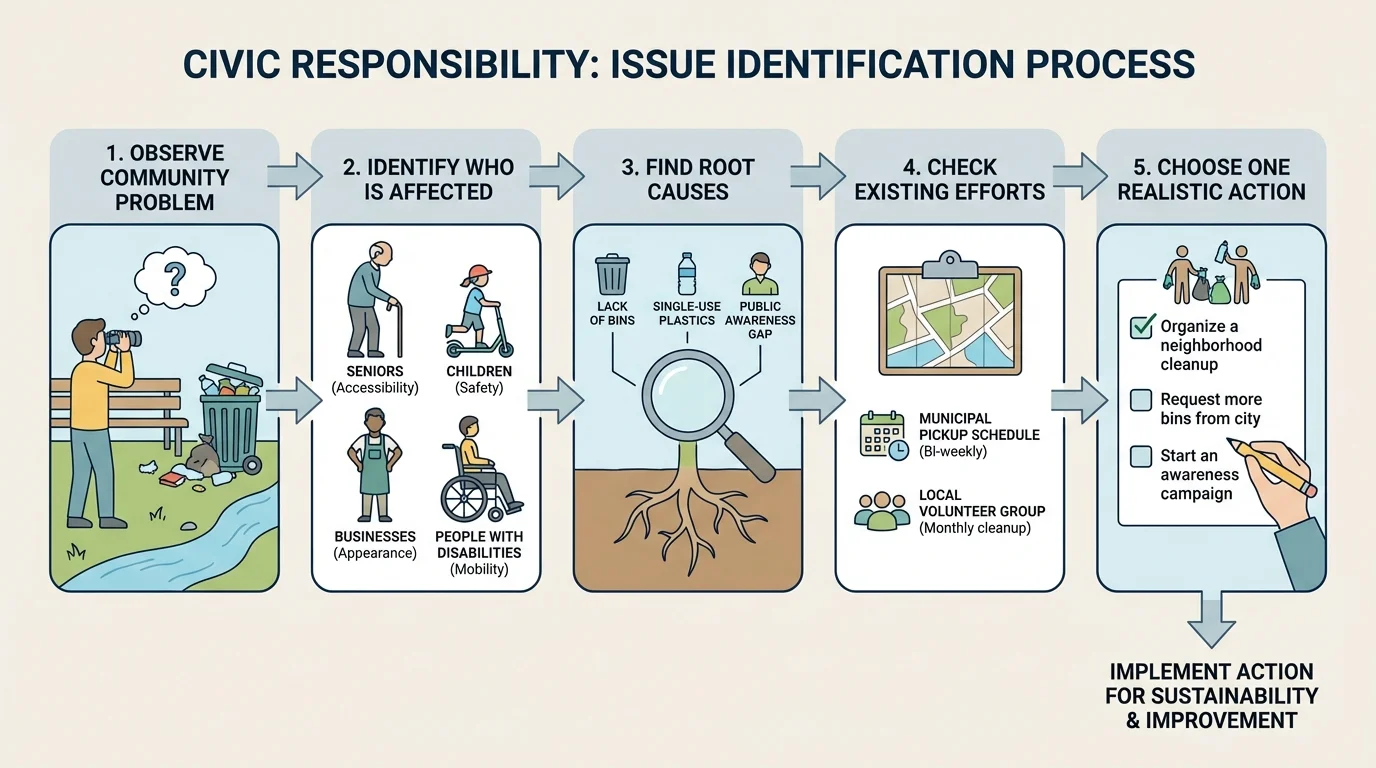
You can also use a simple decision method: notice, verify, narrow, act. Notice the problem. Verify that it is real by checking reliable sources or asking a reliable organization. Narrow the issue to one part you can realistically help with. Act in a way that is safe and useful. This method works for environmental issues, neighborhood concerns, and online awareness efforts.
Suppose you care about waste in your area. "Fix pollution" is too broad. "Create a one-week educational post series explaining what the local recycling center accepts" is much more realistic. Suppose you care about hunger. "End food insecurity" is too broad. "Help collect only the top five requested pantry items this month" is a practical starting point. Small, targeted efforts often do more good than oversized plans that fall apart.
Many community organizations say the most helpful volunteers are not always the ones who volunteer the most hours. They are the ones who communicate clearly, follow instructions, arrive prepared, and do what the organization actually needs.
As you saw in [Figure 1], narrowing a problem does not make it less important. It makes your response stronger. Large issues are usually solved through many smaller, organized actions.
Not every community need calls for the same response. Sometimes the best choice is direct service, such as packing meals, cleaning a shared space, or assembling care kits. Sometimes the better choice is education, such as creating a fact-based digital flyer or short video that explains safe disposal of batteries. Sometimes advocacy matters more, such as respectfully contacting local leaders about a broken streetlight, unsafe crossing, or lack of accessible services.
The stakeholders matter here. Stakeholders are the people or groups affected by an issue or involved in solving it. If your action ignores the needs of stakeholders, it may fail even if your intentions are good. A shelter, park department, neighborhood association, or nonprofit often knows what kind of help is most useful. Listening first is part of responsibility.
Here is a simple comparison of action types.
| Type of action | Best use | Example | Main caution |
|---|---|---|---|
| Direct service | Immediate needs | Sorting donations for a local pantry | Follow instructions so your help is useful |
| Education | Lack of awareness | Posting accurate local recycling rules online | Check facts before sharing |
| Advocacy | Policies or systems need change | Emailing officials about unsafe sidewalks | Be respectful and specific |
| Fundraising | An organization needs money for supplies | Running an approved online donation campaign | Be transparent about where funds go |
| Habit change | You want lasting everyday impact | Reducing single-use plastics at home | Stay consistent over time |
Table 1. Common types of civic action, when they are most useful, and important cautions.
Choosing the right action means matching the method to the problem. If a shelter needs specific supplies, awareness posts alone may not help enough. If people are misinformed, a donation drive may not fix the real issue. Good civic action is not about doing what feels impressive. It is about doing what fits.
[Figure 2] shows that effective service usually follows a process. You do not need a giant project plan, but you do need enough structure to avoid confusion. Even a small effort benefits from clear goals, communication, and follow-up.
Step 1: Set one clear goal. A weak goal is "help the environment." A strong goal is "collect two bags of litter from a local walking trail this Saturday with permission" or "share five verified posts about water conservation over one week." A clear goal helps you measure whether your effort worked.
Step 2: Identify who needs to be involved. That may include a local organization, a parent or guardian, a community leader, event staff, volunteers, or neighbors. If your activity affects public spaces or other people, check who should approve it first.
Step 3: Gather information and check rules. Find out what supplies are needed, what safety concerns exist, and whether permission is required. If you are collecting donations, confirm accepted items. If you are sharing information, confirm sources. If you are working in a public area, learn the local rules.
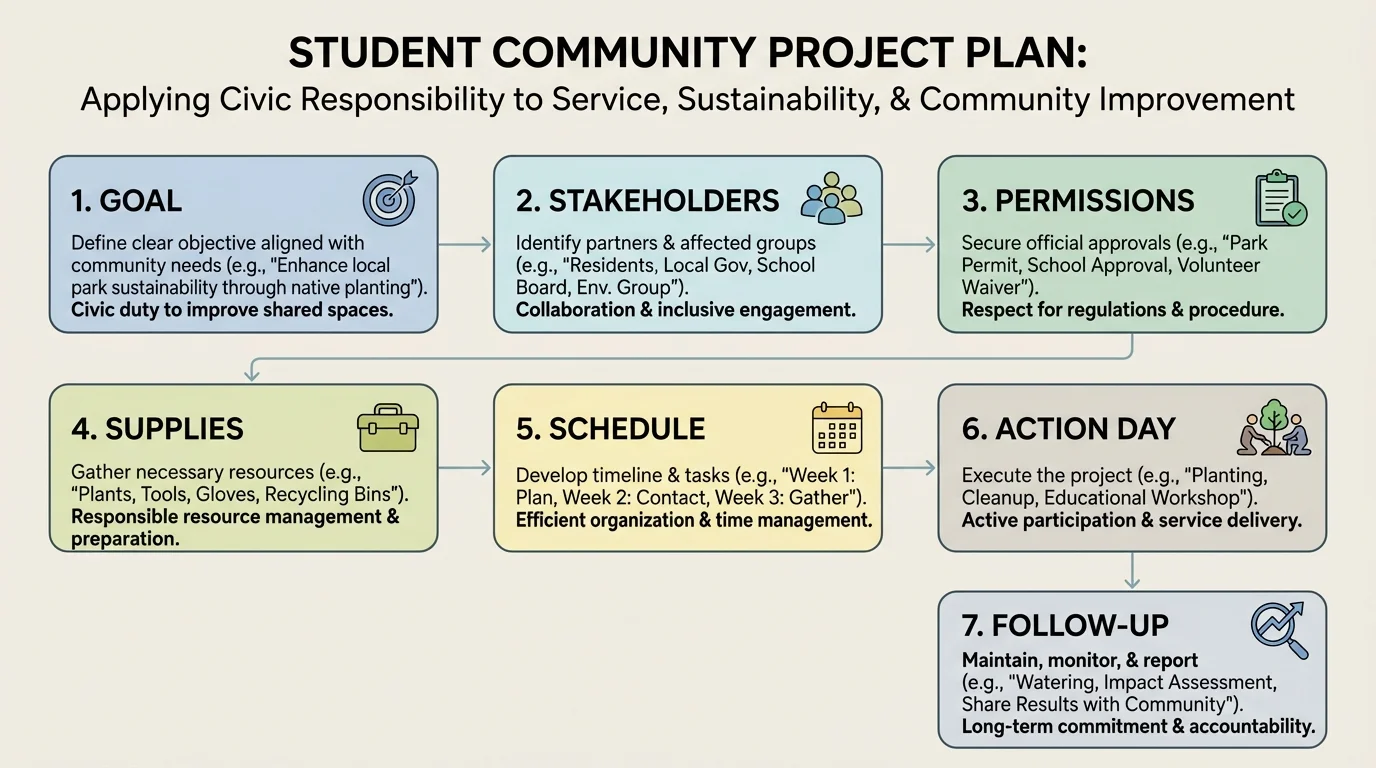
Step 4: Make a simple timeline. Decide what happens first, next, and last. A timeline can be very basic: research on Monday, contact organization on Tuesday, gather supplies by Friday, complete activity on Saturday, review results on Sunday. If you estimate time, be realistic. If a task takes about half an hour each day for five days, that is approximately \(30 \times 5 = 150\) minutes, or \(150 \div 60 = 2.5\) hours total.
Step 5: Act responsibly. Show up prepared. Follow the instructions given by the organization or site manager. Communicate if plans change. Treat people and places with respect. Take care of safety before speed.
Step 6: Check results. Ask what changed because of your effort. Did the organization receive what it needed? Was the area cleaner? Did people respond to your awareness posts? Did you learn that a different approach would work better next time? Reflection is part of responsibility, not an extra step.
Case study: organizing a small supply drive
You want to help a local animal rescue from home by organizing a targeted online drive for pet towels and cleaning supplies.
Step 1: Confirm the need
You message the rescue and ask which items are most needed. They reply that unopened detergent, paper towels, and clean used bath towels are most helpful right now.
Step 2: Set a realistic goal
Instead of saying "collect a lot," you aim for 10 towels and 15 supply items over two weeks.
Step 3: Communicate clearly
You create a short post with the exact item list, deadline, and drop-off instructions approved by the rescue.
Step 4: Follow through
You track responses, remind people once halfway through, and deliver only the approved items.
This works because the effort matches a real need and respects the organization's process.
Later, when you plan another project, [Figure 2] still applies: goal first, then people, rules, supplies, schedule, action, and follow-up. That sequence helps prevent common mistakes like collecting the wrong items, overpromising, or forgetting permission.
[Figure 3] shows that good civic action should help now without making things worse later. That is the heart of sustainability. A one-time effort can be useful, but sustainable thinking asks a bigger question: will this action still make sense next week, next month, or next year?
For example, donating random used items may feel helpful, but if many are broken, expired, or unusable, the receiving organization must spend time sorting and discarding them. A more sustainable choice is to ask what is needed, give only usable items, and support a system the organization can manage. In environmental work, a cleanup matters, but it is even better if people also reduce future waste by using reusable bottles, sharing accurate disposal information, or encouraging more bins in key areas.
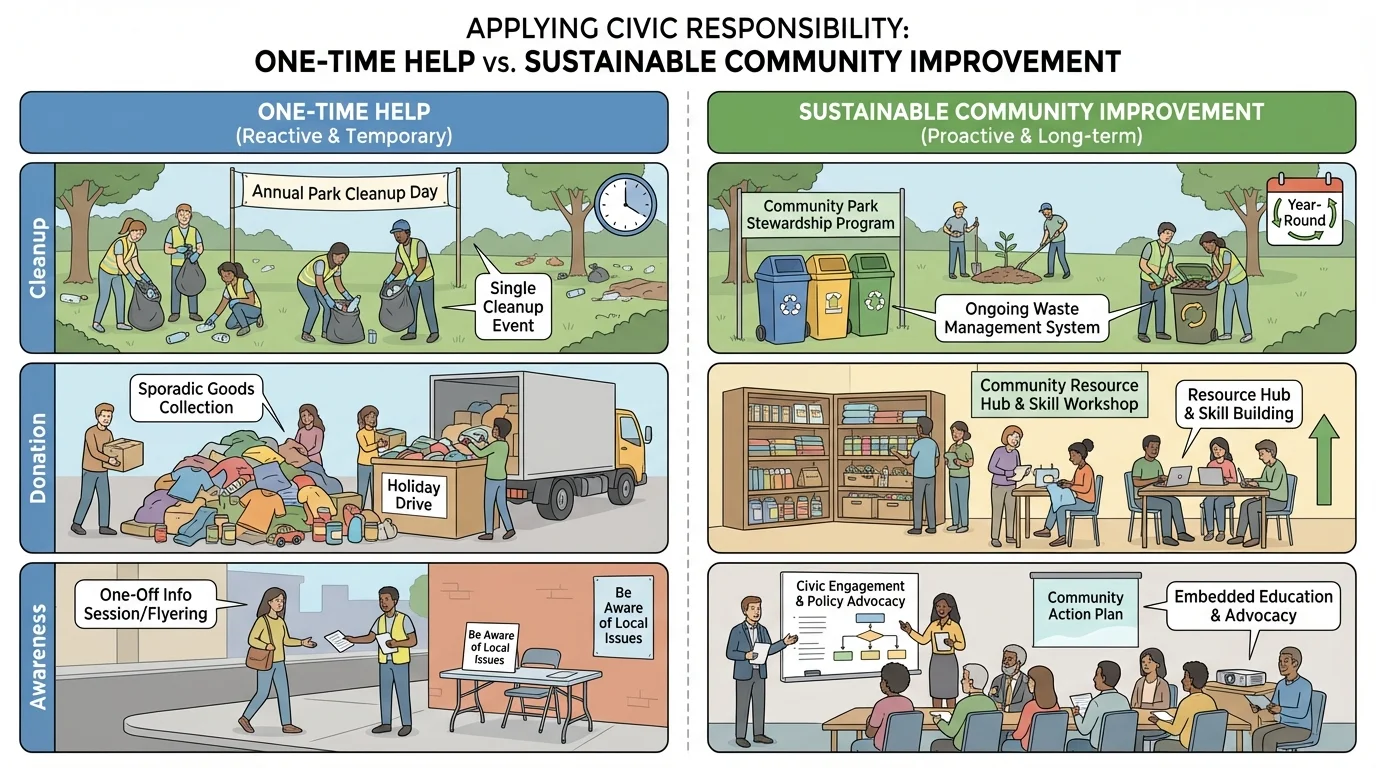
Sustainability also includes people. If a project depends on one person doing everything, it may stop quickly. If the project is simple enough for others to continue, it lasts longer. That could mean creating a shared checklist, posting clear instructions, or choosing goals that fit available time and resources.
A useful way to test sustainability is to ask three questions: Will this help be useful? Will it create extra waste or burden? Can the benefit continue? If the answer to the second question is yes, improve the plan. If the answer to the third is no, consider how to make the effort easier to repeat or support.
Short-term help and long-term improvement work best together. Picking up litter today helps immediately. Teaching proper disposal and requesting better trash access can reduce litter tomorrow. Donating supplies helps now. Supporting organized systems helps later. Strong civic responsibility balances urgent needs with future impact.
As [Figure 3] shows, sustainable action is often not the flashiest option. It is the one that remains helpful after the excitement fades.
Responsible community action also requires civic awareness and legal awareness. Civic awareness means understanding how communities function, who makes decisions, what organizations already exist, and how people are affected by shared rules and systems. Legal awareness means knowing that some actions require permission, privacy protection, honesty, and compliance with local rules.
This does not mean you need to know every law. It means you should pause before acting and ask practical questions. Can I collect money for this cause without approval? Am I allowed to post photos of volunteers or recipients? Is this event happening on public or private property? Are there age requirements for volunteering? If I am writing about a community problem online, am I sharing verified information?
Privacy is especially important. If you help people in vulnerable situations, do not post their names, faces, addresses, or personal stories without clear permission. Helping someone does not give you the right to publicize their situation. Respect protects dignity.
Honesty matters too. If you organize donations or fundraising, be transparent. Say exactly what is being collected, who will receive it, and how it will be delivered. Never exaggerate a cause or use emotional pressure to manipulate people. Trust, once damaged, is hard to rebuild.
Remember: Being responsible online is part of being responsible in your community. The same skills that matter in digital citizenship—fact-checking, respectful communication, privacy awareness, and accountability—also matter in civic engagement.
You should also be careful not to mistake attention for impact. A post that gets likes is not automatically helpful. A respectful email to the right office, a verified list of needed supplies, or a well-planned volunteer shift may do much more real good.
Civic responsibility includes knowing how to raise concerns and propose solutions. You do not need to be loud to be effective. You need to be clear, respectful, and specific. If a crosswalk signal near your area is broken, a useful message includes the location, the problem, how often it happens, and why it creates risk. If a community center needs more recycling bins, explain what you observed and offer a practical suggestion.
This is where advocacy becomes important. Advocacy means speaking up to support a cause, a need, or a group of people. Good advocacy focuses on facts, solutions, and respect. It avoids insults, rumors, and vague complaints.
Simple message template for a community concern
You can adapt this structure for emails, forms, or messages to organizations:
Step 1: State the issue clearly
"I'm writing to report that the trash bins at the north entrance of the park are often overflowing on weekends."
Step 2: Add useful details
"I noticed this on the last three Saturdays, and litter is spreading onto the walking path."
Step 3: Explain the impact
"This creates a mess, attracts pests, and makes the area less safe and welcoming."
Step 4: Offer a realistic suggestion
"Would it be possible to increase pickup frequency or add another bin near that entrance?"
This approach is respectful and more likely to get a useful response.
When you communicate this way, you show that civic engagement is not just emotional reaction. It is problem-solving.
Scenario one: You want to organize a neighborhood cleanup. Responsible action means checking whether the location is public or private, wearing gloves, avoiding dangerous materials, and disposing of collected trash correctly. It also means not treating the cleanup as a one-day photo opportunity. A stronger effort includes asking why litter collects there and how to reduce it in the future.
Scenario two: You want to support a local pantry. Responsible action means confirming what items are needed most, checking expiration dates, and communicating clearly about drop-off times. It also means understanding that people deserve dignity. Avoid posting pictures of recipients or using language that makes helping sound like showing off.
Scenario three: You care about energy use at home. Civic responsibility includes personal choices because shared resources affect everyone. Turning off unnecessary lights, reducing water waste, and unplugging devices when possible are small actions, but over time they matter. If a device uses 10 watts for 5 extra hours each day, that is \(10 \times 5 = 50\) watt-hours daily. Over 30 days, that becomes \(50 \times 30 = 1,500\) watt-hours, or \(1.5\) kilowatt-hours. Small habits scale up.
Scenario four: You see false information online about a local issue. Civic responsibility means not reposting it just because it is dramatic. Check the original source. Compare with reliable local information. If you respond, do so respectfully and with facts. Digital spaces are part of community life now, so digital responsibility is civic responsibility too.
"The best way to find yourself is to lose yourself in the service of others."
— Mahatma Gandhi
Service does not mean ignoring your own limits. Responsible civic action includes knowing what you can realistically handle. If you overcommit, miss deadlines, or promise things you cannot deliver, your effort may create stress for others. It is better to do one manageable thing well than five things poorly.
Strong civic responsibility is usually built through habits, not occasional bursts of enthusiasm. Start with reliability. If you sign up, follow through. If you are unsure, ask questions early. If you make a mistake, admit it and fix it. Communities become stronger when people are dependable.
Another habit is reflection. After any service or improvement effort, ask yourself what worked, what did not, and what you would change. Reflection is not about judging yourself harshly. It is about learning how to be more effective next time. Maybe your communication was unclear. Maybe your timeline was too rushed. Maybe the organization needed a different kind of help. That information makes future action stronger.
You should also keep learning about your area. Follow reliable local news. Read community organization updates. Pay attention to public issues that affect daily life, such as transportation, safety, access to resources, environmental concerns, and support services. Informed people are better prepared to help in useful ways.
Finally, remember that civic responsibility is not reserved for special events. It appears in ordinary decisions: how you speak about others, whether you respect shared spaces, whether you verify information, whether you conserve resources, and whether you contribute to solutions. Community improvement is built from repeated choices, and your choices count.
