Some choices look personal on the surface but quietly shape years of your life. Where you study after high school, the kind of work you pursue, and who you stay close to can affect your money, stress levels, confidence, schedule, and future opportunities. These decisions are not random. They are deeply connected to who you are and what matters most to you.
Your choices make more sense when you understand two things: your identity and your priorities. Identity is about how you understand yourself. Priorities are the things you place first when not everything can happen at once. When you know both, decisions become clearer. When you ignore both, it becomes easier to choose based on pressure, trends, or fear.
Identity includes the beliefs, values, traits, interests, culture, relationships, experiences, and goals that shape how you see yourself.
Priorities are the needs, responsibilities, and goals that matter most to you right now and guide how you use your time, energy, and resources.
This matters in real life. A student may be accepted into a well-known university far from home but choose a local program instead because family support, lower cost, and mental health matter more right now. Another student may turn down a job with higher pay because the schedule would destroy sleep, school plans, and personal relationships. Those are not weak decisions. They are choices shaped by self-awareness.
Big life decisions often feel stressful because there is rarely one perfect answer. You are usually comparing options that each offer something good while also asking you to give something up. That is called a tradeoff. A flexible job might pay less. A prestigious school might mean more debt. A relationship might feel exciting but drain your focus and peace.
At this stage of life, you may also feel pressure from parents, social media, friends, extended family, or your own expectations. Online, it can seem like everyone else already knows their path. In reality, many people are still figuring out what fits them. The goal is not to pick what looks impressive. The goal is to choose what is sustainable, healthy, and aligned with your life.
"Knowing yourself is the beginning of all wisdom."
— Aristotle
Self-awareness does not guarantee an easy choice, but it does help you make a smart one. It lets you ask better questions: Does this option fit my values? Can I realistically handle the cost, time, and stress? Am I choosing this because I want it or because I want approval?
Your identity has layers, as [Figure 1] shows, and each layer can influence your decisions in a different way. Your values, interests, personality, culture, responsibilities, and past experiences all affect what feels right, safe, meaningful, or realistic for you.
One part of identity is your values. Values are the principles you want your life to reflect, such as honesty, independence, stability, creativity, service, faith, or learning. If you value stability, you may prefer a path with steady income and clear structure. If you value creativity, you may want work that allows original thinking and expression.
Another part is your strengths and needs. Maybe you focus well independently, enjoy problem-solving, and like long-term projects. Or maybe you need active work, frequent social interaction, and flexible routines. Neither is better. They just point toward different environments.
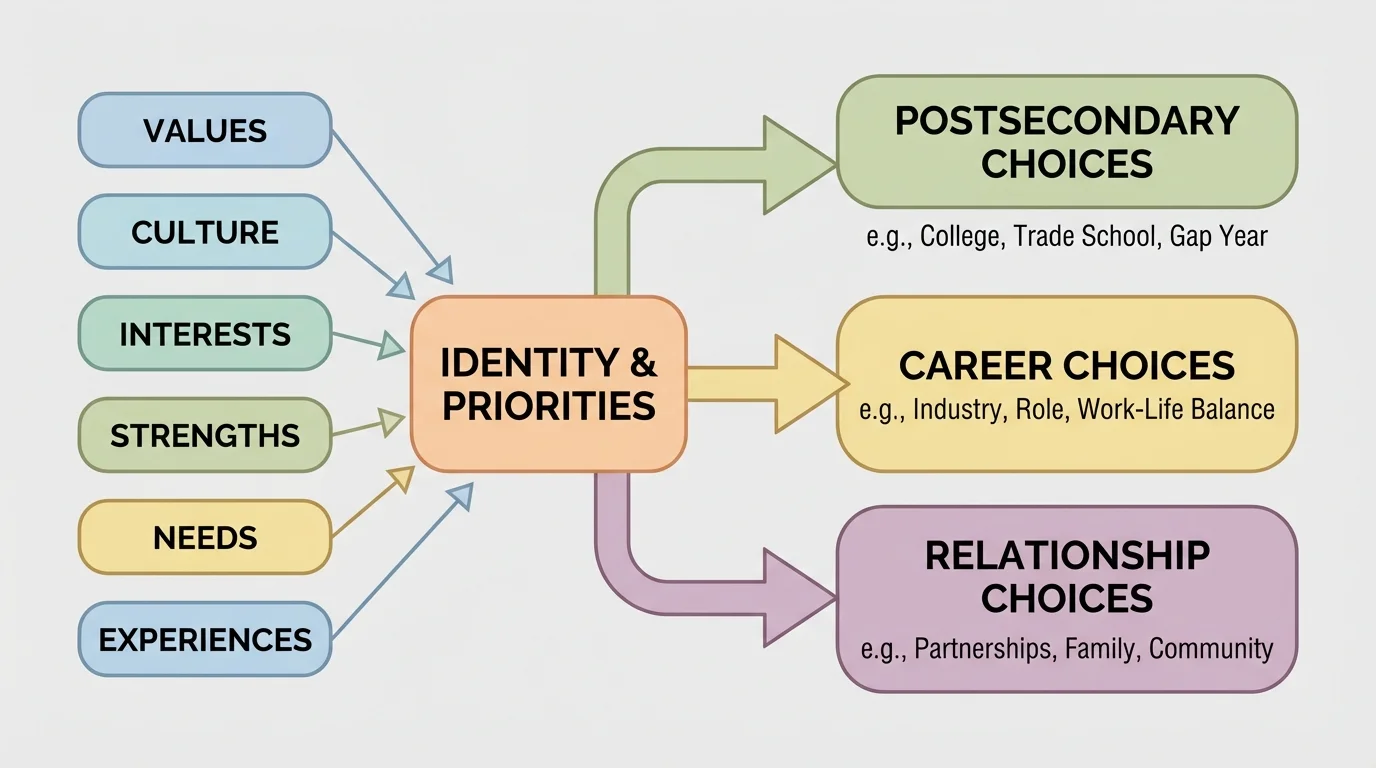
Your background also matters. Family expectations, language, community ties, financial situation, health needs, and lived experience can influence what options feel possible or responsible. Sometimes students think this means they have fewer choices. A better way to see it is that your context gives you important information. It tells you what support you have, what stressors exist, and what kind of path is realistic right now.
Identity is not a label. It is a decision filter. When you understand your identity, you can use it to sort options. Instead of asking only, "Is this a good opportunity?" you ask, "Is this a good opportunity for me at this stage of life?" That shift leads to stronger choices.
Identity can also change. You may discover new interests, become more independent, or realize that a goal you had at age sixteen no longer fits at age eighteen or twenty. That is normal. Growth does not erase identity; it updates it.
Later, when you compare education and work options, the identity map from [Figure 1] still matters because the same factors that shape self-understanding also shape what kind of future feels sustainable.
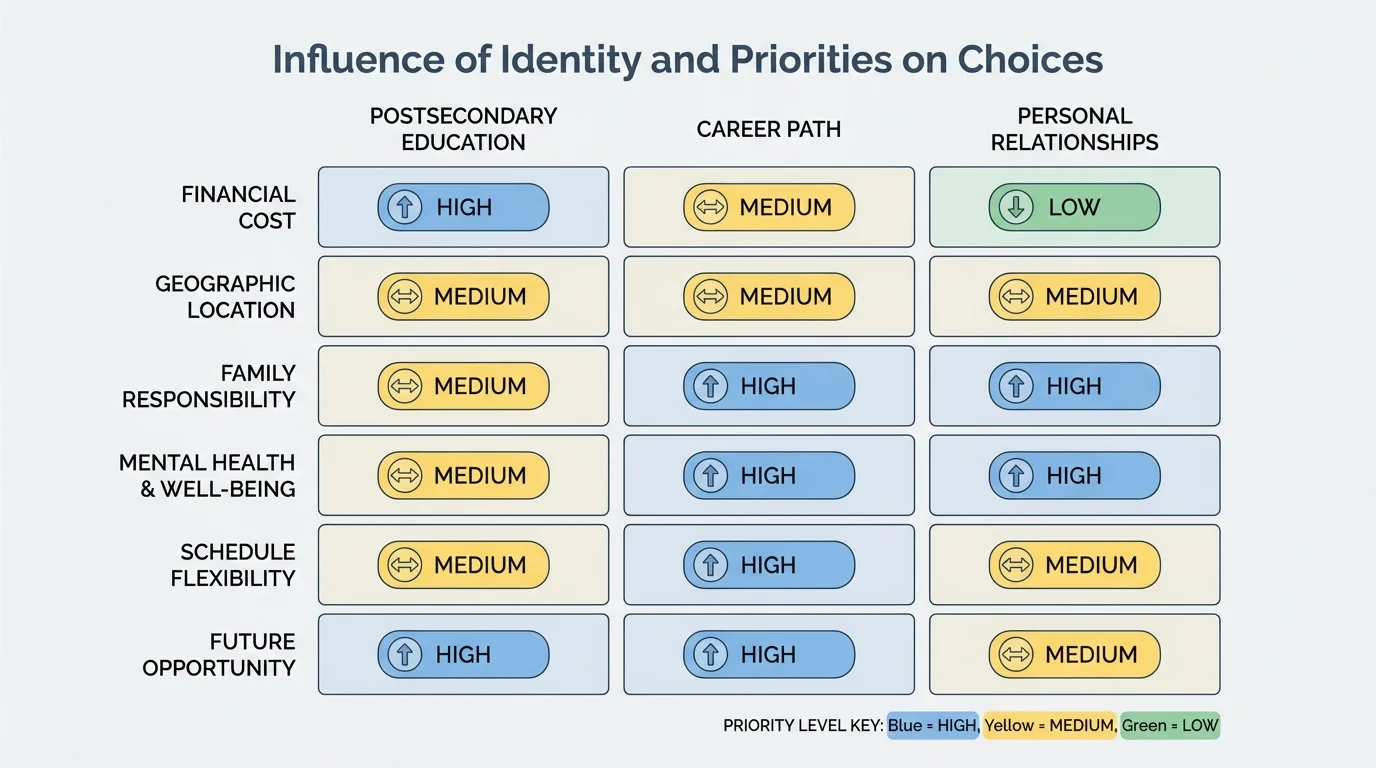
Priorities are not everything you care about. They are the things you place first when time, money, energy, and attention are limited. As [Figure 2] illustrates, some priorities rank higher than others depending on your current situation.
For example, your current priorities might include earning money, protecting mental health, helping family, avoiding debt, staying close to home, building independence, or finding a strong training program. Someone else might prioritize moving away, networking, prestige, or fast career entry. Different priorities lead to different choices.
A useful question is not "What sounds best?" but "What matters most right now?" Notice the phrase right now. Priorities can be temporary. If your family needs your help this year, staying local may be a top priority now even if you plan to move later.
When priorities are unclear, people often say yes to too many things and then feel overwhelmed. You might commit to full-time work, difficult coursework, constant social plans, and a serious relationship all at once. The result is often burnout, missed deadlines, conflict, or disappointment.
Clear priorities help you make clean decisions. If academic focus is your top priority, that may mean limiting work hours. If financial survival is your top priority, that may mean choosing a shorter training program or working while studying. If emotional stability is your top priority, that may mean taking a slower path instead of forcing yourself into an environment that harms your well-being.
Research on decision-making consistently shows that people are less satisfied with choices when they chase external approval instead of acting on personal values and realistic priorities.
You do not need to justify your priorities to everyone. You do need to be honest about them with yourself.
Postsecondary choices include more than one path. Options can include a four-year college, community college, technical or trade school, certificate programs, apprenticeships, military service, direct entry into work, a gap year with purpose, or a combination of these.
The best fit depends on more than grades. It also depends on your motivation, learning style, support system, finances, goals, and responsibilities. For example, if you learn best by doing, a hands-on training program may fit better than a heavily lecture-based program. If cost is a major concern, starting at a lower-cost institution may protect your future freedom.
Comparing two postsecondary options
Maya wants to study health care. She is deciding between a university program far from home and a local community college that offers a transfer route.
Step 1: Identify identity factors.
Maya values family connection, learns well with smaller class sizes, and gets stressed by significant financial uncertainty.
Step 2: Identify priorities.
Her top priorities are affordable tuition, emotional support, and a clear path into a health career.
Step 3: Compare real consequences.
The university offers prestige and independence but much higher debt. The community college costs less, keeps support nearby, and still leads toward her goal.
Step 4: Choose the better fit.
For Maya, the local option fits her identity and current priorities better.
Notice that this is not about taking the easiest path. It is about taking the smartest path for her current reality. Another student with different values, finances, and goals might choose differently and still be making a good decision.
When reviewing postsecondary options, ask practical questions: What will this cost? How much support will I have? What is the completion rate? What are the likely job outcomes? Can I handle the schedule? Does this path match how I learn and live?
Career decisions are often treated like one giant question: "What do you want to be?" A better question is: "What kind of work life fits me?" Your career fit depends on the match between who you are and the demands of the work.
Some people need structure, predictable routines, and clear expectations. Others prefer variety, independence, and creative problem-solving. Some care deeply about public service or helping others. Others prioritize income, entrepreneurship, or remote flexibility. Again, these are not moral rankings. They are fit questions.
If you ignore fit, you may end up in a job that looks successful but drains you every day. For example, a student who dislikes constant social interaction may struggle in customer-facing roles even if they pay well. A student who loves movement and physical tasks may feel trapped at a desk for eight hours a day. A student who values freedom may dislike a job with rigid scheduling even if it has prestige.
| Work factor | Questions to ask yourself | Why it matters |
|---|---|---|
| Environment | Do I prefer quiet, busy, indoor, outdoor, remote, or hands-on spaces? | The wrong environment can raise stress and lower performance. |
| People contact | Do I want frequent interaction or more independent work? | This affects energy, focus, and satisfaction. |
| Income needs | What do I need to support myself and future goals? | Financial reality matters, not just passion. |
| Purpose | Do I need strong meaning in my work, or is work mainly a support for my life outside work? | This shapes motivation and long-term commitment. |
| Growth | Do I want fast advancement, stability, or flexibility? | Your future goals affect your present choices. |
Table 1. Questions that help evaluate whether a job or career path fits your identity and priorities.
Career choices are also affected by practical limits. Maybe you need income quickly, so a short training path makes sense now. Maybe your long-term goal requires several stages: part-time work, certification, then advanced training later. A realistic plan is stronger than a fantasy plan.
Good career decisions balance meaning and reality. A strong career choice usually sits at the intersection of interests, strengths, opportunities, and responsibilities. If one part is missing, the path may be harder to sustain.
This is where tradeoffs return. A high-paying job may reduce family time. A meaningful career may require years of training. A flexible freelance path may bring income uncertainty. Naming the tradeoff clearly helps you decide whether the cost is worth it.
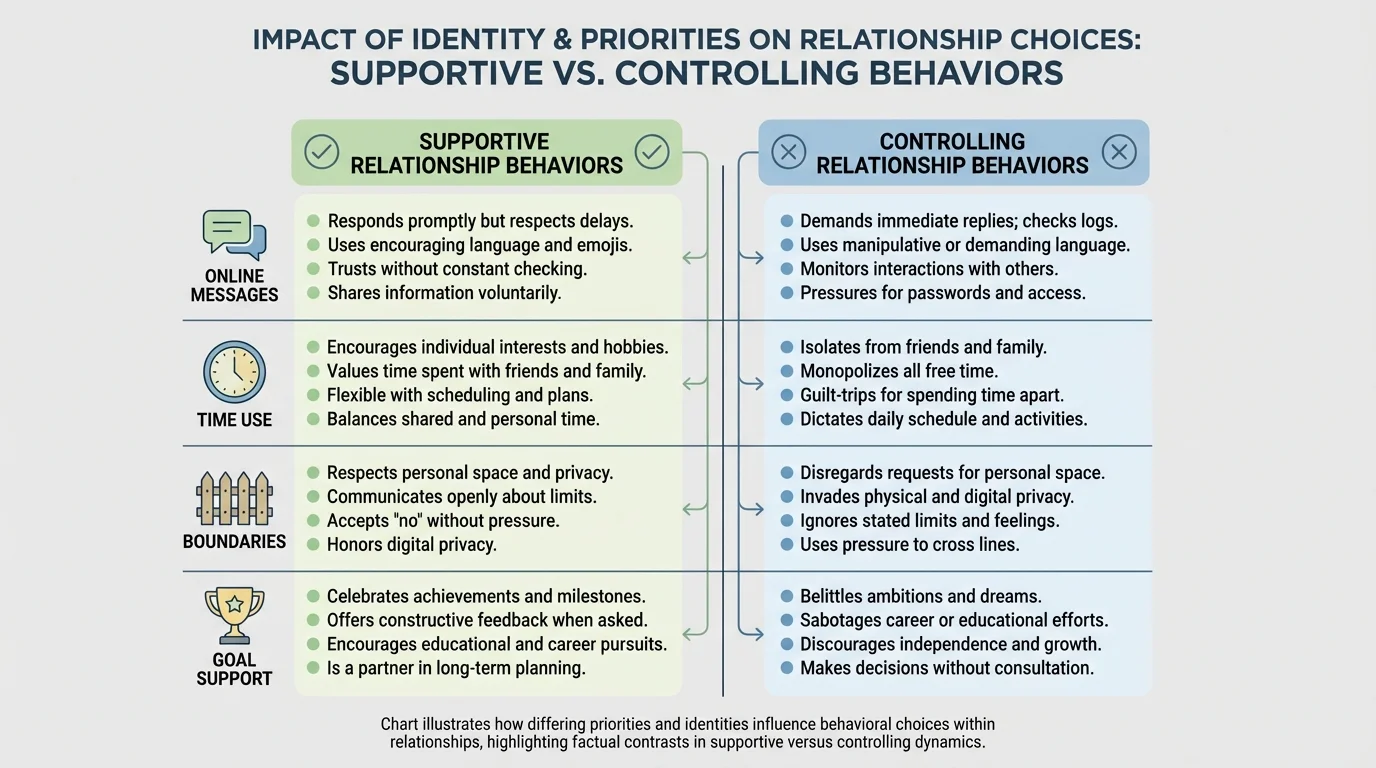
Relationships also shape your future. As [Figure 3] shows, the people you date, trust, exchange late-night messages with, make plans with, and listen to can either support your goals or disrupt them. Healthy relationships and unhealthy relationships often create very different patterns in your life.
A healthy relationship usually respects your goals, time, boundaries, and growth. An unhealthy one may pressure you to ignore responsibilities, move too fast, stay constantly available, or change core parts of yourself to keep the peace. This can happen in friendships, dating relationships, and even online groups.
Your identity matters here because people often choose relationships that reflect what they believe they deserve or need. If you know your values and boundaries, you are more likely to choose people who respect them. Your priorities matter because every relationship requires time and emotional energy. If your top priorities are healing, school completion, or financial stability, a relationship that creates chaos may pull you away from what matters most.
Boundaries are limits you set to protect your well-being, time, values, and safety. Boundaries can sound like: "I cannot stay on video calls late every night because I need sleep," or "I am not comfortable sharing my passwords," or "I need time for work and study this week."
Relationship choice example
Jordan starts dating someone who gets upset whenever Jordan studies, works a shift, or spends time with family.
Step 1: Identify the conflict.
Jordan says education and family are top priorities, but the relationship demands constant attention.
Step 2: Compare behavior with values.
The partner says they are supportive, but their actions punish Jordan for honoring important responsibilities.
Step 3: Set a boundary.
Jordan explains available time clearly and refuses guilt-based pressure.
Step 4: Watch the response.
If the partner respects the boundary, the relationship may improve. If not, Jordan has useful information about whether the relationship is healthy.
Later, the comparison in [Figure 3] can help you notice whether a relationship is truly supportive or only feels intense. Intensity is not the same as care.
When choices feel messy, use a repeatable system. The process in [Figure 4] works for education, work, and relationships because it helps you slow down and compare fit instead of reacting only to emotion.
Step 1: Name yourself clearly. Write down your top values, strengths, stress limits, responsibilities, and goals. If you cannot describe yourself, you will struggle to choose well.
Step 2: Rank your priorities. Pick your top three for this season of life. Be honest. If money is urgent, say so. If peace is urgent, say so. If family responsibility is urgent, say so.
Step 3: List your options and test the fit. For each option, ask: Does this match my values? Does it support my top priorities? What does it require from me daily, not just in theory?
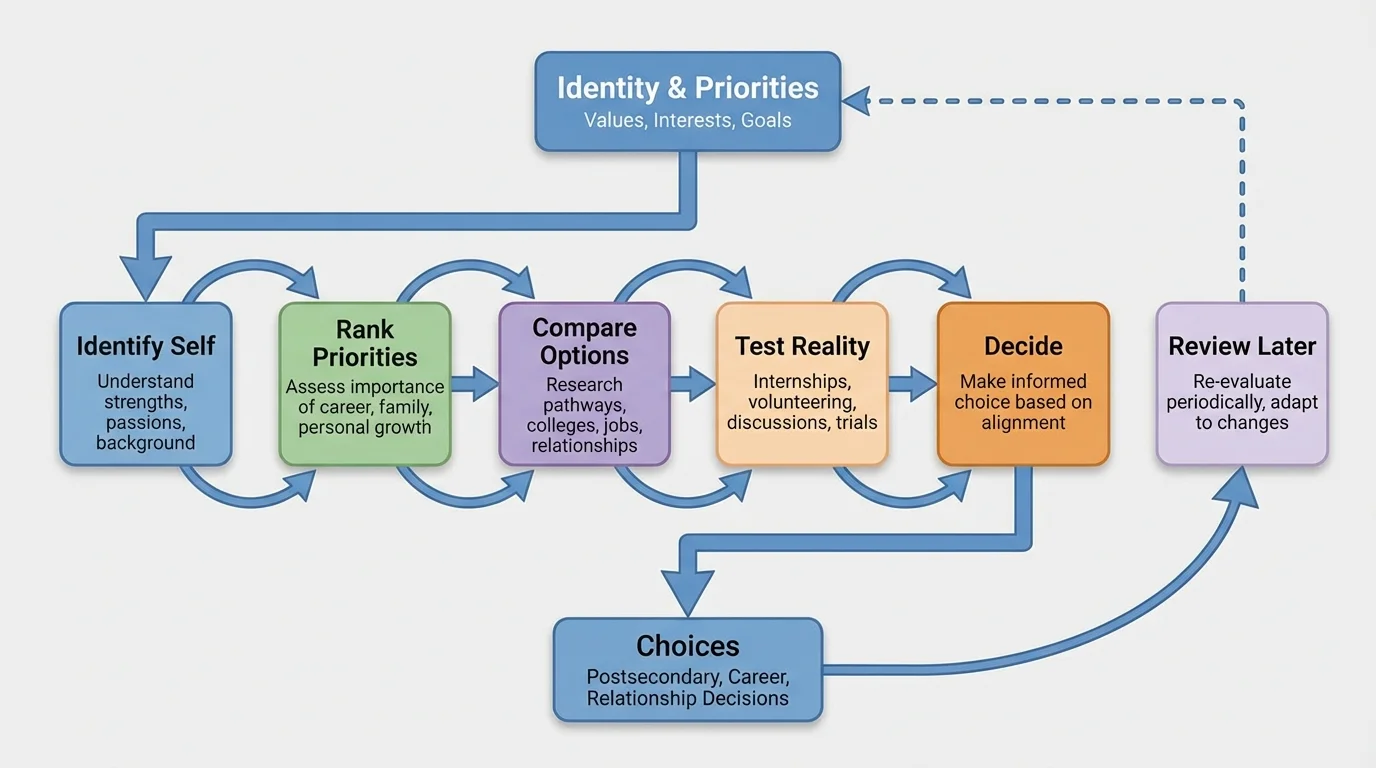
Step 4: Check reality. Look at cost, transportation, schedule, emotional impact, support, safety, and opportunity. This step protects you from making choices based only on image.
Step 5: Decide and review. Make the best choice you can with the information you have. Then review after a set period, such as one month or one semester, to see whether the choice still fits.
Quick decision checklist in action
Lena is choosing between taking on extra work hours or staying with a lighter schedule while finishing an online certification.
Step 1: Identity check.
Lena is reliable and ambitious, but she knows stress affects her sleep and focus.
Step 2: Priority check.
Her top priorities are finishing the certification and keeping stable mental health.
Step 3: Reality check.
More work would bring money now, but it would likely delay the certification and increase burnout.
Step 4: Choice.
She keeps the lighter schedule temporarily, completes the certification, and plans to increase income after that milestone.
The flow in [Figure 4] is especially useful when other people are pushing opinions at you. It gives you a way to return to your own values and evidence.
Pay attention if you notice these warning signs: you constantly feel dread about the option, you are choosing mainly to impress others, the plan depends on unrealistic energy or money, the relationship requires you to hide parts of yourself, or the path directly conflicts with your top values.
Also notice when your body is telling you something. Ongoing stress, loss of sleep, irritability, or emotional numbness can be signs that a choice is costing too much. That does not mean every hard thing is wrong. Some good choices are difficult. But repeated harm is different from healthy challenge.
Self-awareness is not just knowing what you like. It also means noticing patterns in your energy, emotions, behavior, and decision-making. Those patterns are useful data.
If you made a choice that no longer fits, changing direction is not automatically failure. It may be evidence that you learned something important.
Life changes fast. A family situation may shift. Money may become tighter. Your mental health may need more attention. A new interest may become a serious goal. Because of this, strong decision-makers review their plans instead of clinging to outdated ones.
You might begin with direct employment, then move into training later. You might start a relationship and then realize you need more independence. You might pursue one major and later switch after learning more about yourself. These changes can be responsible, not reckless, if they come from reflection and evidence.
The key is to update your choices intentionally. Ask: What has changed about me, my responsibilities, or my goals? What now matters most? What do I need to keep, pause, or let go?
You do not need to solve your entire future today. You do need a process for making your next decision wisely. Start small and be specific.
Try This: Write five values that matter most to you. Then circle the top three. Next, list your top three current priorities. Compare the lists. Where do they match? Where do they conflict?
Try This: For one postsecondary, career, or relationship choice you are facing, make two columns: fits me and costs me. Fill both honestly. This helps you see the option more clearly.
Try This: Ask one trusted adult or mentor for feedback, but do not ask, "What should I do?" Ask, "What strengths and blind spots do you see in how I am approaching this decision?" That keeps the focus on your judgment rather than handing your life to someone else.
Try This: Set a review date. If you make a decision now, choose a future point to reassess it. Good decisions are not only about choosing; they are also about monitoring the results.
As you move toward adulthood, one of the most important skills you can build is learning to make choices that fit your real self and real life. Approval fades quickly. Fit lasts longer.
