Many people approach long-term planning ineffectively. They start with a big goal like "I want to be successful," "I want to move out by eighteen," or "I want a great career," but they skip the part that matters most: understanding themselves. A plan that ignores your real strengths, your real limitations, and your real support system usually falls apart—not because you are lazy or incapable, but because the plan was never built for your actual life.
Long-term planning is not just about dreaming ahead. It is about making choices now that still make sense months or years from now. That includes choices about classes, jobs, money, health, habits, friendships, and responsibilities at home. If you know what helps you thrive, what tends to throw you off, and who or what can support you, your plan becomes much more realistic and much more powerful.
When long-term planning is done well, it reduces stress, improves follow-through, and helps you recover from setbacks faster. When it is done poorly, you might overcommit, underestimate problems, depend on motivation alone, or compare yourself to someone whose life situation is completely different from yours.
Long-term planning means making decisions and setting goals that guide your actions over an extended period of time, often months or years.
Strengths are abilities, traits, habits, or resources that help you succeed.
Limitations are challenges, constraints, or skill gaps that can make progress harder.
Support systems are the people, tools, routines, and resources that help you manage life and work toward your goals.
Good planning is not about pretending limitations do not exist. It is about noticing them early, then building around them. It is also not about waiting until you feel perfectly confident. Most strong plans are built by people who know they will need help, structure, and adjustment along the way.
If you are sixteen, long-term planning already matters more than you might think. The habits you build now can affect how you handle deadlines, job applications, driving responsibilities, money, health choices, and independence. Even a goal that feels far away—like college, trade training, full-time work, or living on your own—depends on many small decisions made ahead of time.
For example, suppose you want to work in graphic design. A weak plan might be: "I'll figure it out later." A stronger plan might be: "Over the next year, I'll improve my design software skills, build a small portfolio, ask for feedback from a mentor online, and research what training programs or freelance opportunities fit my budget." The second plan works because it connects a future goal to your current reality.
Long-term planning also protects you from avoidable problems. If you know that you struggle with procrastination, poor sleep, or taking on too many responsibilities, those patterns need to be part of your plan. Ignoring them does not make them disappear. It just means they will surprise you later.
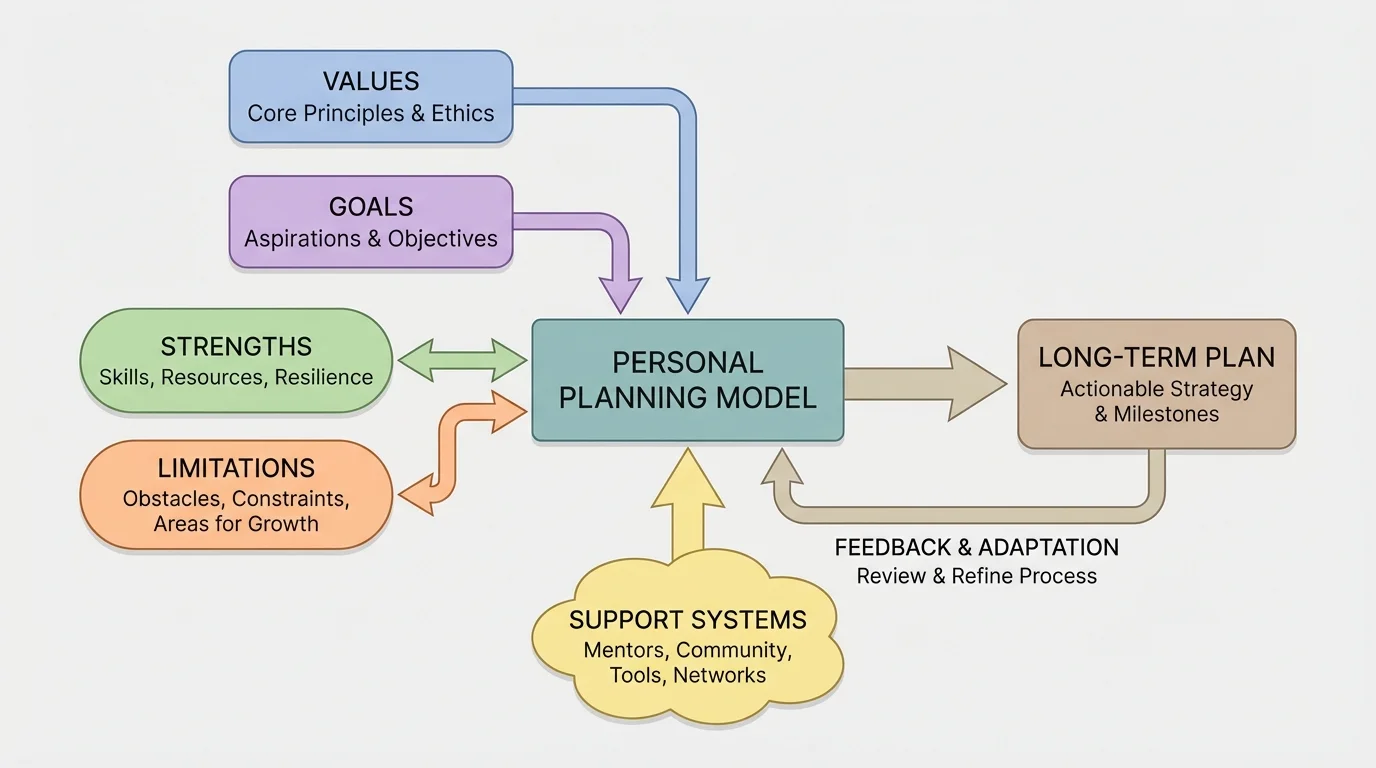
Self-awareness is the foundation of strong planning, and [Figure 1] shows that a useful plan grows from the connection between what you do well, what is hard for you, what matters to you, and where you want to go. If you skip this step, you may set goals based on pressure, image, or comparison instead of fit.
Your self-awareness includes noticing your patterns. Do you focus better in the morning or late afternoon? Do you do your best work alone, with accountability, or in short timed sessions? Are you energized by people-facing activities, or drained by them? Do you stay calm under pressure, or do you need extra time to regulate when things change suddenly?
It also includes understanding your values. A plan should match what matters to you, not just what looks impressive online. Some students value stability, others creativity, service, flexibility, income, or independence. None of these are automatically right or wrong. But they shape what kind of long-term goals will actually feel meaningful enough to keep pursuing.
One of the biggest mistakes in planning is confusing fantasy with possibility. A fantasy ignores your current situation. A possibility takes your current situation seriously and asks, "What can I build from here?" That question is much more useful than "What sounds good?"
Realistic planning is not negative thinking. It is honest thinking. When you name a limitation, you are not labeling yourself as incapable. You are identifying a factor that needs strategy. For example, if you get overwhelmed easily, that does not mean you cannot handle big goals. It means your plan should include smaller deadlines, clearer routines, and support during high-stress periods.
A good self-check before making a long-term plan is to ask yourself four questions: What am I good at? What tends to get in my way? What matters most to me? What kind of support helps me follow through? Those answers often reveal more than motivation does.
A strength is not only a talent. It can also be a useful habit, attitude, resource, or experience. You might be organized, calm in emergencies, good with technology, persistent, creative, empathetic, responsible with money, or quick to learn from feedback. Strengths are building materials for long-term planning.
The key is to connect your strengths to actual goals. If you are dependable and consistent, that may help with part-time work, saving money, or completing online courses. If you communicate clearly, that may support leadership roles, customer service jobs, tutoring, or networking. If you are curious and self-directed, you may do well in areas where you need to learn independently.
Strengths also tell you how to approach a goal. Two students may want the same outcome but need different paths. One might reach a goal through discipline and routine. Another might do better through creativity and flexible problem-solving. The smartest plan is the one that uses your natural advantages instead of constantly fighting them.
Example: Turning a strength into a strategy
Jordan wants to earn money while still keeping up with online coursework. Jordan knows one major strength is reliability.
Step 1: Name the strength clearly.
Instead of saying "I'm pretty good at stuff," Jordan says, "I follow through and meet deadlines."
Step 2: Match the strength to opportunities.
Reliable people often do well in jobs that depend on consistency, such as pet sitting, remote customer support, inventory tasks, or helping a family business.
Step 3: Use the strength in the plan.
Jordan creates a weekly schedule, chooses a job with predictable hours, and uses dependability as a selling point in applications and interviews.
The strength is not just something nice to know. It becomes part of the actual plan.
You should also be careful not to undersell yourself. Many people notice their mistakes faster than their strengths. If something comes naturally to you, you may assume it is not special. But if that skill consistently helps you solve problems or earn trust, it matters.
A limitation is any factor that makes progress harder. That can include lack of experience, emotional stress, poor time management, financial limits, transportation issues, family responsibilities, health challenges, fear of failure, or weak study habits. Some limitations are temporary. Some are ongoing. Both matter.
The goal is not to be harsh with yourself. The goal is to be accurate. If you know you often underestimate how long tasks take, then a good long-term plan should include buffer time. If you know your attention drops after about 30 minutes of focused work, then your plan should use shorter work blocks rather than expecting endless concentration. If you know money is tight, then your plan should include lower-cost options, earning strategies, and financial deadlines.
Limitations become dangerous when they stay unnamed. A student may say, "I just need to try harder," when the real issue is lack of structure, sleep, confidence, or support. Trying harder helps sometimes, but strategy helps more.
Some limitations are skill gaps. These are especially important because they can often be improved with practice. If public speaking makes you nervous, that does not mean you can never lead. If budgeting feels confusing, that does not mean you will always struggle with money. It means your plan should include skill-building time instead of pretending the skill already exists.
Many failed plans are not caused by a lack of ambition. They fail because the person built the plan around their best day instead of their usual day.
That idea is important. Planning around your best day leads to overconfidence. Planning around your usual day leads to consistency. And consistency is what moves long-term goals forward.
Your support system is bigger than "people who care about you," and [Figure 2] shows that support often comes in layers: internal habits, trusted people, digital tools, and community resources. Some support is emotional. Some is practical. Some is structural.
People-based support can include parents, guardians, siblings, relatives, mentors, coaches, supervisors, friends, counselors, or online communities built around goals you care about. These people might encourage you, give advice, check in on your progress, offer transportation, provide connections, or simply remind you that you are not doing everything alone.
Tool-based support includes calendars, reminders, budgeting apps, habit trackers, shared family schedules, note systems, therapy apps, timers, meal planning lists, and quiet workspaces. These may seem basic, but they can make the difference between a plan that stays in your head and a plan that shapes your daily choices.
Routine-based support includes habits and systems that reduce decision fatigue. If you always plan your week on Sunday evening, save part of every paycheck automatically, or prepare tomorrow's tasks the night before, your routine is acting as support. You are not relying on mood; you are relying on structure.
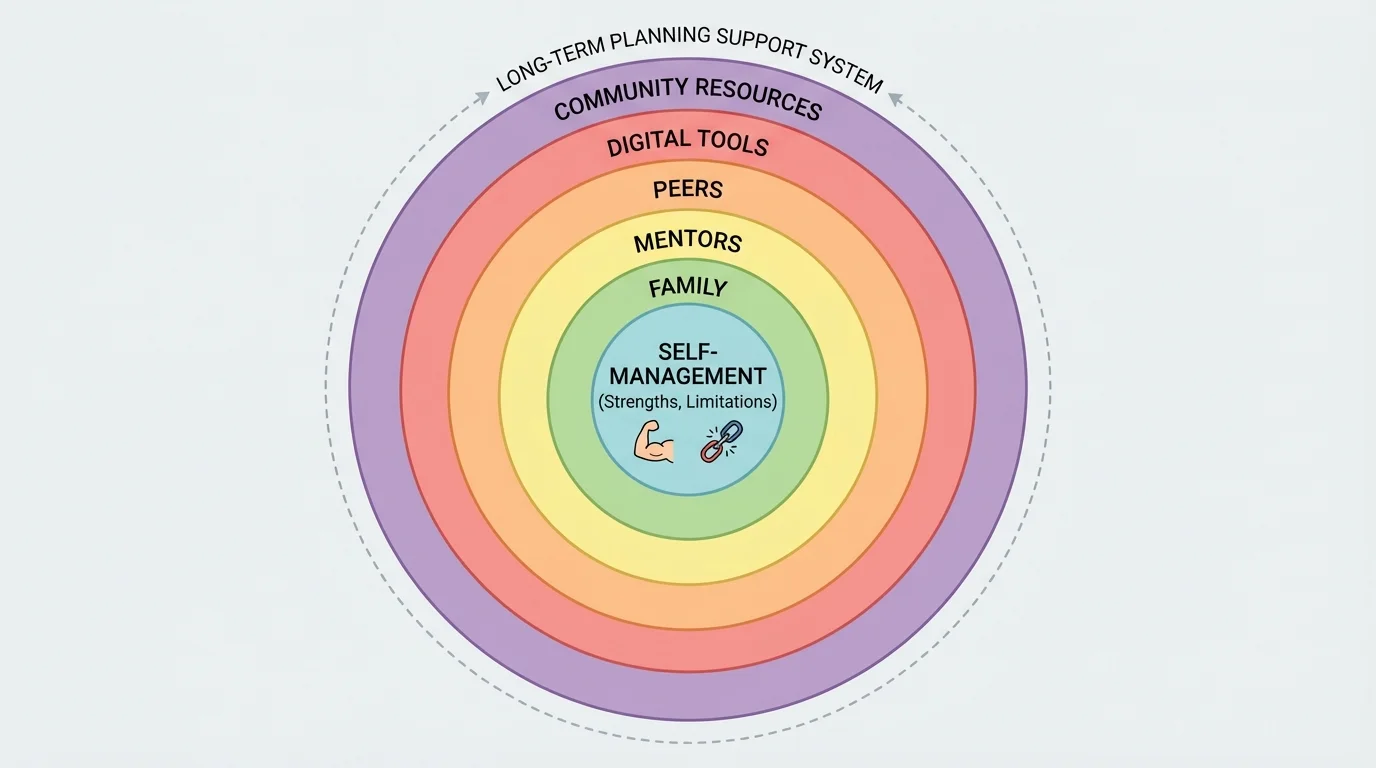
Community support may include tutoring programs, local libraries, job training centers, mental health services, volunteer organizations, youth programs, faith communities, or online professional networks. If you think support only counts when it is personal and emotional, you may miss practical help that is already available.
There is also a difference between healthy support and unhealthy dependence. Healthy support helps you grow your skills, solve problems, and become more capable over time. Unhealthy dependence keeps you from learning how to act on your own. A strong support system should not do all your work for you. It should help you do your work better.
| Type of support | What it looks like | How it helps long-term planning |
|---|---|---|
| Emotional support | A trusted person listens when you feel discouraged | Keeps setbacks from turning into quitting |
| Practical support | Someone helps with transportation or job leads | Removes barriers that block action |
| Skill support | A mentor gives feedback on your resume or portfolio | Improves quality and confidence |
| Structural support | Calendar reminders and weekly routines | Makes consistency more likely |
| Professional support | Counseling, tutoring, or training programs | Adds expert guidance when needed |
Table 1. Different types of support and how each one strengthens long-term planning.
One sign of maturity is learning how to ask for the right kind of help. Saying "I need help" is a start, but saying "I need someone to look over my application by Friday" is much more effective. The more specific you are, the more useful support becomes.
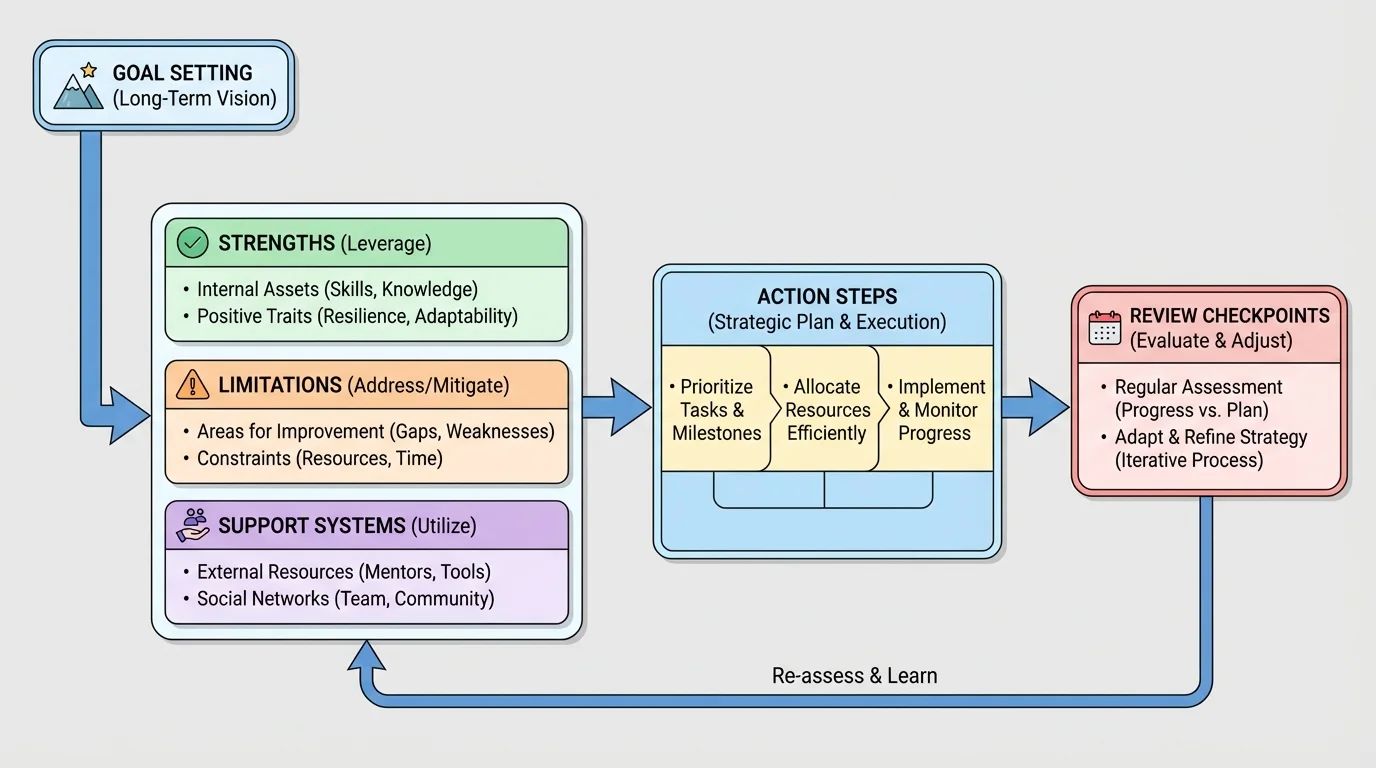
A strong long-term plan works like a process, not a wish list, and [Figure 3] illustrates how goals, strengths, limitations, supports, and review points connect. If even one part is missing, the plan becomes weaker. If all the parts work together, the plan becomes much more resilient.
Use this five-part framework when planning for any major goal: identify the goal, list your strengths, name your limitations, map your support system, and create checkpoints. These checkpoints can be weekly, monthly, or tied to important milestones.
Step 1: Define the goal clearly. "Be healthier" is vague. "Exercise three times a week, sleep at least 7 hours most nights, and reduce energy drink use over the next three months" is much clearer.
Step 2: List what helps you. Ask: What skills, habits, experiences, or resources already give me an advantage?
Step 3: List what could interfere. Ask: What patterns, limits, or obstacles are likely to slow me down?
Step 4: Identify support. Ask: Who can help? What tools or routines can help? What resources do I need to use?
Step 5: Set checkpoints. Ask: How will I know whether this plan is working by next week, next month, or the end of the season?
Example: Planning for life after high school
Suppose Maya wants to start a medical assistant training program within two years while continuing to help at home and save money.
Step 1: Goal
Maya sets a clear target: complete prerequisites, save for program costs, and apply on time.
Step 2: Strengths
Maya is organized, compassionate, and consistent with deadlines.
Step 3: Limitations
Maya has family responsibilities, gets anxious with big decisions, and has limited income.
Step 4: Support systems
Maya talks with a family member about schedule planning, uses a budgeting app, asks a mentor to review applications, and researches low-cost training options.
Step 5: Checkpoints
Each month, Maya checks savings progress, application deadlines, and whether the workload still feels manageable.
This plan is stronger because it does not assume unlimited time, money, or emotional energy. It is built around real conditions.
As we saw earlier in [Figure 1], self-knowledge is not separate from planning. It is the base of planning. Goals that fit your strengths and account for your limitations are not smaller goals; they are smarter goals.
Consider a student who wants to start a small online business selling custom art prints. A strength might be creativity and digital design skill. A limitation might be inconsistency with deadlines. A support system might include a parent helping track shipping supplies, a friend giving feedback on product photos, and a content scheduler that automates posts. Without recognizing the limitation, the student may miss orders and lose trust. With planning, the student can build systems before the business grows.
Now think about a student who wants to improve mental health and overall stability. A strength might be honesty and willingness to reflect. A limitation might be isolation, poor sleep, or difficulty asking for help. Support might include counseling, a trusted adult, exercise routines, sleep alarms, and fewer late-night social media habits. Long-term planning in this case is not about career first. It is about building enough stability to handle other goals well.
Or consider someone who wants to save $2,000 over time for a car, certification program, or emergency fund. The plan should include income, spending habits, limitations, and support. If that student can save $40 per week, then after 50 weeks the total is $2,000. But that only works if the plan also accounts for real barriers like impulse spending or irregular work hours. A budget app, automatic transfers, and accountability from a family member might be just as important as the money goal itself.
"A goal without a plan is only a wish."
— Antoine de Saint-Exupéry
This quote matters because wishes do not organize your time, energy, or choices. Plans do. And the strongest plans are honest about what helps you and what makes things harder.
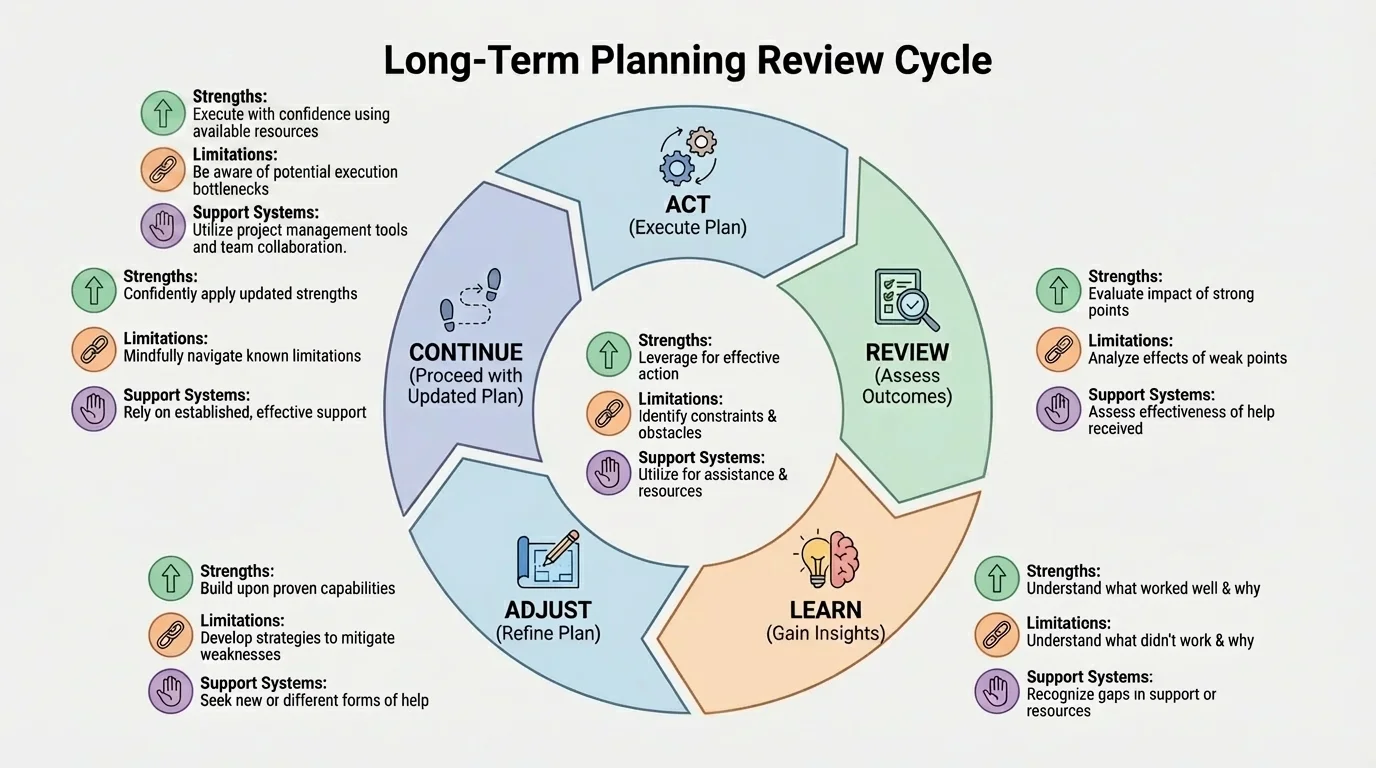
Long-term planning is a cycle with checkpoints, not a one-time decision, and [Figure 4] illustrates how action, review, learning, and adjustment keep a goal alive over time. If your plan is never reviewed, it can quietly stop matching your life.
A plan may need adjustment because your responsibilities changed, your interests became clearer, your health shifted, or a strategy simply did not work. None of that automatically means the goal is wrong. Sometimes the goal is still right, but the method needs to change.
For example, if your original plan was to work 20 hours a week while taking a heavy online course load, and you start falling behind, the answer might not be "I failed." The answer might be "This workload is unrealistic right now." You may need fewer work hours, more study structure, or a longer timeline.
Review questions can help: What is working? What is not working? What has changed? What support do I need now that I did not need before? What can I simplify?
The review process also helps you separate discomfort from danger. Some discomfort is normal growth. Learning a new skill, managing more responsibility, or receiving feedback can feel uncomfortable and still be healthy. Danger is different. Danger looks like burnout, serious anxiety, constant conflict, ignored health needs, or patterns that are making your life less stable over time.
Later, when you revisit support planning, [Figure 2] still matters because your support system may need to change as your goals change. The support you need for finishing coursework is not always the same support you need for job hunting, money management, or emotional recovery after a setback.
Flexibility is a strength, not a weakness. Changing a timeline, finding a new strategy, or asking for different support does not mean you are giving up. It means you are responding to reality. Strong planners do not force a broken method forever. They notice, adjust, and keep moving.
If a plan fails, ask whether the problem was the goal, the timeline, the structure, the support, or the self-awareness behind it. That question leads to improvement. Shame usually does not.
You do not need to have your whole future figured out to start planning well. You just need to become more honest and more intentional. Know what helps you. Know what tends to get in your way. Know where support can come from. Then build a plan that matches your real life instead of an idealized version of it.
Try This: Write one goal for the next year. Under it, list three strengths that can help you, three limitations that may interfere, and three supports you can use. Then add one checkpoint date when you will review the plan.
Try This: Ask one trusted person a specific question about your future plan, such as "What do you think I do especially well?" or "What is one problem you think I should plan for earlier?" Outside perspective can reveal patterns you miss.
Try This: Pay attention for one week to when you are most focused, most stressed, and most likely to avoid tasks. That information is not random. It is planning data.
Try This: Replace one vague statement with a measurable action. For example, replace "I need to get my life together" with "I will use a calendar for all deadlines and review it every night for the next two weeks."
Long-term planning becomes powerful when it is personal. Not dramatic. Not perfect. Personal. The better you understand your strengths, your limitations, and your support systems, the better your future decisions will fit the life you are actually building.
