Some people look calm under pressure not because life is easier for them, but because they have a system. When three assignments are due, your phone keeps buzzing, a family responsibility pops up, and your energy drops, the difference is rarely raw willpower. The difference is whether you know what to do next. That is what resilience really looks like in everyday life.
If you learn online, pressure can be especially sneaky. There may be more flexibility, but that also means fewer built-in reminders, more responsibility for managing your time, and more chances for schoolwork, home responsibilities, jobs, sports, social plans, and personal goals to pile onto the same day. A bad week can feel like everything is happening at once. The good news is that resilience is not something you either have or do not have. You can build it.
A personal resilience system is a set of habits, tools, and decisions that helps you stay functional when life gets demanding. It does not mean you never feel stressed. It means stress does not get to control every choice you make.
Without a system, pressure often turns into a cycle: you feel overwhelmed, avoid starting, lose time, feel guilty, rush badly, and then trust yourself less next time. With a system, pressure still exists, but you notice it earlier, respond faster, and recover better. That matters for grades, jobs, relationships, sleep, health, and confidence.
Pressure is the feeling that the demands on you are high and time, energy, or control feels limited.
Emotional regulation is your ability to notice feelings and respond in a way that helps rather than harms you.
Competing responsibilities are different demands that matter at the same time, such as school deadlines, family responsibilities, paid work, activities, and personal care.
Think of resilience like having a phone battery pack. It does not remove the need for energy, but it keeps you from dropping to zero when the day gets intense. Your system needs to help you do three things: prepare, respond, and recover.
Pressure usually builds in a chain: something triggers stress, your mind starts telling a story about it, your body reacts, your behavior changes, and the problem often gets worse. If you only notice the very last part, such as snapping at someone or missing a deadline, you miss your chance to interrupt the cycle earlier.
Your first job is to learn your own pattern. [Figure 1] For one person, pressure sounds like, "If I can't do all of it, I might as well do none of it." For another, it looks like perfectionism, doom-scrolling, procrastination, irritation, forgetting details, or staying up too late to catch up. Your pattern is personal, but it is usually predictable.
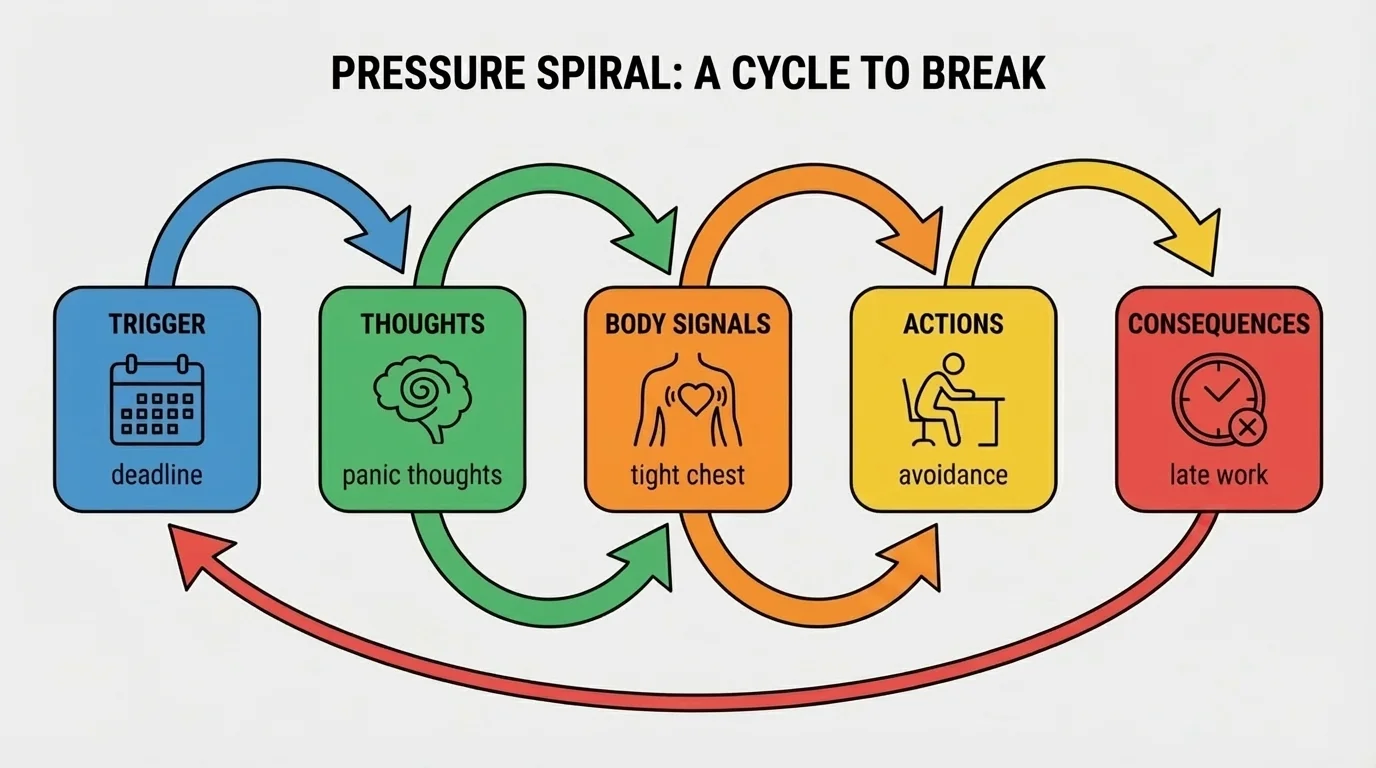
Common triggers include multiple deadlines in the same week, unclear instructions, fear of disappointing others, conflict at home, lack of sleep, social drama, money worries, and trying to do everything at the last minute. None of these automatically causes collapse. What matters is whether you recognize the signs early.
Your early warning signs might be physical: headache, tight shoulders, stomach discomfort, fast breathing, restlessness, or sudden exhaustion. They might be emotional: anger, panic, hopelessness, shame, or numbness. They might be behavioral: avoiding messages, pretending a task does not exist, overcommitting, skipping meals, or working without breaks.
When you know your pattern, you can respond with strategy instead of self-judgment. As shown in [Figure 1], the goal is to interrupt the chain before the consequences grow. A student who notices, "I'm starting to avoid opening the assignment page," is in a much stronger position than a student who only notices after the deadline passes.
Pressure pattern example
Jordan has an essay due Friday, a part-time shift on Thursday evening, and a younger sibling to help at home.
Step 1: The trigger appears.
Jordan sees the essay instructions and thinks, "This is a lot. I need a huge block of time."
Step 2: The stress response starts.
Jordan feels tense, opens social media "for a minute," and avoids the assignment for two days.
Step 3: The consequence grows.
Now the deadline is closer, stress is higher, and Jordan feels even less able to start.
Step 4: The system interrupts the spiral.
Jordan breaks the essay into a 15-minute outline, sends one clarifying message to the teacher, and blocks out two focused work sessions.
The pressure does not vanish, but it becomes manageable because the pattern is recognized early.
A useful question is: What do I tend to do when I feel cornered? If you know that answer, you can plan for it instead of being surprised by it.
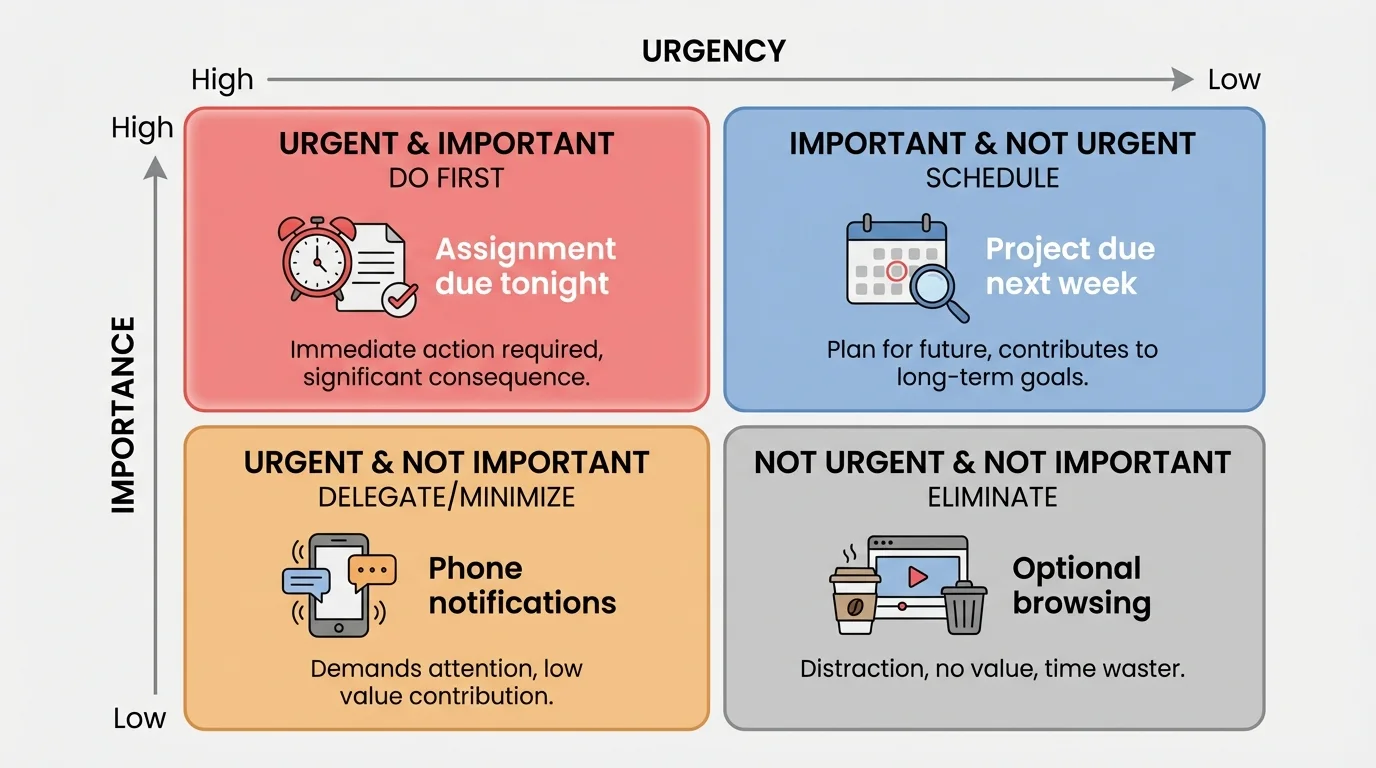
Your core system handles pressure before emotions take over. One of the most practical tools is prioritization, which means deciding what matters most right now instead of treating every task as equally urgent. A simple priority matrix shows one way to sort your responsibilities so you can act instead of freeze.
[Figure 2] Start with a full list. Write down everything that is competing for your attention: assignments, chores, job hours, appointments, messages you need to answer, and personal needs like sleep or exercise. Your brain feels more overloaded when it has to keep everything in memory. Getting it onto paper or a notes app reduces mental clutter.
Then sort tasks into four groups: urgent and important, important but not urgent, urgent but less important, and neither urgent nor important. This is a form of triage. If a quiz closes tonight, that is urgent and important. If you need to start a project due next week, that is important but not urgent. If a nonessential group chat keeps demanding attention, that may feel urgent without being important.
Another key strategy is task breakdown. Large responsibilities often feel impossible because they are vague. "Do history project" is overwhelming. "Open directions, highlight requirements, choose topic, find two sources, draft intro" is workable. Small steps reduce resistance and create momentum.
Use buffer time whenever possible. Buffer time is extra room built into your schedule in case something takes longer than expected. If you think an assignment will take one hour, plan for one hour and 20 minutes. If two things are due the same day, aim to finish one the day before. Buffers protect you from normal life problems such as tech issues, fatigue, or interruptions.
Resilient students also make decisions in advance. This is called a contingency plan. For example: "If family responsibilities interrupt my study block, I will do the reading on my phone notes app during waiting time and finish the outline after dinner." Planning your response ahead of time saves energy when stress is high.
The core system has four parts: capture, sort, break down, and schedule. Capture everything in one place. Sort by urgency and importance. Break down big tasks into clear actions. Schedule the first few actions with buffer time. This is simple, but repeated use turns panic into a process.
It also helps to create a minimum day plan. A minimum day plan is what you do when energy is low but responsibilities still exist. Instead of aiming for your perfect routine, you define the smallest acceptable version: attend the required live session, submit one key assignment piece, answer one important message, eat, drink water, and sleep at a reasonable time. Minimum plans prevent bad days from becoming disaster weeks.
As the priority matrix in [Figure 2] shows, resilience is not doing everything. It is doing the right next things and intentionally letting some lower-value tasks wait.
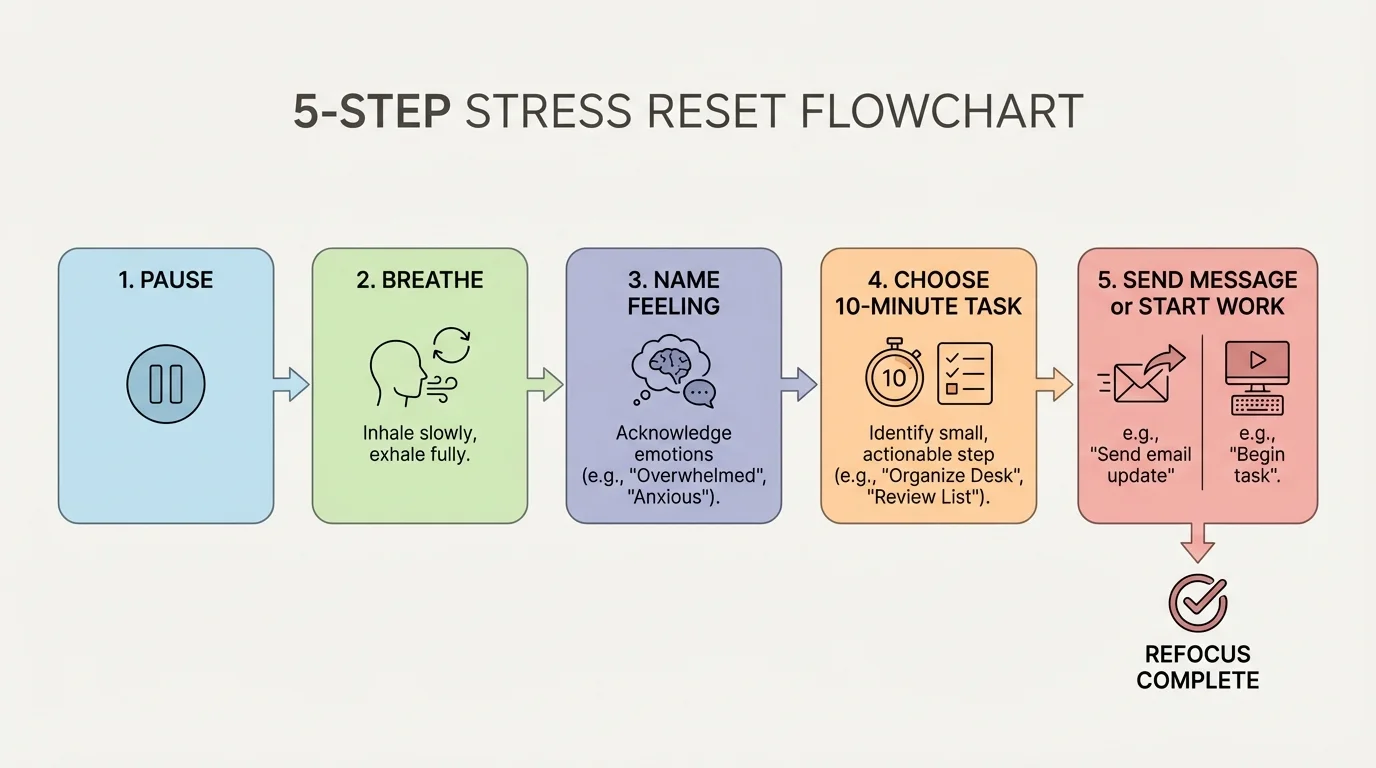
Even with a strong system, some moments will feel intense. A message arrives that changes your plan. You realize a deadline is sooner than you thought. You get criticism, or you are exhausted and still need to function. In those moments, emotional regulation matters because a stressed brain tends to think in extremes: "I'm done," "I ruined everything," or "There's no point now." A reset works best when it follows a simple repeated sequence.
[Figure 3] Try a five-minute reset. Pause. Stop switching between apps and tasks. Breathe. Take slow breaths with a longer exhale than inhale. Name what is happening. "I'm overwhelmed and starting to panic." Reduce the problem size. Ask, "What is the next 10-minute action?" Communicate if needed. If you need clarification or support, send one clear message now rather than avoiding it.
This works because naming your state makes it more manageable. It shifts you from being carried by emotion to observing it. You do not need to feel calm before acting. Often, action creates calm.
Other useful in-the-moment tools include stepping away from your screen for two minutes, drinking water, standing up, stretching, changing rooms, or setting a timer for a short work sprint. These are not magic tricks. They are ways to help your nervous system settle enough for decision-making to return.
Watch out for fake relief. Fake relief feels good for a moment but makes pressure worse later. Examples include scrolling for an hour instead of taking a real 10-minute break, saying "I'll deal with it tomorrow" without a plan, or picking a fight because stress needs somewhere to go. Real relief restores your ability to function. Fake relief delays the problem and increases guilt.
Your body often reacts to pressure before your thoughts fully catch up. That is why a fast heartbeat, shallow breathing, or muscle tension can be early signals to use a reset before your stress spirals further.
Later, when you reuse the same reset sequence shown in [Figure 3], it becomes faster and more automatic. That is one reason routines are powerful: they reduce the number of decisions you need to make during difficult moments.
Pressure gets worse when silence grows around it. If you are confused, falling behind, or dealing with a genuine conflict in responsibilities, early communication usually protects both your progress and your relationships. Waiting until after a deadline with no message often creates more stress than sending a short, honest note earlier.
Good pressure communication is clear, respectful, and specific. You do not need to tell your whole life story. A strong message usually includes three parts: what is happening, what you have already done, and what you need. For example: "I'm working on the project and realized I'm unclear about the source requirement. I reviewed the instructions and my notes, but I'm still unsure. Could you clarify whether we need two or three sources?"
If you need more time, be direct. Say what happened briefly, show responsibility, and suggest a realistic plan. For example: "I underestimated how long the assignment would take and I'm also covering an unexpected family responsibility tonight. I have completed the outline and first section. Could I submit the final draft tomorrow by 6 p.m.?" This is much stronger than disappearing.
Three strong communication moves
Move 1: Ask early.
Do not wait until the problem becomes a crisis if you already know there is a problem.
Move 2: Be concrete.
Replace vague statements like "I'm stressed" with useful details such as "I can submit Part A tonight and Part B tomorrow."
Move 3: Protect trust.
Follow through on whatever revised plan you agree to. Reliability builds credibility for future situations.
This skill also matters with family, employers, coaches, or friends. If you say yes to too much because you fear disappointing people, you may end up disappointing more people later. Boundaries are not selfish. They are how you stay dependable.
Sometimes the real problem is not one big task but several legitimate responsibilities colliding at once. Schoolwork matters. Family matters. Health matters. Paid work may matter. Relationships matter. Resilience does not ask you to pretend all of these are easy to balance. It asks you to make deliberate choices.
When responsibilities compete, use a decision filter: What is time-sensitive? What has the biggest consequence if ignored? What only I can do? What can move, shrink, or wait? This keeps you focused on outcomes instead of guilt. If your sibling needs immediate help and a discussion post is due by midnight, maybe you ask for 20 quiet minutes now, submit the post, then return to help. If you are sick, your best choice may be to complete only the highest-priority work and rest.
You also need to protect your capacity, which means the amount of energy, attention, and emotional strength you actually have. Capacity is not infinite. Pretending it is infinite leads to poor work, conflict, and burnout. Being realistic about capacity is not weakness; it is accurate self-management.
| Situation | Unhelpful response | Resilient response |
|---|---|---|
| Two deadlines on the same day | Freeze and avoid both | List both, estimate time, start the one with the closest deadline or biggest impact |
| Unexpected family responsibility | Pretend nothing changed | Adjust plan, communicate early, protect the most important task |
| Low energy and poor sleep | Force an unrealistic perfect day | Use a minimum day plan and complete essentials |
| Too many commitments | Keep saying yes | Pause and renegotiate lower-priority commitments |
Table 1. Comparison of common pressure situations and more resilient responses.
Notice that resilient choices are not always comfortable. Sometimes resilience means disappointing your perfectionism. Sometimes it means telling a friend, "I can't join tonight because I need to finish this." Sometimes it means admitting you need help.
You will still have setbacks. You might miss a deadline, forget something important, react emotionally, or realize you pushed too hard for too long. A resilience system includes recovery, not just prevention.
First, avoid the spiral of shame. Shame says, "I messed up, so I am a mess." That belief makes people hide, quit, or repeat the same pattern. A better response is: "Something went wrong. What is the next repair step?" Repair may mean apologizing, submitting late work, asking for a new plan, or resetting your schedule for the next two days.
"You do not rise to the level of your goals. You fall to the level of your systems."
— James Clear
Second, run a quick review. Ask: What triggered this? What warning signs did I miss? What tool would have helped earlier? What will I do differently next time? This is not about blaming yourself. It is about upgrading your system.
Third, rebuild physically as well as mentally. Stress recovery is harder if you are chronically underslept, dehydrated, overcaffeinated, or disconnected from movement and sunlight. Basic care sounds obvious, but under pressure it is often the first thing people sacrifice and the first thing they need back.
A resilient student does not say, "I'll take care of myself after everything is done." That moment never fully arrives. Instead, the student treats food, sleep, breaks, and connection as part of staying effective.
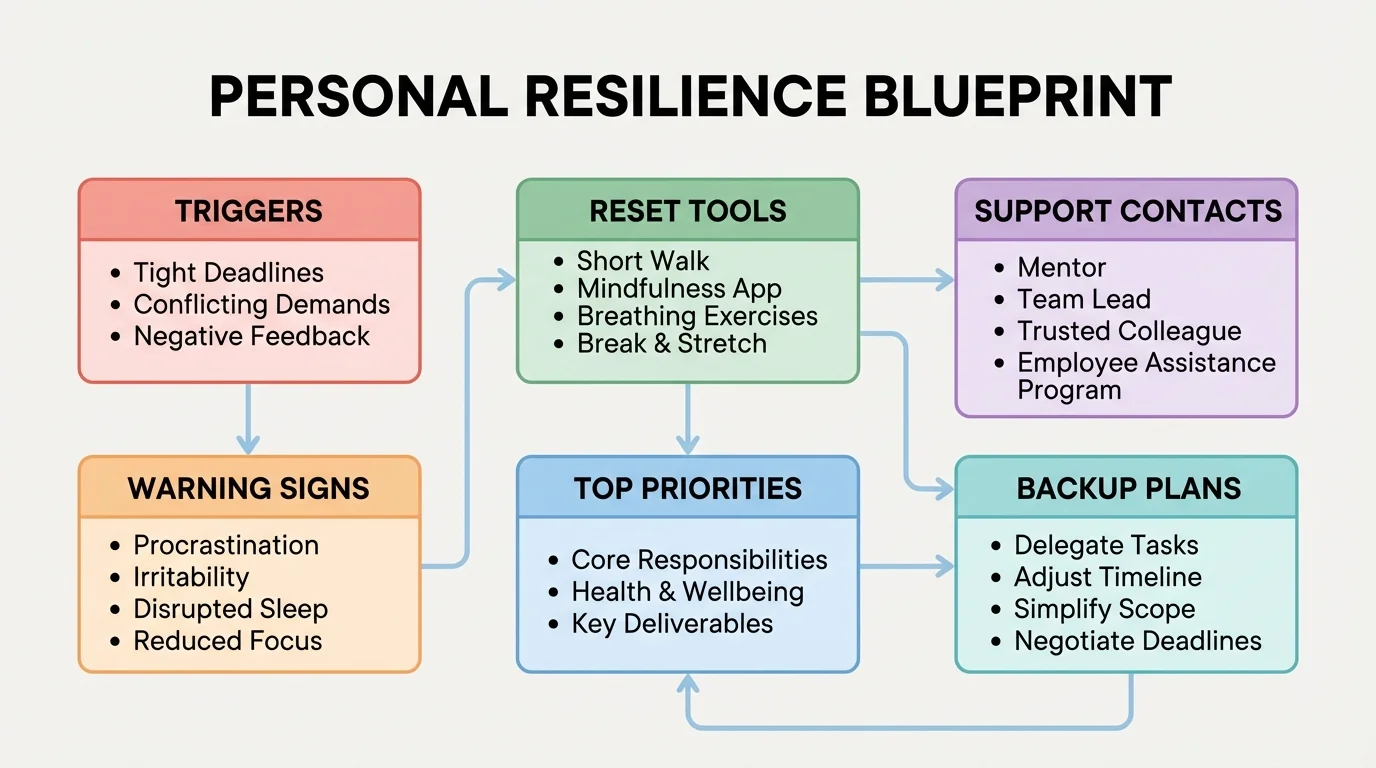
Your best system is one you can actually use on a hard day. A one-page blueprint helps turn good intentions into repeatable action. It should be simple enough to read in a minute and practical enough to guide your choices when your brain feels crowded.
[Figure 4] Start with your top pressure triggers. Write down three to five situations that commonly throw you off. Then list your early warning signs: body, emotions, and behaviors. Next, write your go-to reset actions. Keep them specific: breathe for one minute, write the next three tasks, turn on focus mode, send one message, drink water, stand up, and start a 10-minute timer.
Then identify your support network. Who can help with what? One person may be good for emotional support, another for assignment clarification, another for schedule help, and another for practical responsibilities at home. Support is stronger when you know who to contact before things get urgent.
Finally, include your backup plans. What will you do if you lose internet for a while? If you get sick? If work hours suddenly increase? If two important deadlines land together? Thinking through these situations in advance makes them less overwhelming when they happen.
You can also build a weekly review around this blueprint. Once a week, look ahead, spot likely pressure points, and prepare. This is where resilience becomes proactive instead of reactive.
Personal resilience blueprint example
A student named Maya creates a one-page plan.
Step 1: Triggers
Back-to-back deadlines, unclear instructions, and family interruptions during study time.
Step 2: Warning signs
Tight chest, avoiding messages, and telling herself she has to do everything perfectly.
Step 3: Reset tools
Two slow breaths, list the next smallest action, set a 10-minute timer, and send one clarification message if needed.
Step 4: Backup plan
If the day gets disrupted, complete the minimum day plan: attend required session, submit one essential task, and reschedule lower-priority work.
Maya is still busy, but she is far less likely to spiral because she already knows her pattern and her response.
Later, when pressure rises again, the blueprint in [Figure 4] still helps because it turns stress into a checklist: notice, sort, regulate, communicate, and recover. That is what a personal resilience system is meant to do.
