Some of the worst harm in communities is caused by people who thought they were helping. A fundraiser can spread someone's private story without consent. A volunteer can take over instead of listening. A social media post can turn real suffering into content. Good intentions matter, but they are not enough. If you want to contribute well, you need more than kindness. You need judgment, self-awareness, and respect for other people's humanity.
A community is any group of people connected by place, identity, shared goals, shared challenges, or shared experiences. That could mean your neighborhood, an online support group, a local mutual-aid network, a faith community, a sports club, a youth activism group, or even a digital space built around a cause. Contributing to a community means using your time, effort, voice, resources, or skills to support the well-being of others and the overall functioning of the group.
Done well, community contribution builds trust, solves problems, and helps people feel seen. Done poorly, it can waste time, create dependency, embarrass people, reinforce stereotypes, or shift attention toward the helper instead of the people affected. That is why the goal is not to be seen as a "good person." The goal is to be genuinely useful in a way that respects others.
Community contribution means offering support, labor, advocacy, resources, or skills to strengthen a group or help address a shared need.
Empathy is the ability to understand and care about another person's feelings, perspective, and experience.
Dignity means recognizing that every person has worth and deserves respect, privacy, choice, and voice.
Accountability means taking responsibility for your impact, following through on commitments, and repairing harm when you make mistakes.
These ideas matter in everyday life, not just in major social movements. If a friend's family is going through a crisis, if a local shelter needs supplies, if an online community is dealing with harassment, or if a neighborhood cleanup needs volunteers, your approach affects whether your contribution helps or hurts.
Empathy, dignity, and accountability work together, as [Figure 1] shows. If you have empathy without accountability, you may feel deeply but act carelessly. If you care about accountability without empathy, you may become rigid or cold. If you talk about dignity but never ask what people want, you may still center yourself. Strong community contribution balances all three.
Empathy is not the same as pity. Pity looks down on people and assumes weakness. Empathy tries to understand without reducing someone to a problem. For example, if a student in an online youth group says they are overwhelmed because they are caring for younger siblings, pity might sound like, "That's so sad, your life is a mess." Empathy sounds more like, "That sounds exhausting. What kind of support would actually help right now?" One response labels the person. The other respects their experience and opens space for choice.
Dignity means people are more than their hardest moment. When you contribute to a community, dignity asks you to avoid treating others like a project, a charity case, or a source of inspiration. Someone asking for support still has preferences, boundaries, strengths, and the right to say no. Respecting dignity can be as simple as asking before sharing information, using the language people prefer for themselves, and not assuming you know what is best.
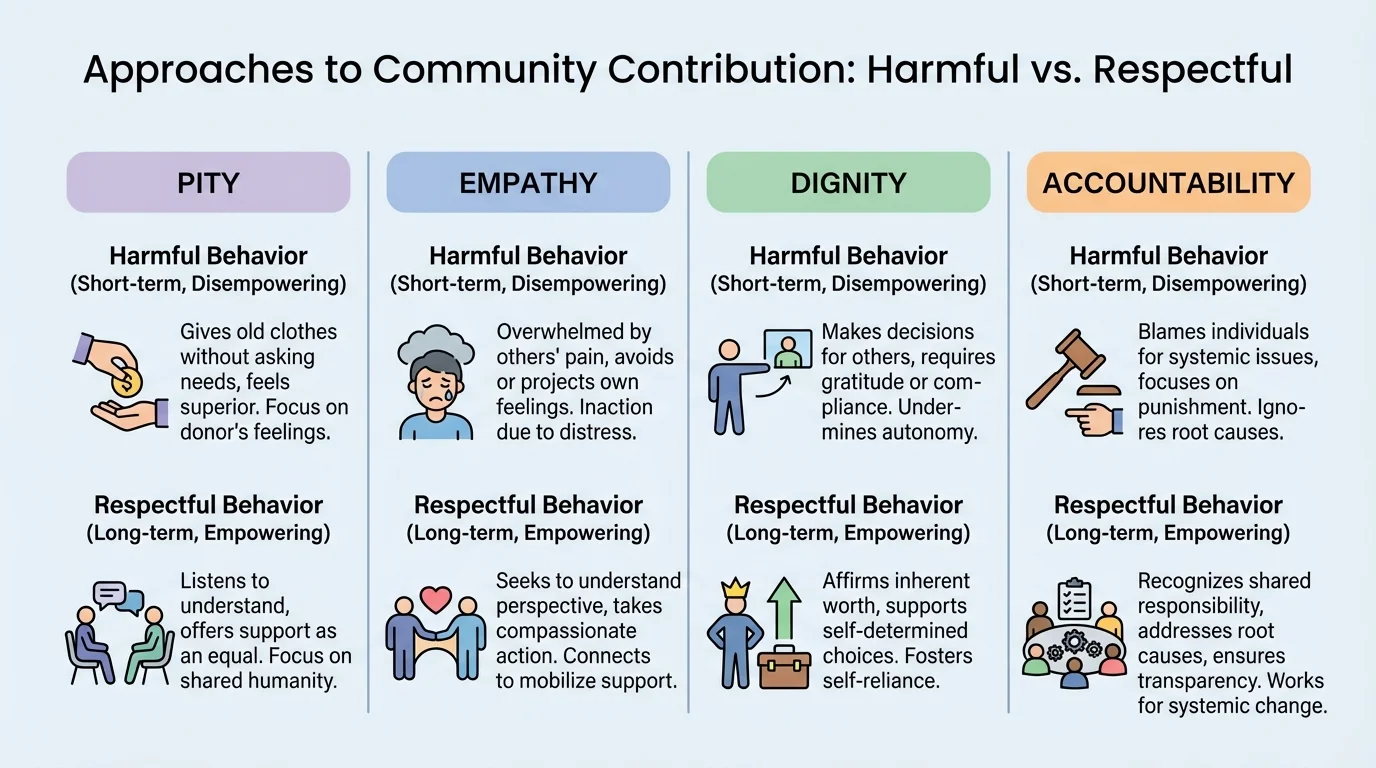
Accountability is where many people struggle. It means you do not judge your actions only by your intentions. You also look at the effect. If you promised to help organize donations and then disappeared, accountability means acknowledging that your choice affected others. If you posted a story about someone's hardship without permission, accountability means removing it, apologizing, and learning from the mistake instead of defending yourself.
Good questions to ask yourself are: Am I trying to help, or am I trying to feel helpful? Those are not always the same. The first focuses on the community's needs. The second focuses on your image, emotions, or approval from others.
Research on volunteering and civic engagement consistently finds that communities benefit most from people who are reliable and collaborative, not from people who make the biggest first impression. Quiet follow-through often matters more than dramatic gestures.
This is one reason empathy must be paired with humility. You can care deeply and still misunderstand. You can be passionate and still be uninformed. Humility keeps you open to correction instead of making the situation about your pride.
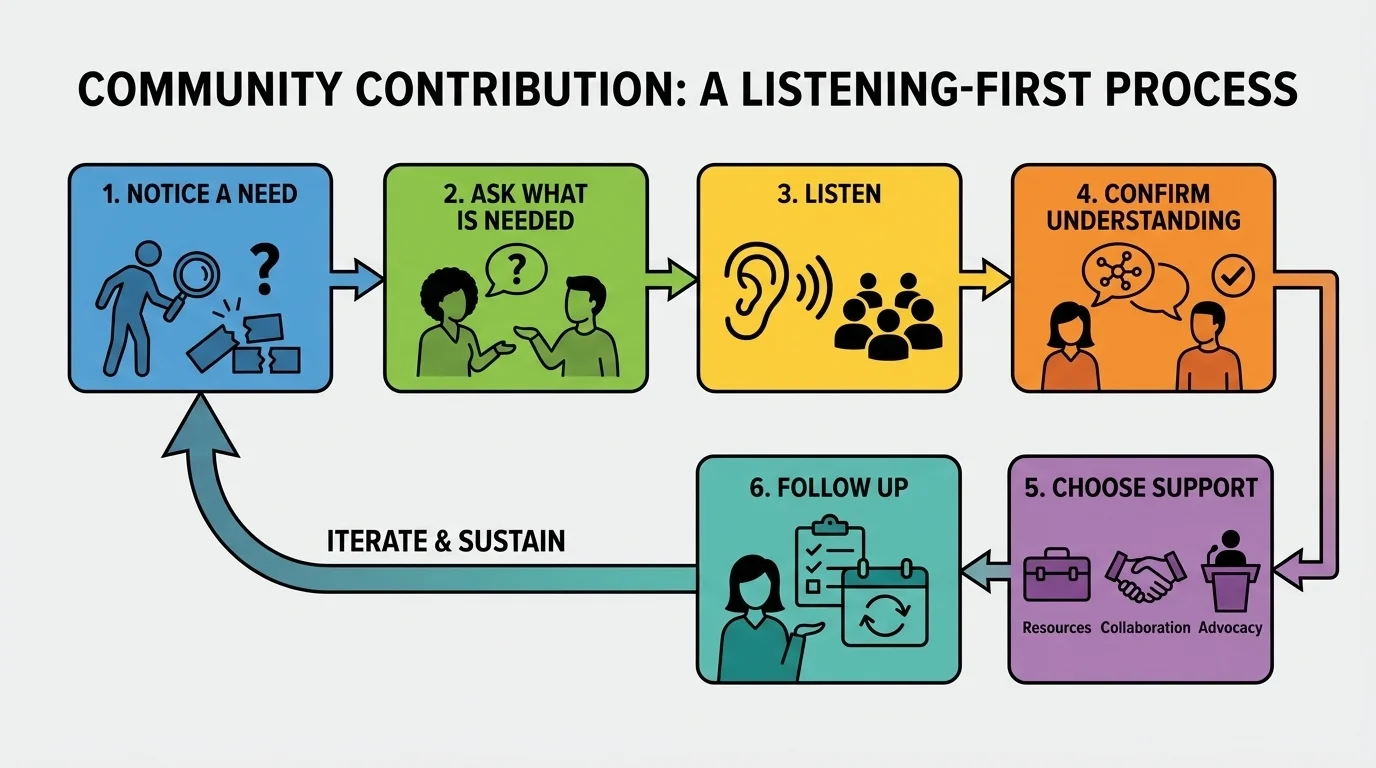
The fastest way to become unhelpful is to assume you already know what people need. Effective contribution starts with listening, as [Figure 2] illustrates. Listening sounds simple, but in real life it requires patience, attention, and the willingness to hear an answer that changes your plan.
Start by noticing a need without jumping to conclusions. Maybe you see posts in a community forum about members struggling to access food, transportation, or tutoring. Maybe someone mentions that a local event is inaccessible to disabled attendees. Maybe a neighborhood group says they need volunteers, but what they really need is consistent scheduling help rather than more donated items. The key is to ask questions before acting.
You can use a simple listening sequence: notice the issue, ask what is needed, listen without interrupting, confirm your understanding, and then decide whether you can help. This prevents a lot of avoidable harm. It also shows respect, because it keeps the people affected involved in the decision.
Here are practical questions you can ask: "What would be most useful right now?" "What support would feel respectful?" "Is there a way to help that does not create extra work for you?" "Would you rather have supplies, money, time, or help sharing information?" These questions are better than assuming. They also reduce the chance that you will offer something that sounds generous but creates problems.
Listening also means paying attention to who is speaking and who is not. In many groups, the people most affected by a problem are not always the loudest voices. If a community discussion is being dominated by people who are less impacted, part of respectful contribution may be making space for others to speak or seeking out perspectives that are missing.
Listening is a form of action
Listening is not passive when it helps you respond more accurately. In community work, a rushed solution can do more damage than a slower, informed response. Taking time to understand the situation often saves time, trust, and resources later.
Sometimes listening shows you that you are not the right person to lead. That is not failure. It may mean your best role is amplifying someone else's work, donating quietly, handling background tasks, or stepping back so people with more experience can guide the effort. As we saw in [Figure 2], good contribution often begins with asking and following rather than leading immediately.
There is no single correct way to support a community. The best approach depends on the need, your skills, your resources, and what people actually want. Sometimes the most useful contribution is direct help. Sometimes it is advocacy. Sometimes it is behind-the-scenes organizing. Sometimes it is simply being dependable.
You can usually contribute in at least six ways: time, skills, money, resources, advocacy, and relationship-building. Time might mean regularly helping at a food pantry or moderating a safe online support space. Skills might mean designing flyers, translating information, tutoring, editing resumes, or helping a nonprofit with spreadsheets. Money and resources can help quickly when organizations know how to use them well. Advocacy can include contacting local decision-makers, sharing verified information, or helping people understand their rights. Relationship-building means being someone people can trust over time.
Your contribution should match both the need and your capacity. If you have a busy schedule and tend to overcommit, promising weekly volunteer hours you cannot sustain may hurt more than offering one reliable monthly shift. If you are good with technology, setting up a clearer sign-up system for a community event may matter more than trying to do everything yourself. Reliability is part of accountability.
| Type of contribution | What it looks like | Best use | Risk if done poorly |
|---|---|---|---|
| Time | Volunteering, organizing, mentoring | When steady help is needed | Dropping out without notice |
| Skills | Design, tutoring, translation, tech support | When specialized help saves effort | Taking over without coordination |
| Money | Donations, mutual aid, emergency funds | When speed and flexibility matter | Giving for attention or with strings attached |
| Resources | Food, clothing, devices, transportation | When specific items are requested | Donating unusable or unwanted items |
| Advocacy | Sharing information, speaking up, campaigning | When systems need change | Spreading misinformation |
| Relationship-building | Checking in, connecting people, trust-building | When community strength matters long-term | Being inconsistent or intrusive |
Table 1. Common forms of community contribution, when they are useful, and what can go wrong.
Before saying yes, ask yourself: "Do I have the time to follow through?" "Do I understand the need?" "Am I the best person for this role?" "Will this support people's autonomy, or will it make me the center?" These questions help you choose wisely instead of reacting impulsively.
Choosing a helpful role
You notice a local youth center posting online that they need support for a weekend event.
Step 1: Check the actual need.
You message the organizer and learn they already have enough volunteers for setup, but they need someone to manage digital sign-ins and update schedule changes.
Step 2: Match the need to your strengths.
You are organized, comfortable with spreadsheets, and available during the event window.
Step 3: Make a realistic commitment.
Instead of saying, "I can help with anything all day," you say, "I can manage sign-ins from noon to 4 p.m. and help update messages if plans change."
Step 4: Follow through and communicate.
You log on when promised, keep records, and tell the organizer early if a problem comes up.
This contribution is effective because it is specific, realistic, and responsive to what was actually needed.
Notice that none of this requires being the most visible person. In healthy communities, some of the most important people are the ones who quietly keep systems working.
Helping does not give you unlimited access to other people's lives. Boundaries protect dignity. If someone shares a struggle with you, that does not automatically give you permission to post about it, retell it in a group chat, or use it to motivate others. Consent matters even when your goal is awareness.
Consent means getting clear permission before sharing someone's story, image, private information, or personal situation. A person in need is still entitled to privacy. This matters in digital spaces especially, where screenshots and reposts can spread quickly and stay online for a long time.
Boundaries also apply to your own role. You are not responsible for fixing every problem. If someone needs mental health support, legal help, medical care, or crisis intervention, the most respectful action may be helping them connect with qualified support rather than trying to handle it yourself. Overstepping can be dangerous.
"Respect is not proven by how much access you get to someone. It is proven by how well you honor their limits."
Another part of respect is cultural humility. This means recognizing that you do not know everything about another person's background, identity, values, or community. Instead of acting like an expert on experiences you have not lived, you stay curious, listen carefully, and avoid stereotypes. You do not need to know everything to be respectful, but you do need to avoid acting certain when you are uninformed.
Watch out for "savior" behavior. That happens when someone acts as though they are rescuing others rather than working with them. Savior behavior often includes posting dramatic before-and-after stories, expecting praise, ignoring local leadership, or making help conditional on gratitude. Dignity means people do not owe you a performance of thankfulness because you chose to contribute.
Once you understand the need and your role, you need a clear plan. [Figure 3] shows a simple action cycle for responsible contribution: identify the issue, set a realistic goal, choose your role, communicate clearly, act, and review the result.
This process matters because vague good intentions often lead to weak follow-through. A plan makes your help more dependable. It also helps others know what they can count on from you.
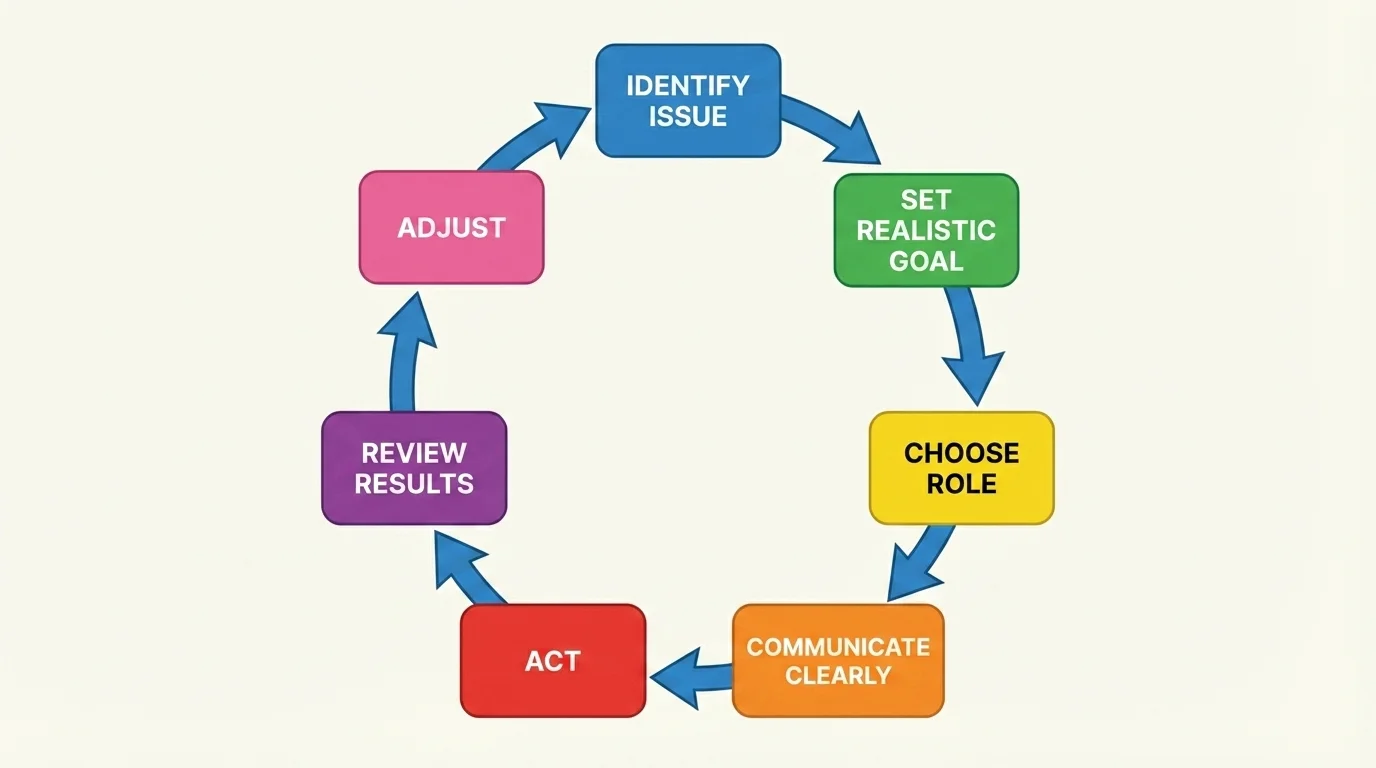
Step 1: Identify the issue clearly. Try to name the actual problem, not just your emotional reaction to it. "People are struggling" is too vague. "The community pantry is short on shelf-stable food and volunteer coverage on Saturdays" is something you can respond to.
Step 2: Set a realistic goal. A good goal is specific and possible. "I will solve hunger in my city" is not realistic. "I will help organize one verified pantry donation drive this month" is realistic. Clarity helps you avoid burnout and disappointment.
Step 3: Choose your role. Decide whether you are leading, assisting, donating, organizing, sharing information, or connecting people. Not every situation needs a leader. Sometimes the strongest move is support.
Step 4: Communicate clearly. Tell people what you can do, when you can do it, and any limits. Clear communication prevents confusion. It is better to say, "I can help edit the flyer tonight but I cannot stay involved next week," than to make an open-ended promise you will not keep.
Step 5: Follow through. Reliability builds trust. If something changes, communicate early instead of disappearing. Accountability is often less about never making mistakes and more about what you do when plans change.
Step 6: Review the impact. Ask what worked, what did not, and what the community actually experienced. Reflection is not separate from action. It is part of the cycle that helps you improve.
Action plan for a community supply drive
You want to support a local organization that serves families displaced by a storm.
Step 1: Verify needs.
You check the organization's official updates and find that they need hygiene kits, phone chargers, and gift cards more than used clothing.
Step 2: Set a realistic goal.
You decide to collect twenty hygiene kits over two weeks instead of trying to run a huge campaign alone.
Step 3: Communicate clearly.
You create a simple post listing requested items, drop-off times, and the final delivery date. You avoid exaggeration or emotional pressure.
Step 4: Deliver and confirm.
You bring the items on time and ask the organization if the collection method was actually useful.
This approach respects dignity because it responds to stated needs, not assumptions.
One of the most practical skills here is learning to make commitments that are honest. Saying no to a role you cannot fulfill is more responsible than saying yes for the sake of looking generous.
You will make mistakes. Everyone does. You may misunderstand a need, forget a task, use the wrong language, share something too quickly, or realize later that your "help" created extra work. The question is not whether you will ever mess up. The question is what you do next.
Accountability in practice usually has five parts: notice the harm, stop the harmful action, listen to feedback, apologize without defensiveness, and change your behavior. If needed, make a concrete repair. That might mean correcting misinformation, replacing a missed shift, removing a post, or asking what would help restore trust.
A weak apology sounds like, "I'm sorry you felt hurt," or "I was only trying to help." Those responses shift attention away from the impact. A stronger apology sounds like, "I shared your situation without asking. That was disrespectful. I removed the post, and I'll ask for permission in the future." Specific apologies show that you understand what went wrong.
Repair matters more than self-protection
When people are corrected, they often want to prove they are still good. But in community settings, the priority is not protecting your image. It is reducing harm and rebuilding trust. Listening, changing, and making repair are stronger than arguing about intent.
Do not expect instant forgiveness. Trust may return slowly. Consistent changed behavior matters more than emotional speeches. This is another reason steady, respectful contribution matters more than dramatic moments.
The comparison in [Figure 1] still applies here: accountability is not just saying you care. It is showing, through action, that you can be trusted after a mistake.
Online spaces are real communities, and your behavior there affects real people. [Figure 4] illustrates how group chats, community servers, social media pages, fundraising platforms, and mutual-aid networks all rely on trust, and how your online choices shape safety and belonging.
Digital contribution can look like moderating respectfully, sharing verified resources, reporting harassment, helping someone navigate a form, creating accessible captions, or boosting a fundraiser from a trusted source. It can also mean slowing down before reposting emotional content. Urgency is not the same as accuracy.
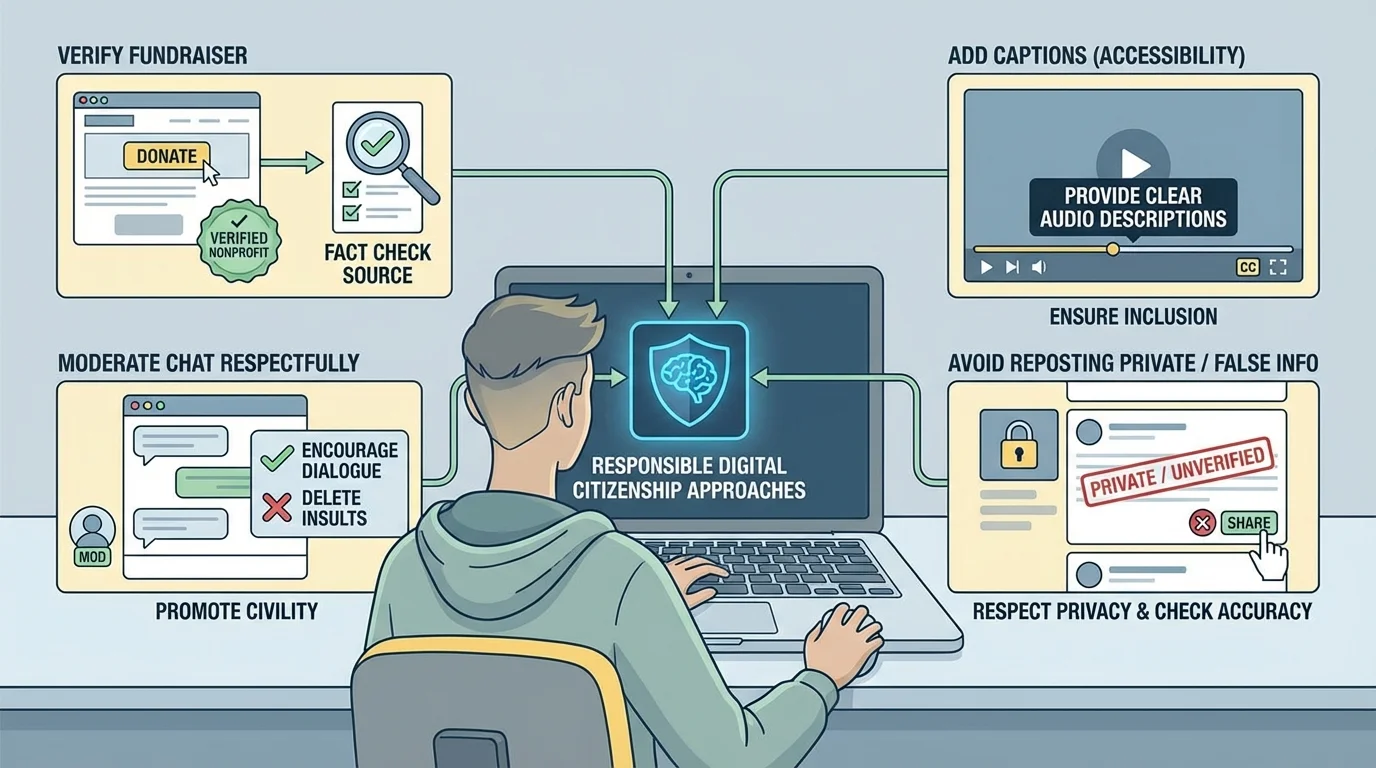
Before sharing a fundraiser or urgent post, check basic signs of credibility. Is the source identifiable? Are details consistent? Is there confirmation from a trusted organization or person directly involved? If you cannot verify something, it may be better to pause than to spread a false story. Misinformation can waste donations, expose vulnerable people, and damage trust.
Language matters online because tone is easy to misunderstand. If you are giving feedback in a volunteer chat or community project, be direct but respectful. Public call-outs are sometimes necessary for serious harm, but many smaller issues are handled better through clear, private communication when appropriate and safe.
Accessibility matters too. If you are creating content for a community cause, think about captions, image descriptions, readable formatting, and whether the information is understandable to people with different needs. Inclusion is part of dignity.
Responsible online support
A friend asks you to share a crowdfunding link for someone facing medical expenses.
Step 1: Verify before sharing.
You check whether the campaign is connected to the person or their family and whether the details are consistent across sources.
Step 2: Protect privacy.
You do not add extra personal details or screenshots that were not already shared with permission.
Step 3: Share accurately.
You post the link with clear information and avoid dramatic claims you cannot confirm.
Step 4: Stay accountable.
If you learn new information that changes the situation, you update or remove your post.
This approach combines empathy, dignity, and accountability in a digital setting.
Later, when you think about whether a post is respectful or exploitative, return to that scene. The difference often comes down to whether the action protects trust, privacy, and accuracy.
One-time acts of help can matter, but communities are strengthened most by people who stay thoughtful and consistent over time. Long-term contribution does not mean doing everything. It means building habits of responsiveness, reliability, and learning.
Mutual aid is one example of sustainable community support. It is a model in which people support one another directly, recognizing that everyone both gives and receives at different times. This mindset is often healthier than treating help as something powerful people give to powerless people. It reminds you that community is relational, not transactional.
To stay involved sustainably, keep your commitments realistic. Protect your health, schedule, and emotional energy. Burnout can make you resentful, unreliable, or reactive. It is better to contribute steadily at a level you can maintain than to overextend yourself and disappear. Small repeated actions can have huge effects over time.
Healthy interpersonal skills include self-awareness, emotional regulation, communication, perspective-taking, and follow-through. Community contribution depends on all of them. How you manage yourself affects how safe and useful you are to others.
You also grow by reflecting. After you contribute, ask: "What did I learn?" "What feedback did I receive?" "Did this support people's autonomy?" "Would I do anything differently next time?" Reflection keeps you from repeating the same mistakes and helps you develop judgment.
Communities need people who are willing to learn, not people who need to look perfect. That is good news. You do not have to know everything before you begin. You do need to begin with respect, listen carefully, act responsibly, and be willing to change.
Try This: The next time you see a need in a local or online community, pause before reacting. Ask one clarifying question, offer one realistic form of help, and make one commitment you know you can keep.
Try This: Before sharing any community-related post online, take sixty seconds to ask: "Is it verified? Is it respectful? Do I have permission? Could this cause harm?" That short pause can prevent major mistakes.
Try This: Make a personal contribution list with three categories: what you can offer regularly, what you can offer occasionally, and what you should not promise right now. Knowing your limits makes your support more dependable.
