People often think leadership is about being confident, collaboration is about dividing work, and relationships are about liking each other. In real life, it is not that simple. A person can be smart, talented, and full of ideas, but if they interrupt others, avoid responsibility, or handle conflict badly, people stop trusting them. Strong interpersonal skills are what turn good intentions into results.
If you are applying for a job, leading a volunteer project, managing a group chat, helping at home, or building a friendship or dating relationships, your behavior affects other people. The way you listen, respond, apologize, disagree, and follow through shapes whether people feel respected and safe around you. These skills are not extras. They are part of being reliable, mature, and effective.
Interpersonal skills are the habits you use when dealing with other people. They include how you speak, listen, manage emotions, respond to feedback, solve problems with others, and respect limits. In an online school setting, these skills show up in messages, video calls, emails, shared documents, gaming communities, sports teams, clubs, jobs, and family conversations.
Interpersonal skills are the communication and relationship habits that help you interact effectively and respectfully with other people. They include listening, empathy, self-control, honesty, cooperation, and conflict resolution.
When these skills are strong, people know what to expect from you. They trust your words, feel heard, and are more willing to work with you. When these skills are weak, small issues become bigger: group tasks fall apart, friendships get tense, messages are misunderstood, and avoidable drama takes over.
Think about two different team members in an online project. One replies clearly, asks questions, admits when they are behind, and thanks others for their effort. The other leaves messages on read, gets defensive when asked about progress, and blames everyone else at the deadline. The difference is not just personality. It is interpersonal skills.
To evaluate strong people skills, start with the main set shown in [Figure 1]: communication, listening, empathy, accountability, boundary-setting, and conflict resolution. These skills overlap. For example, good conflict resolution depends on listening and self-control, while leadership depends on communication and accountability.
The first key skill is active listening. This means paying attention to understand, not just waiting for your turn to talk. A strong listener asks clarifying questions, notices tone, and checks meaning. A weak listener interrupts, assumes, or replies without really understanding the issue.
Empathy is another major skill. Empathy does not mean agreeing with everything someone says. It means recognizing that other people have feelings, pressures, and viewpoints that matter. In practice, empathy sounds like: "I can see why that upset you," or "I didn't realize you were under that much pressure."
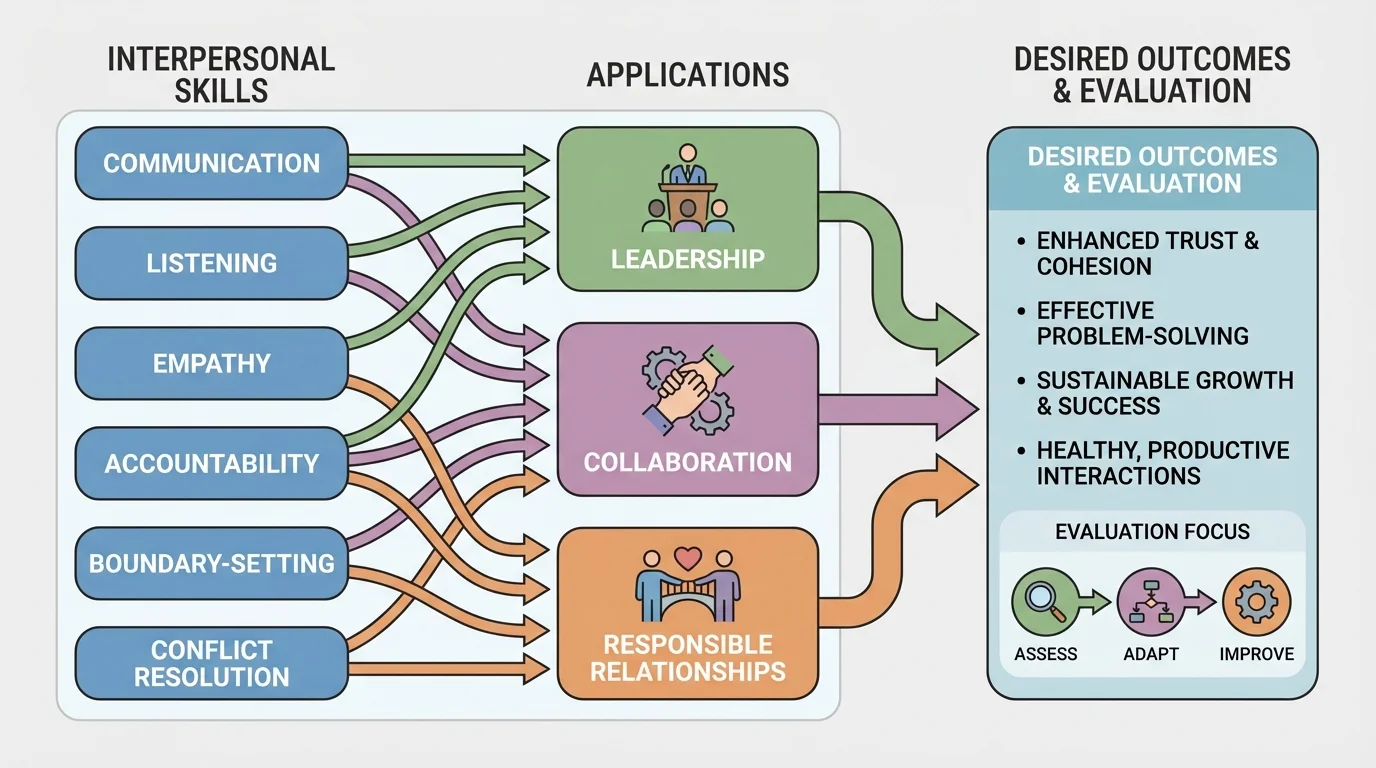
Communication is not just talking more. It means being clear, respectful, and direct enough that people know what you mean. Strong communicators say what is needed without attacking, hinting, or creating confusion. They also choose the right format. Some situations can be handled by text. Others need a call because tone matters.
Accountability means owning your actions and their impact. If you miss a deadline, hurt someone's feelings, or forget a commitment, accountability sounds like: "I didn't follow through. That affected you. Here is how I'm fixing it." It does not sound like: "Well, I was busy, and everyone makes mistakes, so it's not a big deal."
Boundary-setting is the ability to state what is and is not okay for you. This includes time, privacy, tone, touch, emotional pressure, and digital access. Healthy boundaries protect relationships because they make expectations clear. Without boundaries, resentment and confusion grow.
Conflict resolution is how you handle disagreement without making the problem worse. The goal is not to "win" every argument. The goal is to understand the issue, communicate clearly, and move toward a fair solution when possible.
A useful way to evaluate any interpersonal skill is to ask three questions: Does this behavior build trust? Does it show respect? Does it help solve the problem? If the answer is no, the skill needs work, even if the person feels justified.
As you continue through the lesson, keep comparing behaviors, not personalities. Saying "I'm just an awkward person" or "that's just how I am" can block growth. Interpersonal skills are learned behaviors. That means they can be practiced and improved.
Leadership is not the same as control. A leader influences direction, tone, and standards. You can lead as the oldest sibling, a captain of a sports team, a volunteer organizer, the person managing a shared online project, or simply the one who takes initiative when others feel stuck.
A strong leader communicates clearly. They make expectations visible: who is doing what, by when, and how updates will be shared. They do not assume everyone "just knows." They reduce confusion before confusion becomes conflict.
Strong leaders also stay calm under pressure. This does not mean they never feel frustrated. It means they do not let their frustration spill out in ways that shut other people down. They know that panic, sarcasm, and blame spread quickly.
Another leadership skill is giving feedback well. Useful feedback is specific, respectful, and focused on behavior. "Your message was hard to follow; can you break it into bullet points?" is useful. "You're terrible at explaining things" is insulting and unhelpful. One improves performance. The other damages trust.
Leadership also requires inclusion. If one person always talks and another never gets heard, the group loses information and motivation. A strong leader notices who is quiet, invites input, and avoids treating confidence as the same thing as competence.
Case study: leading a small online fundraiser
Step 1: Set clear roles
You assign one person to create graphics, one to track donations, and one to write updates. You post deadlines in one shared document so nothing is hidden in scattered messages.
Step 2: Check in early
Instead of waiting until the last minute, you ask for quick updates halfway through. This catches problems while there is still time to fix them.
Step 3: Respond to mistakes without blame
When a post goes up with the wrong date, you correct it, explain the fix, and adjust the plan. You do not embarrass the person in the group chat.
Step 4: Give credit
After the event, you thank people specifically for what they contributed. This strengthens motivation and trust.
This is leadership through communication, accountability, and respect.
One simple way to evaluate leadership is this: after interacting with a leader, do others feel clearer, calmer, and more capable? If yes, that leader is probably using strong interpersonal skills.
Collaboration is where your habits become visible fast. In a shared project, people notice whether you respond, whether you pull your weight, and whether you make work easier or harder. The process for handling team friction in a healthy way, as shown in [Figure 2], starts with clarification before accusation.
Good collaborators communicate early. If you are confused, ask. If you are delayed, say so before the deadline. If you disagree, explain your reasoning instead of withdrawing or becoming rude. Silence creates more problems than honest updates.
Reliability is one of the most important teamwork skills. People do not need perfection. They need consistency. A teammate who says, "I can finish half of this by tonight" and actually does it is more valuable than someone who promises a lot and delivers little.
Collaboration also involves flexibility. Sometimes your idea is not chosen. Sometimes you need to adjust to another person's schedule, skill level, or communication style. Maturity means adapting without taking every change personally.
Suppose you are working with two others on a community event flyer. You expected one person to write the text, but they thought they were only doing images. If you say, "You never do anything right," the conflict gets worse. If you say, "I think we understood the roles differently. Let's clarify who owns each part and reset the timeline," you move toward a solution.
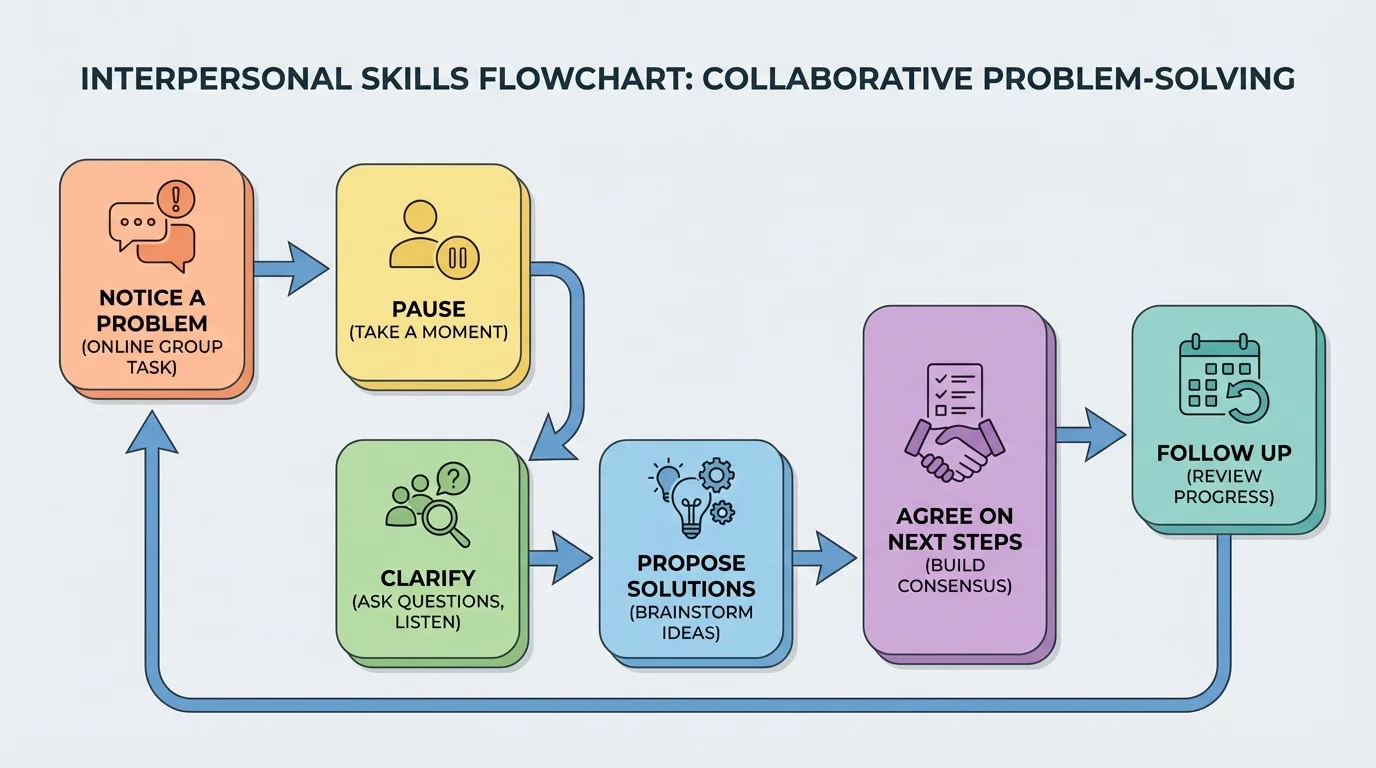
A useful collaboration habit is to separate intent from impact. Someone may not have meant to ignore your message, but the impact still matters if work stalled. Strong collaborators can say both: "I know you may not have meant to leave me hanging, but I needed an update sooner." That is direct without being unnecessarily hostile.
Healthy problem-solving usually follows a pattern: pause, describe the issue, ask for perspective, propose next steps, and confirm the plan. This works in school-related tasks, jobs, volunteer roles, and creative projects.
Try This: Before sending a frustrated message, use the "read it tomorrow" test. Draft the message, wait if possible, then reread it asking: Is it clear? Is it respectful? Does it focus on solving the problem? If not, revise it.
Responsible relationships are built on honesty, respect, safety, and choice. Whether the relationship is a friendship, dating relationships, family connection, or community connection, the basic question is the same: do both people treat each other with care and responsibility? The communication pattern in [Figure 3] shows what respectful boundary-setting looks like in everyday digital communication.
A responsible relationship includes clear communication. You should not have to guess constantly what is okay, what someone means, or whether your limits will be respected. Healthy communication is not perfect, but it is direct enough to reduce confusion.
Respect is not only about being "nice." Respect means taking another person's feelings, time, privacy, and autonomy seriously. It means not pressuring, mocking, manipulating, or using guilt to get your way.
Consent matters in responsible relationships. Consent means a clear, voluntary, informed yes. It applies to physical affection, sharing private information, posting pictures, emotional pressure, and digital access. Silence, pressure, or guilt are not consent.
Boundaries might sound like: "I'm not comfortable sharing my password," "I need you to stop joking about that," "I can talk later, but not right now," or "I'm not ready for that." A healthy response is not punishment or pressure. A healthy response is respect.
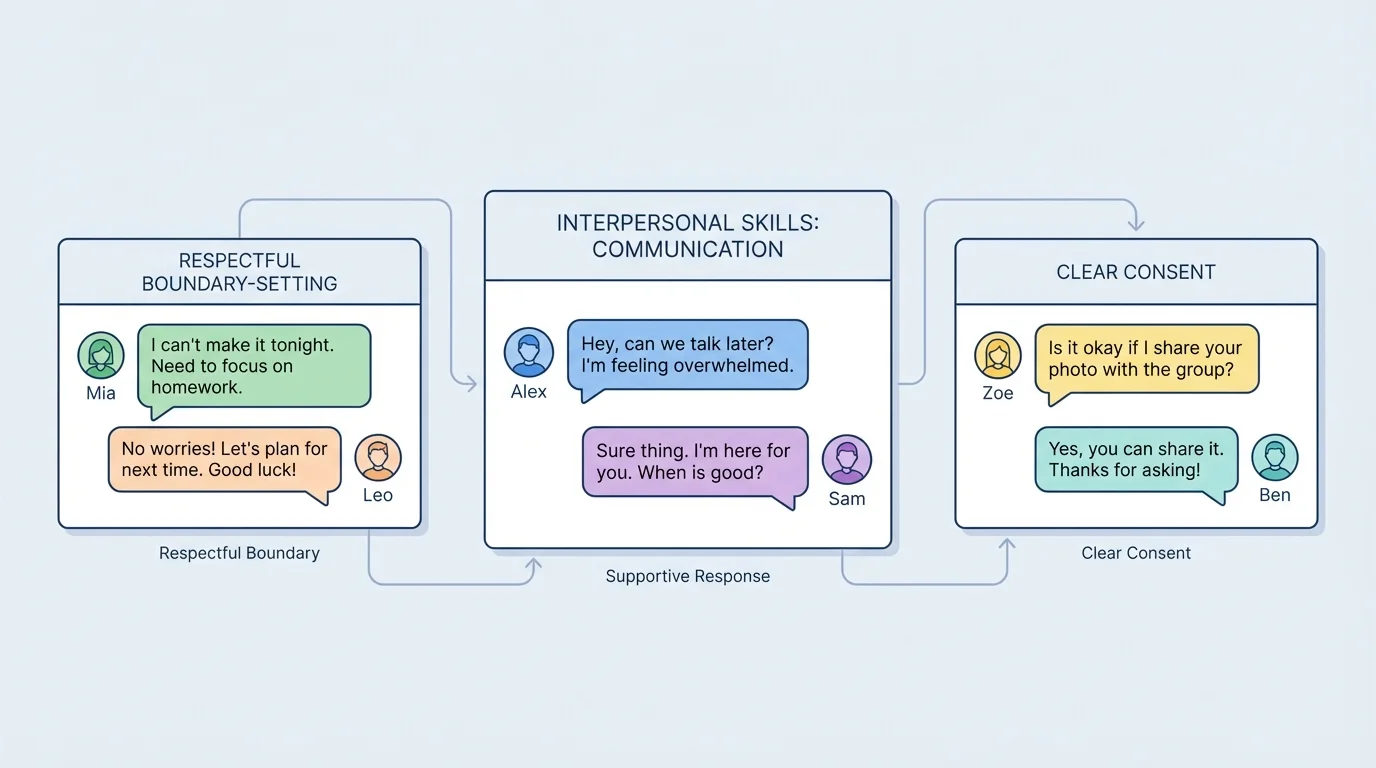
Notice how the example presents boundaries as clear and calm rather than aggressive. Many people avoid setting limits because they think it is rude. In reality, unclear limits often create more hurt than honest ones do.
Responsible relationships also require trustworthiness. If someone tells you something private, spreads a concern, or depends on you emotionally, that is not permission to share their business casually. Trust is easy to damage and hard to rebuild.
"Clear is kind. Unclear is unkind."
— Common communication principle
It is also important to recognize warning signs. Red flags include constant disrespect, controlling behavior, guilt-tripping, ignoring boundaries, explosive anger, lying, and making you feel responsible for managing another person's emotions all the time. A relationship does not have to be physically unsafe to be unhealthy.
Try This: Practice one sentence you can use when you need a boundary: "I care about this relationship, and I need us to speak respectfully," or "I'm not okay with that. If it continues, I'm ending this conversation." Scripts help when emotions are high.
Evaluating interpersonal skills is not about labeling yourself as "good with people" or "bad at relationships." It is about noticing patterns. A single awkward moment does not define you. Repeated habits do.
Ask yourself questions like these: Do people often seem confused after I explain something? Do I interrupt? Do I get defensive when I hear criticism? Do I follow through on what I promise? Can I apologize without making excuses? Do people feel safe being honest with me?
People usually judge trustworthiness less by grand statements and more by repeated small behaviors, such as answering honestly, respecting privacy, and doing what they said they would do.
You can also evaluate yourself by looking at outcomes. If the same kind of conflict keeps happening with different people, there may be a skill issue worth examining. For example, if several people say you are hard to reach, that may point to communication or reliability problems. If people hesitate to tell you the truth, that may point to defensiveness.
Feedback matters too. You do not need to believe every opinion someone has about you, but patterns in feedback are worth noticing. If a parent, coach, supervisor, friend, or mentor gives similar advice more than once, pause and consider it seriously.
| Skill | Strong signs | Weak signs |
|---|---|---|
| Listening | Asks questions, reflects back key points | Interrupts, assumes, misses details |
| Communication | Clear, respectful, timely | Vague, harsh, avoids needed conversations |
| Accountability | Owns mistakes and repairs them | Blames, excuses, minimizes impact |
| Boundary-setting | States limits calmly and clearly | People-pleases, explodes later, stays unclear |
| Conflict resolution | Seeks understanding and solutions | Escalates, withdraws, tries to win at all costs |
Table 1. Signs of strong and weak interpersonal skills across common situations.
Self-awareness is not about criticizing yourself constantly. It is about being accurate. If you know your strengths and your growth areas, you can improve faster and make better choices about how you interact with others.
Improving people skills works best when you focus on small repeatable habits. You do not need a whole new personality. You need better choices in key moments.
Step 1: Slow down before responding. Many communication problems happen because people react too fast. Pause long enough to ask yourself what outcome you want.
Step 2: Use direct language. Replace vague hints with clear statements. Instead of "Whatever, it's fine," say, "I was frustrated because I needed an answer sooner."
Step 3: Listen for the real issue. Sometimes the argument is not about the surface topic. It may be about feeling ignored, disrespected, or overloaded.
Step 4: Take responsibility early. A quick honest apology can prevent a small problem from growing. A strong apology includes three parts: what you did, the impact, and the repair. Example: "I ignored your message all day. That left you stuck. Next time I'll send a quick update even if I can't answer fully."
Repair script after a mistake
Step 1: Name the behavior
"I interrupted you several times on the call."
Step 2: Name the impact
"That probably made you feel dismissed."
Step 3: State the repair
"I'm sorry. I'm going to let you finish and then respond."
This kind of apology is more effective than "Sorry if you were offended," which avoids responsibility.
Step 5: Practice boundaries before you need them. If you already know your values and limits, it is easier to speak clearly under pressure.
Step 6: Match your actions to your words. Trust grows when your behavior is consistent. If you say honesty matters, tell the truth. If you say you care, show up.
Try This: Pick one habit for the next seven days: respond to important messages within a reasonable time, stop interrupting, ask one follow-up question in each serious conversation, or own one mistake without excuses.
Everyone makes mistakes in relationships. The real question is what happens next. Poor interpersonal habits become dangerous when they are repeated, defended, or used to control other people.
Watch for red flags in yourself and others: sarcasm used as a weapon, silent treatment, constant defensiveness, bringing up private information to win arguments, blaming others for your emotions, or refusing to respect limits. These behaviors damage trust fast.
If you notice one of these habits in yourself, start with honesty. Name it clearly. Ask what triggers it. Then replace it with a healthier action. For example, instead of sending three angry messages, ask for a break and return later. Instead of gossiping, address the issue directly with the person involved.
If another person repeatedly ignores your boundaries or manipulates you, stronger action may be necessary. That could mean limiting contact, ending the conversation, getting support from a trusted adult, or leaving the relationship. Responsible relationships require mutual respect, not one person doing all the emotional work.
The goal of evaluating interpersonal skills is not perfection. It is responsibility. Strong interpersonal skills help you lead without controlling, collaborate without chaos, and build relationships that are respectful, trustworthy, and safe.
