A lot of relationships do not fall apart because one problem was too big. They fall apart because small problems were left unaddressed, denied, joked away, screenshotted, or turned into silent resentment. Knowing how to handle a difficult conversation is not just a "nice" social skill. It affects friendships, family trust, jobs, dating, teamwork, and your reputation. If you can speak honestly without attacking, listen without collapsing, and repair after mistakes, you gain a skill many adults still struggle to build.
A difficult conversation is any conversation where the stakes feel personal, the emotions are strong, or the outcome matters to you. That might be telling a friend they crossed a line, admitting you let someone down, responding to criticism, setting a boundary with a family member, or dealing with tension in a volunteer team, sports club, part-time job, or online community.
When people avoid these conversations, the problem usually does not disappear. It often grows. A missed reply turns into "You do not care." A rude comment in a group chat becomes a week of tension. A broken promise damages trust. On the other hand, when communication is handled well, people feel safer, conflicts become more specific and solvable, and trust can actually become stronger after repair.
Repair is the process of addressing harm, rebuilding trust, and improving the relationship after conflict or a mistake.
Accountability means owning your actions, acknowledging their impact, and taking steps to make things right instead of hiding, blaming, or minimizing.
Intent vs. impact means that what you meant to do and how your actions affected someone can be different. Good communication pays attention to both.
One reason hard conversations go badly is that people often enter them with hidden goals. You may say you want to "talk," but secretly you want to win, punish, prove a point, or force the other person to admit you were right. That mindset changes your tone before the conversation even starts.
Most difficult conversations include three layers at once: the facts, the feelings, and the meaning. The facts are what happened. The feelings are the emotions attached to it. The meaning is the story each person tells themselves about what happened. For example, one friend thinks, "You ignored me on purpose," while the other thinks, "I was overwhelmed and did not know how to answer." If you only argue about facts, you may miss the part that actually hurts.
Another key skill is emotional regulation. That means managing your emotions well enough to communicate clearly. Emotional regulation does not mean pretending you are not upset. It means noticing your state and choosing your actions instead of letting the emotion run the conversation.
If your heart is racing, your hands are tense, or you are drafting angry messages you know you will regret, that is information. It usually means you need to pause before speaking. A pause is not avoidance if you use it to prepare.
"Honesty without care feels harsh. Care without honesty feels fake. Real communication needs both."
That balance matters because people often lean too far one way. Some are so direct that they become hurtful. Others are so afraid of conflict that they become vague, passive, or dishonest. The goal is not to be perfectly calm or perfectly kind. The goal is to be clear, respectful, and responsible.
Before a hard conversation, use a simple preparation process, as [Figure 1] shows. Preparation lowers the chance that you will ramble, overreact, or say something true in the least effective way. You do not need a script for every sentence, but you do need a plan.
Step 1: Decide your real goal. Ask yourself, "What do I want by the end of this conversation?" Good goals sound like: "I want to clear up a misunderstanding," "I want to set a boundary," or "I want to take responsibility and repair trust." Weak goals sound like: "I want them to feel bad," or "I want to prove they are the problem."
Step 2: Separate observation from interpretation. An observation is what a camera could record: "You left the call suddenly and did not reply for two days." An interpretation is the story added on top: "You were trying to embarrass me." Start with observations, not assumptions.
Step 3: Check your emotional state. If you are at a very high level of anger, panic, or shame, give yourself time. Drink water, walk, breathe slowly, write down your key points, or wait until you can say what matters without exploding. A useful self-check is: "Can I state the issue in two calm sentences?" If not, wait.
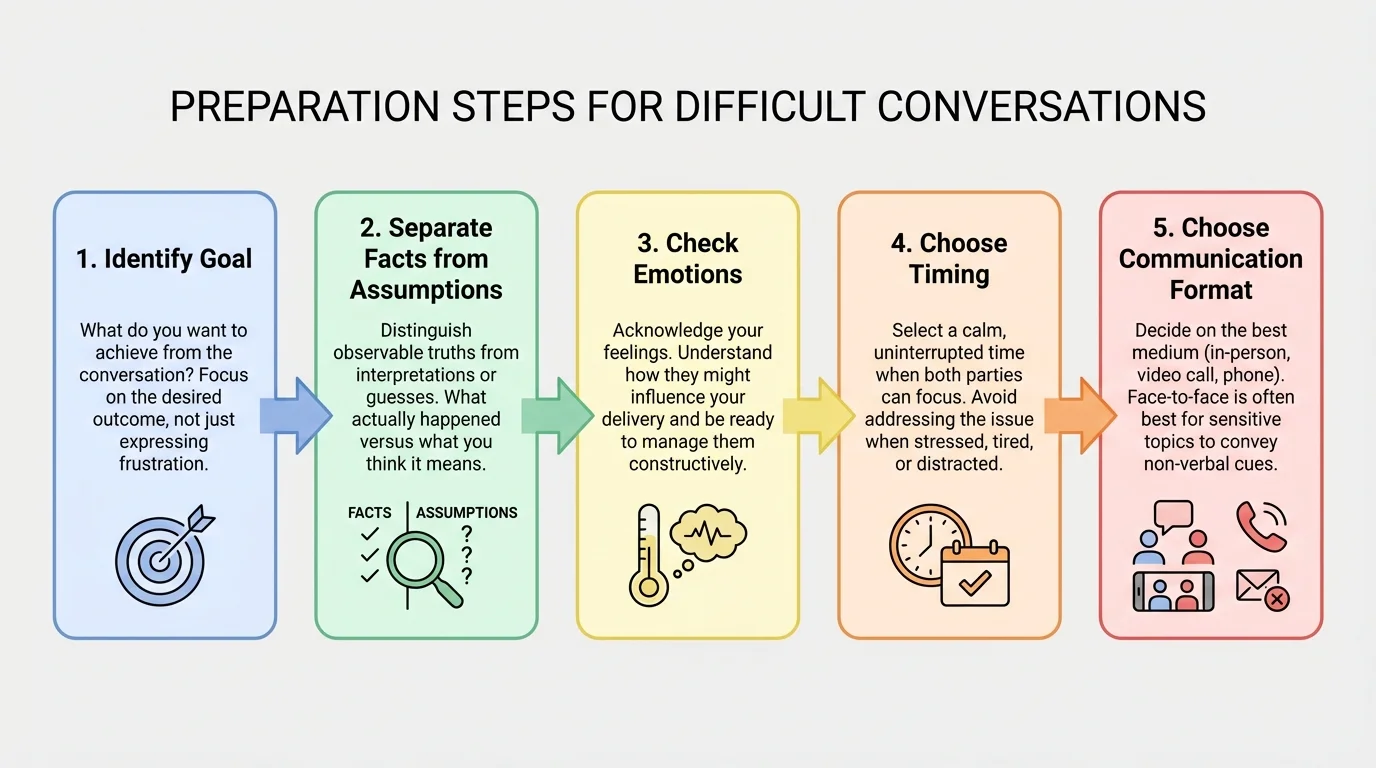
Step 4: Choose the right timing and format. Some conversations should not happen by text. If the issue is emotionally charged, likely to be misunderstood, or important to the relationship, a call or video conversation is often better. Text works best for simple clarifications, brief check-ins, or setting up a time to talk.
Step 5: Plan your opener. The first few lines matter. They set the tone. A strong opener is calm, specific, and respectful. For example: "I want to talk about something that has been bothering me, and I'm not trying to start a fight. I want us to understand each other better."
Later, when you need to decide whether to text, call, or wait, the logic in [Figure 1] still applies: goal first, then facts, then emotion, then timing.
Preparation example: conflict with a friend
Your friend posted a joke online that seemed to target you, and several people reacted to it.
Step 1: Define the goal
Your goal is not "win." Your goal is: "Tell them the post hurt me and find out whether it was intentional."
Step 2: Separate facts from story
Fact: they posted it after your disagreement. Story: "They wanted everyone to laugh at me."
Step 3: Choose the format
Because public posts create tone problems and embarrassment, you move the conversation to a private message and ask for a call.
Step 4: Draft the opener
"Can we talk privately? That post seemed connected to what happened, and it bothered me. I want to clear it up directly instead of guessing."
Notice that this approach avoids a public fight, avoids mind-reading, and still addresses the issue directly.
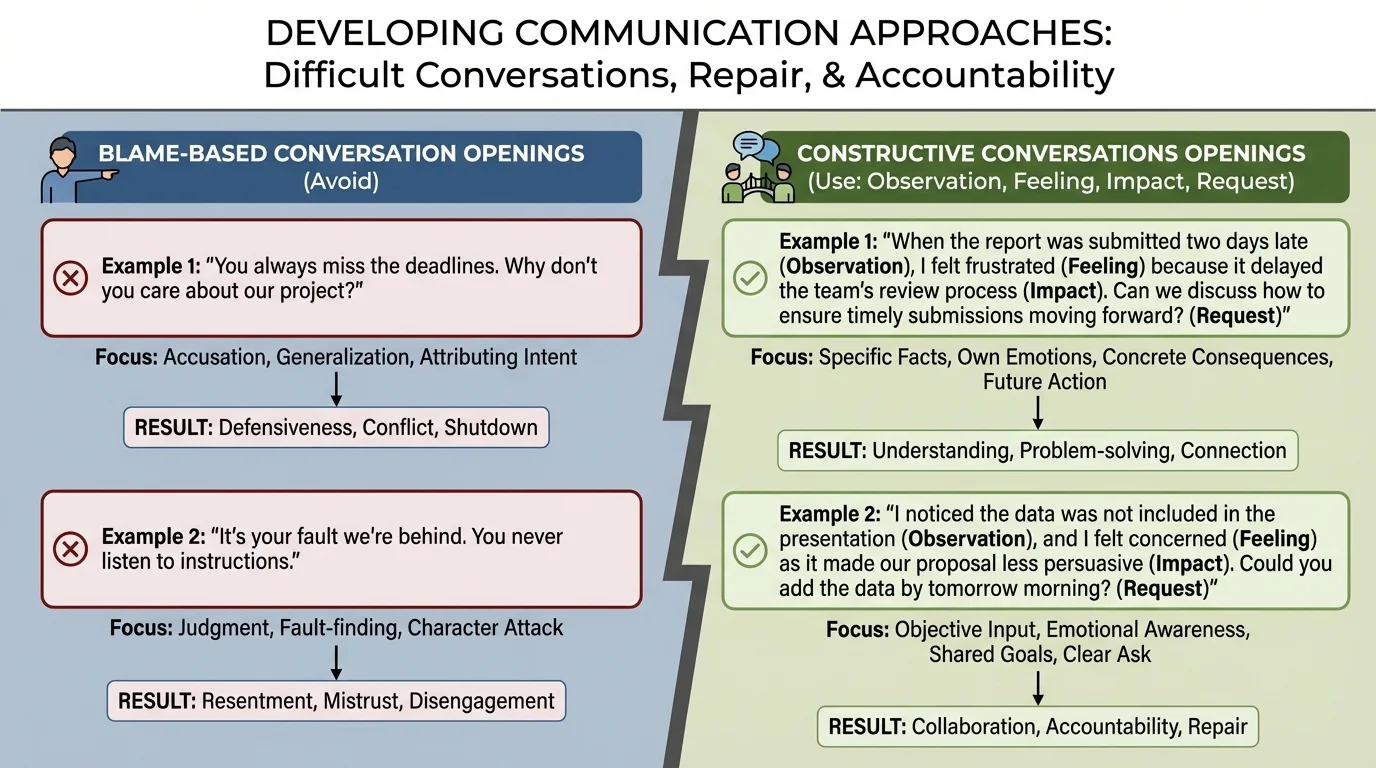
The words you use at the beginning can either lower or raise defensiveness, as [Figure 2] makes clear. You do not need therapeutic language, but you do need structure. A useful pattern is: observation, feeling, impact, request.
It sounds like this: "When you interrupted me three times during the call, I felt dismissed. It made it hard for me to finish what I was saying. Next time, can you let me finish before responding?" This works because it is specific and actionable. It points to a behavior, not the person's entire character.
This is usually stronger than saying, "You are so disrespectful," or "You always make everything about you." Words like always and never may feel satisfying, but they often make people defend themselves instead of listening.
Using I-statements can help, but they must be genuine. "I feel like you are selfish" is not really an I-statement. It is a disguised accusation. A better version is: "I felt frustrated when my message was shared without asking me."
You can also be direct without sounding cold. Try openings like these:
If the other person reacts strongly, do not rush to fill the silence or immediately defend every detail. Let the conversation breathe. Starting well does not guarantee agreement, but it makes productive discussion much more likely. In the friend example above, the difference between accusation and clarity looks exactly like the contrast shown in [Figure 2].
Short pauses often make hard conversations better. A few seconds of silence can feel uncomfortable, but it gives both people time to process instead of reacting instantly.
One more useful tool is naming your purpose out loud. Saying "I'm not trying to attack you; I'm trying to solve this" can reduce confusion. It does not fix everything, but it tells the other person what kind of conversation you are trying to have.
Difficult conversations are not only about saying your piece. They are also about hearing what the other person means, not just what your stress response hears. That requires active listening, which means paying attention, checking understanding, and showing that you are following the message.
Active listening can sound like this: "So you felt left out when I made that decision without asking you. Is that right?" or "I hear that you were not trying to insult me, but you understand why it landed that way." Notice that this does not mean agreement. It means accurate understanding.
Validation is another powerful skill. Validation means acknowledging that the other person's feelings make sense from their point of view. It does not mean saying they are correct about everything. For example: "I can see why that upset you," or "It makes sense that you felt embarrassed."
When emotions rise, ask clarifying questions instead of launching into counterarguments. Good questions include: "What part bothered you most?" "What did you need from me in that moment?" and "What would have helped?" These questions move the conversation toward understanding and solutions.
De-escalation matters too. Keep your tone steady. Speak a little more slowly. Stay specific. If the conversation becomes circular, say, "I want to keep talking, but I think we are getting more reactive. Can we take ten minutes and come back?" That is a reset, not a retreat.
Listening for the need underneath the words
People often argue about surface behavior when the deeper issue is respect, trust, inclusion, privacy, or reliability. If you listen only for the complaint, you may miss the real issue. If you listen for the underlying need, your response becomes more useful.
For example, "Why did you not answer me?" may really mean "I felt unimportant." "Why did you tell other people?" may really mean "I needed privacy." Once you hear the need underneath, your response can address the actual problem.
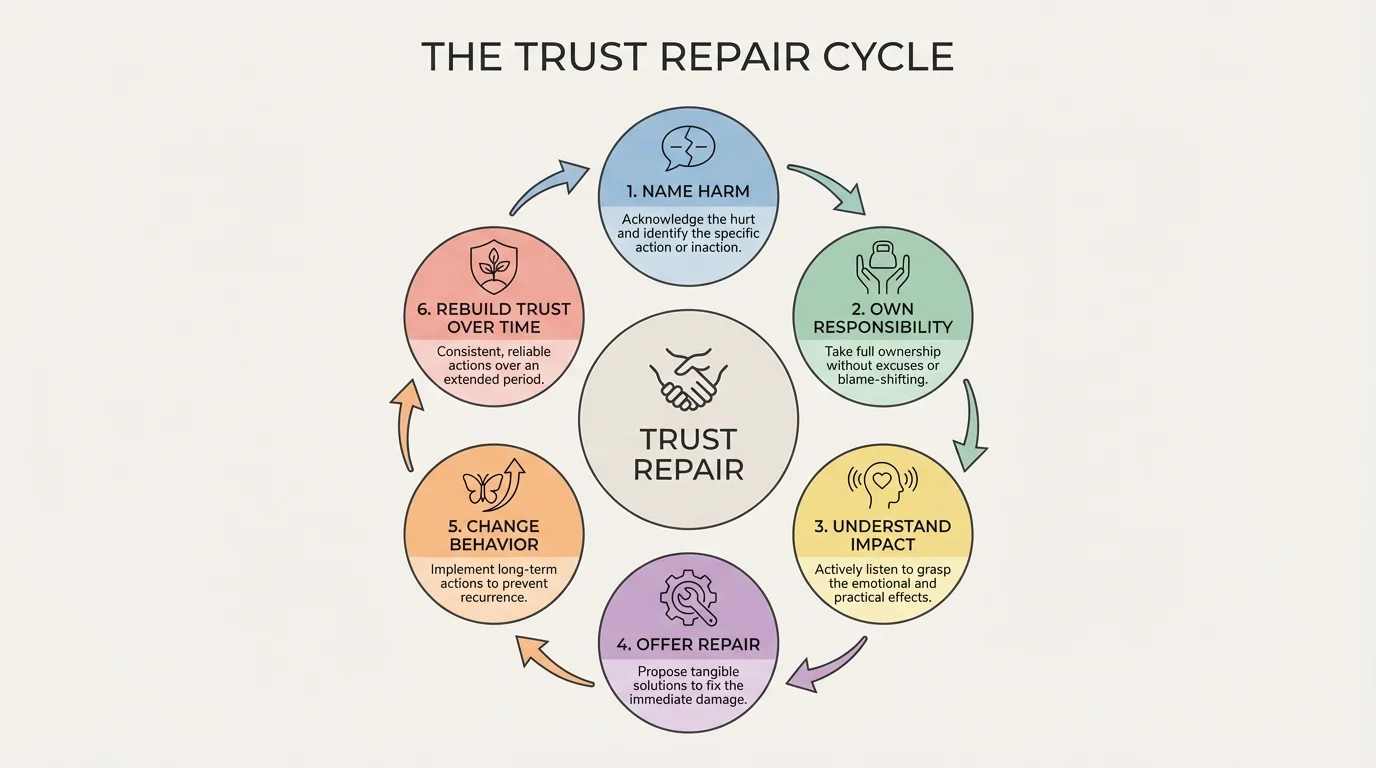
Conflict does not always end with agreement. Sometimes you realize you caused harm. That is where repair matters. Repair is not one apology sentence and then everything returns to normal. It is a process, as [Figure 3] illustrates, of naming what happened, owning your part, responding to the impact, and showing change over time.
An effective apology has several parts. First, name the behavior clearly. Second, acknowledge the impact. Third, take responsibility without excuses. Fourth, offer to repair what you can. Fifth, change the behavior. Without changed behavior, the apology loses value.
Compare these two apologies. Weak apology: "I'm sorry if you were offended." That shifts the problem onto the other person's reaction. Strong apology: "I shared your message without permission. That broke your trust and put you in an unfair position. I should not have done that. I'm sorry. I've deleted it everywhere I can, and I won't share private messages again."
Sometimes repair also includes asking, "What would help now?" The answer may be practical. Maybe the other person wants a correction posted, a replacement for something damaged, space for a few days, or a commitment about future behavior. Repair becomes meaningful when it addresses real impact.
Trust usually returns slowly. That is normal. You are not entitled to instant forgiveness simply because you apologized. The trust-building part of [Figure 3] often takes longer than the apology itself, and it depends on consistency.
Repair example: breaking a commitment
You promised to help with an event for a community group, overslept, and did not warn anyone.
Step 1: Name the action clearly
"I said I would be there at nine, and I was not."
Step 2: Acknowledge impact
"That put extra pressure on everyone else and made the setup harder."
Step 3: Take responsibility
"I should have set better alarms and contacted someone as soon as I realized. That is on me."
Step 4: Offer repair
"I can stay late today, and for future events I'll confirm the night before and have a backup alarm."
This kind of apology is respectful because it is specific, accountable, and action-based.
Accountability is not the same thing as humiliating yourself. Shame says, "I am a terrible person." Accountability says, "I made a harmful choice, and I need to address it." Shame often leads to defensiveness, hiding, or self-pity. Accountability leads to repair and growth.
When someone gives you criticism, try not to answer with instant self-protection. Instead, pause and ask: "What part of this is true?" That question can be uncomfortable, but it is useful. Even if you disagree with some details, there may still be a part you need to own.
Accountability also includes understanding boundaries. A boundary is a limit that protects safety, respect, time, energy, or privacy. If someone tells you a boundary, accountability means taking it seriously. If you need to set a boundary, do it clearly: "I'm willing to talk about this, but not if I'm being insulted," or "Do not post about me without asking."
Consequences are part of accountability too. Sometimes the consequence is emotional distance. Sometimes it is losing a role, a privilege, or trust for a while. Consequences are not always punishment; often they are the natural result of broken trust. Accepting that reality is part of acting maturely.
| Response style | What it sounds like | Likely result |
|---|---|---|
| Defensiveness | "That is not what I meant, so it should not matter." | The other person feels dismissed. |
| Minimizing | "You are overreacting. It was not a big deal." | The conflict usually gets worse. |
| Accountability | "I see how that affected you, and I need to fix my part." | Repair becomes possible. |
| Boundary-setting | "I will discuss this, but I will not stay in a conversation that becomes abusive." | Safety and respect are protected. |
Table 1. Comparison of common responses in difficult conversations and their likely effects.
A practical test for accountability is simple: if your explanation takes longer than your ownership, you may be explaining too much and owning too little.
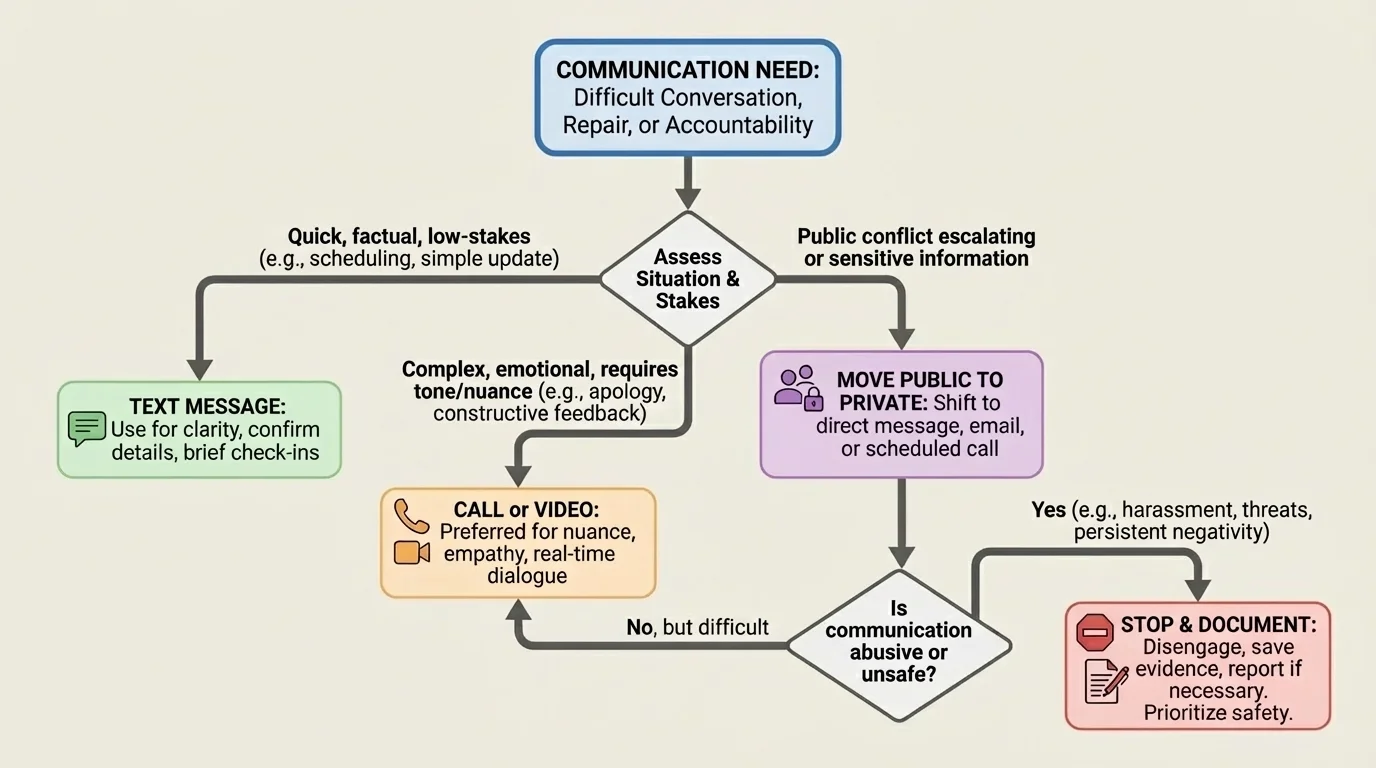
Online communication adds extra risk because tone is easier to misread and messages can spread fast. The platform matters, as [Figure 4] shows. A short text can sound cold. A delayed reply can feel intentional. A public comment can turn a private issue into a performance.
Use text for low-intensity issues, logistics, or asking to talk. Use voice or video for sensitive issues, repeated misunderstandings, apologies, and emotionally loaded conflict. If something is already becoming messy in a group chat, move it private if possible. Public conflict often invites spectators instead of solutions.
Before sending a difficult message, read it once for content and once for tone. Ask yourself: "If I received this message while stressed, how would it sound?" Remove sarcasm unless you are absolutely sure it will be understood. In conflict, sarcasm usually makes things worse.
Also remember that screenshots are real. If you would not want a message seen by others, do not send it impulsively. This is not about paranoia; it is about digital maturity.
If an online interaction becomes threatening, manipulative, or harassing, the goal changes. You are no longer trying to "communicate better" with someone who is violating basic respect. At that point, the path in [Figure 4] that involves ending contact, documenting messages, blocking, and getting support may be the healthiest option.
Not every conflict needs endless discussion. Productive communication requires at least some willingness from both people to be honest, respectful, and responsive.
A good digital habit is to avoid serious conflict when you are tired, late at night, or already upset from something else. The medium is less forgiving when your judgment is off.
Here are some useful sentence starters you can adapt to real situations:
Scenario 1: Friend conflict. A friend repeatedly cancels plans at the last minute. Instead of saying, "You obviously do not care about me," try: "When plans get canceled right before we're supposed to meet, I feel brushed off. If you are unsure, I'd rather know earlier."
Scenario 2: Family tension. A family member reads your messages over your shoulder during a video call. You can say: "I need more privacy with my conversations. Please do not read my screen without asking." That is a clear boundary, not disrespect.
Scenario 3: Work or volunteer issue. A co-worker or teammate keeps assigning you tasks they agreed to do. Try: "I've noticed I'm picking up tasks we said you would handle. I need us to stick to the plan or talk about changing it directly."
Scenario 4: You made the mistake. You posted something rude when angry. A responsible response is: "I posted that while upset, and it was unfair. I deleted it, but I know that does not erase the impact. I'm sorry. I'm going to step back before posting when I'm angry from now on."
Quick reset tool for a heated moment
Step 1: Stop the spiral
Say, "I want to answer carefully, not react fast."
Step 2: Name one specific issue
Choose the main problem instead of bringing in every past frustration.
Step 3: Ask one clarifying question
"What part felt most disrespectful to you?"
Step 4: Make one request or one repair offer
"Next time, please ask before sharing," or "I can correct that now."
This tool is simple, but it prevents many conversations from turning into a pile of unrelated complaints.
Good communication is powerful, but it is not magic. Some situations are unsafe or unhealthy. If someone threatens you, mocks your boundaries, twists your words on purpose, repeatedly lies, or uses private conversations to control you, the answer may not be "communicate better." The answer may be to step back, document what happened, tell a trusted adult or supervisor, and protect yourself.
This is especially true with harassment, pressure for private photos or information, stalking behavior, repeated public humiliation, or pressure to keep harmful secrets. In those situations, safety matters more than perfect wording.
You are also allowed to end a conversation that is going nowhere. You can say, "I do not think this is productive right now," or "I'm willing to continue when we can both speak respectfully." Ending a damaging conversation is sometimes the most responsible choice.
Communication is a skill, not a personality trait. You do not have to be naturally calm, extroverted, or confident to improve. You build it by practicing before the stakes are highest.
Try This: Before your next difficult conversation, write three short notes: what happened, how it affected you, and what you want next. Keep each one to one sentence. That forces clarity.
Try This: When someone gives you feedback, wait two breaths before responding. That tiny pause can protect you from immediate defensiveness.
Try This: After a conflict, ask yourself two questions: "What did I handle well?" and "What will I do differently next time?" Reflection turns experience into skill.
Try This: Practice one strong sentence for boundaries: "I'm not available for disrespect," "Please ask before sharing my information," or "Let's move this off text and talk directly."
The goal is not to become perfect at conflict. The goal is to become someone who can face tension with honesty, steadiness, and responsibility. That changes how other people experience you, and it changes how much trust you can build and keep.
