Some of the biggest mistakes people make are not usually caused by a lack of intelligence. They happen because someone focused on what felt good right now and ignored what the choice would cost later. A decision can look exciting, convenient, or harmless in the moment, then create stress, conflict, wasted time, lost money, or damaged trust a week later. That is why learning how to evaluate complex choices matters so much.
At your age, choices are starting to carry more weight. You may be deciding whether to take a part-time job, how to manage your time, whether to keep a promise, what to post online, whether to lend someone money, or how to respond when two responsibilities collide. These are not just "good or bad" choices. They are often tradeoffs, where every option gives you something and costs you something.
A simple choice has low stakes and few effects. Choosing between two snacks is usually simple. A complex choice affects several parts of your life at once. It may involve your goals, your finances, your schedule, your relationships, your safety, or your reputation. It may also affect other people, not just you.
Complex choices feel hard because you are balancing more than one question at the same time: What do I want? What can I afford? What could go wrong? Who will be affected? What am I giving up? What do I owe other people? The better your decisions become, the more often you will slow down and ask these questions before acting.
Consequences are the results that follow a choice. They can be positive or negative, immediate or delayed.
Opportunity cost is the value of the best alternative you did not choose.
Responsibilities are duties, commitments, and obligations you are expected to meet for yourself and others.
One useful way to think about decision-making is this: a smart choice is not always the one that feels best first. It is often the one that still looks solid after you examine what happens next, what it prevents you from doing, and what obligations it affects.
A choice becomes more complex when it has multiple possible outcomes, when the results are uncertain, or when different values compete. For example, taking on extra work hours might help you earn money, but it might also cut into sleep, coursework, and time with family. Saying yes to one thing can quietly mean saying no to three other things.
When you evaluate a choice well, you look at three major areas. First, you compare consequences. Second, you identify the opportunity cost. Third, you check your responsibilities. If you skip any one of these, your decision can become lopsided.
It also helps to think about stakeholders, meaning the people affected by the choice. In your life, stakeholders may include you, your family, an employer, a teammate, a younger sibling, a friend, or people who trust your online behavior. A decision that looks fine from only your point of view may look very different when you consider everyone involved.
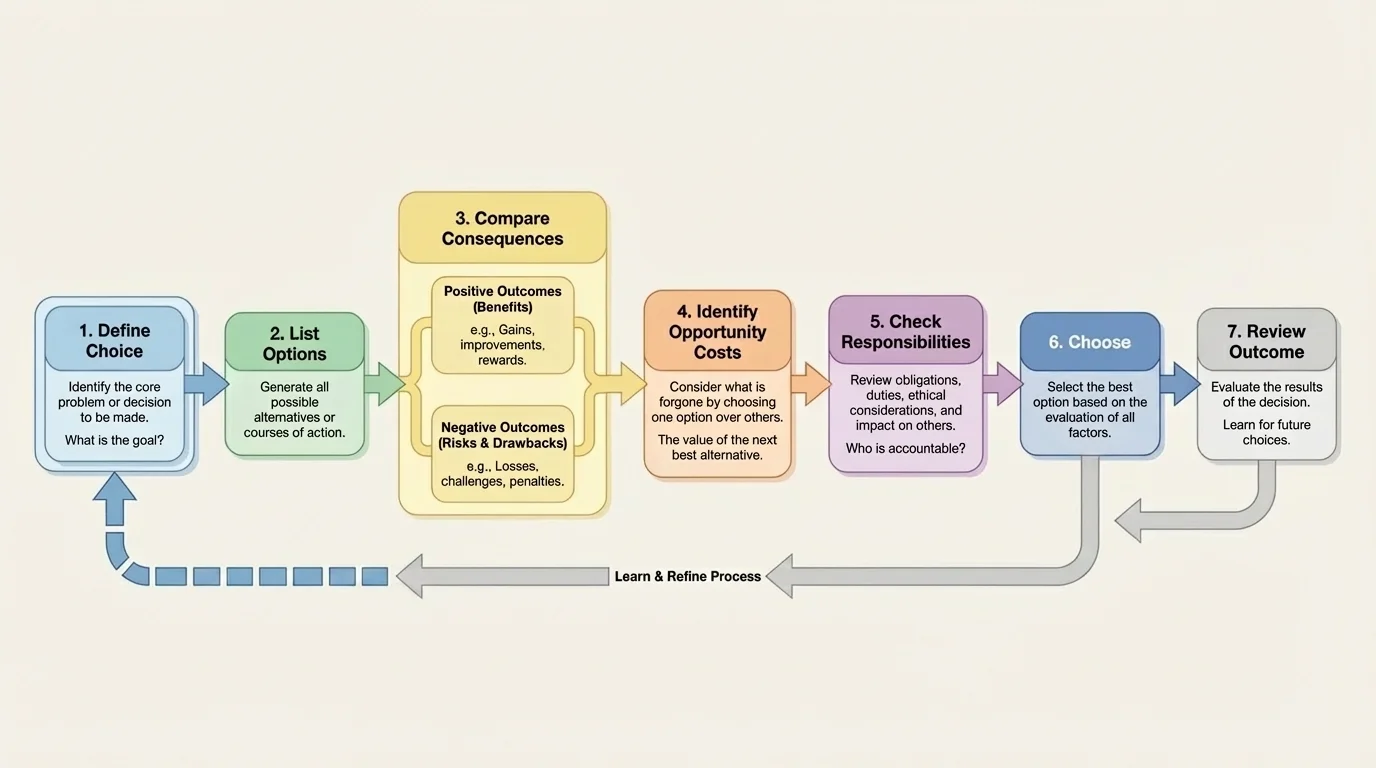
When a choice matters, use a simple process instead of relying only on mood. The sequence in [Figure 1] shows a practical way to move from reaction to reasoning. You do not need to overcomplicate every small decision, but for choices with real impact, a structure helps.
Step 1: Define the choice clearly. State the real decision in one sentence. "Should I accept a weekend job that pays well but conflicts with family responsibilities and study time?" is clearer than "I do not know what to do."
Step 2: List realistic options. Include more than two if possible. Sometimes the best option is not yes or no, but a modified version such as fewer work hours, a later start date, or setting conditions.
Step 3: Predict likely consequences. Ask what happens today, this week, next month, and later in the year.
Step 4: Identify what each option costs you in missed alternatives. This is where many people overlook opportunity cost.
Step 5: Check responsibilities. Ask what promises, duties, rules, and values are involved.
Step 6: Choose and make a follow-through plan. Good decisions still need action.
Step 7: Review the result. This helps you improve your future decisions.
If this seems slow, remember that slowing down for ten minutes can prevent weeks of stress. Many poor decisions happen because a person mistakes speed for confidence. Careful thinking is not weakness. It is self-control.
Good decision-making is comparison, not guessing. You do not need perfect certainty before choosing. What you need is a reasonable comparison of likely outcomes. The goal is not to predict the future exactly. The goal is to make a choice that makes sense based on the information you have right now.
A strong decision process also protects you from pressure. If someone says, "Just decide now," your internal response can be, "I need a few minutes to think through the consequences." That sentence alone can save you from impulsive choices.
Consequences are not just punishments. They are all results, including helpful ones. For each option, look at both positive and negative outcomes. Then separate short-term effects from long-term effects.
For example, suppose you are thinking about staying up until 2 a.m. to finish a streaming series even though you have work and school tasks the next day. The short-term consequence is obvious: entertainment and relaxation. The short-term negative consequence is less sleep. The long-term consequences might include weaker focus, worse mood, lower performance, and a pattern of poor sleep that affects health.
A useful checklist for consequences includes these areas:
Sometimes consequences are direct. If you spend $85 on impulse purchases, you have $85 less for something important. Sometimes consequences are indirect. If you repeatedly ignore messages from an employer or volunteer coordinator, you may not get future opportunities because you seem unreliable.
Case study: Accepting extra work hours
You are offered an extra shift on Saturday.
Step 1: List possible benefits.
You might earn $72, gain experience, and appear dependable.
Step 2: List possible costs.
You may lose study time, miss a family commitment, and feel exhausted on Sunday.
Step 3: Compare time effects.
If the shift is 6 hours and travel takes 2 hours total, that commitment uses 8 hours of your weekend.
Step 4: Ask whether the short-term gain fits the long-term plan.
If the money solves an urgent need, the shift may be worth it. If it hurts a major deadline or breaks an important promise, it may not.
This is why good decision-making is rarely about one factor alone. More money is not automatically better. More free time is not automatically better either. The best choice depends on the full picture.
Opportunity cost is one of the most useful ideas in practical life. Every time you say yes to one option, you are also saying no to something else. That "something else" might be money, time, energy, rest, another experience, or progress toward a goal.
Suppose you have $120 saved. You are considering buying new wireless earbuds for $90. The purchase itself is easy to see. The opportunity cost is what you cannot do with that same $90. Maybe it could have covered transportation for a new job, supplies for a certification course, or most of an emergency fund. The question is not only "Can I buy this?" but also "What am I giving up if I do?"
The same idea applies to time. If you spend 2 hours scrolling social media, the opportunity cost might be finishing a project, getting exercise, helping at home, or sleeping earlier. Time is especially important because once it is gone, you cannot earn it back the way you can earn more money.
People often notice the price of what they choose but ignore the value of what they gave up. That is one reason smart people still make weak decisions: they calculate the visible cost and miss the hidden one.
To estimate opportunity cost, compare your chosen option with the best realistic alternative, not every possible alternative. If your options are to work, rest, or attend an event, the opportunity cost of working is whichever of those other two would have been most valuable to you in that situation.
As the decision process in [Figure 1] reminds you, opportunity cost comes before choosing, not after regret. You want to notice what you are giving up while you still have control.
Many bad decisions happen when someone thinks only in terms of preference and ignores duty. As [Figure 2] suggests, your understanding of responsibilities should include more than "What do I feel like doing?" It should include "What am I expected to do?" and "What kind of person do I want to be?"
Responsibilities often overlap. A single decision may affect your well-being, your family, your job, and your future goals at the same time. That overlap is exactly what makes the choice complex.
Here are common responsibility categories:
Responsibilities do not mean you must always please everyone. They mean you should identify legitimate obligations before deciding. If a friend wants you to share someone else's private message, your responsibility to respect privacy may matter more than your desire to fit in.
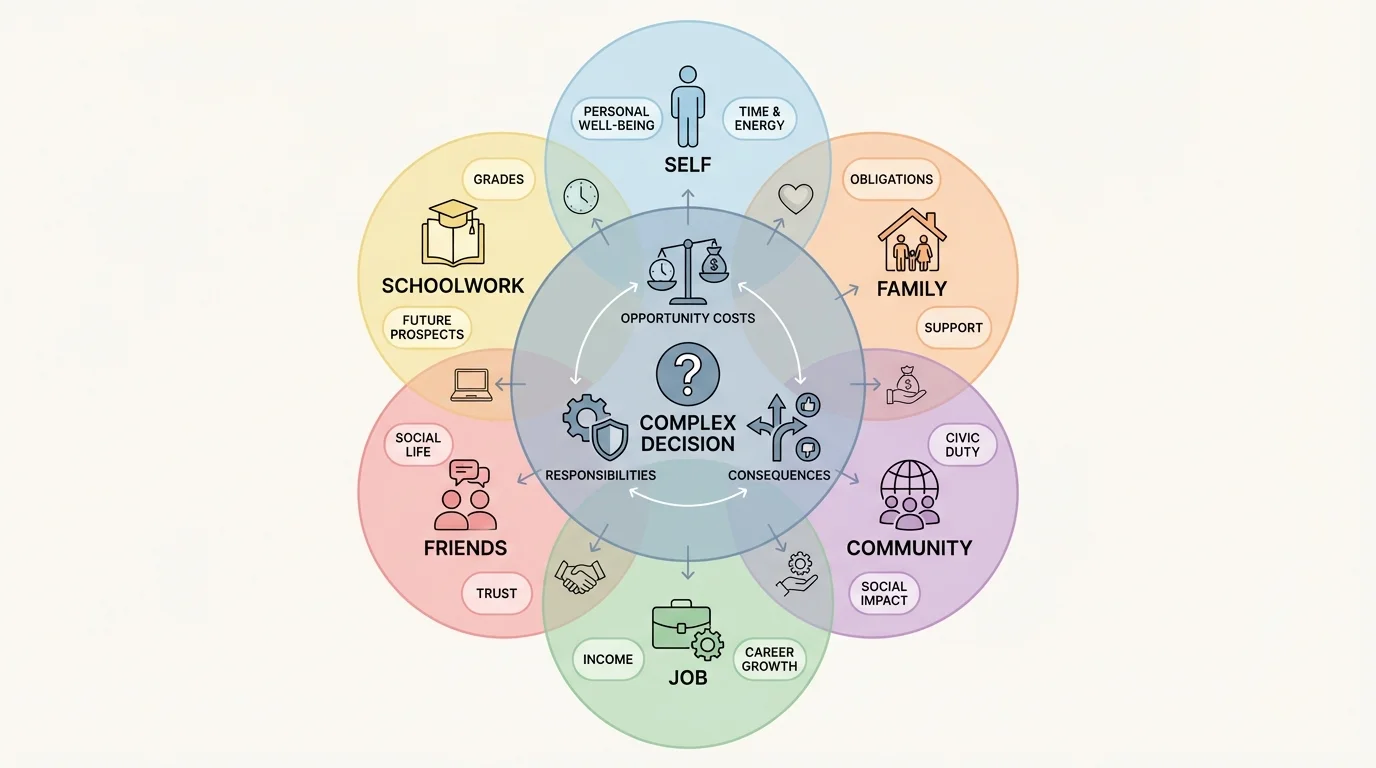
Responsibilities also include responsibility to yourself. That matters because some people are good at helping others but bad at protecting their own sleep, focus, money, or boundaries. Saying yes to everyone else can become irresponsible if it consistently harms your health or future.
"You are free to choose, but you are not free from the consequences of your choice."
When responsibilities conflict, rank them by seriousness. Safety usually comes before convenience. A legal obligation usually comes before social pressure. A promise tied to someone else's well-being usually matters more than a casual preference.
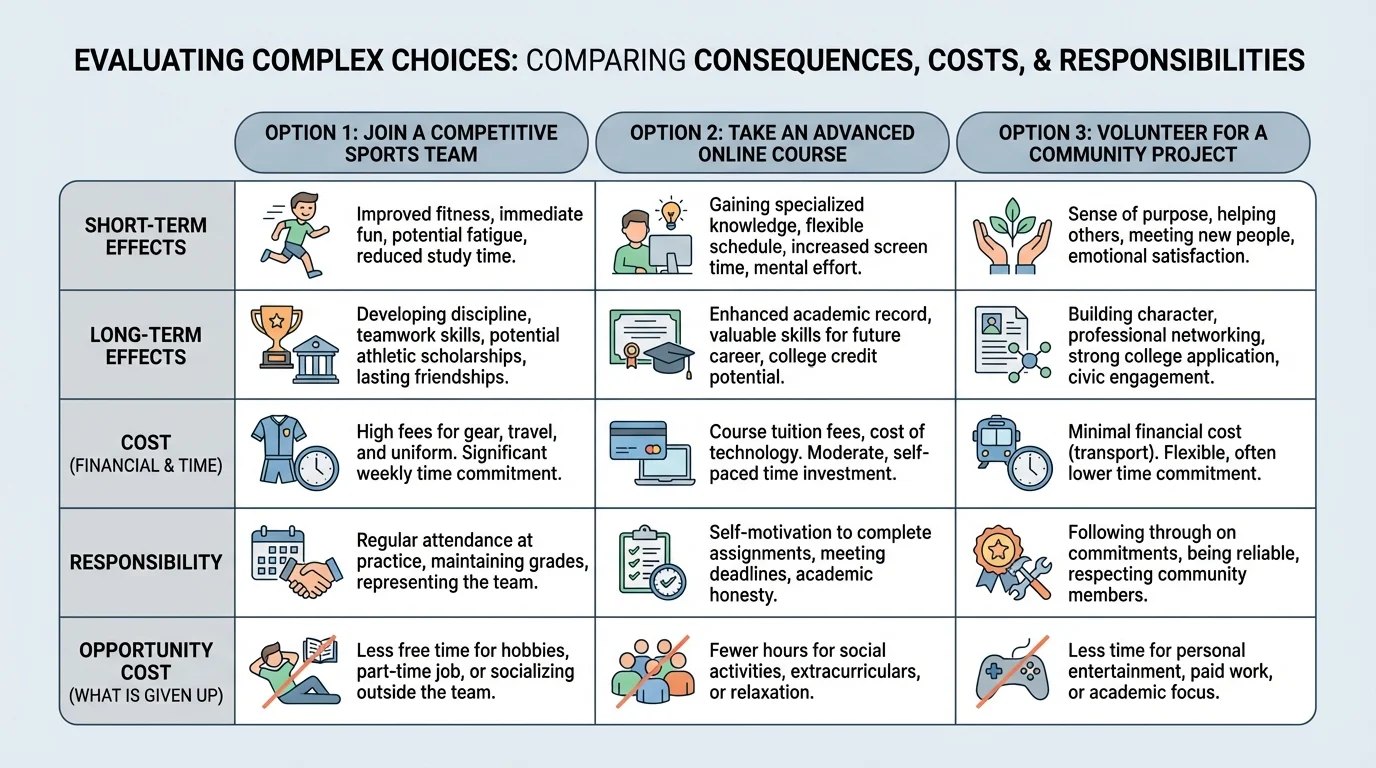
When a choice feels messy, put it where you can see it. As [Figure 3] shows, a simple comparison table helps you organize your thinking instead of letting every thought compete in your head at once.
You can compare options across categories such as short-term effects, long-term effects, cost, opportunity cost, and responsibility. You do not need advanced math. A simple rating system works well. For example, you might rate each category from 1 to 5, where 1 means poor and 5 means strong.
Here is a sample structure:
| Category | Option A | Option B | Option C |
|---|---|---|---|
| Short-term benefit | High | Medium | Low |
| Long-term benefit | Low | High | Medium |
| Money impact | Costs a lot | Costs little | Earns money |
| Time impact | Uses a lot | Balanced | Uses some |
| Responsibility fit | Weak | Strong | Medium |
| Opportunity cost | High | Low | Medium |
Table 1. A simple comparison structure for evaluating several decision options.
If you want a more detailed version, assign numbers and total them. For example, if one option gets ratings of 2, 5, 3, 2, and 4, the total is \(2 + 5 + 3 + 2 + 4 = 16\). Another option with 4, 4, 5, 4, and 3 totals \(4 + 4 + 5 + 4 + 3 = 20\). The higher number does not automatically decide for you, but it helps reveal which option is stronger overall.
Be careful, though: not every category should count equally. A fun social benefit should not outweigh a serious safety concern just because you gave both one point. If one factor is critical, treat it as critical. Sometimes one red flag is enough to reject an option.
Case study: Choosing transportation to a new part-time job
Your options are rideshare, public transit, or borrowing a family car.
Step 1: Compare money.
Rideshare costs $18 each shift, public transit costs $4, and borrowing the car may cost gas money plus responsibility for timing.
Step 2: Compare reliability.
Public transit may be slightly slower, but it is predictable. Borrowing the car depends on another person's schedule.
Step 3: Compare responsibilities.
If using the family car creates conflict with someone else's work schedule, that matters. Saving time for yourself does not erase inconvenience for them.
Step 4: Compare opportunity cost.
If rideshare takes $18 each shift and you work 4 shifts, that is \(4 \times 18 = 72\). That $72 could have gone to savings, food, or phone service.
By this point, the decision table becomes more than a chart. It becomes a way to make your thinking visible and easier to defend.
Scenario 1: Posting online when angry. The short-term benefit is emotional release. The opportunity cost may be future trust, a job opportunity, or peace in a relationship. Your responsibility includes honesty, self-control, and respect for privacy. Waiting before posting is often the strongest choice.
Scenario 2: Lending money to a friend. The positive consequence may be helping someone immediately. The negative consequence may be not getting repaid or damaging the friendship. The opportunity cost might be not having money for your own essentials. Your responsibility to be kind does not mean you must take on financial risk you cannot handle.
Scenario 3: Missing a commitment for a better offer. Maybe you agreed to help a family member, then get invited to something more fun. The consequence of changing plans may be disappointment and reduced trust. The opportunity cost of going to the fun event is the trust you lose by breaking your word. Responsibility matters heavily here.
Scenario 4: Taking on too many goals at once. It can feel productive to say yes to everything: work, gym, side hustle, volunteering, social plans, and multiple personal projects. But the consequence may be burnout. The opportunity cost is doing a few important things well. Responsibility includes being realistic with your energy and not overpromising.
One trap is making an impulsive decision. This happens when you act on emotion before thinking through results. A pause can change everything. Even ten minutes can help your brain move from reaction to evaluation.
Another trap is peer pressure. Online messages, group chats, and social media can make bad ideas feel normal because many people are encouraging them. Popularity is not proof of wisdom. Ask whether the choice still makes sense if nobody is watching.
A third trap is the sunk cost mindset. This means continuing with a bad option just because you already invested time, money, or energy. For example, if you joined an activity that is now harming your schedule and mental health, the fact that you already spent weeks on it does not automatically mean you should keep going. Past cost is real, but it should not control every future decision.
You already know how to set goals and manage time. Use those skills here. A choice is easier to evaluate when you know what you are trying to protect or build.
There is also a trap called wishful thinking. This is when someone focuses on the best possible outcome and ignores likely risks. If a plan depends on everything going perfectly, it is usually a weak plan.
Finally, some people avoid making a choice because they do not want discomfort. But avoiding a decision is still a decision. If you ignore a deadline, fail to answer a message, or delay a hard conversation, consequences still happen. Responsibility includes responding, not disappearing.
Sometimes every option has a downside. That does not mean you are stuck. It means you are in a real decision-making moment. Your job is not to find a magical option with zero cost. Your job is to choose the option with the strongest balance of consequences, the lowest unacceptable risk, and the best fit with your responsibilities.
Ask yourself: Which option causes the least harm? Which option protects what matters most? Which option can I explain honestly to someone I respect? Which option will I still be able to defend next week?
If needed, choose the best available option and make a plan to reduce the downside. For example, if you must work extra hours for financial reasons, you can still protect yourself by scheduling study time, communicating limits, and planning rest. A responsible choice is not only about the option itself. It is also about how you carry it out.
Pick one real choice you are facing this week. Write down the options. Under each one, list at least three likely consequences, one opportunity cost, and two responsibilities involved. If your first answer changes after writing, that is a good sign. It means you are thinking more clearly.
Another useful habit is this sentence: "Before I decide, I want to think about what this leads to, what it costs, and who it affects." That one line can help you slow down, protect your priorities, and make choices you respect later.
