Here is an important truth about adulthood: many problems are not actually one problem. Missing a work shift might look like a scheduling issue, but it can also become a money issue, a transportation issue, a communication issue, and a stress issue all at once. The people who handle adult life well are not the ones who never face problems. They are the ones who learn how to slow down, sort the situation, and make decisions with a clear head.
If you are in high school now, this matters sooner than you might think. You may already be dealing with deadlines, part-time work, family responsibilities, appointments, online communication, extracurricular commitments, and your own mental energy. Adult systems do not wait until some magical future. They start showing up as soon as you have responsibilities that affect other responsibilities.
Adult systems are the organized parts of life that have rules, timelines, costs, and consequences. Think about finances, transportation, work schedules, healthcare appointments, rental agreements, insurance, taxes, online forms, passwords, and communication with employers or service providers. Each system has its own expectations. The challenge is that these systems often overlap.
A transition is a change from one stage, routine, or role to another. Starting your first job, changing your sleep schedule, learning to manage your own appointments, moving to a new place, or taking on more financial responsibility are all transitions. During a transition, even simple tasks can feel harder because your old routine no longer fully works.
Then there are competing priorities. This happens when two or more important things need your time, money, attention, or energy at the same time. For example, you may need to save money, but you also need transportation to get to work. You may want more work hours for income, but you also need enough sleep to function. Good decision-making is often less about finding a perfect answer and more about choosing the best available option.
Analytical problem-solving means breaking a problem into parts, gathering useful facts, comparing options, and choosing a response based on evidence and consequences rather than impulse alone.
Tradeoff means giving up one benefit in order to gain another.
Decision fatigue is the mental exhaustion that makes choices feel harder after too many decisions or too much stress.
When you use analytical problem-solving, you stop treating every stressful moment like an emergency. Instead, you ask: What exactly is the problem? What facts do I know? What matters most right now? What can wait? What are the likely results of each option?
Before you solve a problem, you need to see the full system around it. A late paycheck, for example, is not just "annoying." It may affect food, phone service, transportation, and your ability to get to your next shift, as [Figure 1] illustrates. When one part of life changes, other parts may shift too.
This is called systems thinking: looking at how parts connect instead of viewing each problem by itself. If you only focus on the surface issue, you might choose a quick fix that creates a bigger problem later. If you zoom out, your decisions become smarter.
Ask yourself these questions when a problem appears:
Suppose your phone data is almost gone and your job communicates through an app. The problem is not only "I need more data." The system includes your paycheck date, Wi-Fi access, job communication, transportation apps, and maybe family expectations. Seeing the whole system helps you choose better than reacting with panic.
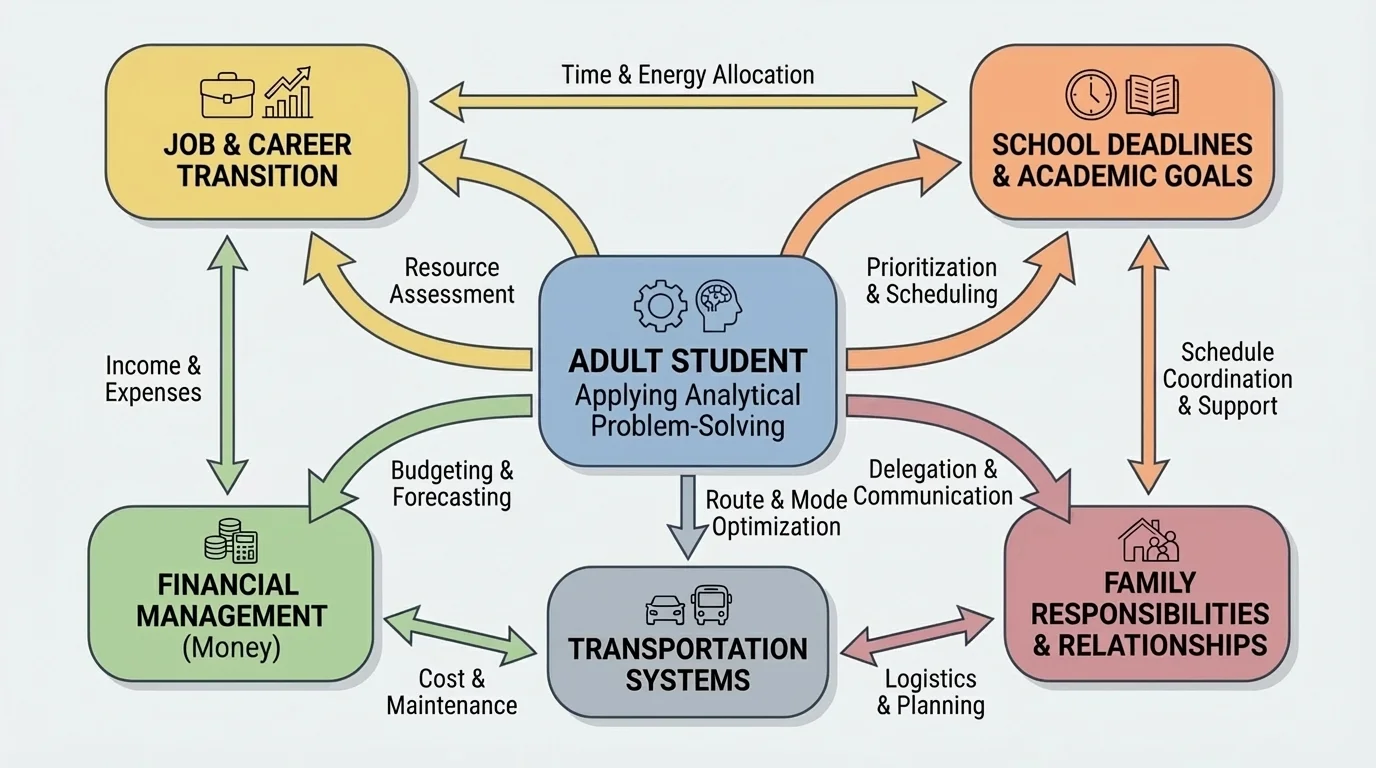
Systems thinking also helps you notice leverage points. A leverage point is a small action that improves several areas at once. Setting up calendar reminders, for example, can reduce missed appointments, late submissions, and forgotten shifts. A weekly budget check can lower stress, prevent overdrafts, and help you plan transportation.
Small failures in adult life often spread faster than big ones. Forgetting a password might delay access to pay information, which delays bill payment, which creates fees or stress. That is why organized systems matter more than dramatic "motivation" bursts.
You do not need to control every part of life perfectly. You do need to notice connections. The more you understand the system, the less likely you are to solve the wrong problem.
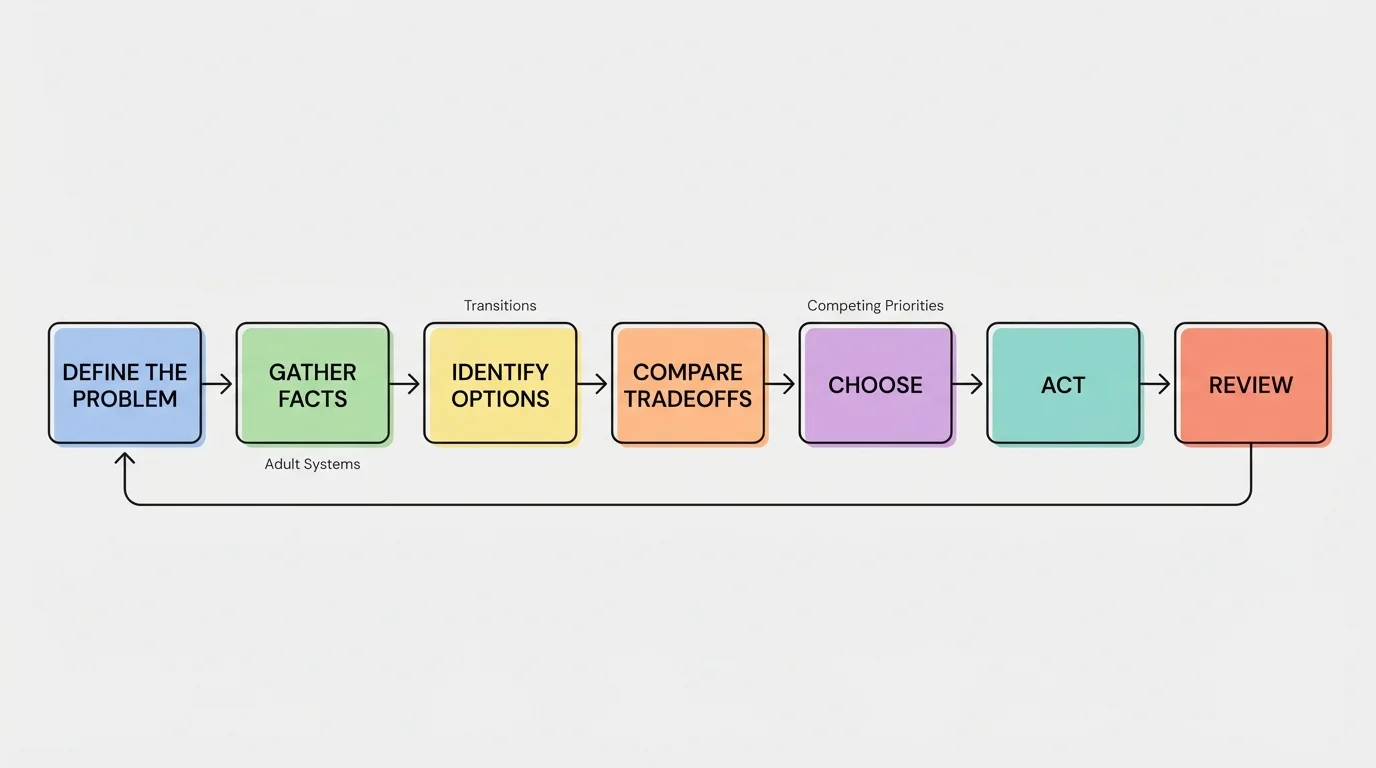
When a situation feels messy, use a repeatable process instead of guessing. This sequence works for many real-life decisions because it keeps you from skipping straight from stress to action.
Step 1: Define the real problem. Say it clearly and specifically. "Everything is falling apart" is not useful. "I have two work shifts this week that I cannot reach because my ride fell through" is specific enough to solve.
Step 2: Gather facts. Find out what is true, not just what you fear. What is the deadline? What does it cost? Who needs to know? What options are actually available? Stress often fills gaps with worst-case assumptions.
Step 3: Identify options. Come up with at least three possible responses if you can. The first idea is not always the best idea. More options usually mean better thinking.
Step 4: Compare tradeoffs. Ask what each option helps, what it harms, what it costs, and what risk it creates.
Step 5: Choose and act. Pick the strongest reasonable option, not the fantasy option. Then do the next concrete step: send the message, make the call, update the calendar, move the money, or ask for help.
Step 6: Review the result. Afterward, ask: Did this work? What should I do differently next time? Review turns mistakes into useful information.
Case study: Your work shift and transportation problem
Step 1: Define the problem
Your usual ride is unavailable for two shifts this week.
Step 2: Gather facts
The shifts start at 4:00 p.m. and 10:00 a.m. A rideshare costs about $14 each way. The bus is available for one shift but not the other. You have $46 in available spending money.
Step 3: Identify options
Option A: Pay for rideshare both days. Option B: Use the bus one day and rideshare one day. Option C: Ask manager to swap one shift and use the bus for the other.
Step 4: Compare tradeoffs
Option A costs about $56 total, which is more than your available money. Option B costs about $28 for the rideshare day and less stress than missing work. Option C may save money, but only if the swap is approved quickly.
Step 5: Choose and act
Choose Option B immediately, then message your manager about a possible future shift swap to reduce later costs.
The best choice is not always the cheapest or easiest. It is the one that works within your real limits.
Notice something important: analytical problem-solving does not remove emotion. It gives structure to emotion. You may still feel frustrated, but now you know what to do next.
Transitions are where many people lose balance because old habits stop matching new responsibilities. Maybe you start a job and suddenly need to wake up earlier, prep meals, plan transportation, and communicate professionally. Maybe a family responsibility changes and your free time shrinks. The solution is not "try harder." The solution is to redesign your system.
During a transition, expect temporary confusion. That does not mean you are failing. It means your routine is being rebuilt. The key is to reduce avoidable uncertainty.
Use this transition approach:
For example, if you begin working evenings, you may need to shift homework time, meal timing, and when you answer messages. If you ignore the system change, things start slipping one by one. If you redesign on purpose, the transition becomes manageable.
Transitions create decision overload. When your routine changes, your brain has to make more choices than usual: when to wake up, what to eat, when to leave, what to pack, who to inform, and what to postpone. This is why planning ahead during a transition is not extra work; it is a way to lower stress and prevent avoidable mistakes.
One helpful method is to create a "minimum stable routine." This means the smallest set of habits that keeps life functioning even during a busy or stressful period. A minimum stable routine might include setting alarms, checking your calendar twice a day, charging your phone at night, packing essentials before bed, and reviewing tomorrow's top three tasks.
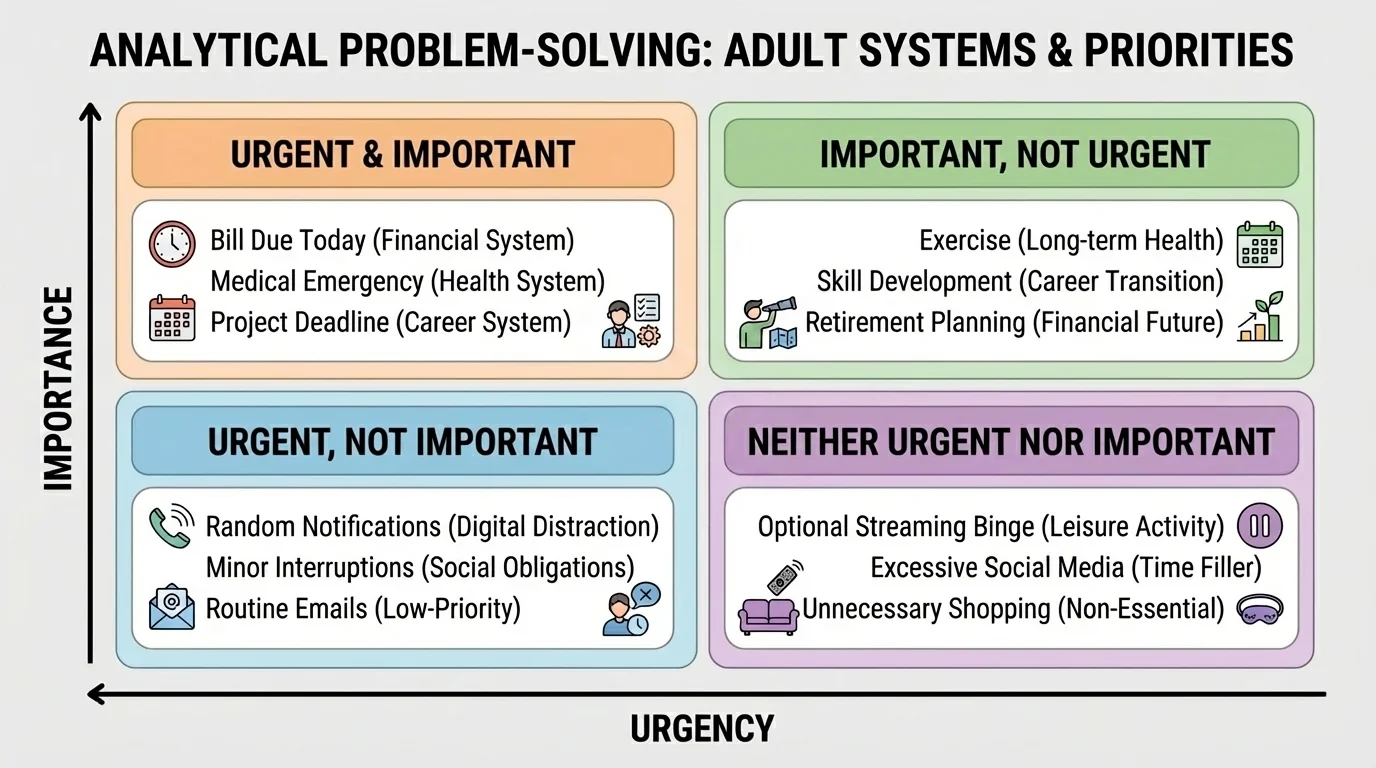
Not everything that feels urgent is important, and not everything important feels urgent. That is one reason competing priorities are so hard. Your brain often reacts to noise, pressure, and guilt before it reacts to long-term value.
The priority grid in [Figure 3] helps you separate emotional pressure from actual importance. When multiple demands hit at once, sort them into four groups: urgent and important, important but not urgent, urgent but not important, and neither.
Here is a practical version:
| Priority Type | What It Means | Example | Best Response |
|---|---|---|---|
| Urgent and important | Needs attention soon and has real consequences | Bill due today, work shift starting soon, medical issue | Do it first |
| Important, not urgent | Matters for long-term stability | Saving money, sleep, exercise, updating resume | Schedule it |
| Urgent, not important | Feels pressing but has lower value | Random notifications, nonessential requests | Limit or delegate |
| Neither urgent nor important | Consumes time without helping much | Scrolling for hours, procrastination tasks | Reduce it |
Table 1. A practical priority grid for sorting competing demands in daily life.
One of the biggest adult skills is protecting important tasks before they become emergencies. Paying attention to sleep, budgeting, and planning transportation may not feel dramatic, but these habits prevent bigger problems later. The "important but not urgent" category is where many stable lives are built.
Case study: You have $80 for the next five days
Step 1: List fixed needs
Bus pass $25, phone payment $30, food $25. The total is $80.
Step 2: Notice the tradeoff
If you spend $18 on takeout today, you create a shortage. The new amount left is $80 minus $18, which is $62.
Step 3: Recalculate needs
You still need \(\$25 + \$30 + \$25 = \$80\), but you now have only $62. That creates a gap of \(\$80 - \$62 = \$18\).
Step 4: Make the analytical choice
You can skip the takeout, cook from what you have, and protect transportation and phone access. That choice supports work communication and mobility.
Adult decisions often come down to protecting the systems that keep other systems running.
This does not mean you should never spend money on fun, rest, or enjoyment. It means timing matters. Analytical thinking asks, "Can I afford this without damaging something more important?"
Let's look at how this thinking works in situations you might actually face.
Scenario 1: You need a medical appointment but do not want to miss work. The real problem is not just scheduling. The system includes your health, job communication, transportation, and possibly cost. A weak response is to avoid the appointment and hope the problem disappears. A stronger response is to check appointment times, message your manager early, and choose the least disruptive option. Early communication usually protects trust.
Scenario 2: You are exhausted and falling behind. Many people try to solve this by pushing harder. But if the root problem is poor sleep, too many commitments, or constant interruptions, "work harder" solves nothing. Analytical problem-solving asks what is causing the overload. You might need to reduce optional commitments, batch messages, or create a shut-down time at night.
Scenario 3: You get offered more work hours. More hours can mean more money, but also less time, less energy, and weaker performance elsewhere. This is a classic tradeoff analysis situation. You compare the benefit of extra income with transportation costs, sleep, deadlines, and stress. Sometimes saying yes is smart. Sometimes saying no protects the rest of your system.
You already use parts of analytical thinking in everyday life when you compare products, decide how to spend your time, or plan around a deadline. The goal now is to make that process more deliberate and more reliable when the stakes are higher.
Scenario 4: You forgot an important deadline. The first move is not shame. It is damage control. What is still possible? Who needs to hear from you? What consequence can still be reduced? Then ask what failed in the system: reminder setup, calendar use, unclear communication, or overcommitment.
Strong problem-solvers do not waste all their energy on self-blame. They learn fast, repair what they can, and improve the system.
Even smart people make poor decisions under stress. The issue is not intelligence. It is that pressure can narrow your thinking.
Watch for these traps:
A good response to these traps is to pause and ask for evidence. What facts support my fear? What deadline is real? What happens if I wait one hour and think clearly? What would I tell a friend to do in this exact situation?
"You do not rise to the level of your goals. You fall to the level of your systems."
— James Clear
This idea matters because adult life is full of repeated decisions. If your system is weak, you must keep rescuing yourself. If your system is strong, many problems never grow large in the first place.
A simple planning setup reduces forgotten tasks, lowers stress, and saves mental energy. Your personal system does not need to be fancy. It just needs to work consistently.
Build your system around a few core tools:
Your reset routine can be short. Check tomorrow's schedule. Charge devices. Pack what you need. Look at transportation. Set alarms. Confirm your top priorities. Five to ten minutes of preparation can prevent hours of chaos later.
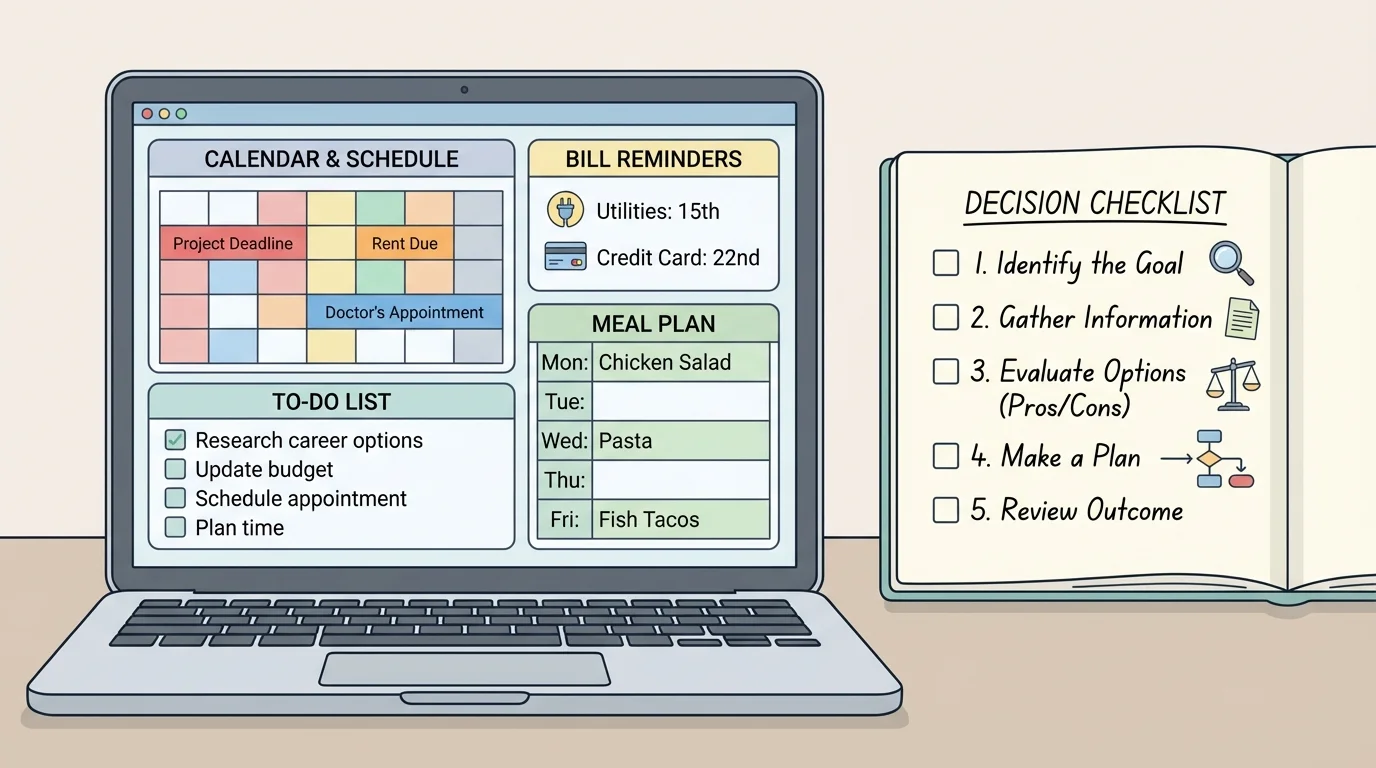
It also helps to use a decision checklist for bigger choices. Try questions like these:
Over time, this checklist becomes a habit. Instead of reacting instantly, you begin evaluating automatically. That is a major sign of maturity: not just making decisions, but making them on purpose.
Choose one current issue in your life that feels annoying, confusing, or stressful. Write the problem in one sentence. Then list the systems involved: time, money, transportation, health, communication, schoolwork, family, or energy. Next, write three possible options and one likely consequence of each.
Another useful action is to do a "friction scan." Friction is anything small that repeatedly makes life harder: lost chargers, missing passwords, no reminders, no meal plan, late-night scrolling, unclear communication, or always waiting until the last minute. Fix one friction point this week. Small fixes create big stability over time.
Quick routine you can start today
Step 1: Set one daily calendar check
Choose a time you can keep, such as after breakfast or before dinner.
Step 2: Write tomorrow's top three priorities
Keep the list realistic. If everything is top priority, nothing is.
Step 3: Prepare one thing the night before
Lay out documents, charge your phone, prep food, or confirm transportation.
Step 4: Review once a week
Ask what caused stress, what worked, and what system change would help next week.
Consistency beats intensity. A simple routine done often is more powerful than a perfect plan done once.
Analytical problem-solving is not about becoming emotionless or controlling every outcome. It is about building enough clarity to move through adult systems, transitions, and competing priorities without getting pulled around by every stressful moment. The more you practice seeing the system, comparing tradeoffs, and acting deliberately, the more capable and confident you become.
