Some teens spend months chasing an opportunity that looks impressive online, only to realize later that it taught them almost nothing. Other students take a smaller, less flashy role and end up gaining real skills, useful contacts, and a stronger path forward. The difference is not luck. It is evaluation. If you can judge an opportunity well before you commit, you can save time, avoid bad situations, and choose experiences that actually move you toward your future.
At your age, early career opportunities matter because they help you test what work feels like in real life. You are not just picking something to fill time. You are learning what kind of environment fits you, what skills you enjoy using, and what responsibilities you are ready for. A good opportunity can build confidence, help you earn money, expand your network, and make future applications stronger. A poor one can waste hours, create stress, and even put you in unsafe or unfair situations.
When adults look at a student's background, they often care less about whether the title sounded impressive and more about what the student actually did. For example, helping manage social media for a local business, assisting with pet care, or organizing files for a nonprofit can all be valuable if you learned communication, reliability, problem-solving, or technical skills. The real question is: What did this experience teach you, and how can you prove it?
That is why evaluating opportunities matters. You are not only asking, "Can I get this?" You are asking, "Is this worth my time? Is it safe? Will I grow? Will this help me later?" Those questions can guide you whether you are considering a paid job, an internship, a volunteer role, a job-shadow experience, or a short-term project.
Work-based learning is structured learning that happens through real or realistic work experiences. It can include internships, apprenticeships, service-learning, part-time jobs, job shadowing, client projects, and other opportunities where you build career skills through actual tasks and responsibilities.
Internship usually refers to a short-term experience in which you learn about a field by helping with real work under supervision. Some internships are paid and some are unpaid, depending on the organization and local laws.
A career pathway is the route you might take from early experiences to later training, jobs, and long-term goals.
Not every good opportunity looks the same. Sometimes the best next step is a formal internship with clear training. Sometimes it is a part-time job that teaches you time management, customer service, and accountability. Sometimes it is a volunteer role where you lead a real project and gain strong examples for future interviews.
An early career opportunity is any experience that helps you build workplace skills, explore an industry, or develop evidence that you can handle responsibility. This includes a work-based learning experience, but it also includes many other forms of real-world growth.
Here are common types:
Different opportunities build different strengths. A paid restaurant job may teach speed, teamwork, and customer communication. A remote office internship may teach software tools, email professionalism, and project tracking. A volunteer role might develop leadership if you organize people, solve problems, or manage a schedule.
Many employers value transferable skills as much as field-specific experience for entry-level roles. Showing that you are dependable, teachable, and professional can matter just as much as already knowing everything about the industry.
This is important because you do not need the "perfect" first opportunity. You need one that helps you grow in ways that match your goals.
A strong evaluation process keeps you from making decisions based only on excitement, pressure, or a fancy title. As [Figure 1] shows, it helps to move through a clear checklist: your goals, the skills you will build, the support you will get, the practical costs, and the safety and reputation of the opportunity.
Start with your purpose. Ask yourself what you want right now. Do you need income? Do you want to test a career field? Are you trying to build experience for college, training, or future job applications? Do you want a flexible role that fits sports, family duties, or other commitments? A good opportunity for one student may be a bad fit for another.
Step 1: Check the skill value. Look at what you will actually do. Will you learn customer service, scheduling, data entry, teamwork, writing, coding, equipment use, problem-solving, sales, or project planning? If most of the role is passive observation with no feedback, the value may be limited unless the field access itself is rare or important.
Step 2: Check the supervision. A quality opportunity usually includes a clear supervisor, mentor, manager, or coordinator. You should know who trains you, who answers questions, and who gives feedback. A vague setup often leads to confusion and poor learning.
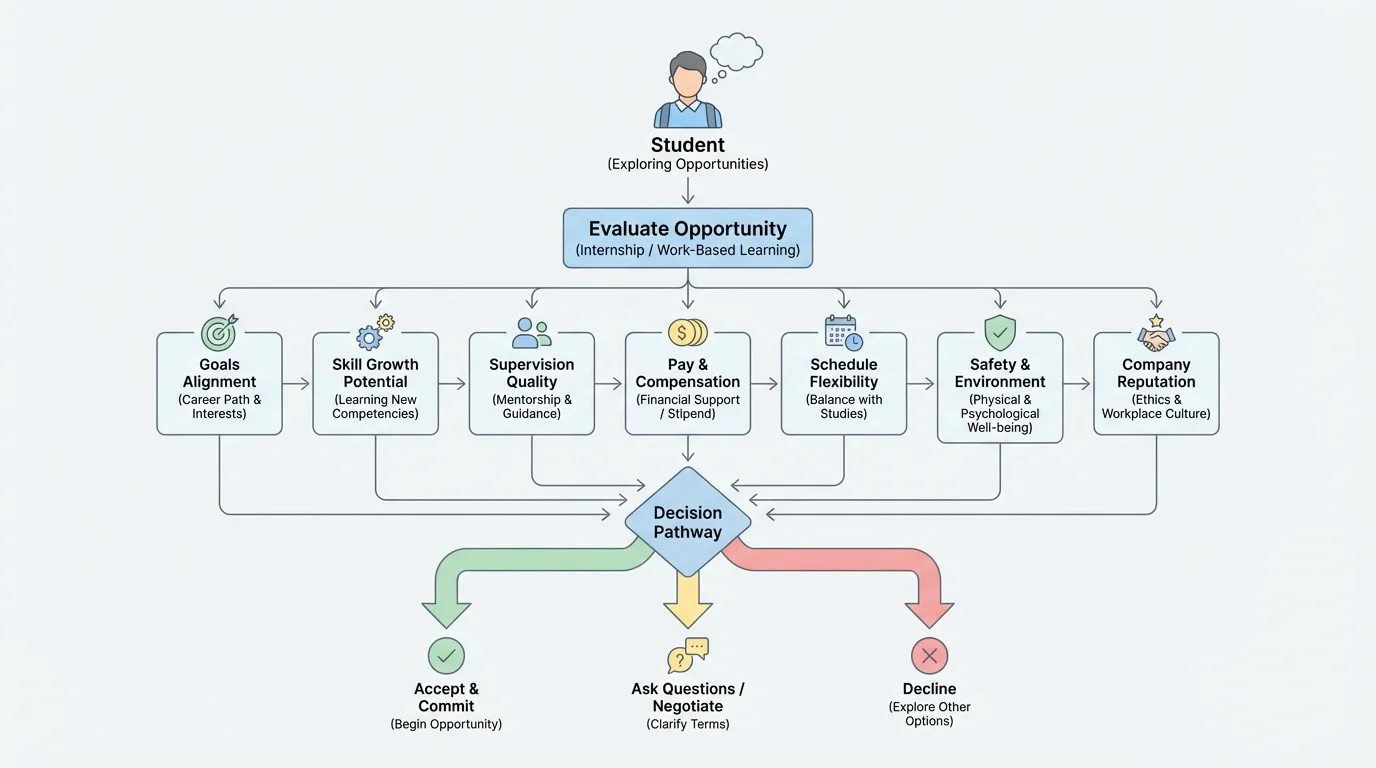
Step 3: Check pay and costs. Not every opportunity must be paid to have value, but unpaid work should still offer strong learning, reasonable hours, and legal fairness. Also think about hidden costs. If you earn $120 for a week of work but spend $40 on transportation and $25 on supplies, your usable earnings drop to $55 because \(\$120 - \$40 - \$25 = \$55\). Even when money is not the main goal, costs still matter.
Step 4: Check the schedule. Can you realistically manage the hours with your coursework, family responsibilities, sleep, and other commitments? A great opportunity is not great if it causes burnout. Overcommitting can hurt both your performance and your health.
Step 5: Check safety and legality. You should understand the location or online platform, the tasks expected, the age requirements, the communication methods, and whether anything feels inappropriate or risky. If the role involves private messaging with adults, isolated settings, unsafe equipment, or pressure to ignore rules, stop and ask questions. It is okay to bring in a parent, guardian, or trusted adult when reviewing the situation.
Step 6: Check reputation. Research the organization. Look at its website, public reviews, online presence, and contact information. If possible, talk to someone who has worked there. Real organizations usually communicate clearly and professionally.
Think in terms of return on effort. A helpful way to judge an opportunity is to compare what you put in with what you get back. Your effort includes time, energy, transportation, supplies, stress, and opportunity cost. Your return includes pay, skills, contacts, references, confidence, and future options. The best choice is often the one with the strongest total return, not just the biggest title.
Another useful question is whether the experience gives you transferable skills. These are skills you can carry into many different jobs and settings. For example, learning to speak professionally with customers, use scheduling software, handle conflict calmly, or keep records organized can help in dozens of careers.
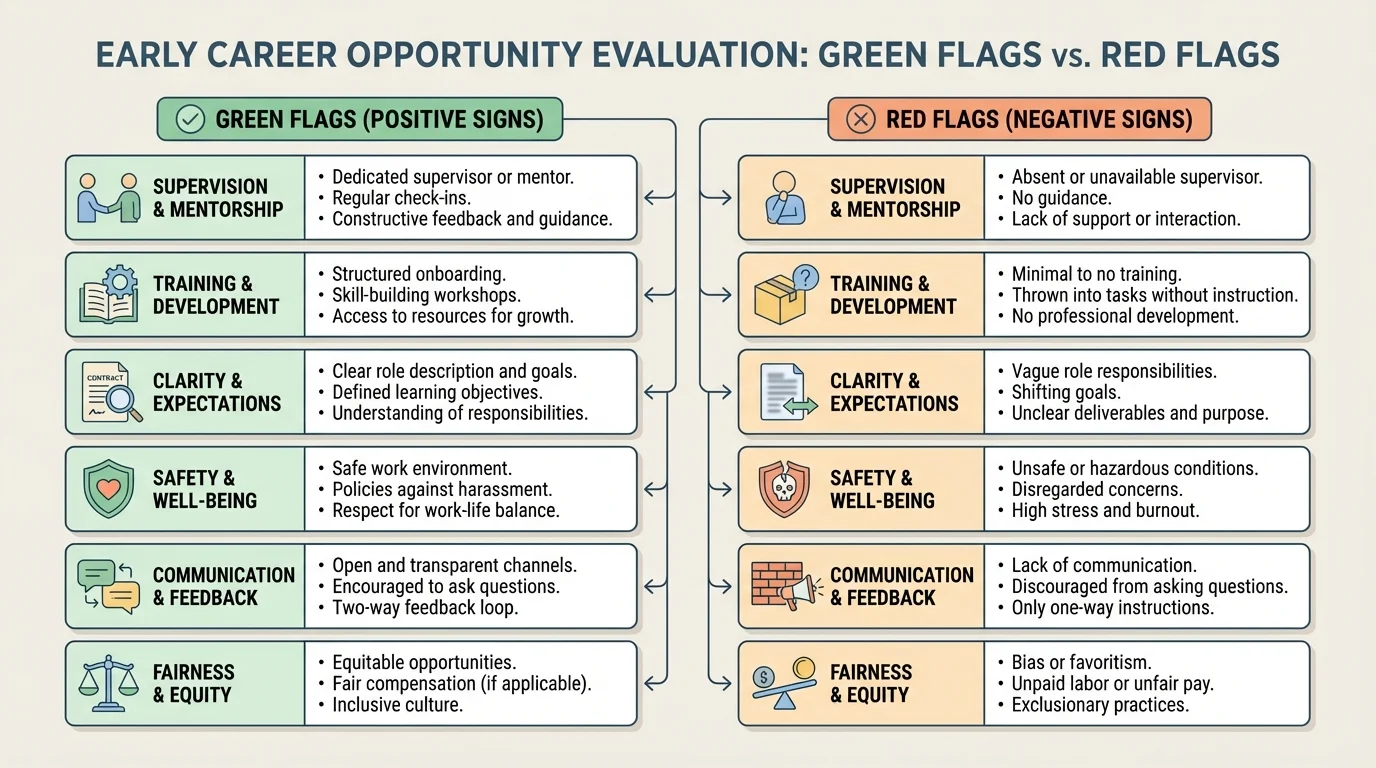
When you evaluate opportunities, watch for warning signs and positive signs. The comparison in [Figure 2] makes this easier to spot quickly: strong opportunities are usually clear, respectful, and organized, while risky ones are vague, pressured, and unfair.
Green flags include clear job duties, a named supervisor, training, written expectations, reasonable hours, respectful communication, safe working conditions, and chances to learn. If someone can explain what you will do, what success looks like, and how you will be supported, that is a good sign.
Red flags include vague descriptions, promises that sound too good to be true, pressure to decide immediately, requests for sensitive information too early, unpaid work that seems to replace regular employees, disorganized communication, or instructions that make you uncomfortable. Be especially cautious if someone refuses to answer basic questions or tries to isolate you from trusted adults.
Online opportunities need extra care. A remote role can be great, but it should still have professional email communication, clear tasks, known contacts, and reasonable boundaries. If a person contacts you through random social media direct messages, avoids official channels, or asks for personal data before a formal offer, take that seriously.
One common mistake is assuming that "unpaid" automatically means "bad" or "paid" automatically means "good." Neither is always true. A paid job with poor treatment, chaos, and no learning may be less useful than a short unpaid internship with excellent mentoring and strong skill growth. But unpaid opportunities should still respect your time and should not depend on guilt, confusion, or exploitation.
Another mistake is choosing based only on prestige. A famous company name does not help much if your role is meaningless or unsupported. On the other hand, a small local business, clinic, or nonprofit may give you real responsibilities and personalized feedback. As seen earlier in [Figure 2], quality often shows up in structure and communication, not just brand recognition.
When you have more than one option, compare them using the same categories. This keeps your decision grounded in facts instead of mood. A simple chart can help.
| Opportunity | Main Benefit | Main Cost or Risk | Best For |
|---|---|---|---|
| Paid part-time retail job | Income, customer service, reliability | Evening or weekend hours, repetitive tasks | Students who need money and workplace basics |
| Unpaid office internship | Professional exposure, mentor access, resume value | No income, possible transportation or technology costs | Students exploring a specific career field |
| Volunteer project leadership | Leadership, planning, community impact | May require self-direction and extra initiative | Students building initiative and public service experience |
| Freelance digital work | Portfolio, independence, flexible schedule | Irregular pay, client communication challenges | Students with a marketable skill like design or editing |
Table 1. A comparison of common early career opportunities, including major strengths, trade-offs, and best-fit situations.
Suppose you are choosing between a coffee shop job and a virtual marketing internship. The coffee shop job pays now and helps you practice speed, teamwork, and customer interaction. The internship may not pay, but it teaches software tools and gives you a professional contact in a field you want to explore. If your main goal is immediate income, the job may win. If your main goal is testing a marketing pathway, the internship may be more valuable. The better choice depends on your actual priorities.
Case study: Comparing two opportunities
A student is deciding between Opportunity A, a paid pet care job, and Opportunity B, an unpaid media internship.
Step 1: Identify the goal
The student wants both experience and some income, but is especially curious about media careers.
Step 2: Compare the real benefits
Opportunity A offers pay, reliability, and client communication. Opportunity B offers software experience, portfolio samples, and mentoring.
Step 3: Compare the trade-offs
Opportunity A has fewer career-specific skills for media. Opportunity B has no pay and requires strong time management.
Step 4: Decide using priorities
If income is urgent, Opportunity A may be the smart choice now. If the student can afford unpaid hours and wants career exploration, Opportunity B may provide better long-term value.
The strongest decision is the one that fits both current needs and future goals.
You can also score options informally. For example, rate each one from low to high on skill growth, supervision, flexibility, pay, and future value. You do not need complicated math. You just need a consistent method so you are not making decisions blindly.
Strong candidates ask thoughtful questions. Doing that does not make you difficult. It makes you responsible. You have a right to understand what you are joining.
Useful questions include:
You should also ask yourself questions. Am I taking this because it fits my goals, or because I feel pressure? Can I realistically handle the workload? Does anything about this situation feel unclear or off? Would I be comfortable explaining this opportunity to a trusted adult and showing them the messages or details?
"The best opportunities do not just use your time. They develop your ability."
If you are offered something on the spot, it is okay to say, "Thank you. I would like a little time to review the details." That is professional. Rushed decisions often lead to preventable mistakes.
Evaluating an opportunity well is only half the job. Once you accept it, your behavior shapes what you gain from it. Showing up on time, communicating clearly, asking smart questions, and following through consistently can turn an average role into a strong reference and a powerful learning experience.
Be intentional about what you are learning. Keep track of tasks, tools, accomplishments, and problems you solved. If you helped serve customers, note how you handled difficult interactions. If you used software, write down which programs and what you created. If you improved a process, remember the before-and-after difference. These details become useful later on resumes, applications, and interviews.
Ask for feedback while the experience is still happening, not only at the end. A quick question such as "What is one thing I am doing well and one thing I should improve?" can help you grow faster. This also shows maturity and coachability.
Professional communication matters too. Reply respectfully, be honest if you need help, and avoid disappearing when something gets difficult. Reliability is one of the most valuable things an employer or mentor can say about you.
You do not need to be perfect to be professional. Professionalism usually means being prepared, respectful, honest, responsive, and willing to improve.
It also helps to notice what the experience teaches you about yourself. Maybe you discover that you enjoy fast-paced work, or maybe you prefer quieter, detail-heavy tasks. Maybe you like helping people directly, or maybe you enjoy behind-the-scenes organization more. That kind of self-knowledge is useful. An opportunity does not fail just because it shows you what you do not want. That is valuable information too.
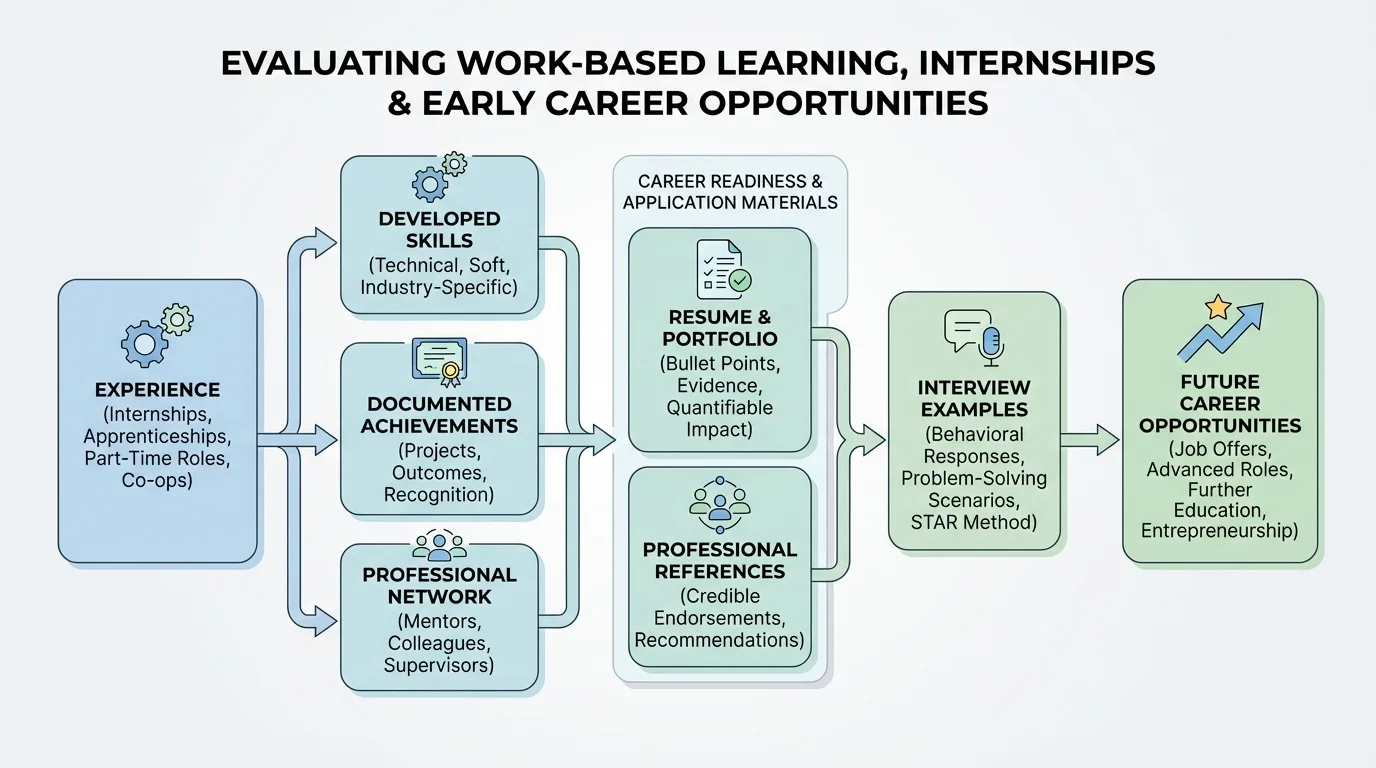
One of the smartest things you can do is turn one experience into several future advantages. As [Figure 3] illustrates, a single internship, job, or volunteer role can lead to skills, achievements, a stronger resume, a reference, better interview stories, and clearer career direction.
To do that, document your experience in a useful way. Instead of writing "helped at office," write specific results such as "organized digital files," "responded to client emails," "scheduled appointments," or "created three social media posts." Specific actions sound more credible and help others understand your capabilities.
Ask for a reference if you performed well and built a positive relationship. A reference from a supervisor, manager, or coordinator can help with jobs, scholarships, training programs, and future internships. Do not wait years if possible. It is easier when the person still remembers your work clearly.
You should also reflect on fit. Did this opportunity confirm your interest in a field, or did it make you curious about something else? What skills came naturally, and which ones need work? What kind of environment helped you do your best? Those answers help you choose the next step with more confidence.
A resume becomes stronger when it includes real examples of responsibility and results. A future interview becomes easier when you can tell short, specific stories about times you solved a problem, learned a tool, supported a team, or handled pressure. That is why even a small early opportunity can matter so much. It gives you evidence.
Later, when you describe your growth, you can connect the dots clearly: what the opportunity was, what you learned, what you accomplished, and what you want to do next. That kind of reflection shows maturity. As the pathway in [Figure 3] makes clear, experience becomes most powerful when you actively convert it into proof of skill and direction.
Before saying yes to any early career opportunity, run through this checklist:
If several answers are weak or unclear, ask more questions. If the answers stay vague, you may be better off waiting for a stronger opportunity.
