Here is a truth many adults learn later than they want to: people usually do not "find" a career all at once. They build one step by step. The students who seem confident are often not more certain than you are. They just have a plan, and a plan makes uncertainty easier to handle.
If you are in grade 11, this is a great time to create that plan. You do not need your whole future figured out. You do need a direction, a way to build useful skills, and a way to connect with real people who can help you learn about opportunities. A strong plan can save time, reduce stress, and help you avoid drifting through important decisions.
A career action plan is a written roadmap for getting from where you are now to where you want to go next. It is not a promise that everything will go exactly as expected. It is a tool that helps you make smart choices, track progress, and adjust when your goals change.
[Figure 1] Most strong career action plans include four core parts: a target direction, networking, skill growth, and clear next steps. In other words, you decide what you might want, connect with people who know more about it, build the skills that make you ready, and then take action instead of waiting around.
Career action plan means a step-by-step plan for reaching a career goal. Networking means building professional relationships that can give you information, advice, support, or access to opportunities. Skill-building means intentionally improving abilities that help you succeed in school, work, training, or daily life.
Think about the difference between these two students. One says, "I want a good job someday," but does nothing specific. The other says, "I'm interested in health care, so this month I'll research three roles, message one medical assistant for an informational interview, and complete an online first aid course." The second student is much more likely to move forward because the goal has become visible and actionable.
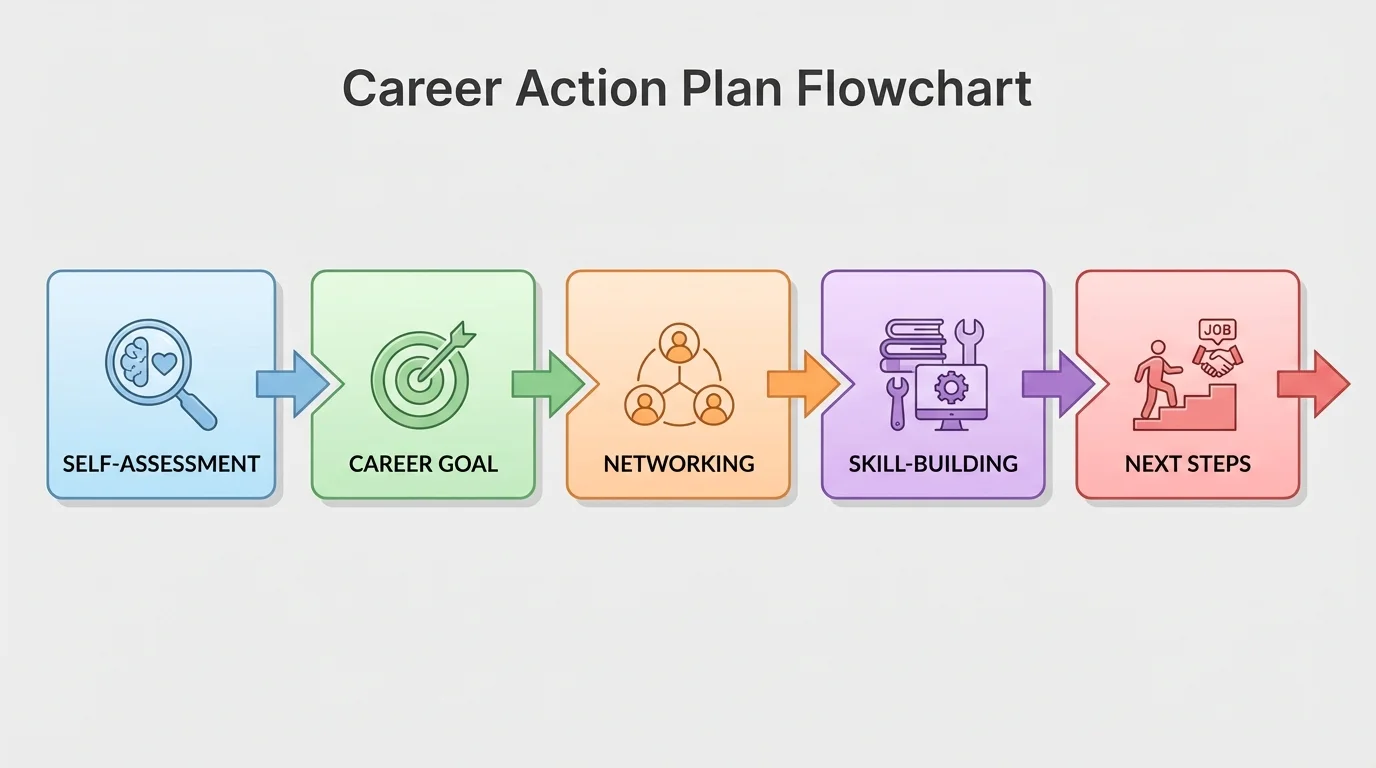
The first step is choosing a direction. Not a forever decision. Just a reasonable starting point. Many students get stuck because they think they must choose one perfect career immediately. That is not how most lives work. You are looking for your career pathway, not a final label.
Start by asking yourself four practical questions:
You can gather this information from real life. Pay attention to what energizes you. If you like editing videos, organizing online events, solving tech problems, tutoring younger students, selling handmade products, or helping family members navigate forms and appointments, those are clues. Career planning is not only about dream careers. It is also about patterns in what you do well and what you enjoy.
Direction first, precision later
You do not need to know your exact job title to make progress. Choosing a broad field like business, health care, skilled trades, education, design, technology, or public service is enough to start researching roles, meeting people, and building relevant skills. Specific choices often become clearer after experience.
A useful way to narrow options is to compare a few possible fields side by side.
| Possible field | Why it fits you | Skills you may need | Next step to explore |
|---|---|---|---|
| Graphic design | You enjoy visual creativity and editing apps | Design software, communication, portfolio building | Watch tutorials and create three sample designs |
| Health care support | You like helping people and staying organized | Empathy, attention to detail, reliability | Interview someone in a support role and research certifications |
| Information technology | You like troubleshooting devices and solving problems | Technical knowledge, patience, documentation | Take a beginner tech course and practice basic repairs |
| Entrepreneurship | You like independence and creating ideas | Planning, communication, budgeting, marketing | Test a small service or online product |
Table 1. Examples of how interests and strengths can connect to possible career directions.
Once you have a direction, turn it into goals. A good goal is specific enough to guide action but flexible enough to adjust if you learn something new. This is where many students improve fast: they stop saying vague things like "do better" and start saying exactly what will happen next.
Use three layers of planning:
For example, if you are interested in digital marketing, your long-term goal might be to work in marketing for a company or run freelance projects. Your mid-term goal could be to complete a certificate course and build sample work. Your short-term goal could be to learn one design platform, create a mock ad campaign, and connect with two people working in the field.
Example: turning a broad interest into a clear goal
A student says, "I want to work with computers." That is too broad to guide action.
Step 1: Narrow the field.
The student identifies possible areas: tech support, coding, cybersecurity, and web design.
Step 2: Pick one area to explore first.
The student chooses tech support because they already enjoy fixing device problems for family members.
Step 3: Write a practical short-term goal.
"Over the next 30 days, I will complete one beginner IT course, learn five common troubleshooting steps, and talk to one person who works in tech support."
Now the student has a goal that can actually be followed.
One helpful checkpoint is to ask: Can I prove I completed this? "Learn about jobs" is weak. "Compare three job roles and save notes on training, pay, and daily tasks" is much stronger because it creates evidence.
Networking is often misunderstood, but it is simply relationship-building with purpose. It does not mean using people. It means learning from people, showing genuine interest, and staying connected in a respectful way.
[Figure 2] Your network can include relatives, family friends, neighbors, coaches, volunteer supervisors, religious or community leaders, employers, clients, online mentors, club advisors, and people you meet through extracurricular programs or part-time work. Even one helpful conversation can teach you what a job is really like, what training matters, or where beginners usually start.
A lot of students think networking only counts if they already know professionals in high-paying careers. That is false. If your cousin works in a hospital, your neighbor runs a business, your former babysitting client works in accounting, or a family friend repairs cars, those are all real connections. You are not asking them to hand you a career. You are asking to learn.
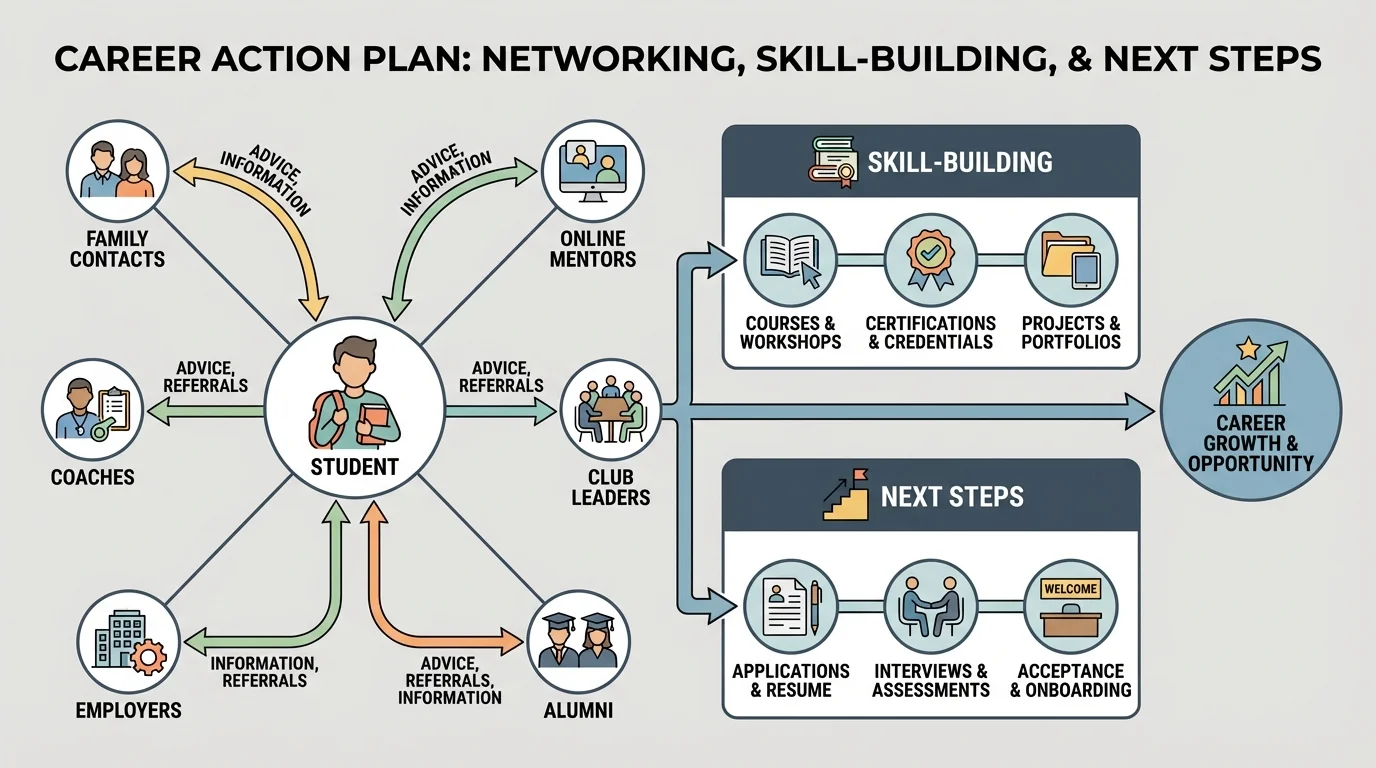
Start small. Reach out with a short, polite message. Introduce yourself, say why you are contacting them, and ask one clear question. For example: "Hi, I'm exploring careers in physical therapy and was told you work in that field. I'm a grade 11 student trying to learn more. Would you be willing to answer two or three questions by message or a short call sometime this month?"
What to ask in an informational interview
An informational interview is a short conversation with someone who shares what their job is like. It is not a job interview. Its purpose is learning.
Step 1: Prepare smart questions.
Ask things like: What does a normal day look like? What skills matter most? What do beginners usually misunderstand about this field?
Step 2: Respect their time.
Keep the conversation short, arrive prepared if it is a video call, and avoid asking for a job immediately.
Step 3: Follow up.
Send a thank-you message and write down what you learned.
This turns one conversation into useful career knowledge and a stronger connection.
Professional behavior matters online too. Use a clear email address, write complete sentences, and check spelling before sending messages. If you use social media for professional contact, keep your public profile respectful. People often notice your communication style before they notice your grades or resume.
Later, when you apply for a job, internship, or program, the network map matters because opportunities often move through people before they appear in public listings. Someone may tell you about a part-time opening, a volunteer position, or a scholarship because you built a real connection early.
Career planning is not only about choosing a field. It is also about becoming the kind of person people trust to do work well. That means building both job-specific skills and broader workplace skills.
Technical skills are the abilities tied to a certain field, such as editing video, coding basic websites, using spreadsheets, handling customer checkouts, creating social media posts, using design software, or learning basic medical terminology. Transferable skills are useful in almost any job: communication, reliability, problem-solving, time management, teamwork, adaptability, and professionalism.
If two students want the same opportunity, the one who can show evidence of skills usually stands out. Evidence can include a portfolio, completed course certificates, a list of responsibilities from volunteer work, work samples, references, or measurable results. For example, "helped manage a youth group account and increased followers by 20" is stronger than "good at social media."
Employers often care as much about consistency and communication as technical ability. A person who responds professionally, shows up on time, and follows through can beat a more talented person who is unreliable.
Skill-building can happen in many places: online courses, part-time jobs, home responsibilities, freelance projects, community volunteering, certifications, internships, mentoring, and self-directed practice. If you want to work in design, create real samples. If you want to work with children, volunteer in a youth program. If you want to work in business, practice customer communication and budgeting in a small selling project.
One useful idea is your portfolio. A portfolio is a collection of proof that shows what you can do. It can include artwork, writing samples, coding projects, event plans, customer reviews, presentation slides, photos of completed work, or reflections on projects. Even if your field is not "creative," a portfolio can still show growth and seriousness.
[Figure 3] Big goals feel less overwhelming when you break them into smaller pieces. "Become a nurse" is too large to act on today. "Research three nursing-related roles, compare training paths, and contact one person in health care this week" is manageable.
Your plan should answer five questions: What is my goal? What task comes first? When will I do it? What proof will show it is done? What happens after that? This keeps your plan from becoming a list of intentions with no movement.
A simple weekly action plan might look like this:
| Goal | This week | Deadline | Proof completed |
|---|---|---|---|
| Explore graphic design | Watch two tutorials and create one sample poster | Friday | Saved poster file |
| Start networking | Message one designer and ask for a short informational interview | Wednesday | Sent message screenshot |
| Build credentials | Sign up for a beginner design course | Sunday | Course enrollment confirmation |
| Track progress | Write three things learned in notes app | Sunday | Reflection notes |
Table 2. A sample weekly career action plan for a student exploring graphic design.
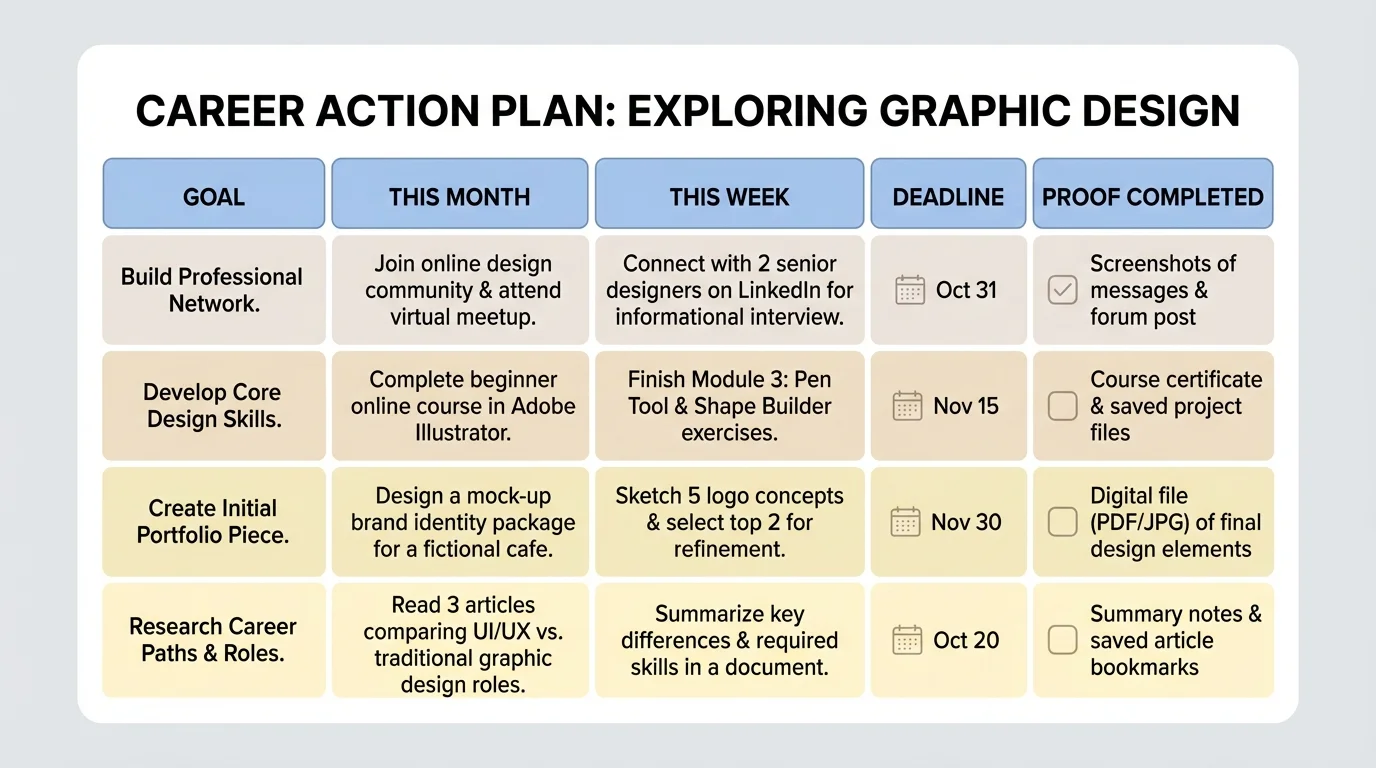
Notice what makes this work: every action is concrete, scheduled, and measurable. If you skip a week, the plan does not fail. You just restart. Consistency matters more than perfection.
How to build your own action plan
Step 1: Write one career direction.
Example: "I want to explore careers in sports medicine."
Step 2: Set one monthly goal.
Example: "By the end of the month, I will understand at least three sports medicine-related roles."
Step 3: Set weekly actions.
Week 1: research roles. Week 2: watch interviews or day-in-the-life videos. Week 3: contact one professional. Week 4: compare training paths.
Step 4: Decide how you will track it.
Use a notes app, calendar, spreadsheet, or printed checklist.
This is how a goal turns into movement.
The planning chart in [Figure 3] also reminds you that deadlines and proof matter. If a task has no deadline, it easily gets delayed. If a task has no proof, it can feel completed when it really is not.
Most career plans hit obstacles. That does not mean the plan is wrong. It usually means the process is real. You may feel unsure, busy, underqualified, or nervous about reaching out to adults. Those feelings are common.
If you think, "I have no experience," remember that experience can start small. Helping manage a family schedule, tutoring, selling products online, caring for siblings, assisting at community events, organizing digital files, or running a social media page all build useful abilities. The key is learning how to describe those experiences professionally.
If you fear rejection, remember that unanswered messages are normal. Adults are busy. Send polite follow-ups, then move on. One ignored message does not mean you are unqualified. It means one person did not respond.
"You do not have to see the whole staircase, just take the first step."
— Martin Luther King Jr.
If your interests change, adjust your plan. That is a strength, not a failure. Maybe you thought you wanted coding and discovered you prefer digital design. Maybe you wanted nursing and learned you are more interested in health administration. A plan should be flexible enough to grow with your knowledge.
Another obstacle is time. If your schedule is full, use small blocks. A focused 20-minute session can still move you forward: one message sent, one role researched, one course lesson completed, one project sample improved. Progress often looks smaller in real life than it does in motivational videos, but it still counts.
If you want a realistic place to begin, focus on the next 30 days. Do not try to solve your entire future in one weekend. Just build momentum.
Week 1: Choose one field to explore and write down why it interests you. Make a list of your current strengths and at least three skills you need to improve.
Week 2: Research three roles in that field. Save notes on what those jobs involve, what education or training they usually require, and what entry-level experience helps.
Week 3: Reach out to one or two people for career advice. Keep your message respectful and short. Ask for insight, not a favor.
Week 4: Begin one skill-building step. That could be a short course, volunteer experience, project, certification, or practice routine. Then decide your next monthly goal.
You already use planning skills in everyday life when you manage deadlines, organize responsibilities, or prepare for something important. Career planning uses the same habit: break a large goal into smaller actions and follow through.
Try This: open a notes app or document today and create four headings: Career Direction, People to Contact, Skills to Build, and Next Steps. Under each heading, write at least two items. A simple written plan is stronger than a vague mental plan.
Try This: choose one message you can send this week. It could be to a relative, community leader, former supervisor, or someone in a field you want to understand better. Keep it professional and specific.
Try This: create one piece of evidence that shows effort. That might be a mini portfolio sample, a certificate from an online lesson, a reflection after a volunteer activity, or a list of jobs and training paths you researched.
The roadmap from earlier in [Figure 1] still applies here: know yourself, pick a direction, build relationships, develop skills, and keep moving. You do not need a perfect plan. You need a useful one.
