Some of the most useful career skills do not start with a job title. They start when you try to solve a real problem for someone else. Maybe you edit short videos for local creators, sell custom digital study guides, offer pet sitting in your neighborhood, run a small lawn-care service, or design simple logos online. A small project can teach you more about responsibility, communication, and decision-making than waiting for the "perfect" opportunity. The key is not just starting. It is knowing how to launch something manageable, handle problems, and keep improving.
When you run even a tiny project, you are practicing the kind of thinking employers, clients, and future business owners use every day. You have to decide what you offer, who it helps, how much it costs, what could go wrong, and how you will respond when things change. That is where project scope, money tracking, feedback, and flexibility become real skills instead of just ideas.
Small project or service means a limited, manageable activity that creates value for others, such as tutoring, car washing, social media help, handmade products, or digital design work.
Risk assessment means identifying what might go wrong, estimating how serious it would be, and planning how to reduce the damage.
Customer feedback is information people give you about their experience, including what worked, what confused them, and what they want improved.
A good small project is not huge, expensive, or complicated. It is clear. If you can explain it in one sentence, you are usually off to a better start. "I create custom birthday invitation graphics within 48 hours." "I walk dogs after school on weekdays." "I offer beginner guitar coaching over video call." Clear projects are easier to market, price, and improve.
Your first move is to choose a project that solves a specific problem. People do not buy random effort. They buy outcomes. A busy parent may need a reliable dog walker. A small business owner may need simple social media posts. A student may need tutoring before a test. Ask yourself three questions: Who needs this? What problem does it solve? Why would someone choose me?
Keep your first version small. This is often called a minimum viable product, or the simplest useful version of what you offer. If you are starting a baking service, do not launch with ten flavors, custom packaging, and delivery across town. Start with one or two products, a pickup option, and a short order form. Smaller scope means fewer mistakes, less wasted money, and faster learning.
It also helps to define your limits. Decide what you will do and what you will not do. If you offer tutoring, maybe you help with algebra homework online for students in middle school, but you do not promise last-minute test prep at midnight. Boundaries protect your time and make your service more professional.
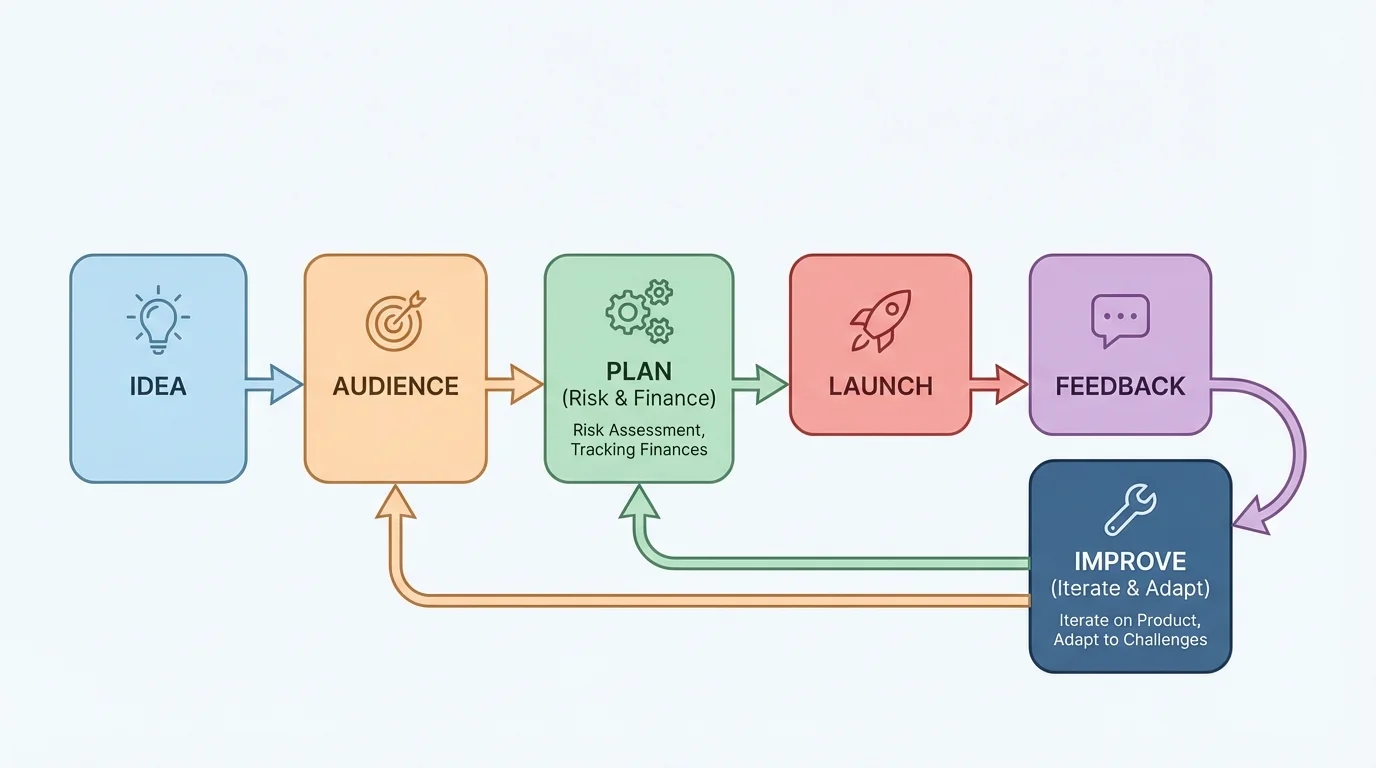
A simple plan keeps your project from turning into stress and confusion. As [Figure 1] shows, small projects work best when you move through a clear sequence: idea, audience, plan, launch, feedback, and improvement. You do not need a giant business document. You need a working plan you can actually use.
Write down five basics: your goal, your audience, your tasks, your timeline, and your success measures. If your project is "weekend yard cleanup," your goal might be to get three paying clients in one month. Your audience might be neighbors within a short travel distance. Your tasks include advertising, answering messages, buying supplies, doing the work, and asking for reviews. Your timeline shows when each step happens. Your success measures could include number of bookings, repeat customers, and whether you stay within your budget.
Choose tools that are simple enough to maintain. A notes app, spreadsheet, calendar, and message template may be all you need. The best system is the one you will consistently use. If you create a complicated tracker and stop updating it after three days, it is not helping you.
It is also smart to estimate your time honestly. If a logo design usually takes you two hours, do not promise a one-hour turnaround just because you want customers quickly. Underestimating time creates late work, stress, and disappointed clients. Over time, accurate planning becomes one of your strongest professional habits.
Quick planning example: online tutoring service
Step 1: Define the offer
You offer one-on-one online math help for students in grades 7 through 9, with sessions lasting 45 minutes.
Step 2: Set a goal
Your first-month goal is 4 sessions with at least 2 returning students.
Step 3: List tasks
Create a short ad, set your availability, prepare a booking form, and create a simple payment and reminder system.
Step 4: Decide how to measure success
Track bookings, completed sessions, no-shows, and customer satisfaction after each session.
This kind of plan is short, clear, and practical.
If you skip planning, small problems grow fast. You might book too many people, forget costs, or promise things you cannot deliver. A short plan does not make your project rigid. It gives you something solid to adjust from.
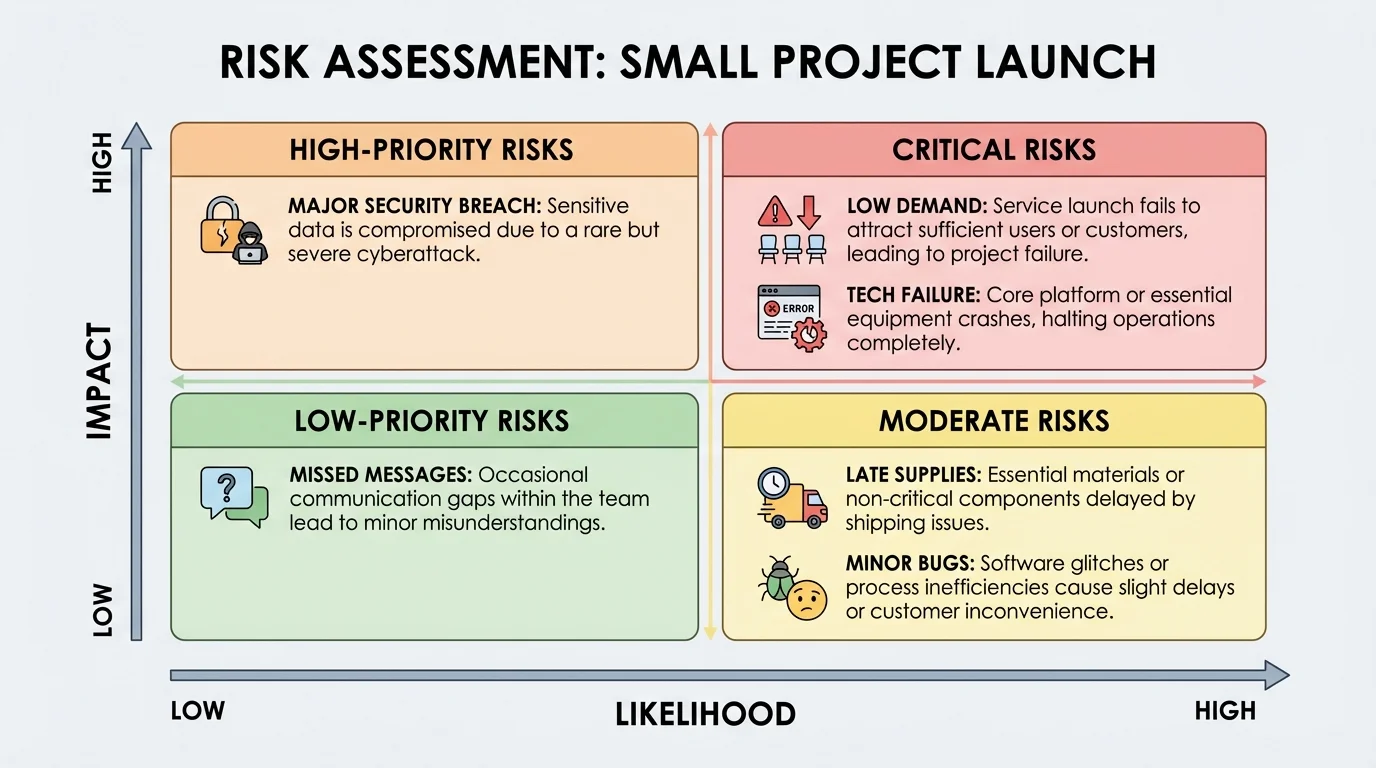
Most projects do not fail because of one giant disaster. They struggle because small, predictable problems were ignored. A risk matrix helps you see which risks need the most attention, as [Figure 2] illustrates. Instead of worrying about everything equally, you focus on what is both likely and damaging.
Start by listing possible risks. Think in categories: time, money, technology, safety, demand, communication, and quality. If you run a car-washing service, a risk could be bad weather. If you sell digital art, a risk could be missed deadlines or file format problems. If you tutor online, a risk could be internet failure or cancellations.
Then rate each risk by likelihood and impact. You can use a simple scale from 1 to 5. For example, if late customer replies are common but not too serious, that risk might be likelihood 4 and impact 2. A payment app outage might be likelihood 2 and impact 4. You do not need perfect math. You need a consistent way to compare problems.
One simple way to prioritize is multiplying the two ratings. If a risk has likelihood 4 and impact 5, then its score is \(4 \times 5 = 20\). If another risk has likelihood 2 and impact 2, then its score is \(2 \times 2 = 4\). The higher score deserves more attention first.
Good risk assessment is not fear. It is preparation. The point is not to convince yourself that something will go wrong. The point is to decide in advance what you will do if it does. That turns panic into a plan.
For each important risk, create a response. This usually falls into one of four actions: avoid it, reduce it, prepare for it, or accept it. You might avoid a risk by not taking rush orders. You reduce a risk by confirming appointments the day before. You prepare for a risk by having backup internet or a second payment option. You accept a small risk if fixing it would cost more than the problem is worth.
Think about safety and trust, too. If your project involves entering homes, handling food, watching children, walking dogs, or meeting new people, you need strong boundaries and communication. Let a family member know where you are. Use written agreements. Do not take on tasks that are beyond your experience or unsafe for your age.
Risk example: small baking service
Step 1: List risks
Late ingredient delivery, underpricing, food allergy misunderstanding, and last-minute cancellations.
Step 2: Rate them
Food allergy misunderstanding may have low likelihood but very high impact. Underpricing may have high likelihood and medium impact.
Step 3: Plan responses
Use ingredient labels, ask allergy questions in writing, order supplies early, and require deposits for custom orders.
That one page of planning can prevent expensive mistakes and protect people.
Later, when you face a real challenge, you will respond faster because you already thought it through. That is the practical value of risk assessment.
A lot of small projects feel successful until the money is counted. You may be busy, but busy is not the same as profitable. Your cash flow shows how money moves in and out of your project, and [Figure 3] displays a simple way to track it. If you do not track your numbers, you can end up working hard for very little return.
Start with three categories: startup costs, ongoing costs, and income. Startup costs are one-time purchases like tools, packaging, or software. Ongoing costs are things you keep paying for, such as ingredients, gas, printing, or platform fees. Income is the money customers pay you.
The basic idea of profit is simple:
\[\textrm{profit} = \textrm{income} - \textrm{expenses}\]
If you earn $120 from tutoring in one week and spend $15 on materials and $5 on scheduling software, your expenses are $20. Your profit is \(120 - 20 = 100\), so your profit is $100.
Pricing matters here. If one bracelet costs $3 in materials and takes one hour to make, charging $4 is probably too low because it leaves almost nothing for your time. Even if your numbers are simple, they should be honest. Include all costs you can reasonably track.
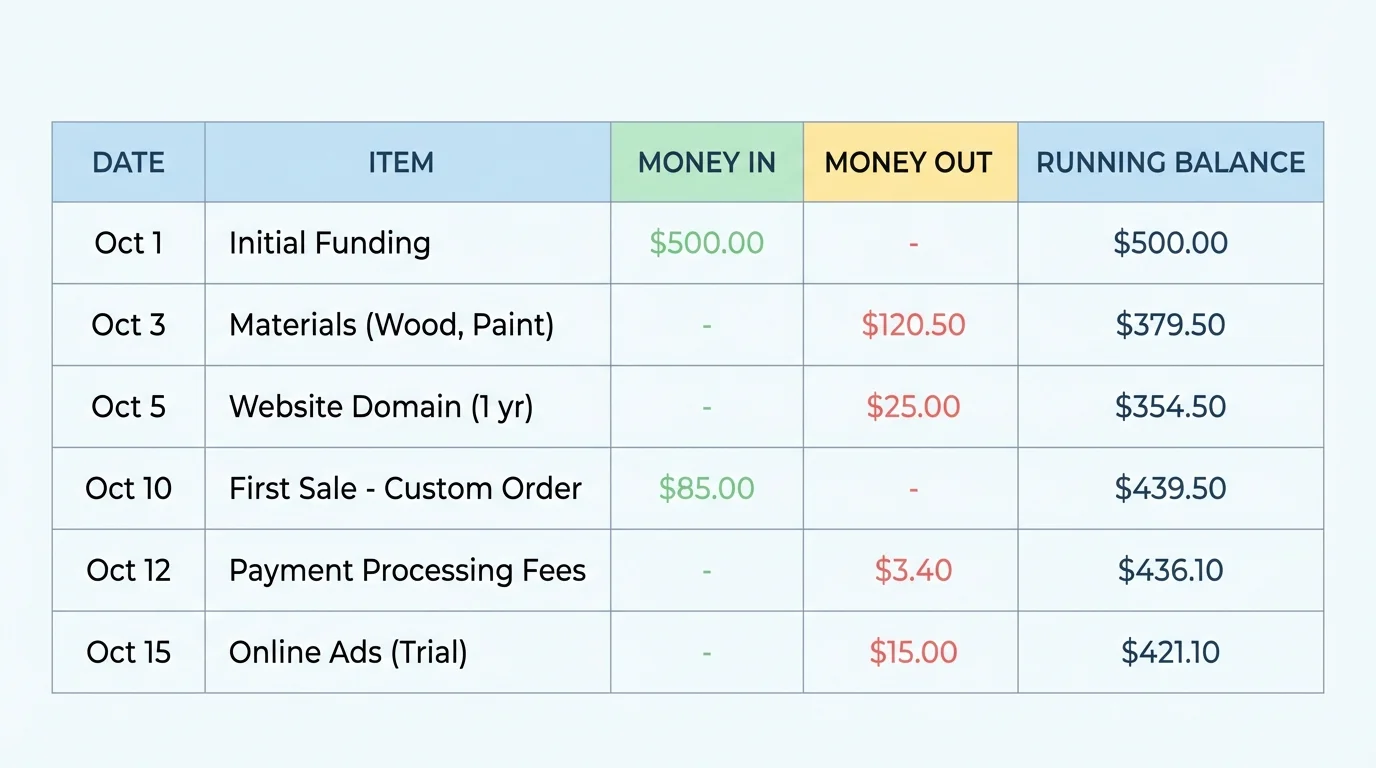
You do not need accounting software to begin. A basic table works well.
| Date | Item | Money In | Money Out | Running Balance |
|---|---|---|---|---|
| June 3 | Flyers printed | $0 | $12 | -$12 |
| June 5 | Dog walk booking | $18 | $0 | $6 |
| June 6 | Leash bags | $0 | $4 | $2 |
| June 7 | Dog walk booking | $18 | $0 | $20 |
Table 1. Example of a simple finance tracker for a small service.
Watch your balance over time. A project can be profitable overall but still have short-term problems if you spend money before customers pay. That is why cash flow matters, not just total profit. As you saw in [Figure 3], a running balance helps you catch those moments early.
Pricing example
Step 1: Add direct costs
You spend $6 on supplies for a custom gift basket.
Step 2: Add other realistic costs
You spend $2 on packaging and delivery mileage.
Step 3: Decide on a price above your total cost
Your total cost is \(6 + 2 = 8\), so charging $15 gives you \(15 - 8 = 7\) in profit before any extra fees.
That does not guarantee success, but it gives you a smarter starting point.
Keep personal money and project money as separate as possible, even if that only means using different rows in your tracker and labeling every transaction clearly. Messy records create confusion fast.
Many people delay launching because they want everything to be flawless. But waiting too long often means you learn too slowly. A smart launch is clear, small, and reliable. You make sure customers know what you offer, how to book, what it costs, and how long it takes.
A soft launch can help. That means starting with a limited audience, such as family friends, neighbors, or a small online group, before trying to grow bigger. This gives you a chance to test your process, fix confusing steps, and build confidence. A few successful first customers are more valuable than a wide launch that creates chaos.
Your communication should answer basic customer questions before they ask them. Include what the service is, who it is for, the price, how to contact you, and when they can expect results. If you leave these details vague, people hesitate or get frustrated.
Launch day is really a system test. Are your messages organized? Do you know your schedule? Do you have what you need to deliver? Can you handle one change without falling apart? Strong launches look calm because the preparation happened earlier.
Feedback is one of the fastest ways to improve, as [Figure 4] shows through a simple cycle of asking, sorting, deciding, and improving. But not all feedback is equally useful. "It was okay" tells you almost nothing. Good feedback is specific enough to guide a decision.
Ask short, practical questions. For example: What did you like most? What was confusing or inconvenient? Would you use this again? What would make it better next time? If you sell a product, ask about quality, price, packaging, and delivery. If you provide a service, ask about communication, timing, and results.
You can gather feedback through a quick text message, a short online form, a follow-up email, or a direct message after the job is done. Keep it simple so people actually respond. The goal is not to impress people with a long survey. The goal is to learn something useful.
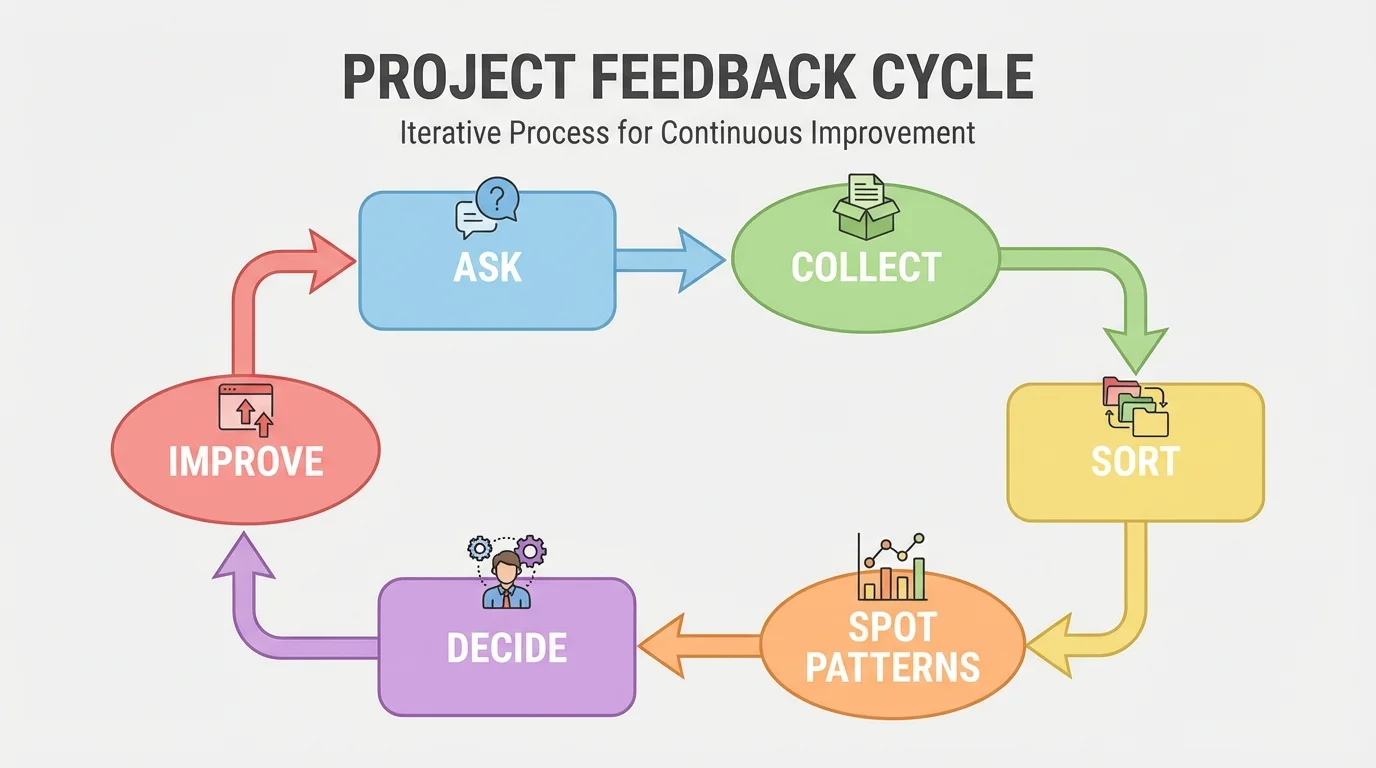
Once feedback comes in, sort it into patterns. One person saying your price is too high does not automatically mean you should lower it. But if several people say your booking process is confusing, that is a pattern. Look for repeated comments, especially when they connect to sales, delays, or customer satisfaction.
Businesses often learn more from a few detailed comments than from a large number of vague compliments. Clear criticism can be more useful than praise because it gives you something specific to fix.
It also matters how you respond. If someone gives fair criticism, do not argue right away. Thank them, review the situation, and decide whether the issue points to a real weakness in your system. Professionalism shows most clearly when things are not perfect.
Later, when you update your process, you can return to the same loop shown in [Figure 4]. Good projects do not treat feedback as a one-time event. They build it into the routine.
To iterate means to make repeated improvements based on what you learn. This is how strong projects grow. You do not need to change everything at once. In fact, small changes are usually better because you can tell what actually helped.
Suppose you offer phone repair tutorials online and people keep asking for shorter videos with clearer titles. Instead of rebuilding your entire channel, test one change at a time. Make the next three videos shorter. Use clearer thumbnails or labels. Then compare the response. Did watch time improve? Did more people finish the video? Did questions decrease?
Iteration works best when it is tied to evidence. Make a short note of what you changed, why you changed it, and what happened afterward. Otherwise, you may keep changing things randomly and never know what really made the difference.
Improvement beats perfection. The goal is not to launch one flawless version. The goal is to keep moving toward a version that works better for real people in real conditions.
Sometimes the best improvement is not in the product itself. It might be your response time, your instructions, your packaging, your booking system, or the way you set expectations. Customer experience includes all of that.
Challenges are not a sign that your project was a bad idea. They are part of running anything real. The question is whether you react emotionally or strategically. If bookings drop, ask why. If a customer leaves a bad review, separate the facts from the feeling. If you are overwhelmed, look at your system before blaming yourself.
Common problems include low demand, underpricing, poor scheduling, inconsistent quality, late communication, supply issues, and burnout. Each problem needs a different response. Low demand may mean your target audience is wrong or your message is unclear. Burnout may mean your prices are too low for the time required, or you are accepting too much work at once.
One of the smartest responses is to shrink before you grow. If your service is messy, reduce the number of options, shorten your service area, or limit your hours. A smaller, reliable system usually earns more trust than a larger, chaotic one.
If someone is unhappy, respond calmly and clearly. A useful structure is: acknowledge, clarify, offer a reasonable next step. For example: "Thanks for telling me. I understand the delay was frustrating. I had a scheduling problem on my end. I can offer a revised delivery time by tomorrow or a partial refund." That kind of response protects your reputation better than excuses or silence.
"Plans are useful because reality changes."
— Practical project mindset
Adapting also means knowing when to stop, pause, or redesign. Some ideas are worth improving. Others teach you something and should be left behind. That is not failure. That is informed decision-making.
The projects that last are usually not run by the most talented people. They are run by the most consistent people. Keep records. Reply within a reasonable time. Confirm details in writing. Meet deadlines you promise. If you cannot meet one, communicate early. Reliability makes people trust you.
Document what works. Save message templates, price lists, checklists, and common customer questions. Over time, this becomes your own playbook. It saves time and reduces mistakes.
Set boundaries that protect your energy and school-life balance. Decide your work hours, response hours, and the kinds of jobs you accept. If you are available all the time, your project can take over your life and your quality can drop. Strong boundaries are professional, not rude.
As you continue, review your progress every few weeks. Ask: What is earning money? What causes stress? What do customers praise? What keeps going wrong? Which risks from earlier actually happened, as we saw in [Figure 2], and which ones no longer matter? What should I stop doing? The best managers are willing to notice reality and respond to it.
Launching and managing a small project is really practice for bigger responsibilities later. Whether you eventually freelance, start a business, lead a team, or simply want to be more capable, these habits carry forward. You learn to make decisions with limited time, limited money, and real consequences. That is powerful experience.
Try this: write a one-sentence description of a project or service you could realistically test in the next month. Then list one likely customer, three startup tasks, two major risks, one simple way to track money, and one feedback question you would ask after the first sale. That small plan is often enough to turn an idea into action.
