Every time you scroll, click, search, like, or buy, a digital system is making small decisions about what appears around you. It decides what appears first, what gets hidden, which ad follows you, and sometimes which causes or news stories feel urgent. That means your phone is not just a tool you use. It is also an environment that shapes what you notice, trust, and do.
For your generation, digital life is not separate from "real life." It is where you read news, compare products, sign up for events, support causes, communicate with organizations, and manage your identity. Because of that, understanding digital systems is a practical life skill. It helps you avoid manipulation, protect your privacy, and make choices that actually reflect your values instead of someone else's business model.
Digital systems are the connected tools, platforms, software, devices, and data processes that collect information, sort it, and influence what people see and do online.
Privacy is your ability to control who gets access to your personal information, behavior, location, and communications.
Consumer choice is the process of deciding what to buy, subscribe to, or support with your money.
Civic participation is taking part in public life, such as learning about issues, contacting leaders, joining campaigns, volunteering, voting when eligible, or speaking out on community concerns.
Digital systems can be useful, efficient, and empowering. They help people find emergency updates fast, compare prices in seconds, and organize support for important issues. But they can also distort reality, reward emotional reactions over careful thinking, and gather more data than most users realize. The key skill is not avoiding technology altogether. It is learning how to use it with awareness.
Many digital tools are designed to be convenient, but convenience often comes with trade-offs. If an app is free, the company may still profit from your attention, your behavior, or your data. If a platform keeps you engaged longer, it can sell more ads. If a shopping site learns your habits, it can push products more effectively. These systems are not neutral. They are built with goals.
That does not mean every platform is harmful. It means you should ask better questions: Who benefits if I click this? Why am I seeing this first? What data is being collected? Is this helping me make a clear decision, or is it steering me toward a faster, more emotional one?
Small design details can strongly affect behavior. A button color, countdown timer, autoplay setting, or default privacy option may look minor, but each one can push users toward a specific action without them fully noticing.
Once you understand that digital systems are built to guide behavior, you can start noticing patterns instead of just reacting to them.
Algorithms help decide which posts, videos, news stories, and campaigns get attention, and this changes how people participate in civic life. A message about a local issue may spread widely or disappear quickly depending on timing, engagement, and platform rules. This matters because what you see often shapes what you believe is important.
[Figure 1] Digital systems make civic participation easier in some ways. You can learn about local elections, find registration deadlines, contact public officials, donate to relief efforts, join a community meeting by video call, or support a petition in minutes. Someone who cannot attend an in-person event may still participate online. That increases access.
But speed and access come with problems. False claims can spread faster than corrections. Emotionally charged content often gets more engagement than careful explanation. A dramatic post may make a problem seem bigger, smaller, simpler, or more one-sided than it really is. If you only see content that matches your existing beliefs, your understanding can become narrow.
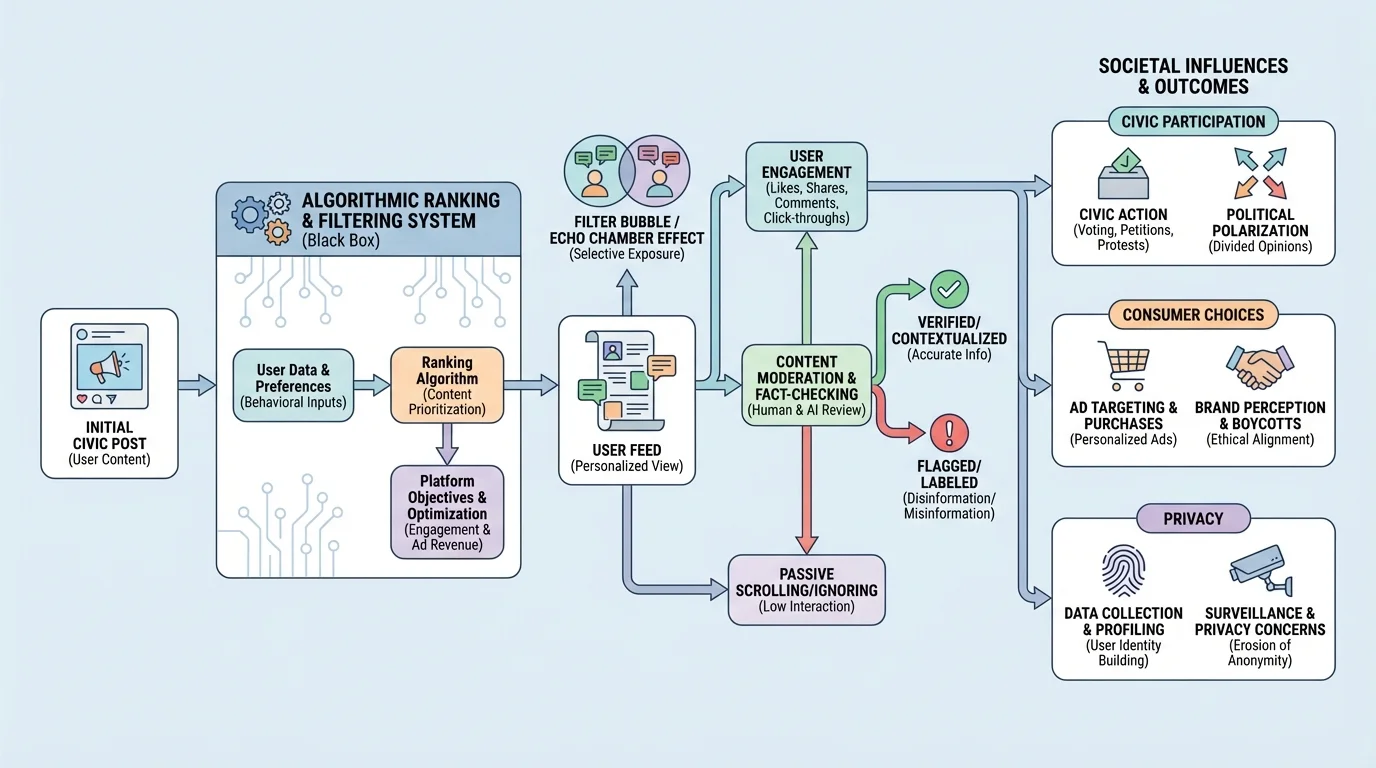
This is where misinformation becomes dangerous. A false post about voting rules, emergency aid, a protest, or a public health issue can discourage people from acting, scare them into bad decisions, or create unnecessary conflict. Sometimes the person sharing it means well. Intent does not erase harm.
Civic participation online is strongest when it goes beyond quick reactions. Reposting a slogan may raise awareness, but deeper participation usually involves checking facts, reading multiple sources, understanding the issue, and taking a concrete step. That step could be emailing a city council member, attending a virtual town hall, researching a ballot measure, or helping a local organization share accurate resources.
From awareness to action
Digital platforms often make awareness feel like action. Seeing, liking, and reposting can matter, but they are not always enough. Real civic impact usually requires moving from attention to informed action: verify the claim, learn what the issue actually involves, and choose a step that helps in the real world.
A practical question to ask yourself is: "What am I being asked to do, and do I have enough trustworthy information to do it responsibly?" That question protects you from being manipulated by urgency alone.
Later, when you compare online campaigns, remember the chain shown in [Figure 1]: a platform does not just host civic content; it ranks, spreads, and filters it. That means visibility is not the same as truth or importance.
Your shopping decisions are shaped by more than product quality and price. A clear buying path and a manipulated one can feel very different, and that difference matters because digital stores can influence your choices before you even realize you are deciding. Product placement, recommendations, reviews, influencer promotions, limited-time offers, and app design all affect what feels appealing or urgent.
[Figure 2] One major force is personalization. When a platform tracks what you watch, search, click, or leave in your cart, it can tailor suggestions specifically for you. That can be helpful if you are trying to find running shoes in your size or compare laptops in your budget. But it can also trap you in a cycle of repeated nudges that make buying feel more necessary than it really is.
Another influence is social proof. Reviews, ratings, unboxing videos, and influencer endorsements can create the feeling that "everyone" approves of a product. Sometimes those signals are useful. Sometimes they are misleading. Fake reviews, sponsored recommendations that are not clearly disclosed, and selective testimonials can push you toward a poor purchase.
Dark patterns are design tricks that push users into actions they might not freely choose, such as signing up for a subscription, sharing more data, or making cancellation difficult. Examples include a countdown timer that resets, a prechecked box for add-on services, a giant "accept all" button for tracking, or tiny gray text for "decline."
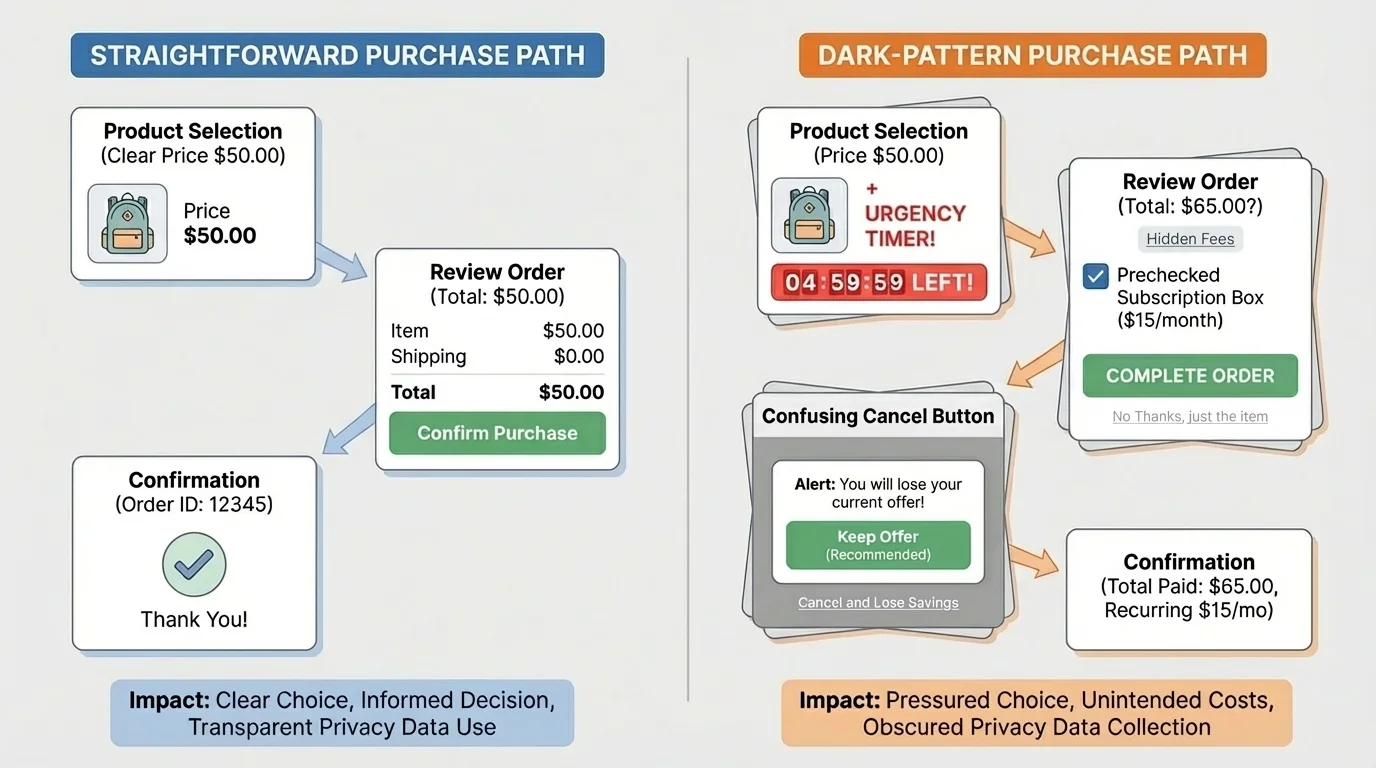
Think about a common scenario. You click on a hoodie advertised for $30. At checkout, extra shipping, a handling fee, and an automatically added protection plan raise the total to $48. Then the site offers "Buy now before stock runs out in 2 minutes." That pressure is designed to reduce careful thinking. Even if the total cost still fits your budget, the decision is no longer fully clear.
Subscription services work the same way. A free trial can turn into an automatic monthly charge if you do not cancel in time. If the company makes cancellation hard to find, that is not an accident. It is a business strategy.
| Digital influence | How it affects you | Smart response |
|---|---|---|
| Targeted ad | Shows products based on your behavior | Ask whether you wanted the product before seeing the ad |
| Influencer recommendation | Makes a product feel trustworthy or trendy | Check if it is sponsored and compare outside reviews |
| Urgency timer | Creates pressure to act fast | Pause and verify whether the deal is real |
| Prechecked boxes | Adds services or sharing permissions | Review every checkbox before paying |
| Personalized feed | Repeats similar products until they feel necessary | Search independently on another site before buying |
Table 1. Common digital shopping influences, their effects, and practical responses.
Good consumer decision-making online means slowing down enough to separate what you want from what the platform wants. That one pause can save money, protect your data, and reduce regret.
Case study: buying headphones online
You see wireless headphones promoted by a creator you follow. The ad says "today only," and the product page shows a high rating.
Step 1: Check the source of trust
Look for signs the creator was paid to promote the item. Then read reviews on at least two other sites, not just the seller's page.
Step 2: Check the real price
Add shipping, taxes, and any warranty or subscription options before deciding. A listed price of $39 may become much higher at checkout.
Step 3: Check whether the urgency is real
Leave the page and return later, or search the item on another platform. If the timer resets or the same "limited" offer keeps appearing, that pressure is likely artificial.
Step 4: Compare based on your needs
Ask what matters most: sound quality, battery life, comfort, durability, or return policy. Buying the most promoted product is not the same as buying the best fit.
This approach turns an emotional purchase into an informed one.
When you look back at [Figure 2], notice that the manipulated path works by increasing confusion and urgency. The safer path keeps information visible and choices reversible.
Privacy usually does not disappear in one dramatic moment. It is often chipped away through many small permissions, habits, and defaults. A weather app wants location, a game wants contacts, a website wants cookies, and a social platform wants access to your camera and microphone. Each request may sound harmless on its own.
[Figure 3] Metadata is data about your data, such as when you sent a message, where you were, what device you used, or how often you contacted someone. Even without reading the content of your messages, metadata can reveal routines, relationships, and patterns. That is why privacy is not only about secrets. It is also about control.
Companies may collect browsing history, location data, purchase history, device identifiers, search terms, watch time, and click patterns. Some of that data is used for convenience, such as remembering your login or recommending a song. Some is used for ad targeting, behavior prediction, and profiling.
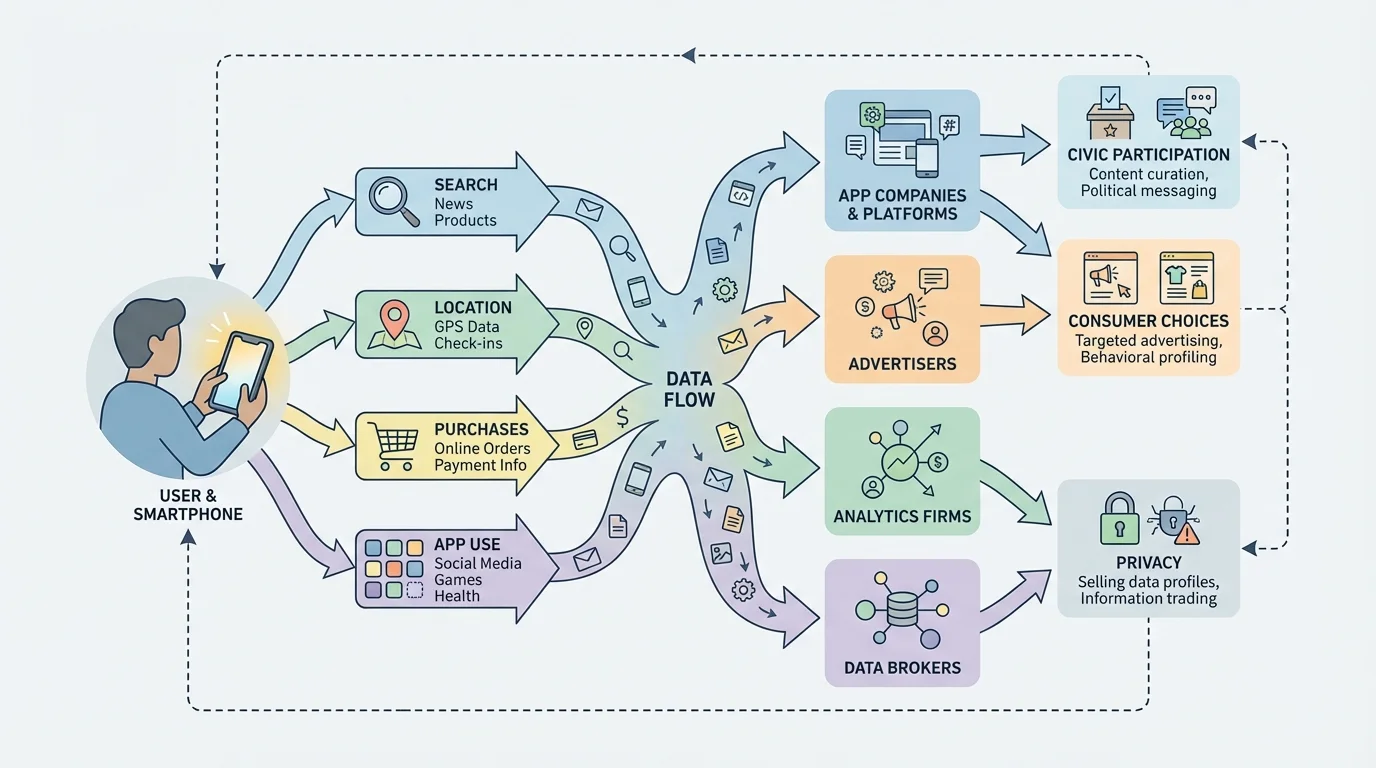
Data brokers are companies that collect, combine, buy, and sell information about people. They may build detailed profiles from public records, online activity, app data, and purchase data. You may never directly interact with them, but they can still know a surprising amount about your interests, age range, location patterns, and likely habits.
This matters in real life. Stolen or overshared personal information can lead to identity theft, account takeovers, scams, stalking risks, embarrassing leaks, or decisions being made about you based on inaccurate profiles. A future employer, college, insurer, or landlord may not see everything about you, but your digital footprint can still affect opportunities.
Privacy and power
Privacy is not just about hiding bad behavior. It is about preventing other people or organizations from having unfair power over your choices, your reputation, your safety, or your future. When others know more about you than you realize, they can predict and influence you more easily.
A useful rule is this: if an app asks for access, ask whether that permission is necessary for the app's basic function. A map app needs location. A flashlight app does not need your contacts.
The data pathways in [Figure 3] also explain why deleting one post does not always erase the larger record. Data may already have been copied, shared, stored, or inferred from your activity.
An filter bubble happens when digital systems keep showing you similar ideas, products, or viewpoints based on your past behavior. Over time, that can make your online world feel complete even when it is narrow. You may think, "This is what everyone is saying," when really it is what the system has learned you are likely to engage with.
The attention economy rewards content that keeps users on a platform. That often means emotionally intense material, novelty, conflict, and constant updates. Calm, careful, nuanced content may be accurate but less likely to spread widely. This affects both civic participation and consumer decisions. Outrage sells attention; attention sells ads.
Platform design can also create habits. Autoplay, endless scroll, push notifications, streaks, badges, and recommendation loops reduce natural stopping points. If you spend an extra hour reacting instead of thinking, the platform benefits, even if you do not.
Recommendation systems do not need to "understand" you like a human does. They only need enough behavioral data to predict what you are likely to click next, and those predictions can still shape your beliefs, spending, and time.
This is why self-awareness matters. If your mood, fear, or curiosity is being used to increase engagement, your choices may feel personal while being heavily steered.
A simple pause-and-check routine prevents many digital mistakes, and it can be organized into decisions you can use before sharing, buying, or granting access. You do not need to become paranoid. You need reliable habits.
[Figure 4] When you see a civic claim online, start with source checking. Who posted it? Is the source original, qualified, and transparent? Can you confirm it through another credible source? Does the post pressure you to act immediately before you can verify anything? Urgency is often used to bypass judgment.
When shopping online, compare beyond the first result. Search the item on more than one platform. Read recent reviews, not just the average score. Check the return policy, shipping cost, and whether the product is from a verified seller. Screenshot or save receipts and confirmations.
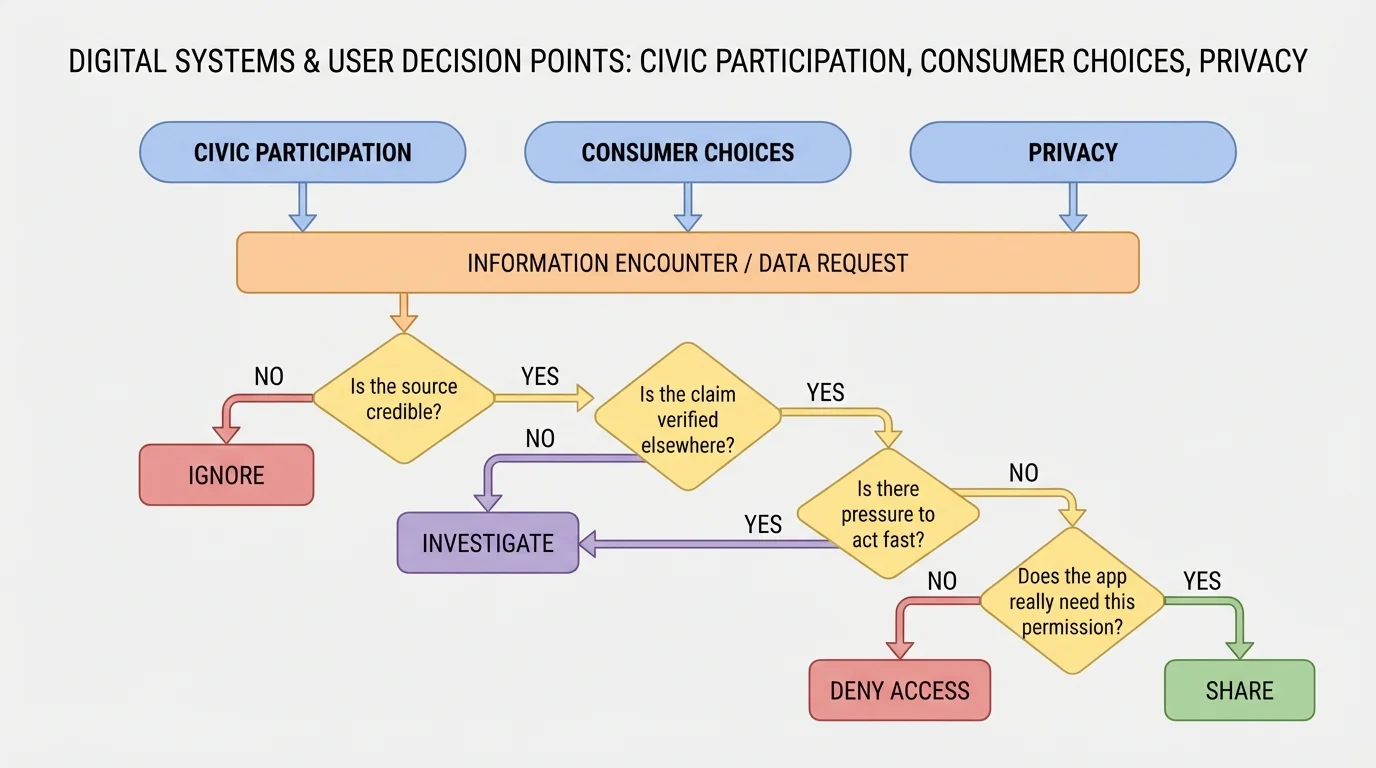
For privacy, review app permissions regularly. Turn off location sharing for apps that do not need it. Use strong, unique passwords and a password manager if possible. Enable two-factor authentication on important accounts like email, banking, and primary social accounts. Your email account is especially important because many password resets go there.
Also check your settings for ad tracking, personalized ads, and account visibility. Default settings usually favor the platform, not the user. It is worth taking ten minutes to change them.
Quick decision framework for daily use
Step 1: Pause
Before clicking, sharing, buying, or allowing access, stop for a few seconds.
Step 2: Identify the push
Ask whether the system is using urgency, emotion, convenience, or social pressure.
Step 3: Verify
Check the source, the cost, or the permission request using a second source or your settings menu.
Step 4: Decide intentionally
Choose the action that matches your goals, not just the easiest button on the screen.
This framework works for news posts, charity appeals, shopping deals, app permissions, and account security decisions.
As you use this routine, [Figure 4] becomes less of a chart and more of a habit. The goal is not to overthink every click. It is to notice when a high-stakes click deserves more than an automatic response.
Suppose a post says a local policy change will "take effect tomorrow" and urges people to flood an office with messages immediately. If you share it without checking, you may spread inaccurate information. If you verify it first and find the official notice, you help others respond effectively instead of chaotically.
Suppose a creator promotes a "must-have" study app with a free trial. You sign up quickly, forget the renewal date, and get charged monthly. A better approach is to set a calendar reminder the same day you enroll, review the cancellation steps immediately, and ask whether a free alternative already meets your needs.
Suppose a quiz app asks for your birthday, contacts, microphone, exact location, and photo access even though it only provides trivia games. That is a sign to deny most permissions or skip the app entirely. Good digital citizenship includes protecting yourself from unnecessary collection.
"If you are not paying for the product, you are probably part of the product."
— Common digital media warning
This quote is not always literally true, but it captures an important idea: free services often make money through your attention, your behavior, or your data.
The strongest protection is not a single app or setting. It is a set of habits. Follow multiple trustworthy news sources instead of one feed. Separate "research mode" from "scroll mode" when you need accurate information. Keep shopping wish lists for at least a day before buying nonessential items. Review your privacy settings once a month. Remove apps you no longer use.
You can also reduce manipulation by creating friction on purpose. Turn off autoplay. Disable some notifications. Log out of shopping sites after browsing. Use a different browser for school, work, or serious research than for entertainment if that helps you separate recommendation patterns. These small choices help you take back attention.
Being a strong digital citizen does not mean rejecting technology. It means understanding that digital systems are built by people, for goals, and with trade-offs. Once you see that clearly, you can participate more thoughtfully, spend more wisely, and protect your privacy more effectively.
