One of the biggest myths about growing up is that independence means handling everything alone. Real independence is not about ignoring warning signs or staying in a bad situation to prove you are strong. It is about seeing problems clearly, trusting your judgment, and making choices that protect your safety, values, and future. That is especially true in relationships, where small risks can affect your emotions, time, reputation, finances, and even physical safety.
At your age, relationships can include dating, close friendships, group chats, online communities, teammates, coworkers, and people you meet through hobbies or part-time jobs. Some of these connections will be supportive and healthy. Others may involve pressure, dishonesty, control, or disrespect. Learning to recognize the difference prepares you to make decisions for yourself instead of being pushed into them by someone else.
Relationship choices do not stay inside the relationship. They affect whether you feel calm or constantly stressed, whether you can focus on schoolwork or a job, whether you keep your own friends and interests, and whether your online life stays private. A person who ignores your boundaries today may try to control bigger choices later, such as who you talk to, where you go, or what you share online.
When you recognize risks early, you are more likely to act before things get worse. That might mean slowing down a relationship, setting a clear limit, asking a trusted adult for advice, or ending contact. These are not overreactions. They are examples of healthy, independent decision-making.
Why risk recognition builds independence
Independent decision-making means you can gather information, notice patterns, evaluate consequences, and choose based on your values instead of fear, pressure, or guilt. In relationships, this skill helps you protect your emotional health, physical safety, time, digital privacy, and future goals.
Think about the difference between two students living at home. One feels free to say, "I am not comfortable with that," and acts when someone ignores the answer. The other keeps giving in because they worry about losing the relationship. The first student is practicing independence. The second is letting someone else make decisions for them.
A red flag is a warning sign that a relationship may be unhealthy or unsafe. One red flag does not always tell the whole story, but patterns matter. If troubling behavior keeps happening, gets stronger over time, or makes you feel smaller, trapped, afraid, or guilty, pay attention.
Common relationship risks include manipulation, lying, repeated disrespect, intense jealousy, pressure for sexual activity, attempts to isolate you from family or friends, and controlling behavior. Risks can also appear online, such as demanding passwords, tracking your location, checking your messages, posting private content, or pressuring you to send images or personal information.
Consent means a clear, informed, voluntary yes. It is not silence, pressure, fear, guilt, or giving in to avoid conflict.
Boundary means a limit you set to protect your comfort, safety, time, privacy, or values.
Autonomy means your right and ability to make choices about your own body, feelings, time, and life.
Some risks are obvious, such as threats or insults. Others are easier to miss because they may look like attention, concern, or passion at first. For example, constant texting can seem flattering until it turns into anger when you do not answer right away. "I just care about you" can become a cover for monitoring and control.
[Figure 1] offers a quick comparison that helps you notice patterns early. Healthy relationships support your choices and your growth. Risky relationships often shrink your world and make you doubt yourself.
Healthy people respect your time, communicate honestly, accept "no," and do not punish you for having your own life. Risky people may guilt-trip you, invade your privacy, test your limits, or act like your boundaries are a personal attack.
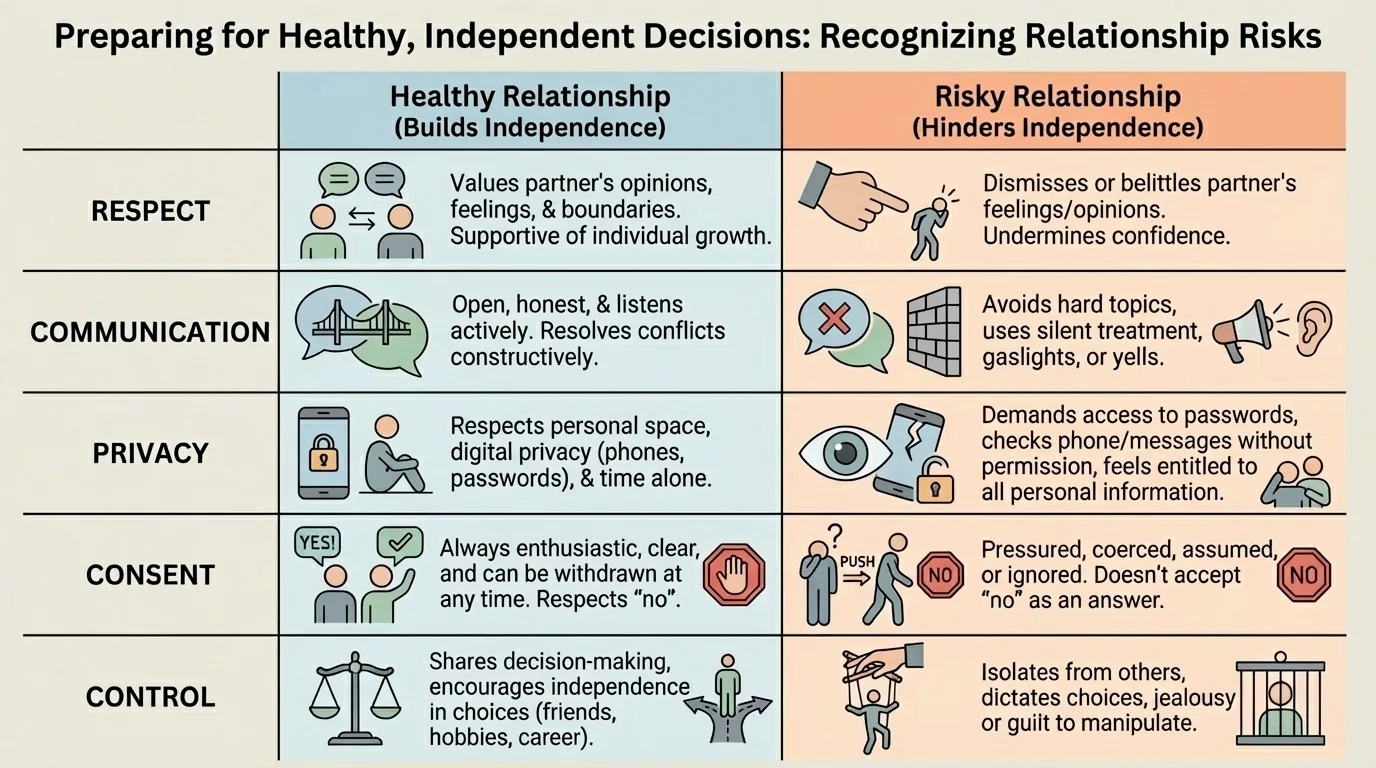
| Area | Healthy | Risky |
|---|---|---|
| Communication | Honest, calm, direct | Blaming, guilt-tripping, silent treatment |
| Boundaries | Respected without punishment | Ignored, mocked, pushed |
| Consent | Freely given and can be withdrawn | Pressured, assumed, or demanded |
| Privacy | Your accounts and devices stay yours | Password demands, checking messages, tracking |
| Independence | You keep friends, goals, routines | You are isolated or made to feel guilty for independence |
| Conflict | Problems are discussed respectfully | Threats, insults, intimidation, revenge |
Table 1. Comparison of common healthy and risky relationship behaviors.
You do not need a relationship to be "the worst possible" before taking concerns seriously. If something repeatedly leaves you anxious, unsafe, pressured, or confused, that alone matters. Your discomfort is information.
[Figure 2] shows how many unhealthy situations do not start with obvious danger. They start small and grow through escalation. A person may test one limit, see whether you accept it, and then push a little further.
For example, first they joke about who you follow online. Then they get upset when you message certain people. Next they ask for screenshots to "prove" what you are doing. After that, they may pressure you to share your location or stop talking to friends. The behavior did not appear all at once, but the pattern clearly moves toward control.
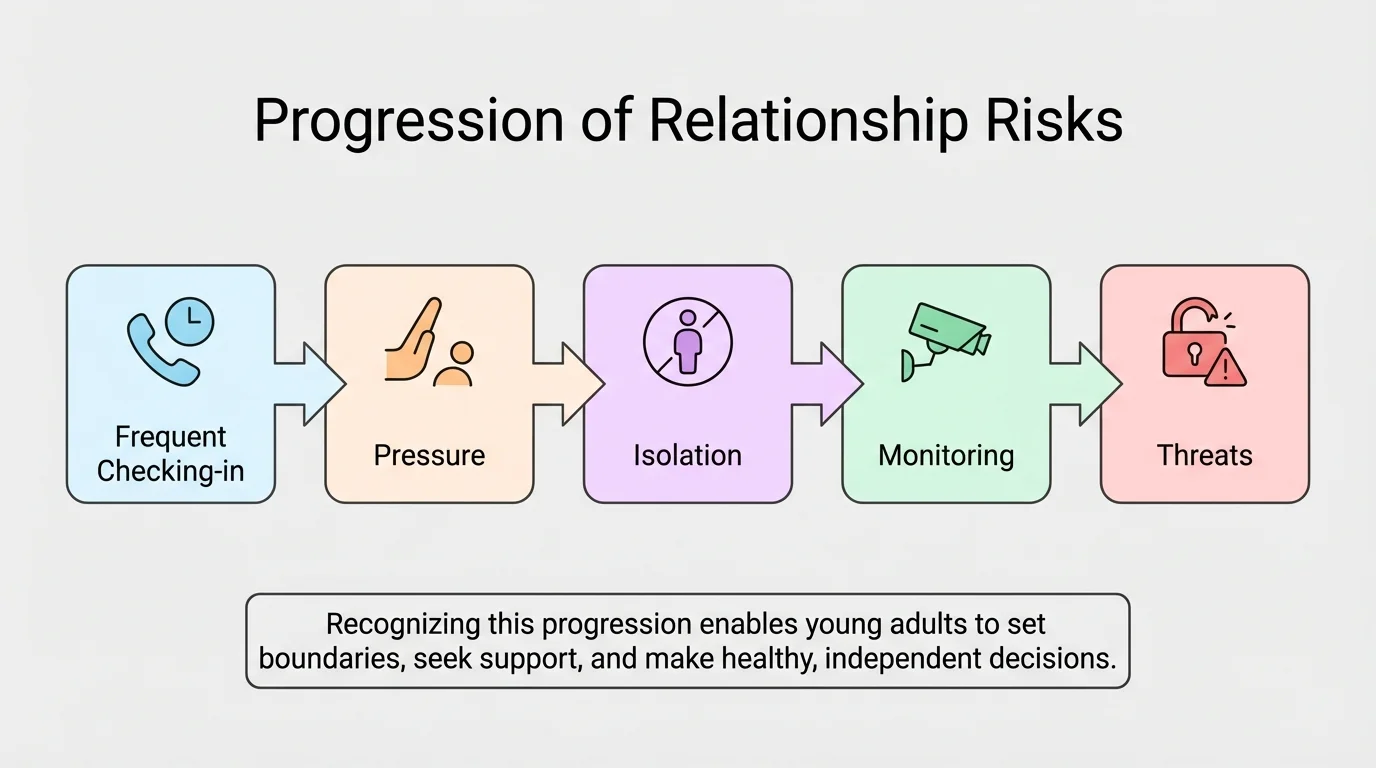
This is why small red flags matter. If you only watch for extreme behavior, you may miss the earlier signs that give you a chance to respond sooner. Looking back later, many people realize the serious problem was built out of smaller moments they talked themselves out of noticing.
People who are controlling do not always seem angry at first. They may appear extra attentive, extra protective, or intensely invested very quickly, which can make early warning signs harder to recognize.
Another reason risk escalates is that pressure can change your thinking. If someone repeatedly says you are overreacting, selfish, dramatic, or disloyal, you may begin to question your own judgment. That is one reason clear outside support matters.
Consent is not a one-time permission slip. It applies to physical affection, sexual activity, sharing personal details, posting photos, discussing private experiences, borrowing belongings, and using someone else's time or emotional energy. Consent must be freely given, and it can change at any moment.
Boundaries are how you protect that consent in real life. A boundary might sound like, "Do not read my messages," "I am not sending photos," "I need time with my friends," or "I am not comfortable riding with someone who has been drinking." These are not rude statements. They are responsible ones.
Your autonomy matters even if another person is disappointed. Someone else's frustration does not cancel your right to choose. A healthy person might feel let down, but they still respect your answer. A risky person treats your answer like a challenge to defeat.
Online spaces need boundaries too. If someone pressures you to keep a call on all night, answer instantly, share your passwords, or send content you do not want to send, that is not closeness. It is pressure. Digital behavior is real behavior, with real consequences.
"No is a complete sentence, and changing your mind is allowed."
It also helps to remember that consent under pressure is not true consent. If you say yes because you are afraid they will get angry, leave you, embarrass you, or spread something private, your decision is being controlled by fear. Healthy relationships do not require fear to function.
When something feels off, a repeatable process helps you avoid panic and think clearly.
[Figure 3] shows a decision path that turns a confusing situation into practical steps you can follow. You can use this framework in dating, friendships, online communities, and any close connection where someone has influence over your emotions or choices.
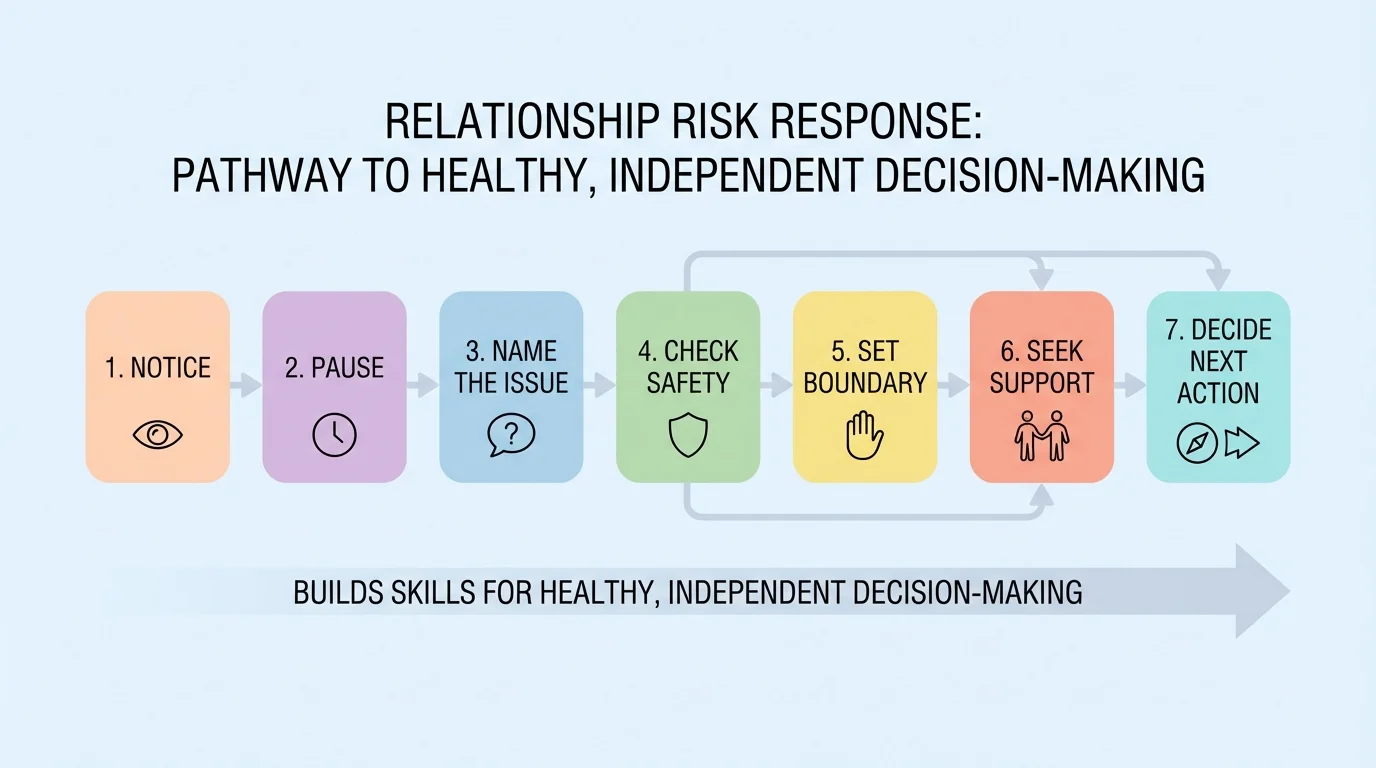
Step 1: Notice the pattern. Ask yourself what is actually happening, not what you hope it means. Is this a one-time mistake followed by accountability, or is it repeated behavior?
Step 2: Check how you feel. Do you feel safe, respected, and free to say no? Or do you feel nervous, guilty, pressured, watched, or trapped? Your emotional response is useful data.
Step 3: Name the issue clearly. Be specific. Instead of saying, "Something feels weird," say, "They got angry when I did not answer for one hour," or "They asked for my password after I said no." Clear language makes better decisions possible.
Step 4: Decide whether the issue is about skill or character. A skill problem may look like poor communication followed by genuine listening and change. A character problem may look like repeated lying, pressure, disrespect, or control. Character problems are more serious because they reveal values, not just mistakes.
Step 5: Set a boundary. Keep it direct and short. "I am not sharing that." "Do not speak to me like that." "If you keep pressuring me, I am ending this conversation."
Step 6: Watch the response. This is critical. Healthy people may not welcome every boundary, but they adjust. Risky people argue with it, mock it, punish it, or push harder.
Step 7: Choose the next action. That might mean slowing things down, reducing contact, blocking someone, leaving the relationship, or getting immediate help if safety is involved.
Decision framework in action
Situation: Someone you are talking to online gets upset when you spend an evening offline and says, "If you cared, you would send your location."
Step 1: Notice the pattern
This is not just a request for information. It links proof of caring to giving up privacy.
Step 2: Name the issue
The issue is pressure and control, not romance.
Step 3: Set a boundary
You might say, "I do not share my location to prove anything."
Step 4: Watch the response
If they respect your answer, that matters. If they insult you, guilt you, or keep pushing, that is a stronger warning sign.
Step 5: Act
Limit contact, save messages if needed, and tell a trusted adult if the pressure continues or becomes threatening.
Notice how this process protects your independence. You are not waiting for the other person to define what is acceptable. You are making an evidence-based choice about your own life.
Scenario one: A dating partner wants your passwords "so there are no secrets." That is a privacy issue, not proof of trust. Trust is built through honesty and consistent behavior, not by giving up access to your accounts.
Scenario two: A friend gets angry every time you spend time with other people and says they are the only one who really cares about you. This may be isolation. As we saw with risk patterns in [Figure 2], attempts to shrink your support system are serious because they make you easier to control.
Scenario three: Someone pressures you to send photos, then says you are being childish or unfair for refusing. That is coercion. The problem is not your boundary. The problem is their disrespect for it.
Scenario four: You are offered a ride home, but the driver has been using substances or acting unpredictably. Relationship pressure can make people ignore safety facts. Independent decision-making means choosing the safer option, even if someone is annoyed.
Scenario five: A person apologizes after crossing a line. Apologies matter only if behavior changes. Words without change are not repair; they are just delay tactics.
Safe responses usually combine clear communication, practical protection, and outside support. You do not have to pick only one strategy.
[Figure 4] shows some of these options in action. If the risk is lower-level but still important, try a direct script: "I am not okay with that." "Do not ask me again." "If this continues, I am stepping back." Short statements work better than long debates with someone who wants to wear you down.
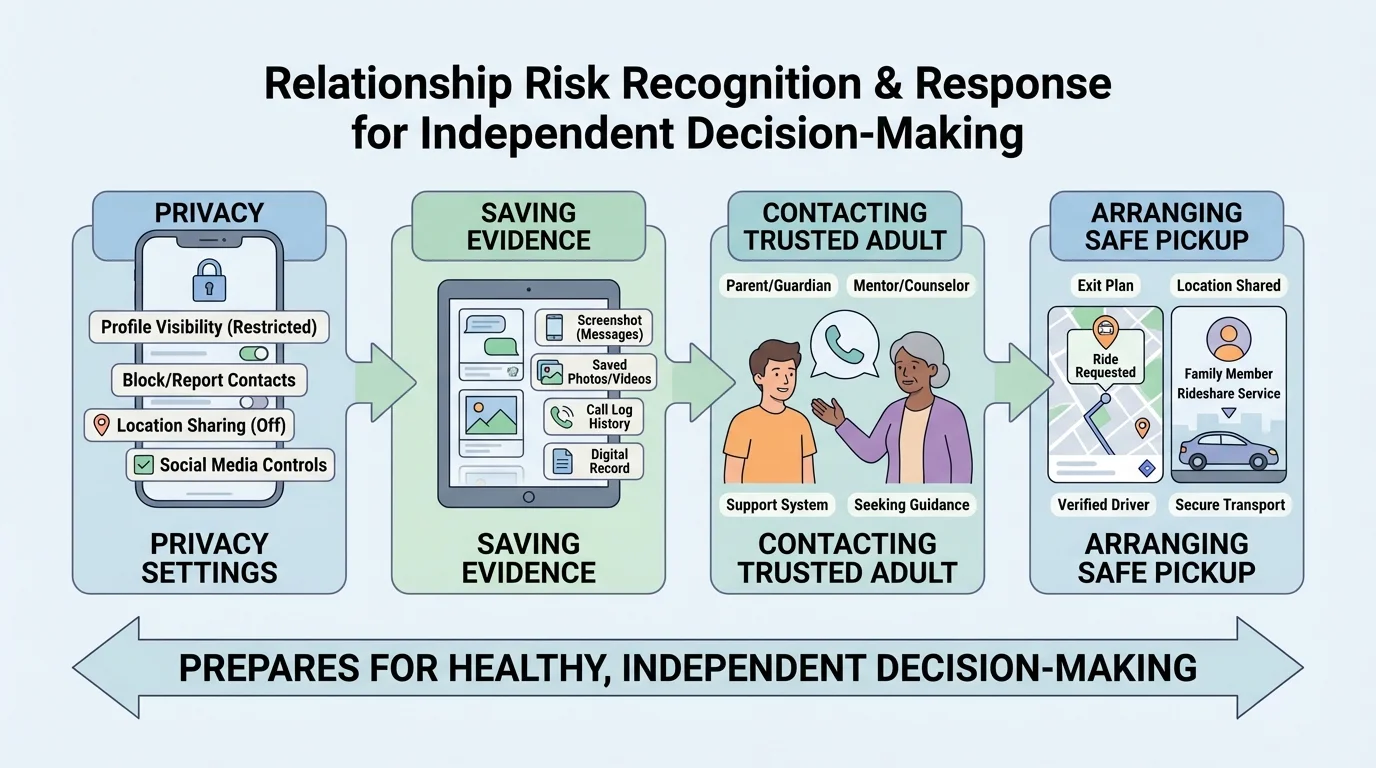
If the issue involves digital pressure or harassment, protect your information. Change passwords, enable privacy settings, turn off location sharing, review who can see your posts, and save screenshots of threats or repeated pressure. Documentation can help if you need support from a parent, guardian, counselor, platform moderator, or law enforcement.
If you feel unsafe, do not focus on being polite. Focus on leaving safely and contacting help. That might mean ending a call, blocking someone, asking a trusted adult for immediate support, arranging a safe pickup, or calling emergency services if there is immediate danger.
Useful response scripts
These are simple because pressure often makes it harder to think in long sentences.
Script 1: For privacy pressure
"I do not share passwords. That is not negotiable."
Script 2: For repeated sexual pressure
"I said no. Stop asking."
Script 3: For insults or guilt-tripping
"I am ending this conversation now."
Script 4: For a safety exit
"I need to leave. I am calling someone I trust."
One of the strongest choices you can make is to tell a trusted adult what is happening before a situation becomes a crisis. That could be a parent, guardian, counselor, coach, supervisor, relative, or another safe adult. Getting advice is not losing control. It is using support wisely.
Recognizing and responding to relationship risks prepares you for much more than dating. It teaches you how to judge character, protect boundaries, and make decisions that match your values. Those same skills matter when dealing with roommates, bosses, coworkers, friends, and future partners.
For example, if you can notice manipulation in a relationship, you are more likely to notice it in a workplace. If you can set a boundary with someone demanding your passwords, you are also more likely to protect financial accounts and personal documents as an adult. If you can leave a controlling situation now, you are building the confidence to leave unhealthy situations later.
Healthy independence is not cold or distant. It includes care, trust, and connection. But it also includes standards. You get to decide that respect is required, consent is real, privacy matters, and fear is not a normal price for closeness.
Your feelings are important, but they are not your only tool. Strong decision-making combines feelings, observed behavior, patterns over time, consequences, and support from trusted people.
As you move into adult life, one of the most protective habits you can build is this: when someone wants access to your body, time, emotions, account information, location, or private life, pause and ask whether they are honoring your autonomy or trying to take it from you. That question can change everything.
