A lot of people picture adulthood as something dramatic: getting a job, moving out, signing a lease, paying major bills. But many adult problems actually begin with much smaller things—forgetting a form, missing an email, losing a password, not tracking due dates, or putting off a task for "later" until it becomes urgent. Adult readiness is not just about being old enough to make choices. It is about being able to manage the ordinary systems that keep life stable.
If you can keep track of appointments, respond to messages, store important documents, remember deadlines, and handle recurring responsibilities without constant panic, you are building real readiness. If you cannot, everyday life becomes harder, more expensive, and more stressful than it needs to be. That is why small systems matter so much. They turn good intentions into dependable action.
Adult readiness means being prepared to handle the responsibilities of independent life with reasonable consistency. Daily systems are repeatable routines or tools you use to manage everyday tasks. Administrative tasks are the organizing, tracking, communicating, and recordkeeping jobs that keep your life running behind the scenes.
Think about the difference between someone who says, "I'm responsible," and someone who can actually prove it. The second person remembers a telehealth appointment, uploads a document before a deadline, checks a bank balance before spending money, and follows up on a message. That is what readiness looks like in real life.
Many people fail at adult responsibilities not because they are lazy or incapable, but because they rely too much on memory, mood, and last-minute effort. Memory is unreliable. Motivation changes. Emergencies happen. A system is what protects you when your day gets busy.
For example, you may fully intend to pay a streaming subscription on time, refill a prescription, send a work availability update, and complete a scholarship application. But if all of those tasks live only in your head, one forgotten detail can create a chain reaction. A missed payment can trigger a fee. A missed form can delay an opportunity. A late reply can make you seem unreliable. One weak system often affects several areas of life at once.
Strong daily systems reduce decision fatigue. Instead of asking yourself every day what needs attention, you already have a place to look: your calendar, your task list, your budget tracker, your document folder, or your weekly reset routine. That saves time and mental energy.
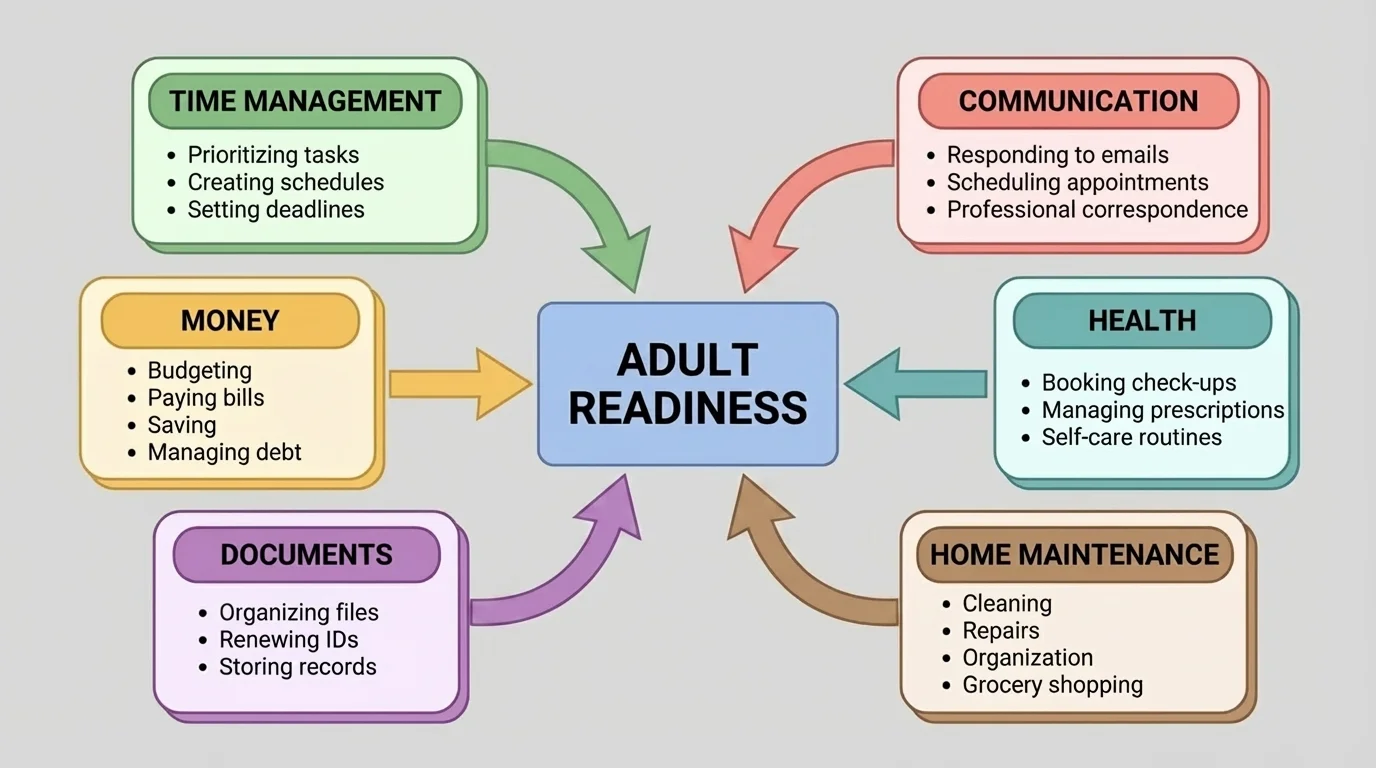
Most of the "invisible work" of adulthood falls into a few repeating categories, as [Figure 1] shows. Once you understand these categories, adult life starts to feel less random and more manageable.
One category is time management. This includes using a calendar, setting reminders, arriving on time, planning travel time, and keeping track of recurring deadlines. Another category is recordkeeping, which means storing information where you can find it later—things like ID copies, medical forms, login details, receipts, and job documents.
A third category is administrative tasks related to money. These include checking account balances, monitoring subscriptions, saving receipts, reading billing notices, and noticing when a payment date is approaching. Communication is another major category: answering messages, writing clear emails, confirming appointments, and asking questions when instructions are unclear.
Health and home logistics also count. Refilling medication, scheduling checkups, doing laundry before you run out of clean clothes, replacing household basics, tracking groceries, and noticing maintenance issues are all part of real adult functioning. None of these tasks are glamorous, but they strongly affect quality of life.
Digital organization matters too. Many modern responsibilities happen through apps, websites, and online accounts. If you do not know where your documents are, which email address you used, or how to reset a password, simple tasks can become frustrating. A disorganized phone can create the same kind of chaos as a messy desk.
Missing a small deadline can cost far more than the original task itself. A forgotten return, payment, or form often creates late fees, account holds, lost opportunities, or extra hours spent fixing a preventable problem.
When adults say they are "trying to get organized," they are usually talking about one of these categories. The goal is not perfection. The goal is having dependable ways to remember, track, and complete what life requires.
Daily systems shape your reliability. Reliability means people can count on you to do what you said you would do. Employers, landlords, doctors, family members, and coworkers may never see your planner or your phone reminders, but they definitely see the results. You show up prepared. You respond in time. You handle details without constant excuses.
These systems also affect financial stability. Suppose you earn $120 from a part-time job and plan to save $40, spend $30 on transportation, and use the rest for personal expenses. If you forget about a $15 subscription renewal and a $12 fee for a late payment, your plan changes quickly. Your remaining money becomes $120 minus $40 minus $30 minus $15 minus $12, which is \(120 - 40 - 30 - 15 - 12 = 23\). Weak systems turn manageable budgets into stressful ones.
Adult readiness is also about stress control. When you know where your documents are, what is due this week, and which tasks matter most, you spend less time in panic mode. Stress does not disappear, but it becomes more specific and solvable. Without systems, stress feels vague and constant because your brain is trying to remember everything at once.
Strong systems increase independence. If someone else always reminds you, fills out your forms, tracks your appointments, or fixes your missed deadlines, then your life is functioning through their system, not yours. Real independence means you can manage yourself with only occasional help.
Opportunity is another big factor. A student may be fully capable of doing a job, joining a training program, or renting an apartment, but still lose the chance because they did not upload documents, check messages, or follow instructions. Readiness is not only about ability. It is also about follow-through.
You do not have to wait until you live on your own to practice. Right now, you can build systems in small areas of daily life. Money is one of the easiest places to start. Track what comes in, what goes out, and what repeats. Even if your amounts are small, the habit matters more than the total.
Appointments are another good practice area. If you have a virtual tutoring session, a dentist visit, a sports practice, or a volunteer shift, enter it into a calendar immediately. Add a reminder for the day before and another for when you need to leave or log in. That one habit prevents a huge number of avoidable mistakes.
Health routines matter as well. If you take medication, wear contacts, need regular exercise, or are supposed to drink more water and sleep enough, you are already managing a personal system. Health does not stay separate from the rest of your responsibilities. Feeling exhausted, missing medication, or neglecting basic care can affect schoolwork, work shifts, mood, and decision-making.
Home logistics give you another chance to practice. Laundry, dishes, room cleanup, meal planning, and restocking items like soap or toothpaste all teach the same lesson: if you wait until the need becomes urgent, life gets harder. A simple recurring routine is usually easier than a giant fix later.
The hidden cost of disorganization
Disorganization rarely hurts only one area. A lost password delays a form. A delayed form creates stress. Stress makes it harder to focus. Poor focus leads to mistakes in other tasks. This is why adult readiness is not about handling isolated chores; it is about building systems that stop small problems from spreading.
The same pattern applies to communication. If you ignore messages because you feel awkward, overwhelmed, or unsure what to say, you create confusion for other people and extra work for yourself. A short, clear response is usually better than silence. "I received this and will reply by tomorrow" is simple, professional, and useful.
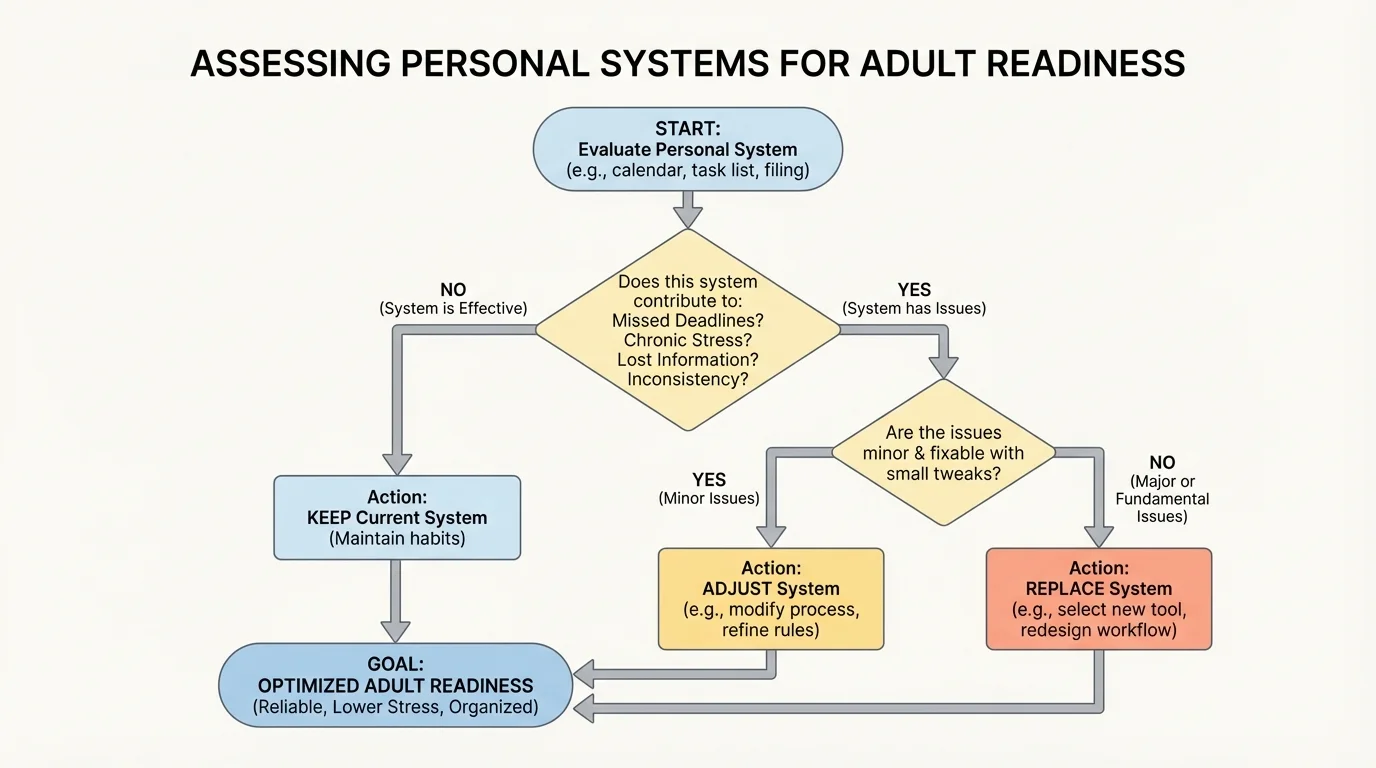
A system should make life more stable, not more complicated. You can test your setup by following a simple decision process, as [Figure 2] illustrates. The point is not to ask whether your system looks organized. The point is whether it actually helps you complete responsibilities consistently.
Ask yourself a few practical questions. Do you miss deadlines often? Do you forget tasks unless someone reminds you? Do you spend time searching for information you should already have? Do you avoid checking email or messages because you expect bad news or confusion? Do the same problems keep repeating?
If the answer is yes to several of those questions, your current system is not strong enough. Maybe it is too complicated. Maybe it depends too much on memory. Maybe you put important information in too many places. A good system is simple enough to use when you are tired, busy, or distracted.
You can evaluate a system using five standards: consistency, speed, accuracy, visibility, and backup. Consistency means you use it regularly. Speed means it does not take forever to update. Accuracy means the information is correct. Visibility means you can actually see what needs attention. Backup means you can recover if your phone dies, you forget a password, or an app fails.
| Standard | Question to Ask | Warning Sign |
|---|---|---|
| Consistency | Do I use this every week? | I create lists but never check them again. |
| Speed | Can I update it in a few minutes or less? | I avoid it because it feels like too much work. |
| Accuracy | Is the information current? | Dates, balances, or details are outdated. |
| Visibility | Can I quickly see what matters next? | Important tasks are buried or forgotten. |
| Backup | If one tool fails, do I still have access? | One lost device wipes out everything. |
Table 1. A practical checklist for judging whether a daily system actually supports adult readiness.
Notice that none of these standards require expensive tools. A strong system might be a notes app, a free calendar, one cloud folder, and a paper backup for key documents. What matters is whether it works repeatedly.
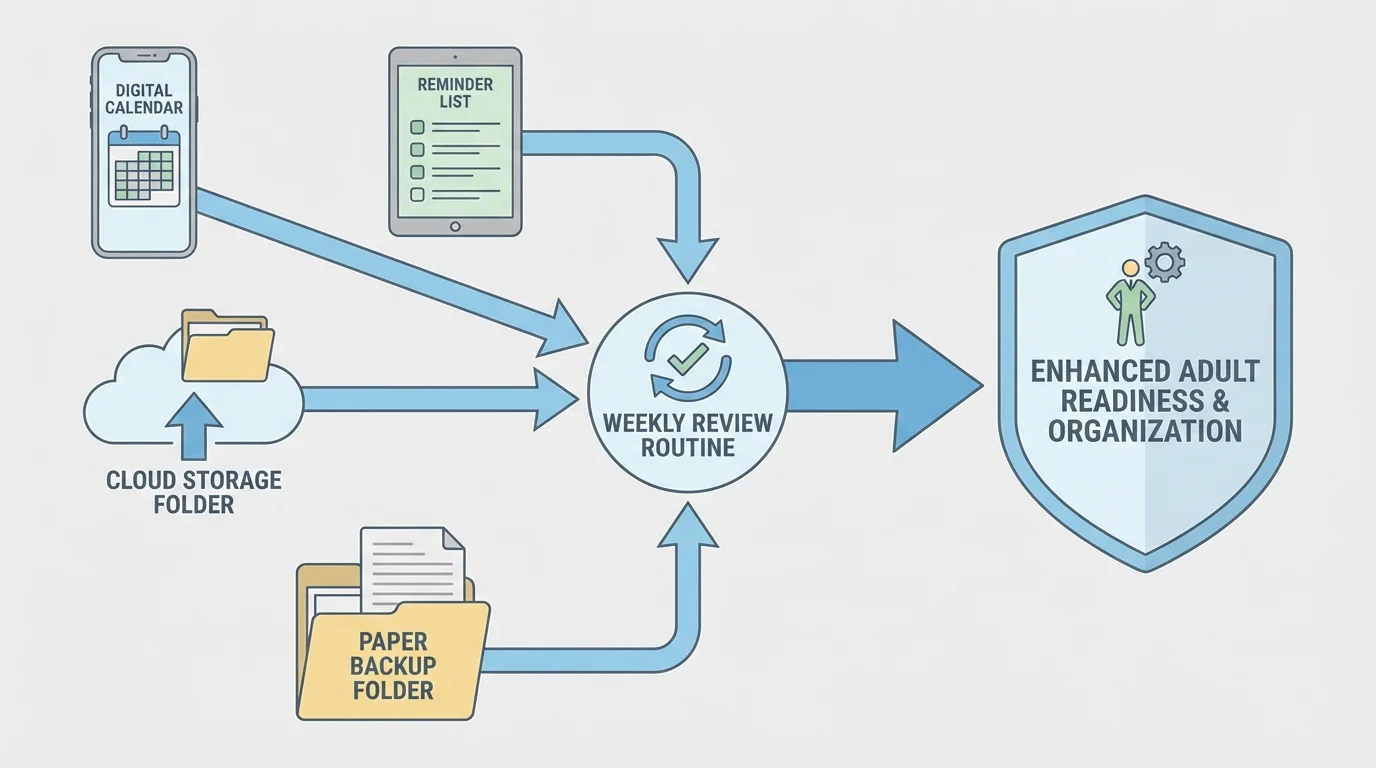
A workable setup usually has a few connected parts rather than one giant to-do list, as [Figure 3] shows. You need a place for time, a place for tasks, a place for documents, a place for money information, and a routine for reviewing everything.
Step 1: Choose one calendar. Put all appointments, deadlines, work shifts, and events there. Do not split important dates across several places unless you are certain they sync correctly.
Step 2: Create one task capture spot. This could be a notes app, a task app, or one paper notebook. The rule is simple: if you need to remember it later, it goes there immediately.
Step 3: Set up document storage. Make digital folders for categories like school, jobs, ID, health, and money. Use names that make sense at a glance. For example, "Job Docs" is clearer than "Misc."
Step 4: Track recurring financial and account tasks. Write down subscriptions, due dates, and account logins in secure, organized ways. If possible, review this once a week so small charges and notices do not surprise you.
Step 5: Schedule a weekly review. Spend about \(10 + 10 = 20\) minutes checking your calendar, task list, email, messages, and document needs. This reset keeps problems from piling up.
Case study: building a manageable system
Jordan keeps forgetting deadlines, loses screenshots of important information, and feels stressed every Sunday night.
Step 1: Identify the failure points
Jordan has dates in three places, no document folders, and unread emails that contain important instructions.
Step 2: Simplify the tools
Jordan moves all deadlines into one calendar, creates one task list, and sets up folders labeled School, Work, Health, and Personal Records.
Step 3: Add reminders and review time
Jordan adds two reminders for every deadline and blocks out 20 minutes every Sunday to review the week.
Step 4: Measure the result
After two weeks, Jordan misses fewer tasks, replies faster, and feels less overwhelmed because information is easier to find.
The system is not fancy, but it is functional. That is what matters.
If you look back at the categories in [Figure 1], you can see how one simple setup supports several parts of life at once. A calendar helps with school, work, health, and home tasks. A folder system helps with jobs, forms, and personal records. One change can improve multiple areas.
Consider two students, both equally smart and motivated. Student A checks messages once a day, keeps a calendar, stores forms in folders, and reviews upcoming deadlines every Sunday. Student B relies on memory, leaves emails unopened, and saves important files randomly. Over time, Student A seems more "mature," but the biggest difference is often system quality, not personality.
When a job application asks for identification, availability, and references by a certain time, Student A can respond quickly. Student B may still be searching through screenshots, old emails, and downloads. The faster response usually creates a better impression.
Housing is another example. If you eventually rent a room or apartment, you may need proof of income, ID, emergency contact information, or a signed agreement. These are not difficult in theory, but they become difficult when documents are scattered or unread. Readiness means you can produce what is needed without chaos.
Even transportation shows the effect of systems. If you plan a trip by checking travel time, setting an alarm, charging your phone, and leaving early, you arrive calmer and more prepared. If you guess, rush, and scramble at the last minute, the same trip becomes stressful. Adult life is full of moments like that.
Quick money example
Taylor plans to have $90 left for the week. Then a forgotten automatic payment of $18 and a ride cost of $14 appear.
Step 1: Add the unexpected costs
The total unplanned amount is \(18 + 14 = 32\).
Step 2: Subtract from the weekly amount
The remaining money is \(90 - 32 = 58\).
A missing reminder changed the week's flexibility by $32. That is why routine account checks matter.
The same principle from [Figure 2] applies here: if a problem keeps repeating, the issue is probably not just effort. The system needs to be adjusted. Repeated surprise fees, repeated lateness, or repeated lost forms are clues.
Some habits have an outsized effect on adult readiness. One is checking important messages at a regular time every day. Another is reading instructions all the way through before starting. A third is writing things down immediately instead of trusting yourself to remember later.
It also helps to keep a short list of "high-risk tasks." These are the tasks most likely to create bigger problems if ignored: payments, forms, appointments, account alerts, transportation plans, and anything involving identification or legal documents. Give these tasks extra visibility.
Another smart habit is using clear file names. "Resume_2026" is more useful than "finalfinalnew." The same goes for screenshots and photos of documents. If you ever need to send something quickly, naming it well now saves time later.
Backup thinking matters too. Keep copies of the most important items in more than one safe place. If your phone is lost, broken, or logged out, you still need a way to access essential information. That is part of redundancy: having a backup so one failure does not ruin everything.
"You do not rise to the level of your goals. You fall to the level of your systems."
— Common success principle
As your responsibilities grow, your systems must grow with them. The setup in [Figure 3] is useful because it stays simple while covering the basics. You do not need a perfect life-management method. You need one that survives real life.
Adult readiness is often judged by visible results: whether you are on time, prepared, responsive, and able to manage yourself. But those results come from invisible systems. Daily routines, reminders, checklists, records, and review habits may seem boring, yet they are what make independence possible.
The good news is that these skills are learnable. You are not either "organized" or "disorganized" forever. You can build systems, test them, simplify them, and improve them. Every time you set a reminder, file a document correctly, respond clearly, or review your week before it becomes chaotic, you are practicing adulthood in a real and meaningful way.
Try This: Pick one area that creates repeated stress—deadlines, documents, messages, money, or appointments—and build one simple system for it this week. Small systems are often the fastest path to bigger confidence.
