A small leak can damage floors in hours. A clogged dryer vent can become a fire risk. A tripped breaker can leave you in the dark even when the rest of the neighborhood has power. Knowing what to do in these moments is not about being handy. It is about staying safe, protecting where you live, and avoiding expensive mistakes.
Independent living includes basic home problem-solving. You do not need to know advanced construction or electrical work. You do need to recognize common problems, use a few tools correctly, and make smart decisions under pressure. The goal is simple: handle small issues safely, reduce damage fast, and know when to stop.
The most important repair skill is knowing your limits. Before you touch anything, pause and check for danger. Watch for standing water near outlets, sparks, smoke, a gas smell, broken glass, flooding, or anything that makes the area unsafe. If there is immediate danger, leave the area and call emergency services or the appropriate utility company.
A good first rule is this: water, electricity, gas, and heat can turn a small problem into a serious one. If you ever smell gas, do not flip switches on or off, do not use an open flame, and do not try to "find the leak" yourself. Leave the space and call the gas utility or emergency services from outside.
Main shutoff means the control point that stops a utility from entering your home, such as the main water valve or the main electrical disconnect.
GFCI outlet is a safety outlet, usually found in kitchens, bathrooms, garages, or outdoors, that shuts off power quickly if it detects a dangerous electrical imbalance.
Trip means a breaker or safety device automatically shuts off power to prevent overheating or shock.
Wear closed-toe shoes for many repair tasks. Use gloves when handling dirty water, rough materials, or sharp edges. Keep a flashlight nearby if the power goes out. If you live with family or roommates, tell someone what you are working on, especially if you need to shut off water or power.
Another smart habit is to learn your home before there is a crisis. Know where the main water shutoff is, where the electrical panel is, and which appliances have separate shutoff valves. If you rent, ask your landlord or property manager where these are located. Taking five minutes now can save hours later.
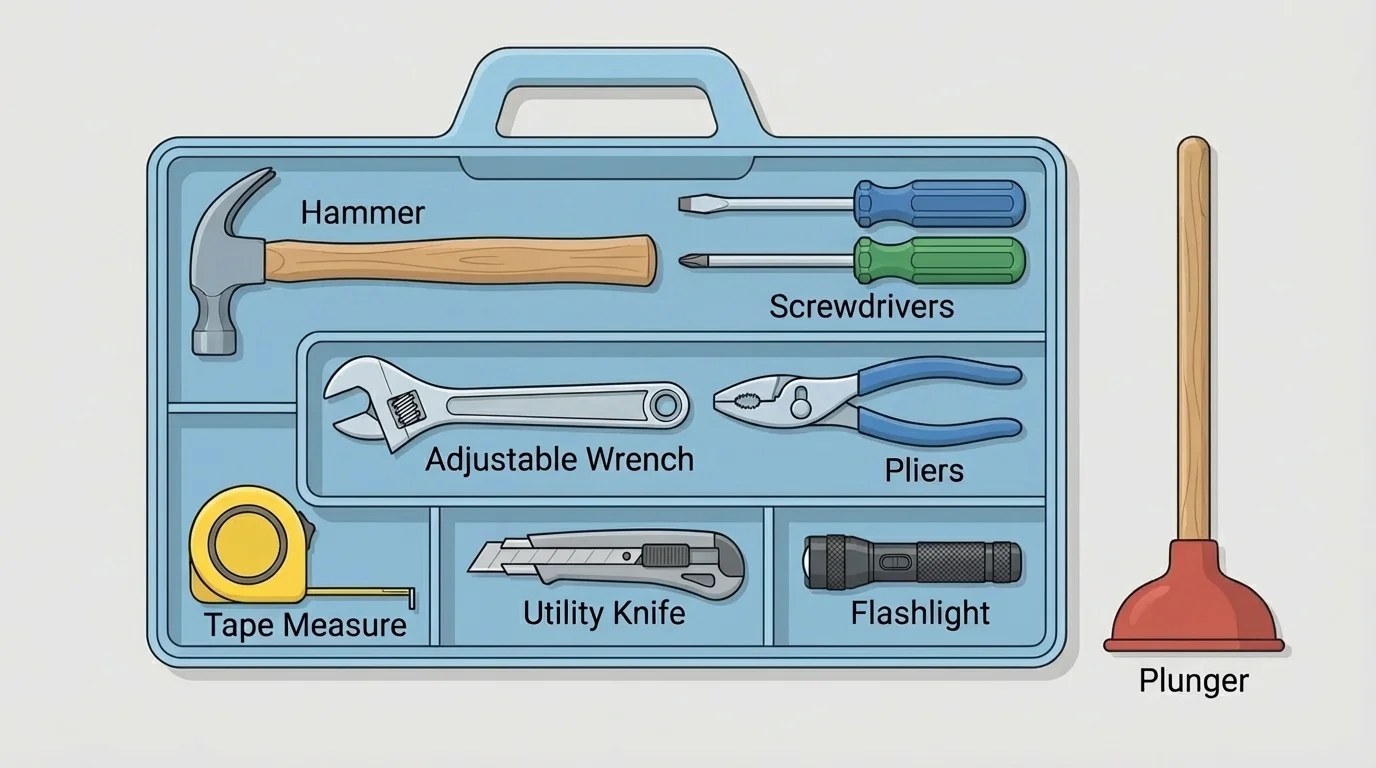
You do not need a garage full of equipment. A basic toolkit covers most beginner tasks, and [Figure 1] shows the core items worth recognizing right away. When you know what each tool does, you are less likely to force the wrong tool onto a job and damage something.
Your starter kit should include a claw hammer, slotted screwdriver, Phillips screwdriver, adjustable wrench, slip-joint pliers, needle-nose pliers, tape measure, utility knife, flashlight, work gloves, plunger, duct tape, painter's tape, a small level, and a set of Allen keys. Add a bucket, old towels, and extra batteries. Those last three are incredibly useful in emergencies.
Screwdrivers are for screws, not prying things open. Match the tip to the screw head. A Phillips screwdriver fits cross-shaped screws; a slotted screwdriver fits slotted screws. Using the wrong one can strip the screw, which means the grooves wear down and become hard to turn.
An adjustable wrench grips nuts and bolts. Tighten it so it fits snugly before turning. If it is loose, it can slip and round off the edges of the metal. Pliers grip, bend, or hold items steady. Needle-nose pliers help in tight spaces; slip-joint pliers are more general-purpose.
A plunger is one of the most useful home tools. A sink plunger usually has a flat bottom, while a toilet plunger often has an extra rubber flange. Using the right plunger makes a huge difference. A flashlight is safer than candles during a power outage because there is no flame risk.
Tool care matters too. Dry tools after use, especially if they touched water. Keep blades covered. Store everything in one spot so you can find it fast. As shown earlier in [Figure 1], a simple organized kit is more useful than owning many tools you cannot identify.
Many household problems are small but annoying: a loose cabinet handle, a wobbling chair leg, a clogged sink, or a picture frame that will not hang straight. These are good beginner jobs because the risk is low and the skills transfer to bigger situations.
Tightening loose hardware: If a doorknob, drawer pull, or cabinet hinge feels loose, use the right screwdriver and turn slowly. Stop when it is secure. Over-tightening can crack wood or strip the screw hole.
Unclogging a sink: Remove visible debris first. Use a sink plunger with enough water to cover the rubber cup. Seal nearby overflow openings with a wet cloth if needed, then plunge firmly. Avoid mixing drain cleaners, especially if different chemicals were already used. Those products can react dangerously and can splash back onto your skin.
Quick repair: patching a small wall hole
You accidentally leave a small hole after removing a wall hook.
Step 1: Clean the area
Remove loose material around the hole with a dry cloth or putty knife.
Step 2: Apply spackle
Use a putty knife to press filler into the hole and smooth the surface.
Step 3: Let it dry
Follow the package directions. Drying time matters because painting too soon can ruin the finish.
Step 4: Sand lightly and paint if needed
Once dry, smooth the patch gently so it blends into the wall.
This is a small repair with low risk, but it teaches patience, surface prep, and cleanup.
Resetting a tripped outlet: If one bathroom or kitchen outlet stops working, it may be a GFCI outlet. Press the reset button once. If it trips again immediately, stop there. Repeated tripping often means a real electrical problem.
Changing filters: HVAC filters, range hood filters, and some appliance filters should be checked regularly. Dirty filters make systems work harder, which can increase energy use and shorten equipment life. If a replacement filter costs $15 but helps your system run properly, it is far better to replace the filter than to pay hundreds for damage later.
A dryer can appear to work normally even when the vent is partly blocked. Clothes may just take longer to dry at first, but trapped lint also raises fire risk.
Some repairs are not beginner tasks: opening sealed electrical devices, working on wiring, cutting into walls without knowing what is behind them, repairing gas lines, climbing onto roofs, or using power tools without training. Confidence is useful; overconfidence is expensive.
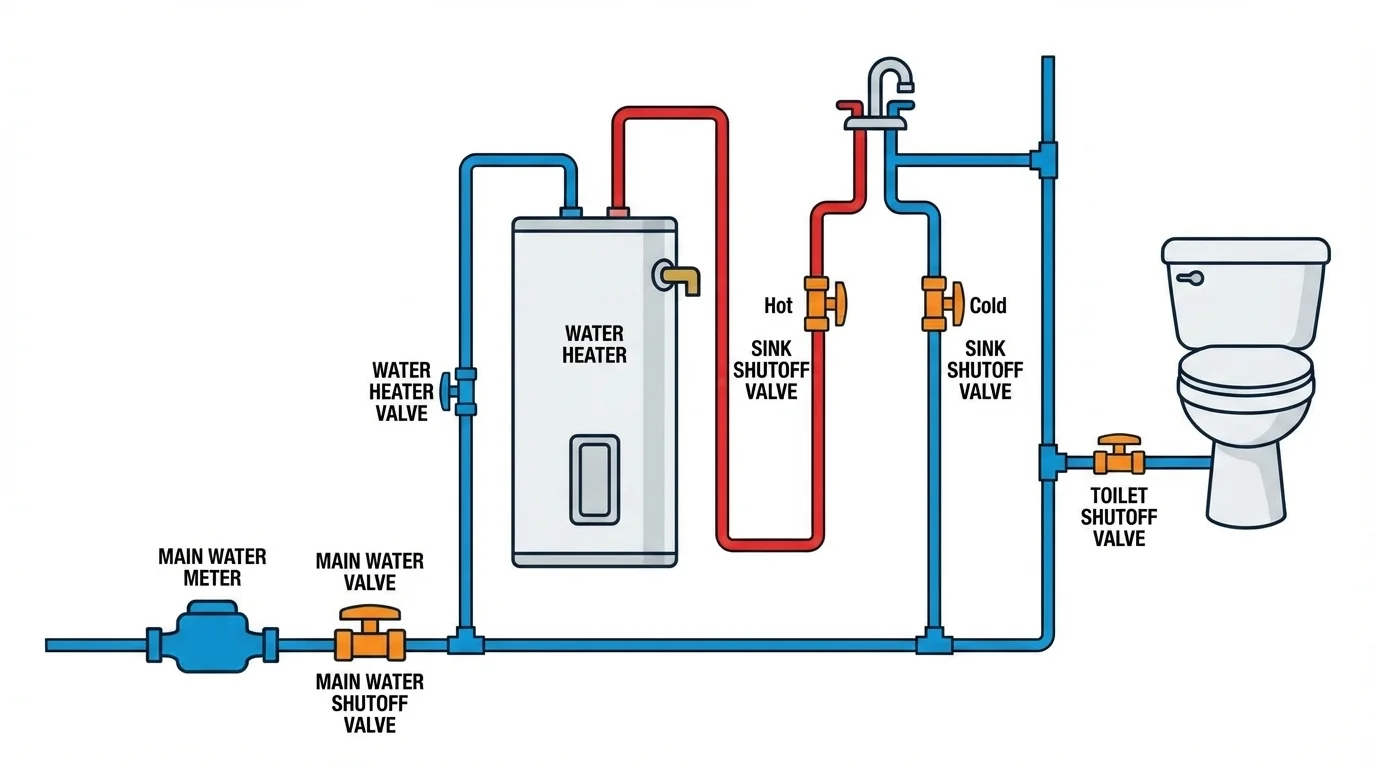
Leaks are one of the most common home emergencies, and the first few minutes matter most. Knowing the shutoff points ahead of time is critical, and [Figure 2] illustrates the usual places to look: under sinks, behind toilets, near water heaters, and at the main shutoff. Your first goal is not to fix everything. Your first goal is to stop water from spreading.
Start by finding the source. Is it coming from a sink supply line, a toilet, a washing machine hose, a water heater, the ceiling, or outside after heavy rain? If the leak comes from one fixture, try the local shutoff valve for that fixture. If you cannot stop it quickly, turn off the main water supply.
After the water is stopped, unplug nearby electronics only if the area is dry and safe to approach. Move rugs, paper items, chargers, and anything valuable out of the wet area. Use towels, a bucket, or a mop to limit damage. Take photos if you rent or need to report the problem to insurance or a property manager.
A temporary fix can buy time. For a dripping pipe joint, you might wrap the area with a repair tape or place a bucket underneath until help arrives. For a leaking sink trap, tightening a slip nut slightly with pliers may help if it is obviously loose. But if the pipe is cracked, corroded, or actively spraying, do not experiment for too long. Shut the water off and call for help.
If water is coming through a ceiling, the problem may be above you even if the stain appears in one spot. Water travels. This is why ceiling leaks can be misleading. If a bulge forms in the ceiling, that can mean water is pooling behind the surface. At that point, the safest move is usually to clear the area underneath and contact a landlord or professional immediately.
Leak response priorities
The right order is: protect people, stop the water, protect property, document the issue, and then decide whether a temporary fix is enough or professional repair is needed. That order keeps you from wasting time on cleanup while damage is still spreading.
Later, when you review what happened, think about prevention. Old hoses, loose connections, and ignored drips often give warnings. As shown in [Figure 2], small shutoff valves are worth locating before you need them because shutting off one fixture is less disruptive than shutting off all water to the home.
When the lights go out, first figure out whether the problem is only in your home or in the larger area. A quick look outside can help. If neighboring homes or streetlights are also dark, it is likely a utility outage. If only part of your home loses power, [Figure 3] shows the two common possibilities: a tripped breaker in the panel or a tripped GFCI outlet near a bathroom, kitchen, garage, or outdoor area.
Use flashlights instead of candles if possible. Keep refrigerator and freezer doors closed. Food stays cold longer when you do not keep checking it. Charge your phone from a power bank if you have one, and unplug sensitive electronics if you expect power to return unpredictably.
To check a breaker panel, open the panel door and look for a breaker that sits differently from the others, often in a middle position. To reset it, push it fully to off first, then back to on. If it trips again right away, stop. That usually means too much load or a fault. Repeated resetting is not a smart solution.
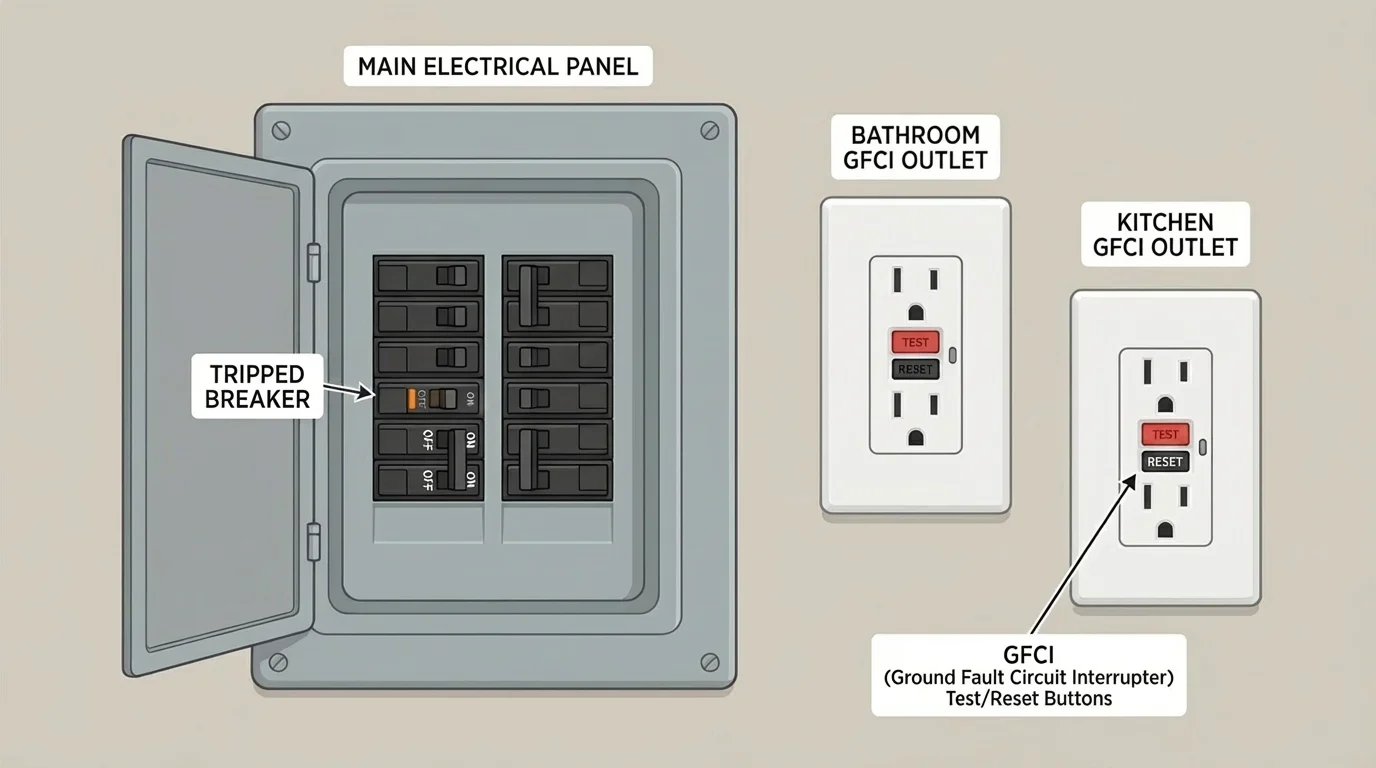
If a GFCI outlet has tripped, press reset once. If it will not reset, unplug items from nearby outlets and try again. If it still fails, you likely need help. Water exposure, damaged cords, or a real fault may be involved.
Electrical warning signs that mean stop immediately include buzzing, a burning smell, warm outlets, scorch marks, sparks, or flickering that happens regularly in one area. Do not remove outlet covers or touch wiring. Electricity is not a "learn by trial and error" category.
Case study: your room loses power but the hallway light works
You are charging a laptop, running a space heater, and using a hair dryer when your room suddenly goes dark.
Step 1: Reduce the load
Turn off or unplug high-power items such as the space heater and hair dryer.
Step 2: Check the breaker panel
Look for a breaker in the tripped position.
Step 3: Reset once
Move the breaker fully off, then back on.
Step 4: Restart carefully
Plug devices back in one at a time. If the breaker trips again, stop and report the issue.
This response is safer than repeatedly forcing the breaker back on while the overload remains.
Food safety matters during longer outages. As a general rule, perishable food should not stay above safe cold-storage temperatures for too long. If the outage is extended and you are unsure about food safety, it is better to throw away risky items than get sick. The cost of replacing milk or leftovers is far lower than the cost of a serious foodborne illness.
The breaker layout in [Figure 3] also reminds you why labeling matters. If your panel labels are missing or confusing, ask a responsible adult, landlord, or electrician to help identify circuits before there is an emergency.
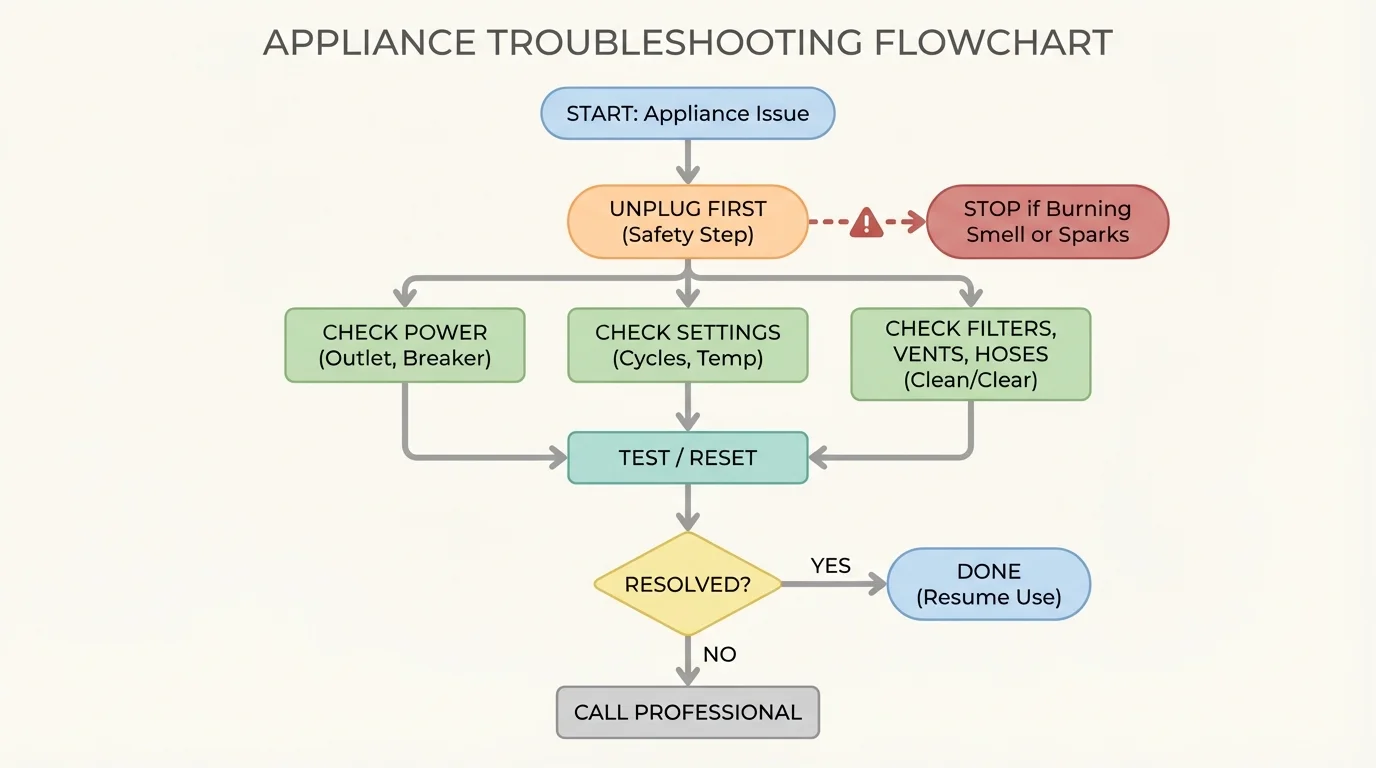
Appliances often fail in boring ways before they fail in dramatic ways. A machine may simply be unplugged, overloaded, set incorrectly, or blocked by lint, dust, or a clogged filter. A consistent troubleshooting routine saves time, and [Figure 4] lays out a smart order: make it safe, check the basics, test one change at a time, and stop if danger signs appear.
Before touching an appliance, turn it off. For many problems, unplugging it is the safest next move. If water is involved, such as with a washing machine or dishwasher, shut off the water supply if needed. Never stick your hands into moving parts or open access panels you are not trained to handle.
Start with basic questions. Is it plugged in? Did a breaker trip? Is a door or lid fully closed? Is the control setting correct? Is a filter clogged? Is a vent blocked? Is there a reset button? Has the appliance overheated and shut itself down temporarily?
Here are common examples:
| Appliance issue | Safe checks you can make | Stop and get help if... |
|---|---|---|
| Washing machine not filling | Check power, water valves, hose kinks, lid/door closure | You see leaking, smell burning, or hear grinding |
| Dryer not drying well | Clean lint trap, check vent airflow, avoid overload | The dryer smells hot or the vent area is extremely hot |
| Microwave not running | Check plug, outlet, door closure, breaker | There are sparks, smoke, or internal damage |
| Refrigerator warm | Check temperature settings, door seal, airflow around unit | The motor clicks repeatedly, smells hot, or stops completely |
| Dishwasher not draining | Check filter, drain area for debris, power supply | Water leaks onto the floor or electrical parts get wet |
Table 1. Common appliance problems, safe beginner checks, and warning signs that require professional help.
A useful rule is one change at a time. If you unplug, clean a filter, reset a switch, and change settings all at once, you will not know what solved the problem. Slow, deliberate troubleshooting is more effective than random guessing.
If something smells like burning, produces smoke, sparks, or unusual heat, your job is not to be a hero. Your job is to shut it off if safe, unplug it if safe, and get help.
Some manufacturers post model-specific help videos or digital manuals online. Use the exact model number, usually found on a sticker inside a door, behind a panel, or on the back. That can help you check a filter, locate a reset feature, or understand error lights without taking the appliance apart.
The decision flow in [Figure 4] also applies beyond appliances. It is a general repair habit: start safe, check the simple causes first, and stop when the risk level rises.
You will respond better under stress if you do not have to invent a plan in the moment. Build a simple routine now. Keep your toolkit in one place. Save important phone numbers in your contacts: landlord, property manager, utility companies, a trusted adult, and emergency services. Know your address without looking it up.
Create a small home emergency kit with flashlights, batteries, a power bank, bottled water, basic first-aid items, work gloves, towels, trash bags, duct tape, and a notepad. If weather-related outages are common where you live, include blankets and shelf-stable snacks.
"Slow is smooth, and smooth is fast."
— Emergency response principle
That quote fits home emergencies well. When people panic, they often waste time. They turn the wrong valve, touch something unsafe, or forget to document damage. A calm sequence works better: assess, shut off, protect, report, and repair.
It also helps to do a quick monthly check. Test flashlights, replace dead batteries, clear lint from the dryer filter, look under sinks for drips, and make sure you can reach shutoff areas without moving heavy clutter. Ten minutes of prevention can avoid a much bigger problem.
Being capable at home is not about doing everything yourself. It is about knowing what you can do, doing it safely, and recognizing when expert help is the smartest move. That is a real adult skill.
