Some of the most important leaders in your life may not have impressive titles. They are the people who notice confusion in a group chat and clear it up, the shift workers who stay calm when a customer gets upset, or the volunteers who quietly make sure everyone knows what to do. Leadership is not just about being "in charge." It is about taking responsibility for what happens around you and how your actions affect other people.
At your age, leadership already shows up in real ways: helping organize a fundraiser, managing tasks in an online group project, training a younger teammate, supporting a family event, or handling responsibilities at a part-time job. If you lead well, people trust you, work gets done, and problems get smaller. If you lead poorly, confusion spreads, people feel ignored, and even small issues can become bigger than necessary.
Leadership matters because people remember how they were treated, not just whether a task got finished. In service, work, and community roles, your reputation often grows from small repeated actions: answering messages, showing up on time, staying respectful under pressure, and doing what you said you would do. These habits affect opportunities later, including references, job offers, volunteer roles, and community trust.
You also do not need to wait for adulthood to practice leadership. The best time to build leadership habits is before the stakes get even higher. A person who learns now to communicate clearly, admit mistakes, and solve problems calmly is preparing for adult responsibilities in employment, relationships, and citizenship.
"Leadership is not about being the loudest person in the room. It is about taking responsibility for what matters and helping others move forward."
That idea is especially important in online and hybrid environments. When people communicate through messages, shared documents, and video calls, misunderstandings happen easily. Strong leadership reduces that confusion by making expectations clear and keeping people connected.
Leadership responsibility is bigger than giving directions. As [Figure 1] shows, responsible leadership includes your choices, your consistency, and the effect you have on other people. A person can have a title and still lead badly, while someone without a title can lead well by noticing needs, communicating clearly, and following through.
Responsibility means owning your role and doing what is expected of you. In leadership, it also means thinking ahead: Who needs information? What could go wrong? How can I help this group function better? A responsible leader does not wait until everything falls apart before paying attention.
Accountability means being answerable for your actions and decisions. If you forget to send a schedule, overlook a safety issue, or speak disrespectfully, leadership means admitting it and fixing it. Blaming other people may protect your ego for a moment, but it weakens trust.
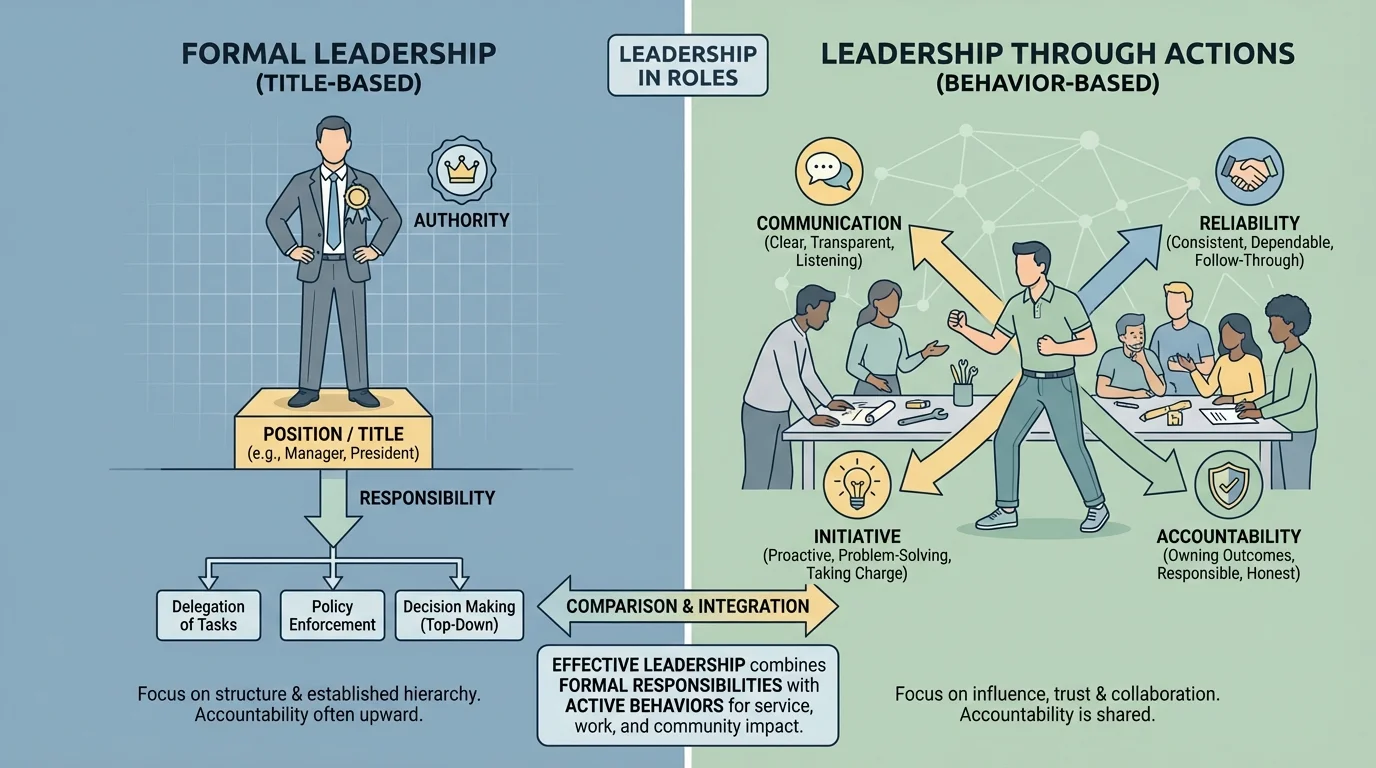
Another key idea is initiative. Initiative is acting without waiting to be told every step. It does not mean taking over everything. It means noticing a need and responding appropriately. For example, if a volunteer event is starting in ten minutes and no one has posted the meeting link, taking initiative might mean messaging the group, confirming the correct link, and making sure everyone receives it.
Leadership is the ability to guide, influence, or support others toward a goal.
Accountability is accepting responsibility for your actions and their results.
Initiative is taking useful action without needing to be pushed or reminded.
Service mindset means leading in a way that helps the group and the people in it, not just your own image.
A strong leader also keeps a service mindset. That means asking, "What helps the group most?" rather than "How do I look important?" This is why leadership and service fit together. Good leaders serve the mission and the people involved.
Service roles include volunteering, mentoring, helping with nonprofit events, supporting local drives, or contributing to community causes online. In these settings, leadership responsibilities often include reliability, respect, representation, and care for others. Even if the role is unpaid, the responsibility is real.
For example, if you help organize a food drive, leadership is not just collecting donations. It may also include answering questions from volunteers, keeping information accurate, handling donated items respectfully, and making sure the event stays welcoming. If you are careless, people may stop trusting the organization itself, not just you.
Leaders in service settings should think about dignity. If you are helping people in need, they are not projects or photo opportunities. A poor leader might post private details online for attention or make people feel judged. A responsible leader protects privacy, uses respectful language, and focuses on helping effectively.
Case study: Volunteer event leadership
You are helping coordinate an online sign-up for a community clean-up. Several volunteers are confused about the time and location.
Step 1: Identify the leadership responsibility.
The main responsibility is clear communication. If people do not know where to go or when to arrive, the event starts with frustration.
Step 2: Take immediate action.
Send one corrected message in the main group chat, update the sign-up page, and ask volunteers to reply with confirmation.
Step 3: Prevent the problem from repeating.
Create one official information post, pin it, and avoid sending conflicting updates in multiple places.
This is leadership because you reduce confusion, support the group, and protect the success of the event.
Service leadership also means understanding limits. If a situation involves safety, mental health, or legal concerns, your job is not to pretend you can solve everything alone. Responsible leadership includes getting help from the appropriate adult, supervisor, or organization contact.
In work settings, leadership may happen in part-time jobs, internships, freelance work, family businesses, or online team projects. You may not be the manager, but you still influence outcomes. Work leadership is often judged by habits more than speeches.
At work, leadership responsibilities include showing up prepared, communicating delays early, following safety procedures, treating people respectfully, solving small problems without drama, and asking thoughtful questions when you need help. Employers notice who makes the workplace easier to run.
A poor work leader creates extra problems: ignoring instructions, arriving late without warning, leaving tasks unfinished, gossiping, or blaming coworkers. A strong work leader improves the environment. They notice when supplies are running low, they warn the team about an issue before it becomes urgent, and they stay professional even when stressed.
Suppose you work a shift at a café and notice that online orders are backing up. Leadership might mean checking which tasks are most urgent, updating the team, and helping reorganize priorities. It does not mean acting bossy. It means helping the team respond effectively under pressure.
Workplace leadership is often quiet. Many people think leadership at work means giving commands. In reality, it usually looks like dependable behavior: being prepared, communicating clearly, protecting safety, and helping the team stay focused. These actions build trust faster than trying to sound important.
Professional communication matters especially in digital spaces. If you send a message like, "I can't do it," people are left guessing. If you send, "I'm delayed by about 15 minutes because of a transportation issue. I've already finished the customer file, and I'll log in as soon as I arrive," you show ownership and make planning easier.
Safety is another major responsibility. In some jobs, unsafe choices can harm people directly. In others, unsafe choices may involve data privacy, passwords, payment information, or online security. Leadership means not cutting corners just because no one is watching.
Community roles include neighborhood groups, youth organizations, sports teams, faith communities, local events, and online communities built around shared interests. Here, leadership is closely connected to trust and inclusion.
A community leader helps people feel that they belong and that the rules apply fairly to everyone. This matters because community spaces can either strengthen people or push them away. If a leader favors friends, ignores disrespect, or allows bullying, people stop participating. If a leader listens, sets clear expectations, and responds fairly, the group becomes stronger.
In online community spaces, leadership includes moderating respectfully, preventing harassment, avoiding rumors, and keeping discussions constructive. Even something as simple as reminding people of community guidelines can be a leadership action when it protects the group's culture.
Leadership in a community role also involves representing shared values. If you are a team captain, event helper, or club officer, your behavior influences how others see the whole group. That is why your language, attitude, and reliability matter beyond your individual image.
People are more likely to stay committed to a group when they believe expectations are fair and leaders are consistent. Trust is built less by charisma and more by predictable, respectful behavior.
As you saw earlier in [Figure 1], leadership is not limited to formal titles. In community settings especially, the people who improve communication, reduce conflict, and include others often become the most trusted leaders, even before anyone gives them a position.
Although service, work, and community settings differ, several responsibilities appear in all of them.
Communicate clearly. People need accurate information at the right time. A leader should avoid vague instructions, mixed messages, and last-minute surprises when possible.
Follow through. If you say you will do something, do it. If circumstances change, update people quickly. Reliability is one of the strongest foundations of leadership.
Make fair decisions. Good leadership is not based on favoritism, mood, or personal convenience. It requires considering the goal, the people affected, and the standards that should apply to everyone.
Respect others. This includes listening, not interrupting, giving credit, and correcting problems without humiliating people. Respect does not make leadership weak; it makes it sustainable.
Stay calm under pressure. Panic spreads fast. A calm leader helps others focus on what to do next.
Set boundaries. Leadership does not mean being available every second or fixing everything personally. It means knowing what is your responsibility, what needs to be delegated, and when to get help.
Respond to conflict constructively. Conflict is normal. Leadership means addressing it directly, privately when appropriate, and with a focus on solving the issue rather than winning.
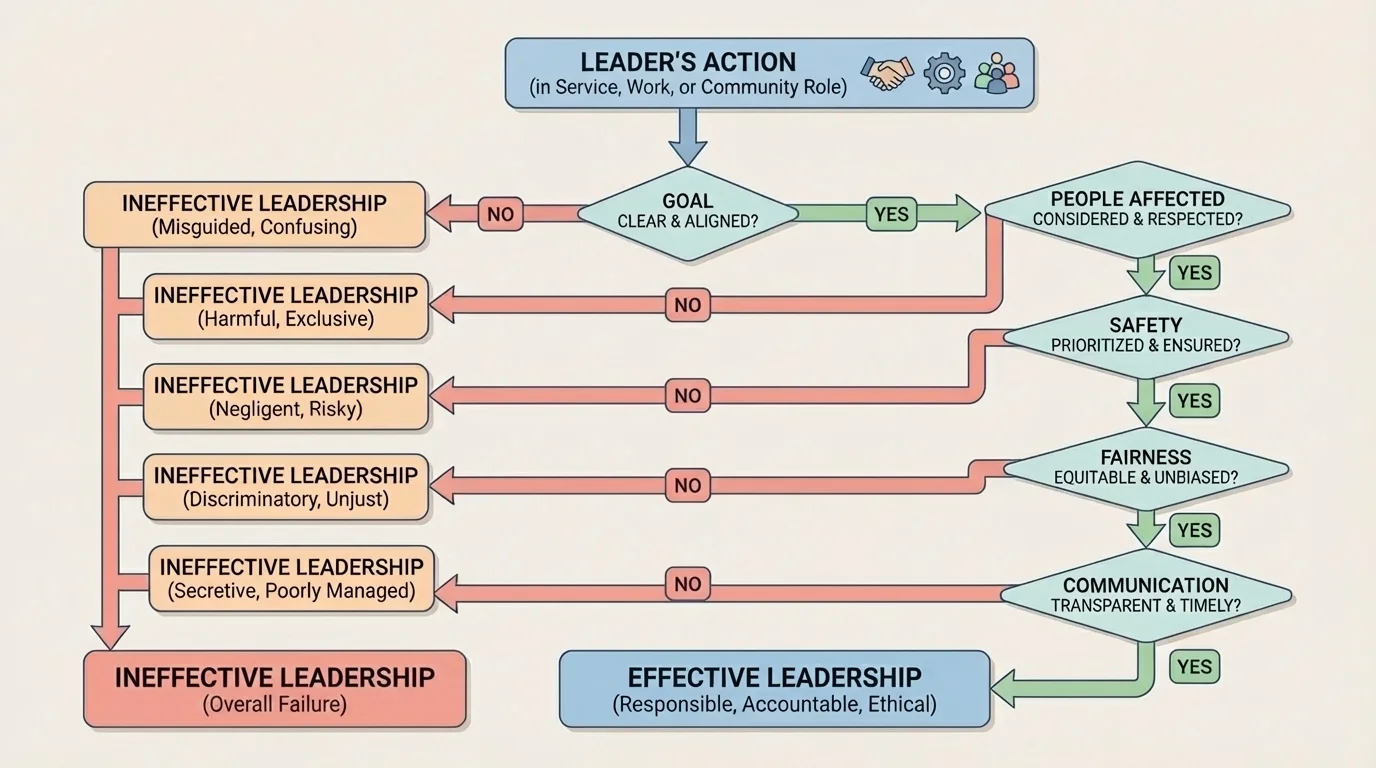
You can evaluate decision-making in leadership by tracing choices and consequences, as [Figure 2] illustrates. Instead of asking only, "Did the task get done?" ask better questions: Was it done safely? Was communication honest? Were people treated fairly? Did the decision help the group long-term, not just in the moment?
One useful way to evaluate leadership is to look at four areas: the goal, the process, the people, and the outcome. The goal asks what the leader was trying to achieve. The process asks how they went about it. The people area asks how others were affected. The outcome asks what happened immediately and what effects lasted.
If a team leader finishes a project on time by confusing everyone, insulting team members, and hiding mistakes, the result may look successful on the surface. But the leadership was weak because trust and teamwork were damaged. On the other hand, a leader who misses a minor deadline after honestly communicating a problem, asking for support early, and protecting quality may actually show stronger leadership.
| Area to Evaluate | Questions to Ask | Signs of Responsible Leadership | Signs of Poor Leadership |
|---|---|---|---|
| Goal | Was the purpose clear and worthwhile? | Clear priorities, useful purpose | Confusing or self-centered goals |
| Process | How were decisions carried out? | Organized, ethical, respectful | Chaotic, secretive, unfair |
| People | How were others affected? | People informed, included, safe | People ignored, embarrassed, unsafe |
| Outcome | What happened right away and later? | Task completed with trust preserved | Short-term result but long-term damage |
Table 1. A practical framework for evaluating leadership actions across service, work, and community roles.
Use this framework in real situations. If a supervisor, volunteer coordinator, captain, or online moderator makes a choice, you can evaluate the quality of that leadership without focusing only on personality. This helps you become a better leader too, because you learn what actions are worth copying and which ones are not.
Case study: Evaluating two leaders
Two students help run a community fundraiser online.
Leader A: Posts updates late, changes plans without telling everyone, and gets defensive when volunteers ask questions.
The event still happens, but several volunteers miss key instructions and feel frustrated. This is weak leadership because the process and people were handled poorly.
Leader B: Shares one clear timeline, assigns tasks early, answers questions respectfully, and admits when one detail needs fixing.
The event runs smoothly, and volunteers stay willing to help again. This is stronger leadership because it supports both the immediate goal and the group's long-term trust.
Later, when you reflect on your own choices, [Figure 2] remains useful because it turns leadership into something you can evaluate step by step rather than something based on popularity.
One of the most useful truths about leadership is that you can lead without controlling everything. This is called informal leadership: influence that comes from your actions, reliability, and example rather than from a title.
If you are not in charge, responsible leadership might look like these actions:
There is a balance here. Leading responsibly does not mean overpowering others, acting like a know-it-all, or undermining the person officially in charge. Good informal leadership supports the group and respects roles. If you disagree with a leader, raise concerns clearly and respectfully instead of creating side conflict.
This matters in jobs especially. Managers often trust employees who solve small problems, communicate early, and support the team. Those habits often lead to more opportunities because they show maturity.
Leadership improves when you use simple systems instead of relying on memory and mood. Here are practical tools you can apply right away.
Use the message check. Before sending an important message, ask: Is it clear? Is it complete? Is it respectful? Is it sent early enough?
Use the priority check. When several problems appear at once, ask: What is most urgent? What affects the most people? What creates the biggest risk if ignored?
Use the follow-through check. At the end of a task or meeting, ask: Who is doing what? By when? How will we confirm it is done?
Use the fairness check. If you are making a decision, ask: Would this still seem fair if it involved someone I do not know well? Am I applying the same standard to everyone?
Use the reflection check. After a leadership moment, ask: What went well? What confused people? What will I do differently next time?
Strong teamwork does not happen automatically. It depends on clear roles, dependable communication, and mutual respect. Leadership strengthens teamwork when it helps people coordinate instead of compete for attention.
A practical communication template can help: "Here's the update, here's what needs to happen next, here's who is handling each part, and here's when to respond." This kind of structure reduces stress because people know what is expected.
Another useful habit is documenting important details. If you are helping run an event, keep one shared list with times, names, links, and task owners. Good leaders reduce avoidable confusion.
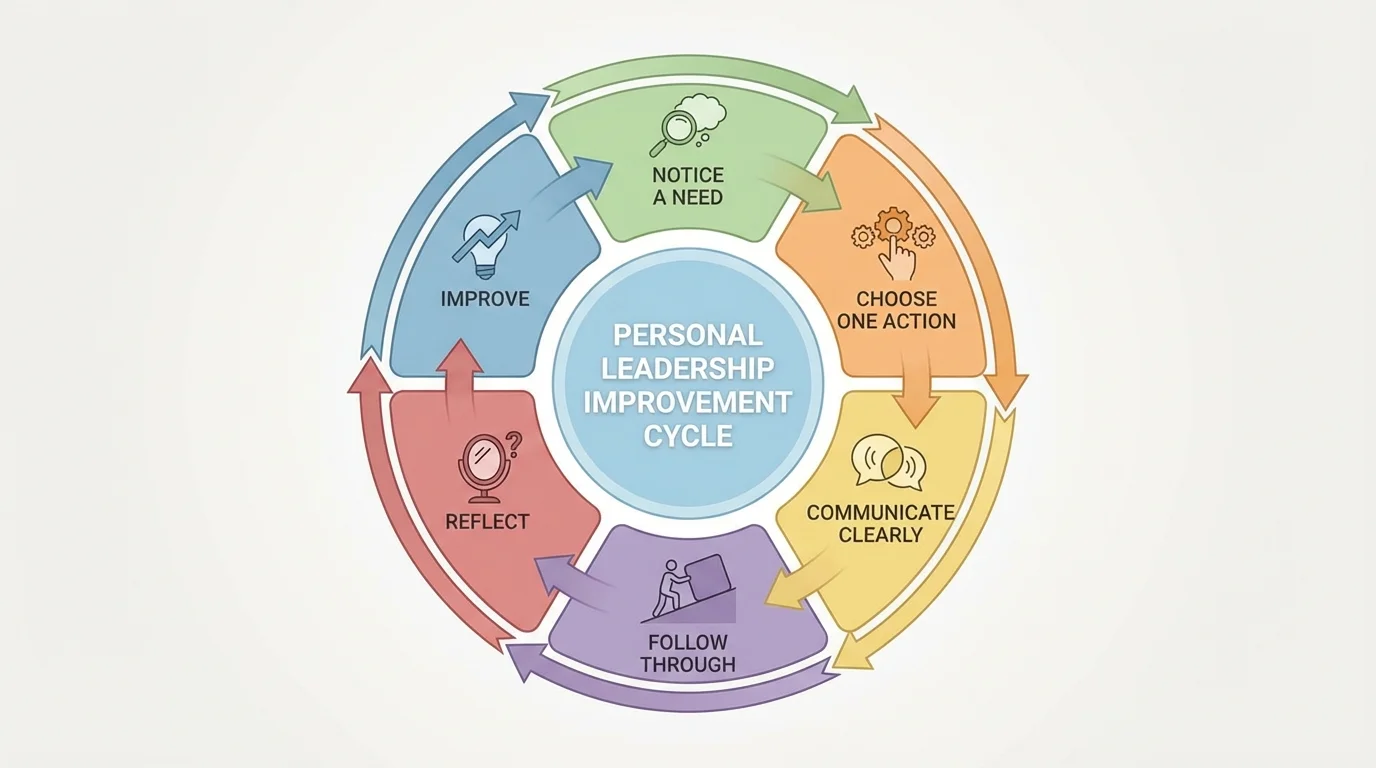
Leadership growth is not a personality trait you either have or do not have. It works more like a cycle, as [Figure 3] shows: notice a need, choose a helpful action, communicate clearly, follow through, and reflect afterward. Repeating that cycle builds real leadership over time.
Start small and specific. Choose one setting where you already have responsibility: a volunteer role, part-time job, sports team, club, family responsibility, or online community. Then identify one leadership habit to improve this week.
Examples include replying to important messages within a set time, confirming details before an event, checking in with teammates earlier, staying calm when plans change, or taking ownership of a mistake without excuses.
You do not need a huge transformation. If you improve one repeated behavior, your leadership becomes more effective. Someone who becomes more reliable, more respectful under stress, or more organized is becoming a better leader in ways other people can feel.
Try This
Step 1: Pick one real role you currently have.
Choose something specific, such as volunteer helper, employee, team member, sibling helping at home, or moderator in an online group.
Step 2: Name one leadership responsibility connected to that role.
For example: clear communication, follow-through, fairness, or problem-solving.
Step 3: Choose one visible action.
Examples: send earlier updates, make a checklist, ask one clarifying question before starting, or own mistakes immediately.
Step 4: Reflect after you do it.
Ask whether your action made the group more organized, calm, informed, or respected.
As you continue, [Figure 3] keeps the process grounded. Leadership is not about trying to seem impressive. It is about repeatedly doing what helps people, protects trust, and moves a group toward a goal.
