Some groups fall apart even when everyone is talented. Others do great work with average skills because one person helps people communicate clearly, follow through, and stay focused on the same goal. That is leadership. It is not just for team captains, managers, or public speakers. You lead any time you help people work together in a healthy, effective way—whether that is during an online group project, a part-time job, a volunteer event, a gaming community, a sports team, or responsibilities at home.
At your age, people start noticing who can be trusted, who stays calm under pressure, and who makes others feel respected. Those habits matter. They affect friendships, job references, family trust, opportunities, and your reputation. A person who leads badly may get short-term control, but they usually lose cooperation. A person who leads well earns something stronger: credibility.
You do not need a title to lead. If your friend group is planning a fundraiser and you organize tasks fairly, that is leadership. If you notice confusion during a video call and clarify the next steps, that is leadership. If you admit a mistake instead of blaming others, that is leadership too. Strong leadership is less about being "in charge" and more about helping people move forward together.
Good leadership creates real benefits. People respond faster. Misunderstandings decrease. Tension is lower. Goals are more likely to be reached. Poor leadership causes the opposite: missed deadlines, resentment, vague expectations, and silence when problems should be addressed. In online spaces especially, bad leadership often shows up as ignored messages, passive-aggressive comments, unclear roles, or one person doing everything while others disappear.
"Leadership is not about being the loudest person in the room. It is about helping people do their best work together."
If you want people to trust you, three qualities matter over and over: respect, accountability, and shared purpose. These are not just nice ideas. They are practical habits that shape how you speak, plan, decide, and respond when things go wrong.
Think of leadership as a three-part structure, as [Figure 1] shows. If one part is weak, the whole group feels it. Respect affects how safe people feel speaking honestly. Accountability affects whether plans turn into action. Shared purpose affects whether people are even moving in the same direction.
When respect is missing, people may stay quiet, withdraw, or become defensive. When accountability is missing, promises mean little. When shared purpose is missing, even hardworking people pull against each other. Strong leadership keeps all three working together.
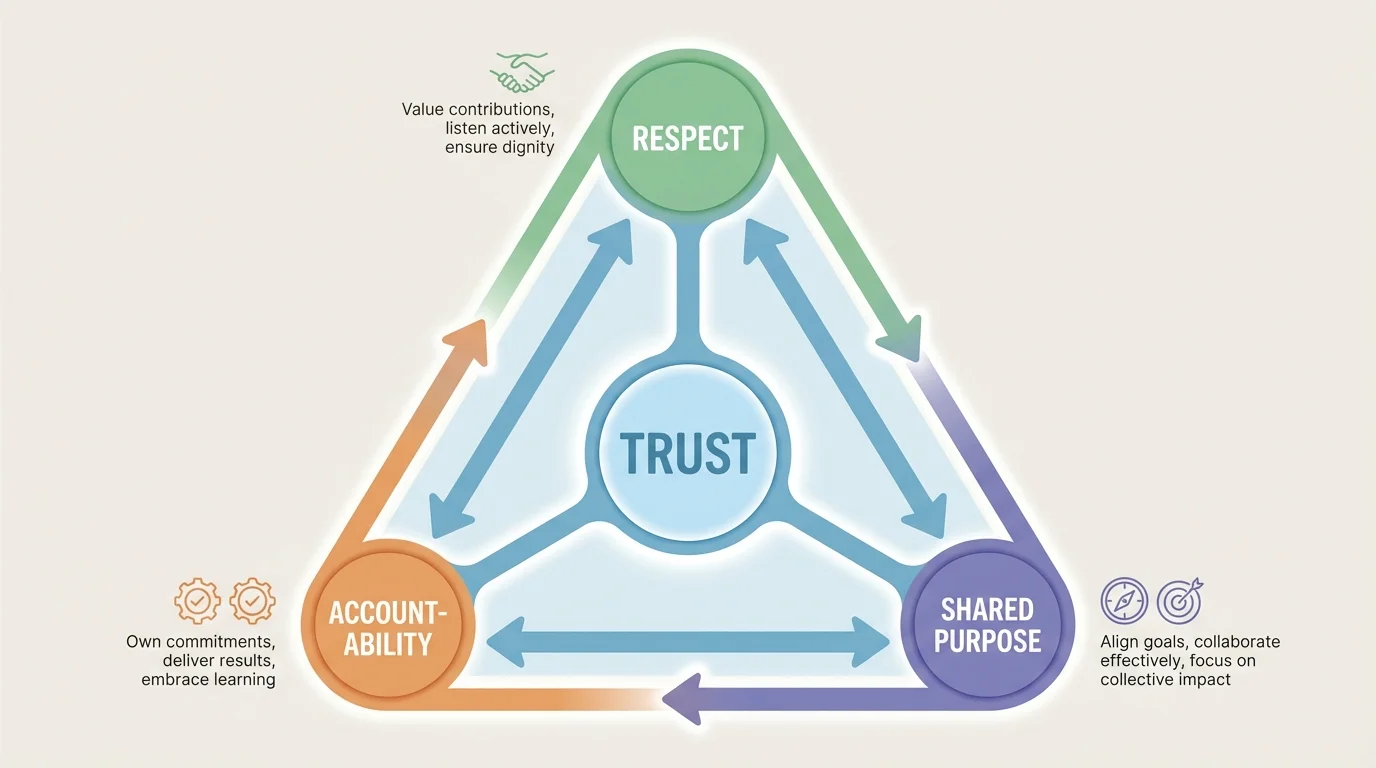
Trust grows when people feel heard, see follow-through, and understand the goal. That is why leadership is not just about motivation. It is also about consistency. You build trust through repeated actions: replying clearly, showing up prepared, owning mistakes, and keeping the goal visible.
Respect means treating people with dignity, listening seriously, and communicating without demeaning them.
Accountability means taking ownership of your actions, responsibilities, and results.
Shared purpose means a group clearly understands what it is trying to achieve and why it matters.
A useful way to remember this is simple: respect shapes how people work together, accountability shapes whether work gets done, and shared purpose shapes what everyone is working toward.
Respectful leadership starts with how you talk to people, especially when you are stressed. It means you do not interrupt, mock, ignore, or assume bad intentions right away. You ask questions before judging. You separate a problem from the person. You correct behavior without attacking identity.
In online communication, respect matters even more because tone is harder to read. A short message like "You didn't do this" can sound harsh even if that was not your intention. A more respectful version might be: "I noticed this part is still unfinished. What do you need to complete it by tonight?" The second version still addresses the issue, but it leaves room for honesty and problem-solving.
Respect also means making space for others to contribute. A leader who dominates every conversation may look confident, but often weakens the group. People support what they help build. When you ask, "What are we missing?" or "What do you think is the best next step?" you show that input matters.
Respect is not the same as agreeing with everyone. You can disagree clearly and still be respectful. Respect means you challenge ideas fairly, avoid insults, and stay focused on the issue instead of trying to embarrass someone. This is especially important when conversations happen through text, where people may react strongly to wording.
Another part of respect is recognizing boundaries. Not everyone is available at the same time. Not everyone works best in the same way. Good leaders avoid demanding instant replies, making public callouts unnecessarily, or expecting others to read their mind. They state expectations clearly and reasonably.
You should also pay attention to inclusion. If one person is always ignored in a group chat or video call, respectful leadership means drawing them in: "We have not heard from Jordan yet—what do you think?" Small choices like that can change the whole group dynamic.
Try This: Before sending a message when you are frustrated, pause for two minutes and reread it once as if you were the other person. Remove sarcasm, blame, and vague criticism. Replace it with a clear request.
Accountability is where leadership becomes visible. Anyone can make plans. Leaders follow through. If you agree to do something by Thursday, do it by Thursday. If you cannot, communicate early instead of disappearing. Reliability is one of the fastest ways to build trust.
Accountability also means not hiding when something goes wrong. A weak leader avoids responsibility, makes excuses, or shifts blame. A strong leader says, "I missed that deadline. That is on me. Here is how I will fix it." That response does not make you look weak. It makes you credible.
Owning mistakes is especially important in digital spaces because silence creates confusion. If you miss a deadline and say nothing, other people now have to guess what happened, whether they can trust you, and how the plan should change. Clear communication protects the group from unnecessary stress.
Example: accountable response after a missed task
You were supposed to make the slides for a youth volunteer presentation, but you underestimated how long it would take.
Step 1: State the problem directly.
"I said I would finish the slides by tonight, but I am not done."
Step 2: Take ownership without excuses.
"I misjudged the time needed, and that affected the group."
Step 3: Offer a repair plan.
"I can finish the first half by 8:00 p.m. and the rest by 10:00 p.m., or I can send my notes now so someone else can help."
Step 4: Follow through on the repair.
Do exactly what you promised next.
This kind of response protects trust because it combines honesty, responsibility, and action.
Accountability is easier when you track commitments. If you lead any group activity, keep a simple record: who is doing what, by when, and what "done" actually means. Vague commitments lead to vague results. Specific commitments are easier to manage.
For example, "work on the post" is vague. "Draft the announcement, choose one image, and send it by 6:00 p.m." is specific. Clear expectations help everyone succeed.
Shared purpose is what keeps a group from turning into a bunch of separate people doing unrelated things. A leader helps make the goal visible, as [Figure 2] illustrates through the path from goal to action. People need to know not just what they are doing, but why it matters and how their role contributes.
If a group says, "Let's make this good," that sounds positive but means almost nothing. A stronger shared purpose sounds like: "We want to create a clear, persuasive five-minute presentation for local donors by Friday so they understand why this project deserves support." That version gives direction.
Once the goal is clear, leadership turns purpose into structure. Who is doing research? Who is designing? Who is checking accuracy? When is the first draft due? How will updates be shared? Clear structure prevents confusion, duplicated effort, and last-minute panic.
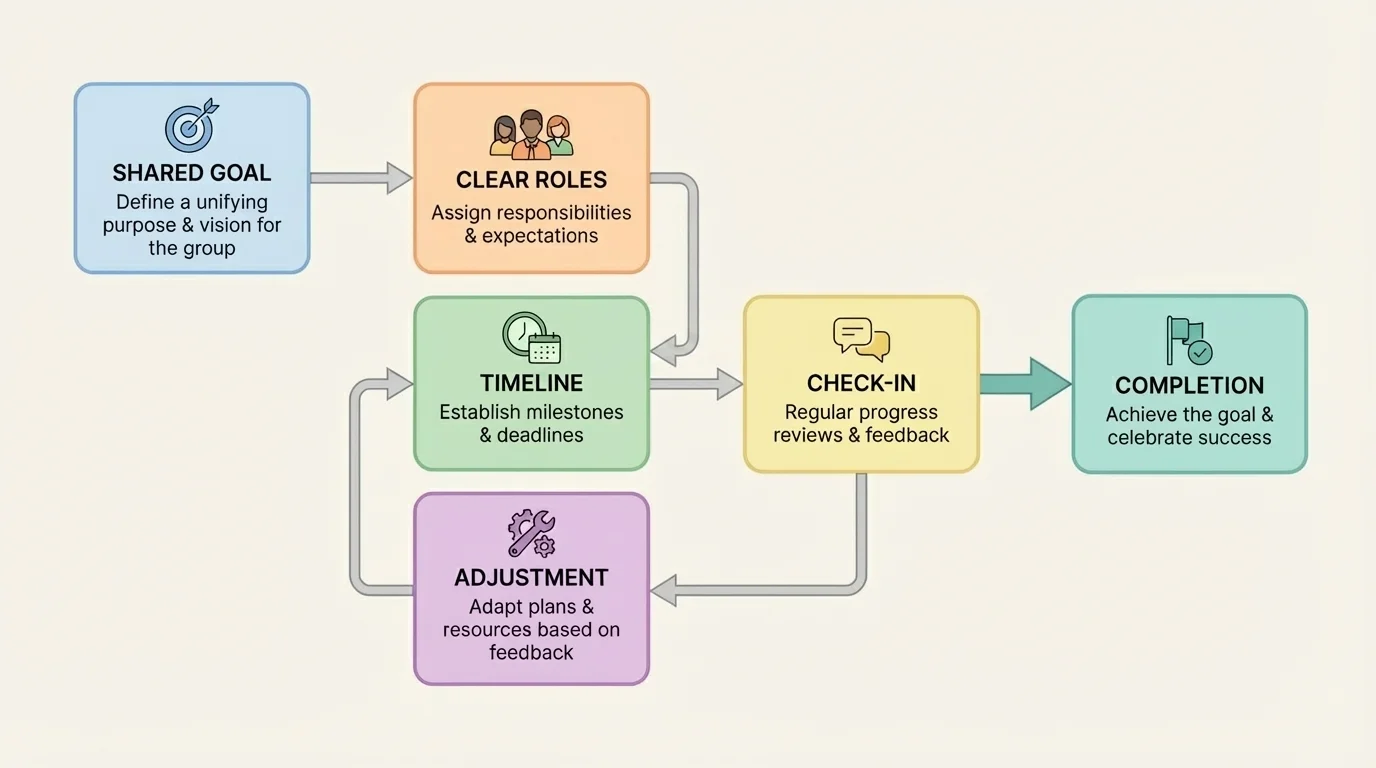
A group works better when members can answer four questions quickly: What are we doing? Why are we doing it? What is my role? What happens next? If people cannot answer those questions, the leader's next job is clarity.
Shared purpose also helps during disagreement. When people argue from personal preference alone, conflict becomes more emotional. When you bring the conversation back to the purpose—"Which option best serves the goal?"—decisions become more productive. This is one reason [Figure 2] matters beyond planning: the same structure helps the group adjust when things change.
| Weak Group Direction | Stronger Shared Purpose |
|---|---|
| "Let's post something soon." | "Let's publish a clear event post by 7:00 p.m. so people have time to sign up." |
| "Everybody help with the meeting." | "One person runs the agenda, one takes notes, and one sends the follow-up summary." |
| "Make it better." | "Shorten the intro, add two examples, and fix the title so the message is clearer." |
Table 1. Comparison of vague directions and clearer statements that create shared purpose.
Groups often fail because of unclear expectations, not lack of effort. Many people are willing to help, but they hesitate when they do not know exactly what is needed.
Try This: The next time you help lead anything, write one sentence that finishes this prompt: "Our goal is to ___ by ___ so that ___." If your sentence feels vague, keep improving it until it gives real direction.
Sometimes leadership feels hard because people know the idea but not the words. Practical language helps. You do not need to sound formal. You need to sound clear, calm, and fair.
Here are a few examples you can actually use:
To invite input: "I want to hear everyone's view before we decide."
To clarify a role: "Can you take responsibility for the final edit and send it by 5:00 p.m.?"
To redirect disrespect: "Let's keep this focused on the issue, not each other."
To admit a mistake: "I should have communicated earlier. That is my mistake."
To reconnect the group to purpose: "Which option best supports what we are trying to accomplish?"
To address silence: "I have not heard from you yet. Are you blocked, unsure, or just busy?"
Strong leaders are often good at saying difficult things without making the situation worse. That is a skill, not a personality type. You can practice it.
Conflict resolution is a major part of leadership because people will not always agree. The goal is not to eliminate disagreement. The goal is to handle it in a way that protects progress and relationships.
Start by identifying the real problem. Is the issue a missed deadline, unclear role, rude tone, different priorities, or unequal effort? Many conflicts get worse because people argue about the surface issue while ignoring the actual cause.
Then speak directly and specifically. "You never help" is too broad and usually leads to defensiveness. "The last two times, the file was not uploaded when expected, and it delayed the rest of us" is clearer and easier to solve.
A strong correction has three parts: describe the behavior, explain the impact, and ask for a better next step. For example: "When updates are missing, the group cannot plan. Starting today, please post your progress by 4:00 p.m." This keeps the conversation focused on change, not blame.
Good leaders also know when to listen longer. If someone seems defensive, there may be information you do not have yet. They may be overwhelmed, confused, or embarrassed. Listening does not mean lowering standards. It means solving the right problem.
If you need to apologize, make it real. A real apology names the action, recognizes the impact, and changes behavior. "Sorry if you were offended" is weak because it avoids responsibility. "I interrupted you and dismissed your idea on the call. That was disrespectful. I am sorry, and I will handle that better next time" is much stronger.
When conflict is handled well, trust can actually increase. People learn that problems can be addressed honestly without the group falling apart.
Initiative means acting without waiting to be told every step. It is valuable because groups often stall when everyone notices a problem but nobody moves. If you see confusion, you can suggest a plan. If a task is unclaimed, you can volunteer. If communication is disorganized, you can create a shared checklist.
But there is a difference between initiative and control. Taking over looks like deciding everything alone, ignoring input, or assuming your way is automatically best. Real leadership creates momentum while still respecting the group.
A good test is this: after you step in, do other people feel more capable or less included? If your leadership makes everyone else passive, you may be controlling more than leading.
One useful habit is to offer structure, then invite response. For example: "To keep us moving, I drafted a simple timeline. Take a look and tell me what should change." That shows initiative without acting like the plan is untouchable.
If leadership feels abstract, use a repeatable system. The process in [Figure 3] works in many situations: online projects, volunteer events, home responsibilities, side jobs, and community groups. It keeps leadership practical instead of dramatic.
Here is the system: listen, define the goal, assign actions, follow up, and review. Most leadership problems happen because one of these steps gets skipped.
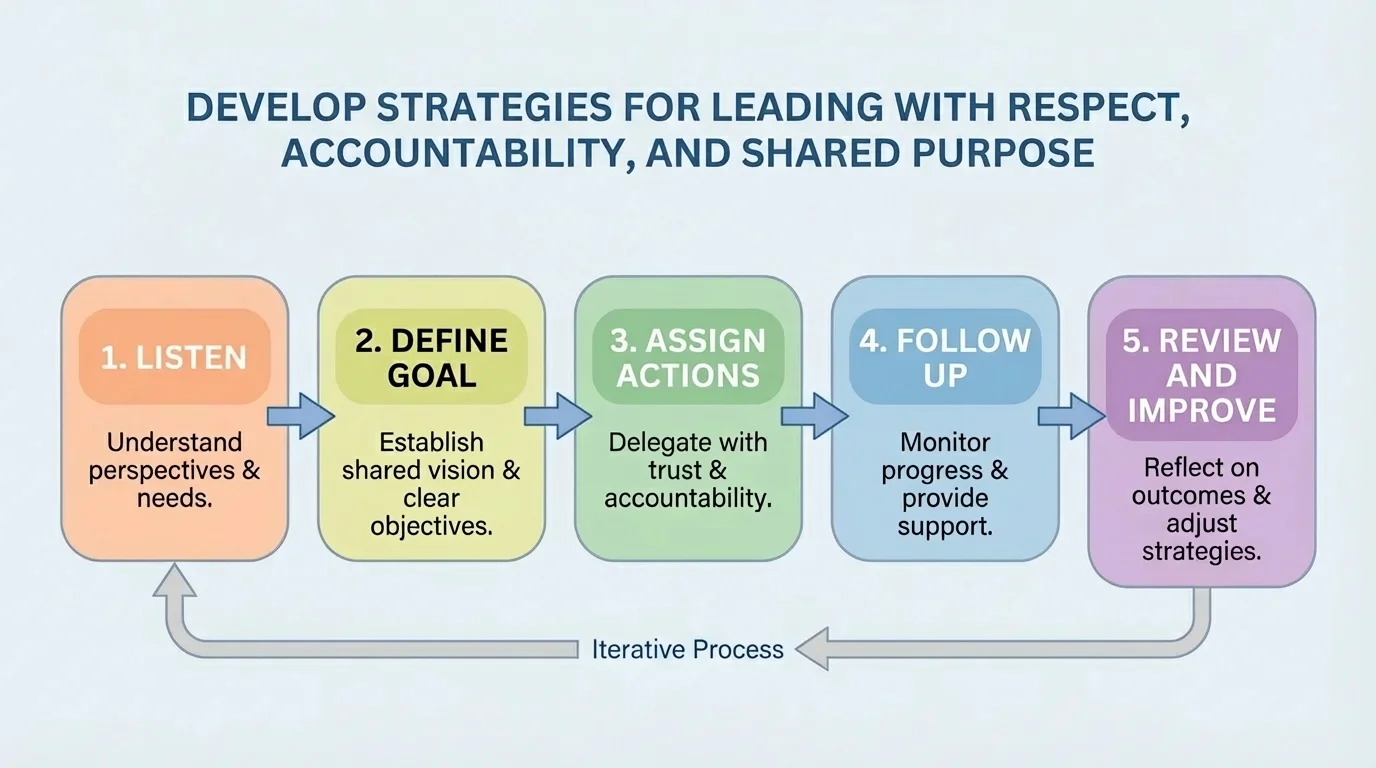
Step 1: Listen. Before trying to lead, understand the situation. What is the problem? What do people need? What has already been tried?
Step 2: Define the goal. Make the target clear enough that everyone can recognize success.
Step 3: Assign actions. Decide who is responsible for each part and when it is due.
Step 4: Follow up. Check progress before the deadline, not only after something fails.
Step 5: Review and improve. Ask what worked, what did not, and what should change next time. This is where growth happens. Later, when you are leading a new situation, [Figure 3] gives you a simple mental checklist instead of forcing you to guess what to do next.
Example: using the 5-step system for a volunteer event
Step 1: Listen
You learn that sign-ups are low because the event information is scattered across different messages.
Step 2: Define the goal
The goal becomes: one clear event announcement posted tonight with time, location, contact details, and sign-up instructions.
Step 3: Assign actions
One person writes the post, one checks details, and one shares it on two platforms.
Step 4: Follow up
You check in after one hour instead of waiting until late evening.
Step 5: Review
After the event, the team decides to keep all future announcements in one shared document first.
This is leadership because it improves cooperation, clarity, and results.
Try This: Use the 5-step system on one small situation this week. It could be planning chores at home, organizing a study call, or helping coordinate a community activity.
One common mistake is confusing control with strength. If you do everything yourself, you may feel efficient, but the group becomes weaker and more dependent. Fix this by delegating clearly and letting others own meaningful parts.
Another mistake is being "nice" instead of clear. Avoiding discomfort may feel kind in the moment, but unclear expectations create bigger problems later. Respectful leadership includes honest communication.
A third mistake is only speaking up when something is wrong. Good leaders also notice progress. Saying "Thanks for getting that in early" or "That explanation made the whole plan clearer" reinforces behaviors that help the group succeed.
Another leadership trap is reacting emotionally in public messages. If something is serious, handle it directly and calmly, not with a dramatic post or a sarcastic comment. Public embarrassment often damages cooperation more than the original mistake did.
Leadership looks a little different depending on the setting, but the core principles stay the same.
At home, leadership may mean noticing what needs to be done, dividing tasks fairly, and communicating respectfully even when family members are stressed.
At a part-time job, leadership may mean showing reliability, helping new coworkers understand procedures, and solving problems without blaming customers or teammates.
In sports, leadership often means effort, composure, and support under pressure—not just giving speeches.
In online communities, leadership means setting a respectful tone, discouraging pile-ons, clarifying rules, and addressing problems consistently.
With friends, leadership can mean stopping gossip, making sure plans are fair, and speaking up when someone is being excluded.
You already know from other life-skills topics that communication, self-management, and time awareness matter. Leadership builds on those same skills. If you cannot manage your own reactions and responsibilities, it becomes much harder to guide a group well.
No matter the setting, people watch patterns. They notice whether you stay respectful when annoyed, whether your words match your actions, and whether you care about the group more than your ego.
Leadership is not a fixed trait that some people have and others do not. It is a set of habits you build over time. You get better by noticing what happens in real situations, reflecting honestly, and adjusting.
Ask yourself questions like: Do people feel comfortable being honest with me? Do I follow through? Do I make goals clear? Do I listen before deciding? Do I handle mistakes in a way that builds trust or weakens it?
You do not need to be perfect to lead well. In fact, pretending to be perfect often makes leadership worse. What matters more is being teachable, steady, and willing to improve. People trust leaders who are real, fair, and consistent.
The strongest leaders are often the ones who help others grow too. They do not just complete tasks. They build environments where people can contribute, learn, and take responsibility themselves.
