Some of the worst decisions people make are not made because they are cruel or careless. They are made because the pressure feels intense, the situation moves fast, and the easy option seems harmless for just a moment. A friend wants a favor. A supervisor hints that "everyone does it." A group chat pushes you to keep quiet. In real life, ethical choices rarely arrive with perfect timing. They show up when you are stressed, rushed, embarrassed, loyal to someone, or afraid of being left out.
That is why ethical decision-making is not just about knowing right from wrong in theory. It is about being able to think clearly when the stakes feel personal. It means choosing actions that match your values even when there is pressure, even when no one is watching, and even when doing the right thing costs you something in the short term.
An ethical dilemma happens when a situation forces you to choose between competing pressures, values, or responsibilities. Sometimes both options have downsides. Sometimes the wrong option looks easier, faster, or more rewarding right now. That is what makes these moments difficult.
Ethical decision-making means choosing actions based on honesty, fairness, respect, responsibility, and the likely effects on other people and on your future. It is not just asking, "Can I do this?" It is asking, "Should I do this?" and "What happens next if I do?"
Pressure can cloud judgment in predictable ways. You might tell yourself, "It is only once," "No one will find out," or "I do not want drama." Those thoughts are common, but they are risky. They shrink your focus to the next five minutes instead of the next five months.
Ethical choices also get harder when relationships are involved. It feels different to refuse a stranger than to refuse a close friend, sibling, coach, manager, or teammate. But your relationship with someone does not erase the impact of a harmful choice. Loyalty matters, but real loyalty does not require dishonesty, cruelty, or silence about serious harm.
A decision is more likely to be ethical if it protects people from unnecessary harm, respects truth, treats others fairly, and accepts appropriate responsibility. Ethical decisions are not always comfortable, popular, or convenient. They are often the choices that preserve trust.
When you evaluate a choice, ask whether it is based on integrity. Integrity means your actions match your values, not just your moods or your audience. A person with integrity does not act one way in public and another way in private. They do not change their standards just because the pressure changes.
Ethics is practical, not abstract. In daily life, ethics shows up in ordinary decisions: whether you tell the truth after making a mistake, whether you share private information, whether you help cover for someone who acted recklessly, whether you copy work, whether you manipulate a parent, customer, or employer, and whether you speak up when someone is at risk.
Another important idea is accountability. Accountability means owning your choices and their effects. If your action affects other people, you cannot ethically pretend it is "just your business." Freedom and accountability go together.
You should also think about consequences. This does not only mean punishment. It includes effects on trust, safety, reputation, mental health, opportunities, and relationships. A choice can feel small but still create a chain of damage.
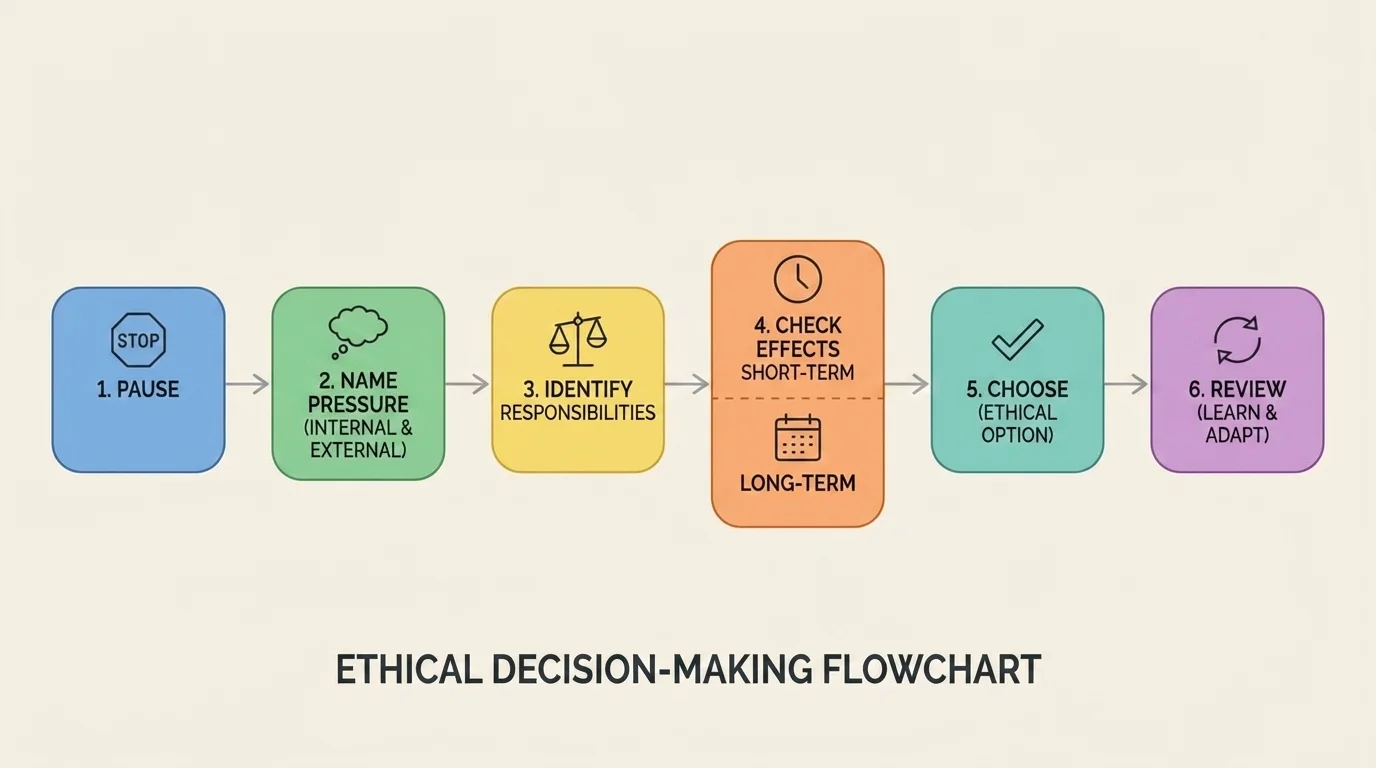
When a situation gets messy, a simple process helps you slow down and think clearly. A reliable path is to pause, name the pressure, identify your responsibilities, check likely consequences, choose the most ethical action, and review what happened afterward. Using a process does not remove stress, but it keeps stress from making the decision for you.
[Figure 1] Step 1: Pause. If possible, do not answer immediately. A rushed decision is often a pressured decision. Even saying, "Give me a minute to think," can lower the emotional temperature.
Step 2: Name the pressure. Ask yourself: What is pushing me right now? Fear? Loyalty? Embarrassment? Money? Wanting approval? Time pressure? Naming the force makes it easier to resist it.
Step 3: Identify your responsibilities. Who could be affected? What duty do you have to yourself, to other people, to safety, to honesty, or to rules you agreed to follow?
Step 4: Look ahead. What happens in one hour, one week, and one year if you choose this option? Ethical thinking stretches time.
Step 5: Choose the action you could defend openly. If you would be ashamed to explain your choice to a trusted adult, employer, future roommate, or future self, that is an important warning sign.
Step 6: Review and repair. Afterward, ask what you learned. If harm was done, take responsibility and make repairs where possible.
Quick-use ethical check
Step 1: Ask, "What pressure am I feeling?"
This keeps you from confusing pressure with principle.
Step 2: Ask, "Who could be helped or harmed?"
This broadens your view beyond yourself.
Step 3: Ask, "Would I be okay if this choice became public?"
If the answer is no, stop and reconsider.
Step 4: Ask, "What option protects trust and safety best?"
That option is usually the strongest ethical choice, even if it is harder.
This process is especially useful online, where people often feel pushed to respond instantly. You do not owe instant access to your judgment. Delaying a response can be a sign of maturity, not weakness.
Pressure takes different forms, including peer pressure, authority pressure, urgency pressure, and online pressure. Each one can make an unethical choice feel normal, necessary, or harmless. The more clearly you recognize the type, the easier it is to respond effectively.
[Figure 2] Peer pressure sounds like: "Come on, everyone agreed," or "Do not be the only one who says no." This kind of pressure uses belonging as leverage.
Authority pressure sounds like: "Just do what I told you," or "Do not make this complicated." This can come from an older sibling, supervisor, coach, community leader, or employer. Respect matters, but authority does not make every instruction ethical.
Urgency pressure sounds like: "We need an answer now," or "There is no time to explain." Sometimes urgency is real. Sometimes it is used to stop you from thinking.
Online pressure can be especially intense because messages pile up, screenshots last, and group reactions happen fast. People say things in chats or direct messages that they might not say face-to-face.
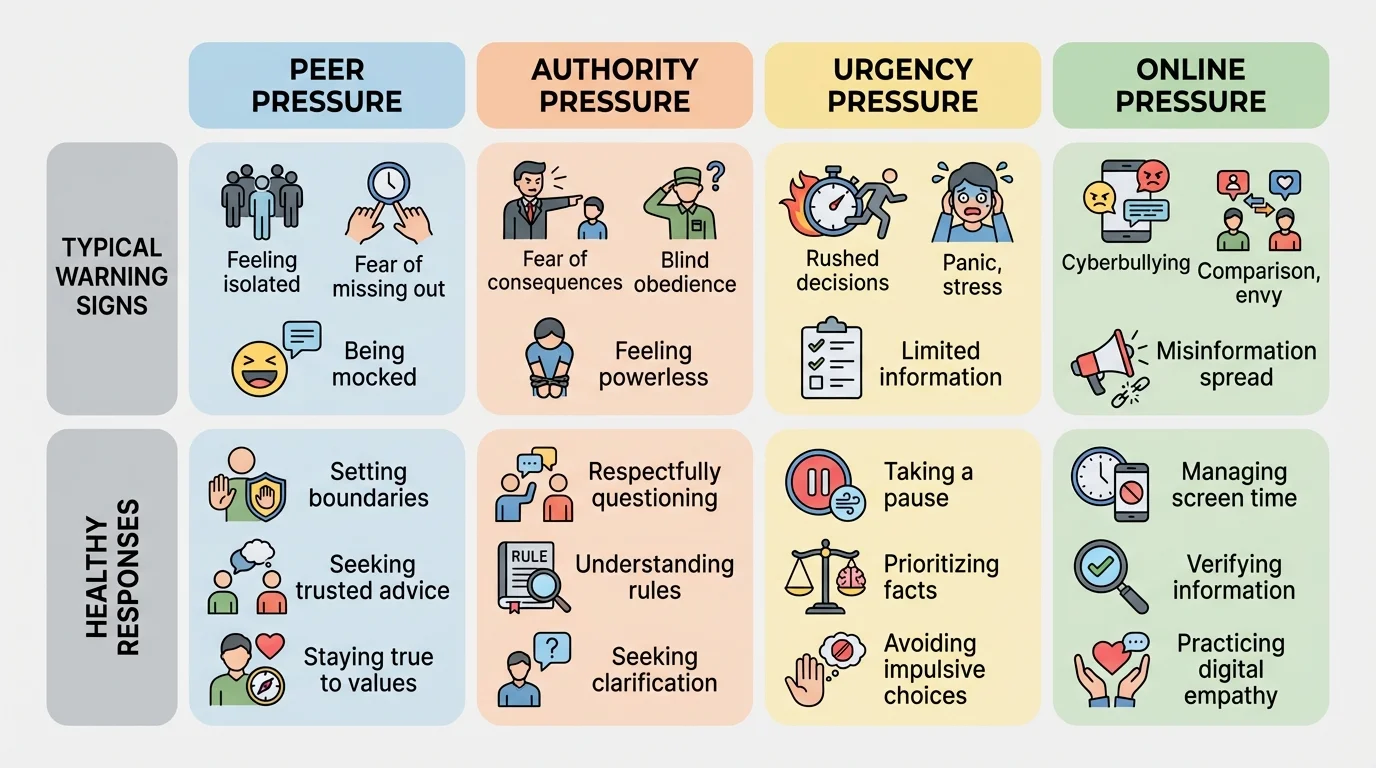
Healthy responses are often short and calm. You do not need a dramatic speech. Try statements like: I am not comfortable with that. I need time to think. I will not lie for you. I can help fix this, but I will not help hide it. If someone is at risk, I am telling an adult.
Notice that these responses do two things: they set a boundary and they avoid unnecessary escalation. Ethical strength is not about sounding tough. It is about staying clear.
People are more likely to go along with a bad decision when they believe everyone else accepts it, even if many people privately feel unsure. One person calmly refusing can change the direction of the whole group.
If pressure keeps increasing after you say no, that itself is important information. A healthy friend, team, or workplace might be disappointed, but it should not punish you for refusing dishonesty or harm.
Responsibility means understanding what is truly your job to do, what is not your job, and what obligations come with your role. If you babysit a younger child, work a shift, manage a shared account, handle private information, or agree to help with a project, your choices affect more than just you.
Responsibility is not the same as blame. You can have a responsibility to respond even if you did not cause the problem. For example, if you notice a dangerous mistake at work, you may not have created it, but you still have a responsibility to act appropriately once you know about it.
Roles change what ethics requires. The right choice depends partly on your role in the situation. A bystander, a friend, a team leader, an employee, and a caregiver may all face the same event but have different responsibilities within it. Ethical thinking asks not only, "What do I want?" but also, "What is required of me in this role?"
Here are some common responsibilities students your age may face outside of a physical school setting:
| Role | Possible responsibility | Ethical risk |
|---|---|---|
| Friend | Be honest and supportive | Covering up serious harm in the name of loyalty |
| Employee or volunteer | Follow rules, protect safety, report problems | Falsifying records or hiding mistakes |
| Sibling or caregiver | Protect younger children and vulnerable people | Ignoring risk to avoid conflict |
| Online participant | Respect privacy and communicate responsibly | Sharing private content or joining harassment |
| Team member | Do your part and communicate truthfully | Blaming others or taking dishonest shortcuts |
Table 1. Common roles and the ethical responsibilities and risks that often come with them.
A useful question is: What am I responsible for protecting here? The answer may be safety, privacy, fairness, trust, truth, or someone's well-being. That question often points you toward the ethical option.
One quick decision can create a ripple effect through the way a single choice branches into effects on trust, reputation, opportunity, and safety. Ethical thinking is not only about avoiding immediate trouble. It is about understanding how actions travel forward through time.
[Figure 3] For example, lying to protect a friend from embarrassment may seem kind in the moment. But if the lie hides unsafe behavior, the long-term effect may be greater harm. Posting private screenshots for social approval may get a fast reaction, but it can destroy trust and follow you through your digital footprint.
Digital footprint means the record of your online activity that can remain accessible long after you post, comment, share, or message. Even deleted content may be saved by screenshots, archives, or other users. Ethical online decisions matter because the audience is often bigger and more permanent than it seems.
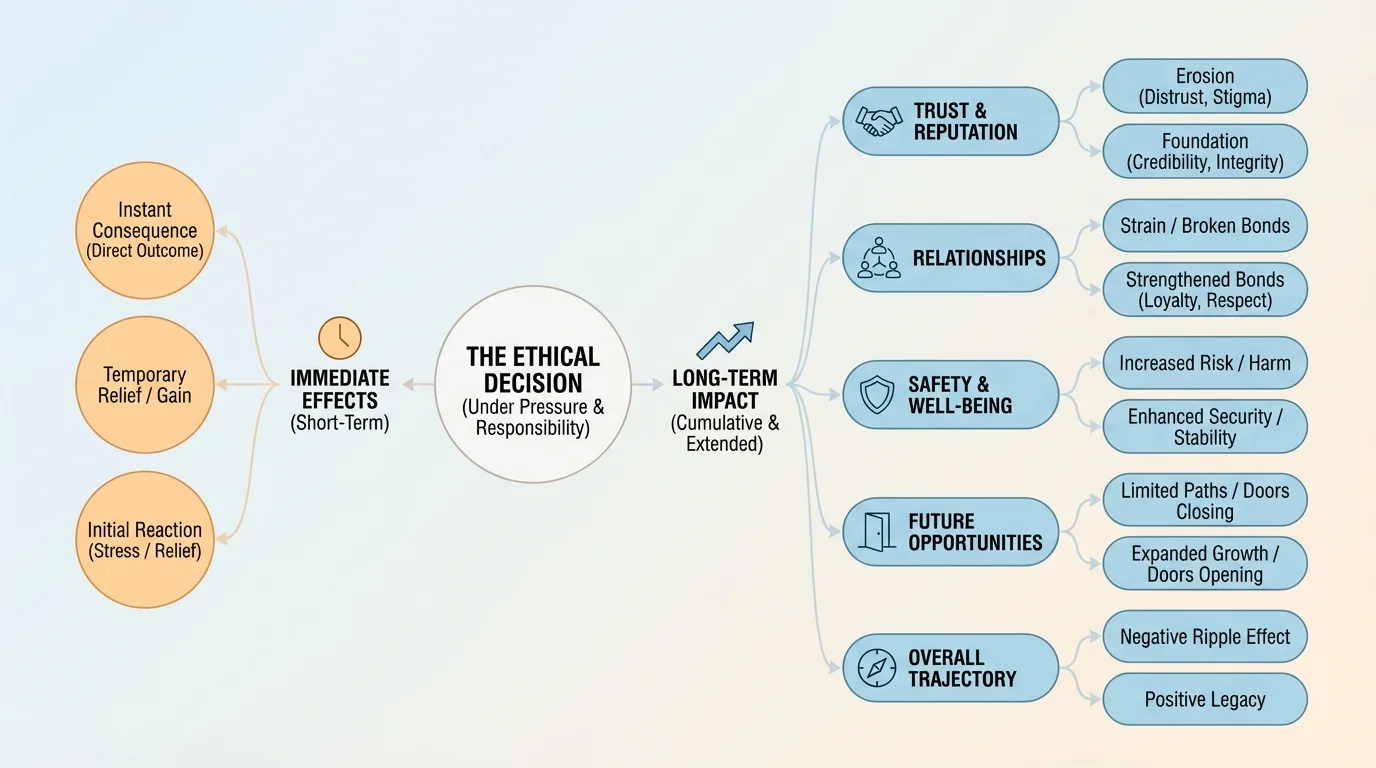
Long-term impact also includes your reputation. Reputation is not just popularity. It is the pattern people come to expect from you. Are you honest? Reliable? Fair? Safe? When you build a reputation for integrity, people trust you with more responsibility. When you repeatedly choose shortcuts, people remember that too.
This matters in jobs, volunteering, housing, relationships, and community life. A person who can be trusted under pressure becomes valuable. That trust can open doors later.
"Character is what you do when no one is watching."
— Common ethical principle
The reverse is also true. One dishonest action does not always destroy a future, but repeated dishonesty trains you into a pattern. Habits shape character. Character shapes major decisions later.
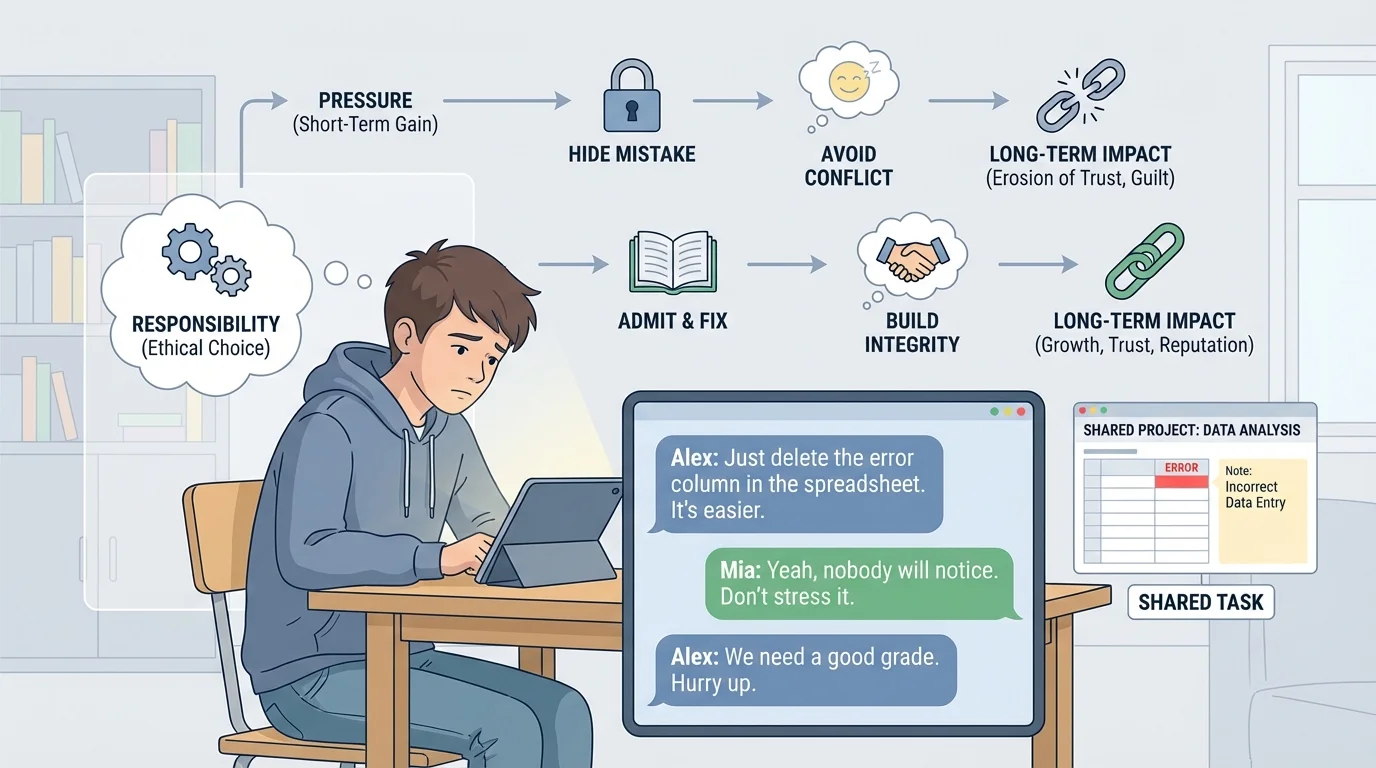
Ethics becomes clearer when you test it in realistic situations. An online team-chat situation can capture a common pattern: someone makes a mistake, other people push for silence, and the easiest option is to protect the group in the short term. But the ethical question is not only, "How do we avoid embarrassment?" It is also, "What do we owe each other now?"
[Figure 4] Scenario 1: You help with a community fundraiser. Another volunteer accidentally enters the wrong payment amounts into a spreadsheet. A group message starts, and someone says, "Do not mention it yet. We can fix it later if anyone notices." The ethical response is not to panic or publicly shame the person. It is to address the error honestly and quickly with the appropriate organizer. Hiding a financial mistake can create bigger confusion and destroy trust.
Scenario 2: A friend asks you to tell their parent they were with you all evening, but you know they were somewhere unsafe. This is where responsibility and long-term impact matter more than loyalty pressure. If there is a real safety issue, protecting your friend may mean refusing to lie and involving a responsible adult.
Case study: pressured to lie for a friend
Step 1: Identify the pressure.
You do not want your friend to be angry, and you may fear losing the friendship.
Step 2: Identify the responsibility.
If the situation involves safety, your responsibility to protect well-being is stronger than your responsibility to protect your friend from consequences.
Step 3: Evaluate long-term effects.
Lying may protect comfort tonight, but it can enable future risk and damage trust with adults who rely on you.
Step 4: Choose a boundary statement.
Say: I care about you, but I am not going to lie about where you were.
Scenario 3: At a part-time job, a supervisor asks you to clock out but keep cleaning for "just ten more minutes." That request is unethical because it asks you to work without pay. Authority pressure can make it hard to refuse, but your labor and time matter. A calm response might be: I can finish while on the clock, or I can continue next shift, but I cannot work unpaid.
Scenario 4: Someone shares private photos or messages in a group chat and says, "Do not be dramatic, it is funny." The ethical choice is not to forward, react, or join in. Privacy violations spread harm fast. If the content is exploitative, threatening, or involves someone vulnerable, you should save evidence if safe and report it to a trusted adult or appropriate platform.
These examples point to a bigger truth: ethical decisions are often less about dramatic heroism and more about refusing small acts of dishonesty before they grow.
Many people know the ethical answer but struggle with the social part: what to say. You do not need to over-explain. Short, clear language often works best.
Useful scripts include: No, I am not doing that. I am not comfortable being part of this. I will help solve the problem, but not by lying. I need to step back from this conversation. If this continues, I am going to involve someone else.
If you have learned about boundaries, assertive communication, or online safety before, use those same skills here. Ethical decision-making often depends on calm tone, clear wording, and the ability to tolerate someone else's disappointment.
It also helps to avoid debating every detail when the issue is clear. If someone keeps pushing, repeating your boundary can be stronger than inventing new reasons. Ethical firmness is often simple.
When possible, move difficult conversations into safer formats. If a group chat is escalating, step out. If a private message feels manipulative, stop responding and seek advice. If a voice call feels intimidating, follow up in writing so there is a record.
Some situations are too serious to handle alone. Get help when there is a safety risk, threats, coercion, exploitation, illegal activity, self-harm concern, abuse, harassment, blackmail, or pressure to hide significant harm. In these cases, silence is not neutrality. Silence can protect the wrong thing.
Conflict of interest can also affect judgment. A conflict of interest happens when personal benefit, loyalty, or fear interferes with your ability to act fairly or responsibly. If you are too personally involved to think clearly, bring in a trusted adult, manager, parent, guardian, mentor, or another appropriate support person.
Getting help is part of ethical action. Asking for guidance is not the same as avoiding responsibility. It can be the most responsible thing to do when the situation is bigger than your role, knowledge, or safety level.
If you need to report a problem, stick to facts. Write down what happened, when it happened, who was involved, and what evidence exists. Avoid exaggeration. Clear documentation supports fairness.
Notice how the earlier framework still applies here, just as in [Figure 1]. You pause, identify the pressure, clarify your role, think ahead, and choose the action you can defend. The framework is not only for small decisions; it also helps in serious ones.
The best ethical decisions often start long before the pressure moment. If you already know your non-negotiables, you will decide faster and more clearly. For example: I do not lie to cover unsafe behavior. I do not share private content. I do not work unpaid. I do not stay silent when someone is in danger.
It also helps to rehearse responses. That may feel awkward, but it works. People who have already practiced a boundary statement are more likely to use it under stress. Think of it like mental preparation for a difficult conversation.
Try This
Write down three sentences you can realistically use when pressure shows up. Keep them short enough to remember. Examples: I need a minute to think. I am not okay with that. I can help fix it, but I will not help hide it.
Another useful habit is reflection. After a difficult moment, ask yourself: What pressure did I feel? What values mattered? Did I protect the right things? What would I do differently next time? This kind of reflection strengthens judgment.
As you continue making choices, remember that ethics is not perfection. You will sometimes hesitate, misread a situation, or wish you had acted sooner. What matters is that you learn, repair where possible, and keep building a pattern of honesty, courage, and responsibility. Over time, those patterns become your character.
That is the real goal: not just making one good choice, but becoming the kind of person who can be trusted when choices are hard. The ripple effects described earlier in [Figure 3] work in a positive direction too. One honest decision strengthens trust, and trust often leads to stronger relationships, safer communities, and more opportunities in the future.
