People often think adulthood starts with a birthday, but in real life it starts when other people begin trusting you with real responsibilities. A manager trusts you to show up. A doctor trusts you to give accurate information. A bank trusts you to protect your account. Friends and partners trust you with personal details. That trust can open doors fast, and losing it can close them just as fast.
Even at your age, you are already part of adult systems. You may have a job, a bank card, a learner's permit, a medical appointment you help manage, a social media account, or responsibilities at home. These systems do not just run on rules. They run on character. When you act with integrity and respect, people see you as reliable, safe, and mature. When you act carelessly, dishonestly, or disrespectfully, the consequences can reach far beyond one awkward moment.
Think about the difference between two job applicants. One exaggerates their experience, arrives late to a video interview, and blames technology without taking responsibility. The other is honest about what they know, logs in early, and communicates clearly. The second person may not be more talented, but they immediately appear more trustworthy. In adult life, trust is often the first test.
Integrity means doing what is honest, responsible, and ethically right, even when no one is watching or when doing the right thing is inconvenient.
Respect means recognizing the dignity, boundaries, rights, time, and perspectives of other people, as well as treating shared systems and rules seriously.
Integrity and respect are connected. If you are honest but rude, people may not feel safe around you. If you are polite but dishonest, people may not trust you. Strong adult relationships usually require both. You tell the truth, keep your word, own your mistakes, and treat others like their needs and rights matter.
Accountability is a major part of integrity. It means you do not just make choices; you also accept responsibility for their results. If you miss a deadline, accountability sounds like, "I missed it. That's on me. Here's how I'll fix it." It does not sound like, "Everyone else was confused too," or "I thought someone would remind me."
Respect is more than saying "please" and "thank you." It includes listening, honoring someone's privacy, accepting "no," not pressuring people, not mocking differences, and understanding that other people have lives, stress, beliefs, and limits that may not match yours. Respect is also how you behave when you disagree. Adult disagreement should not become personal attacks, gossip, threats, or humiliation.
You also owe integrity and respect to yourself. That means not lying to yourself about what is healthy, not letting others push you into violating your values, and not participating in behavior that could damage your future. Self-respect helps you set standards for how you will act and how others may treat you.
Adult systems are the organized structures that shape daily life, and [Figure 1] shows how connected they are. A problem in one area can quickly affect another. Missing work can affect money. Ignoring money can affect housing or transportation. Oversharing online can affect jobs, relationships, or even safety.
Some systems are formal, like healthcare, banking, employment, contracts, laws, and government services. Others are less formal but still powerful, like digital communities, family expectations, friend groups, and community organizations. They all depend on people following rules, communicating clearly, and treating one another fairly.
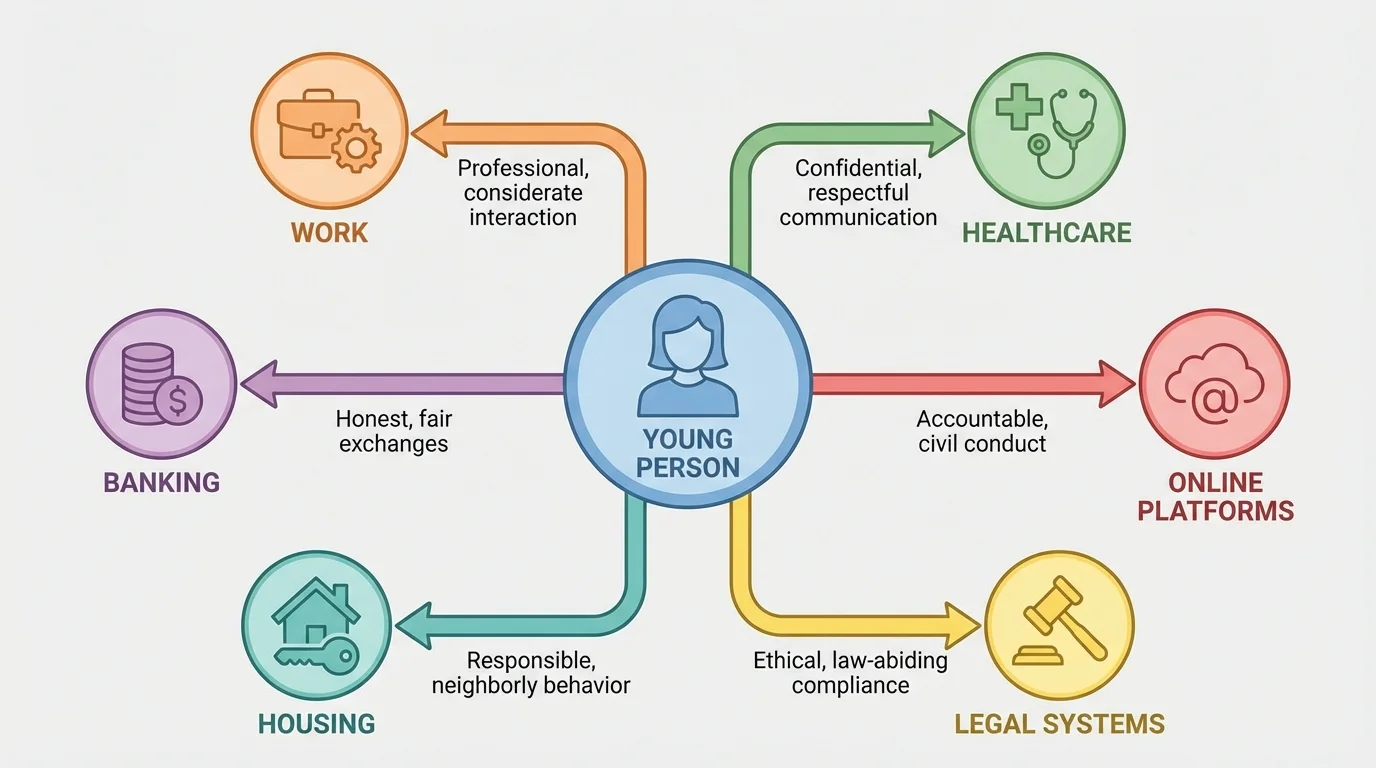
For example, in healthcare, integrity means telling the truth about symptoms, medications, and habits so you can get safe treatment. Respect means showing up on time, following instructions, and understanding that medical workers manage many people's needs. In banking, integrity means protecting your passwords, checking charges honestly, and not using money that is not yours. Respect means understanding that financial agreements and deadlines matter.
Online spaces are adult systems too. Your messages, posts, usernames, comments, and digital history can shape how people judge your maturity. Employers, scholarship reviewers, teammates, and community leaders may see your online behavior. Respect online means not sharing private screenshots without permission, not joining pile-ons, and not treating distance like an excuse to forget basic decency.
As we saw in [Figure 1], these systems overlap. If you act irresponsibly in one area, the impact can spread. A public argument online might seem separate from your future career, but to an employer it may signal poor judgment, weak self-control, or disrespect for others.
Many employers and volunteer organizations check online presence before making decisions. They are often not looking for perfection; they are looking for patterns of judgment, honesty, and respect.
That is why everyday choices matter. Sending a truthful email, protecting a private message, returning borrowed money, or admitting a mistake may feel small in the moment. In adult systems, those small actions build your reputation over time.
Integrity becomes visible through behavior. One obvious part is honesty, but honesty alone is not enough. A person with integrity also follows through, handles private information carefully, and avoids taking unfair advantage of others.
Confidentiality matters in many relationships. If a friend tells you something personal, that does not automatically give you the right to share it in a group chat. If a workplace gives you access to customer information, using it casually or discussing it outside work is a serious violation. Integrity asks, "Is this mine to share?" If the answer is no, keep it private unless safety is at risk.
Consent also connects to integrity. You do not pressure someone into sharing photos, location information, passwords, or emotional labor. You ask clearly, respect the answer, and understand that silence or pressure is not true agreement. Integrity refuses manipulation.
Money brings integrity into focus very quickly. Suppose a cashier gives you too much change, or a payment app accidentally sends you extra money. Integrity means returning what is not yours, even if the other person may never notice. People reveal their values most clearly when they think they can "get away with it."
Case study: Returning extra money
You buy food and notice later that you were refunded twice.
Step 1: Verify what happened
Check the receipt, account activity, and notification history so you are sure there was an error.
Step 2: Report it promptly
Contact the business, explain the duplicate refund, and ask how to return or correct it.
Step 3: Keep records
Save the message or confirmation in case the issue returns later.
That choice protects your reputation and keeps a small error from becoming dishonesty.
Integrity also means avoiding shortcuts that seem harmless but are not. Copying someone else's work, lying on an application, pretending you completed training you skipped, or using someone's subscription or account without permission all send the same message: "I will take what I did not earn." In adult settings, that message can cost you opportunities.
Respect shows up in the way you communicate, especially when emotions are high. If someone disappoints you, respect means addressing the issue directly instead of posting vague insults, exposing private information, or trying to embarrass them. Strong people can be clear without being cruel.
Boundary is an important concept in adult relationships. A boundary is a limit that protects a person's time, space, emotional energy, body, or values. Respecting boundaries means not demanding immediate replies, not pushing for personal details, not showing up in someone's space without permission, and not treating access as a right.
Power dynamic matters too. Not all relationships are equal. A boss, coach, older partner, landlord, or authority figure may have more power than you in a situation. Respect does not mean obeying unhealthy demands. It means understanding the structure of the relationship, communicating professionally, and recognizing when you need support, documentation, or distance. Healthy adults do not use their position to pressure or control others.
| Situation | Respectful response | Disrespectful response |
|---|---|---|
| Someone says they are busy | Ask when they are available and wait | Spam messages and guilt-trip them |
| You disagree online | Challenge the idea without insults | Mock, dox, or harass the person |
| A friend shares something personal | Keep it private unless safety is at risk | Forward screenshots for attention |
| You are corrected at work | Listen, ask questions, improve | Argue, blame, or shut down |
Table 1. Examples comparing respectful and disrespectful responses in common adult interactions.
Respect also includes dealing fairly with differences. People may have different beliefs, cultures, identities, communication styles, and family structures. You do not have to agree with everyone to treat them with dignity. Maturity means resisting the urge to turn difference into disrespect.
"Character is what you do when no one is watching."
— Common ethical principle
In real life, respect can require restraint. You may know the perfect comeback. You may have screenshots. You may have the power to expose someone's embarrassing moment. Respect asks whether using that power is fair, necessary, and humane.
Pressure changes behavior. People who seem decent can still make poor choices when they are rushed, angry, scared, tempted, or trying to impress others. That is why a clear ethical decision-making process matters.
[Figure 2] The first move is to pause. Many harmful choices happen because someone reacts instantly. A ten-second pause can stop a lie, an impulsive post, a revenge message, or a bad financial decision. Slowing down is not weakness. It is self-control.
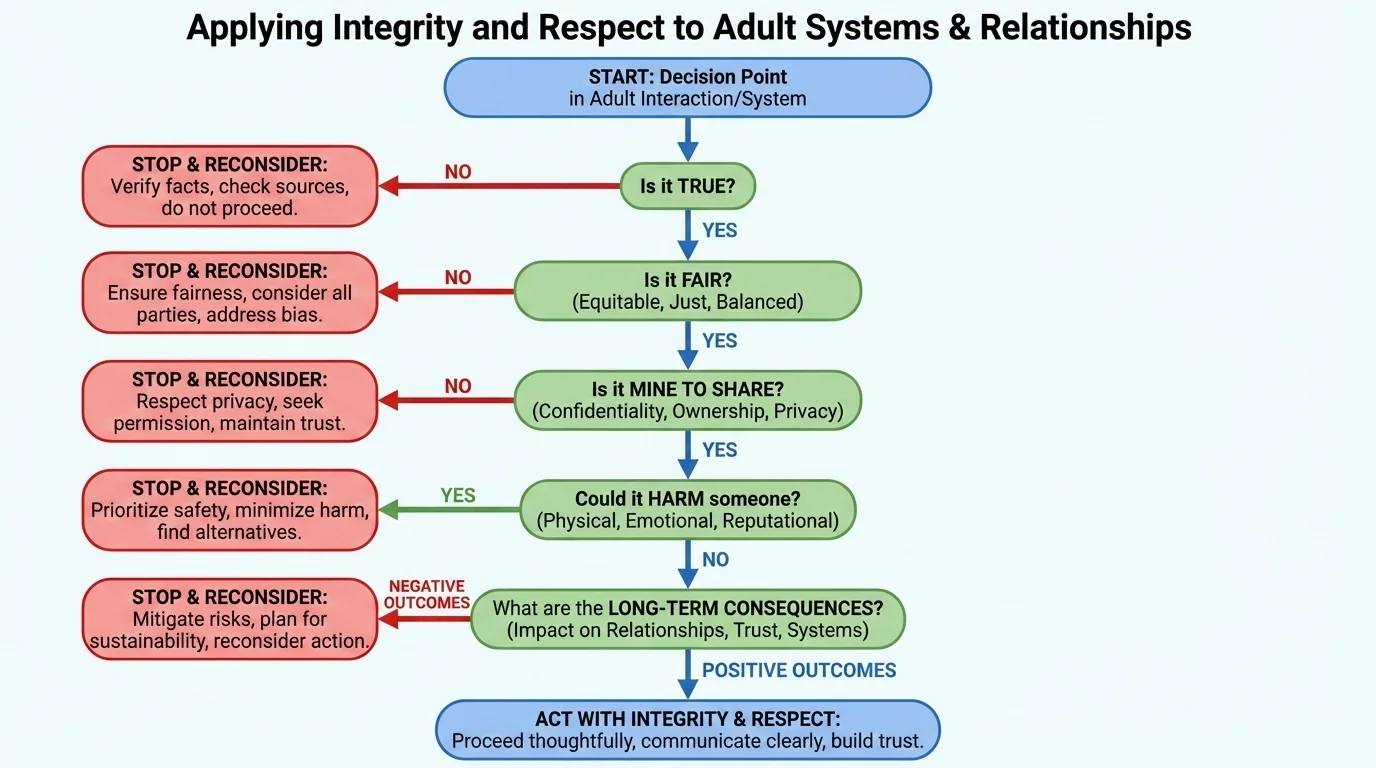
Use this framework when something feels ethically messy. Step 1: Ask, "What are the facts?" Make sure you are not reacting to rumors, assumptions, or only one side. Step 2: Ask, "Who could be affected?" Include yourself, the other person, and anyone indirectly involved. Step 3: Ask, "Is it honest, fair, and respectful?" Step 4: Ask, "Would I be okay if this choice were public?" Step 5: Ask, "What happens next week, next month, or next year if I do this?"
This is where consequences matter. A choice may feel useful right now and still be a bad choice overall. Sending a cruel message might feel satisfying for five minutes, but it can damage trust for years. Lying to avoid trouble may work for one day and create a larger problem later.
A practical test for hard moments
If you are unsure what to do, run your choice through three quick filters: truth, fairness, and future impact. If the choice depends on deception, treats someone unfairly, or threatens the future version of your reputation, it is probably not a strong choice.
As [Figure 2] shows, good decision-making is rarely about one dramatic question. It is usually a series of small checks that keep you from acting on impulse.
At work, integrity means showing up when scheduled, communicating early if you cannot, and doing the task you agreed to do. Respect means speaking professionally, not insulting customers in private chats, and accepting feedback without making everything personal. If you make a mistake, say so early. Problems usually get worse when people hide them.
In friendships and dating, integrity means being clear about your intentions, not leading people on for attention, not cheating, and not using emotional vulnerability as a weapon later. Respect means listening, accepting boundaries, and not treating affection like something owed to you because you were "nice."
At home and with roommates, integrity means contributing fairly, cleaning up your share, replacing what you use, and communicating about money or shared space honestly. Respect means not blasting noise late at night, not using others' belongings without asking, and not turning every frustration into a dramatic confrontation.
Online, integrity means not creating fake stories, editing screenshots to mislead people, or stealing content. Respect means not humiliating people for entertainment. Screens create distance, but the harm is still real. A person reading your comment alone at midnight feels that impact in real life, not just on the internet.
Case study: A group chat conflict
A friend sends you a private message about another person, and someone asks you to post screenshots in a larger chat.
Step 1: Stop before forwarding anything
Private messages usually are not yours to share freely.
Step 2: Ask what purpose sharing would serve
If the goal is humiliation, revenge, or attention, it fails the respect test.
Step 3: Choose a cleaner response
Encourage direct conversation, step out of the drama, or seek help from a trusted adult if safety is involved.
This protects privacy, reduces escalation, and keeps you from becoming part of the harm.
These situations may look different on the surface, but they often involve the same questions: Am I being honest? Am I respecting limits? Am I acting in a way I would defend later?
Even people with strong values make mistakes. What matters next is whether you minimize the harm or address it honestly. Trust usually rebuilds in stages.
[Figure 3] If you hurt someone, start by naming what you did. Be specific. "I shared something private that was not mine to share" is better than "I'm sorry if you were upset." The second version avoids responsibility. The first one shows understanding.
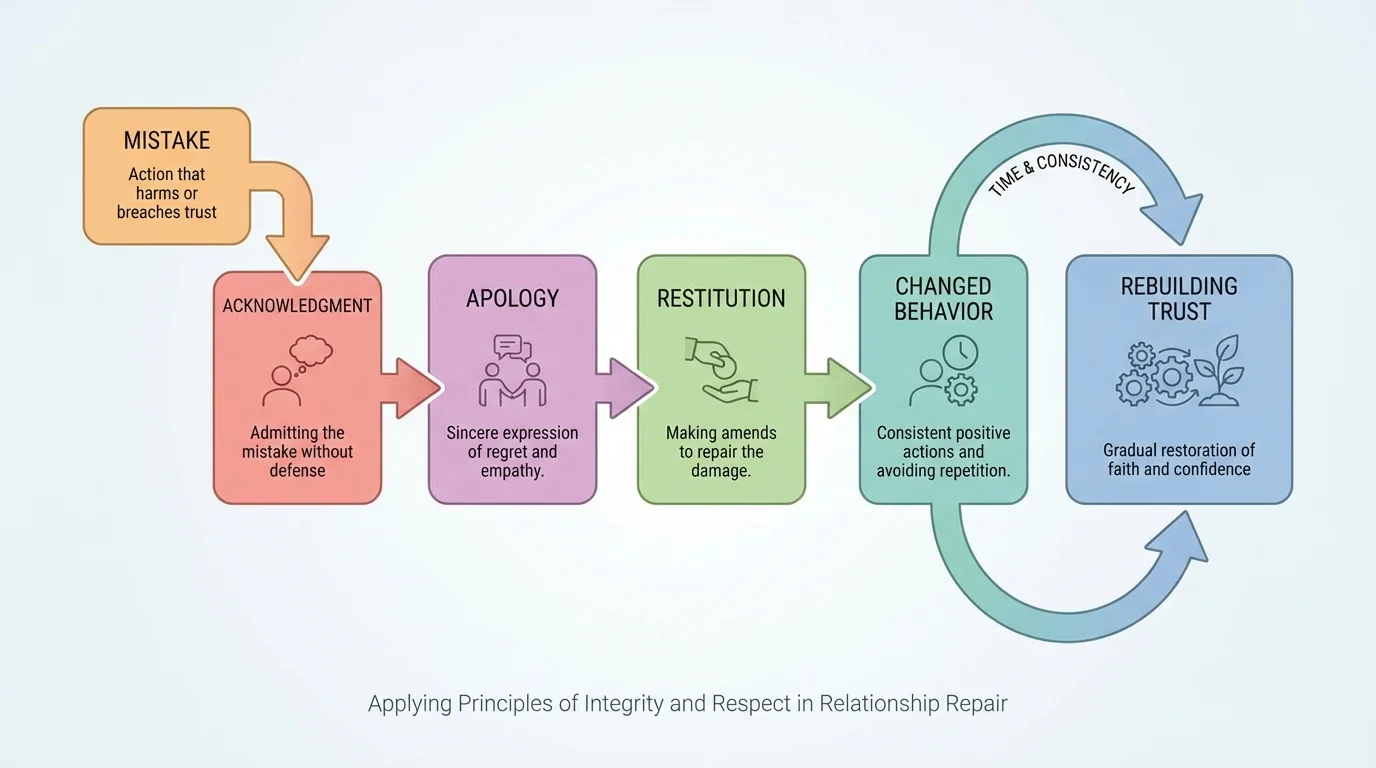
Next, apologize without defending yourself. Then ask what repair is possible. Sometimes repair means replacing money or property. Sometimes it means correcting false information, deleting a post, or giving someone space. Sometimes trust will not fully return, and you have to accept that. Integrity includes accepting consequences without demanding instant forgiveness.
Restitution means taking action to repair damage when possible. If you borrowed something and broke it, replace it. If you spread false information, correct it publicly. If your lateness cost someone time or money, do what you reasonably can to make it right. Words matter, but changed behavior matters more.
Later, as shown in [Figure 3], trust grows back through consistency. One apology does not erase a pattern. People believe change when they see different actions repeated over time.
Healthy relationships are not conflict-free. They are repair-capable. The goal is not to be perfect; the goal is to be honest, respectful, and responsible when imperfection shows up.
If someone harms you, respect for yourself matters here too. You can listen to an apology and still keep boundaries. Forgiveness is not the same as access. Rebuilding a relationship should depend on safety, effort, and real change.
Your reputation is not built in one dramatic moment. It is built in patterns. Do you tell the truth when it costs you something? Do you respect people when they cannot benefit you? Do you protect privacy? Do you follow through? Adult systems notice patterns, even when you think nobody is paying attention.
Integrity and respect help you in practical ways. They make it easier to keep jobs, maintain strong relationships, earn recommendations, build financial stability, and create a digital presence you are not afraid of. They also protect your inner life. Living dishonestly forces you to track stories, hide evidence, and fear being exposed. Living with integrity is simpler and stronger.
Try this: choose one area of your life this week where trust matters most right now. It might be work, home, dating, money, or online behavior. Ask yourself three questions: What promise have I made? What boundary do I need to respect? What action today would make me more trustworthy? Then do that one action on purpose.
Another useful habit is to create a personal rule before pressure hits. For example: "I do not share private screenshots." "I do not lie to get out of commitments." "If I owe money, I communicate before the due date." "If I am angry, I wait before posting." Personal rules reduce confusion when emotions are high.
When you apply integrity and respect to adult systems and relationships, you become someone people can rely on. That does not mean becoming passive, silent, or perfect. It means becoming solid. Honest. Fair. Careful with power. Clear with boundaries. Responsible for your impact.
