Communities rarely change just because people are frustrated. They change when people notice a problem, understand how decisions get made, and take action in a way that other people can hear, trust, and support. If a neighborhood has unsafe crosswalks, a local park is neglected, or teens cannot access mental health resources, the difference between "nothing changes" and "something improves" often comes down to three things: showing up, knowing the rules, and speaking up strategically.
That is where civic engagement, legal awareness, and advocacy come in. These are not just adult skills for politicians, lawyers, or activists. They are practical life skills. You can use them when you want safer streets, fairer treatment, clearer information, or better opportunities in your town, online spaces, workplace, clubs, or volunteer organizations. Learning these skills helps you move from feeling powerless to acting with purpose.
You may already care about community issues more than you realize. Maybe you have noticed that a local bus route makes it hard for teens to get to jobs. Maybe your area has too few recycling bins. Maybe a community center website is inaccessible, or a local policy affects young workers unfairly. When people ignore those problems, they usually stay the same or get worse. When people organize and respond effectively, change becomes possible.
Strong communities are not built only by officials. They are also built by residents who pay attention, ask questions, share accurate information, and work with others. Even if you cannot vote yet, you can still contribute through volunteering, public comments, youth advisory groups, neighborhood projects, respectful online campaigns, and communication with decision-makers.
"The most common way people give up their power is by thinking they do not have any."
— Alice Walker
This idea matters because many people underestimate their influence. You do not need to be famous, wealthy, or in charge to help change something. But good intentions are not enough. If you act without facts, ignore legal limits, or push so aggressively that people stop listening, your effort can backfire. Real change usually requires both passion and judgment.
Civic engagement means taking part in the life of your community in ways that help solve problems or improve conditions. That can include volunteering, attending local meetings, helping with mutual aid, joining a youth council, participating in service projects, or contacting public officials about an issue.
Legal awareness means understanding the laws, rights, responsibilities, and procedures that affect a situation. It includes knowing what you are allowed to do, what protections you have, what risks exist, and where to find reliable information before you act.
Advocacy means actively supporting a cause, policy, person, or solution. Advocacy can be public or private. It might involve writing emails, collecting stories, speaking at meetings, creating informative posts, building support, or asking leaders to take a specific action.
Community change is a meaningful improvement in how a group of people lives, works, stays safe, or accesses opportunities. It can be small, such as better lighting in a public area, or large, such as a new local policy or service.
Public policy is a rule, law, plan, or decision made by government or institutions that affects many people.
These three ideas work best together. Civic engagement gets you involved. Legal awareness helps you act wisely. Advocacy helps you move other people toward a solution. If one is missing, change is harder. For example, if people care deeply but do not understand the rules, they may waste time or expose themselves to unnecessary consequences. If they know the rules but never take action, the problem stays in place. If they act without a clear message, support may disappear.
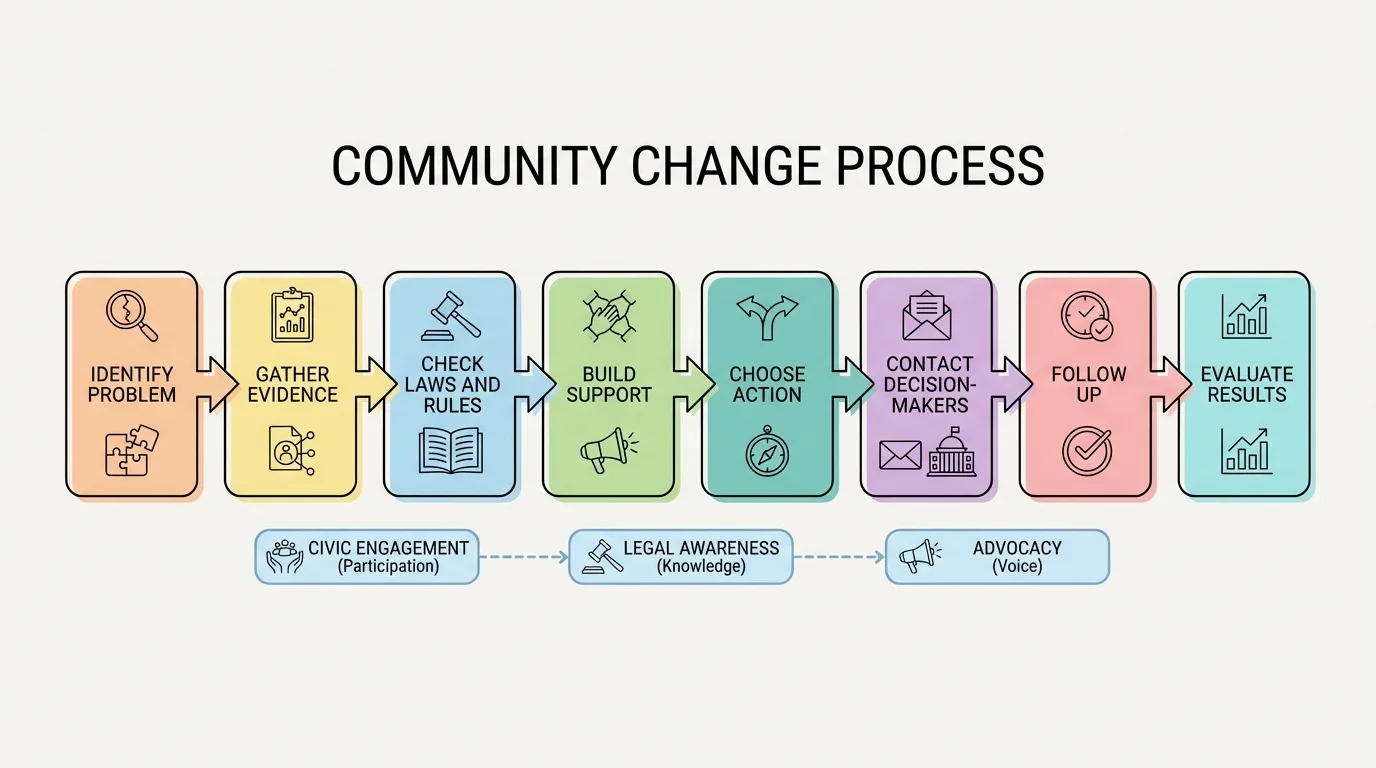
Community change usually follows a process, as [Figure 1] shows. People first identify a problem, then gather evidence, learn who has authority, check the legal and practical limits, organize support, take action, and follow up. This is important because many efforts fail not because the cause is weak, but because the plan is incomplete.
A simple way to think about it is this: notice, learn, connect, act, review. First, notice a specific issue. Second, learn what is really happening. Third, connect with people affected and people who can help. Fourth, act in a way that fits the situation. Fifth, review whether the action worked and what should happen next.
For example, suppose your town has a dangerous intersection near a community center. Posting an angry rant online may get attention for a day. But a stronger response would include photos taken safely, reports from residents, traffic data if available, a list of near-miss incidents, research into which local office handles traffic changes, and a respectful request for clearer signage or a crossing guard. That approach is more likely to be taken seriously.
The same pattern applies in many settings. If a library cuts teen programming, you can gather attendance data, collect respectful feedback from users, ask how decisions were made, and suggest realistic alternatives. If a local employer has unclear scheduling practices for teen workers, legal awareness matters even more because labor rules, documentation, and reporting channels may affect what action is appropriate.
Why evidence matters
People in authority often respond more seriously when concerns are specific, documented, and connected to real impact. Evidence can include photos, dates, public records, meeting notes, survey responses, screenshots, and firsthand accounts. Strong advocacy is not just emotional; it is organized and credible.
Later, when you evaluate whether your action worked, [Figure 1] still matters because change is rarely one message and done. You may need follow-up emails, additional supporters, revised goals, or a different decision-maker. Persistence works better when it stays informed and focused.
Civic engagement is broader than protests or elections. It includes everyday choices that strengthen public life. You are participating civically when you help address local needs, share accurate information, serve others, and take responsibility for how your actions affect the wider community.
Here are practical forms of civic engagement you can use right now:
Not every issue needs a huge campaign. Sometimes the most effective civic action is small and consistent. If a local trail is filled with litter, organizing a cleanup and asking the parks department for more trash cans may be more useful than complaining repeatedly. If residents do not know about free community health services, a well-designed information post can increase access.
Many local decisions that affect daily life, such as street lighting, park maintenance, library funding, and public transit schedules, are influenced by city councils, county boards, or special district meetings that residents can often watch online.
One sign of mature civic engagement is choosing the response that fits the problem. A missing sidewalk, an unfair fee, a dangerous rumor, and a civil rights concern do not all call for the same strategy. Good civic judgment means asking: Who is affected? Who has authority? What action is safest, legal, and most likely to help?
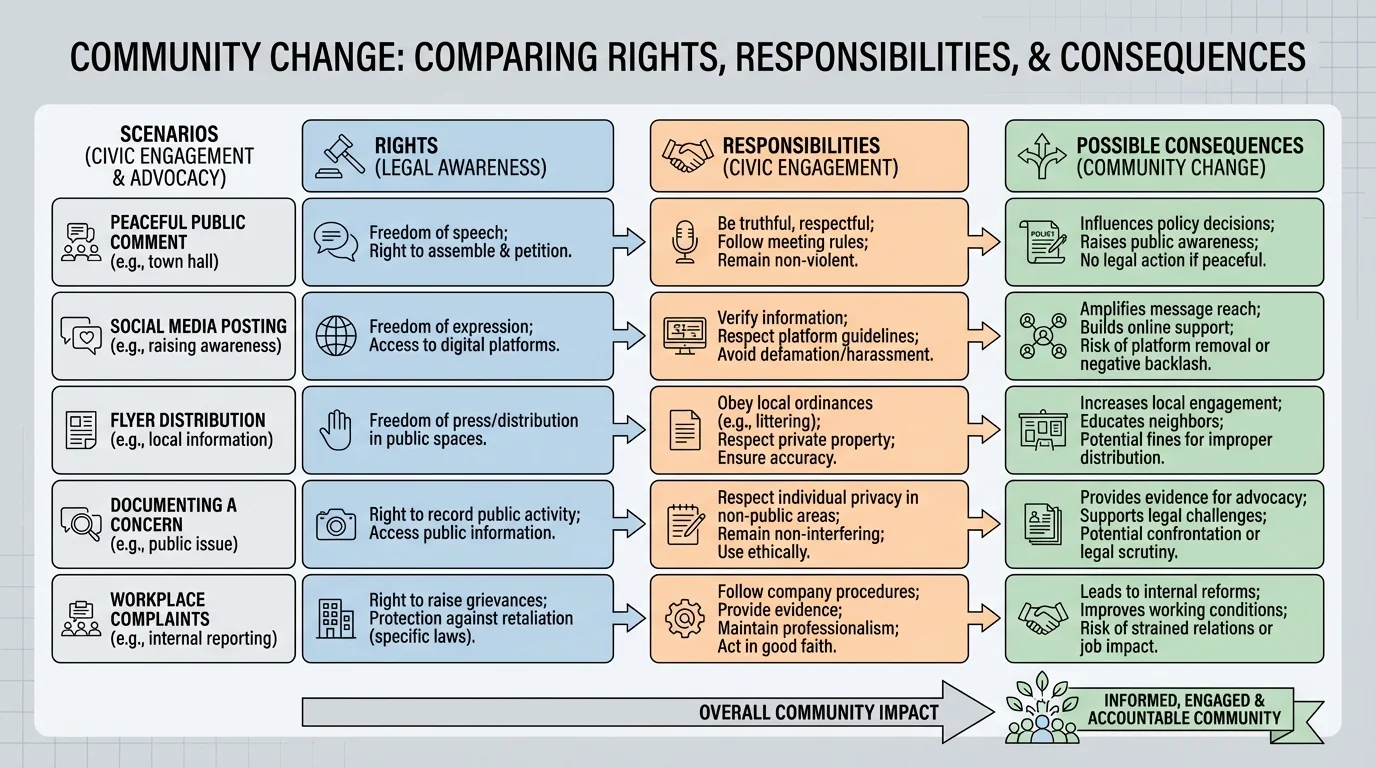
Legal awareness means understanding how rights and limits fit together, as [Figure 2] shows. In community action, this includes knowing your rights to express opinions, gather information, and participate in public processes, while also understanding rules about safety, privacy, harassment, trespassing, defamation, permits, labor protections, and documentation.
This matters because people sometimes assume that caring about a cause automatically makes every action acceptable. It does not. For example, sharing private information about someone without consent, making false accusations online, entering restricted property, or recording people where laws limit that can create harm and legal consequences. A strong cause does not excuse reckless methods.
Legal awareness also protects you. If you know the rules, you are less likely to be intimidated by people who misuse authority or spread false claims about what is allowed. You are also more likely to recognize when a policy may be unfair, when a complaint should be documented, or when professional help is needed.
Before acting on a community issue, ask a few legal-awareness questions:
Suppose you want to advocate for safer working conditions at a part-time job. Civic engagement might involve speaking with coworkers and documenting concerns. Legal awareness means learning labor protections, required breaks where applicable, age restrictions, and reporting channels. Advocacy means presenting concerns clearly and asking for a specific fix. If you skip the legal part, you may miss protections that strengthen your position.
As with the rights-and-responsibilities balance in [Figure 2], the goal is not to become a legal expert overnight. The goal is to avoid acting blindly. Reliable sources include government websites, official policy pages, nonprofit legal aid organizations, and established advocacy groups with clear contact information and updated materials.
| Situation | Helpful action | Legal awareness question | Risk if ignored |
|---|---|---|---|
| Unsafe public area | Document conditions and contact local officials | Who has authority over the space? | Complaint goes nowhere |
| Harmful social media rumor | Report, correct with facts, avoid spreading it | Does this involve defamation or privacy? | More harm and possible legal issues |
| Workplace concern | Keep records and learn labor protections | What rights do young workers have? | Retaliation goes undocumented |
| Public meeting comment | Prepare a clear statement | What are the meeting rules and time limits? | Message is cut off or unclear |
Table 1. Examples of how civic action becomes more effective when paired with legal awareness.
Stakeholders are the people or groups affected by an issue or able to influence the outcome. Strong advocacy starts by identifying them clearly. If you want better lighting in a public area, stakeholders may include residents, local businesses, public works staff, city officials, and people who regularly use that space.
Effective advocacy is not just speaking loudly. It involves several practical skills:
A weak message sounds like this: "Nobody cares about this park and it is terrible." A stronger message sounds like this: "The park's lights have been broken for three weeks, and several families say they no longer feel safe using the walking path after dark. We are requesting repair updates and temporary lighting." The second version is more useful because it is concrete and actionable.
Case study: Improving access to a community food pantry
A student notices that many families do not know the pantry's hours because information is scattered and outdated online.
Step 1: Define the problem
The issue is not simply "people are confused." The issue is that accurate hours and eligibility details are hard to find.
Step 2: Gather evidence
The student checks the pantry website, social media pages, and local community posts and finds inconsistent information.
Step 3: Identify the decision-maker
The student finds the nonprofit coordinator and volunteer communications contact.
Step 4: Advocate with a solution
The student sends a respectful message with screenshots and suggests a single updated information page plus a monthly verified post.
Step 5: Follow up
When the page is updated, the student shares the correct link through community channels.
This works because the student does not just criticize. The student helps solve the problem.
Coalition-building also matters. A message from one person can be powerful, but several informed voices often carry more weight. That does not mean spamming officials or creating pressure without facts. It means organizing people around a shared goal and a respectful strategy.
Much community action now happens online. Petitions, livestreamed meetings, local social media pages, email campaigns, and digital storytelling can all support change. Online tools make civic engagement faster, but they also make mistakes spread faster.
Misinformation is false or misleading information shared without proper verification. In civic life, misinformation can damage trust, hurt real people, and weaken a cause. If you repost an inaccurate claim because it sounds urgent, you may end up undermining the very issue you care about.
Before sharing, ask: Who posted this? Where did the information come from? Is there evidence? Is the source current? Does another reliable source confirm it? Screenshots, short videos, and emotional stories can be powerful, but they can also be incomplete or manipulated.
Good digital judgment uses the same core skills as good in-person community action: verify facts, protect privacy, communicate respectfully, and think about consequences before you act.
Privacy is another major issue. If you are documenting a concern, think carefully before posting names, faces, addresses, or private messages. In some cases, reporting through official channels is smarter and safer than posting publicly. Public exposure may raise awareness, but it can also create retaliation, harassment, or legal risk if handled carelessly.
Digital advocacy works best when it combines speed with accuracy. A useful post might explain the issue, provide one verified link, identify a realistic next step, and avoid exaggeration. That type of communication helps people act instead of just react.
Consider two responses to the same issue: a local bus stop has no shelter, and riders are getting soaked during bad weather.
Response A: Someone posts, "This town never does anything right," tags random accounts, and gives no location, no details, and no suggested action. The post may collect likes, but it does not create a path to change.
Response B: Someone identifies the exact stop, gathers rider comments, checks which transit authority manages it, learns how improvement requests are submitted, and shares a short public message asking others to submit verified comments too. This response is far more likely to succeed because it combines civic engagement, legal awareness, and advocacy.
How to evaluate an action
Ask four questions: Is it accurate? Is it lawful and respectful of rights? Is it aimed at the right decision-maker? Is it likely to produce a useful result? If the answer to several of these is no, the action probably needs revision.
Here is another example. A teen hears that a community recreation program is charging fees that may exclude low-income families. A careless response would be to accuse staff of discrimination online without evidence. A stronger response would be to review the published fee policy, ask whether scholarships or waivers exist, compare information across sources, speak with affected families if appropriate, and then advocate for clearer access or expanded support. The second approach protects both fairness and credibility.
Sometimes advocacy also means knowing when an issue is urgent. If someone is in immediate danger, a slow public campaign is not the first step. Safety comes first. Emergencies, abuse, threats, or serious hazards may require emergency services, mandated reporting, legal aid, or direct intervention by responsible authorities. Civic action is important, but timing and judgment matter.
[Figure 3] shows a simple decision path that can help you choose a safe and effective response. When you care about an issue, do not jump straight from emotion to action. Slow down long enough to identify the problem clearly, gather facts, and choose the method that fits.
Use this practical framework:
Step 1: Name the issue clearly. Write one sentence describing the problem. If your sentence is too vague, your action will probably be vague too.
Step 2: Check whether anyone is in immediate danger. If yes, contact the appropriate emergency or reporting channel first.
Step 3: Gather evidence. Save dates, locations, screenshots, photos taken lawfully, and public documents.
Step 4: Learn the rules. Find out what laws, policies, or procedures apply.
Step 5: Identify the decision-maker. Ask who actually has the power to fix the issue.
Step 6: Choose your action. Options include a respectful email, a report, a meeting comment, a petition, a volunteer effort, a public information campaign, or joining an existing organization.
Step 7: Make a specific request. Ask for one realistic action, deadline, or response.
Step 8: Follow up and evaluate. Did anything change? If not, what is the next best move?
Mini action plan example
Issue: A public park has no clear signs about where to report broken equipment.
Step 1: Define the goal
The goal is not just "better parks." The goal is clear reporting information so repairs happen faster.
Step 2: Gather facts
Take note of the park name, damaged equipment, date, and whether any contact information is posted.
Step 3: Check authority
Look up whether the city parks department, county agency, or another group manages the park.
Step 4: Advocate
Send a message asking for visible signage with a phone number or reporting form and attach the details.
Step 5: Follow through
If there is no response, contact the next appropriate office or attend a public meeting comment period.
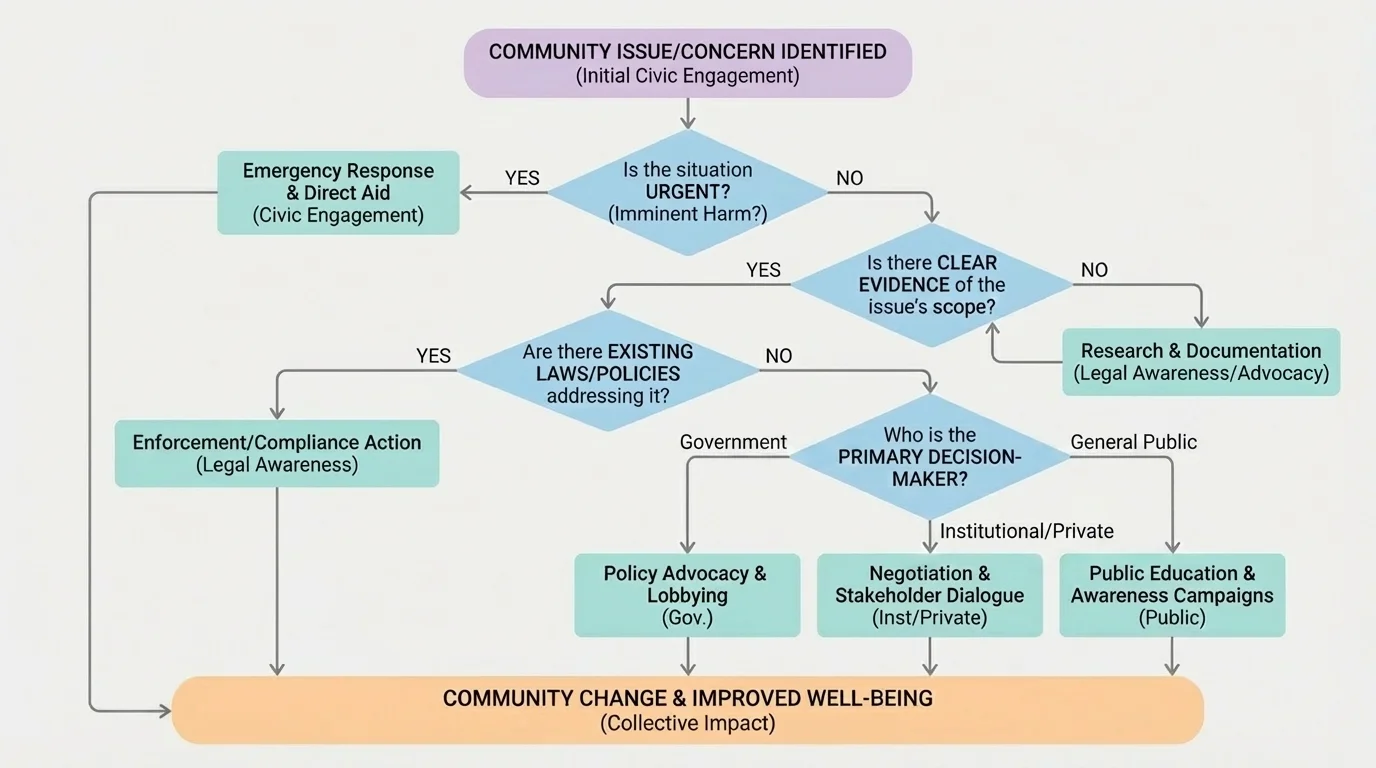
When you revisit your plan later, this decision path remains useful because community problems rarely fit one script. Some need service and cooperation. Some need policy change. Some need legal support. Some need public awareness. Choosing wisely is part of acting responsibly.
You do not need to solve every issue alone. In fact, one of the smartest civic habits is knowing when to ask for help. Trusted adults, nonprofit leaders, legal aid groups, worker centers, librarians, organizers, and public officials can all play a role. Asking informed questions is not weakness. It is part of effective action.
The long-term value of these skills goes beyond one project. Civic engagement teaches responsibility. Legal awareness protects you and others. Advocacy turns concern into influence. Together, they help communities become safer, fairer, and more responsive. They also help you become someone who does more than notice problems—you learn how to respond in ways that can truly move a community forward.
