One local election can change bus routes, library funding, road repairs, internet access, park rules, and public safety decisions that affect your daily life more than many national headlines do. That is why citizenship is not just a label on a government form. It is a set of choices. Even before you are old enough to vote, you are already shaping public life through what you share online, what issues you pay attention to, and whether you speak up when something in your community needs fixing.
Active citizenship means taking an ongoing role in the life of your community and country instead of staying completely passive. It includes learning about issues, voting when eligible, communicating with decision-makers, helping solve problems, and acting in ways that support the common good. A person can complain constantly and still not be an active citizen. Real participation requires effort, judgment, and responsibility.
Public life is not limited to famous politicians or national debates. It includes city councils, school boards, public health decisions, transportation planning, local laws, neighborhood organizations, online public discussions, and community service groups. The choices made in these spaces affect real people. If responsible people ignore them, decisions still get made, just without their input.
Active citizenship is responsible participation in the civic life of a community, including voting, advocacy, staying informed, and contributing to the public good.
Public life is the shared space where people discuss, decide, and act on issues that affect the community.
Civic responsibility means the duties people have to participate ethically, respectfully, and thoughtfully in society.
Being active does not mean you have to agree with everyone, post about every issue, or become an activist on every topic. It means knowing that your voice, choices, and habits have consequences. When citizens are informed and involved, communities tend to make stronger decisions. When people spread false claims, ignore elections, or attack others instead of engaging with facts, trust breaks down and problems usually get worse.
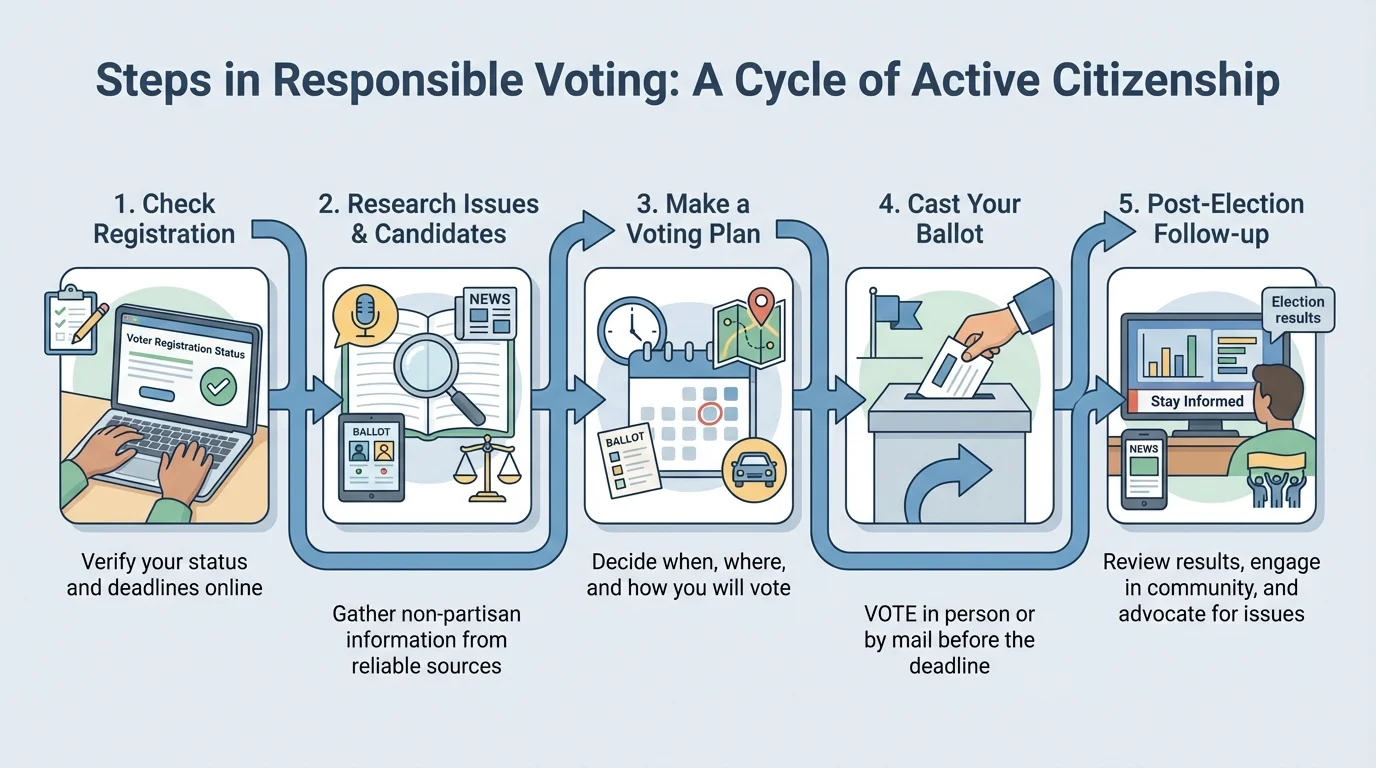
Three major responsibilities are at the center of active citizenship: voting, advocacy, and informed participation. These work together. Voting gives people a formal voice in government. Advocacy helps people push for change between elections. Informed participation keeps those actions grounded in reality instead of rumor or emotion alone. [Figure 1] outlines the responsible voting process.
Think of it this way: voting is one important tool, but it is not the whole toolbox. If your town is considering cuts to a youth program, the election matters. But so do public comments, emails to officials, community surveys, fact-based posts, and meetings where residents explain how the cuts would affect families. Citizenship becomes stronger when people use the right tool for the situation.
From opinion to action
Having an opinion is easy. Active citizenship begins when you test that opinion against evidence, listen to other viewpoints, and choose a responsible action. The goal is not just to feel strongly. The goal is to help create a community that functions better, protects rights, and solves problems fairly.
That matters especially online. A repost, comment, or short video can influence what other people believe about an issue. In modern public life, digital behavior is civic behavior. If you share a false claim about voting rules, crime, health policy, or a local decision, you can mislead hundreds of people in minutes. If you share accurate information and encourage respectful discussion, you can help people make better decisions.
When you become eligible, voting is not just about showing up on election day. It is a process that begins with knowing what is being decided, checking whether you are registered, learning how and where to vote, and reviewing reliable information before you cast a ballot. Responsible voting is deliberate, not random.
Voter registration is the official process of getting your name added to the list of eligible voters. In some places registration is automatic, while in others you must complete it yourself by a deadline. If you move, change your name, or miss a deadline, you may need to update your information. A responsible voter checks these details early instead of waiting until the last minute.
Voting also requires research. That means understanding who is on the ballot, what each office does, and what each issue or proposal would actually change. For example, many people can name national leaders but know very little about local offices such as mayor, county commissioners, judges, or school board members. Yet those positions often make decisions that directly affect transportation, internet access, safety rules, public spaces, and educational services.
A responsible voter asks practical questions: What powers does this office actually have? What policies has this candidate supported? What evidence supports the claims in campaign ads? What are the likely effects of this ballot measure on taxes, services, or access? This kind of thinking helps you avoid voting based only on slogans, family pressure, or one viral post.
There is also a difference between voting emotionally and voting thoughtfully. Emotions are part of politics because public issues affect real lives. But emotion without information makes you easy to manipulate. Strong campaign messages often try to trigger fear, anger, or loyalty before you have time to verify details. Good citizenship means pausing long enough to examine the facts.
Practical voting checklist for your first election
Step 1: Check the date and type of election.
Local, state, and national elections can happen at different times. Learn what is actually on the ballot.
Step 2: Confirm registration status and deadlines.
Use your official state or local election website, not a random social media graphic.
Step 3: Read about candidates and measures from multiple sources.
Compare official campaign pages, nonpartisan voter guides, local news reporting, and public records when available.
Step 4: Make a voting plan.
Know where you will vote, what identification is required if any, and how you will get there or vote by mail if that option exists.
Step 5: Follow through.
A plan only matters if you actually vote on time.
When citizens vote consistently, leaders know they are being watched. When citizens do not vote, a smaller group ends up making choices for everyone else. That does not mean every election gives perfect options, but not participating at all usually reduces your influence even further. Later, when you evaluate policy decisions, the process in [Figure 1] still matters because responsible citizenship includes paying attention after the ballot is cast.
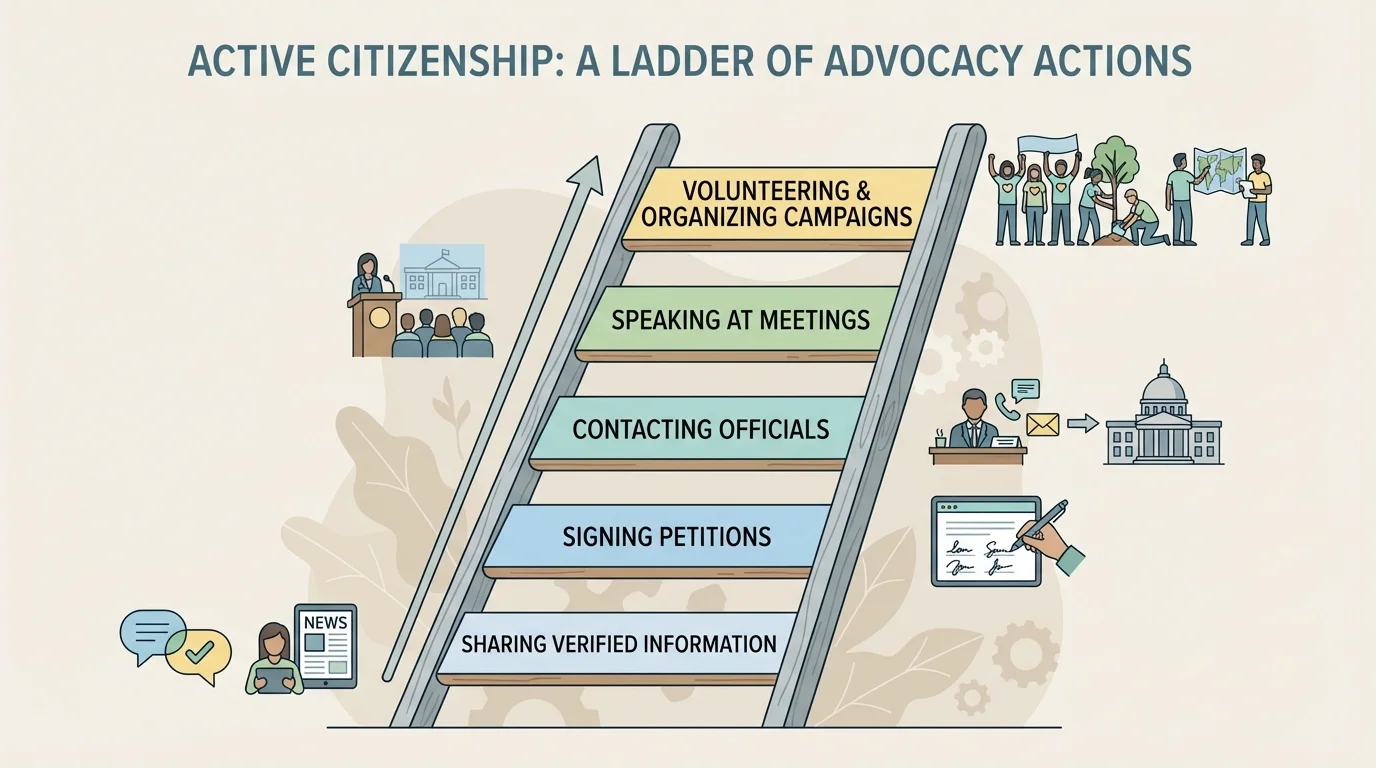
Advocacy means publicly supporting a cause, policy, or group and taking action to influence decisions. It can be as small as writing a clear email to a local official or as large as helping organize a community-wide campaign. The key is that advocacy is purposeful. It connects your concern to a concrete action. [Figure 2] shows a range of advocacy methods.
Advocacy takes many forms, and some are more effective than others depending on the problem. Actions range from low-commitment steps such as signing a petition or sharing verified information to higher-commitment efforts such as speaking at a public meeting, volunteering with a community group, or helping organize a long-term campaign. Good advocates match the method to the goal.
For example, if a city is considering cutting evening bus routes, one angry post might get attention for an hour. But a stronger advocacy approach would include collecting accurate information about the proposed change, documenting how many workers and students rely on that route, emailing transportation officials, encouraging affected residents to submit public comments, and speaking during a meeting if public input is allowed.
Effective advocacy is usually specific, fact-based, and respectful. Officials and community leaders are more likely to respond when people clearly identify the issue, explain who is affected, and request a realistic action. "Fix everything now" is weak advocacy. "Please keep route 14 running until 9 p.m. because evening workers at the shopping center have no safe alternative transportation" is much stronger.
Advocacy also requires listening. If you want to persuade people, you need to understand what they care about, what evidence they trust, and what objections they have. That does not mean giving up your values. It means communicating in a way that has a chance of working. Arguing online just to embarrass someone may feel satisfying for a moment, but it often changes nothing.
"The future depends on what you do today."
— Often attributed to Mahatma Gandhi
There are unhealthy forms of advocacy too. Spreading unverified accusations, harassing public officials, doxxing, threatening people, or editing clips to mislead others are not signs of strong citizenship. They damage trust, create legal and ethical problems, and can hurt the very cause a person claims to support.
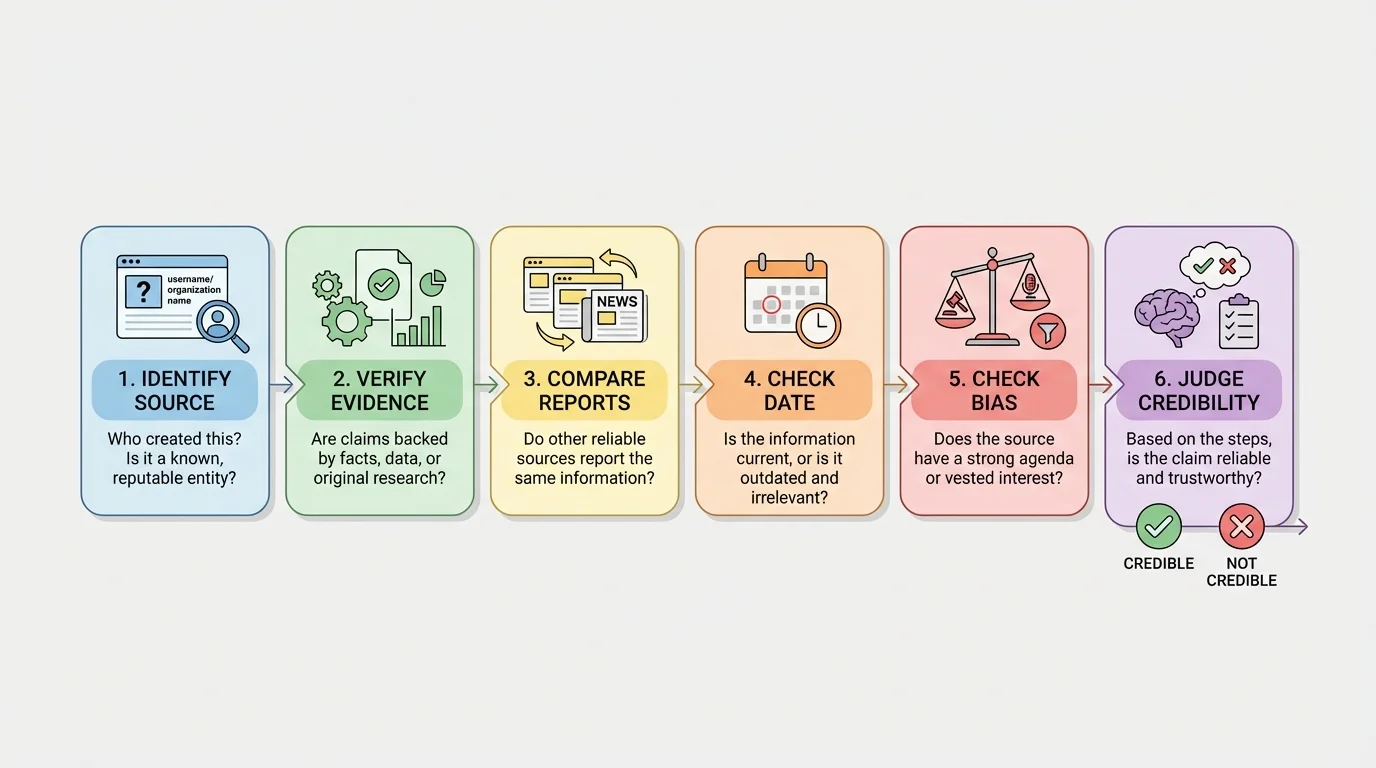
Public policy affects your life whether you follow it closely or not. It shapes rules, services, funding, and priorities in areas such as health, roads, internet access, education, housing, and environmental protection. To participate responsibly, you need more than opinions. You need dependable information and the habit of checking claims before acting on them. [Figure 3] presents a useful source-check process.
That is where media literacy becomes essential. Media literacy means understanding how messages are created, why they are shared, whose interests they serve, and whether they are supported by evidence. Informed participation requires a repeatable routine for checking information rather than trusting whatever appears first in your feed.
Use a simple source-check method. Identify the original source. Check the date. Separate reporting from opinion. Look for evidence, not just confident language. Compare multiple credible sources. Ask whether the claim leaves out important context. If a post includes a dramatic statistic, ask where it came from. If it quotes a law or rule, read the official version if possible.
This matters because misinformation spreads fast during elections, emergencies, protests, and controversial local decisions. A false post about polling locations, a fake quote from a candidate, or a misleading video clip can change behavior before the truth catches up. People who participate responsibly slow that cycle down by verifying first and sharing second.
Informed participation also means paying attention to local issues, not just national ones. You might follow city council updates, read local news from reliable outlets, watch livestreamed public meetings, or subscribe to announcements from community organizations. These habits help you understand how decisions are made and where your input can actually matter.
Local elections often have much lower turnout than national elections. That means a relatively small number of informed voters can have a major impact on decisions that affect daily life in their own communities.
Respectful discussion is part of informed participation too. You do not have to stay silent when someone is wrong, but you should aim to clarify rather than just attack. Ask what evidence they are using. Share a credible source. Point out uncertainty when facts are still developing. In public life, credibility matters, and people are more likely to trust someone who is careful than someone who is loud.
Active citizenship includes legal awareness. In a democracy, people have important rights such as freedom of speech, the right to vote when eligible, and the right to assemble and petition. But rights exist alongside responsibilities. You are responsible for using those rights in ways that do not cross into threats, harassment, fraud, or deliberate deception.
Civil discourse is public discussion carried out with respect, reason, and a willingness to engage seriously with others, even in disagreement. Civil discourse does not mean weak opinions or fake politeness. It means criticizing ideas without dehumanizing people. That standard matters online, where distance can make cruelty feel easier.
You also need to understand that not every rule is censorship and not every disagreement is a rights violation. Private platforms can set terms of service. Community groups can set participation rules. Public meetings may have time limits for comments. Knowing the difference between government restrictions, platform moderation, and community standards helps you advocate more effectively and avoid confusion.
Rights and responsibilities work together
Your rights protect your ability to participate in public life. Your responsibilities shape how you use that freedom. A healthy civic culture depends on both. If people demand rights without accepting responsibility for truth, respect, and lawful conduct, public trust weakens.
Another legal issue is privacy. If you contact officials, organize online, or discuss sensitive topics, protect your personal information and the information of others. Do not post someone's private address, phone number, or personal details to intimidate them. Besides being harmful, it can create serious legal consequences.
Responsible citizenship also includes understanding the limits of your own knowledge. If you are not sure whether a claim about protest laws, voting requirements, or local rules is true, pause and verify it. Legal misinformation can put people at risk. A confident rumor is still a rumor.
When a public issue matters to you, it helps to use a process instead of reacting impulsively. A clear framework helps you avoid spreading weak claims, wasting effort, or choosing actions that do not fit the problem. Strong civic action is thoughtful as well as passionate. [Figure 4] outlines one way to make these decisions.
Step 1: Define the issue clearly. What exactly is happening? Who is making the decision? Who is affected?
Step 2: Gather information from reliable sources. Look for official documents, trustworthy reporting, and direct statements from involved groups.
Step 3: Decide what outcome you want. Do you want a policy changed, a program protected, more awareness, or better enforcement of an existing rule?
Step 4: Choose the right action. You might vote, contact an official, attend a livestreamed meeting, submit a public comment, volunteer, donate, create a fact sheet, or help others access accurate information.
Step 5: Follow up. Civic action is rarely one-and-done. Check what happened, thank people who helped, and adjust your approach if needed.
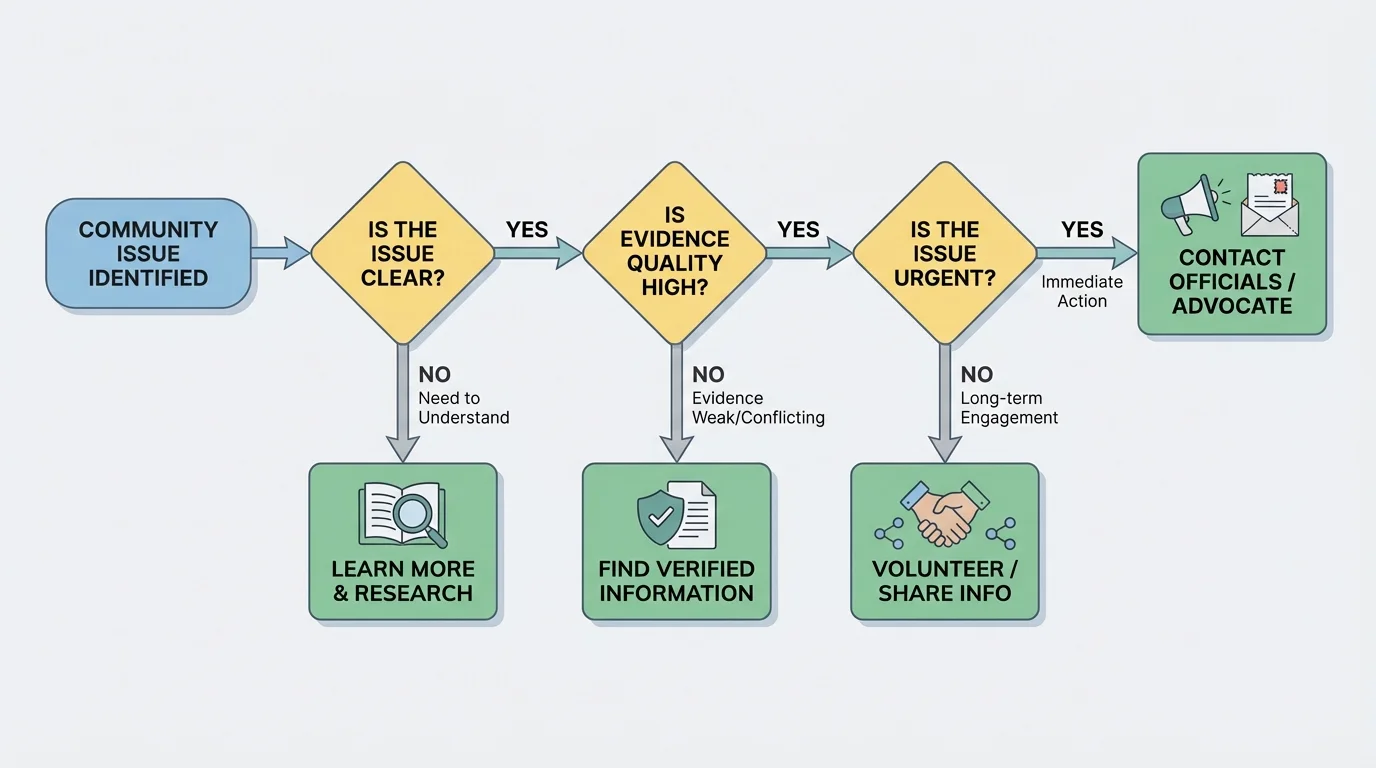
This process is useful because not every issue requires the same response. Sometimes the best first move is learning more. Sometimes it is warning others not to share a false claim. Sometimes it is mobilizing support quickly because a deadline is near. The decision tree in [Figure 4] reminds you to match your action to the situation instead of copying whatever others are doing.
How to write a strong message to a public official
Step 1: State the issue in one sentence.
Example: "I am writing about the proposal to reduce weekend library hours."
Step 2: Explain why it matters.
Share a brief, truthful example: "Many students use the library internet and study space on weekends."
Step 3: Make a clear request.
Example: "Please oppose the reduction or consider a schedule that keeps Saturday access."
Step 4: Stay respectful and concise.
Officials are more likely to read and consider messages that are clear and professional.
Consider a realistic example. A post starts spreading in your community saying a local clinic is closing because of a new law. People are angry and begin reposting it. An active citizen does not just react. First, check the clinic's official announcement, local news coverage, and any public documents. If the claim is false, you can help stop panic by sharing correct information. If it is true, then advocacy may be needed to inform residents and contact decision-makers.
Another example: your area plans to change bus schedules, and the new timing would make it harder for teenagers with part-time jobs to get home safely. Voting may matter later if transportation leadership is elected, but advocacy matters now. Gather details, identify who approves the plan, and encourage affected residents to submit comments. This is exactly the kind of situation where the advocacy ladder in [Figure 2] helps you choose practical actions instead of stopping at outrage.
A third example involves online debate. Suppose someone shares a dramatic video clip of a public official and claims it proves corruption. Before reposting, use the source-check process from [Figure 3]. Is the clip edited? Is it current? Is there a longer version? Are there verified reports explaining the context? Informed participation often means resisting the pressure to react instantly.
These scenarios show that civic life is not separate from ordinary life. It is woven into transportation, health services, local spaces, online information, and community safety. The habits you build now prepare you for larger responsibilities later.
You do not have to wait until age eighteen to practice active citizenship. You can start by following one local issue carefully for a month. Read reliable coverage. Learn who makes the decision. Watch a public meeting online. Notice how different groups describe the same issue. This builds the habit of informed attention.
You can also practice advocacy in low-risk, constructive ways. Write a respectful email to a community organization. Help with a service project. Volunteer for a local cause. Share verified resources instead of hot takes. Ask adults in your life how they decide whom to vote for and what information they trust. The goal is not to copy them automatically, but to learn how responsible adults reason through public choices.
Another useful habit is keeping a simple civic notes document on your device. Save links to reliable local news, official government pages, election deadlines, and issues you want to understand better. That small system makes you less likely to depend on random posts when something important happens.
Finally, remember that active citizenship is not about being perfect. You may misunderstand an issue at first or change your mind when new evidence appears. That is not weakness. In civic life, changing your view because the facts improved is a strength. Responsible citizens care more about getting closer to the truth and contributing to the common good than about winning every argument.
