One missed deadline, one signed form you did not understand, or one nervous conversation with an authority figure can change a situation fast. Legal problems do not always begin with a dramatic court case. Sometimes they start with a traffic stop, a boss who refuses to pay you, a landlord who ignores safety issues, a company that keeps charging your card, or someone in authority asking questions you are not ready to answer. Knowing your rights is not about being argumentative. It is about protecting yourself, communicating clearly, and making smart decisions before a problem gets bigger.
Legal awareness is part of responsible citizenship. It helps you take care of yourself, respect other people's rights, and participate more confidently in your community. You do not need to memorize every law. What matters most is knowing how to pause, assess the situation, keep records, and ask the right person for help when needed.
Legal issues often feel overwhelming because they involve power, rules, and consequences. A person in uniform, a formal email, or a contract full of legal language can make you feel like you have no choice. But in many situations, you do have choices. You may have the right to stay silent, the right to ask questions, the right to review a document before signing, the right to report discrimination, or the right to challenge unfair treatment.
When you know your options, you are less likely to react impulsively. That matters because impulsive choices can create new problems: deleting messages, arguing in anger, lying to avoid embarrassment, signing a form just to get it over with, or ignoring a notice because it feels scary. A better response is usually slower and more organized: read, save, document, ask, and then act.
Many legal problems become much harder to fix not because the person was wrong, but because they waited too long, lost documents, or responded emotionally instead of strategically.
That is one reason legal awareness connects to community life. People who understand basic rights are more likely to support fair treatment, notice abuse of power, and help others find trustworthy resources instead of spreading bad advice online.
Some rights vary by location, age, and situation, so you should never assume the rules are identical everywhere. Still, a few broad principles show up often. You may have rights related to due process, privacy, fair treatment, access to records, safe working conditions, and freedom from discrimination or harassment. Knowing that a right exists is only the first step. You also need to know how to use it calmly and clearly.
For example, in consumer situations, you often have the right to accurate information before buying something, the right to dispute unauthorized charges, and the right to cancel in certain circumstances. In work situations, you may have rights involving wages, breaks, scheduling, or reporting unsafe conditions. In housing situations, tenants may have rights related to repairs, deposits, notice before entry, or protection from retaliation. In interactions with authorities, you may have rights about identification, questioning, searches, and contacting a parent, guardian, or lawyer depending on your age and local law.
Legal right means a protection or freedom recognized by law. Consent means giving permission voluntarily and knowingly. Discrimination is unfair treatment based on protected traits such as race, religion, sex, disability, or other categories defined by law. Evidence is information that helps prove what happened, such as messages, photos, receipts, contracts, videos, or witness statements.
[Figure 1] A key practical habit is to separate what feels unfair from what is legally unfair. Sometimes both are true. Sometimes something feels rude or disappointing but is not illegal. Other times a person normalizes serious behavior that actually violates policy or law. If you are unsure which it is, that uncertainty itself is a reason to get advice.
One simple way to decide what to do next is to ask a short set of questions: Is anyone unsafe? Is there a deadline? Is money, housing, school access, work, immigration status, or your record at risk? Are you being pressured to sign or speak immediately? If the answer to any of these is yes, the situation may need legal advice sooner rather than later.
You should seek legal help quickly when there is a risk of arrest, eviction, job loss, deportation, physical danger, identity theft, major debt, a court date, or a document you do not understand but are being pushed to sign. You should also get help if the other side already has a lawyer, if you are being contacted by an investigator, or if the issue involves discrimination, harassment, abuse, or retaliation.
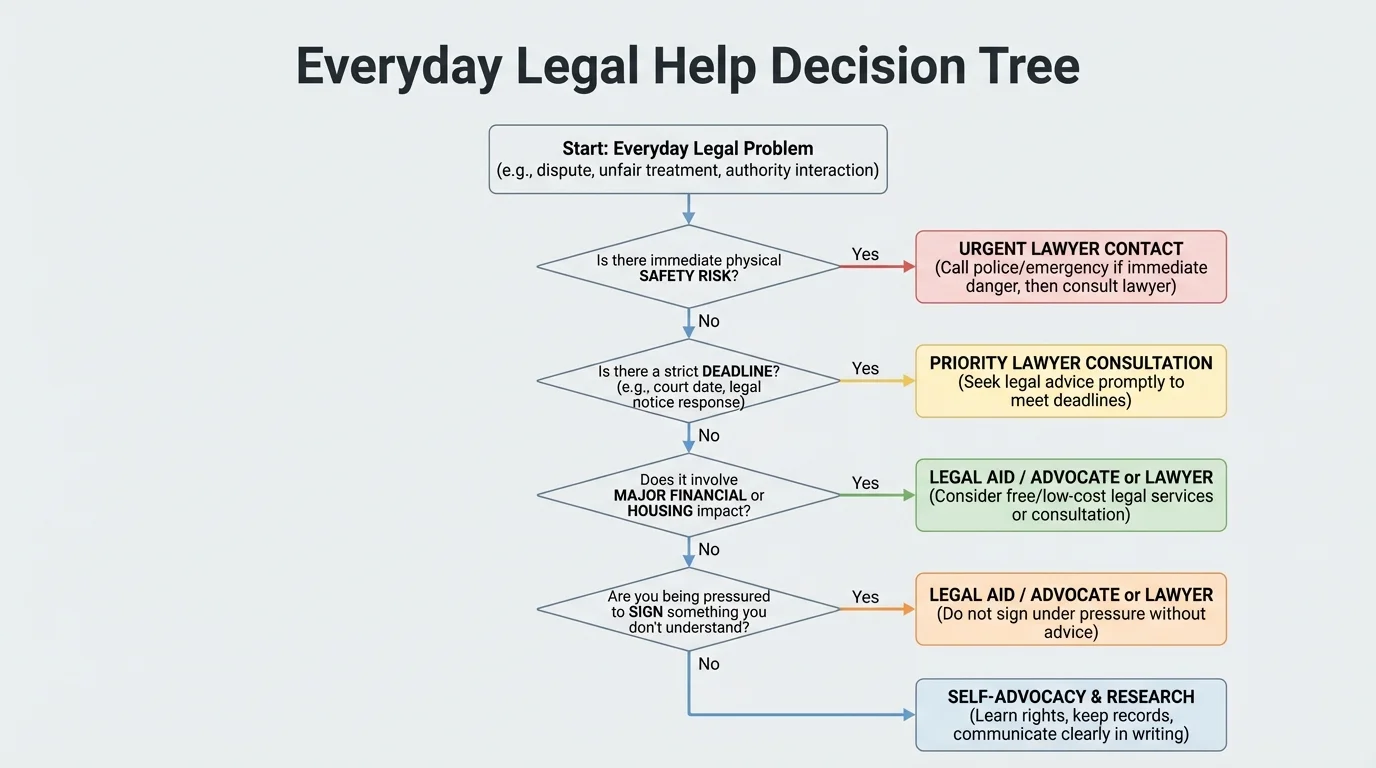
Not every issue requires a lawyer right away. Some problems can start with self-advocacy: saving receipts, sending a clear written complaint, asking for a supervisor, requesting records, or contacting a government agency or consumer protection office. But self-advocacy works best when the problem is low-risk, the facts are clear, and there is no immediate deadline.
A useful rule is this: the more serious the consequences, the more important it is to get reliable advice early. Waiting can cost money, weaken evidence, or close options. If a notice says you must respond in a certain number of days, treat that deadline as real even if you think the claim is unfair.
Urgency is not the same as panic. Legal situations often create pressure on purpose. A calm, organized response usually protects you better than a fast emotional one. If something feels urgent, do three things first: save the document or message, note the deadline, and tell a trusted adult or support person what is happening.
Later, when you use the decision process in [Figure 1], you will notice that deadlines and safety concerns matter more than how embarrassed or annoyed you feel. Your feelings matter, but risk level should guide your next step.
People often use these words as if they mean the same thing, but they do not. The differences are easier to see side by side in [Figure 2]. A lawyer is a licensed professional who gives legal advice and may represent someone in court or formal legal proceedings. An advocate supports a person's interests, helps them communicate, understand options, and navigate systems, but may or may not be a lawyer.
Legal aid is legal help for people who qualify based on income or type of case. It may come from nonprofit organizations, public defenders, legal clinics, or community programs. Some legal aid groups focus on housing, youth rights, family issues, immigration, disability rights, or domestic violence. Others offer brief advice, forms, or referrals rather than full representation.
There are also school or community counselors, social workers, ombuds offices, labor agencies, tenant unions, and civil rights organizations that are not law firms but can still be extremely helpful. They may explain procedures, connect you to services, or help you document a complaint correctly.
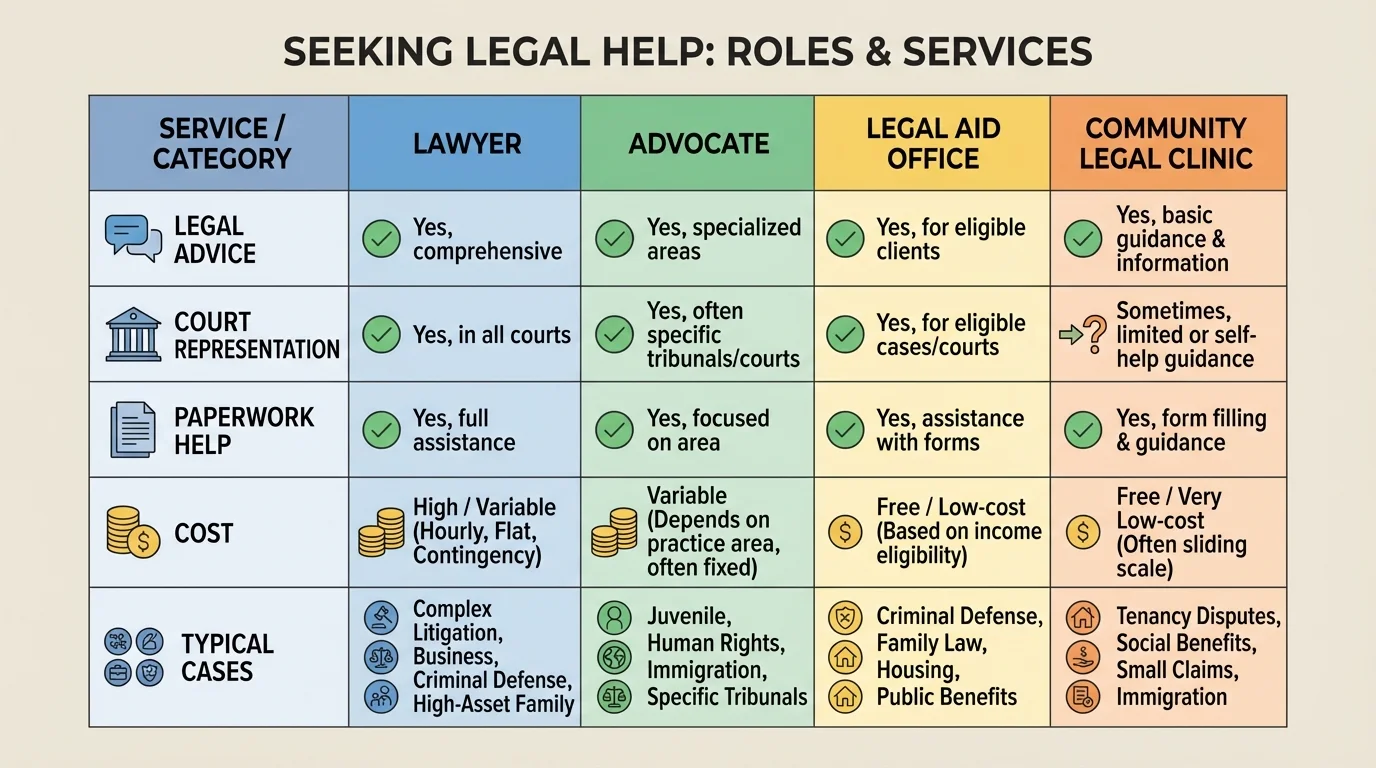
The most important question is not "Who sounds impressive?" It is "Who is qualified for this exact problem?" A lawyer for criminal defense may not be the best person for a housing issue. A consumer complaint office may solve a billing problem faster than a private attorney. A youth advocate may help you prepare for a meeting even if they cannot represent you in court.
| Helper | What they usually do | Best for | Limits to know |
|---|---|---|---|
| Lawyer | Gives legal advice, negotiates, files papers, may represent you | High-risk matters, court issues, serious disputes | May cost money; may specialize narrowly |
| Advocate | Helps you speak up, organize facts, and access services | School, housing, disability, community support, meetings | May not be allowed to give legal advice |
| Legal aid office | Provides free or low-cost legal help if you qualify | Civil problems like housing, family, benefits, discrimination | May have waitlists or case limits |
| Agency or complaint office | Investigates or enforces rules in a specific area | Wages, consumer fraud, housing code, civil rights | Does not handle every issue or give full representation |
Table 1. Common types of legal and advocacy support, what they do, and their limits.
If you compare these options with [Figure 2], you can see why choosing help is partly about matching the problem to the right system, not just finding the first person who says they can help.
When you reach out for help, you do not need a perfect explanation. You do need a clear one. Start by making a simple timeline: what happened, when it happened, who was involved, what was said or sent, and what happened next. Keep it factual. Avoid guessing motives unless you can prove them.
Gather your documents in one place. That might include screenshots, emails, contracts, lease terms, pay stubs, notices, photos, receipts, bank records, usernames, timestamps, names of witnesses, and any complaint number you already received. If something happened online, save links and images before posts disappear. If there are voicemails, save them.
Quick preparation checklist before you ask for legal help
Step 1: Write a timeline
List the events in order with dates, times, and names if you know them.
Step 2: Save evidence
Take screenshots, download files, photograph documents, and back them up somewhere safe.
Step 3: Identify the risk
Note any deadline, safety issue, money loss, threat, or important meeting date.
Step 4: Prepare questions
Ask what your options are, what deadlines matter, what not to do, and what documents are still needed.
Step 5: Protect privacy
Use secure devices when possible, especially if someone else may monitor your messages or accounts.
It also helps to know your goal. Do you want a refund, a correction to a record, safer conditions, an apology, your wages, protection from contact, or legal representation? You may not get everything you want, but being clear about your priority helps the person assisting you.
Stress can make people forget simple steps, so using a sequence helps, as [Figure 3] illustrates. If an authority figure approaches you, stay calm, keep your hands visible, and do not argue physically or run. Your first goal is safety. Your second goal is clarity.
If you are stopped or questioned, ask respectful, direct questions: "Am I free to leave?" "Why am I being stopped?" "Do I need to provide identification?" "Can I speak with a parent, guardian, or lawyer?" The exact answers depend on local law and your age, but asking these questions helps you understand the situation instead of guessing.
If someone asks to search your belongings or device, do not physically resist. If you do not want to agree, you can state clearly, "I do not consent to a search." That sentence matters because it avoids giving permission while staying calm. If they search anyway, do not interfere physically. Make a note of what happened afterward.
If you are being questioned about something serious, especially if you feel pressured or confused, it may be wise to say you want legal advice before answering detailed questions. Many people talk too much because silence feels awkward. But volunteering extra details can create misunderstandings or lock you into a story told under stress.
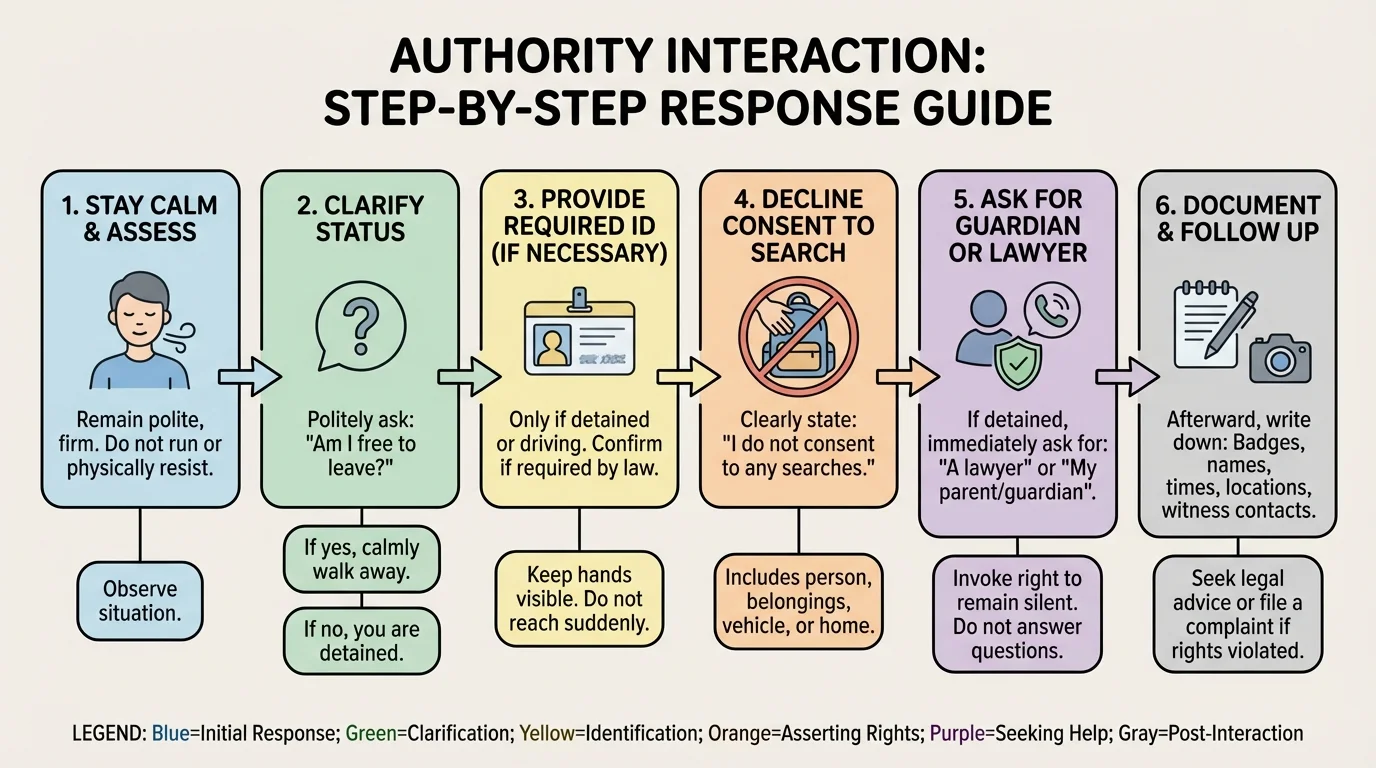
After the interaction, write down the time, place, names, badge numbers if visible, what was said, what was searched, and whether there were witnesses or video. That record may be useful later even if the situation seems minor at first.
The same sequence also applies to non-police authority situations, such as security staff, investigators, or administrators. You can be respectful without giving up your right to ask questions, request clarification, or seek advice before making a statement.
"Be calm, be clear, and keep a record."
— A strong rule for most legal situations
If you are a minor, your rights and procedures may differ from those of an adult. That is another reason to get location-specific advice rather than assuming you know the rules from social media clips or TV scenes.
Not every conflict is a legal issue, but many everyday disputes have legal parts. If a landlord ignores mold, broken heat, or unsafe wiring, that is not just annoying. If an employer refuses to pay for hours you worked, that is not just "bad management." If someone retaliates after you report harassment, that can matter legally. If a company keeps charging you after cancellation, consumer protections may apply.
Start by documenting what happened and what rule, agreement, or policy may have been violated. Then communicate in writing when possible. Written communication creates a record. A calm email often works better than a heated phone call because it states the issue, your request, and the date in one place.
Self-advocacy before escalation often follows a simple pattern: state the problem, cite the evidence, request a specific fix, give a reasonable deadline, and save the response. If that fails, you can escalate to a supervisor, agency, complaint system, advocate, or lawyer with a stronger paper trail.
Suppose your employer paid you for only part of your hours. A useful message might identify the pay period, the dates and times worked, the amount missing, and a polite request for correction by a certain date. Suppose a company denied your refund even though its own policy supports it. Attach the policy, your receipt, and your prior messages. Facts matter more than outrage.
Unfair treatment also includes discrimination or harassment. If you are treated differently because of a protected characteristic, denied access, threatened after reporting a problem, or targeted repeatedly, document exact words, dates, witnesses, and patterns. These details are much more useful than a general statement like "They were unfair to me."
Online spaces matter too. False accusations, nonconsensual image sharing, stalking, threats, impersonation, or account theft can have legal consequences. Save evidence before reporting or blocking if it is safe to do so. Platform reporting tools are useful, but they are not always enough.
You do not need to sound like a lawyer to protect your rights. In fact, clear everyday language is usually best. Try short statements such as: "I want this in writing." "I need time to review this." "I do not consent." "Please explain the policy you are relying on." "I am requesting a copy of my records." "I am reporting this because it feels unsafe and unfair."
It also helps to avoid certain mistakes. Do not threaten legal action casually if you are not prepared to follow through. Do not post every detail publicly while a dispute is active. Do not alter screenshots. Do not sign a statement you know is inaccurate. Do not assume that deleting messages makes the issue disappear.
Two short real-world examples
Situation 1: A manager says you are not getting paid for training time.
You save your schedule, messages, and time records, then send a polite written request asking for corrected pay. If the problem continues, you contact a labor agency or legal aid service.
Situation 2: Security staff want to search your bag at an event.
You stay calm, ask whether entry requires a search, and if you do not agree, you state that you do not consent and leave if leaving is an option. If force or discrimination is involved, you document details and seek advice.
Sometimes the safest exercise of a right is not speaking more, but speaking less. Sometimes it is leaving, documenting, or getting support before responding. Rights are not only things you say. They are also choices about timing, privacy, and evidence.
Not all advice is good advice. Be careful with anonymous posts, viral videos, or friends who say, "I know the law." A strong source is one that explains limits, asks factual questions, and does not promise impossible outcomes.
When contacting a legal office or advocacy group, ask: What kinds of cases do you handle? Do you represent minors? Is this advice confidential? What documents should I bring? Are there fees? What happens next? If they cannot help directly, ask for a referral to someone who can.
Watch for red flags. Be cautious if someone pressures you to sign immediately, asks for large upfront payments without clear explanation, refuses to give anything in writing, guarantees success, or tells you to hide or destroy evidence. Honest professionals explain uncertainty because legal outcomes are rarely guaranteed.
You already use evaluation skills in other parts of life: checking sources, comparing options, and noticing pressure tactics. Legal situations require the same habits, just with higher stakes.
Confidentiality matters too. If your device, email, or messages may be monitored by a parent, partner, employer, or someone causing harm, think carefully about how you seek help. A library computer, trusted friend's phone, or secure account may be safer depending on the situation.
Legal awareness is not about trying to "win" every disagreement. It is about understanding that rules, rights, and responsibilities shape daily life. When you know how to ask questions, document facts, respect procedures, and seek help wisely, you become harder to intimidate and better prepared to contribute to your community.
That confidence matters in adult life: signing leases, reviewing job offers, responding to debt notices, reporting unsafe conditions, voting, joining community groups, challenging discrimination, or helping a friend find reliable support. Civic engagement is not only public speeches or protests. Sometimes it is a well-written complaint, a careful report, or a calm request for accountability.
You do not need to know everything. You need a repeatable process: slow down, identify the issue, protect your evidence, understand the risk, and contact the right kind of help. That process can protect your future opportunities, your safety, and your voice.
Try This: Create a private folder for important records such as contracts, pay information, receipts, screenshots, and official notices. Add a note with emergency contacts and the names of local legal aid or complaint agencies you could use if something goes wrong.
Try This: Practice one calm sentence you can use under pressure, such as "I need this in writing," or "I would like to speak with a lawyer or trusted adult before answering." Rehearsing simple language now makes it easier to use when stress is high.
