A lot of future success is determined long before the big moment arrives. By the time someone submits a college application, applies for an apprenticeship, interviews for a job, or signs a lease for an apartment, many of the important factors are already in motion: habits, grades, savings, reputation, skills, and reliability. Your future is not created by one dramatic decision alone. It is shaped by the choices you make when no one is watching and when the payoff is still far away.
It is easy to think of adulthood as something that starts later, after graduation, after moving out, or after getting a full-time job. But adulthood begins building now. The way you manage deadlines, communicate online, spend money, respond to stress, and use your time already shows whether your current choices match the life you say you want.
If your goal is to enter a training program, attend college, start a business, work full time, join the military, or live independently, your current decisions can either open doors or quietly close them. Missing assignments, overspending, ignoring responsibilities, and posting careless content online may not seem serious in the moment. Still, repeated patterns create real consequences.
Postsecondary goals are plans for education, training, or work after high school, such as college, trade school, certification programs, apprenticeships, military service, or direct entry into a career.
Adult goals are goals related to independent living and long-term well-being, such as earning income, managing money, maintaining health, building strong relationships, and handling responsibilities without constant supervision.
These two kinds of goals often overlap. For example, if you want to become a dental hygienist, you may need postsecondary training. At the same time, you also need adult skills like budgeting, transportation planning, communication, and self-management. A strong future is rarely built from one area alone.
Your future path does not have to look like someone else's. One student may plan to attend a four-year university. Another may want a welding certification, a cosmetology license, a coding boot camp, a small business, or a paid apprenticeship. What matters is not copying one path. What matters is choosing a direction and making decisions that support it.
Adult goals can be just as important as education or career goals. You may want to save for a car, keep a stable job, move into your own place, support family members, build a professional reputation, or learn how to manage stress without falling apart. These goals require more than hope. They require self-management, consistency, and good judgment.
Some goals are short-term goals, like finishing this semester strong or saving $200. Others are long-term goals, like completing a degree or being financially independent by age 21. Good decision-making means checking whether today's action helps the short-term goal, the long-term goal, or neither.
Every major future outcome is built through patterns, as [Figure 1] shows. One skipped assignment does not destroy a future plan, and one responsible choice does not guarantee success. But repeated decisions create habits, habits shape results, and results affect opportunities.
This chain matters in school, work, and daily life. If you regularly meet deadlines, ask for help early, and stay organized, you build trust and stronger performance. If you often procrastinate, ignore messages, or quit when something gets difficult, you create a different pattern. Over time, people begin to see you as dependable or unreliable, prepared or unprepared.
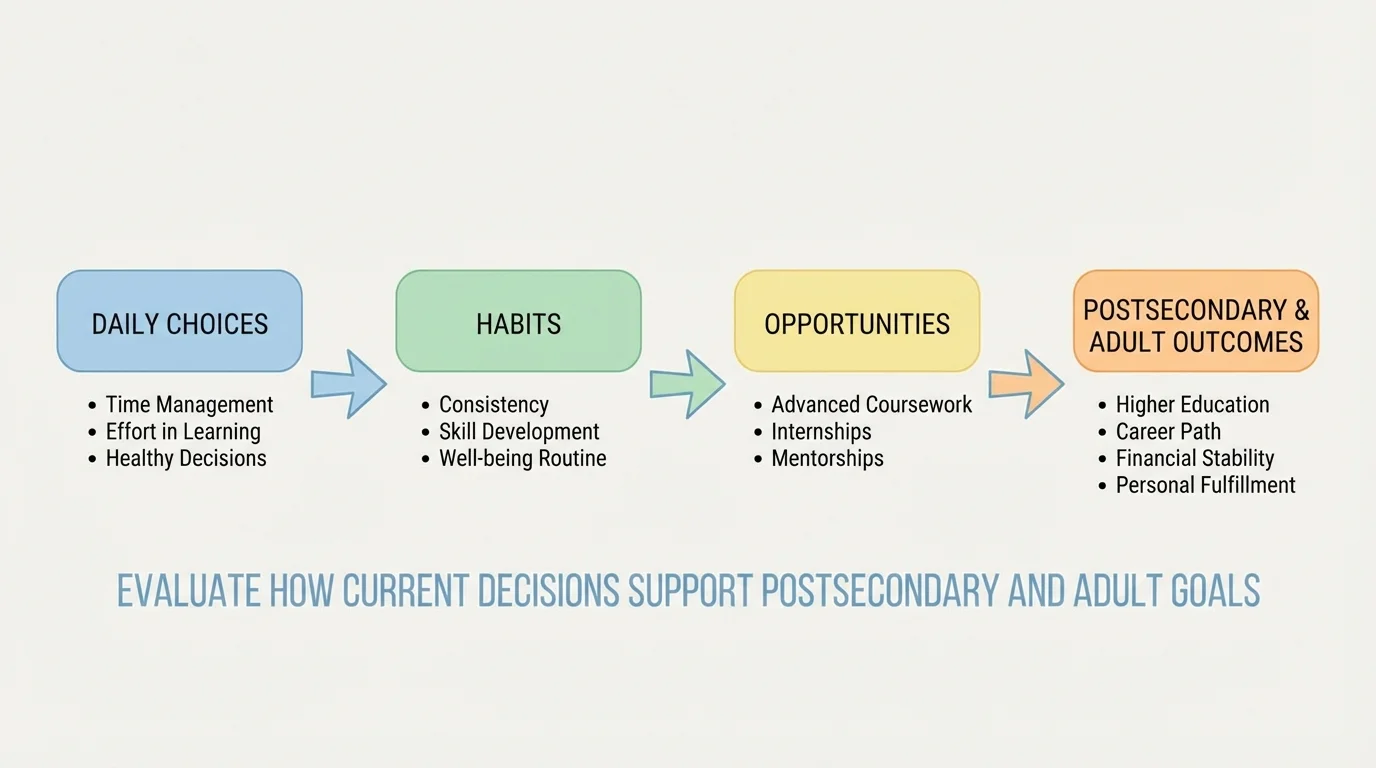
Think of it like this: a daily choice becomes a weekly pattern, a weekly pattern becomes a monthly reputation, and a monthly reputation affects future options. That is why decision-making is not only about avoiding mistakes. It is about intentionally building a life that works.
Your opportunity cost also matters. Opportunity cost means what you give up when you choose one option over another. If you stay up until 2:00 a.m. scrolling on your phone, the cost is not just lost sleep. The cost may include worse focus the next day, weaker work quality, more stress, and lower progress toward your goals.
Small decisions create future momentum. A choice may feel tiny in the moment, but repeated choices move you in a direction. Future-ready decisions usually strengthen at least one of these areas: skills, trust, health, finances, or access to opportunities. Choices that weaken those areas may feel good now but often create bigger problems later.
This is also true online. A careless joke, rude message, dishonest post, or inappropriate photo can affect your digital reputation. Employers, scholarship committees, training programs, and clients may look at your online presence. That does not mean you have to be perfect. It means your online behavior should match the future you want.
When you are unsure what to do, use a repeatable process. The framework in [Figure 2] gives you a practical way to pause and think before acting. This is especially useful when you feel pressure, urgency, or emotion pushing you toward a quick decision.
Step 1: Name the goal. Be specific. Instead of saying, "I want a good future," say, "I want to qualify for a medical assistant program," or "I want enough savings to cover my own phone bill and transportation." Clear goals make decisions easier to evaluate.
Step 2: Name the decision. What exactly are you choosing? For example: Should I take more work hours this month? Should I spend this money or save it? Should I respond to this message right now or finish my coursework first?
Step 3: List the short-term benefits and costs. What feels good or hard right away? A short-term benefit might be fun, comfort, extra money, or less stress in the moment. A short-term cost might be effort, missing out, or discomfort.
Step 4: List the long-term benefits and costs. This is the part many people skip. Ask: Will this choice help me build skills, protect my reputation, improve my financial stability, or move me closer to my plan? Or will it create problems later?
Step 5: Choose the option that best matches your goals and values. The best choice is not always the easiest or most exciting one. It is the one that supports the life you are trying to build.
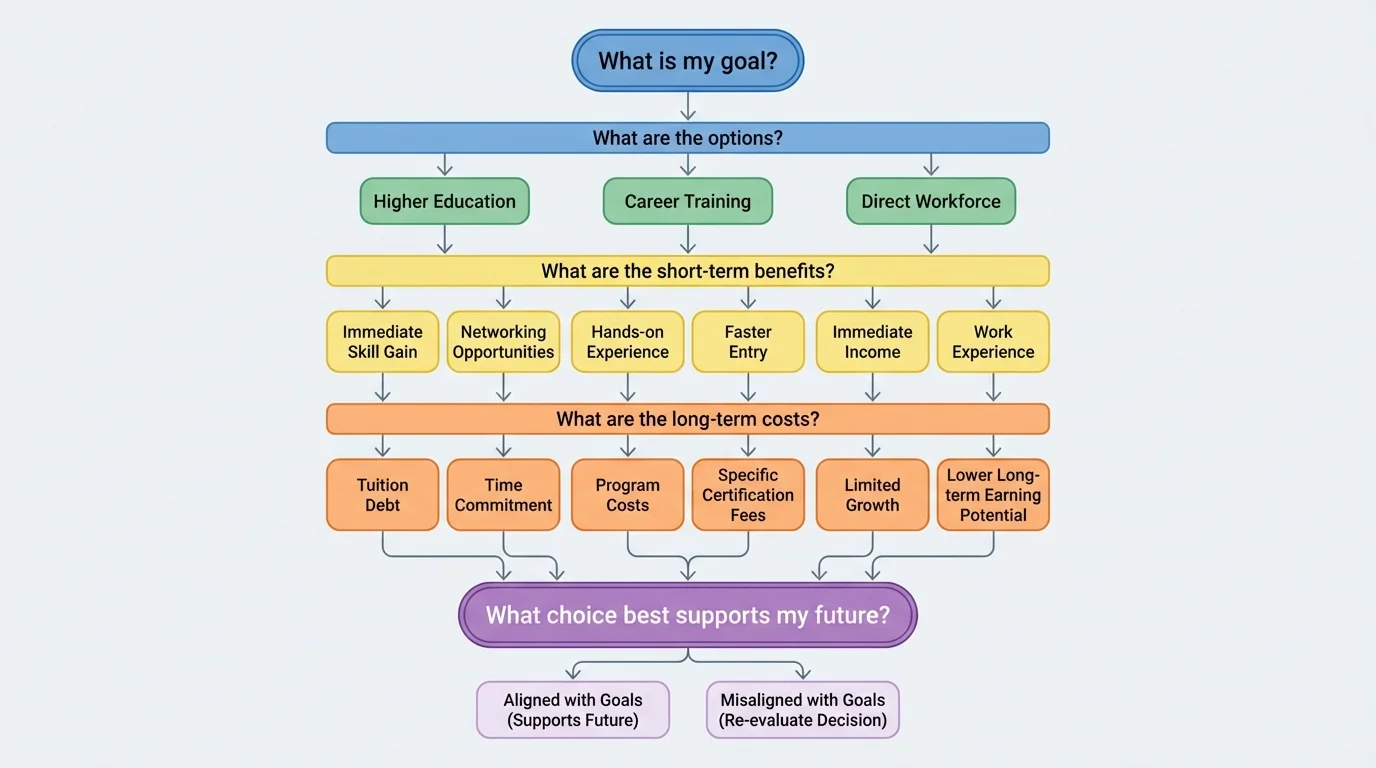
If two choices both have benefits, compare them honestly. For example, working extra shifts can help you earn money, but if those hours cause missed coursework, poor sleep, and falling grades, the decision may stop supporting your larger goal. Sometimes a choice is not simply "good" or "bad." It depends on whether it fits your current priorities.
Quick decision check
You have $120 saved, and you are deciding whether to buy new headphones for $85.
Step 1: Name the goal
Your goal is to save $300 for a certification exam fee.
Step 2: Compare where your savings would stand
If you buy the headphones, you would have \(120 - 85 = 35\) dollars left. If you keep saving, you stay at $120 and remain closer to your exam goal.
Step 3: Evaluate support for the goal
The headphones may be enjoyable, but they do not directly support the certification plan unless your current pair is unusable for online study or work.
A future-supporting choice would usually be to delay the purchase or find a lower-cost option.
Using a framework does not make life boring. It makes your decisions more intentional. You still get to choose what matters to you. The difference is that you stop letting random moods decide your future.
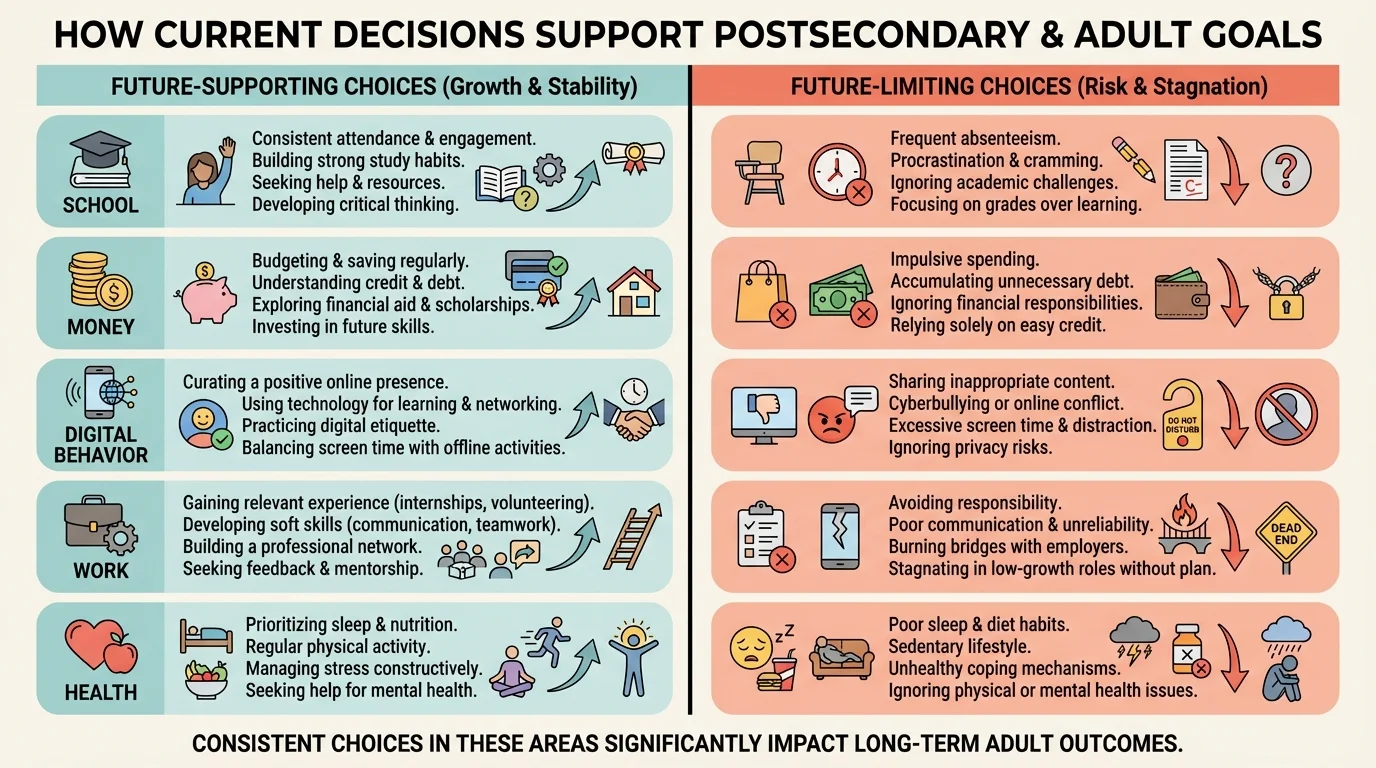
Many choices that shape adulthood seem ordinary at first. Across school effort, money, health, work, and digital behavior, small decisions add up, as [Figure 3] illustrates. The areas below matter because they influence whether you are building readiness or creating obstacles.
School and training effort. Even if you are not planning a traditional college path, your coursework still matters. Completing work on time, communicating with instructors, and building basic reading, writing, and technology skills affect almost every path after high school. Employers and training programs value people who can learn, follow through, and solve problems.
Time use. Your schedule reveals your priorities. If most of your free time disappears into entertainment, distraction, or endless scrolling, you may be trading long-term progress for short-term escape. Rest is important, but so is balance.
Money choices. Spending every dollar you get can delay independence. Saving even a small amount builds flexibility. If you earn $60 and save \(20\\%\), then you save \(0.20 \times 60 = 12\) dollars. That habit matters more over time than one big saving decision.
Digital footprint. Your online behavior can support your goals by showing professionalism, creativity, responsibility, and respectful communication. It can also damage opportunities if it shows dishonesty, cruelty, or reckless behavior.
Health habits. Sleep, nutrition, movement, and stress management affect your ability to think clearly and follow through. Exhaustion can make even simple responsibilities feel impossible.
Work habits. If you have a part-time job, showing up on time, communicating professionally, and learning from feedback build skills you will use for years. These habits transfer directly to future jobs and training programs.
| Decision Area | Choices That Support Goals | Choices That Can Delay Goals |
|---|---|---|
| Coursework | Meeting deadlines, asking for help, staying organized | Ignoring assignments, procrastinating, giving up quickly |
| Money | Saving part of earnings, tracking spending, avoiding impulse buys | Spending everything, borrowing casually, ignoring bills |
| Online behavior | Respectful posts, professional messages, thoughtful sharing | Rude comments, risky content, dishonest image-building |
| Health | Getting enough sleep, eating regularly, managing stress | Chronic sleep loss, skipping meals, constant burnout |
| Work | Being punctual, reliable, and coachable | Missing shifts, poor communication, quitting without a plan |
Table 1. Comparison of common decisions that either support or interfere with postsecondary and adult goals.
Notice that none of these are dramatic movie-style choices. They are normal life decisions. That is exactly why they matter so much. The future is often shaped by what you do repeatedly, not by what you say you want once.
Many employers say reliability and communication matter as much as technical ability for entry-level workers. Someone can be talented, but if they are consistently late, hard to reach, or careless online, they may lose opportunities to someone who is more dependable.
As you continue making choices, return mentally to the pattern shown earlier in [Figure 1]. A choice becomes a habit, and habits affect opportunity. That pattern stays true whether you are thinking about assignments, paychecks, or professional behavior.
One of the hardest parts of decision-making is that the wrong choice often feels better at first. The benefit is immediate: fun, comfort, attention, convenience, or relief. The cost appears later. That delay tricks people into thinking the decision does not matter.
This is where delayed gratification becomes important. Delayed gratification means accepting a smaller reward now in order to gain something more valuable later. It is not about never having fun. It is about knowing when a short-term want is interfering with something bigger.
For example, staying home from your part-time job because you do not feel motivated might sound good in the moment. But if the absence is avoidable, the long-term effect may include lost trust, reduced hours, or weaker references. On the other hand, if you truly need rest because you are sick or overwhelmed, taking care of your health may support your long-term stability. Context matters.
"You do not rise to the level of your goals. You fall to the level of your systems."
— James Clear
That idea matters because motivation changes. Systems are what protect your goals when you are tired, distracted, or frustrated. A system might include a study schedule, automatic savings, a bedtime routine, a weekly planner, or a rule that you do not post online when you are angry.
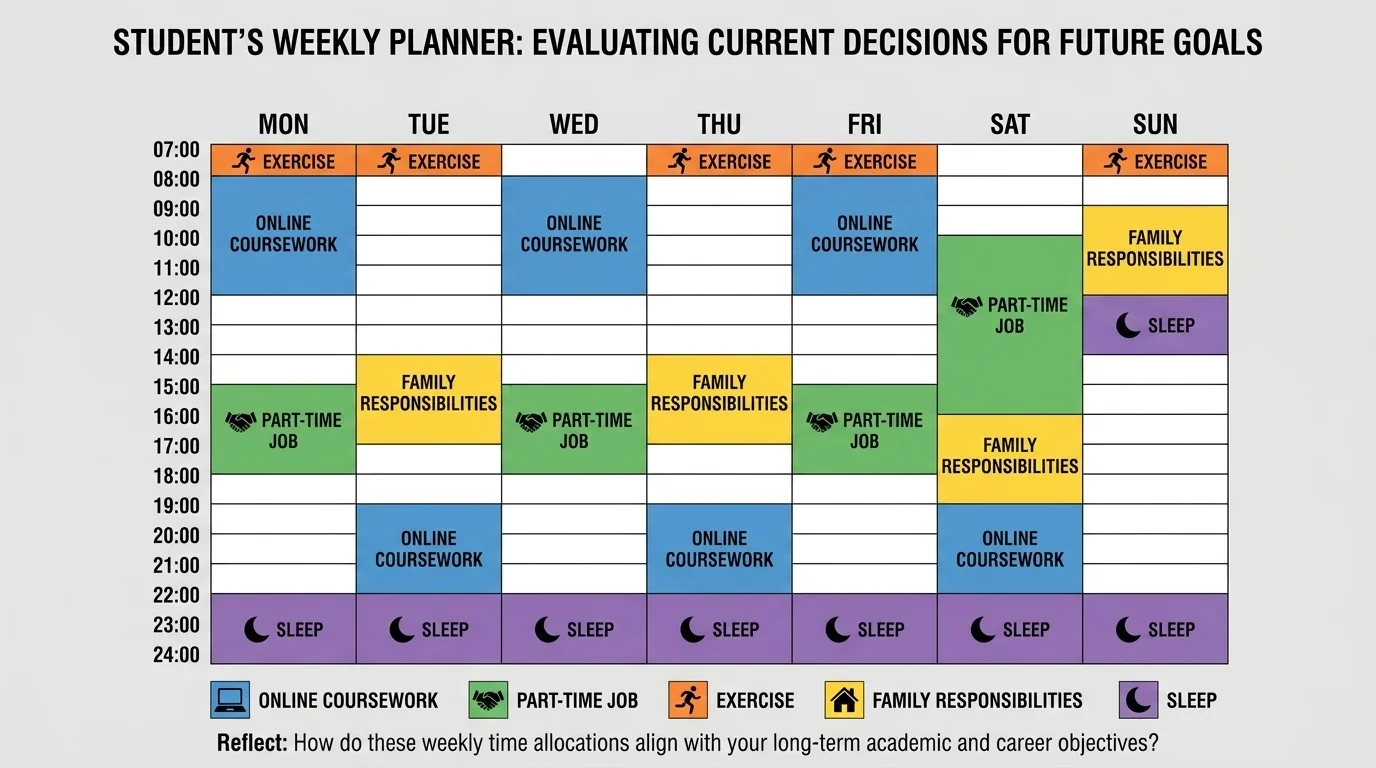
Practical evaluation gets easier when you test it on real situations. In the scenario below, a weekly schedule must balance school, work, rest, and home responsibilities, as shown in [Figure 4]. The question is not just whether something is possible. It is whether the decision is sustainable and goal-supporting.
Scenario 1: Extra work hours
You want to save for a car and help with family expenses. Your manager offers you extra evening shifts, but your online coursework is already piling up.
Step 1: Identify the goal conflict
You have two valid goals: earning money and staying on track academically.
Step 2: Evaluate likely consequences
If extra shifts cause repeated late assignments, stress, and poor sleep, they may hurt your larger plan, especially if your future goal depends on graduation or training.
Step 3: Adjust instead of choosing extremes
You might accept fewer extra shifts, set a strict work limit, or talk with your manager about availability.
A strong decision supports income without damaging the foundation of your future plan.
This kind of balance shows why smart choices are not always all-or-nothing. Sometimes the answer is not "take the job" or "quit the job." It is creating a schedule that protects your priorities. A planner like the one in [Figure 4] helps you see whether your week actually has enough time for sleep, coursework, work, and basic responsibilities.
Scenario 2: Online behavior and reputation. You are upset after an argument and want to post something harsh on social media. Short-term benefit: release, attention, feeling powerful. Long-term risk: damaged relationships, screenshots that last, and a reputation for being impulsive. If your goal is to be seen as trustworthy and mature, posting in anger does not support that goal.
Scenario 3: Spending versus saving. You receive birthday money and want to spend all of it on clothes. But you also need to pay for transportation to your internship next month. The evaluation question is simple: which choice better supports your stated goal? Spending may feel satisfying now, but saving protects your ability to follow through later.
Scenario 4: Avoiding a hard conversation. You are falling behind in a course and feel embarrassed. Ignoring messages may reduce stress briefly, but it usually makes the problem worse. Reaching out to an instructor, advisor, supervisor, or trusted adult may feel uncomfortable, yet it supports your goals because it keeps you engaged and accountable.
Good decisions become easier when you do not rely on last-minute willpower. Planning ahead reduces the number of stressful choices you have to make in the moment. Instead of asking, "What do I feel like doing right now?" you ask, "What did I already decide matters?"
Start with three categories: time, money, and behavior. For time, create a weekly routine with specific blocks for coursework, work, chores, rest, and personal time. For money, decide what percentage to save from any income. For behavior, set personal rules that match your future, such as replying professionally, keeping commitments, and pausing before posting online.
Build a simple support plan
Step 1: Write one postsecondary goal and one adult goal
Example: complete a welding certification and save $500 for transportation costs.
Step 2: Identify the weekly habits each goal needs
Examples: finish all online modules by Friday, save $25 each week, go to bed by 11:00 p.m. on school nights.
Step 3: Choose one accountability check
Examples: calendar reminders, a budgeting app, a weekly check-in with a parent, mentor, or trusted adult.
Plans work best when they are specific enough to follow and realistic enough to keep.
Accountability helps. This can come from a parent, guardian, mentor, supervisor, older sibling, coach, or trusted adult in your community. In an online school setting especially, you may need to build that support intentionally rather than waiting for someone to notice you are struggling.
It also helps to review your decisions regularly. Once a week, ask yourself: What did I do this week that supported my goals? What got in the way? What needs to change next week? Reflection is not about guilt. It is about adjustment.
Sometimes your goals change, and that is normal. You may discover that the career you first imagined is not the one you want anymore. You may need to work sooner than expected, care for family members, or take a different educational path. A changed plan is not a failed plan.
What still matters is the skill of evaluation. No matter where your path leads, you will keep needing to ask: Does this decision strengthen my options or weaken them? Does it build trust, skill, stability, and health? Or does it create avoidable problems?
Goal setting is not just writing down what you want. It also includes aligning your habits with that goal. A goal without matching behavior remains a wish.
You do not need to have your entire life figured out at age 16. But you can begin acting like your future matters now, because it does. The most powerful choices are often the quiet ones: finishing the task, saving part of the money, telling the truth, logging off, showing up, asking for help, and doing what matches the person you want to become.
