Some people look like they are "just lucky" when they reach a big goal, but most of the time you are seeing the end of a plan, not the beginning of one. Whether the goal is earning enough money for a car, building a strong job résumé, preparing for training after high school, or improving your health, big results usually come from small actions repeated over time. The difference between a wish and a result is usually a plan.
Long-range planning matters because the future does not organize itself for you. If you wait until a deadline is close, a problem appears, or your motivation disappears, you end up reacting instead of leading your own life. A strong plan helps you make choices on purpose. It also lowers stress because you already know your next step.
A long-range action plan is a step-by-step strategy for reaching a goal that will take weeks, months, or even years. It is not just a to-do list for today. It connects where you are now to where you want to be later.
When you make a long-range plan, you take responsibility for your future in a practical way. You stop saying, "I hope things work out," and start asking, "What needs to happen first, next, and after that?" That shift matters in school, work, finances, relationships, and personal growth.
Think about two students who both want a part-time job within six months. One says, "I'll start applying sometime." The other sets deadlines to update a résumé, ask two adults for feedback, practice interview questions, and apply to three places every week. The second student is much more likely to succeed, not because they wanted it more, but because they planned better.
Many people overestimate what they can do in a week and underestimate what they can do in six months. Long-range planning helps you use time realistically instead of emotionally.
Planning also protects your future self. If you create a plan now, you make life easier later when you are tired, busy, discouraged, or dealing with a surprise problem.
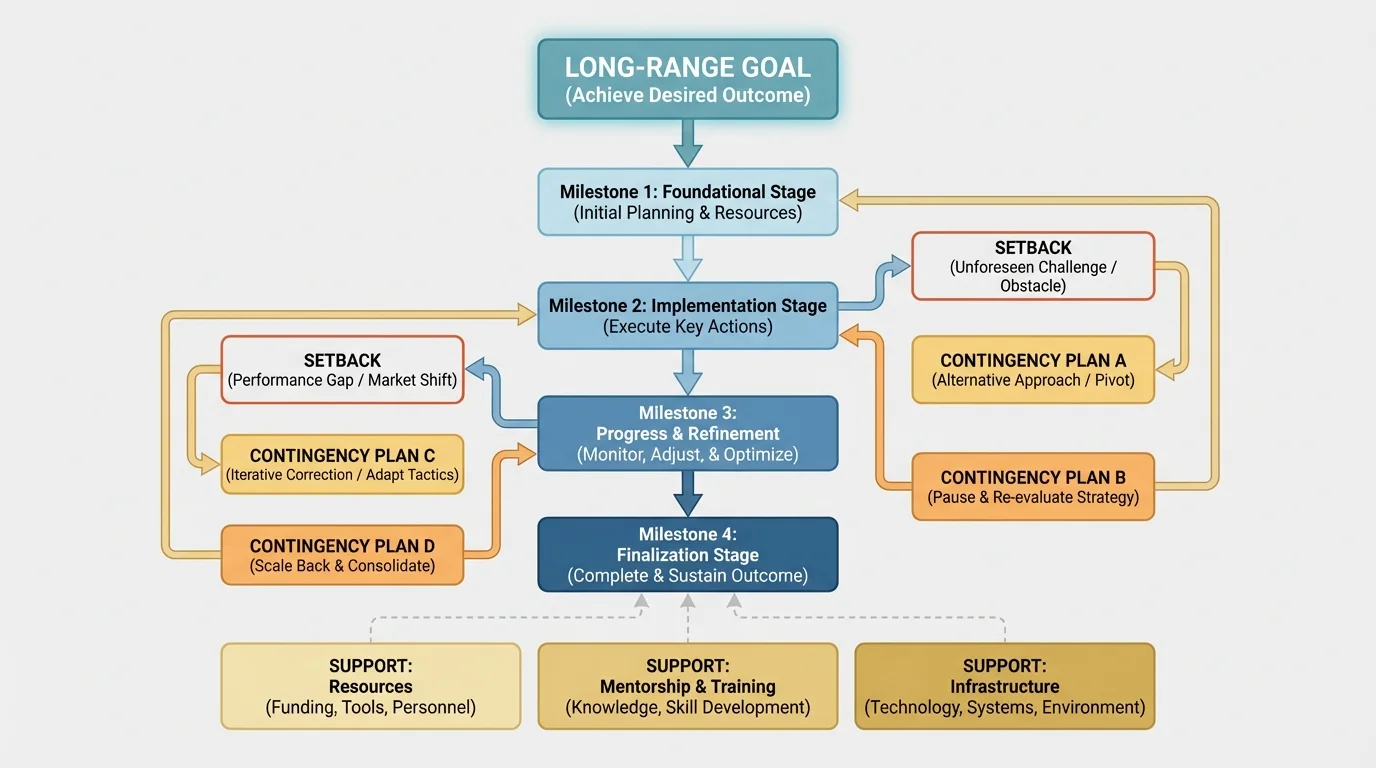
A good plan is not just one goal written at the top of a page. As [Figure 1] shows, a strong plan connects your destination, your checkpoints, the support around you, and the backup routes you will use if something goes wrong. These parts work together.
The first part is the goal itself: what you want to accomplish. The second part is a series of smaller steps called milestones. A milestone is a meaningful checkpoint that shows progress. The third part is your support system: people, tools, routines, and resources that help you keep going. The fourth part is a contingency plan, which means deciding in advance what you will do if things do not go as expected.
Without milestones, a goal can feel too big. Without supports, a plan can collapse under stress. Without contingencies, one setback can make you think the whole goal is ruined. Strong planning is not about pretending everything will go perfectly. It is about preparing to keep moving even when it does not.
Long-range action plan means a detailed plan for reaching an important future goal over an extended period of time.
Milestone means a checkpoint that marks important progress toward a larger goal.
Support system means the people, resources, habits, and tools that help you stay on track.
Contingency plan means a backup response you prepare in advance for likely problems or setbacks.
One useful way to think about planning is this: your goal is the destination, milestones are the road signs, supports are the fuel and tools, and contingencies are the alternate routes.
Before you can build a long-range plan, you need a goal that is specific enough to guide action. "Do better" is too vague. "Save $1,200 in ten months for transportation costs" is much clearer. "Get healthier" is vague. "Exercise four times each week for the next three months and improve sleep to at least eight hours most nights" is clearer.
A clear outcome should answer three questions: What do you want? Why does it matter? By when? If you cannot answer those questions, your plan will probably drift.
Be honest about whether the goal is realistic. A realistic goal is still challenging, but it fits your actual life. If you have school responsibilities, family duties, limited money, and other commitments, your plan must reflect that. Good planning is not fantasy. It is strategy.
Clarity creates action. When a goal is clear, it becomes easier to choose what to do today. A vague goal produces vague effort. A specific goal gives you a target, a deadline, and a reason to keep going when motivation changes.
It also helps to decide how you will measure success. If your goal is saving money, the measure may be your account balance. If your goal is career preparation, the measure may be completing applications, building a portfolio, earning a certification, or getting interview experience. If your goal is personal wellness, the measure may be weekly habits rather than a perfect result.
Large goals become manageable when you divide them into stages. As [Figure 2] illustrates, milestones act like checkpoints on a timeline, making it easier to see whether you are moving at the pace you intended.
Start from the final goal and work backward. If you want to reach a result in one year, ask what should be true in nine months, six months, three months, and one month. Then break those stages into weekly actions.
For example, suppose you want to save $1,200 in ten months. Instead of only focusing on the final amount, break it down. The monthly target is approximately \(1200 \div 10 = 120\), so you need about $120 each month. The weekly target is about \(1200 \div 40 = 30\) if you use forty weeks as a rough planning guide. Now the goal feels concrete: find ways to earn or set aside about $30 each week.
Milestones should be meaningful. "Think about my future" is not a milestone. "Complete résumé draft by October 15," "Save first $300 by November 1," or "Submit three training program applications by February 1" are much stronger milestones.
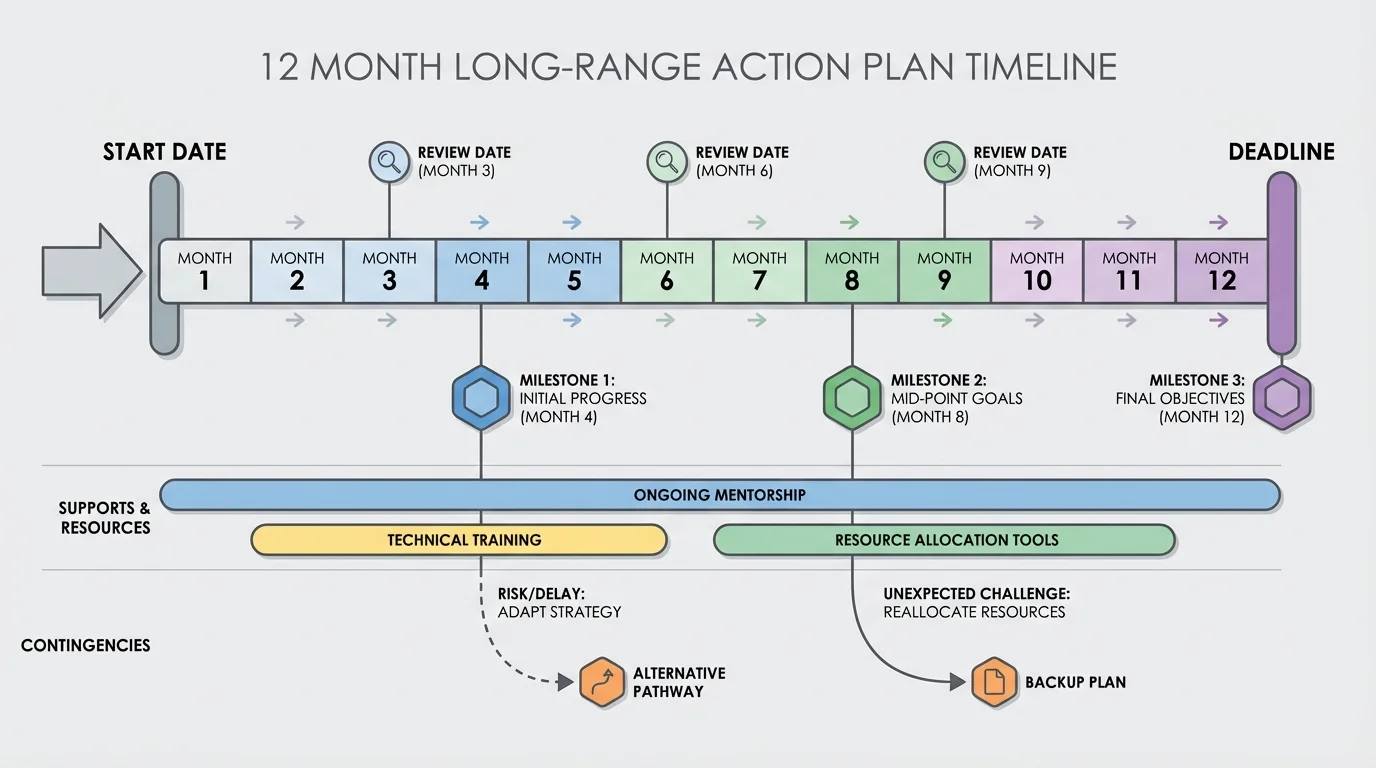
It is also smart to include review points. A review point is a scheduled time to check whether your current plan is working. For example, every two weeks you might ask: Am I on schedule? What is slipping? What needs to change? This is where planning becomes active instead of passive.
Example: Turning a big goal into milestones
Goal: Build enough experience to apply for a paid internship next summer.
Step 1: Define the final outcome.
By May, you want a polished résumé, one strong reference, a basic portfolio or sample work, and at least five internship applications submitted.
Step 2: Set milestone deadlines.
By October: list skills and past experience. By November: draft résumé. By January: complete one short online course. By March: finish sample projects. By April: ask for a reference and revise application materials.
Step 3: Turn milestones into weekly actions.
Examples include spending one hour each Tuesday updating documents, one hour each Thursday building sample work, and one Sunday each month reviewing progress.
The student now knows what to do now, not just what they hope happens later.
Later, if you notice you are behind, the timeline in [Figure 2] reminds you that missing one checkpoint is a signal to adjust, not a reason to give up.
People often make plans based only on effort: "I'll just work harder." Effort matters, but support matters too. A good plan asks, "What will help me succeed consistently?"
Supports can include adults who give advice, friends who keep you accountable, online tools that remind you of deadlines, a quiet workspace, transportation, saved money, a phone alarm, a budgeting app, a meal routine, or a weekly check-in with yourself. Support is anything that makes the right action easier.
Try to think in categories. You may need time support, such as blocked study hours; skill support, such as tutorials or practice; emotional support, such as someone to talk to when you feel discouraged; and practical support, such as internet access, supplies, or transportation.
If your goal depends on something outside your control, name that clearly. For example, if you need a reference for a job or program, part of your support system may be maintaining professional communication with an adult mentor. If your plan depends on saving money, support may include tracking spending and reducing unnecessary purchases.
| Type of support | What it looks like | Why it helps |
|---|---|---|
| People | Parent, guardian, coach, employer, mentor | Advice, accountability, feedback |
| Tools | Calendar app, reminder alarms, budget tracker | Keeps tasks visible and organized |
| Routines | Weekly review, fixed work block, sleep schedule | Reduces decision fatigue |
| Resources | Money, transportation, internet, supplies | Makes action possible |
| Skills | Interview practice, résumé writing, time management | Improves performance and confidence |
Table 1. Common support categories and how each one strengthens a long-range plan.
Strong planning also means asking for help early, not only when things are falling apart. That takes maturity. Responsibility does not mean doing everything alone. It means knowing when and how to use support wisely.
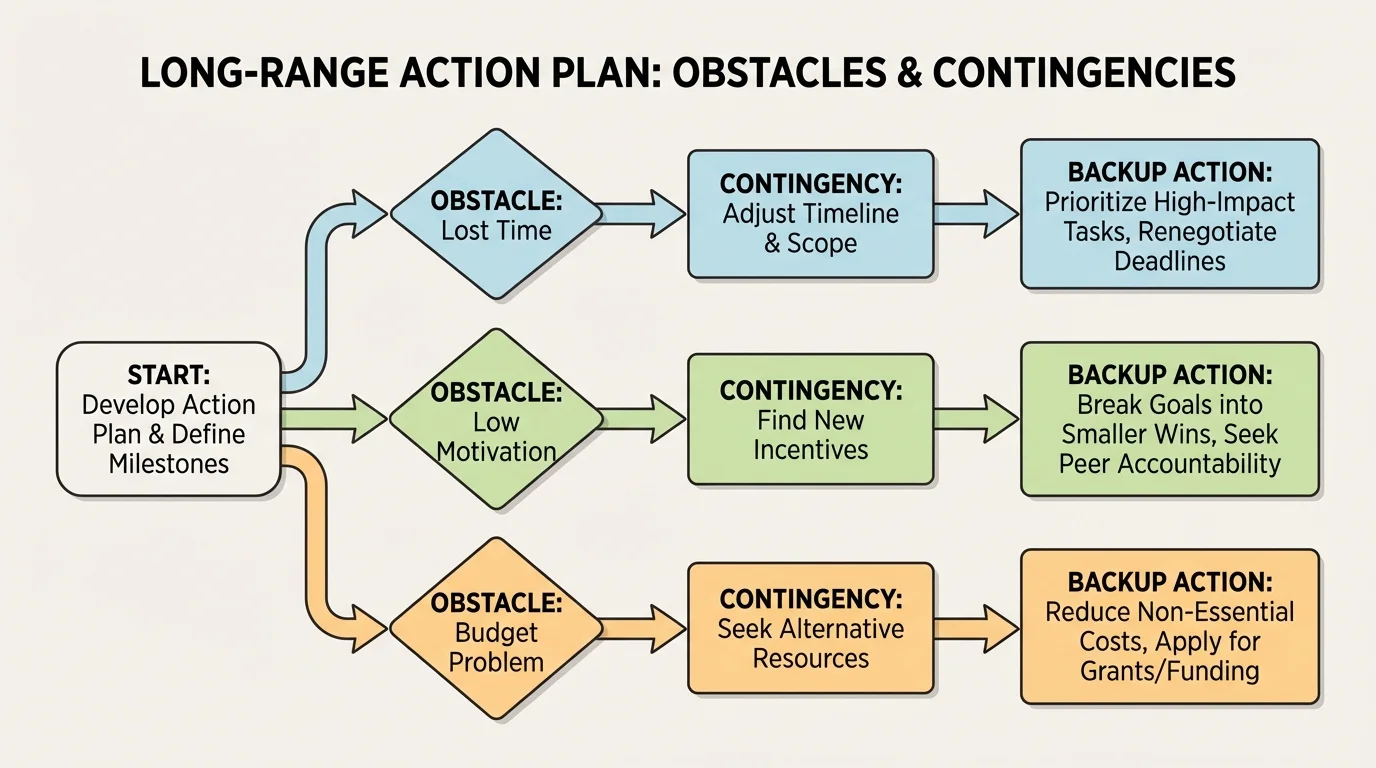
Most plans fail for a simple reason: people plan for the ideal week, not real life. As [Figure 3] shows, contingency planning means thinking through common obstacles ahead of time and deciding what you will do if they happen.
Ask yourself, "What could realistically get in the way?" Common answers include getting sick, losing motivation, having a family obligation, earning less money than expected, struggling in a class, forgetting deadlines, or feeling overwhelmed.
Then create backup responses. If you miss one workout week, your contingency is not "quit." It might be "restart with two shorter sessions next week." If you cannot save the full $120 in one month, your contingency might be "cut entertainment spending by $20 and pick up one extra shift or side job task." If a deadline becomes unrealistic, your contingency might be "revise the timeline and protect the most important milestone first."
Example: Writing contingencies into a plan
Goal: Complete a driver education course and save for permit-related costs.
Step 1: Identify likely obstacles.
The student may have schedule conflicts, limited money, or trouble staying consistent with study sessions.
Step 2: Write a backup action for each obstacle.
If schedule conflicts happen, move study sessions to Saturday morning. If money is short, reduce one optional expense and extend the savings timeline by two weeks. If focus drops, study with a friend on video chat for accountability.
Step 3: Decide what counts as a true emergency versus a normal setback.
A normal setback means adjust the plan and continue. A true emergency may require pausing and fully rebuilding the timeline.
Contingencies keep a setback from turning into a collapse.
The decision-tree idea in [Figure 3] is useful because it reminds you that one obstacle can lead to several possible responses. You are rarely stuck with only one option.
"Plans are useless, but planning is indispensable."
— Dwight D. Eisenhower
This quote matters because life changes. The exact plan may need edits, but the skill of planning keeps you ready to adapt.
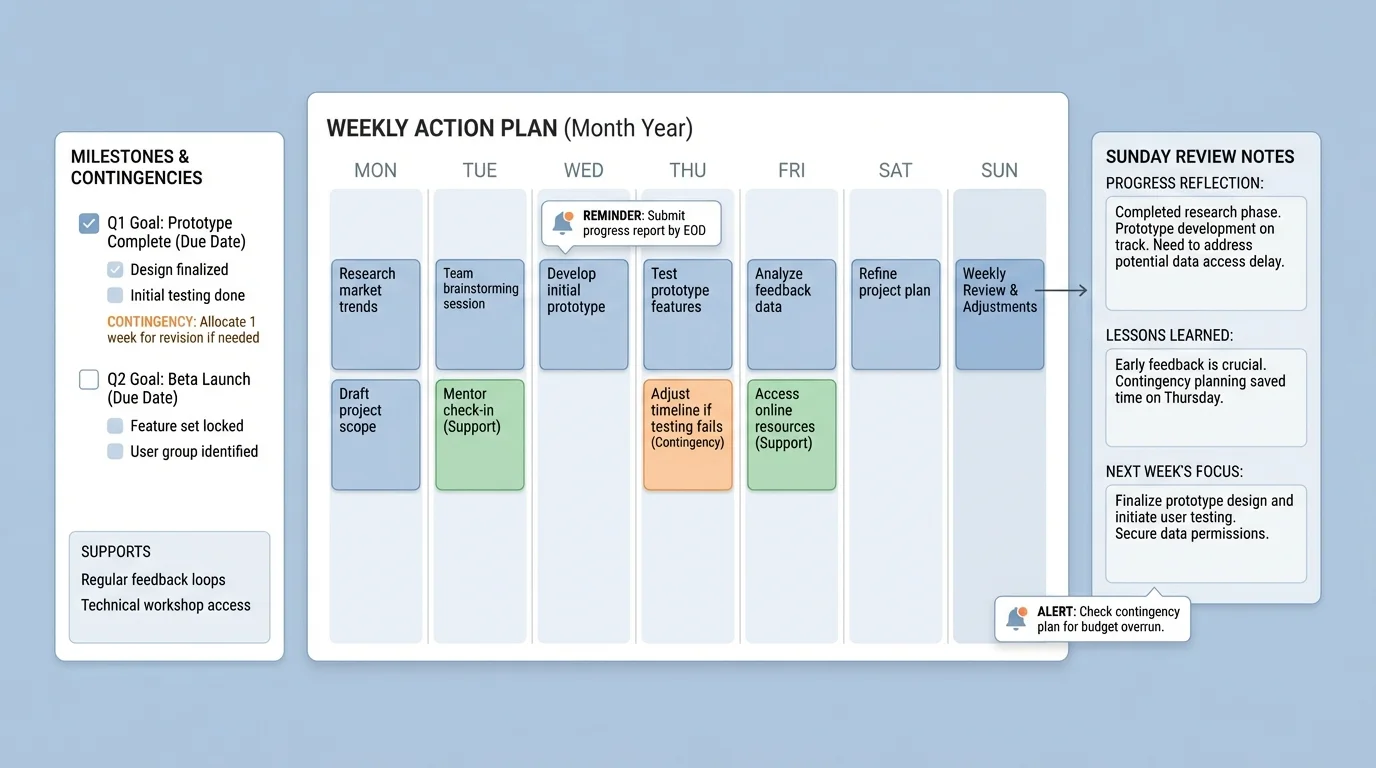
Even the best goal will not move forward if you only think about it once in a while. A planning system turns intention into repeated action. As [Figure 4] illustrates, your system should make deadlines, tasks, and review times visible every week.
Your system does not need to be complicated. You can use a notes app, a spreadsheet, a digital calendar, a paper planner, or a combination. What matters is that you check it regularly and trust it enough to use it.
A simple system has four parts: your final goal, your next milestone, your tasks for the current week, and your review date. If one of those parts is missing, you may stay busy without actually making progress.
One effective routine is a weekly review. Choose one day, maybe Sunday evening, and spend ten to fifteen minutes asking: What did I finish? What got delayed? What is the next important step? What support do I need this week? This small habit can prevent months of drifting.
Your system should also match your real attention span. If you ignore long lists, keep your weekly tasks short. If you forget deadlines, use alarms. If you feel overwhelmed by large projects, break them into tasks that can be done in less than one hour.
Later, when you evaluate your progress, [Figure 4] remains useful because it shows that successful planning depends on regular review, not one-time motivation.
Long-range planning becomes easier when you see what it looks like in real life. Here are three practical examples.
Example 1: Saving for a car-related expense
Goal: Save $1,800 in twelve months for a down payment, insurance start-up costs, or repairs.
Step 1: Break the total into smaller targets.
The monthly target is \(1800 \div 12 = 150\). A rough weekly target is about \(1800 \div 52 \approx 34.62\), so the student may round up and aim for $35 per week.
Step 2: Choose supports.
Use a savings tracker, automatic transfer, spending log, and one adult who checks in monthly.
Step 3: Write contingencies.
If you fall short by $40 in one month, make up $20 over each of the next two months or add one extra work shift if possible.
This plan is strong because the target is measurable and the backup response is already prepared.
A money goal is a great example of responsibility because it forces you to connect present choices with future freedom.
Example 2: Preparing for work or training after high school
Goal: Be ready to apply for a job, certification program, or community college opportunity within eight months.
Step 1: Set milestones.
Month 1: research options. Month 2: list requirements. Month 3: create résumé. Month 4: collect documents. Month 5: build skills. Month 6: ask for references. Month 7: complete applications. Month 8: prepare for interviews.
Step 2: Build supports.
Use online career resources, set reminder dates, and ask a trusted adult to review materials before submission.
Step 3: Add contingencies.
If one application requirement takes longer than expected, prioritize the programs or jobs with the earliest deadlines and shift less urgent tasks one week later.
This kind of plan helps you avoid the panic of last-minute applications.
Career planning is not only about ambition. It is also about community. The people who support you, review your materials, and connect you with opportunities become part of your progress.
Example 3: Building a health routine
Goal: Improve energy and consistency over sixteen weeks.
Step 1: Define success clearly.
Exercise four times per week, prepare simple meals ahead of time twice each week, and keep a regular sleep routine on most nights.
Step 2: Set milestones.
Weeks 1 to 4: establish schedule. Weeks 5 to 8: maintain consistency. Weeks 9 to 12: increase difficulty slightly. Weeks 13 to 16: review and adjust.
Step 3: Plan contingencies.
If you miss two days, restart with the next scheduled session instead of trying to "punish" yourself with an unrealistic catch-up plan.
This plan works because it focuses on habits, not perfection.
One common mistake is making the goal too broad. If your goal could mean ten different things, your action plan will stay blurry. Another mistake is underestimating how long tasks take. Give yourself more time than you think you need.
A third mistake is relying only on motivation. Motivation changes. Systems, supports, and habits are more reliable. A fourth mistake is treating setbacks as proof of failure. Usually, setbacks are information. They show where your plan needs adjustment.
Some students also create plans that look impressive but are impossible to follow. If your plan depends on perfect energy, perfect focus, and zero interruptions, it is not realistic. Make a plan that works on ordinary days, not just ideal ones.
Progress is rarely a straight line. Responsible planning means checking, adjusting, and continuing. A revised plan is often stronger than the original one.
Finally, do not keep your plan only in your head. Write it down. When your plan is visible, it is easier to act on it, measure it, and improve it.
Choose one goal that matters to your future and write it in one clear sentence with a deadline. Then list three milestones, three supports, and three likely obstacles with backup responses. Keep it simple.
You can also create a quick planning check:
That short framework can help with almost any long-term goal, from money and health to work, training, and personal growth. Planning is one of the clearest ways to take responsibility for yourself, contribute to your future, and build a life on purpose.
