A lot of adult problems do not begin with obvious cruelty. They begin with speed. Someone replies too fast, assumes too much, ignores context, or focuses only on what is easiest for them. A rude message in a group chat, an unfair choice at work, a dismissive comment about a neighbor, or silence when someone is being excluded can all seem small in the moment. But those choices shape trust, safety, reputation, and opportunity. That is why empathy and community awareness are not just "being nice." They are practical tools for making ethical decisions when other people are affected.
As you move into adult settings, people will expect more from you than good intentions. They will expect judgment. That means noticing what others may be experiencing, understanding the setting you are in, and acting in ways that reduce harm and support fairness. Ethical action is not about trying to look good. It is about choosing what is responsible, respectful, and just, even when no one is grading you.
Adult life gives you more freedom, but it also gives you more impact. If you have a job, volunteer role, driver's license, bank account, social media presence, or caregiving responsibility, your decisions affect real people. One careless post can damage trust. One thoughtful response can protect someone's dignity. One choice to speak up can stop harm from spreading.
Many professional conflicts are not caused by technical mistakes alone. They often grow from poor communication, weak perspective-taking, and failure to consider how a decision affects other people.
That matters because ethical action in adult life is rarely announced with a giant sign saying, "This is a moral test." More often, it appears as an everyday choice: whether to include someone in a conversation, whether to verify a rumor before sharing it, whether to admit a mistake, whether to respect someone's time, or whether to make space for a person whose needs are different from yours.
Empathy is the ability to understand and respond to another person's feelings, needs, or perspective. Community awareness means noticing how people are connected and how decisions affect groups, shared environments, and systems. Ethical action is behavior guided by fairness, respect, responsibility, honesty, and care for others.
These three ideas work together. Empathy helps you understand the human side of a situation. Community awareness helps you see the wider impact. Ethical action is what you actually do next.
For example, suppose a coworker in a part-time job keeps arriving a few minutes late. If you only look at the surface, you might label them irresponsible. If you use empathy, you might ask what is going on. If you use community awareness, you also think about how lateness affects teammates, customers, scheduling, and stress levels. Ethical action might include addressing the issue honestly, offering support if appropriate, and helping find a solution instead of gossiping or attacking.
Perspective-taking is one of the strongest parts of empathy, and [Figure 1] illustrates why it matters. When you pause long enough to ask, "What might this look like from their side?" you interrupt the habit of reacting from ego, frustration, or assumption. That does not mean the other person is automatically right. It means you are giving yourself enough information to respond intelligently.
Empathy improves ethical action in at least four ways. First, it helps you notice hidden struggles. Someone may seem distracted because they are caring for a younger sibling, dealing with anxiety, or recovering from a family emergency. Second, it reduces unnecessary harm. A direct message can be honest without being humiliating. Third, it improves conflict resolution because people are more likely to listen when they feel heard. Fourth, it strengthens trust. People remember whether you treated them like a problem or like a person.
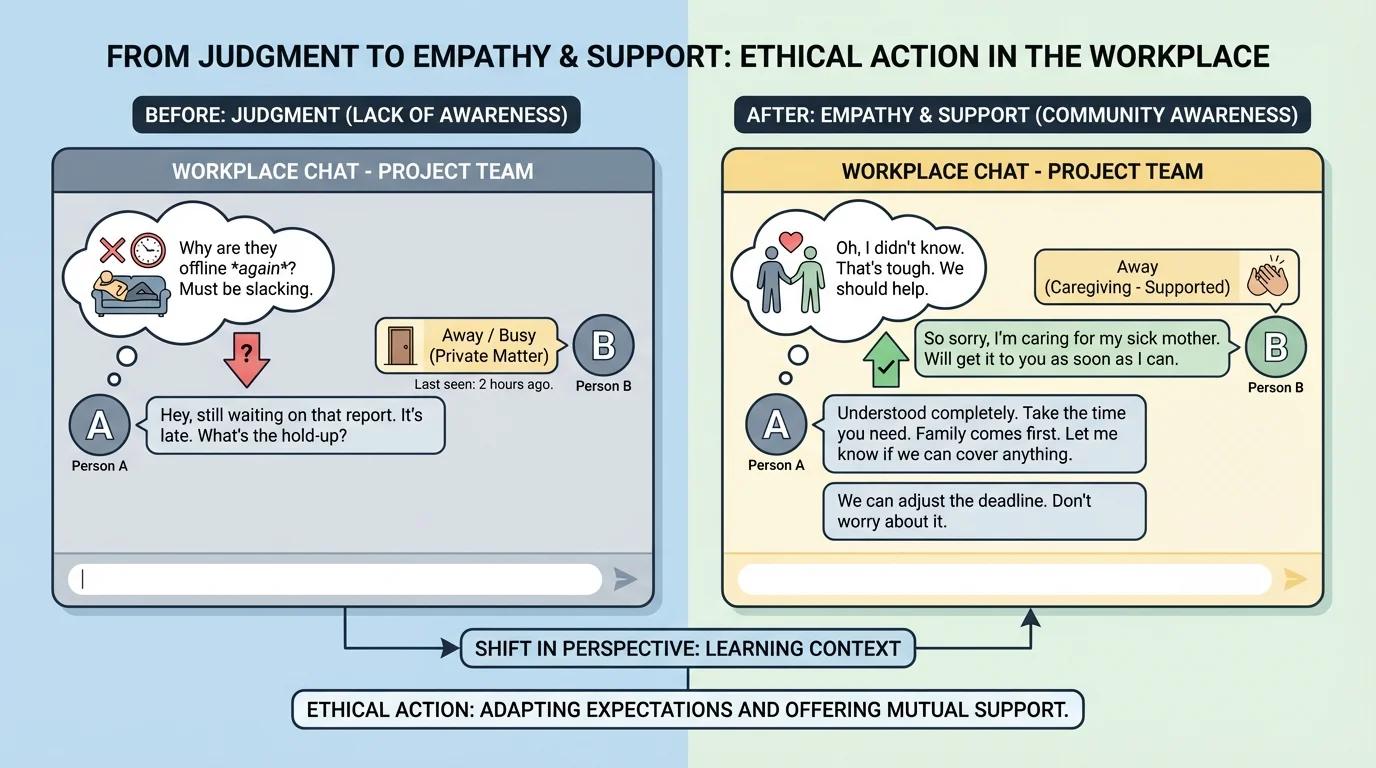
Empathy is especially important in online communication, where tone is easy to misread. A short reply can sound hostile when it was actually rushed. A person who does not turn on their camera during a video meeting may be dealing with a chaotic home environment, low bandwidth, or privacy concerns. If you jump straight to judgment, you may act unfairly.
At the same time, empathy is not mind reading. It does not mean inventing excuses for someone without facts. Ethical empathy asks questions, listens carefully, and checks assumptions. A useful sentence is: "I want to understand what's going on before I respond." That one sentence can prevent a lot of damage.
Case study: responding ethically instead of reactively
You are coordinating a volunteer event, and another volunteer fails to upload needed materials on time.
Step 1: Pause before sending an angry message.
Instead of typing the first thing you feel, take a minute to separate frustration from facts.
Step 2: Ask for context.
Send a message like, "I noticed the files are still missing. Is something getting in the way?"
Step 3: Listen to the answer.
You learn they were helping a family member get emergency medical care.
Step 4: Choose an ethical response.
You still address the missed responsibility, but you avoid shaming them. You ask what support is realistic and reassign urgent tasks for the event.
The result is accountability without cruelty.
Later, the same principle still applies. As shown earlier in [Figure 1], empathy changes not only what you feel but also the kind of action you consider acceptable. Without empathy, your choices get narrower and harsher. With it, you are more likely to act fairly.
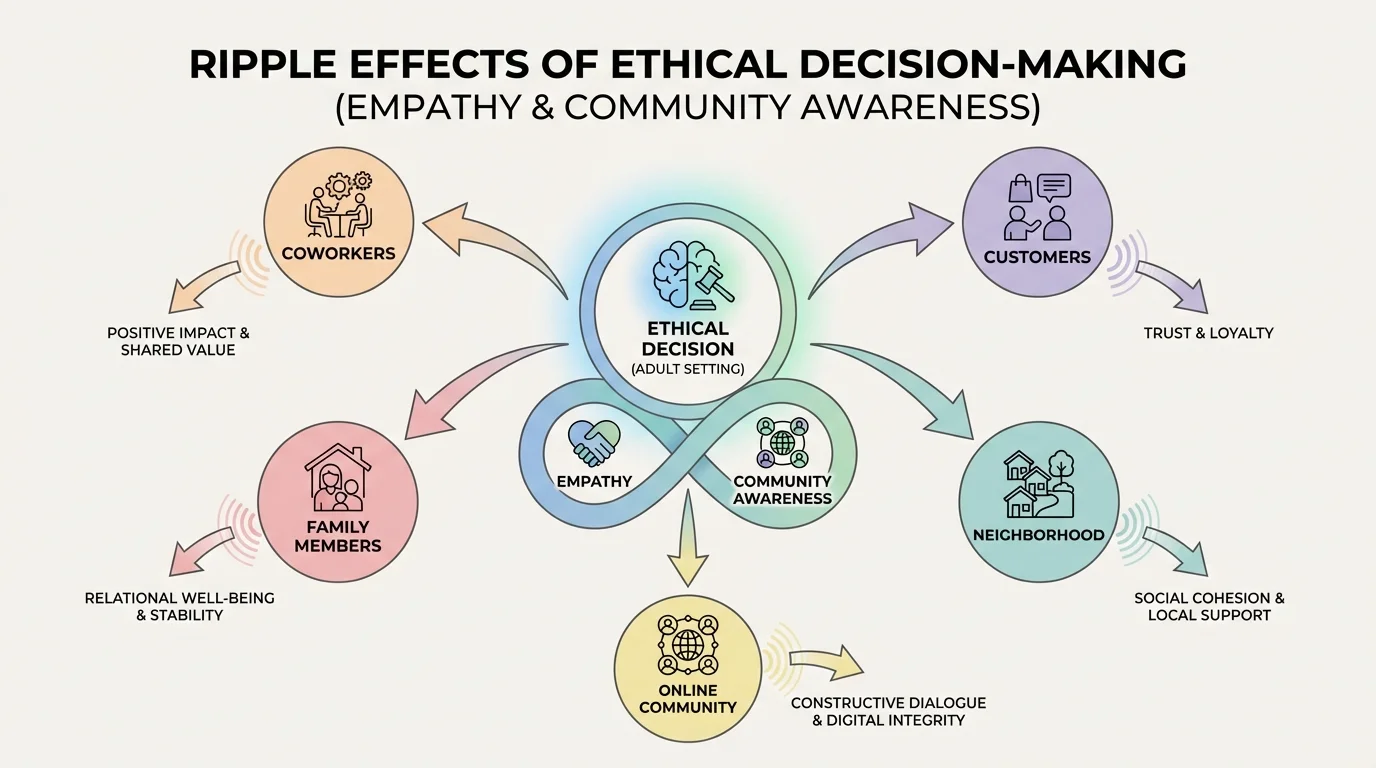
Stakeholder thinking matters because no ethical choice happens in isolation, and [Figure 2] illustrates those ripple effects. Community awareness means asking who is affected, who has less power, who may be left out, and what the long-term consequences are. A decision that feels convenient for you may create costs for many others.
This is where ethics becomes bigger than personal feelings. You might empathize with one friend who wants special treatment, but community awareness reminds you to think about fairness for everyone else too. In adult settings, ethical action often requires balancing compassion for individuals with responsibility to the group.
Community awareness includes understanding differences in culture, income, disability, language, transportation, caregiving duties, and access to technology. For example, if a team always schedules online meetings at one time without asking for input, that may exclude people with work shifts or family care duties. If a community event has no captioning or translation, some people may be shut out entirely. Ethical action asks not only, "Is this efficient?" but also, "Who becomes invisible if we do it this way?"
This kind of awareness also matters in public spaces. Playing loud music late at night, leaving trash in a shared area, spreading unverified local rumors online, or parking in ways that block access may seem minor to the person doing it. But from a community perspective, those choices affect sleep, safety, trust, mobility, and belonging.
Sometimes the most ethical action is not dramatic. It may be asking who is missing from the conversation, checking whether information is accessible, or choosing not to amplify a joke that targets a vulnerable group. Community awareness trains you to see consequences before they become conflict.
| Question to Ask | What It Helps You Notice | Why It Matters |
|---|---|---|
| Who is affected? | Direct and indirect impact | Prevents self-centered decisions |
| Who has less power here? | Risk of unfairness or pressure | Protects vulnerable people |
| Who might be excluded? | Accessibility and belonging | Supports inclusion |
| What happens if everyone did this? | Community-wide consequences | Tests long-term ethics |
| What repair is needed if harm occurs? | Responsibility after mistakes | Builds accountability |
Table 1. Questions that build community awareness before making a decision.
When you return to this idea later, [Figure 2] remains useful because ethical action is rarely about one-on-one impact alone. The wider your view, the more responsible your choices become.
Good intentions are not enough when pressure is high. You need a process. A simple ethical decision-making framework helps you slow down and choose better.
Step 1: Pause. Do not act at peak anger, embarrassment, or excitement. Even a pause of a few minutes can prevent a harmful decision.
Step 2: Gather facts. What do you know for sure? What are you assuming?
Step 3: Consider people, not just rules. How might each person be experiencing this?
Step 4: Think community impact. Who else could be affected now or later?
Step 5: Choose the fairest realistic action. Aim for honesty, respect, and responsibility.
Step 6: Communicate clearly. Explain your choice without attacking or hiding.
Step 7: Review. Did your action actually reduce harm? If not, what repair is needed?
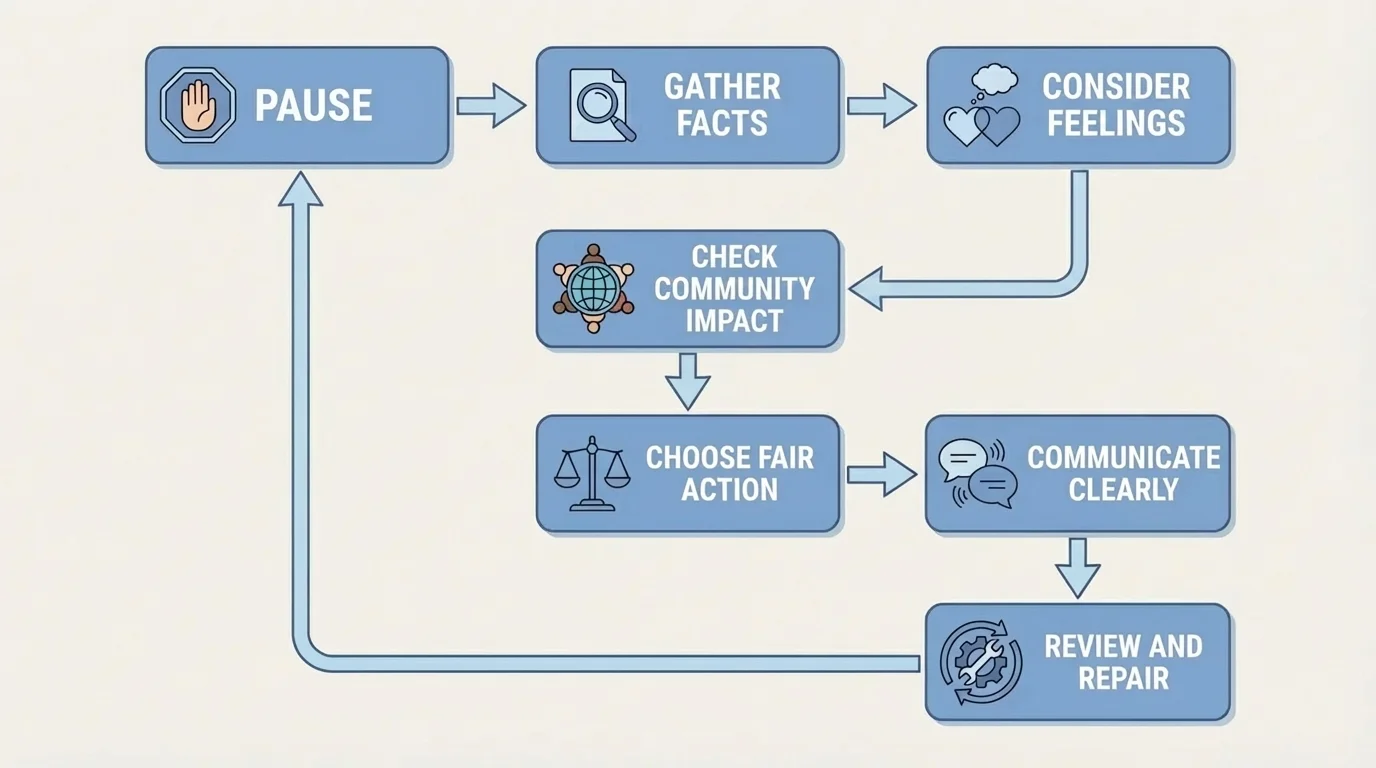
[Figure 3] This framework works in personal, professional, and digital life. It is especially useful when your first impulse is defensive. Maybe you want to clap back in a comment thread, ignore a roommate issue, or protect a friend who acted badly. The framework reminds you that ethical action is not about loyalty to your impulse. It is about loyalty to what is right.
Fairness is not always sameness. Treating everyone exactly the same can still be unfair if people are starting from different circumstances or facing different barriers. Ethical action sometimes means offering flexibility, access, or support so that people have a genuinely fair chance to participate.
For example, if two employees are expected to join an online meeting, treating them "the same" might sound fair. But if one has reliable private internet and the other is joining from a shared, unstable connection while caring for a child, the ethical response may include flexibility, recording the meeting, or sharing notes. Equal treatment and fair treatment are not always identical.
When you use the process in [Figure 3], you also become more consistent. That matters because people trust adults whose decisions are grounded in principles, not mood.
These skills show up in many places. Ethical action looks a little different depending on the environment, but the core questions stay the same: Who is affected? What is fair? What reduces harm? What respects dignity?
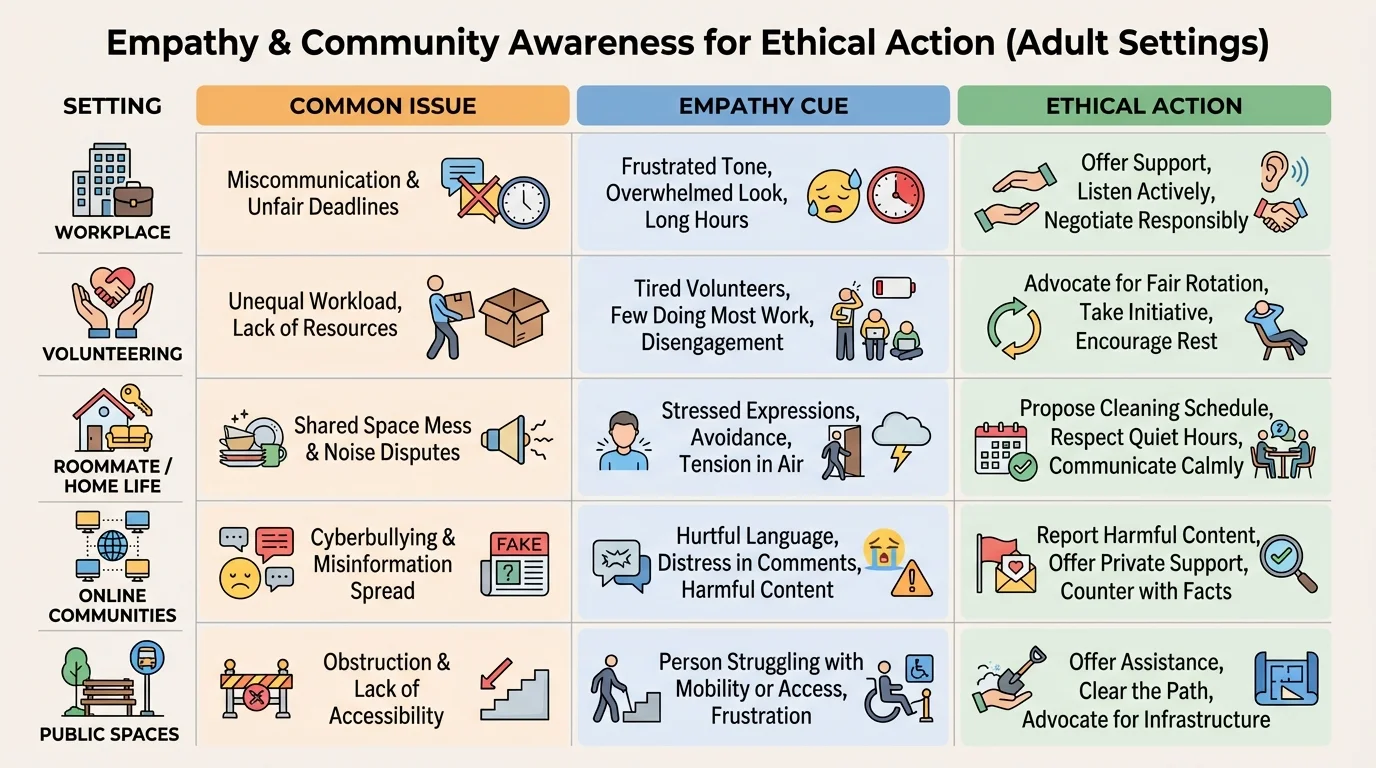
[Figure 4] At work: You may notice a teammate being talked over on a call. Empathy helps you recognize the discomfort. Community awareness helps you see how group habits affect whose ideas get heard. Ethical action could be saying, "I want to come back to their point," or making sure credit goes to the right person.
In volunteering or community service: You might be tempted to make decisions for people instead of with them. Empathy means listening to actual needs rather than assuming. Community awareness means respecting the knowledge and dignity of the people being served. Ethical action avoids savior behavior and supports collaboration.
With roommates, neighbors, or shared housing: Adult ethics includes noise, cleaning, bills, guests, privacy, and shared resources. Empathy helps you understand stress or different habits. Community awareness reminds you that shared space depends on mutual respect. Ethical action means clear agreements, honest communication, and repair when someone causes inconvenience or damage.
In family care: You may one day help with younger siblings, older relatives, or a family member facing illness. Empathy helps you respond with patience. Community awareness helps you notice how caregiving affects everyone in the home, including your own capacity. Ethical action can include sharing responsibilities, asking for help, and avoiding resentment-based decisions.
In online communities: It is easy to forget there are real humans behind screens. Empathy slows down ridicule and pile-ons. Community awareness helps you see how group behavior can normalize harassment, misinformation, or exclusion. Ethical action may mean refusing to share unverified claims, privately checking on someone targeted by a group, or reporting harmful behavior.
In public life: Returning a cart, cleaning up after yourself, respecting accessible spaces, and being considerate in lines are not tiny issues. They are signs that you understand your part in a shared world. Ethical adults do not ask only, "Can I get away with this?" They ask, "What kind of environment am I helping create?"
Real-world comparison
Consider the same habit in two different settings: playing audio out loud from your phone.
Situation A: You are alone in your room.
The impact is mostly personal. Ethical concerns are low unless it disturbs someone nearby.
Situation B: You are in a waiting room or shared transit area.
The impact spreads to strangers who did not consent to the noise. Community awareness changes what respectful behavior looks like.
The behavior is similar, but the ethical meaning changes because the setting changes.
That is why [Figure 4] matters beyond one example. Different adult settings require different forms of awareness, but all of them reward the same habit: thinking beyond yourself.
Even caring people make unethical choices when they are rushed, stressed, insecure, or trying to fit in. One barrier is bystander effect, which happens when people fail to help because they assume someone else will step in. In online spaces, this can look like watching harassment happen and saying nothing because the group is large.
Another barrier is bias. You may interpret the same behavior differently depending on who does it. A person you like seems "stressed," while someone you dislike seems "lazy." Empathy becomes weaker when you reserve it only for people who are similar to you or easy to relate to.
Stress also narrows moral attention. When you are exhausted, you may focus only on your own workload, frustration, or convenience. That does not excuse harmful behavior, but it explains why self-regulation is part of ethical action. If you cannot manage your state, you are more likely to make unfair choices.
Self-awareness and emotional regulation support social awareness. If you can notice your own anger, defensiveness, or panic early, you are more likely to pause, listen, and act responsibly instead of reactively.
A different mistake is over-identifying with one person's emotions so strongly that you lose fairness. Empathy is valuable, but if it causes you to excuse repeated harm, ignore facts, or neglect everyone else affected, it stops being ethical. Caring deeply is not the same as judging wisely.
You do not become more ethical by waiting for a big test. You build the skill through small habits. Start by paying attention to moments when your first reaction is annoyance, sarcasm, or dismissal. Those are often the best practice moments.
Try This: Before responding to a frustrating message, ask yourself three questions: "What facts do I know?" "What might I be missing?" and "Who else is affected by what I do next?" This takes less than a minute, but it can completely change your response.
Try This: In one conversation this week, focus on listening for needs rather than just words. Is the person asking for flexibility, reassurance, clarity, respect, or space? Ethical action improves when you respond to the actual need instead of just the surface statement.
Try This: In a shared environment at home or in your neighborhood, notice one thing that makes life easier for others and do it without being asked. Refill something, clean a shared area, lower noise, or communicate early about a possible issue. Community awareness grows through repeated attention.
It also helps to develop simple scripts. You do not need perfect words. You need usable ones. Try: "I want to be fair, so let me understand this better." Or: "I can see this affected you. Let's talk about what repair looks like." Or: "That may work for some people, but who might be left out?"
"The real test of character is what you do when your choices affect people who may never know your name."
These habits matter because adulthood includes more unsupervised moments. No teacher is standing over your shoulder. Ethical action becomes part of your reputation, your relationships, and your own self-respect.
Boundary setting is part of ethical action too. You can care about someone's struggle and still say no to being manipulated, mistreated, or overburdened. Healthy empathy says, "I understand your difficulty," not "I must accept any behavior because you are having a hard time."
This matters in friendships, family, work, and community roles. If someone repeatedly breaks agreements, guilt-trips you, or expects you to solve problems they refuse to address, unlimited accommodation may actually support unhealthy patterns. Ethical action includes honesty, limits, and consequences.
A useful model is: acknowledge, clarify, act. Acknowledge the person's situation. Clarify what is still necessary or acceptable. Then act consistently. For example: "I understand you've been overwhelmed. We still need a clear plan for the rent by tonight." That response is more ethical than either cruelty or avoidance.
Strong empathy with weak boundaries can lead to burnout. Strong boundaries with no empathy can become harshness. Ethical maturity requires both.
