Some communities look fine from the outside but feel exhausting from the inside. A team can have smart people, a volunteer group can have good goals, and a friend group can seem active online, yet people may still feel ignored, talked over, stereotyped, or unsafe. That is why building an inclusive, respectful community is not just about having "nice" values. It is about what people actually experience when they join, speak, disagree, make mistakes, or need support.
As you move into adult life, you will enter different kinds of communities: a workplace, an internship, a neighborhood group, a sports league, an online fandom, a volunteer project, or a friend circle. In each one, people notice the same basic question: Do I belong here, and will I be treated with dignity? Your answer to that question will shape whether people trust you, work with you, and want to stay connected.
An inclusive community is a group where people with different identities, backgrounds, abilities, beliefs, and experiences can participate fully and be treated fairly. A respectful community does more than avoid open cruelty. It creates conditions where people can contribute, ask questions, disagree appropriately, and feel that they matter.
This matters in practical ways. At work, inclusion improves teamwork, problem-solving, customer service, and retention. In civic life, it helps communities make better decisions because more people are heard. In social life, it builds friendships that are safer, deeper, and more honest. When inclusion is weak, the consequences are real: people withdraw, stay silent, leave the group, or protect themselves by pretending to agree.
Inclusion means actively making sure people can participate and belong, not just allowing them to be present.
Respect means recognizing another person's dignity, rights, boundaries, and humanity in how you speak and act.
Belonging is the feeling that you are accepted, valued, and able to be yourself without fear of rejection or humiliation.
Notice the difference between tolerance and inclusion. Tolerance says, "You can be here." Inclusion says, "Your presence and perspective matter here." That difference changes everything. A group that only tolerates difference may stay technically open but emotionally closed.
Before you can build community with others, you need to understand yourself. Your habits, assumptions, reactions, and communication style affect the people around you. This begins with social awareness, the ability to notice what other people may be feeling, needing, or experiencing in a situation.
It also requires noticing your own identity and perspective. You have experiences that shape how you see the world. So does everyone else. If you assume your way is "normal" and other ways are unusual, you can accidentally create exclusion without meaning to. For example, if you schedule every group call at one convenient time for yourself, use slang some people do not understand, or joke about a stereotype because "everyone knows it's not serious," you may be sending the message that comfort belongs only to some people.
Another important concept is implicit bias, which refers to automatic assumptions you may carry without consciously choosing them. Having bias does not make you uniquely bad; pretending you have none makes growth harder. Mature people do not say, "I would never do that." They say, "I want to notice my patterns and correct them."
People often judge respect less by grand statements and more by repeated small behaviors: whether you remember names, whether you interrupt, whether you follow through, and whether you change when given feedback.
A practical habit is to ask yourself three questions after group interactions: Who spoke the most? Who was left out? and What did I do that made participation easier or harder?
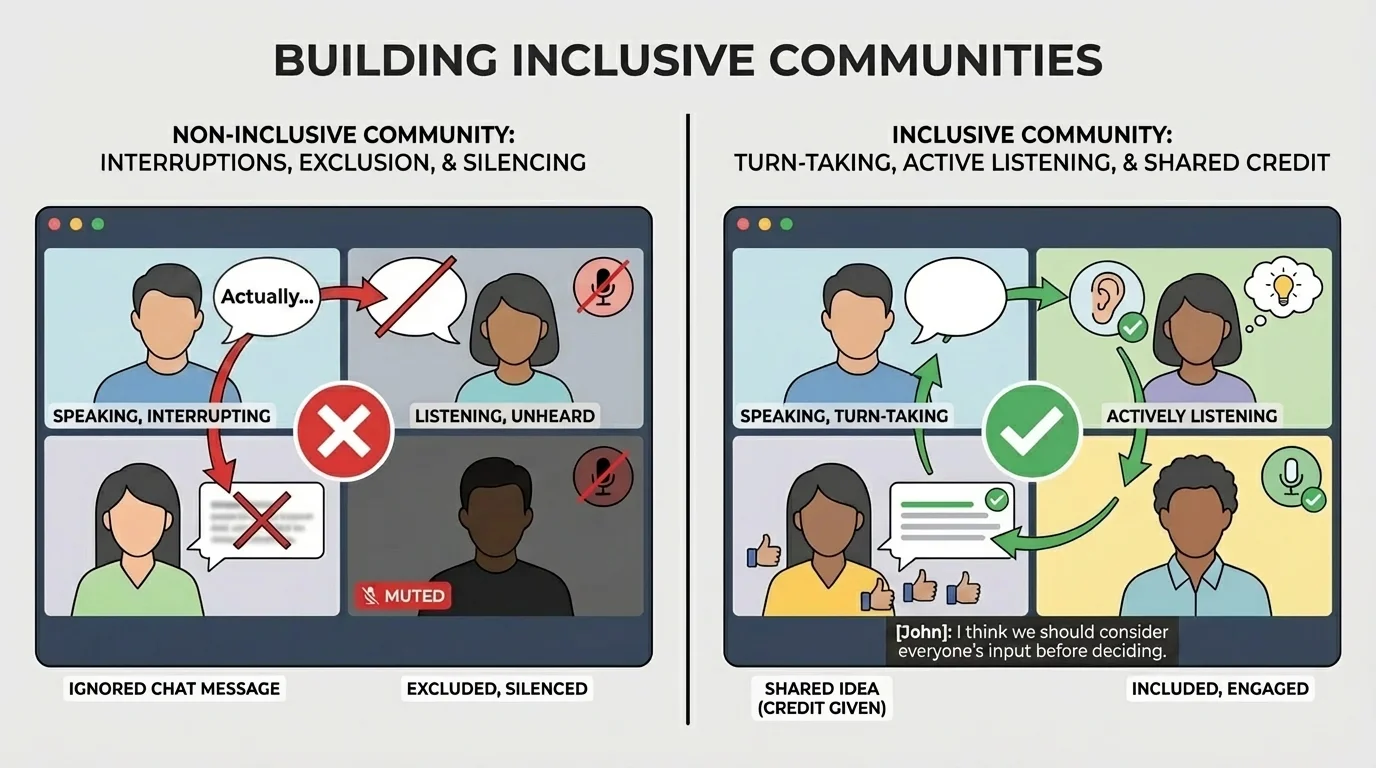
Strong communities are built through repeated choices, as [Figure 1] illustrates. Small behaviors decide whether people feel welcome or shut out: who gets greeted, whose messages get answered, whose ideas get credited, and whose discomfort gets ignored.
One of the most powerful tools is empathy. Empathy is not agreeing with everyone or fixing all problems. It means trying to understand another person's perspective and responding in a way that shows their experience matters. In practice, empathy sounds like, "I can see why that would be frustrating," or "Thanks for saying that; I didn't realize how that landed."
Here are practical ways to build inclusion every day:
Use people's names correctly. If you are unsure how to pronounce a name, ask respectfully and practice. A name is part of identity. Repeatedly getting it wrong when you have been corrected can communicate carelessness.
Share airtime. In group calls or meetings, do not dominate. If you notice you have spoken a lot, pause and invite others in: "I've shared a lot already. Does anyone want to add a different view?"
Credit ideas accurately. If someone contributed an idea, say so. "That builds on Maya's point" is simple and powerful. Shared credit builds trust; stolen credit destroys it.
Make participation easier. Send clear instructions, include deadlines, summarize decisions in writing, and avoid private inside jokes in group spaces. People participate better when expectations are visible.
Respect boundaries. Inclusion does not mean demanding personal stories, touching emotional topics without consent, or expecting someone to represent an entire group. People can belong without being required to educate everyone else.
Be reliable. Respect also means doing your part. If you miss deadlines, ghost messages, or leave all organizing to one person, others often carry the burden. Inclusion fails when only some people do the emotional and practical labor.
Think about the contrast shown earlier in [Figure 1]. On one side, exclusion happens through interruptions and silence toward certain people. On the other, inclusion is visible in turn-taking, access supports, and acknowledgment. That is what makes community-building practical: you can see it in behavior.
Because so much interaction now happens through text, video calls, group chats, gaming platforms, and social media, communication choices matter even more. Tone is easy to misread online. Messages can feel colder, harsher, or more dismissive than intended. Respectful communication means being clear without being cruel.
Start by checking your tone before you send something. Ask: Is this direct, or is it needlessly sharp? Would I say this the same way if the person were stressed or new? Am I criticizing behavior, or attacking identity? "We need the file by tonight" is very different from "You're always behind." One addresses a task; the other labels a person.
Accessibility matters too. A community is not truly inclusive if people cannot meaningfully participate. Practical examples include using captions in video content when possible, not relying only on fast verbal explanations, avoiding unreadable color combinations in shared graphics, and giving enough time for responses instead of expecting instant replies from everyone.
Online group spaces also need norms. Good norms might include: no mocking people for asking questions, no posting private messages without permission, no pressuring people to turn on cameras, no hate speech, and no piling on when someone makes a mistake. Clear standards reduce confusion and make accountability fairer.
Respectful communication is both tone and structure. Many people think respect is just being polite. Politeness helps, but structure matters too. A group can sound friendly while still excluding people through unclear rules, insider language, or inaccessible formats. Inclusion improves when communication is clear, organized, and designed so different people can participate successfully.
A good habit in any shared online space is to assume there may be context you do not know. If someone responds briefly, misses a call, or sounds upset, curiosity is often wiser than judgment. "Hey, just checking in—do you still want to be part of this?" usually works better than "Why are you ignoring everyone?"
Respectful communities are not communities without conflict. They are communities that handle conflict in a way that protects dignity and addresses harm. Sooner or later, someone will be interrupted repeatedly, stereotyped, left out, mocked, or dismissed. What matters is how people respond.
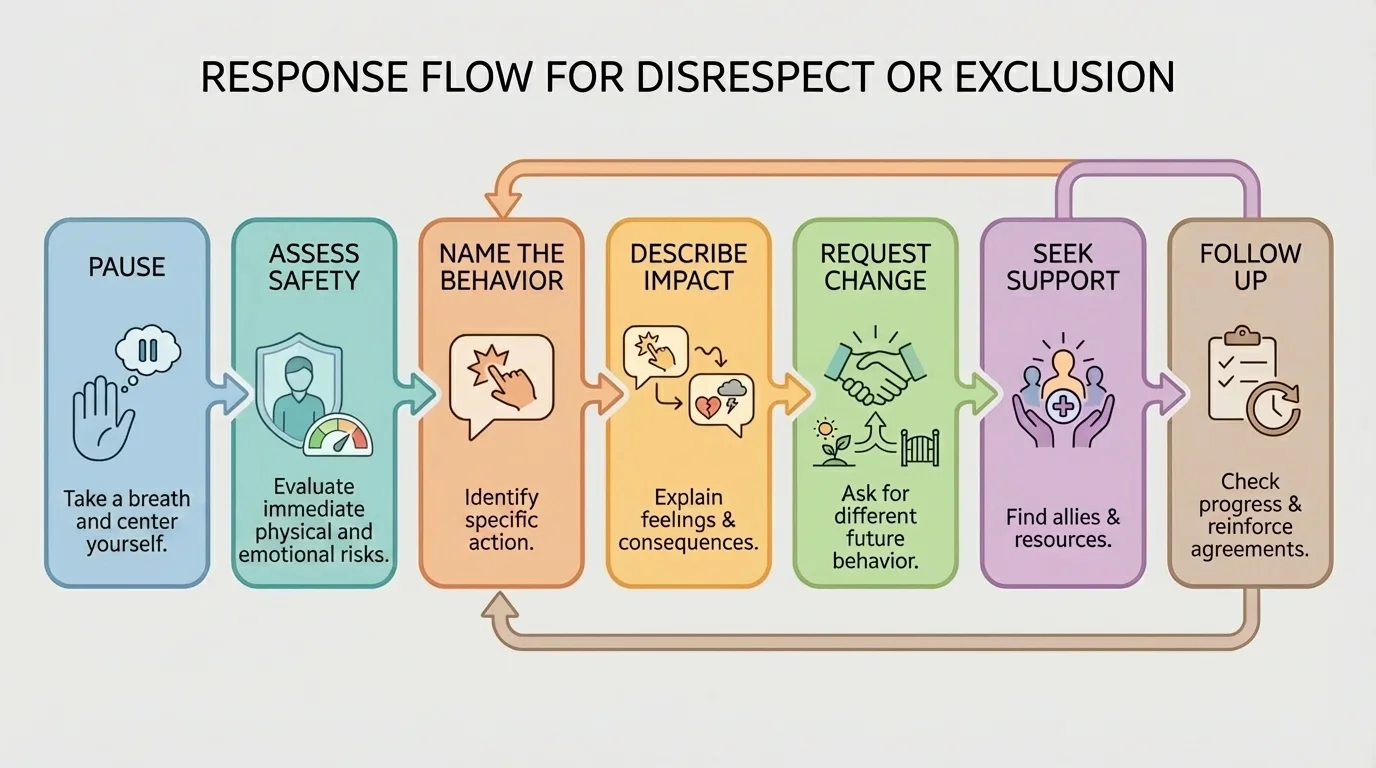
[Figure 2] One useful response framework is: pause, assess, name, ask, follow up. First, pause so you do not react impulsively. Second, assess safety: is this merely awkward, or is someone at risk? Third, name the issue clearly. Fourth, ask for a better behavior. Fifth, follow up later to make sure the problem does not simply restart.
For example, if a person makes a joke that targets a group, you might say, "That joke puts people down. Let's not use that here." If someone keeps interrupting another person in a meeting, you might say, "I want to go back to Jordan's point since they were cut off." These responses are calm, specific, and focused on behavior.
Sometimes you may need a private conversation instead of a public correction. If a friend posts something insensitive online, sending a direct message can be more effective than embarrassing them publicly. You could say, "I know you may not have meant harm, but that post plays into a stereotype. I wanted to tell you because I think you'd want to know."
When microaggressions happen, the challenge is that each one may seem "small" to the person causing harm. But repeated small harms create major stress. Comments like "You're so articulate" said with surprise, "Where are you really from?", or mocking someone's accent can signal that a person is seen as outside the group standard. Addressing microaggressions is not being oversensitive; it is protecting the community climate.
If you are the person who caused harm, the best response is not defensiveness. A strong repair usually includes four parts: acknowledge what happened, listen without arguing, apologize clearly, and change the behavior. "I'm sorry you were offended" is weak because it shifts blame. "I interrupted you twice and that was disrespectful. I'm sorry. I'm going to slow down and make space next time" is better.
Case study: responding when a teammate is excluded
You are in a volunteer planning chat. One member keeps sharing ideas, but no one responds. A few minutes later, someone else says the same thing and the group praises it.
Step 1: Notice the pattern
You recognize that the problem is not only the missed message; it is a pattern of unequal attention.
Step 2: Redirect credit
You reply, "That connects with the idea Sam posted earlier about the same approach."
Step 3: Reopen participation
You add, "Sam, do you want to expand on that?"
Step 4: Follow up if needed
If this keeps happening, you message the organizer privately and describe the pattern with specific examples.
This response is respectful because it does not create drama for attention. It corrects the exclusion and supports future participation.
The response system in [Figure 2] matters because not every situation needs the same action. Some moments call for quick redirection. Others require private repair, moderator support, or formal reporting. The goal is not winning an argument. The goal is protecting dignity and improving the environment.
Workplaces can include part-time jobs, internships, freelancing, customer service, and team projects. In all of them, people remember whether you are trustworthy, respectful, and fair. You do not need a manager title to shape culture. You influence culture every time you train someone, answer a message, greet a new coworker, or react to stress.
In work settings, inclusion often looks like practical professionalism: explaining tasks clearly, not mocking people who are learning, rotating less desirable duties fairly, respecting different communication styles, and avoiding assumptions based on age, race, gender, disability, language, religion, or background.
Suppose a new employee joins and seems quiet during video meetings. An exclusionary response is to label them uninterested. An inclusive response is to make entry easier: send notes before meetings, ask for input in writing, and check privately whether they need clarification. Some people contribute best after thinking, not by speaking first.
Respect at work also includes speaking up when customers or coworkers behave badly. If someone makes a degrading comment, silence may protect your comfort but can abandon the targeted person. Depending on your role and safety, responses can include redirecting the conversation, backing up a coworker, documenting the issue, or reporting the behavior.
Civic engagement means participating in the life of your community. That can include volunteering, attending local meetings, helping with mutual aid, joining advocacy efforts, serving on youth councils, organizing neighborhood cleanups, or helping people access information and services. Inclusion matters here because public decisions affect people differently, and communities make better choices when they hear from a wider range of residents.
In civic spaces, respectful community-building means asking who is missing. Are events held at accessible times? Is information written in plain language? Are youth, elders, disabled people, newcomers, and lower-income residents able to participate? A public event is not truly open if only the most confident or well-connected people can navigate it.
You can contribute by making participation simpler. Share accurate information instead of rumors. Welcome first-time volunteers. Explain how processes work without talking down to people. If a discussion becomes hostile, bring it back to shared goals and facts. Civic life gets stronger when disagreement stays human.
"The way we treat people in shared spaces becomes the kind of society we build."
Another key part of civic respect is refusing dehumanization. It is possible to strongly disagree with a policy or opinion while still recognizing the humanity of the person involved. Once a community starts treating people as enemies instead of neighbors, solving common problems becomes much harder.
Social communities often feel casual, but they can be deeply influential. Friend groups, gaming communities, clubs, fandom spaces, and social media circles shape identity and emotional health. Inclusion here can look simple: not making every plan depend on one type of money, schedule, body, or personality; not pressuring people into sharing private details; and not treating cruelty as humor.
Watch for social patterns that look normal but create exclusion. Examples include always choosing expensive activities, leaving one person out of the group chat, constantly teasing the same person, forcing everyone to be available at the same hour, or dismissing concerns with "it's just a joke." Repetition turns small exclusions into group culture.
Being inclusive socially also means balancing openness with boundaries. You can welcome people without tolerating manipulation, harassment, or disrespect. Healthy communities are not boundary-free; they are clear and fair. A strong friend group might say, "We want everyone to feel included, and that means no humiliation, no sharing screenshots without permission, and no pressuring people to stay in conversations when they need space."
Belonging does not require sameness. People feel safer in communities where differences can exist without becoming a reason for ridicule, tokenizing, or exclusion.
If you host events online or in your community, think ahead. Who might be unintentionally excluded by the location, time, platform, cost, or format? Small planning choices can widen access. For example, giving advance notice, offering alternatives, and clearly stating expectations often helps people participate who might otherwise stay away.
Not every "inclusive" action works equally well. Good intentions matter, but outcomes matter more. You can evaluate community-building strategies by asking whether they increase real participation, improve trust, reduce repeated harm, and make expectations clearer.
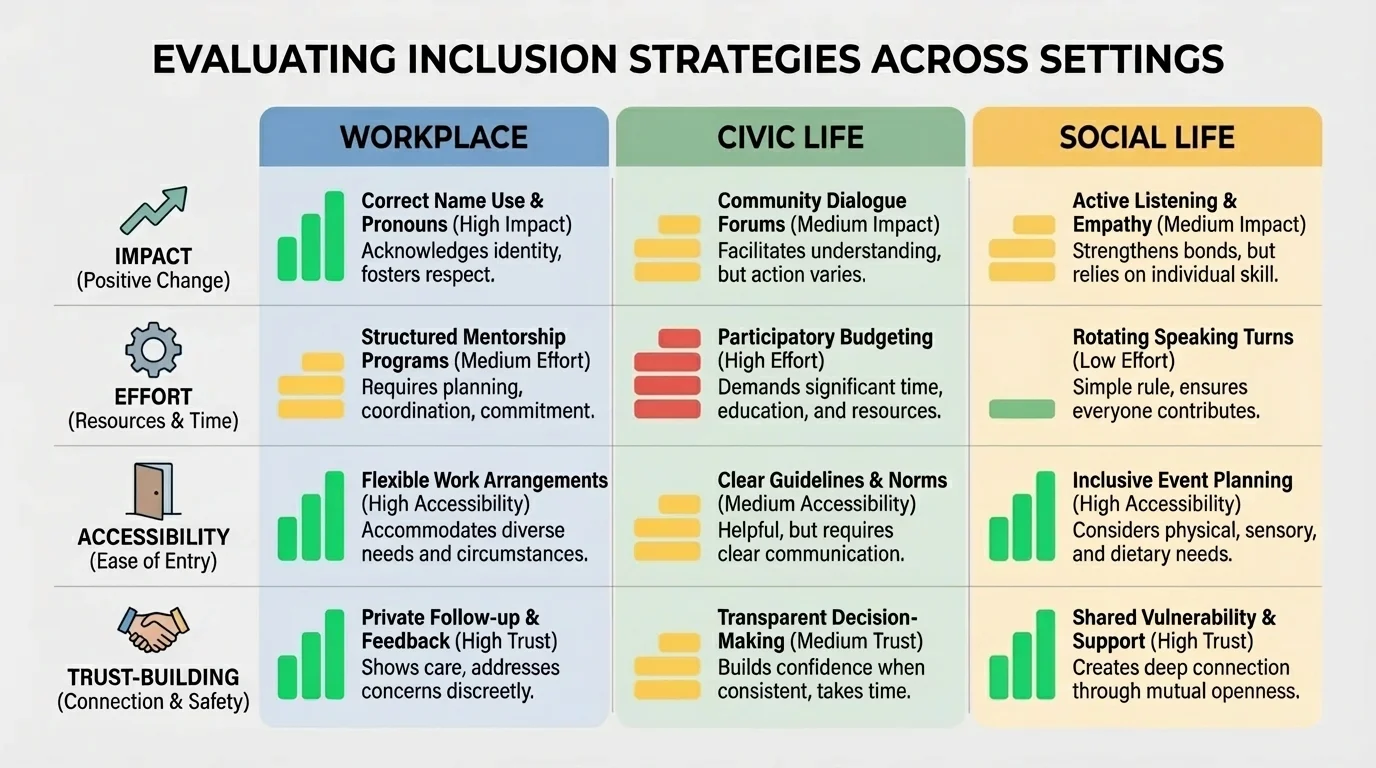
[Figure 3] Useful criteria include accountability, accessibility, consistency, and impact. Accountability means people are expected to repair harm and follow community standards. Accessibility means people can actually participate. Consistency means respect is not given only to popular people. Impact means the strategy produces better experiences, not just better slogans.
For example, posting "Be kind" in a group description may help a little, but it is vague. A clearer strategy is stronger: "No hate speech, no harassment, no sharing private messages, and repeated violations lead to removal." Likewise, saying "everyone is welcome" is weaker than actively inviting quieter members, explaining procedures, and checking whether barriers exist.
The evaluation chart in [Figure 3] highlights an important idea: some of the highest-impact actions are not dramatic. Correctly pronouncing names, rotating speaking turns, making rules visible, and following up after harm often build more trust than public statements alone. Inclusion is often quiet, steady, and consistent.
| Strategy | Why it helps | Limits if used alone |
|---|---|---|
| Welcoming language | Sets a positive tone for new members | Does not solve unequal participation by itself |
| Clear community guidelines | Makes expectations visible and enforceable | Fails if rules are ignored or unevenly enforced |
| Inviting quieter voices | Increases participation and idea diversity | Can feel performative if people are not actually heard |
| Private follow-up after harm | Supports repair without unnecessary humiliation | May be too weak for serious or repeated misconduct |
| Accessible formats | Removes participation barriers | Needs regular review because needs differ by group |
Table 1. Comparison of common inclusion strategies, their strengths, and their limits.
A good evaluator asks both: What is the policy? and What is the lived experience? A group may claim to value respect, but if new members are ignored, certain people are mocked, or feedback leads to retaliation, the community is not functioning well.
You do not need to fix every problem everywhere. But you can choose specific habits that make your communities better. Start small and be consistent.
Try This: Pick one work-related space, one civic or service space, and one social space in your life. In each one, identify one barrier to inclusion and one action you can take this week. Keep the action concrete: learn name pronunciation, invite input from someone overlooked, suggest clear guidelines, add captions, or follow up after a harmful comment.
Try This: Use a simple check after group interactions: Did everyone have a fair chance to participate? Did I make anyone's participation harder? If harm happened, was it addressed? These questions help you evaluate your own impact honestly.
Try This: Practice one repair sentence before you need it. Examples: "I interrupted you—go ahead." "That comment was not respectful." "Thanks for telling me; I'm going to correct that." Prepared language makes respectful action more likely under pressure.
Building an inclusive community is not about being perfect, performing goodness, or avoiding all tension. It is about choosing habits that make dignity, fairness, and belonging more real for the people around you. The strongest communities are not the ones with the best image. They are the ones where people consistently feel seen, respected, and able to participate fully.
