One of the biggest myths about becoming an adult is that good relationships should feel automatic. They do not. Healthy relationships usually depend on skills: knowing what you want, saying it clearly, hearing other people accurately, and respecting limits even when the answer is not what you hoped for. These skills affect dating, friendships, family relationships, work situations, and digital spaces just as much as face-to-face interactions.
If you are around 17 years old, you are likely making more independent choices than you did a few years ago. You may be texting more privately, dating, working part-time, joining community activities, driving, managing your own schedule, or making choices without a parent seeing every detail. That freedom is real, but so is the responsibility. A rushed message, a blurred boundary, or pressure that gets ignored can damage trust, create emotional harm, or put someone in an unsafe situation.
Adult decisions in relationships are rarely just about one moment. They often affect trust, reputation, emotional health, safety, and your future options. Saying yes when you mean maybe, staying quiet when you mean no, or assuming someone is okay because they did not object strongly can lead to confusion and harm. On the other hand, clear communication builds respect. It helps people feel safe around you, and it protects your own well-being too.
Think about a few common situations: a partner wants faster commitment than you do, a friend keeps venting at midnight when you need sleep, someone asks for private photos, a family member expects constant updates about your whereabouts, or a person you like keeps pushing after you hesitate. None of these situations are solved by mind-reading. They are solved by communication skills, decision-making, and respect for boundaries.
Many people think conflict means a relationship is failing, but respectful disagreement often shows the opposite. It means people are being honest enough to say what they need instead of pretending everything is fine.
As adult life gets more complex, one of the strongest signs of maturity is not "always knowing the right answer." It is knowing how to pause, ask questions, speak clearly, and make decisions you can stand behind later.
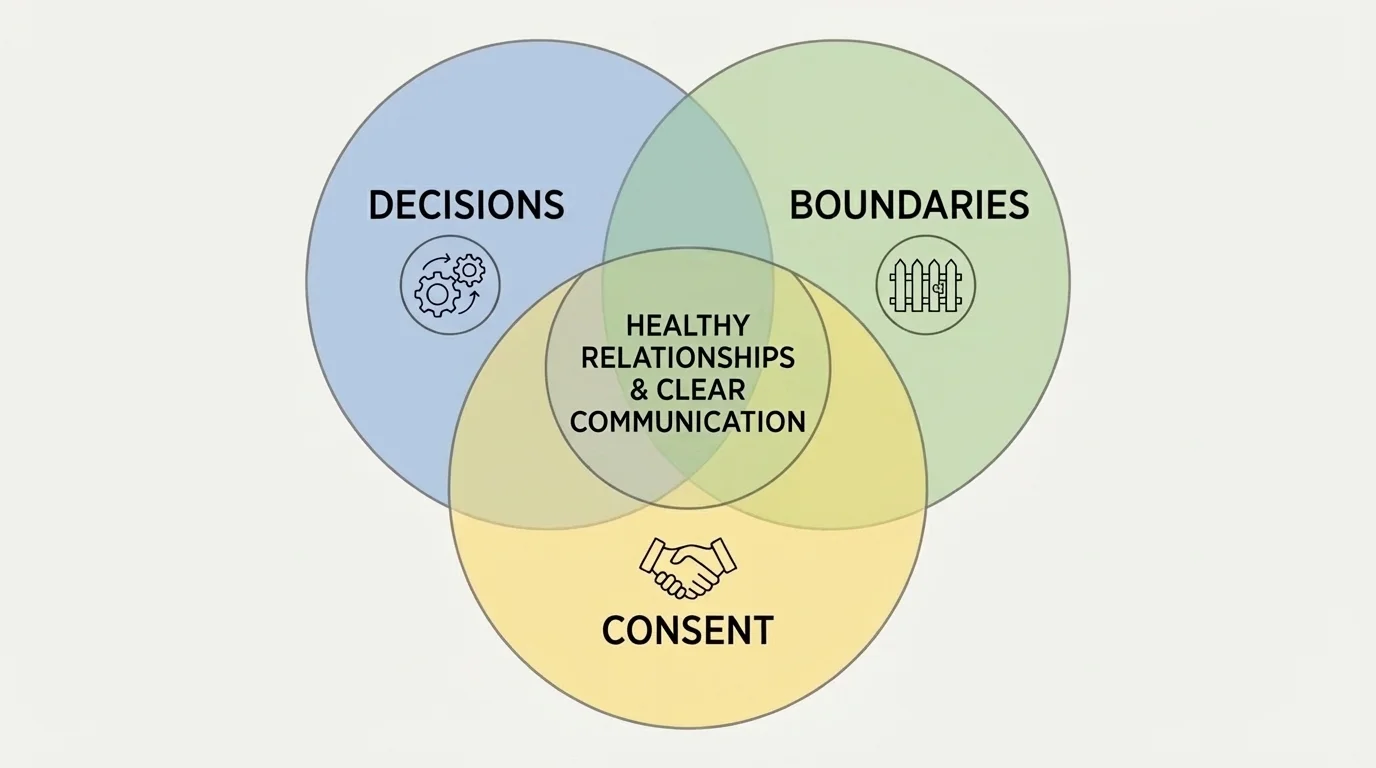
These three skills work together in real situations. A strong relationship decision usually depends on knowing your limits, communicating them, and making sure everyone involved agrees freely and clearly.
As [Figure 1] shows, decision-making means choosing based on your values, goals, safety, and realistic consequences instead of pressure, fear, or impulse. Boundaries are the limits you set around your body, time, emotions, privacy, energy, and digital life. Consent means a clear, voluntary, informed yes to a specific activity or interaction.
Boundaries are the personal limits that protect your physical space, emotional well-being, time, privacy, and values.
Consent is clear permission that is given freely, can be taken back at any time, and applies only to a specific action or situation.
Coercion is pressure, manipulation, guilt, fear, or force used to push someone into something they do not freely choose.
These concepts are connected because your boundaries shape your decisions, and consent is impossible without freedom and clarity. For example, if you feel pressured to share your location with a partner at all times, your decision is no longer fully free. If someone keeps asking after you said no, that is not "convincing." It is pressure.
Another important point: boundaries are not punishments. They are not rude just because another person dislikes them. A boundary is a statement of what you will allow, what you will not allow, and what you will do if that limit is not respected.
Good communication is usually direct, calm, and specific. It does not require being harsh. In fact, the clearest messages are often simple: "I'm not comfortable with that." "I need more time to think." "I'm okay with this, but not that." "Please don't post that photo." "I can talk tomorrow, not tonight."
One practical tool is using I-statements. An I-statement centers your experience instead of attacking the other person. For example, "You are so controlling" may start a fight right away. "I feel pressured when I'm asked to reply instantly, and I need more space to respond" is more likely to be heard clearly. It still names the problem, but it focuses on behavior and impact.
Clear communication often follows a simple pattern: state the issue, state your limit or need, then state the next step. Example: "I don't want to video chat tonight. I need downtime. Let's talk tomorrow after work." That is respectful, honest, and specific.
Practical script for setting a boundary
Step 1: Name the behavior.
"You've been messaging me repeatedly after I said I was busy."
Step 2: State your boundary.
"I'm not available to text constantly during the day."
Step 3: Offer a clear alternative if you want to.
"I can usually reply in the evening."
Step 4: State what you will do if needed.
"If the messages keep coming while I'm working, I'll mute notifications until later."
This kind of communication matters because vague hints often fail. If you say "maybe later" when you really mean "no," the other person may keep pushing or may honestly misunderstand. Being clearer can feel awkward for a minute, but being unclear can create problems for weeks or months.
Many people are taught to "read the room," and that skill matters. Tone, hesitation, silence, body language on video, delayed replies, and changes in mood can all provide useful information. But signals are not enough by themselves. You should not guess your way through important decisions about touch, privacy, time, sexual activity, or emotional intensity.
This is where nonverbal cues matter, but they do not replace words. If someone goes quiet, freezes, turns away, gives a nervous laugh, avoids answering, or seems uncomfortable, the safest move is to pause and ask. A respectful question sounds like this: "Are you comfortable with this?" "Do you want to keep going?" "You seem unsure. Want to stop?"
Silence is not the same as agreement. A delayed response is not automatically consent. A person who said yes once is not saying yes forever. If you are unsure, stop and check. If the answer is not clear, treat it as a no for now.
You already know from everyday communication that people do not always say exactly what they feel right away. In serious situations, maturity means slowing down instead of assuming your interpretation is correct.
That same rule applies online. A person may answer with short texts because they are uncomfortable, not because they are "playing hard to get." If someone stops replying, changes the subject, or avoids opening a message, do not pressure them into engagement.
[Figure 2] illustrates an important truth: consent is not one question asked once at the beginning. It is an active process of asking, listening, noticing, and checking in. It must be enthusiastic consent, not reluctant compliance.
Consent must be freely given. That means no threats, repeated pressure, guilt trips, manipulation, intimidation, or exploiting someone's fear. It must be specific. Agreeing to one activity does not mean agreeing to something else. It must be ongoing. Anyone can change their mind at any point. It must also be informed. If someone is being deceived or does not understand what is happening, consent is not valid.
Consent also depends on capacity. A person who is asleep, heavily impaired, extremely distressed, or unable to understand what is happening cannot give meaningful consent. In any situation where capacity is unclear, the only safe and respectful choice is to stop.
Digital consent matters too. If someone sends you a photo, that does not mean you can share it. If someone tells you something private on a call, that does not mean you can screenshot, record, or repost it. If someone agrees to talk online, that does not mean they agree to sexual messages, explicit images, or constant access to their time.
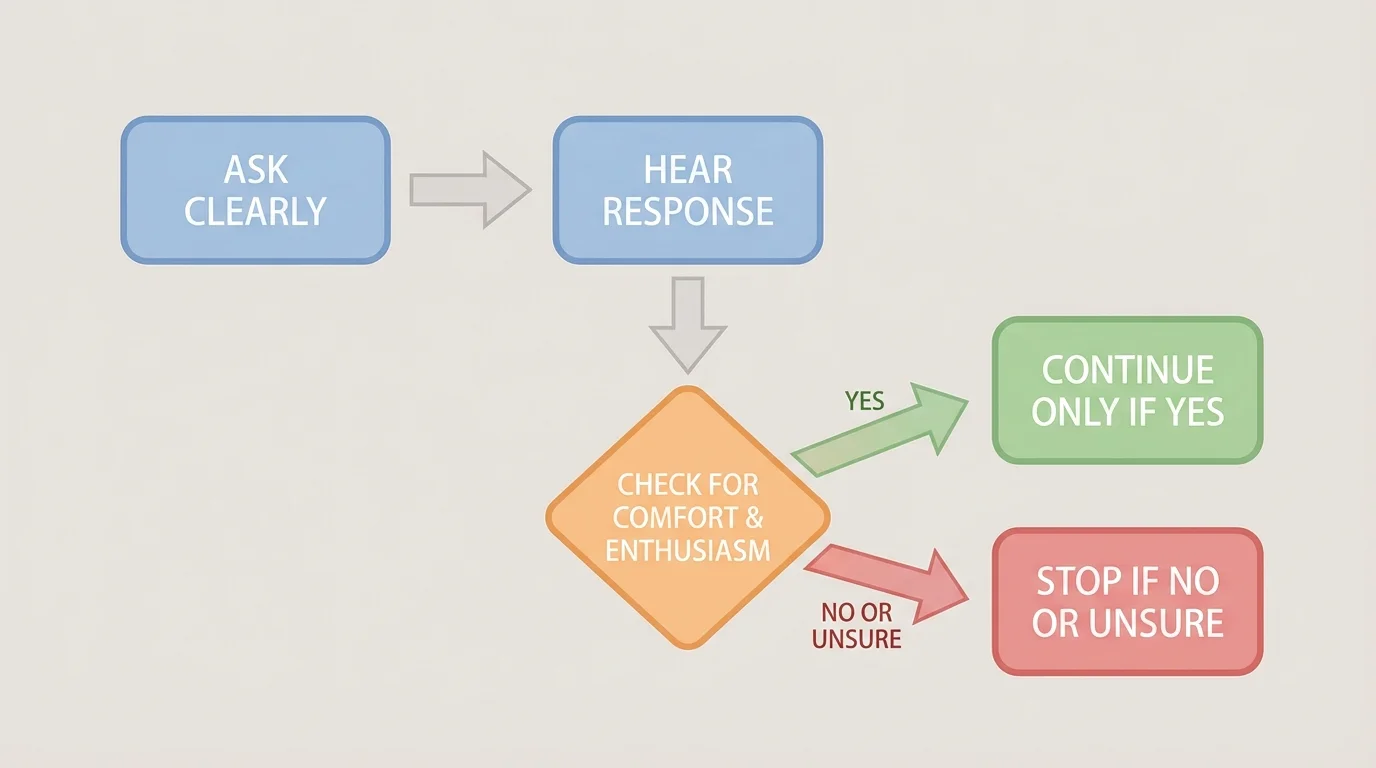
Later in any relationship, the same principle still applies. As we saw in [Figure 2], the responsible habit is to check in rather than rely on assumptions. A respectful person does not see consent as a barrier. They see it as part of trust.
Real-world consent examples
Healthy: "Do you want to keep kissing?" "Are you okay if I put my arm around you?" "Can I share this picture of us?"
Unhealthy: "Come on, if you cared about me, you would." "You already said yes earlier." "I asked three times, so obviously you want to."
Respectful response to no: "Okay. Thanks for telling me."
A useful habit is to pay attention to your own body too. If your stomach tightens, you feel frozen, your thoughts race, or you feel like you are agreeing just to end the pressure, pause. Those reactions may be signs that you do not actually want what is happening.
Not all boundaries are about romance. You need boundaries in every area of life. A friend may expect instant replies. A family member may demand personal details you do not want to share. A coworker may message late at night. A partner may want passwords, location tracking, or proof of loyalty. The specific relationship changes, but the skill stays the same.
There are several kinds of boundaries. Physical boundaries involve touch and personal space. Emotional boundaries involve what you share, how much support you can give, and what topics are off-limits. Time boundaries involve your schedule and availability. Digital boundaries involve privacy, posting, screenshots, passwords, and location sharing. Value boundaries involve what you will or will not do because of your beliefs, goals, or self-respect.
| Type of boundary | What it protects | Example |
|---|---|---|
| Physical | Your body and personal space | "Do not touch me without asking." |
| Emotional | Your mental energy and private feelings | "I can listen for 15 minutes, but I can't be your only support." |
| Time | Your schedule and rest | "I don't take calls after 10 p.m." |
| Digital | Your privacy and online safety | "I don't share passwords or allow screenshots of private chats." |
| Value | Your principles and long-term goals | "I'm not doing that, even if other people are." |
Table 1. Common types of boundaries and examples of what they protect.
Notice that a boundary is strongest when it is clear and connected to action. "Stop being annoying" is not a useful boundary. "If you keep insulting me on calls, I'm ending the conversation" is much clearer.
Healthy boundaries are not walls. They do not prevent closeness; they make closeness safer. When people know your limits and respect them, trust usually grows because both people know where they stand.
Sometimes people react badly when a boundary is new. They may accuse you of being cold, dramatic, selfish, or "different lately." That reaction does not automatically mean your boundary is wrong. It may simply mean the other person benefited from having more access to you than was healthy.
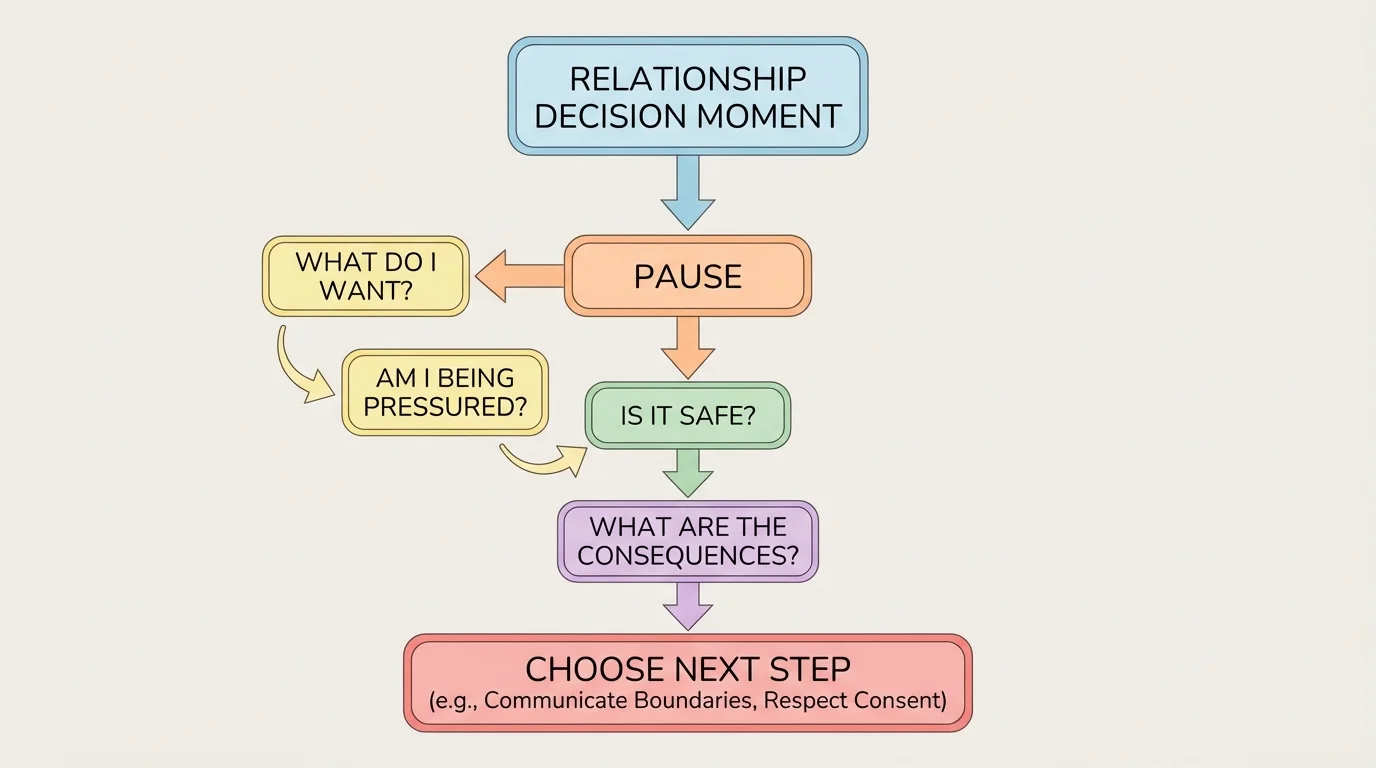
Strong decisions are easier when you use a repeatable process, as [Figure 3] shows. You do not need to solve every relationship problem instantly. You need a way to slow down and think clearly.
Here is a practical framework: pause, check yourself, assess the situation, choose your response, review the result. This can help with pressure about dating, sex, money, moving too fast, online privacy, or staying in contact with someone who drains you.
First, pause. If you feel rushed, that is a signal to slow down. You can say, "I need time to think." Second, check yourself. Ask: What do I actually want? What am I afraid of? Am I choosing this because it fits my values, or because I want to avoid conflict? Third, assess the situation. Is there pressure? Is there a power imbalance? Is this safe physically, emotionally, digitally, and legally? Fourth, choose your response. That might mean yes, no, not now, or only under certain conditions. Fifth, review. Afterward, ask whether the choice respected your boundaries and whether anything needs to change next time.
Case study: being pressured to share a password
Step 1: Pause.
You do not answer immediately, even if the person says, "If you trust me, you'll do it."
Step 2: Check yourself.
You realize you feel nervous and do not actually want to share private access.
Step 3: Assess the situation.
The request crosses a digital privacy line and uses guilt as pressure.
Step 4: Choose your response.
"I don't share passwords. Trust doesn't require unlimited access."
Step 5: Review.
If the pressure continues, you may need a stronger boundary or to reconsider the relationship.
When you use a framework like the one in [Figure 3], your decisions become more consistent. You are less likely to get pulled into choices that conflict with your values just because a moment feels intense.
A major part of relationship maturity is how you handle being told no. You will not always get the answer you want. Someone may not want to date you, may not want physical affection, may not want to share something personal, or may need more space than you hoped. Respect means accepting that answer without punishing them for it.
Healthy responses to rejection include: "Thanks for being honest." "I'm disappointed, but I respect that." "I'll give you space." Unhealthy responses include arguing, guilt-tripping, demanding explanations, insulting the other person, spreading rumors, posting about them, or trying to wear them down later.
You also have the right to change your mind. You are allowed to become uncomfortable. You are allowed to realize that a relationship dynamic no longer works for you. Saying yes before does not trap you forever. Adults revise decisions all the time when they get new information or new clarity.
"No" is a complete answer, and respectful people know how to hear it.
Conflict itself is not the problem. The problem is disrespect. Two people can disagree strongly and still be safe, fair, and honest. The key is whether both people can listen, speak truthfully, and stop harmful behavior when asked.
Harmful relationship dynamics often follow recognizable patterns, as [Figure 4] highlights. Control does not always look dramatic at first. Sometimes it starts as constant checking, jealousy framed as love, demands for proof, pressure to isolate from other people, or guilt when you set limits.
Watch for red flags such as repeated pressure after you say no, demands for passwords or location access, threats to share private information, keeping score of what you "owe," using gifts as leverage, making you feel responsible for their emotions, or turning every boundary into an argument about your loyalty. Another warning sign is when someone ignores your discomfort and focuses only on what they want.
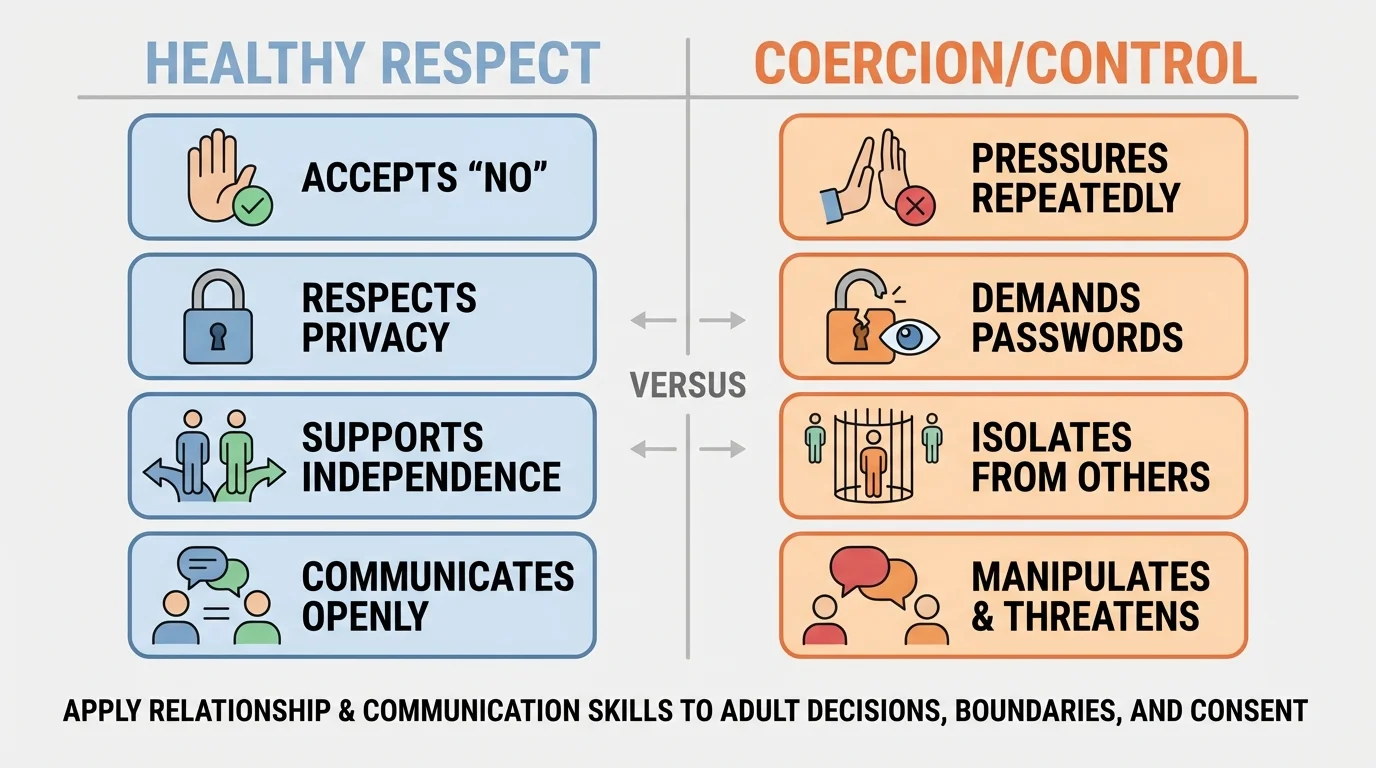
If you notice these patterns, take them seriously. As shown earlier in [Figure 4], healthy respect and coercive control are not small variations of the same thing. One is based on trust; the other is based on power.
If a situation feels unsafe, your priority is not being polite. Your priority is safety. That may mean leaving a call, blocking someone, telling a trusted adult, saving screenshots, contacting a supervisor, or reaching out to a support service. If someone is threatening you, pressuring you sexually, stalking you, or trying to control your movements or communications, get help from a trusted adult, local support organization, or emergency service if needed.
Manipulation often works by making the target feel responsible for the manipulator's feelings. Statements like "You made me do this" or "If you leave, I'll fall apart" are warning signs, not proof that you must stay.
You are never required to remain in a conversation just because someone wants access to you. You are allowed to log off, stop replying, leave, or ask for support.
Sometimes the hardest part is not knowing the principle. It is finding words in the moment. Prepared scripts can help you stay calm and clear.
To slow things down: "I'm not ready to answer that yet." "I need time to think." "Let's talk about this later."
To set a digital boundary: "I don't share passwords." "Please don't screenshot my messages." "Do not post that without asking me."
To refuse pressure: "I said no." "I'm not comfortable with this." "If you keep pushing, I'm ending this conversation."
To ask for consent: "Are you okay with this?" "Do you want to keep going?" "Can I share this?" "Would you like a hug, or not?"
To accept someone else's boundary: "Okay." "Thanks for telling me." "I respect that."
To protect your time and energy: "I can talk for 10 minutes." "I'm not available tonight." "I care about you, but I can't handle this conversation right now."
Try This: Choose three scripts from this section and rewrite them in your own voice. The goal is not to sound formal. The goal is to have language ready before you need it.
Try This: The next time you feel rushed in a relationship situation, delay your response on purpose. Give yourself at least one pause before answering. Even a short pause can protect your judgment.
Try This: Check one area of your digital life today. Review privacy settings, remove location sharing you do not want, or decide in advance what kinds of photos, screenshots, or personal details you do not want shared.
The strongest communication skill you can build right now is alignment: your words match your actual feelings, your decisions match your values, and your actions match the respect you expect from others. That is what healthy adult relationship behavior looks like.
