Two people can say the same basic thing and get completely different results. One gets cooperation, trust, and respect. The other gets ignored, misunderstood, or avoided. The difference is often not just what they say, but the habits that shape how they communicate. Your regular tone, timing, listening style, and response patterns quietly shape your reputation in every part of life.
Communication is not only about big conversations like a job interview, a serious family talk, or a community meeting. It is also about the repeated small choices you make every day: whether you answer messages clearly, whether you listen without interrupting, whether you speak respectfully when frustrated, and whether your words match your actions. These repeated choices form habits, and habits shape relationships.
Strong relationships usually grow from communication that feels safe, clear, respectful, and honest. Weak relationships often break down because of confusion, inconsistency, avoidance, or disrespect. In a workplace, poor habits can damage teamwork and cost opportunities. In a family, they can create tension and distrust. In a community, they can make people see you as dependable or difficult.
Communication habits are the repeated ways you express yourself, listen, respond, and interact with others. They include your tone, word choice, timing, body language on video calls, response speed, and how you handle disagreement.
Relationship quality refers to the level of trust, respect, support, and cooperation between people.
Because habits repeat, their effects add up. A single late reply may not matter much. But if you regularly ignore messages, show up unprepared for calls, or answer with a defensive tone, people start expecting that pattern. The same is true in a positive direction: if you are known for clarity, calmness, and follow-through, people begin to trust you more.
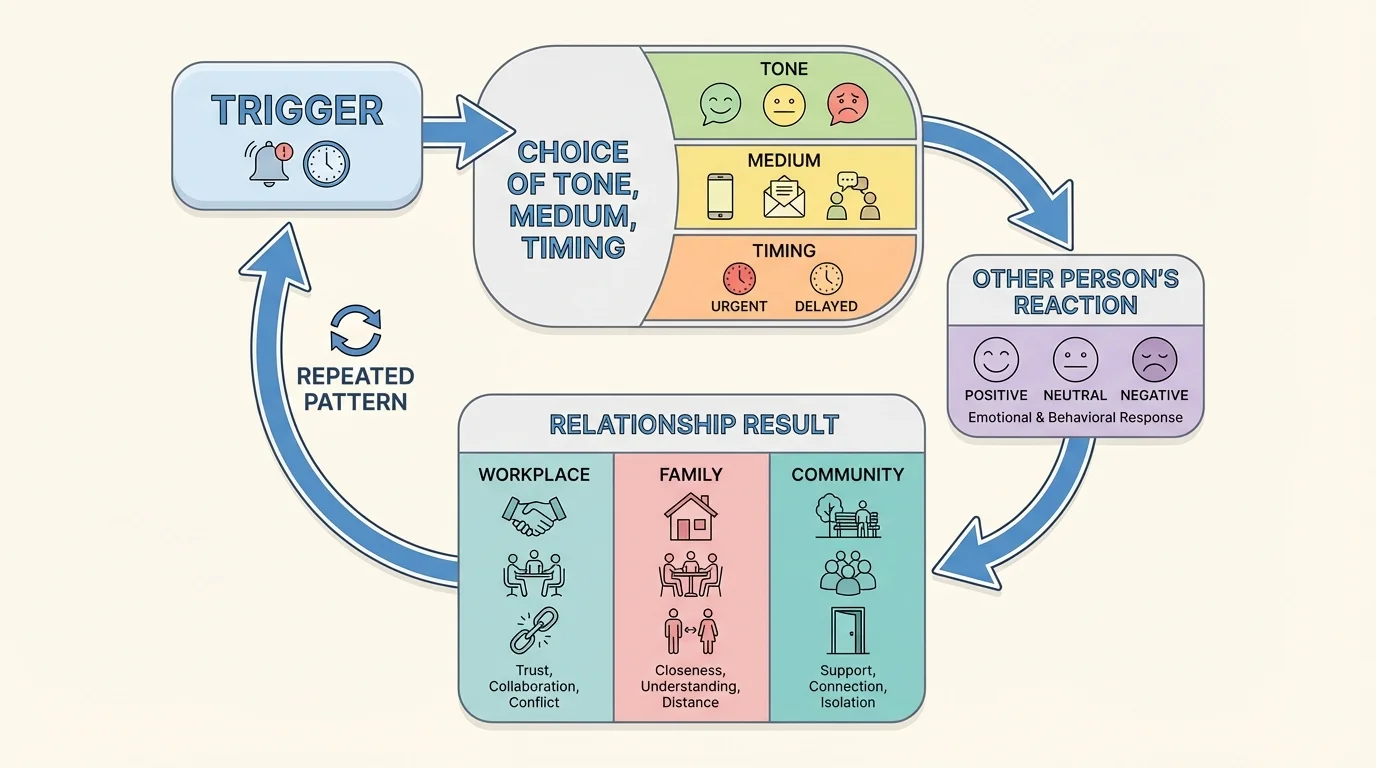
A communication habit is not just talking. It includes how you text, email, comment online, participate in video calls, react under stress, and repair misunderstandings. Over time, these habits create patterns through a cycle from a trigger to a response to a relationship result. People rarely judge you by one moment alone; they judge the pattern they experience from you again and again.
[Figure 1] Some habits are obvious, like interrupting or yelling. Others are quieter but still powerful: replying with one-word answers, delaying difficult conversations, using sarcasm when upset, reading messages without responding, or assuming others should just "know what you meant." In digital spaces, habits also include whether you use respectful wording, whether your messages are organized, and whether you choose the right platform for the situation.
Helpful communication habits often include listening carefully, asking questions before reacting, being direct without being rude, staying calm during conflict, and following through on promises. Unhelpful habits often include blaming, avoiding, overexplaining, complaining without solving, making private issues public, or using silence as punishment.
One useful way to think about it is this: your message always carries more than content. It also carries attitude. If you say, "I need this by tonight," the words may be the same, but the effect changes depending on whether your tone sounds respectful, annoyed, or controlling.
Communication is a pattern, not a performance. Many people try to "communicate well" only in important moments. But relationships are usually shaped by ordinary interactions. A sincere apology carries more weight when it comes from someone who usually communicates with honesty and respect. A polite message means less if it comes from someone who often disappears, gossips, or reacts aggressively.
This is why self-awareness matters. You may intend to sound confident and actually sound dismissive. You may think you are "avoiding drama" when others experience you as unreliable. Assessing communication habits means comparing your intention with your actual impact.
One of the most powerful habits is active listening. Active listening means paying close attention, showing that you understand, and responding to what the other person actually said instead of preparing your next argument. In real life, this can sound like, "So you're saying the deadline changed, and you need help adjusting the plan. Is that right?" That response reduces confusion and makes people feel heard.
Another strong habit is empathy. Empathy does not mean agreeing with everything. It means recognizing another person's perspective and emotions. If a family member sounds short-tempered, empathy helps you pause and consider whether they are stressed instead of immediately taking it as a personal attack.
Clarity also matters. Clear communication saves time and prevents conflict. Instead of sending "Can you do that thing soon?" a clearer message would be, "Can you send the event flyer by 6:00 p.m. today so I can post it tonight?" The clearer version tells the person what is needed, by when, and why it matters.
Consistency builds trust. If you say you will call, call. If you cannot, send a short update. This is part of follow-through, which means matching your communication to your actions. People trust communicators who are predictable in a healthy way.
Respectful honesty strengthens relationships too. Being honest does not require being harsh. You can say, "I can't commit to that project this week," instead of agreeing and then disappearing. You can say, "That joke bothered me," instead of letting resentment build.
Real-world contrast: same situation, different habits
A friend asks why you have been less available lately.
Step 1: Unhelpful response
"I'm fine. You're overthinking it." This dismisses the other person and avoids the issue.
Step 2: Stronger response
"I've been stressed and less responsive lately. It's not about you, but I know I've seemed distant." This response is honest, clear, and respectful.
Step 3: Relationship result
The second response gives the relationship a chance to stay strong because it replaces confusion with understanding.
Good habits do not make conflict disappear. They make conflict easier to solve. That is a major difference. Healthy relationships are not relationships with zero disagreement; they are relationships where people can address problems without destroying trust.
Some habits are harmful because they create confusion. Others are harmful because they create fear, resentment, or emotional distance. A common example is passive-aggressive communication, where someone expresses anger indirectly through sarcasm, coldness, vague comments, or "fine" when they are clearly upset. This forces others to guess what is wrong and often increases tension.
Another damaging habit is defensiveness. A defensive person treats feedback as an attack instead of information. If a supervisor says, "Please send updates earlier," and the response is, "Well, nobody told me exactly what to do," the conversation shifts away from improvement and toward blame.
Interrupting, talking over people, and dominating conversations communicate that your voice matters more than theirs. So does turning every issue back to yourself. On the other end, chronic silence can also be harmful when it is used to avoid responsibility or punish someone.
Digital etiquette matters more than many people realize. Posting private disagreements publicly, sending angry messages late at night, using all caps, forwarding screenshots without permission, or replying with a rude tone can damage trust very quickly. Digital messages often last longer than spoken words because they can be saved, shared, and revisited.
Gossip is another damaging habit. When you talk negatively about people behind their back, others may assume you will do the same to them. Even if gossip feels social in the moment, it weakens your credibility over time.
Many relationship problems are not caused by one dramatic event. They grow out of repeated low-level habits such as delayed responses, unclear expectations, and unresolved tension.
Sometimes harmful habits come from stress, insecurity, or family patterns you grew up around. That may explain them, but it does not excuse them. Assessing your habits honestly is not about shame. It is about responsibility and growth.
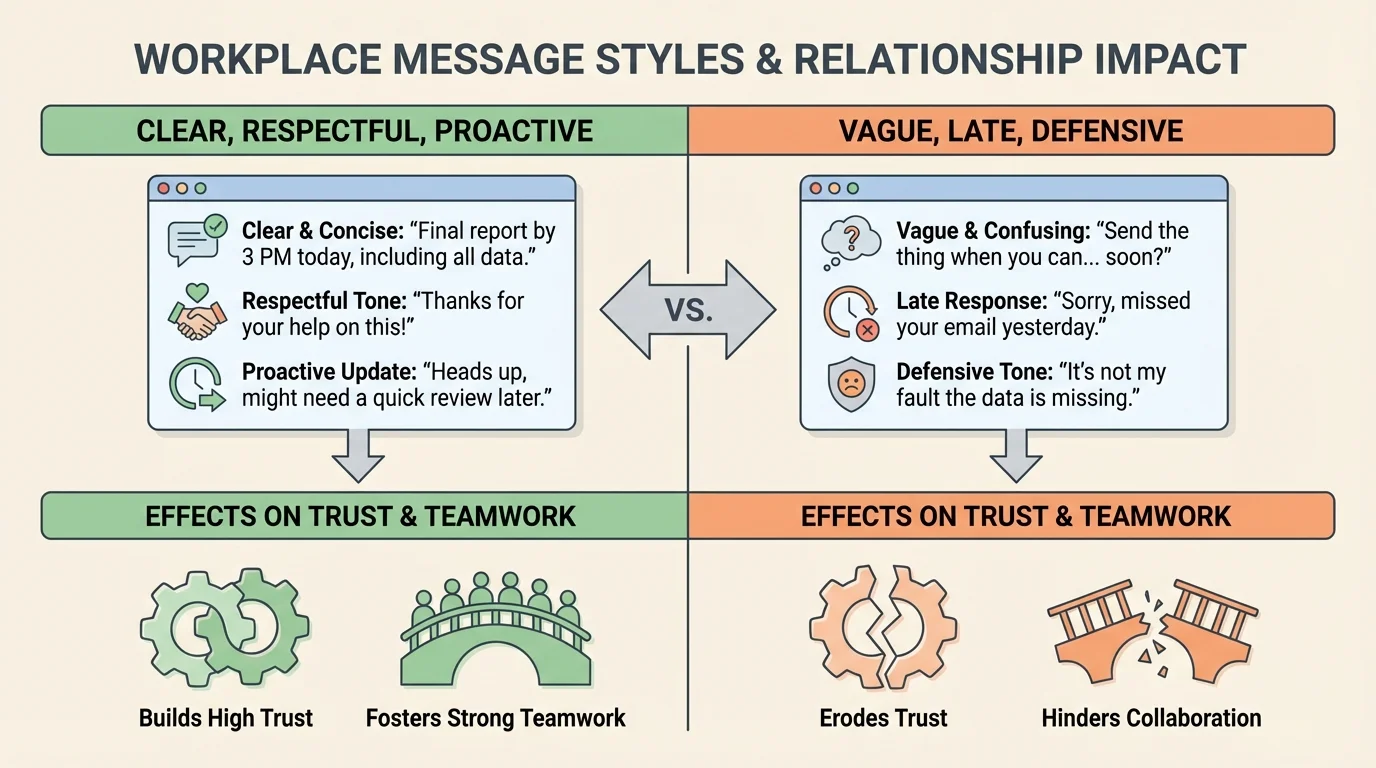
[Figure 2] Workplace relationships are strongly shaped by patterns of professionalism and by the contrast between effective and ineffective messaging. Employers, supervisors, coworkers, and customers notice whether you communicate clearly, respectfully, and on time. Even in entry-level jobs, internships, freelance work, or volunteer roles, your communication habits affect whether people trust you with responsibility.
For example, if you are going to be late for a shift, strong communication looks like this: "I'm running about 10 minutes late because of traffic. I'm on the way and will be there at 3:10." Weak communication looks like saying nothing until after the shift starts, or sending "sorry" with no details. The second habit creates stress for other people because they must guess what is happening.
Workplace communication also includes how you receive feedback. A mature response sounds like, "Thanks for pointing that out. I'll fix it and send the updated version by 5:00." That does not mean you must agree with every comment, but it shows that you can stay professional under pressure.
Email, messaging apps, and video calls are often where workplace habits become visible. If your messages are disorganized, too casual, or emotionally charged, people may question your reliability. If your camera is on during a call and you appear distracted, roll your eyes, or interrupt, those nonverbal habits also affect your reputation.
Strong workplace communication usually includes these actions:
Poor workplace habits can lead to missed deadlines, conflict, being left out of opportunities, weak references, or lost trust. Positive habits can lead to mentorship, more responsibility, better teamwork, and stronger recommendations later. The pattern in [Figure 2] matters because careers are built not only on talent, but also on whether people can depend on you.
Family relationships are different from workplace relationships because they are more personal, emotional, and long-term. That means communication habits can have a deep impact. A habit of listening respectfully can make home feel safe. A habit of criticism, sarcasm, or avoidance can make people feel tense even when nothing major is wrong.
Families often develop roles and patterns over time. Maybe one person becomes the "peacekeeper," another becomes the "exploder," and another shuts down completely. If you know your pattern, you can change it. For example, if you tend to go silent during conflict, a healthier habit might be saying, "I need 20 minutes to calm down, but I do want to come back and talk about this."
boundary setting is especially important in families. A boundary is a limit that protects your time, energy, privacy, or emotional well-being. Healthy communication around boundaries sounds like, "I'm not available to argue by text. If we need to talk, let's do it when we're both calm." Boundaries are not punishments. They are clear limits that support healthier interaction.
Family communication also benefits from repair. Repair means addressing harm after a conflict instead of pretending nothing happened. A real repair might sound like, "I spoke harshly earlier. You didn't deserve that. Next time I need to slow down before responding." That kind of statement rebuilds trust because it includes ownership and change.
"Clear is kind. Unclear is unkind."
— A useful communication principle
When family communication is healthy, people are more likely to ask for help, solve problems together, and feel respected even during disagreement. When it is unhealthy, people may hide things, avoid each other, or react with anger faster because trust has already been weakened.
Community relationships include neighbors, coaches, volunteer leaders, members of clubs, faith groups, sports teams, online groups, and local organizations. In these settings, your communication habits affect whether people see you as cooperative, respectful, and trustworthy.
Community communication often requires interacting with people who are different from you in age, background, beliefs, or communication style. This is where adaptability matters. What sounds casual and fine in a group chat with close friends may sound disrespectful in a volunteer planning meeting or when messaging an adult organizer.
Good community habits include introducing yourself politely, replying to group coordinators, asking how you can help, clarifying expectations, and disagreeing respectfully. If you sign up for an event, then fail to respond or disappear without notice, that affects more than one person. Someone else may have to cover your task, reorganize plans, or explain your absence.
Community trust is built when people know they can count on your words. It is damaged when you overpromise, stir up drama, post carelessly about others, or argue in ways that make collaboration harder. In online community spaces, respectful disagreement is especially important because tone is easy to misread and conflict can spread quickly.
Adapting without being fake means adjusting your communication style to the setting while staying true to your values. You can be friendly in a social group, professional in a workplace, and more emotionally open with family. That is not dishonesty. It is social awareness.
Strong community relationships often open doors. People invite reliable communicators back, recommend them for roles, and trust them with leadership. Weak habits can quietly close those same doors.
[Figure 3] To assess your communication honestly, it helps to use a simple self-assessment process with a step-by-step audit. Do not judge yourself by one awkward conversation. Look for repeated patterns across different settings. Ask: What do I usually do when I am stressed, criticized, ignored, or misunderstood?
Start by paying attention to outcomes. If the same kinds of problems keep happening, your habits may be part of the reason. For example, if people often say they did not know your expectations, maybe your instructions are too vague. If people hesitate to give you feedback, maybe your reactions feel unsafe.
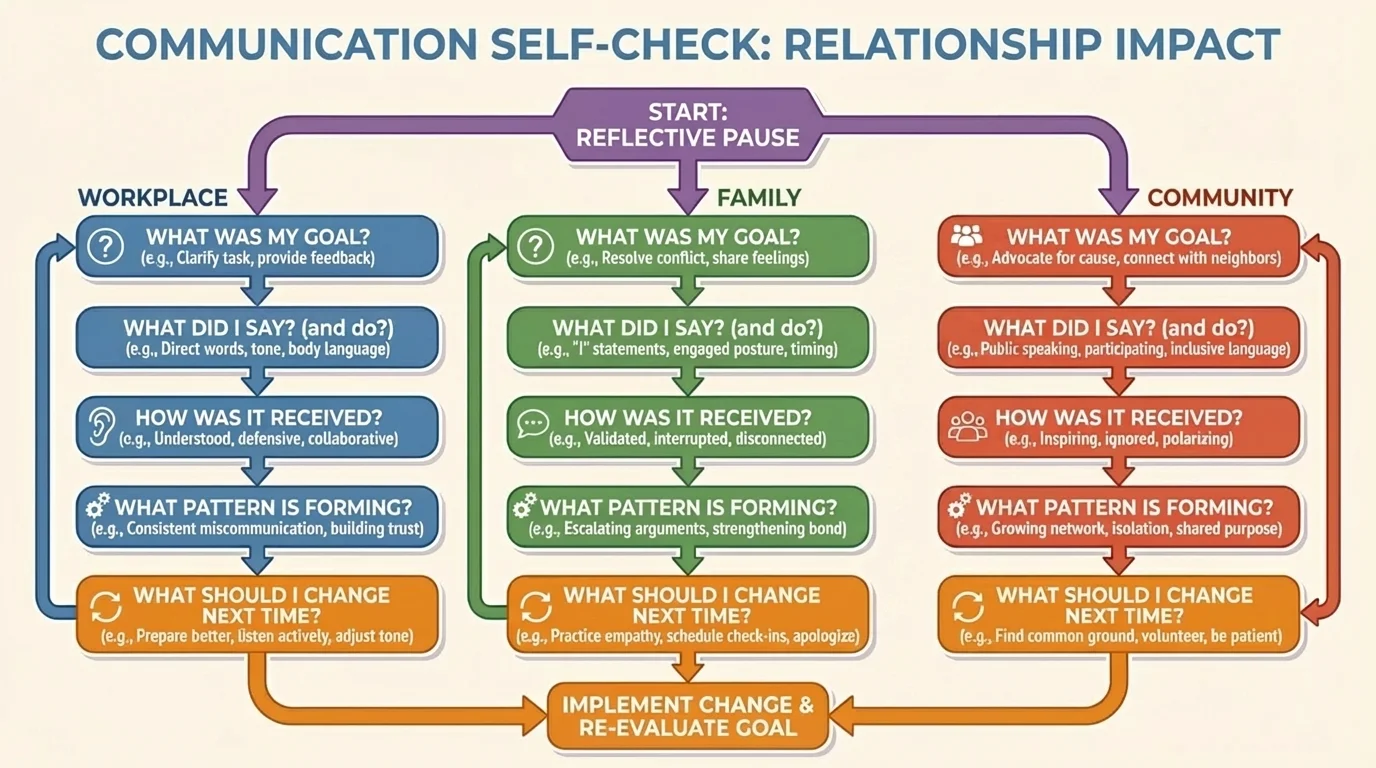
You can use these questions after a conversation, text exchange, or video call:
Another strong strategy is to ask trusted people for feedback. You might say, "I'm trying to improve how I communicate. Is there anything I do that makes conversations harder?" That takes maturity. It also gives you information you may not notice on your own.
| Habit to Assess | Helpful Pattern | Unhelpful Pattern | Likely Effect |
|---|---|---|---|
| Response time | Replies within a reasonable time | Frequently ignores or delays | Trust increases or decreases |
| Tone | Respectful and calm | Sharp, sarcastic, defensive | Safety or tension |
| Clarity | Specific and direct | Vague and confusing | Cooperation or mistakes |
| Listening | Asks and reflects | Interrupts or assumes | Understanding or conflict |
| Accountability | Owns mistakes | Blames others | Respect or frustration |
Table 1. A comparison of common communication habits, healthier patterns, weaker patterns, and their effects on relationships.
The self-check process in [Figure 3] helps because it turns communication into something you can notice and improve, not just something you "hope goes better" next time.
Change works best when you focus on one habit at a time. Trying to fix everything at once usually fails because it is too broad. Pick one pattern that causes the most damage or stress. Maybe it is interrupting, avoiding hard conversations, replying too vaguely, or becoming defensive when corrected.
Step-by-step habit change plan
Step 1: Name the pattern clearly
Example: "When I feel criticized, I interrupt and explain myself before the other person finishes."
Step 2: Choose a replacement habit
Example: "When I feel criticized, I will pause, let them finish, and ask one clarifying question."
Step 3: Create a simple script
Example: "Let me make sure I understand what you mean before I respond."
Step 4: Practice in lower-stress situations
Use the script in texts, calls, or small disagreements before trying it in a major conflict.
Step 5: Review the result
Ask whether the new habit reduced confusion, lowered tension, or improved trust.
Try This: For one week, pause before sending any message written while annoyed, stressed, or rushed. Re-read it and ask: Is it clear? Is it respectful? Is this the right platform? That one pause can prevent many avoidable problems.
Try This: Replace mind-reading with questions. Instead of assuming someone is rude, ask, "Can you clarify what you meant?" Instead of assuming they know what you need, say, "What I need from you is..."
Try This: Practice a repair statement. A strong version is: "I handled that poorly. I'm sorry. Here's what I'll do differently next time." A short, specific repair statement is usually stronger than a long excuse.
Not every communication problem is a simple habit issue. Sometimes the pattern becomes unhealthy or unsafe. Warning signs include repeated humiliation, manipulation, threats, controlling behavior, constant blame, refusal to respect boundaries, or using private information to embarrass someone.
In those situations, improvement may require more than better wording. You may need firmer boundaries, distance, support from a trusted adult, manager, mentor, counselor, or community leader, or a decision to leave the interaction entirely. Good communication does not mean accepting mistreatment.
It is important to know the difference between discomfort and harm. A hard conversation can still be healthy if both people are respectful and willing to listen. But if someone regularly twists your words, mocks you, pressures you, or punishes honesty, the issue is not just style. It is a deeper relationship problem.
Respect is the minimum standard in every setting. You do not need perfect words to communicate well, but you do need honesty, self-control, and regard for the other person's dignity.
A strong communicator is not someone who wins every argument. It is someone who knows how to express needs, listen carefully, adapt to the situation, and protect healthy boundaries.
Over time, communication habits become part of your reputation. People start to describe you in pattern words: reliable, thoughtful, calm, dramatic, unclear, encouraging, reactive, respectful, or difficult. Those labels may not capture your whole personality, but they often grow from repeated communication experiences.
This matters because relationships create opportunities. A manager may recommend you for a job. A family member may trust you with responsibility. A community leader may invite you to help lead a project. Or the opposite may happen if your communication habits create stress and uncertainty.
You do not need to become perfect. You do need to become intentional. If you can notice your patterns, accept feedback, and practice stronger habits, your workplace, family, and community relationships are more likely to become healthier, steadier, and more respectful.
