One decision can change the next five years of your life. Choosing a job, signing a lease, starting a serious relationship, taking on debt, or deciding what to do after high school can affect your finances, stress level, freedom, and future opportunities. That does not mean you should panic. It means big decisions deserve a process. When you know how to think clearly, you are far less likely to be pushed around by fear, hype, or other people's opinions.
A major life decision is not just a choice with a big label. It is any choice that has meaningful consequences over time. Some are obvious, like whether to attend college, enter a trade, work full time, join the military, or move to a new city. Others seem smaller at first but grow larger later, such as taking on credit card debt, quitting a job without a backup plan, or choosing who has influence over your daily life.
The goal is not to become cold or robotic. Good decisions include emotions, but they do not let emotions control the entire process. A strong decision combines evidence, your values, and long-term thinking. If one of those is missing, your decision is more likely to be weak. Evidence tells you what is true, values tell you what matters, and long-term planning tells you what the choice may cost or create later.
Major life decision means a choice that can significantly affect your future responsibilities, relationships, health, time, education, work, or finances.
Values are the principles and priorities that matter most to you, such as stability, independence, honesty, family, growth, creativity, or service.
Long-term planning means looking past the immediate moment to consider what a choice may lead to in months or years.
At your age, many big decisions involve a mix of freedom and responsibility. You may be deciding whether to live at home or move out, whether to work now or continue training, whether to stay in a relationship, or whether to spend money on something that feels urgent today but creates pressure later. These are real-world choices, not abstract thought exercises. The quality of your decisions can affect your mental health, your bank account, and your sense of control over your own life.
When a choice matters, fast reactions can feel powerful but often miss important details. A friend says an apartment is a "great deal." A social media post makes a career path look easy. A person you care about pressures you to decide quickly. In moments like that, your brain wants relief more than clarity. A process slows the rush and helps you notice what is real.
Good decision-making is a form of self-respect. It says, "My future is worth checking facts for." It also protects your independence. People who do not examine major choices carefully often end up living inside someone else's priorities, someone else's timeline, or someone else's sales pitch.
Some decisions are major because they involve commitment. Others are major because they are hard to undo. A helpful test is to ask three questions: Will this affect my life for more than a few weeks? Will it change my responsibilities or options? Will it cost significant time, money, or emotional energy? If the answer is yes to one or more, slow down and evaluate it more carefully.
Examples of major life decisions include choosing a postsecondary path, accepting or leaving a job, moving out, taking out a loan, buying a car, entering or ending a serious relationship, disclosing personal information online, managing a health decision, or choosing who you trust with money, housing, or transportation. Not every important choice looks dramatic at first. Sometimes the major part is the pattern it creates.
A strong framework uses several parts together. First, you need facts. Second, you need self-knowledge. Third, you need perspective about time. Fourth, you need honesty about trade-offs. No option gives you every benefit with no cost. Choosing one path usually means giving up another. That lost alternative is your opportunity cost.
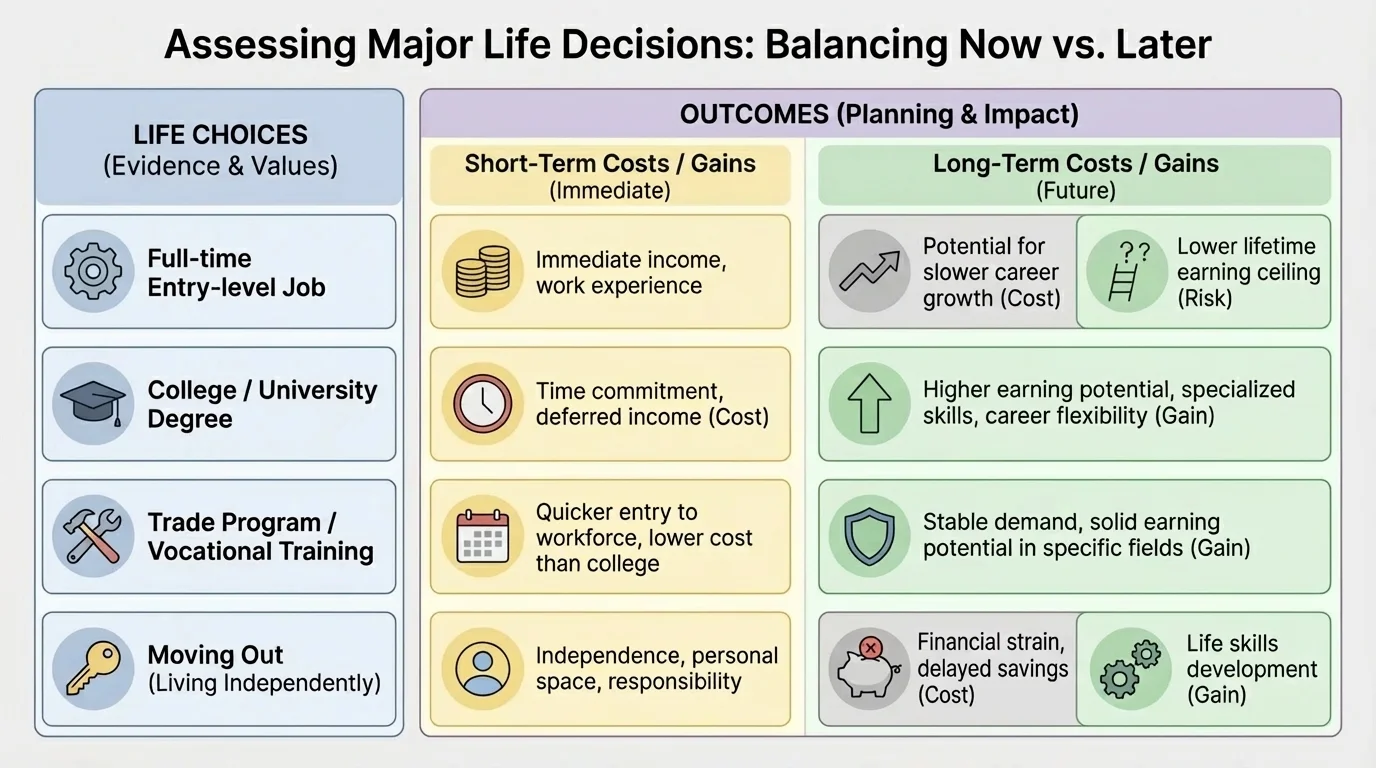
You also need to think about trade-offs. For example, taking a full-time job right away may give you immediate income and independence, but it may reduce time for training that could increase your earnings later. Attending a training program may delay full earnings now but open more options later. The point is not that one choice is always better. The point is that every major choice has benefits and costs, and clear thinkers name both.
A practical decision rule
If an option sounds great only when you ignore the costs, it is not a strong option yet. If an option still makes sense after you examine the facts, your values, the risks, and the long-term effects, it is much more likely to be a wise decision.
Another key part of the framework is risk. Some risks are financial, like debt or unstable income. Some are emotional, like isolation, burnout, or staying in a manipulative relationship. Some are practical, like unreliable transportation or not having a backup plan. Naming risks does not mean being negative. It means being prepared.
A repeatable method helps you think clearly under pressure, and [Figure 1] lays out the full sequence in a simple order you can reuse whenever a decision feels too big, too urgent, or too emotional. Instead of bouncing between random thoughts, you move through a process on purpose.
Step 1: Define the decision clearly. Write the actual choice. Not "What should I do with my life?" but "Should I accept this job offer, or keep looking for a position with training opportunities?" A vague question produces vague thinking.
Step 2: List your realistic options. Include at least three when possible: option A, option B, and a delayed-decision option if delay is practical. Many bad decisions happen because people act as if there are only two choices when there are really more.
Step 3: Gather evidence. Look for costs, requirements, deadlines, responsibilities, and likely outcomes. Talk to credible people, compare sources, and verify claims.
Step 4: Identify your values and non-negotiables. What matters most here: safety, freedom, honesty, growth, income, mental health, family, stability, or something else? What are you unwilling to compromise?
Step 5: Compare short-term and long-term effects. Ask what this choice looks like after one week, six months, and three years.
Step 6: Decide and set a review point. If possible, choose when you will check whether the decision is working.
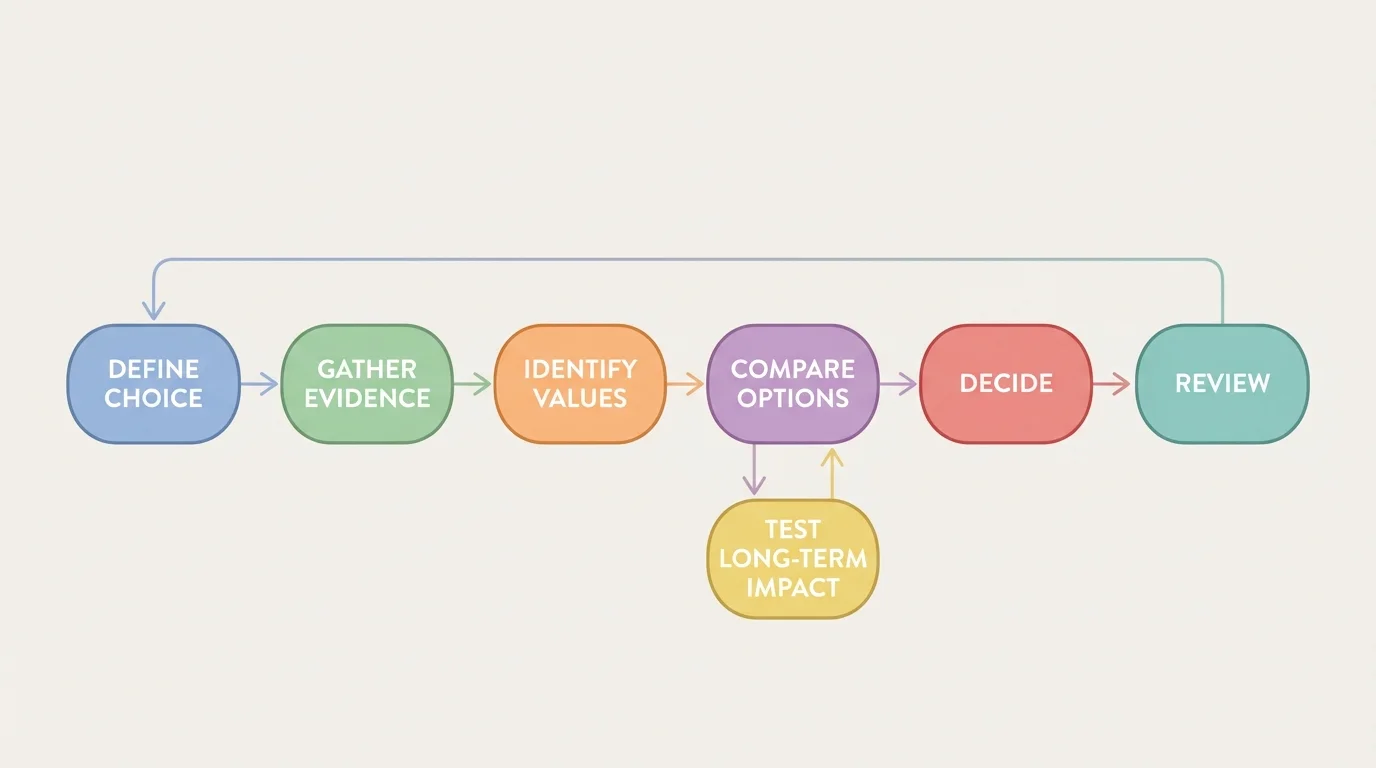
This process is not just for huge life events. You can use it for whether to sign a gym contract, move in with roommates, take on a side hustle, or buy an expensive device on a payment plan. The more often you use a good process, the more natural it becomes.
Case study: Choosing between immediate work and a training program
Step 1: Define the choice
You are deciding between a full-time retail job that starts now and a one-year certification program that costs $4,000 and may lead to higher pay.
Step 2: Gather evidence
The job pays $15 per hour for about \(40 \times 15 = 600\) dollars per week before taxes. Graduates of the certification program in your area report starting pay around $22 per hour. You also learn the program has an \(85\%\) completion rate and local employers actively hire from it.
Step 3: Compare time horizons
Working now gives immediate income. The program creates short-term cost and delayed earnings, but over time the pay difference matters. At \(40\) hours per week, the difference between $22 and $15 is \(22 - 15 = 7\) dollars per hour, or \(7 \times 40 = 280\) dollars more per week before taxes.
Step 4: Check values
If your top priorities are stability and faster long-term growth, the certification may fit better. If you urgently need income for family responsibilities right now, the job may be the better short-term choice.
A strong decision depends on both facts and priorities, not just which option feels impressive online.
Notice that the method does not promise certainty. It improves your odds. You are not trying to predict the future perfectly. You are trying to make the most informed and values-aligned choice available now.
Evidence is stronger when it is specific, verifiable, current, and relevant to your situation. If someone claims, "This program guarantees success," ask for completion rates, job placement data, actual costs, and what support is included. If someone says, "You can totally afford this apartment," ask for the full monthly cost including rent, utilities, internet, groceries, transportation, and emergencies.
Reliable sources can include official program websites, lease documents, employer postings, government resources, professional organizations, contracts, pay stubs, bank statements, and conversations with people who have direct experience. But even firsthand stories should be checked. One person's experience may not represent the average.
You also need to watch for confirmation bias, which is the habit of noticing information that supports what you already want and ignoring information that challenges it. If you already want a certain answer, you are more likely to believe flattering evidence too quickly. Strong decision-makers actively look for disconfirming facts.
People often spend more time researching a phone than researching a loan, lease, or training program. The problem is not intelligence. It is that excitement and urgency can make major decisions feel easier than they actually are.
When you collect evidence, compare at least two or three sources. If all your information comes from one influencer, one friend, or one sales page, your view is too narrow. Big decisions deserve cross-checking.
If evidence tells you what is likely true, values tell you what is worth choosing. Two students can look at the same facts and make different wise decisions because they want different things. One values adventure and mobility. Another values stability and staying close to family. One is ready for risk. Another needs predictability for mental health reasons. A good decision is not only fact-based. It is aligned with who you are trying to become.
Start by naming your top values for this decision. Keep it short. Usually three to five are enough. Then rank them. If everything matters equally, nothing guides the choice. You might rank your values like this: 1. financial stability, 2. personal safety, 3. growth, 4. independence. That ranking can change the decision dramatically.
Also identify non-negotiables. These are boundaries you will not cross. For example: no living situation without a written agreement, no partner who pressures you to isolate from supportive people, no debt payment you cannot realistically afford, no job that interferes with essential medical needs. Non-negotiables protect you when emotions are loud.
"A good choice is not always the easiest choice. It is the choice you can still respect later."
One practical way to use values is to score each option. You can give each value a weight from \(1\) to \(5\), where \(5\) means it matters most. Then rate how well each option fits that value, also from \(1\) to \(5\). Multiply and compare totals. This does not make the choice for you, but it helps you see patterns more clearly.
| Value | Weight | Option A: Local job | Option B: Training program |
|---|---|---|---|
| Financial stability | 5 | 3 | 4 |
| Growth | 4 | 2 | 5 |
| Independence | 3 | 4 | 3 |
| Family proximity | 4 | 5 | 5 |
Table 1. A simple comparison of options using weighted values.
If you calculate totals, Option A would score \((5 \times 3) + (4 \times 2) + (3 \times 4) + (4 \times 5) = 15 + 8 + 12 + 20 = 55\). Option B would score \((5 \times 4) + (4 \times 5) + (3 \times 3) + (4 \times 5) = 20 + 20 + 9 + 20 = 69\). The higher number does not automatically settle the choice, but it reveals which option better matches the priorities you named.
Major choices often look very different over time, as [Figure 2] makes clear by comparing immediate rewards with later consequences. The short term often feels louder because it is visible right now: quick money, attention, comfort, relief, excitement. Long-term effects are quieter, but they often matter more.
Ask yourself: What will this choice likely cost me in time, money, stress, flexibility, and energy? What might it build for me in skills, trust, health, savings, or freedom? A decision that looks good this week may create pressure for the next two years. A decision that feels inconvenient now may create more stability later.
Suppose you want to move out. Rent is $850, utilities are about $120, internet is $60, groceries are $250, transportation is $180, and your phone bill is $70. Your basic monthly total is \(850 + 120 + 60 + 250 + 180 + 70 = 1{,}530\) dollars. If your monthly take-home pay is $1,800, that leaves only \(1{,}800 - 1{,}530 = 270\) dollars for everything else, including emergencies, household supplies, medical costs, and savings. That is not much margin.
This is why long-term planning matters. A choice is not only "Can I start this?" but also "Can I sustain this?" Many decisions fail not at the beginning, but in the third month, when the hidden costs finally appear.
Think in multiple timelines: immediate, near future, and long range. Immediate means today to one month. Near future means a few months to a year. Long range means multiple years. In the moving-out example, the immediate benefit may be independence. The near-future challenge may be tight cash flow. The long-range question may be whether that setup helps or delays your larger goals.
Try the three-timeline test on any major choice
Step 1: Write one benefit and one cost for the next \(30\) days.
Step 2: Write one benefit and one cost for the next \(12\) months.
Step 3: Write one benefit and one cost for the next \(3\) years.
If you struggle to think past the next few days, that is a sign to pause and gather more information.
Long-term planning also includes backup plans. If your job hours drop, what happens? If a roommate leaves, can you still pay your share? If a relationship ends, do you still have support, transportation, and secure housing? Hope is good, but planning for uncertainty is smarter.
Even smart people make poor choices when certain thinking traps take over, and [Figure 3] maps several of the most common ones to better questions you can ask yourself. Recognizing these traps does not make you weak. It makes you more aware.
Peer pressure: You choose based on what keeps others happy, impressed, or quiet instead of what fits your future. Ask: "Would I still want this if nobody else knew about it?"
Fear of missing out: You rush because you are scared another chance will not come. Ask: "Is this truly rare, or does it only feel urgent because of emotion or marketing?"
Sunk cost: You stay with a bad path because you already invested time, money, or effort. Ask: "If I were choosing fresh today, would I still choose this?" That question reveals whether the current path still makes sense.
Wishful thinking: You assume things will somehow work out without a realistic plan. Ask: "What specific conditions would need to be true for this to work?"
Confirmation bias: You collect only the information that supports what you already want. Ask: "What evidence would change my mind?"
All-or-nothing thinking: You act as if one choice will permanently ruin everything or solve everything. Most life decisions are important, but few are absolute. Ask: "What are the recovery options if this does not go as planned?"
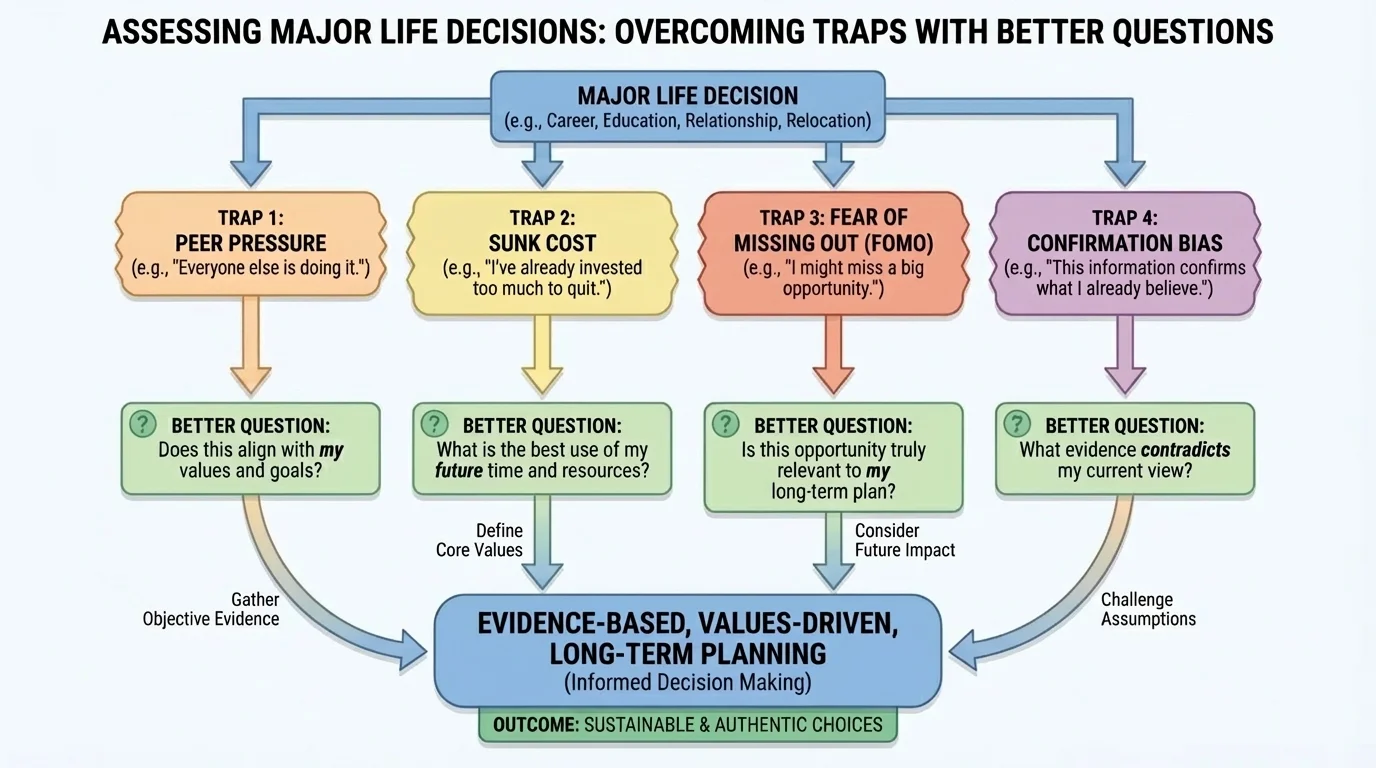
Notice how many traps become weaker when you slow the process down. That is one reason the method in [Figure 1] works so well. It interrupts impulsive thinking and forces your brain to move from reaction to evaluation.
Case 1: A relationship decision. Suppose you are dating someone who pressures you to share passwords, answer immediately at all times, or distance yourself from supportive friends and family. The emotional part of you may want to avoid conflict. But the evidence matters: controlling behavior often gets worse, not better. If your values include respect, trust, and safety, the decision becomes clearer. Long-term planning asks not "How do I keep the peace today?" but "What kind of life does this pattern create?"
Case 2: A job offer. You receive an offer that pays better than your current work, but the schedule is unstable and transportation is unreliable. Evidence includes commute time, gas costs, shift consistency, and whether you can realistically maintain sleep, health, and other responsibilities. A higher hourly rate is not always a better total outcome if the hidden costs are high.
Case 3: Moving in with friends. Living with friends can sound fun and affordable, but evidence should include a written rent agreement, utility split, grocery expectations, cleaning responsibilities, parking, quiet hours, and what happens if someone cannot pay. Shared housing problems often come from unspoken assumptions, not bad intentions.
Quick comparison for a housing decision
Option A: Stay at home for \(12\) more months and save $500 per month.
In one year, savings could be \(12 \times 500 = 6{,}000\) dollars.
Option B: Move out now and save only $50 per month.
In one year, savings could be \(12 \times 50 = 600\) dollars.
The difference is \(6{,}000 - 600 = 5{,}400\) dollars. That does not mean staying home is always the right choice, but it shows how long-term effects can be much larger than they first appear.
Examples like these show that wise decisions are usually less about dramatic confidence and more about careful comparison. When you examine reality clearly, your decision gets stronger.
Not every decision needs weeks of analysis. Some choices do require quick action, especially when safety is involved. If a situation is abusive, unsafe, fraudulent, or medically urgent, acting fast may be appropriate. But most major life decisions are not true emergencies. They only feel urgent because of pressure, fear, or deadlines created by others.
A useful distinction is urgent versus important. An urgent issue demands immediate attention. An important issue has serious consequences but usually benefits from careful thought. Signing a contract, taking on debt, moving out, or accepting a major commitment is often important more than urgent. Important decisions usually improve when you pause, verify, and think.
If someone refuses to let you have time to review the facts, that itself is evidence. Pressure is not proof. Deadlines may be real, but manipulation often hides inside fake urgency.
Start with a decision page in your notes app or journal. Write the question, options, evidence, values, costs, risks, and deadline. Keeping everything visible reduces mental clutter. It also helps you notice when you are repeating feelings instead of gathering facts.
Use a simple checklist: What are my options? What facts do I know? What am I assuming? What matters most to me? What are the short-term effects? What are the long-term effects? What is the worst realistic outcome? What is my backup plan? Who can give credible advice? What would make me change my mind?
Choose advisors carefully. Look for people who know your situation, respect your values, and will tell you the truth even if it is not what you hoped to hear. The best advice is not always the most encouraging. Sometimes the most caring person is the one who says, "Slow down. Check the numbers. Get it in writing."
You do not need perfect certainty before you decide. You need enough clear information, an honest understanding of your priorities, and a realistic view of likely consequences.
Finally, review your decisions after you make them. Reflection builds judgment. Ask: What worked? What warning signs did I miss? What evidence turned out to matter most? This is how decision-making becomes a real life skill instead of a one-time lesson.
