Turning 18 does not magically make your choices smarter. What changes is the size of the consequences. A rushed decision that once meant a bad weekend can now mean overdraft fees, unsafe transportation, missed job opportunities, damaged trust, or months stuck in an agreement you should never have signed. Adulthood is not just about freedom. It is about learning how to handle freedom well.
A strong decision-making process helps you stay independent without becoming reckless. It gives you a way to slow down when something matters, think clearly when emotions run high, and move forward without waiting for someone else to rescue you. That matters whether you are choosing a job, deciding how to spend your money, responding to pressure in a relationship, or figuring out if a risk is worth taking.
Decision-making process is a repeatable set of steps you use to choose between options. Risk management means noticing possible harm, estimating how serious it could be, and taking steps to reduce it. Independence means managing your life responsibly instead of relying on others to solve every problem for you.
The goal is not to become someone who never makes mistakes. The goal is to become someone who makes thoughtful choices, learns fast, and protects what matters. That is a realistic and powerful version of adulthood.
As you gain more control over your schedule, money, movement, and relationships, you also gain more responsibility for the results. If you agree to extra work hours, you may earn more money but lose sleep and fall behind on other responsibilities. If you move in with someone because rent looks cheaper, you may save money short term but create major stress if expectations were never discussed. If you click a suspicious link, the result may not just be annoyance. It could be identity theft, locked accounts, or money lost.
Some choices are small and reversible. Others are big and sticky. A sticky decision is one that is hard, expensive, awkward, or time-consuming to undo. Signing a lease, buying a car you cannot afford, sharing private information online, or quitting a job without a plan are examples. Your process matters most when decisions are costly, emotional, or difficult to reverse.
Good decision-making is also connected to self-respect. When you know how to think through a problem, you are less likely to panic, follow the crowd, or let someone pressure you into a choice that goes against your values.
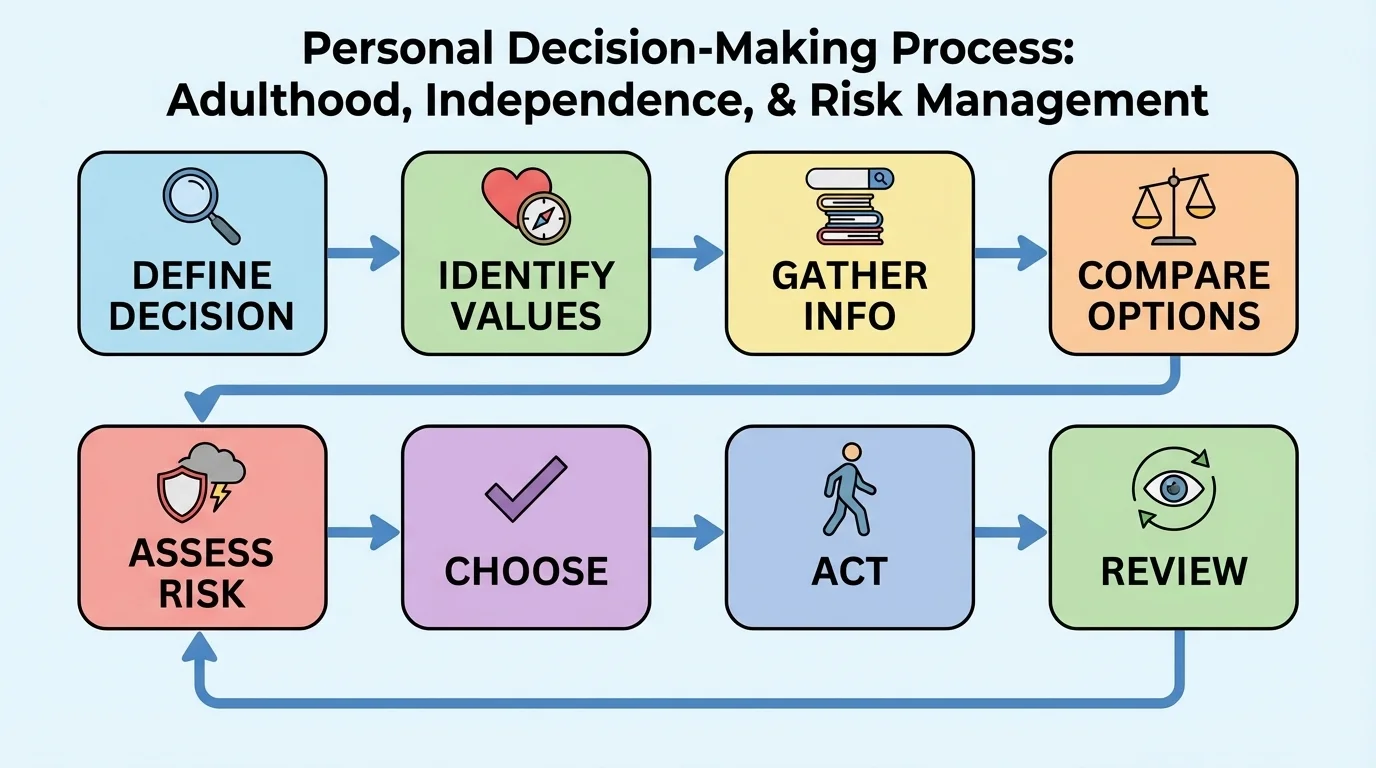
You do not need a perfect system. You need a reliable one. A personal process works best when it is simple enough to remember and strong enough to use when life gets messy. The sequence in [Figure 1] shows a practical flow you can return to whenever a choice affects your safety, money, time, reputation, or future opportunities.
Here is the basic pattern: define the decision, identify what matters, gather useful information, generate options, compare trade-offs, assess risk, choose, act, and review the result. Not every decision needs all of these steps in the same depth. Choosing what to cook tonight is not the same as choosing a roommate. But the process stays useful because it scales.
Think of it like a personal operating system. When stress is high, your brain tends to look for shortcuts. A process gives structure when your emotions, other people, or urgency try to take over.
Many bad choices begin with a fuzzy question. If your question is vague, your answer will be weak. Instead of asking, "What should I do with my life?" ask, "Should I accept this part-time job that pays more but cuts into the time I use for schoolwork and family responsibilities?" A clear question is specific, realistic, and connected to an actual choice.
This is also the point where you separate facts from feelings. Feelings matter, but they are not the whole story. "I feel guilty saying no" is a feeling. "If I say yes, I will have only 32 hours of sleep spread across the next four nights" is a fact pattern you need to take seriously. A smart process makes room for both.
Ask yourself a few clarifying questions: What exactly am I deciding? By when do I need to decide? Who is affected? What happens if I do nothing? Sometimes doing nothing is also a decision, and it has consequences too.
Before you compare options, you need to know what matters most to you. This is where your values come in. Values are the principles you want your choices to reflect, such as honesty, safety, responsibility, growth, stability, respect, or financial self-control.
Your goals matter too, but goals and values are not identical. A goal might be to save $2,000, get a driver's license, move out responsibly, or build work experience. Values guide how you pursue those goals. For example, if independence matters to you, borrowing money every month for nonessential spending may move against that value even if it solves a short-term problem.
Then identify your non-negotiables. These are limits you will not ignore. Examples include not riding with an impaired driver, not signing contracts you do not understand, not sharing account passwords, not taking a job that prevents you from meeting core responsibilities, and not staying in relationships where your boundaries are repeatedly dismissed.
Values-based decisions are usually stronger than mood-based decisions. Moods shift quickly. Values hold steady over time. When you feel pressure, confusion, excitement, or fear, your values act like rails that keep your decision from sliding into a place you will regret later.
When you know your values and your non-negotiables, some options become easier to reject immediately. That saves time and prevents rationalizing choices that are clearly unsafe or misaligned with who you want to be.
Strong decisions need evidence, but not endless research. This is where information overload becomes a problem. If you keep collecting details because you are afraid to choose, you may feel busy while actually avoiding the decision.
Focus on information that changes the outcome. If you are considering a job, useful information includes pay, transportation cost, reliability of hours, shift times, dress requirements, training, growth opportunities, and whether the workplace feels safe and respectful. If you are thinking about renting a place, useful information includes total monthly cost, deposit, utility responsibilities, lease terms, location safety, internet access, and roommate expectations.
Use trustworthy sources. Read the lease, not just the text message summary. Check your bank app, not your guess. Look up company reviews carefully, but remember that extreme reviews can distort reality. Ask direct questions in writing when possible, especially if money or agreements are involved.
It also helps to notice manipulation. Urgency can be real, but fake urgency is a common pressure tactic. "You need to decide right now" should make you pause when the decision is expensive, risky, or hard to reverse. A good opportunity can usually survive one thoughtful review.
People often act as if there are only two choices: yes or no. In real life, there are usually more. You may be able to delay, negotiate, ask for a different schedule, choose a smaller commitment, bring in a trusted adult for review, or test an option before fully committing. More options usually mean better decisions.
Every choice has trade-offs. A trade-off is what you gain and what you give up. Higher pay may cost more time. Independence may bring more bills. A cheaper apartment may mean a longer commute. A relationship may offer emotional support but create stress if trust is weak.
One helpful question is: "What am I saying yes to, and what am I saying no to?" This reveals hidden costs. If you say yes to a late-night shift, you may be saying no to enough sleep, early appointments, or consistent study time. If you spend $300 on something impulsive, you may be saying no to a future emergency buffer.
Another useful idea is opportunity cost. That means the value of the next best option you give up. You do not need complicated economics to use this. If one job pays $1 more per hour but requires a long commute, the opportunity cost may be lost time, extra gas, and more stress. Sometimes the highest number on paper is not the best overall choice.
Quick comparison example: choosing between two jobs
You have two part-time job offers.
Step 1: List the facts
Job A pays $16 per hour and is 25 minutes away. Job B pays $15 per hour and is 10 minutes away.
Step 2: Estimate weekly pay before taxes
If each offers 15 hours per week, Job A gives \(16 \times 15 = 240\) dollars, and Job B gives \(15 \times 15 = 225\) dollars.
Step 3: Compare what the extra pay costs
The difference is \(240 - 225 = 15\) dollars per week. If the longer commute adds transportation costs and more time stress, the higher pay may not actually be the better choice.
The smart answer depends on the full picture, not just the hourly rate.
Comparing trade-offs does not remove uncertainty, but it makes your choice more honest. You are no longer pretending every option is equally good.
[Figure 2] This is where risk assessment becomes essential. Risk is not just "something bad might happen." It is more useful to think about two questions: How likely is the problem, and how serious would the impact be if it happened?
A low-likelihood, low-impact risk usually needs less attention. A high-likelihood, high-impact risk deserves serious caution. For example, forgetting a reusable water bottle is annoying but minor. Sharing your banking login, getting into a car with someone driving recklessly, or signing a lease you have not read can create major harm.
You can also reduce risk without avoiding every opportunity. This is the core of risk management. If you take a new job, you reduce risk by understanding the schedule, tracking expenses, and making a backup transportation plan. If you meet someone from online in person, you reduce risk by meeting in a public place, telling someone where you are, keeping your phone charged, and arranging your own ride.
Watch for warning signs: pressure to decide fast, secrecy, vague promises, missing details, people avoiding direct answers, requests for money or passwords, and situations where you feel you must ignore your own discomfort to keep someone else happy. Those signs do not always prove danger, but they should slow you down.
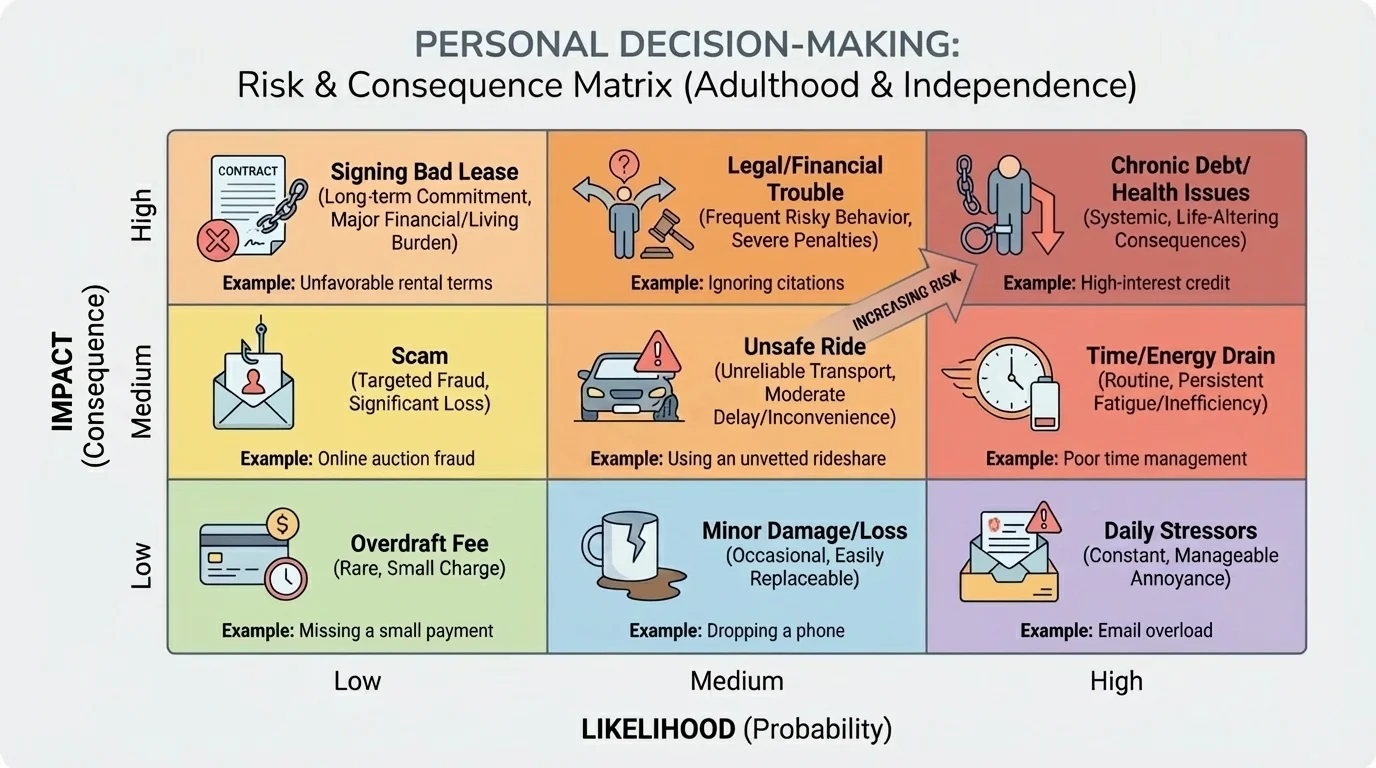
One of the most useful questions in adult life is, "If this goes badly, can I recover?" If the answer is yes and the downside is manageable, the risk may be acceptable. If the answer is no, or recovery would be extremely difficult, you need stronger protection or a different option. That same thinking appears later when you compare life decisions, as shown again by the patterns in [Figure 2].
Many harmful decisions do not start with obviously dangerous choices. They start with small ignored signals: one skipped payment, one vague agreement, one password shared "just this once," or one ride taken because saying no feels awkward.
Risk management is not fear. It is maturity. It lets you take useful chances while protecting your future self.
At some point, thinking has to become action. Once you have enough information, compared your options, and assessed the risk, choose. Waiting for perfect certainty often becomes another form of avoidance. Most real decisions happen with incomplete information.
When you decide, be clear with yourself and others. If your answer is yes, state what you are agreeing to. If your answer is no, say no directly and respectfully. If your answer is "not now," communicate what would need to happen before you reconsider.
This is where boundaries matter. A boundary is a limit you set to protect your time, safety, energy, privacy, or values. Boundaries sound like: "I am not comfortable with that." "I need the details in writing before I agree." "I can work these hours, but not those." "I do not share passwords." "I am leaving if the situation becomes unsafe."
Clear communication reduces confusion, but it also reveals who respects you. People who pressure, mock, or punish your boundaries are giving you important information about whether they are safe or trustworthy to deal with.
"You are free to choose, but you are not free from the consequences of your choice."
— Common decision-making principle
Choosing well is not just about getting a good outcome. It is also about making choices you can explain to yourself with honesty.
After the decision, review what happened. This is where reflection turns experience into skill. Ask: What worked? What did I miss? Were my assumptions accurate? Did I ignore any warning signs? Was the outcome bad because the process was weak, or because the situation was unpredictable?
A poor outcome does not always mean you made a poor decision. Sometimes you make the best possible choice with the information you had, and things still go wrong. The goal is not to judge yourself unfairly. The goal is to get sharper.
Keep notes if that helps. You might notice patterns such as overspending when stressed, agreeing too quickly when you want approval, underestimating transportation time, or avoiding uncomfortable but necessary conversations. Patterns are useful because once you see them, you can plan around them.
Over time, your process becomes more personal. You learn when to trust your instincts, when to slow down, and when to ask for advice. That is what growth looks like in real life.
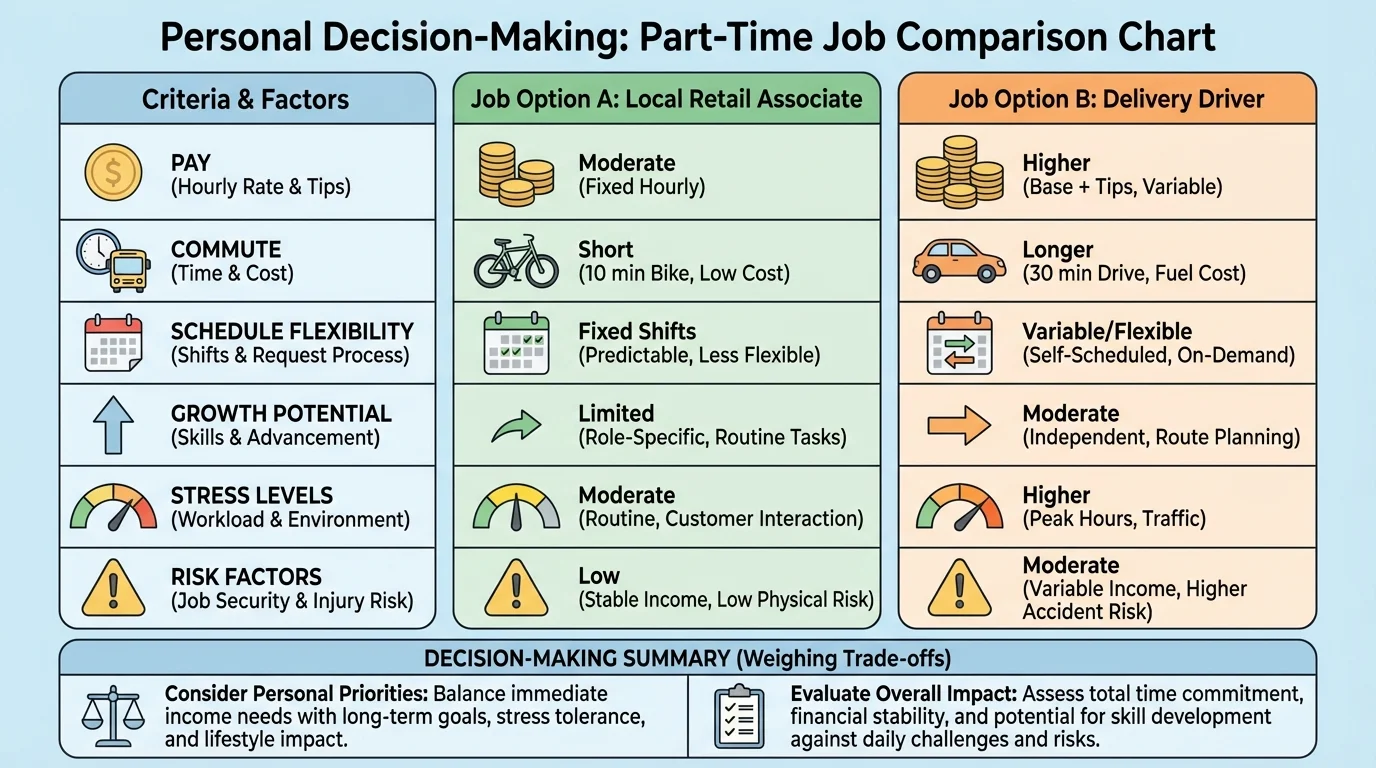
[Figure 3] The same framework works across many parts of life, and comparing options side by side can make a complicated choice easier to judge. The details change, but the structure stays the same: define the choice, identify what matters, compare trade-offs, evaluate risk, then act.
Money: Before buying something expensive, ask whether it supports a real need, whether you can still cover essentials, and what you are giving up by spending now. If your monthly income is $900 and your essential costs are $650, then your remaining amount is \(900 - 650 = 250\) dollars. Spending $220 on something impulsive leaves only \(250 - 220 = 30\) dollars for unexpected needs. That is a risky position if one small problem could throw off the rest of the month.
Housing: A place that looks affordable at first may become unaffordable once utilities, deposits, internet, transportation, and groceries are included. You also need to think about safety, reliability of roommates, quiet hours, distance from work, and what happens if someone fails to pay their share.
Work: A job is not just pay. It is schedule, transportation, stress, learning, treatment by supervisors, and whether it fits your long-term direction. This comparison structure helps you see how a "better" offer can become worse when hidden costs are included.
Transportation: Convenience should never outrank safety. If your safe ride falls through, a slower safe option is still better than an unsafe fast one. Keep backup plans such as rideshare apps, public transit schedules, or a trusted contact list.
Digital life: Independence now includes online judgment. Do not share codes, personal documents, banking details, or location casually. Verify links. Use strong passwords and two-factor authentication. Screens can create distance, but digital choices have real-world consequences.
Health and habits: Decisions about sleep, food, substance use, stress, and routine may look private, but they affect every other area of life. Exhaustion weakens judgment. Chronic avoidance grows problems quietly. Responsible independence includes caring for your body and mind so your decisions stay strong.
Relationships: A healthy relationship supports honesty, consent, trust, and space for boundaries. If a person regularly creates confusion, guilt, fear, or pressure, that is decision-relevant information. Attraction and attachment matter, but they should not cancel out your safety or self-respect.
| Decision area | Helpful questions | Common risks |
|---|---|---|
| Money | Can I still cover essentials after this? | Debt, overdrafts, no emergency buffer |
| Housing | What are the full monthly costs and rules? | Hidden expenses, conflict, unsafe area |
| Work | Does this fit my schedule, growth, and well-being? | Burnout, unreliable hours, long commute |
| Transportation | Is this option safe and dependable? | Unsafe rides, missed shifts, high costs |
| Digital safety | Am I protecting my identity and accounts? | Scams, hacking, privacy loss |
| Relationships | Are my boundaries respected? | Pressure, manipulation, loss of safety |
Table 1. Key decision areas in early adulthood with useful questions and common risks.
As your life becomes more independent, the categories may expand, but the logic remains the same. Good decisions are rarely random. They are built.
You can turn everything above into a short checklist:
Step 1: What exactly am I deciding?
Step 2: What matters most here: safety, cost, time, values, relationships, future goals?
Step 3: What facts do I need before I choose?
Step 4: What are at least three options, including delaying or negotiating?
Step 5: What do I gain, and what do I give up with each option?
Step 6: What could go wrong, how likely is it, and how bad would it be?
Step 7: How can I lower the risk?
Step 8: What is my decision, and how will I communicate it clearly?
Step 9: Afterward, what did I learn?
That checklist is especially useful when emotions are loud. Save it in your phone notes, planner, or somewhere easy to access. If a decision affects your money, safety, housing, work, digital security, or relationships, it is worth a few extra minutes of structured thinking.
Independence becomes stronger when your choices stop being random reactions and start becoming deliberate actions. That is what a personal decision-making process gives you: not control over everything, but control over how you respond.
