Some people spend years fixing a choice they made in a hurry at age 17. That is not meant to scare you; it is meant to remind you that the decisions you make next should be thoughtful, not random. Whether you choose college, training, work, a certification program, or a mix of options, career planning helps you avoid wasting time, money, and energy on a path that does not fit your real goals.
Career planning is not about having your entire life figured out. It is about making smart next-step decisions based on what you know right now, while staying flexible enough to change direction when you learn more. A good plan gives you direction. A bad plan is no plan at all, or a plan based only on pressure, social media, or what other people expect.
Career planning is the process of identifying your goals, researching options, making decisions, and taking steps toward work and education that fit your interests, strengths, and life needs.
Postsecondary choices are the education, training, or work options you pursue after high school graduation.
Transition goals are the practical goals that help you move from student life into adult responsibilities such as work, money management, transportation, and daily routines.
If you do this well, you are more likely to choose a path that fits both your future and your current reality. If you skip it, you may end up enrolling in a program you do not need, taking on debt without a clear reason, or starting a job that does not help you move forward.
Your choices become much clearer when you break them into categories, as [Figure 1] shows through a simple career-fit map. Before you apply anywhere, ask yourself what kind of life you actually want. Not just what sounds impressive. Not just what pays well. What kind of daily routine, environment, and responsibilities fit you?
Start with five areas: interests, values, skills, personality, and practical needs. Interests are what you enjoy learning about or doing. Values are what matters to you, such as stability, helping others, creativity, independence, or income. Skills include both things you are already good at and things you can improve with training. Personality affects how you work best. Practical needs include money, transportation, schedule flexibility, family responsibilities, and health.
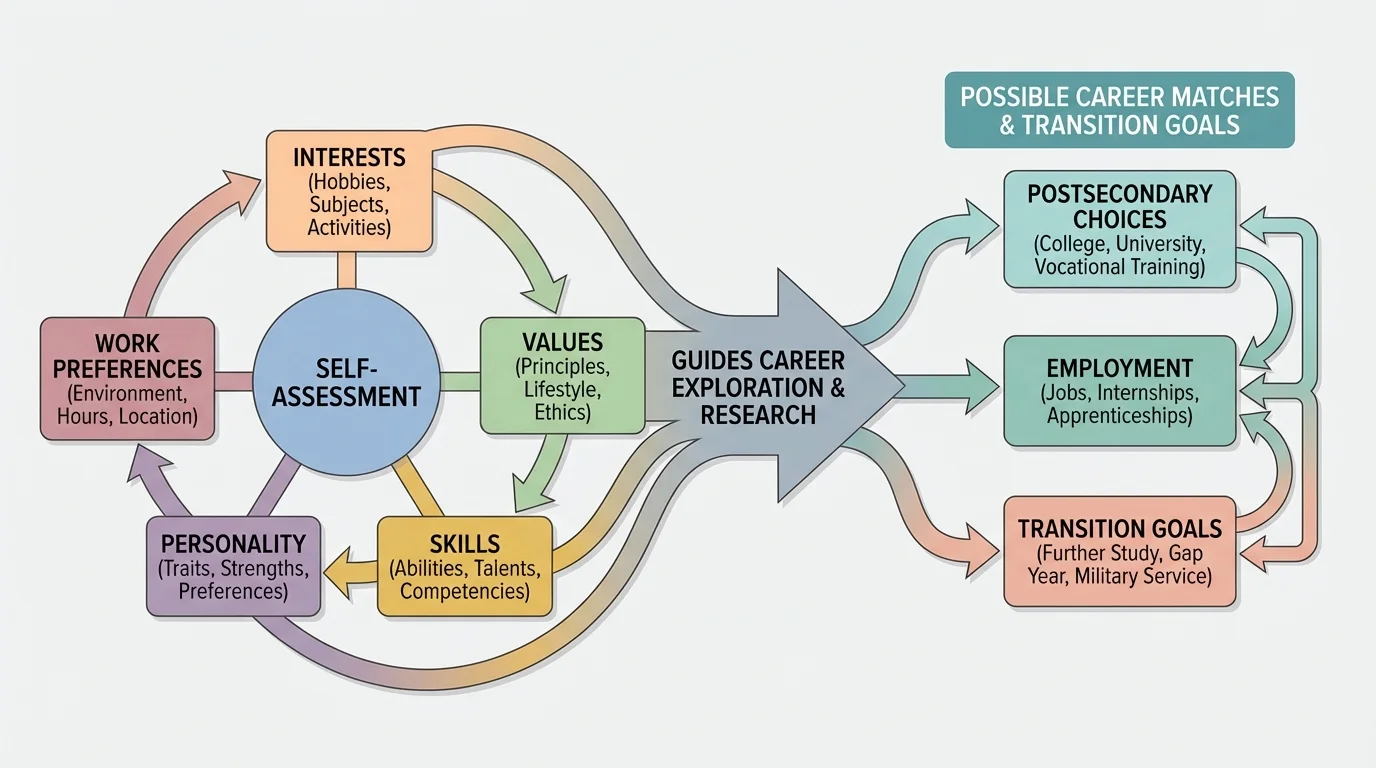
For example, you might love technology but hate sitting alone all day. That could point you away from some jobs and toward others. A student who likes problem-solving, wants stable income, and prefers hands-on work might look into electrical work, HVAC, or industrial maintenance. A student who values creativity, flexible schedules, and digital tools might explore graphic design, marketing, content production, or user experience support.
This is where a self-assessment becomes useful. It does not have to be fancy. You can write notes in a document, use a career interest survey, or make a chart with columns labeled "I enjoy," "I am good at," "I care about," and "I need." The more honest you are, the better your decisions get.
Personal self-assessment example
A student named Maya is deciding what to do after graduation.
Step 1: She lists interests.
She writes: fitness, biology, helping people, social media, and organizing plans.
Step 2: She lists values.
She wants steady income, meaningful work, and a path that does not require moving far from home right away.
Step 3: She lists practical needs.
She needs a program she can afford and transportation she can manage locally.
Step 4: She turns this into options.
She explores community college health programs, personal training certification, physical therapy assistant pathways, and entry-level jobs in wellness settings.
Maya does not have her whole future decided, but she has narrowed her choices to realistic options that match her life.
One of the biggest mistakes students make is confusing someone else's definition of success with their own. A path is not automatically better because it is more expensive, more competitive, or more admired online. If it does not fit your abilities, goals, or finances, it is not the right path for you.
After high school, your options are wider than many people realize, and [Figure 2] compares how these pathways differ in cost, time, and flexibility. The main idea is simple: different goals require different routes. You do not need to force yourself into one traditional model if another path gets you where you want to go faster or more affordably.
A postsecondary pathway is the route you take after graduation to build training, experience, credentials, or income. Common pathways include four-year college, community college, trade school, apprenticeships, military service, certificate programs, direct entry into work, and structured gap years with a plan.
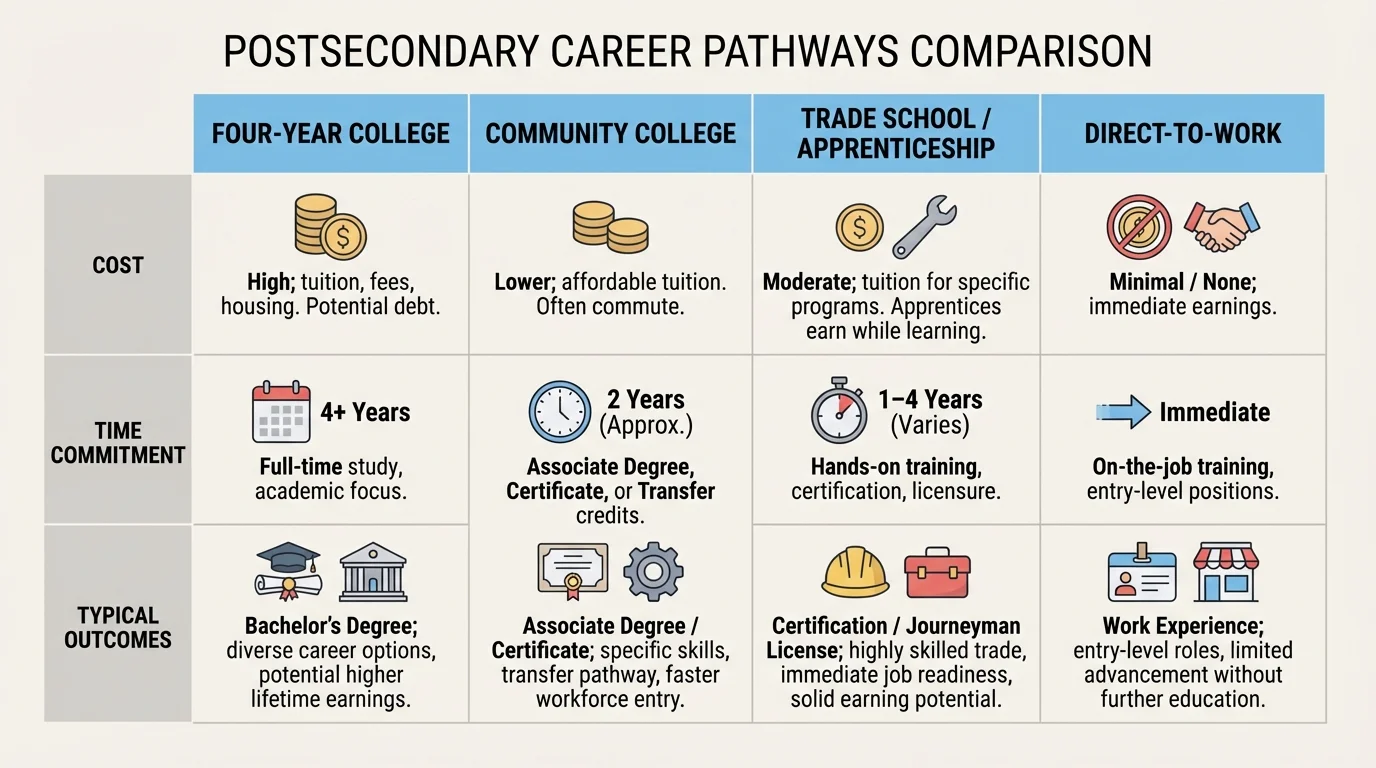
A four-year college can be a strong choice if your target career truly requires a bachelor's degree or if you want broader academic and campus-based opportunities. But it is not automatically the smartest financial move. If you are unsure of your major or career direction, starting at a lower-cost institution may give you time to explore without taking on as much debt.
Community college often offers lower tuition, flexible schedules, transfer options, and career-focused programs. For many students, it is one of the most practical choices available. Trade schools and apprenticeships are especially strong for students who want hands-on training and faster entry into skilled work. In some fields, you can earn while you train, which changes the financial picture in a big way.
Direct-to-work can make sense too, especially if you choose jobs that help you build transferable experience. Retail, customer service, office support, childcare, food service, and logistics jobs can teach reliability, communication, teamwork, scheduling, and problem-solving. The key is to think strategically. A job should be more than a paycheck if you want it to help your long-term career plan.
A gap year can help if it is structured. That means you are not just "taking time off." You are working, volunteering, shadowing careers, saving money, building skills, or completing certifications. Without a plan, a gap year can become lost momentum. With a plan, it can become a smart reset.
| Pathway | Best For | Main Advantages | Possible Challenges |
|---|---|---|---|
| Four-year college | Careers needing a degree; broad academic exploration | More degree options; networking; campus resources | Higher cost; longer timeline; major uncertainty |
| Community college | Lower-cost start; career training; transfer plans | Affordable; flexible; local access | May require strong self-motivation and transfer planning |
| Trade school or apprenticeship | Hands-on learners; skilled trades | Faster training; practical experience; strong earning potential | Field-specific; physical demands in some careers |
| Direct-to-work | Immediate income; experience-building | Start earning right away; develop workplace skills | May need extra training later for advancement |
| Gap year with a plan | Students needing clarity, savings, or maturity | Time to explore and prepare | Can become unstructured without clear goals |
Table 1. Comparison of common postsecondary pathways, including benefits and challenges.
As you compare options, think beyond labels. Ask: What credential do I need? How long will this take? What will it cost? What support will I have? What jobs can this lead to? Can I change direction later if needed?
Some high-paying careers require less schooling than people assume, while some expensive degrees do not lead directly to strong salaries. The smartest move is to compare the actual pathway to the actual career instead of guessing based on reputation.
That is why research matters. Look up program completion rates, job placement information, entry requirements, schedule demands, and whether graduates actually move into the field. You are not just choosing a school or job. You are choosing a path with real consequences.
Once you have a list of possible pathways, compare them like an adult making a real investment. This is where emotions and facts need to work together. Excitement matters, but so do numbers, deadlines, and long-term outcomes.
A helpful strategy is to score each option in several categories: cost, time, interest level, job outlook, flexibility, location, support services, and lifestyle fit. You do not need advanced math. You can rate each category from \(1\) to \(5\), then total the scores. For example, if community college scores \(5\) for affordability, \(4\) for location, \(4\) for flexibility, and \(3\) for interest fit, its total can be compared with another option. The score is not the final answer, but it helps you think clearly.
Be careful with one category in particular: cost. You should know the difference between tuition price, total cost, and actual out-of-pocket cost after aid. You should also know whether borrowing money is likely and how that debt could affect your future choices. Taking on debt for a field with a clear return can be manageable. Taking on debt without a clear plan can trap you.
Good comparison is about fit, not hype. A strong choice balances what you want, what you can afford, and what the pathway can realistically deliver. The goal is not to pick the "best" option in general. The goal is to pick the best option for you right now.
Here are practical questions to ask every program or pathway: What is the graduation or completion rate? What licenses or certifications does it lead to? What jobs do graduates get? What are the schedule demands? Are online or hybrid options available? Is transportation realistic? What happens if I need to work while enrolled?
This is also where [Figure 1] still matters. A pathway may look strong on paper, but if it clashes with your values or daily reality, you may struggle to stay committed. Career planning works best when your decisions match both your goals and your actual life.
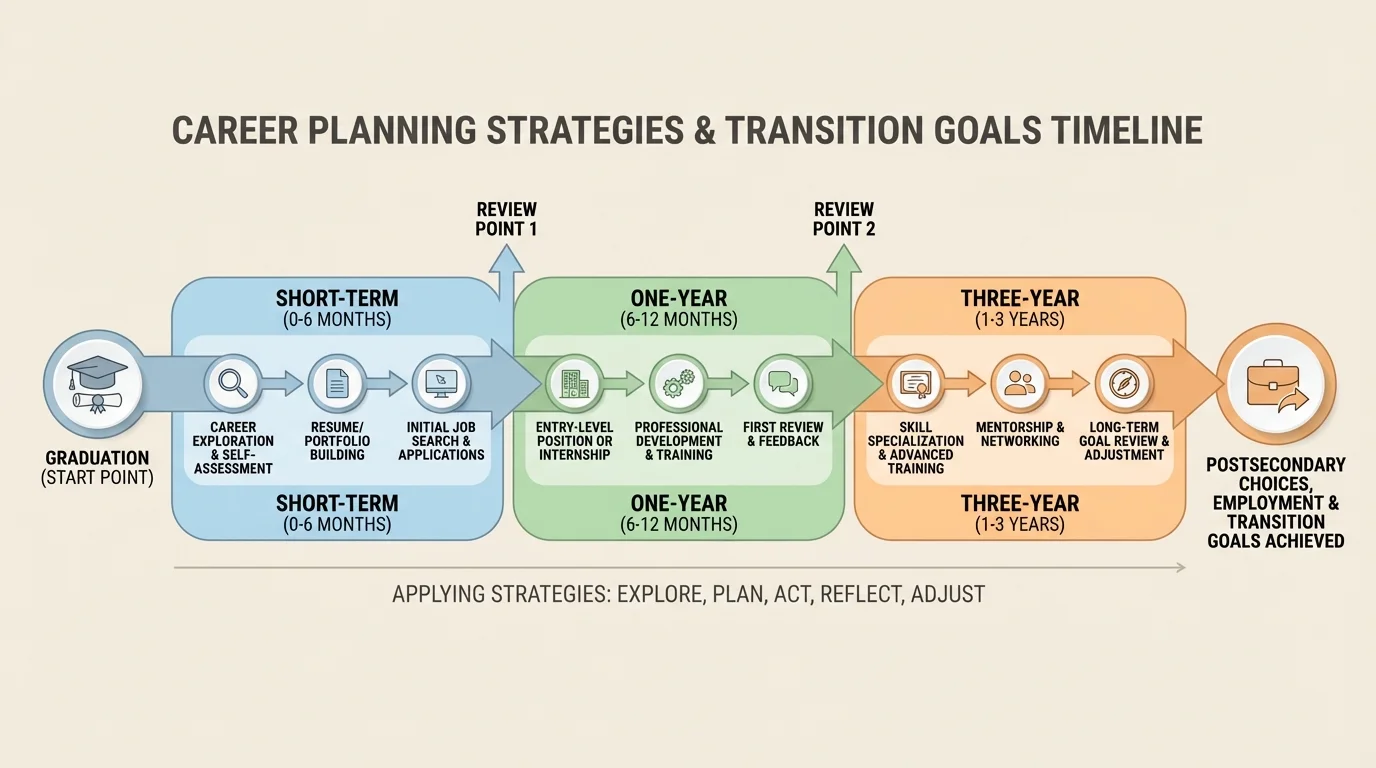
Strong plans are not vague wishes; they work more like timelines with checkpoints, as [Figure 3] illustrates from graduation into early adulthood. Saying "I want a good job someday" is too unclear to guide action. A career plan should include short-term, mid-term, and long-term goals.
Your short-term goals cover the next few months. These might include researching programs, creating a resume, applying for jobs, completing financial aid forms, requesting recommendation letters, or earning a certification. Mid-term goals often cover the next year or two, such as completing the first stage of training, building work experience, or transferring programs if needed. Long-term goals may include reaching a target job, earning a credential, increasing income, or moving into more independent living.
A SMART goal helps because it is specific, measurable, achievable, relevant, and time-bound. "Apply to at least three medical assistant programs by October" is a stronger goal than "look into healthcare careers." "Save $1,500 for transportation and work clothes by August" is stronger than "save money."
You also need checkpoints. A plan should include moments when you stop and ask: Is this working? What have I learned? What needs to change? Review points keep you from staying stuck on a path that no longer makes sense.
Career plan example
A student wants to become a welder.
Step 1: Short-term goal
By the end of this month, he will research three local welding training options and compare cost, schedule, and transportation.
Step 2: Mid-term goal
Within six months, he will complete enrollment steps, apply for aid, and begin training while working part-time.
Step 3: Long-term goal
Within two years, he will gain certification, build work experience, and apply for full-time welding positions with higher pay.
Step 4: Backup plan
If the first training option is full or unaffordable, he will apply to a second program and pursue an entry-level fabrication job to keep gaining experience.
This plan is strong because it includes action, timing, and flexibility.
One powerful habit is to keep all your career documents in one place: resume, cover letter draft, certifications, transcripts, list of references, application deadlines, usernames, passwords, and notes from research. Being organized reduces stress and helps you act quickly when opportunities appear.
Even if your next step is college or training, employment skills still matter. You may need a part-time job, a summer job, an internship, or your first full-time position. Employers are not just hiring your current experience. They are hiring your reliability, communication, attitude, and ability to learn.
Your resume should be clear, accurate, and focused on what you can offer. At this stage, that may include school projects, volunteer work, certifications, part-time jobs, sports, family responsibilities, freelance work, and leadership in clubs or community groups. Do not underestimate real experience just because it was unpaid or informal. If you organized events, managed schedules, trained others, handled money, created content, or solved problems, those are skills.
You also need references. These are adults who can speak honestly and positively about your work ethic and character. Ask permission before listing anyone. Give them context about the kinds of jobs or programs you are applying to. A strong reference can support your application; a surprised reference can weaken it.
Networking matters more than many students expect. Networking does not mean pretending to be important. It means building real connections with people who may offer information, referrals, encouragement, or opportunities. This can happen through family contacts, community groups, volunteer work, part-time jobs, online professional platforms, coaches, mentors, or local employers.
Your online presence matters too. Employers and programs may look at your public profiles. Review what is visible. Remove anything unprofessional, aggressive, or irresponsible. You do not need to become fake. You do need to show judgment.
"Opportunities are often attached to preparation."
For interviews, prepare examples that show responsibility, teamwork, problem-solving, and willingness to learn. If an employer asks, "Tell me about a challenge you handled," have a real story ready. If you have little work experience, use examples from volunteering, online collaboration, family responsibilities, or projects.
Professional communication matters before and after the interview too. Respond to emails promptly. Use respectful language. Show up on time for video calls. Test your technology. Dress neatly. If you cannot attend, communicate early. These details shape how adults see your reliability.
As you move forward, [Figure 3] remains useful because employment often fits into the larger timeline of your plan. A first job may be a stepping stone, not the final destination, but it should still move you toward your goals.
Career planning is not just about jobs or school. It is also about whether your daily life can support your plan. A great opportunity can fall apart if you do not have transportation, a schedule system, enough sleep, or a way to manage your money.
This is why transition goals matter. You may need goals for transportation, budgeting, banking, health insurance, meals, time management, work clothes, childcare, or a quieter place to study. These are not small details. They are part of career readiness.
For example, a student accepts a training program but has no reliable ride and no backup transportation plan. Another student gets a part-time job but keeps missing shifts because her sleep schedule is chaotic. Another enrolls in classes but does not realize books, equipment, and fees add hundreds of dollars. None of these students failed because they lacked ability. They struggled because they did not plan the transition.
Transition goal checklist example
A student is starting community college while working part-time.
Step 1: Money goal
Create a monthly budget for phone, transportation, supplies, food, and savings.
Step 2: Time goal
Block out class time, work shifts, study hours, and sleep on a weekly calendar.
Step 3: Transportation goal
Test the route before the first day and identify a backup option.
Step 4: Support goal
Save contact information for advisors, supervisors, family support, and emergency numbers.
These practical steps make the transition smoother and reduce avoidable problems.
Try this: write down three transition goals that have nothing to do with grades or job titles. Keep them practical. Examples: set up a checking account, learn your bus route, build a weekly routine, or save enough for work shoes and emergency gas.
No career plan survives unchanged forever. Costs change. Interests change. Family responsibilities appear. Health issues happen. Programs fill up. Job markets shift. Changing your plan is not failure. Refusing to adjust when the evidence changes is the real problem.
This is why you need a contingency plan, or backup plan. If your first-choice college is too expensive, what is choice two? If your preferred job field is highly competitive, what related role can help you enter the industry? If you are not accepted right away, what can you do in the next six months to strengthen your position?
Flexible planning builds resilience. The point of a career plan is not to lock you into one path forever. The point is to give you enough structure to move forward and enough flexibility to respond to reality without quitting on yourself.
Good planners do not panic when a plan changes. They gather information, review the goal, and choose the next best move. Sometimes the new route is actually better than the original one because it fits your finances, skills, or timing more effectively.
For example, a student may aim for a four-year nursing program but begin with a local healthcare certificate while completing prerequisites. Another may start in retail, discover strong sales and customer service skills, then move into business, management, or marketing. A straight path is not required. Progress is.
When people feel overwhelmed about the future, it is usually because everything feels too big and too vague. The fix is to shrink the future into the next actions. You do not need a ten-year prediction. You need a clear next step.
Try this: make three lists labeled next 30 days, next 90 days, and next 180 days. In the next 30 days, focus on research and setup. In the next 90 days, focus on applications, documents, and conversations with adults who can help. In the next 180 days, focus on enrollment, employment, training, or savings progress.
Your roadmap might include updating your resume, comparing three programs, applying for two jobs, requesting references, building a budget, setting up transportation, checking application deadlines, and tracking responses. If you complete even a few concrete actions each week, your future becomes less confusing and more manageable.
One more thing matters: talk to real people in the field. Read job postings. Watch day-in-the-life videos carefully, but do not rely only on polished content. Ask what the work is really like, what entry-level positions pay, what training is required, and what people wish they had known earlier. Real information leads to better choices.
Career planning is really decision-making with purpose. It connects who you are, what you need, and where you want to go. When you approach it this way, you stop guessing and start building.
