Many people think getting hired is the hard part. In reality, keeping a job and earning trust often depends on small daily choices: answering a message clearly, showing up when you said you would, protecting private information, and owning your mistakes instead of hiding them. Employers notice these things fast. Even in entry-level jobs, they are looking for someone they can count on.
Workplace expectations are the shared rules and habits that help people work together. Some of these expectations are written in policies or handbooks. Others are unspoken but still very real. If you ignore them, people may see you as careless, disrespectful, or risky to work with. If you understand them, you build a strong professional reputation early.
At work, your skills matter, but your behavior matters too. A person can be smart and talented, but if they miss deadlines, speak disrespectfully, or act dishonestly, coworkers and supervisors may stop trusting them. Trust is a major part of employability. Once trust is damaged, it can be hard to rebuild.
These expectations are especially important because many jobs now include digital communication, shared documents, customer contact, and remote teamwork. That means your choices leave a record. An email, a group chat reply, a missed video meeting, or a careless post on social media can affect how professional you seem.
Workplace communication is the way people share information, ask questions, give updates, and solve problems on the job. Ethics means doing what is honest, fair, and responsible even when no one is watching. Responsibility means following through on what you are expected to do and being accountable for your actions.
When these three areas are strong, people tend to trust you with more tasks, better recommendations, and more independence. When they are weak, even basic tasks can become stressful for everyone around you.
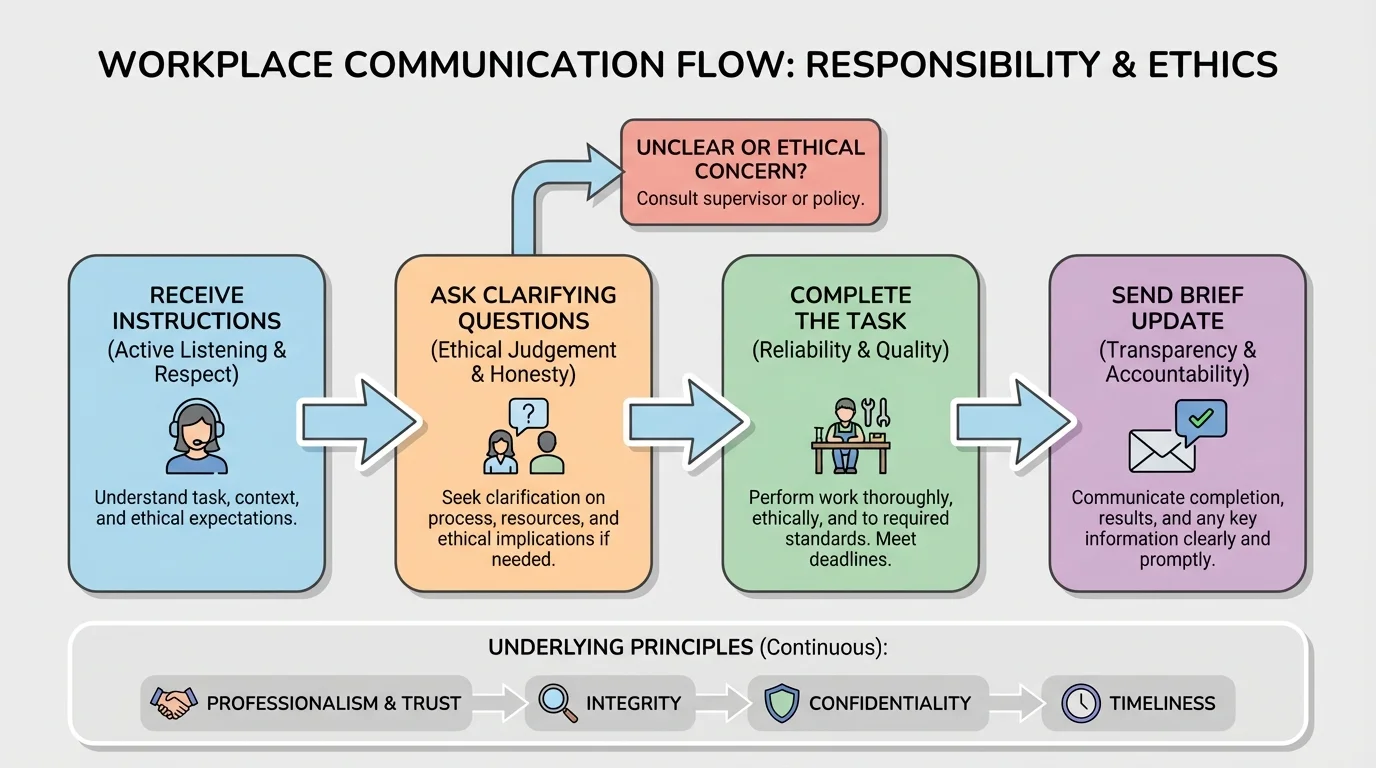
Professionalism in communication is not about sounding robotic or using fancy words. It means being clear, respectful, timely, and appropriate for the situation. Good communication follows a clear pattern: receive information carefully, clarify what you do not understand, complete the task, and then give a useful update.
One major expectation is active listening. This means you fully pay attention, avoid interrupting, and check that you understood correctly. For example, if a supervisor says, "Please finish the inventory list and send it by 3 p.m.," active listening sounds like: "Got it. You want the updated inventory list emailed by 3 p.m. today." That quick response reduces mistakes.
Another expectation is tone. In the workplace, tone should be calm, respectful, and direct. A message like "Need this now" can sound demanding. A better message is "Could you send that file when you have a moment? I need it for today's deadline." The second version is still clear, but it shows respect.
Timing matters too. If you cannot meet a deadline, the professional move is to say so early, not at the last second. A responsible message might be: "I'm still working on the report. I may need an extra hour because two customer entries need to be verified. I wanted to let you know now rather than wait until the deadline." This gives the other person time to adjust.
Digital communication has its own rules. Work emails, texts, and chat messages should avoid slang that could be confusing, rude jokes, or emotional reactions sent in the moment. Before you hit send, ask yourself: Is this clear? Is this respectful? Does this belong in writing? That last question matters because written messages can be forwarded or saved.
Video meetings also require communication skills. Being on time, muting when needed, paying attention, and not multitasking all send a message about your reliability. If your internet cuts out, explain briefly and rejoin as soon as possible rather than disappearing without explanation.
Example: Turning an unclear message into a professional one
Suppose your supervisor sends: "Can you help with the weekend schedule?" A weak response would be "Sure I guess." A stronger response is more specific.
Step 1: Confirm the request
"Yes, I can help with the weekend schedule."
Step 2: Ask for missing details
"Do you need me to make the first draft or just review it?"
Step 3: Clarify timing
"When would you like it completed?"
This kind of response saves time and shows maturity.
If you compare this example with the communication flow in [Figure 1], you can see that strong communication is not just "being nice." It is a practical system for preventing confusion, delays, and frustration.
Ethics shapes how people decide what is right when the answer is not just about convenience. In real workplaces, ethical choices appear in small moments, and pausing to think through the issue can stop a bad decision before it spreads.
Honesty is one of the clearest ethical expectations. That includes being truthful about hours worked, tasks completed, qualifications, expenses, and mistakes. If you clocked in late, changing the time would be dishonest. If you did not finish an assignment, pretending you did would be dishonest. People sometimes justify these choices by saying, "It's not a big deal," but small dishonesty can become a serious trust problem.
Another ethical area is confidentiality. Some jobs give you access to private information about customers, coworkers, schedules, finances, or health. Sharing that information with friends, posting about it online, or using it for gossip is inappropriate and sometimes illegal. Even if the information seems minor, it may still be private.
Fairness also matters. Ethical employees do not play favorites in ways that harm others, steal credit for group work, or shift blame onto a coworker. They treat customers and teammates with respect, even when frustrated. They also avoid conflicts of interest, which happen when your personal interests interfere with your work decisions.
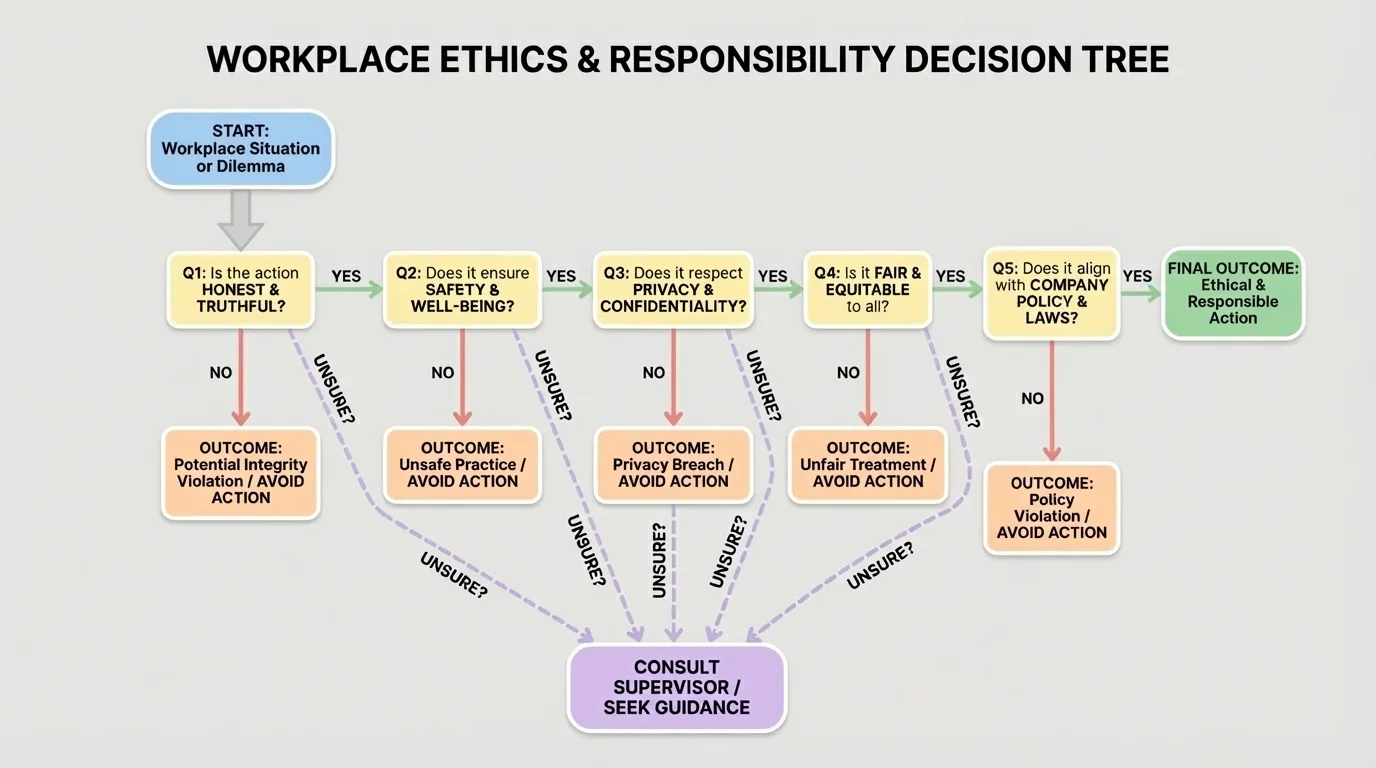
A useful ethical check is simple: Is it honest? Is it safe? Does it respect privacy? Is it fair? Would I be comfortable if my supervisor saw this? If the answer to any of those questions is no, stop and ask for guidance.
Many employees are not fired for lacking technical skill. They are fired for behavior issues like dishonesty, harassment, breaking privacy rules, or ignoring safety procedures. Employers can often teach job tasks faster than they can rebuild trust.
Ethics also includes your online presence. Complaining publicly about coworkers, sharing workplace photos without permission, or joking about customers can damage your reputation. Even when you are off the clock, your actions can affect how employers view your judgment.
Later, when you face a gray-area decision, the questions in [Figure 2] help you slow down. Ethical choices are often less about dramatic situations and more about refusing to cut corners when no one would notice right away.
Accountability means you accept ownership for your work, your time, and your behavior. Employers judge patterns, not promises, and they notice the difference between someone who is dependable and someone who regularly creates extra problems for the team.
Responsibility starts with the basics: showing up on time, being prepared, following instructions, meeting deadlines, and completing tasks carefully. These may sound simple, but they are a big part of workplace success. A manager should not have to chase you down for every update.
Being responsible does not mean never making mistakes. Everyone makes mistakes. What matters is how you respond. A responsible worker says, "I made an error in the order form. I caught it, and here is what I've already done to fix it." An irresponsible worker hides the problem, blames someone else, or waits until the damage gets worse.
Reliability is built through consistency. If you are respectful only when being watched, or on time only occasionally, people will not see you as dependable. Responsibility is not one great day. It is a pattern repeated over time.
Time management is part of responsibility too. If you have three tasks due in one shift, you need to prioritize. A practical method is: first identify what is urgent, then what affects other people's work, then what can wait. If you realize the workload does not fit the time available, communicate early instead of silently falling behind.
| Situation | Responsible response | Irresponsible response |
|---|---|---|
| Running late | Notify supervisor as soon as possible and give an accurate arrival time | Say nothing or make an excuse after arriving |
| Unclear task | Ask clarifying questions before starting | Guess and hope it works out |
| Mistake found | Report it, explain it honestly, and help fix it | Hide it or blame others |
| Deadline pressure | Give an early update and request help if needed | Wait until the deadline passes |
Table 1. Common workplace situations and the difference between responsible and irresponsible responses.
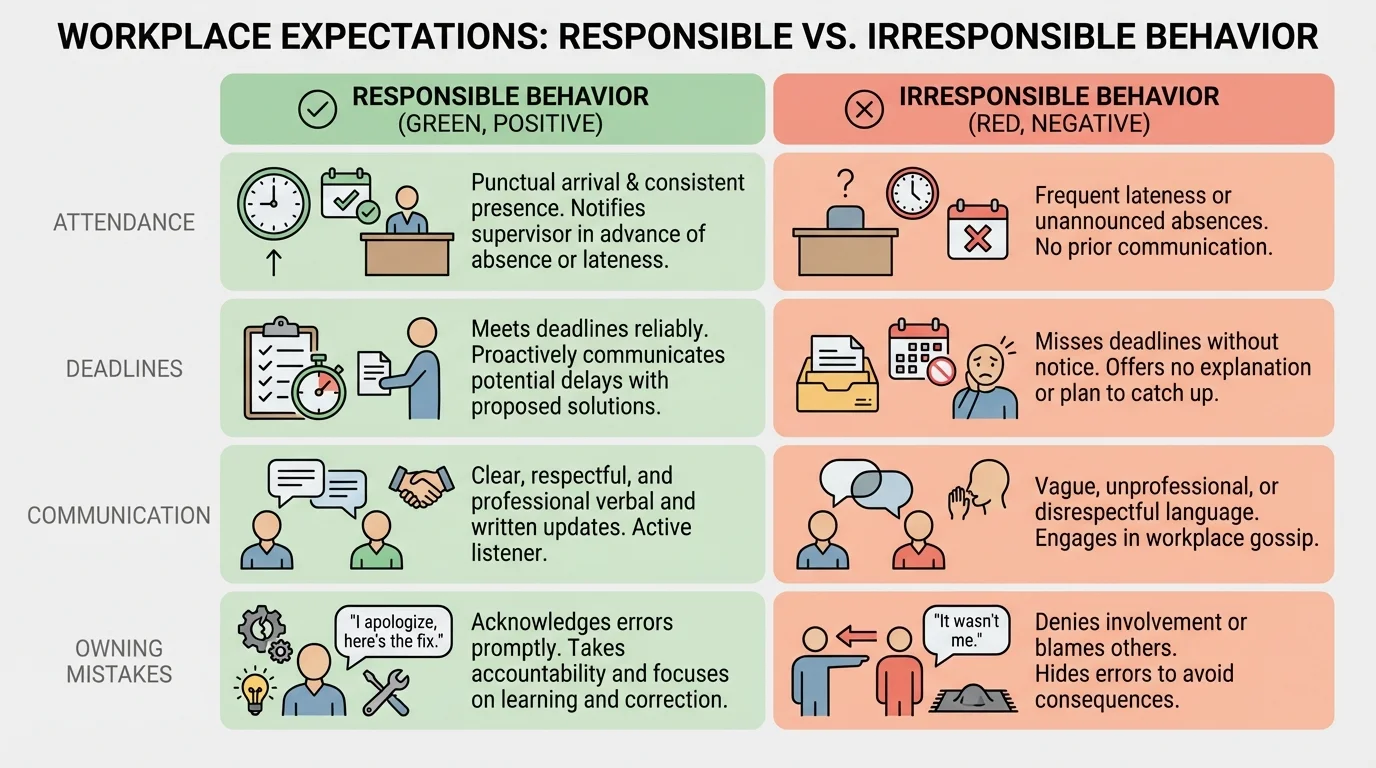
The contrast in [Figure 3] and Table 1 shows something important: responsibility is visible. People may not hear you describe yourself as hardworking, but they can see your habits.
"Your reputation is built in moments when no one reminds you what the right thing is."
One more part of responsibility is following workplace rules, especially safety procedures. Ignoring a rule because it feels inconvenient does not make you independent. It makes you risky.
Workplace expectations are consistent across industries, but they may look a little different depending on the job. In retail or food service, communication often means speaking politely with customers, confirming orders, and letting coworkers know when stock is low. Ethics may involve honest cash handling and fair treatment of customers. Responsibility includes showing up for shifts and staying focused during busy times.
In remote office work, communication might involve email updates, project management tools, and video meetings. Ethics can include protecting passwords, not sharing private company files, and being truthful about work completed. Responsibility includes managing your time without someone constantly watching.
In trades or hands-on jobs, communication may be brief and direct, but it still must be respectful and accurate. Ethics often includes safety, truthful reporting, and proper use of equipment. Responsibility includes being prepared, following procedures, and not taking dangerous shortcuts.
In healthcare support or caregiving roles, privacy and trust become even more serious. A careless comment about a client or patient is not just rude. It can be a major violation of confidentiality. Responsibility also includes accuracy, because mistakes can affect someone's wellbeing.
Different job, same core expectations
The tools change from job to job, but the core pattern stays the same: communicate clearly, act honestly, and follow through. A worker who understands this can adapt more easily to new settings because the underlying expectations do not disappear when the workplace changes.
Gig work and freelance work may look more flexible, but the expectations still exist. If you miss deadlines, answer messages poorly, or overpromise what you can deliver, clients may stop hiring you. Independence does not remove responsibility; it increases it.
When you are new to a job, people often evaluate your behavior before they fully evaluate your skill. They notice whether you answer respectfully, whether you seem teachable, and whether you can handle feedback without becoming defensive.
They also notice consistency. A worker who is polite in interviews but careless in daily tasks quickly loses credibility. Employers often ask themselves questions like: Can this person be trusted with information? Will they tell the truth? Do they solve problems or create them? Can they work with others?
These early impressions matter because they shape future opportunities. The person seen as reliable may get more hours, stronger references, or first consideration for advancement. The person seen as careless may get fewer chances, even if they have potential.
Example: First-month habits that build trust
Step 1: Arrive ready
Log in or show up a few minutes early, with what you need prepared.
Step 2: Write things down
Keep notes on instructions instead of relying on memory alone.
Step 3: Confirm priorities
If you have multiple tasks, ask which one matters most.
Step 4: Follow up
When a task is done, send a short update instead of waiting to be asked.
These habits make you easier to work with, which is one of the fastest ways to build trust.
Notice that none of these habits require you to be the smartest person in the room. They require awareness, self-control, and consistency.
You do not need a perfect temperament to meet workplace expectations. You need a practical response when real situations happen.
If you are going to be late: Tell the appropriate person as soon as possible, give your best estimate, and avoid dramatic excuses. A simple message is better than a long story.
If you do not understand directions: Ask before you begin. Try saying, "I want to make sure I do this correctly. Can you walk me through the first part?" That shows effort, not weakness.
If you hear gossip: Do not repeat it. Joining gossip can damage trust fast. You can stay neutral by saying, "I'm not sure, so I'd rather not spread that."
If a customer or client is upset: Stay calm, listen, and avoid arguing. Even if the other person is rude, your job is to respond professionally, not personally. If the issue goes beyond your role, involve a supervisor.
If you make a mistake: Admit it quickly, explain the facts, and focus on the fix. This response protects trust much better than denial.
One of the strongest habits in adult life is separating feelings from actions. You may feel annoyed, embarrassed, or stressed, but professional behavior means choosing a response that helps the situation rather than escalating it.
Sometimes workplace expectations can conflict with unhealthy pressure. For example, if someone asks you to lie, ignore safety rules, or share private information, that is not a normal expectation you should obey. Ethical responsibility includes speaking up, asking questions, and getting support when something feels wrong.
You do not have to wait until your first full-time job to practice workplace behavior. You can build it now in part-time work, volunteering, clubs, family responsibilities, internships, and even digital communication. When you answer messages clearly, meet deadlines for commitments, and handle disagreements respectfully, you are already training for work life.
Try this: for one week, respond to important messages within a reasonable time and reread them before sending. Notice whether your communication becomes clearer and calmer.
Try this: choose one responsibility habit to improve, such as setting alarms, using a task list, or confirming deadlines in writing. Small systems reduce forgetfulness.
Try this: if you make a mistake in daily life, practice owning it without excuses. That might sound like, "I forgot to send that. I'm doing it now." This builds honesty and accountability at the same time.
Try this: review your social media through an employer lens. Ask yourself whether your posts make you look respectful, responsible, and mature. You do not need to be fake, but you do need judgment.
The good news is that communication, ethics, and responsibility are learnable. You are not born with them fully developed. They improve through repeated choices. Every time you communicate clearly, act honestly, and follow through, you strengthen the habits that employers value most.
