One of the biggest myths about relationships is that strong feelings automatically lead to good decisions. They do not. Plenty of people care about each other and still cross lines, avoid important health conversations, or stay in situations that drain their confidence. As you move toward adulthood, relationship choices stop being just about who you like. They become about safety, respect, honesty, responsibility, and whether both people are actually able to make free, informed choices.
Healthy relationships are not built on guessing games. They are built on clear communication, respect for limits, and access to good information. That matters in dating, casual relationships, long-term partnerships, online connections, and breakups. It also matters when decisions involve physical affection, sex, privacy, time, money, transportation, or emotional energy.
Adult relationship choices can affect your mental health, physical health, reputation, finances, and future plans. A respectful relationship can help you feel supported and confident. An unhealthy one can leave you feeling anxious, pressured, isolated, or unsafe. Sometimes the difference comes down to whether someone respects the word "no," whether they accept a boundary without argument, and whether both people know how to get help when they need it.
Even if you are not currently dating, this skill matters. You may be talking to someone online, considering future relationships, helping a friend, or trying to understand how you do and do not want to be treated. Knowing your standards ahead of time makes it easier to protect yourself in the moment.
Boundary means a limit you set about what you are comfortable with physically, emotionally, digitally, socially, or sexually.
Consent means a clear, voluntary, informed, and ongoing agreement to a specific activity.
Coercion means pressure, manipulation, intimidation, guilt, or force used to get someone to say yes when they do not freely want to.
These ideas connect closely, as [Figure 1] shows, but they are not identical. Boundaries are your limits. Consent is the active agreement given within those limits. Coercion is what happens when respect breaks down and one person tries to push past the other person's freedom to choose.
A boundary can be about much more than sex. You might have boundaries about how often you text, whether someone posts photos of you, whether they show up unannounced, whether they borrow money, or how quickly a relationship moves. Some boundaries stay the same in every relationship. Others depend on trust, timing, and context.
Consent is not the absence of a "no." It is the presence of a real "yes." It must be freely given, specific, and ongoing. Agreeing to one thing does not mean agreeing to something else. Saying yes once does not mean saying yes forever. You can change your mind at any time, even if you already said yes earlier.
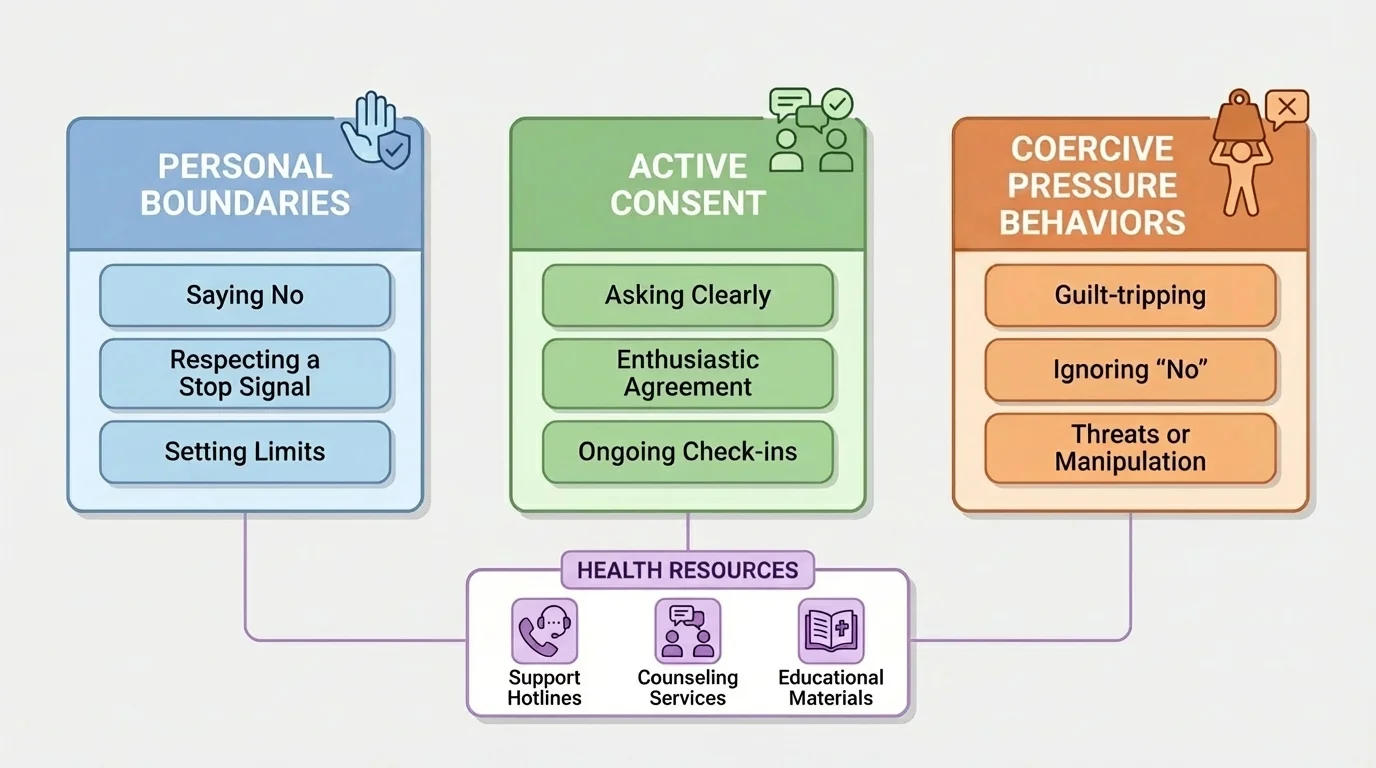
Coercion can be obvious, such as threats or physical force, but it can also sound quieter: "If you loved me, you would," "Everyone else does this," "Don't be dramatic," or "You already led me on." Pressure does not become consent just because someone eventually gives in. If a person says yes because they feel afraid, trapped, worn down, or guilty, that is not healthy agreement.
Consent also cannot happen when someone is too impaired to make a clear decision. Alcohol, drugs, extreme exhaustion, panic, or unconsciousness can make consent impossible. If there is any doubt, the safe and respectful choice is to stop.
People often think boundaries are about pushing others away, but healthy boundaries actually make closeness safer. When both people know what is okay and what is not, trust usually grows instead of shrinking.
Respect is not just about what someone says in the good moments. It shows up in how they respond when you set a limit. A respectful person may feel disappointed, but they do not punish you for having boundaries.
Before you can communicate a limit, you need to know what it is. Many people get pulled into uncomfortable situations because they never paused to decide what they actually want. This is especially common when a relationship moves fast or when attention feels flattering.
Start by asking yourself a few practical questions. What kind of communication feels normal to you? How much personal information do you want to share online? What physical affection are you comfortable with? What are your values around sex? Would you want exclusivity before becoming sexual? How do you feel about your partner having access to your passwords, location, or private messages? Your answers do not need to match anyone else's expectations.
Digital boundaries matter just as much as in-person ones. You can say no to constant tracking, pressure to send explicit images, demands for immediate replies, or someone reposting your content without permission. A partner does not earn unlimited access to your phone, photos, accounts, or body just because you are dating.
Boundary check: values, safety, and capacity
A useful way to test a boundary is to ask whether it protects your values, your safety, or your capacity. Values boundaries protect what matters to you. Safety boundaries reduce physical or emotional risk. Capacity boundaries protect your time, sleep, energy, and mental health. If a relationship repeatedly pushes against all three, it is probably not healthy for you.
It also helps to know your non-negotiables. A non-negotiable is a limit you will not bend because crossing it would seriously affect your safety, dignity, or health. Examples might include no sexual activity without protection, no yelling during conflict, no sharing private images, no driving with someone impaired, or no staying with a person who insults you or tries to isolate you.
Clear communication feels awkward for some people at first, but it gets easier with practice. A simple process, as [Figure 2] illustrates, is to say what you want or do not want directly, pause for a real response, and treat any uncertainty as a reason to slow down. That approach works in texting, video calls, dates, and sexual situations.
You do not need a perfect speech. You need clear words. Examples include: "I am not ready for that." "Please don't post that photo." "I like spending time with you, but I need time alone tonight." "I only want to do this if we both fully want to." "Are you comfortable with this?" "Do you want to keep going?" "You seem unsure, so let's stop."
Body language matters, but it is not enough by itself. Silence, freezing, looking away, or going along without enthusiasm are not strong signs of consent. If something matters, ask. If the answer is not clearly yes, stop and check in.
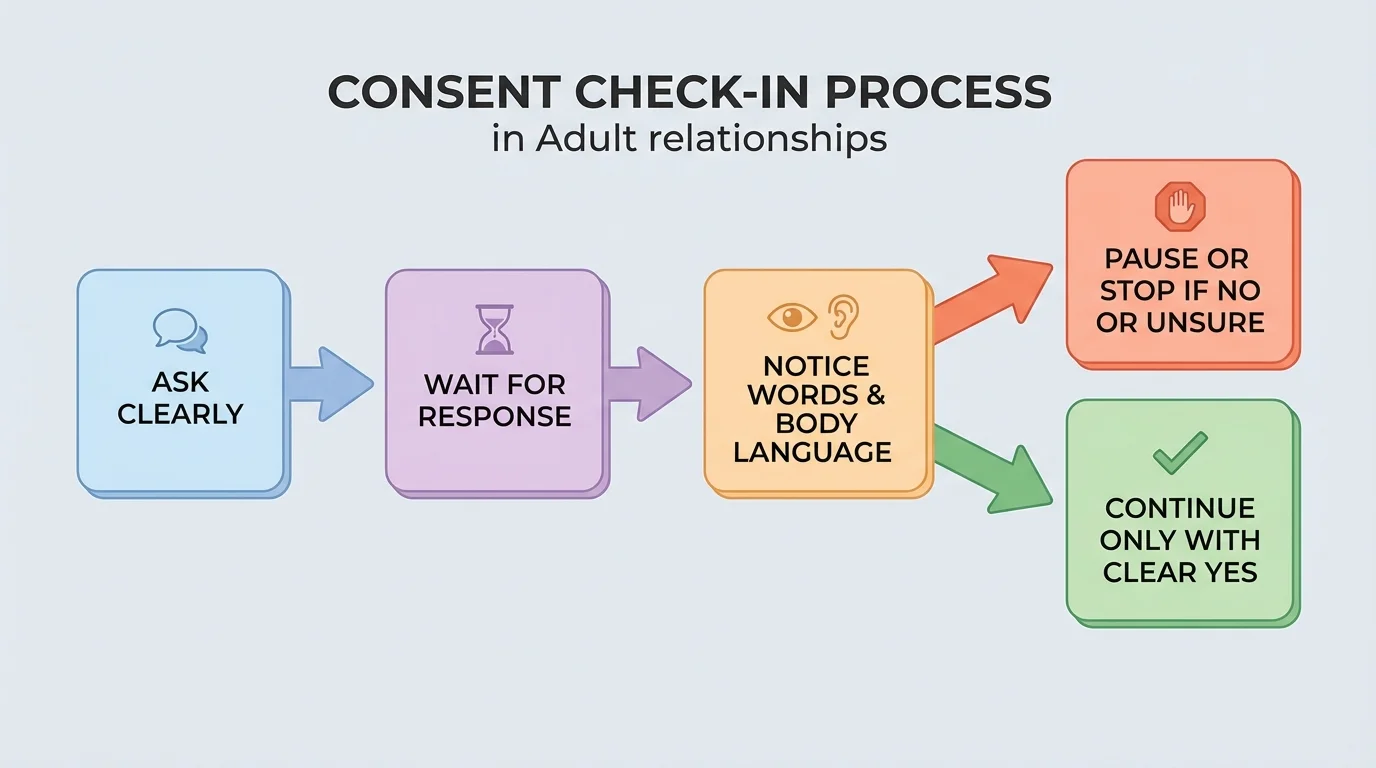
There is also a major difference between asking once and checking in. Consent is ongoing. If an activity changes, the situation changes, or someone seems uncomfortable, check again. As relationships become more serious, this does not become less important. It becomes more important because assumptions get easier to make.
If someone tells you a boundary, your job is not to debate it. Your job is to respect it. Mature responses sound like this: "Thanks for telling me." "Okay, I understand." "We can slow down." "I won't do that again." Immature responses sound defensive, mocking, or guilt-based.
Practical scripts for real situations
Step 1: If you want to set a physical boundary, name it clearly.
Example: "I am okay with kissing, but I do not want anything more tonight."
Step 2: If you want to ask for consent, ask specifically.
Example: "Can I kiss you?" is better than assuming from the mood.
Step 3: If the response is unclear, slow down.
Example: "You seem unsure. We do not have to do this."
Step 4: If the answer changes, respect the new answer immediately.
Example: "Okay, thanks for telling me" ends the pressure and keeps trust intact.
Good communication is not unromantic. It is what makes closeness safer and more genuine. In healthy relationships, clear communication usually increases trust because neither person has to guess whether they are being respected.
Some unhealthy patterns show up early. Watch for repeated disrespect of small limits, because people who ignore "little" boundaries often test larger ones later. If someone keeps pushing after you say no, acts insulted when you need space, or treats your boundaries like a challenge, take that seriously.
Common red flags include jealousy framed as love, constant accusations, checking your phone, demanding passwords, controlling what you wear, pressuring you to cut off friends, threatening self-harm to control you, humiliating you online, or making you feel responsible for their anger. These are not signs of deep caring. They are signs of control.
Another warning sign is isolation. If a relationship slowly cuts you off from friends, family, hobbies, work, or sleep, it becomes harder to think clearly and get support. Control often works by making your world smaller.
"A person who respects you does not need to erase your freedom to feel secure."
If you notice red flags, trust the pattern more than the apology. Apologies matter only if behavior changes. If the same issue happens again and again, the pattern is the real message.
Safety planning can be practical, not dramatic. Tell a trusted person where you are going on a first date. Meet in a public place. Arrange your own ride if possible. Keep your phone charged. Share your location only with people you trust. If you feel uneasy, leaving is enough reason. You do not owe someone extra chances just to be polite.
Adult relationship choices also include health responsibility. If a relationship might become sexual, both people need honest conversations about protection, testing, and pregnancy prevention. Hoping everything will be fine is not a plan.
STIs, or sexually transmitted infections, can spread through different types of sexual contact. Some have obvious symptoms, but many do not. That means a person can have an infection and not know it. Testing matters because guessing based on appearance or trust is not medically reliable.
Contraception refers to methods used to reduce the chance of pregnancy. Some methods also help reduce the spread of infections, while some mainly prevent pregnancy. Condoms are especially important because they can help with both. Birth control methods such as pills, implants, injections, or intrauterine devices may reduce pregnancy risk but do not replace protection against infections.
Shared responsibility matters here. It is not only one person's job to think about condoms, testing, clinic visits, or emergency contraception. Mature decisions involve both people discussing what they know, what they do not know, and what steps they will take before anything happens.
| Topic | Practical question to ask | Why it matters |
|---|---|---|
| Protection | "What method are we using?" | Prevents relying on assumptions in the moment. |
| Testing | "When were you last tested?" | Reduces risk and supports informed decisions. |
| Pregnancy prevention | "What is our plan if protection fails?" | Prepares for real consequences before stress hits. |
| Privacy | "Will we keep health information private?" | Builds trust and respect. |
| Consent | "Are we both fully comfortable with this?" | Keeps the focus on free, ongoing agreement. |
Table 1. Practical questions that support safer, more informed sexual decision-making.
If a condom breaks, a period is late, or you think you were exposed to an infection, act quickly. Delaying care often increases stress and can limit your options. Depending on the situation, this may mean emergency contraception, STI testing, a medical visit, or urgent support after sexual assault.
Your body, your health information, and your boundaries still belong to you inside a relationship. Being close to someone does not cancel your right to decide what happens next.
The same respect shown in [Figure 1] applies here: healthy choice-making combines limits, clear agreement, and freedom from pressure. Health conversations are part of respect, not separate from it.
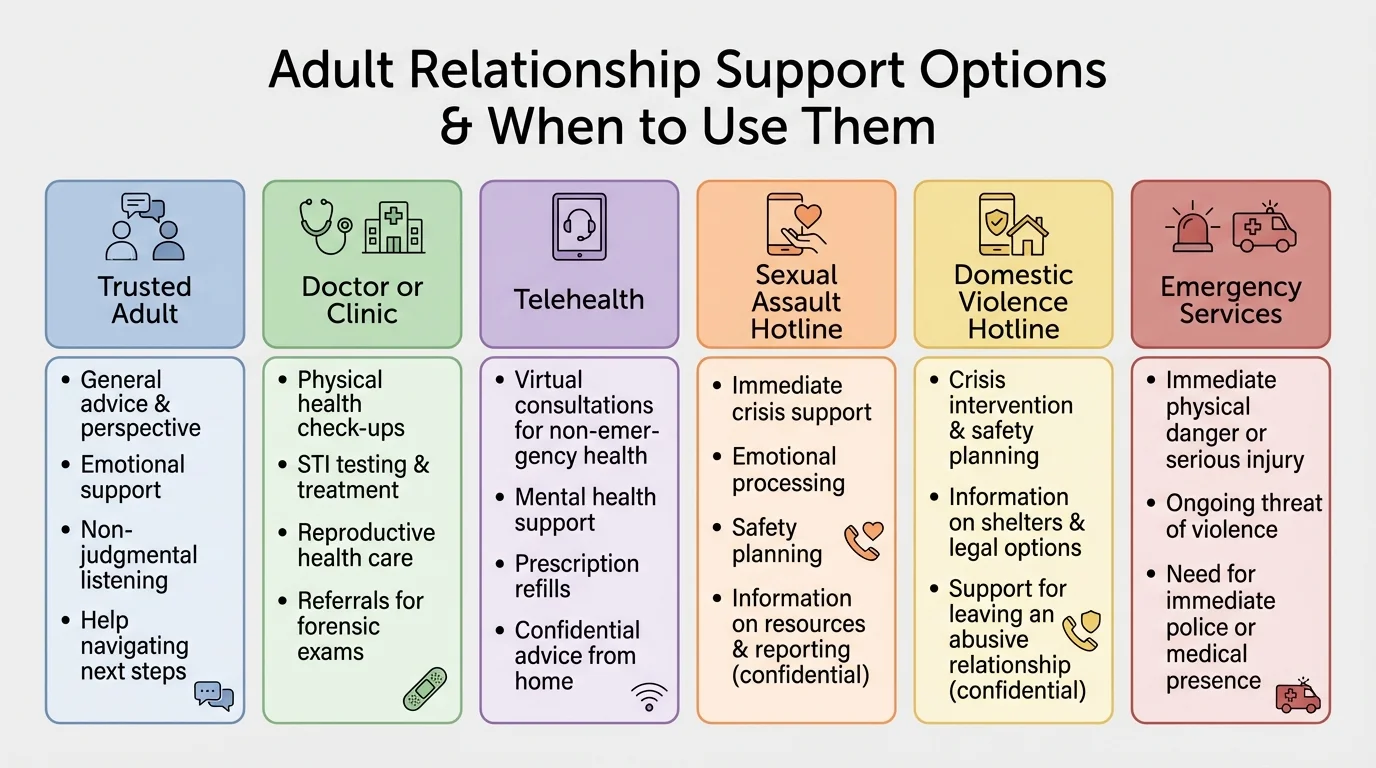
When you need support, different situations call for different resources, as [Figure 3] shows. Some concerns are mainly emotional, some are medical, and some are urgent safety issues. Knowing where to go ahead of time can save you from panic and confusion later.
Reliable health resources can include a doctor, community clinic, sexual health clinic, telehealth provider, nurse line, pharmacist, mental health counselor, or a trusted adult who can help you contact the right service. For relationship abuse, coercion, stalking, threats, or sexual assault, hotlines and crisis services can help you make a safety plan and understand your options.
If privacy is a concern, ask directly: "Will this stay confidential?" "What are the limits of privacy for someone my age?" "Can I get tested or treated without a parent in the room?" Rules vary by location, so asking is practical, not suspicious. You deserve clear information.
Be careful with social media advice. Short videos and anonymous posts can normalize risky behavior or spread misinformation. Use credible sources such as licensed medical providers, recognized public health organizations, or official hotline services. If advice sounds dramatic, shaming, or too simple for a serious issue, verify it elsewhere.
How to choose a reliable resource
Use three quick checks: Is the source qualified, is the information current, and does it give practical next steps? An influencer may sound confident without being correct. A clinic website or licensed professional is more likely to give accurate, updated guidance.
If you or someone else is in immediate danger, emergency services are the right choice. If the issue is not immediate danger but still feels unsafe, a hotline or crisis service can help you decide what to do next without having to figure it all out alone.
When a relationship decision feels confusing, use a simple framework instead of only following emotion.
Step 1: Name the choice. What exactly are you deciding? Becoming exclusive? Meeting in person? Sharing sexual images? Having sex? Staying in the relationship? Breaking up?
Step 2: Check for willingness. Do you genuinely want this, or do you mainly want to avoid conflict, keep attention, or stop someone from being upset?
Step 3: Check for readiness. Do you have the information, privacy, transportation, protection, time, and emotional stability needed to make this choice safely?
Step 4: Check for respect. Can you say no without punishment? Can you ask questions without being mocked? Can you set conditions without being pressured?
Step 5: Check consequences. If this goes badly, what are the likely emotional, physical, digital, or legal consequences? What is your backup plan?
Step 6: Act slowly enough to stay in control. If you need time, say so. A healthy relationship can survive a pause. Pressure usually means the other person is prioritizing speed over respect.
Case study: deciding whether to meet someone from online
You have been talking with someone for two months through messages and video calls. They want to meet alone at night and keep the meeting secret.
Step 1: Name the issue.
The issue is not only whether you like them. It is whether the meeting plan is safe and respectful.
Step 2: Check for red flags.
Secrecy, pressure, and isolation are concerns. Wanting to meet only alone at night can increase risk.
Step 3: Set conditions.
You might say, "I am only willing to meet in a public place during the day, and someone I trust will know where I am."
Step 4: Read the response.
If they respect the plan, that supports safety. If they get angry, guilt-trip you, or keep pushing, that is useful information.
The consent process in [Figure 2] applies beyond physical intimacy. It also applies to meeting plans, photo sharing, travel, and private information. Respect should stay visible in every part of the relationship.
Scenario one: A person you are dating says, "If we are official, you should share your phone password." A healthy response is, "Being in a relationship does not mean giving up privacy." Trust is built through behavior, not surveillance.
Scenario two: During a make-out session, one person becomes quiet and stiff. Even without hearing the word no, the right move is to stop and ask if they are okay. Silence is not a green light.
Scenario three: A partner says they are "too embarrassed" to get tested and wants reassurance instead. Reassurance is not a medical result. If testing matters to you, keep that boundary.
Scenario four: After a breakup, an ex repeatedly messages, threatens to post private photos, and creates new accounts when blocked. That is not romance or persistence. It can be harassment or abuse. Save evidence, block, tighten account privacy, tell a trusted adult or support service, and seek legal or safety help if needed.
Scenario five: You care about someone, but every serious conversation turns into guilt, blame, or tears until you give in. That pattern matters. Love does not require you to surrender your judgment.
As [Figure 3] makes clear, help is not one-size-fits-all. A clinic may help with testing or emergency contraception, while a hotline may help with coercion, stalking, or fear. Good judgment includes knowing which kind of support fits the problem.
The goal is not to become suspicious of everyone. The goal is to become skilled at recognizing respect, naming your limits, and choosing relationships that leave you safer, healthier, and more like yourself rather than less.
