Most people think safety plans are only for extreme situations. They are not. The best time to decide what you will do if someone pressures you, ignores your boundaries, tracks your location, or makes you feel unsafe is before it happens. In adult life, your relationships become more independent. You may be dating, working, driving, managing your own schedule, meeting people online, or spending time in places where no parent or teacher is automatically stepping in. A personal plan helps you protect your time, privacy, emotions, body, and future.
A good safety plan is not about living in fear. It is about making calm decisions ahead of time so you are less likely to freeze, second-guess yourself, or get pulled into someone else's pressure. It also helps you notice the difference between normal conflict and a pattern that is becoming controlling or dangerous.
Healthy relationships are built on respect, honesty, care, and consent. But even healthy relationships can involve misunderstandings, strong emotions, or moments when you need to say no clearly. A safety plan gives you a way to protect yourself without having to invent a response under stress.
Think about common adult situations: someone keeps texting you after you said you need space; a date pressures you to share your location; a partner wants your passwords "to prove trust"; a friend becomes possessive when you spend time with others; a roommate enters your room without permission; a coworker messages you late at night in a way that feels personal and uncomfortable. None of these situations should be ignored just because they do not look dramatic at first.
Personal safety plan is a written or mental plan for how you will protect yourself in relationships and stressful situations. It includes your boundaries, warning signs, trusted contacts, exit options, communication scripts, and steps for getting help.
Boundary is a limit you set to protect your physical space, emotional well-being, privacy, time, values, and choices.
Support system is the people and resources you can turn to for practical help, emotional support, information, or emergency assistance.
When a safety plan is done well, it lowers confusion. When it is missing, people often stay in risky situations longer because they are trying to be polite, avoid conflict, or hope the problem will go away on its own.
Your plan starts with self-awareness. Before you can protect your boundaries, you need to know what they are. This includes physical boundaries, emotional boundaries, digital boundaries, and practical boundaries around time, transportation, and money.
Ask yourself what behaviors make you feel respected and what behaviors make you tense, guilty, trapped, or small. For example, you may be okay with frequent texting, but not okay with someone demanding instant replies. You may be comfortable with affection, but not with any pressure after you say no. You may like sharing parts of your life online, but not your live location or private photos.
It helps to sort your limits into three groups: always okay, sometimes okay, and never okay. Your "never okay" list becomes your non-negotiables. These are behaviors that tell you to step back, set a stronger boundary, or leave.
Example: Turning vague feelings into clear boundaries
Step 1: Notice the discomfort.
You feel stressed when someone sends repeated messages like "Why aren't you answering?" or "If you cared, you'd reply now."
Step 2: Name the boundary.
Your boundary might be: "I do not respond well to pressure for immediate replies. I answer when I am available."
Step 3: Decide the consequence.
If they keep doing it, you mute, pause the conversation, or reduce contact.
Step 4: Prepare a script.
"I'm not available all the time. Please stop pressuring me to respond immediately."
Try This: Write down five boundaries in your phone notes under the categories physical, emotional, digital, time, and money. Keep the wording simple enough that you could actually say it out loud.
Relationship behavior exists on a spectrum, as [Figure 1] shows. Some actions are respectful and healthy, some are unhealthy but may improve with accountability, and some are abusive and dangerous. Knowing the difference helps you respond appropriately instead of minimizing what is happening.
Healthy patterns include respecting your no, accepting feedback, encouraging your independence, communicating honestly, taking responsibility after mistakes, and caring about your comfort. Healthy people do not need to control you to feel secure.
Unhealthy patterns include jealousy framed as love, guilt-tripping, silent treatment, repeated boundary testing, pressure for access to your phone, or making you feel responsible for their emotions. These behaviors are serious because they can escalate if not addressed.
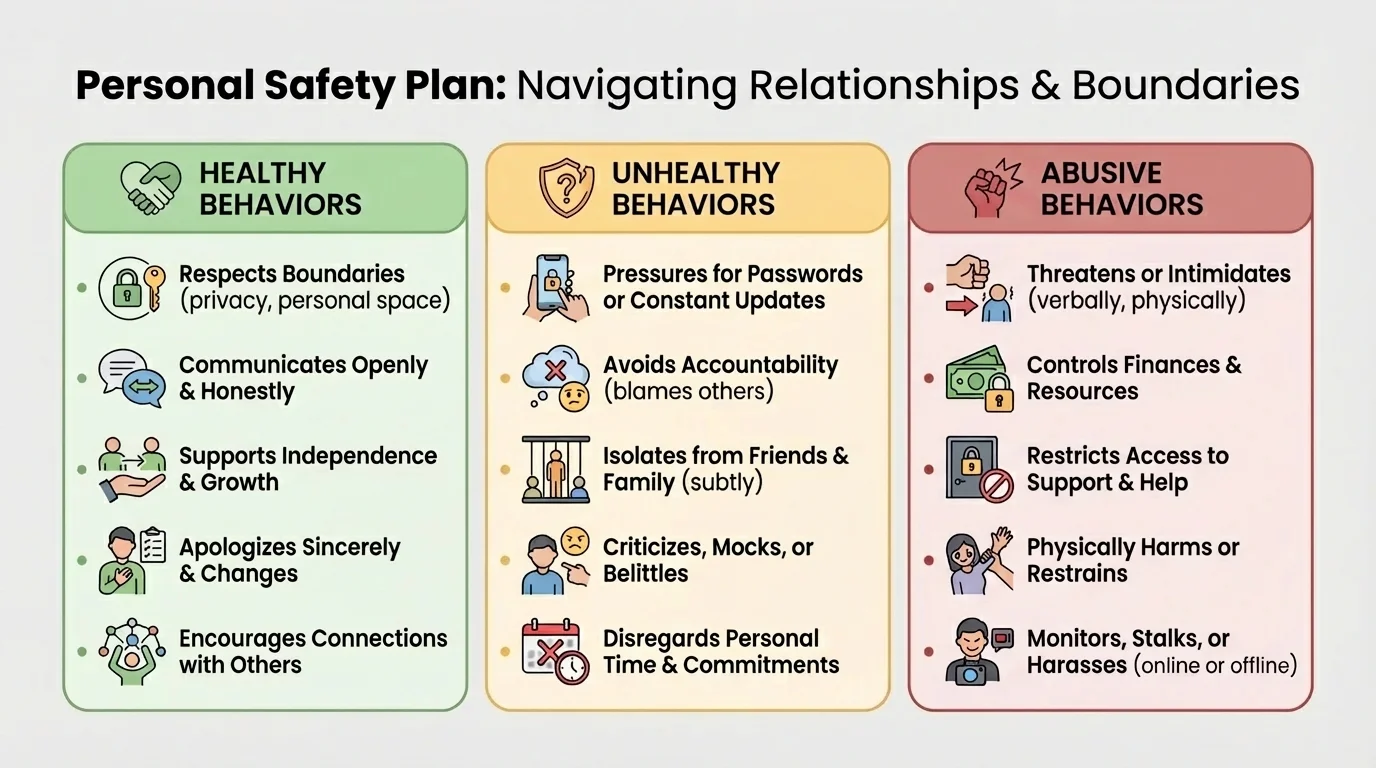
Abusive patterns include threats, intimidation, forced sexual contact, monitoring your movements, isolating you from support, destroying property, humiliating you publicly or online, controlling money, blackmail, stalking, or making you afraid to disagree. Abuse is not just physical. It can be emotional, sexual, digital, financial, or verbal.
One of the most important safety terms to know is coercion. Coercion means pressuring, manipulating, guilting, wearing down, or threatening someone into saying yes. If someone only accepts your boundary after arguing, begging, insulting, or making you feel guilty, that is not respect.
Consent must be free, informed, specific, and reversible. A real yes is not created by pressure, fear, intoxication, confusion, or exhaustion. You can change your mind. You do not owe physical contact, emotional access, or private information because you were nice before, dated before, or said yes to something else earlier.
Another key warning sign is isolation. This happens when someone tries to cut you off from friends, family, activities, work, transportation, or support. It often sounds subtle at first: "Why do you need them?" "If you loved me, you'd stay with me." "Your friends are a bad influence." Over time, isolation makes it harder to leave or get help.
As you saw in [Figure 1], the difference between care and control often shows up in choice. Care gives you room to decide. Control punishes you for deciding differently.
A useful plan is concrete, not vague. It works best when broken into clear actions, as [Figure 2] illustrates: what you do before a situation, during it, and after it. You do not need to expect the worst from everyone. You are simply preparing for the possibility that someone may ignore your limits.
Start with your early warning signs. These are the behaviors that tell you to pay attention. Examples include repeated pressure after you say no, anger when you spend time with others, invasions of privacy, lying that makes you doubt yourself, showing up uninvited, or using your insecurities against you.
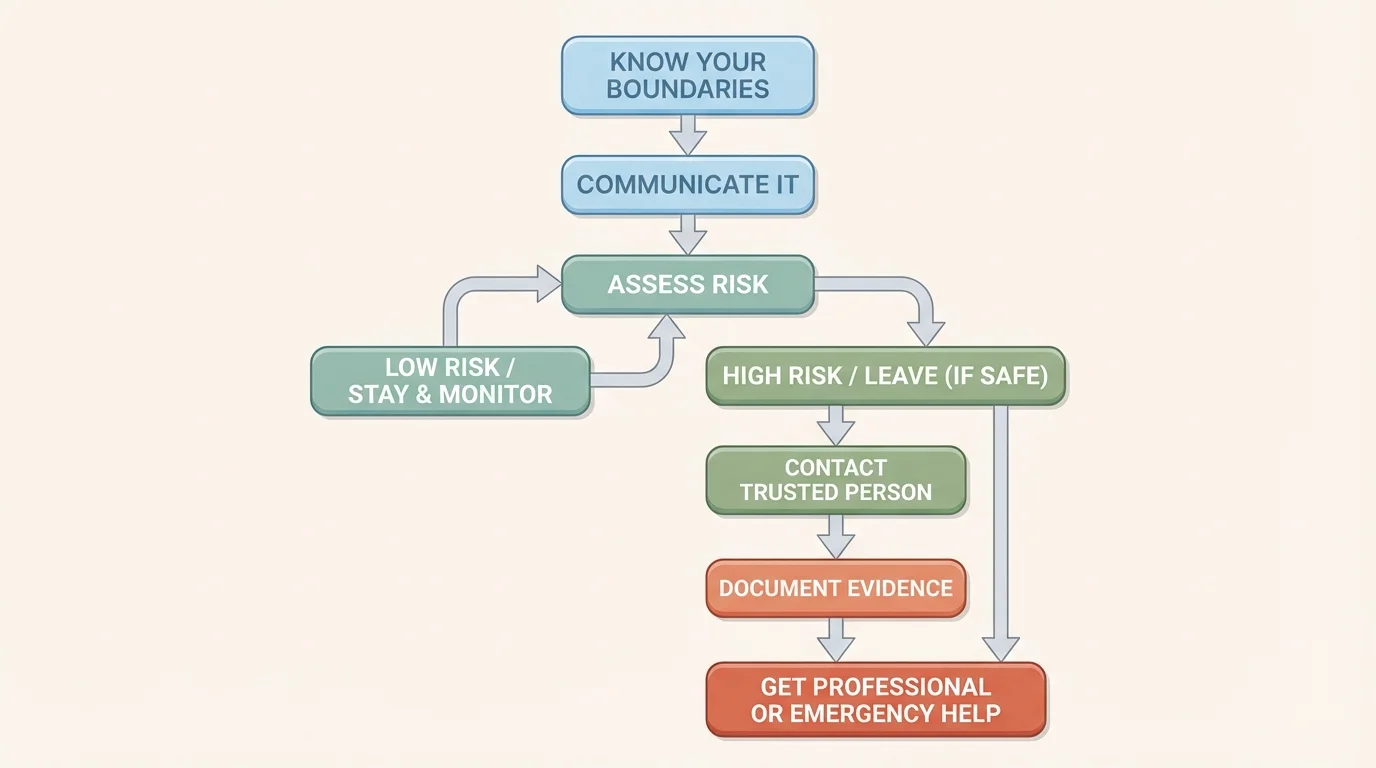
Step 1: Choose your trusted contacts. Pick at least three people you can contact: one friend, one family member or trusted adult, and one professional or community resource if available. Save them in your phone favorites. Decide what kind of help each person can give, such as a ride, a place to stay, emotional support, or help making a report.
Step 2: Set up a check-in system. If you are meeting someone new, going on a date, attending a party, or having a difficult conversation, tell a trusted person where you are going, who you are with, and when you will check in. A simple message can work: "I'm meeting Sam at 6:30. I'll text you by 9:00." You can also use a code phrase like "Can you send me the recipe?" to mean "Call me now" or "I need help leaving."
Step 3: Plan your transportation. Do not rely completely on the other person for your ride if you are unsure about them. Keep your phone charged, know your route, carry enough money for transportation, and have a backup exit option. If your only ride is the person making you uncomfortable, your choices shrink fast.
Step 4: Protect your essentials. Keep your phone, charger, ID, keys, medications, and payment method accessible. In a high-stress moment, searching for basic items wastes time and increases risk.
Step 5: Prepare your boundary scripts. Decide in advance how you will say no, leave, or slow things down. Short sentences are usually stronger than long explanations: "No." "I'm leaving now." "That doesn't work for me." "Do not come over." "I said no."
Step 6: Decide your exit triggers. You do not have to wait until something becomes extreme. Leave if a person ignores your no, blocks your path, takes your phone, pressures you sexually, gets aggressive, becomes unpredictable while using substances, or makes you fear what will happen if you stay.
Step 7: Plan for what happens after. If something concerning happens, your next steps might include contacting a trusted person, going to a safe place, taking screenshots, writing down what happened, blocking the person, changing passwords, or getting medical or legal help.
Example: A practical date safety plan
Step 1: Before the date
You share the location, time, and the person's first and last name with a trusted contact. You charge your phone and bring your own payment method.
Step 2: During the date
You keep your drink with you, stay aware of your comfort level, and notice whether the person respects small boundaries.
Step 3: If pressure starts
You say, "I'm not comfortable with that," and watch their reaction. Respectful people adjust. Unsafe people argue, mock, or push harder.
Step 4: If you need to leave
You use your code phrase, call your own ride, go to a public place, and let your trusted contact know you are leaving.
Try This: Put an emergency contact, a rideshare app if available, and one trusted person in your phone favorites today. That small step removes friction in a stressful moment.
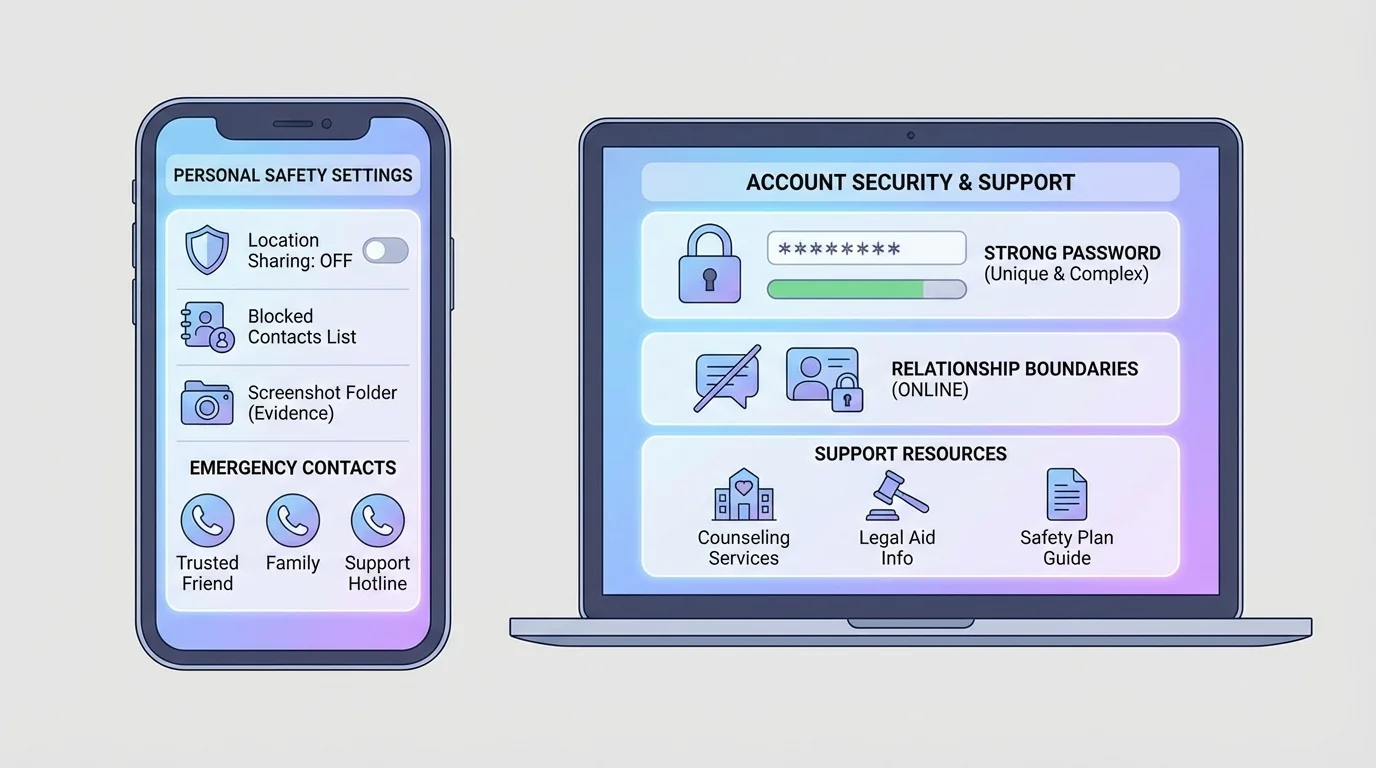
Modern relationship safety includes digital safety, and it has several layers, as [Figure 3] shows: privacy settings, account security, location control, and evidence preservation. A person does not need to be physically near you to violate your boundaries.
Digital boundaries include your passwords, photos, device access, location sharing, social media accounts, private messages, and online identity. No one is automatically entitled to these because you are dating them, care about them, or want to avoid conflict.
Common digital red flags include demanding passwords, checking your phone without permission, insisting on live location access, creating fake accounts to monitor you, posting private information, threatening to share images, or contacting you across multiple platforms after you block them.
If a person is repeatedly watching, tracking, or contacting you online in a way that causes fear or distress, that may be stalking. Stalking can happen through direct messages, location tags, shared accounts, AirDrop-style contact, smart devices, or friends' accounts. Take it seriously early.
Protect yourself digitally by using strong unique passwords, enabling multi-factor authentication, checking app permissions, limiting location sharing, reviewing who can see your posts, and logging out of shared devices. If you end a relationship, change passwords for email, banking, cloud storage, and social media. Also review devices that stay connected, such as tablets, watches, or smart home systems.
Many people think blocking someone solves every digital problem, but a determined person may switch accounts, use mutual contacts, or keep access through a shared device or cloud account. Reviewing connected devices and password recovery options matters just as much as blocking.
If you may need help later, preserve evidence. Take screenshots, save voicemails, photograph damage, and write down dates, times, and locations. This documentation can help you explain the situation clearly to a trusted adult, employer, campus office, healthcare provider, advocate, or law enforcement if needed.
Later, when you review your plan, return to [Figure 3] and check each layer again. Digital safety is not one setting; it is a set of habits.
Many people wait too long to ask for help because they think their situation is not "bad enough." You do not have to prove extreme harm before reaching out. Support is for confusion, concern, fear, pressure, harassment, and uncertainty too.
Your support system can include friends, parents or guardians, relatives, coaches, faith leaders, counselors, doctors, therapists, supervisors, human resources staff, hotline advocates, or local community organizations. Different people are useful for different needs. Some are good listeners. Some are good planners. Some can offer transportation or a safe place.
| Need | Who might help | What to ask for |
|---|---|---|
| Emotional support | Trusted friend, family member, counselor | "Can I talk through what happened?" |
| Safe transportation | Friend, relative, rideshare, community contact | "Can you pick me up now?" |
| Workplace issue | Supervisor, HR, mentor | "I need help with unwanted contact and safety at work." |
| Medical care | Clinic, doctor, urgent care | "I need confidential care and information about my options." |
| Crisis support | Hotline, local advocate, emergency services | "I am not safe and need immediate guidance." |
Table 1. Examples of support needs, possible helpers, and clear ways to ask for assistance.
When you ask for help, be direct. You do not need a perfect speech. You can say, "Someone is crossing my boundaries and I need help making a plan," or "I ended contact, but they keep showing up and messaging me," or "I'm not in immediate danger right this second, but I feel unsafe."
"A boundary is not a request for permission. It is a statement of what you will and will not allow."
Sometimes the first person you tell may not respond well. They may minimize, misunderstand, or focus on what you "should have done." That does not mean your concern is not real. Try another support person. Keep going until you reach someone who takes you seriously.
If you believe you are in immediate danger, your first priority is safety, not explanation. Leave if you can. Go to a public or secure place. Contact emergency services if needed. Call or text someone who can help you right away. If you cannot talk freely, use your code word or send a brief location message.
If a person is escalating, avoid arguing to prove your point. Your goal is not to win the conversation. Your goal is to get safe. In high-risk moments, short responses and physical distance are often more effective than long emotional discussions.
After an urgent event, seek support quickly. That might mean medical care, counseling, advocacy services, reporting options, or help getting your belongings. If your home is not safe, identify alternate places ahead of time such as a relative's home, a friend's house, or another trusted safe location.
Emergency action depends on context. If the risk is immediate, contact local emergency services right away. If the situation is serious but not immediate, a hotline, advocate, clinic, or trusted adult can help you decide next steps.
Some people hesitate because they worry they are overreacting. A useful rule is this: if someone's behavior makes you afraid to say no, afraid to leave, afraid to sleep, or afraid to be found, treat it as serious.
Boundaries are easier to hold when your words are ready. Stress makes people talk too much, apologize for basic limits, or get pulled into debate. Short, calm statements work better.
Here are realistic examples you can adapt:
To slow down: "I'm not ready for that." "I want to take this slower." "I need more space."
To protect privacy: "I don't share passwords." "Turn off my location access." "Do not post that photo."
To respond to pressure: "I said no." "Stop asking." "Trying to guilt me is not okay."
To end contact: "This relationship is no longer healthy for me. Do not contact me again."
To ask for help: "I need you to stay on the phone with me." "Can you come get me?" "I need help making a safety plan."
Example: Responding to manipulative language
Step 1: Notice the tactic.
The person says, "If you really loved me, you would tell me your password."
Step 2: Identify what is happening.
This is pressure and a test of control, not proof of love.
Step 3: Give a short response.
"I don't share passwords. This is not up for debate."
Step 4: Follow through.
If the pressure continues, end the conversation, reduce contact, and tell a trusted person what happened.
Try This: Save two boundary scripts and one help script in your notes app. In a stressful moment, prepared language can keep you focused.
Your safety plan is not a one-time assignment. Adult life changes quickly: a new job, a new relationship, a new app, a new city, a new roommate, or new routines. Review your plan every few months or anytime something major changes.
Ask yourself: Who are my current trusted contacts? Do they know I might call? Are my privacy settings updated? Do I have independent transportation options? Are there any red flags I have been explaining away? What safe places could I go if I needed space or help?
A strong plan does not make you suspicious of everyone. It makes you harder to control. It helps you recognize respect, act on discomfort sooner, and reach support faster. That is a powerful adult skill.
