One of the biggest surprises of adulthood is that life rarely falls apart because of one huge mistake. More often, it gets stressful because of small things you forget over and over: missing a payment, running out of food, not knowing who to call, signing something you did not fully understand, or putting off a task until it becomes urgent. Independent living is really the skill of building systems that keep your life steady.
If you are about to finish high school, this matters now. Whether you plan to live with family, move in with roommates, rent your own place, or rely on community services while working or studying, you need practical habits that help you handle responsibilities without constant panic. Adult life is not about doing everything perfectly. It is about knowing how to organize your time, make informed choices, and get help when you need it.
Independent living means managing your everyday life with increasing responsibility, even if you still receive help from family, friends, or support services. It includes routines, money management, home care, transportation, communication, appointments, and decision-making. It does not mean doing everything alone. In real life, independent adults often use tools, supports, and services wisely.
Independent living is the ability to manage daily life, make informed choices, and use support systems effectively. Self-advocacy means speaking up for your needs, asking questions, and taking action to protect your well-being and rights.
When these skills are strong, you are more likely to pay bills on time, keep your living space safe, follow through on plans, and avoid preventable stress. When they are weak, problems stack up fast. A missed email can become a missed appointment. A missed appointment can delay medication, job onboarding, school paperwork, or housing approval. Small systems create stability.
Most adults do not rely on motivation. They rely on routine. A repeatable schedule reduces decision fatigue and keeps basic responsibilities from slipping. If you wait until you "feel ready" to do laundry, prep food, answer messages, or schedule appointments, those tasks tend to pile up.
[Figure 1] Start by thinking in three layers: daily, weekly, and monthly. Daily routines cover essentials like waking up, hygiene, meals, medication, school or work tasks, and tidying. Weekly routines cover laundry, grocery planning, deeper cleaning, transportation refills, and checking your calendar. Monthly routines cover bills, renewing prescriptions, reviewing your budget, and checking upcoming deadlines.
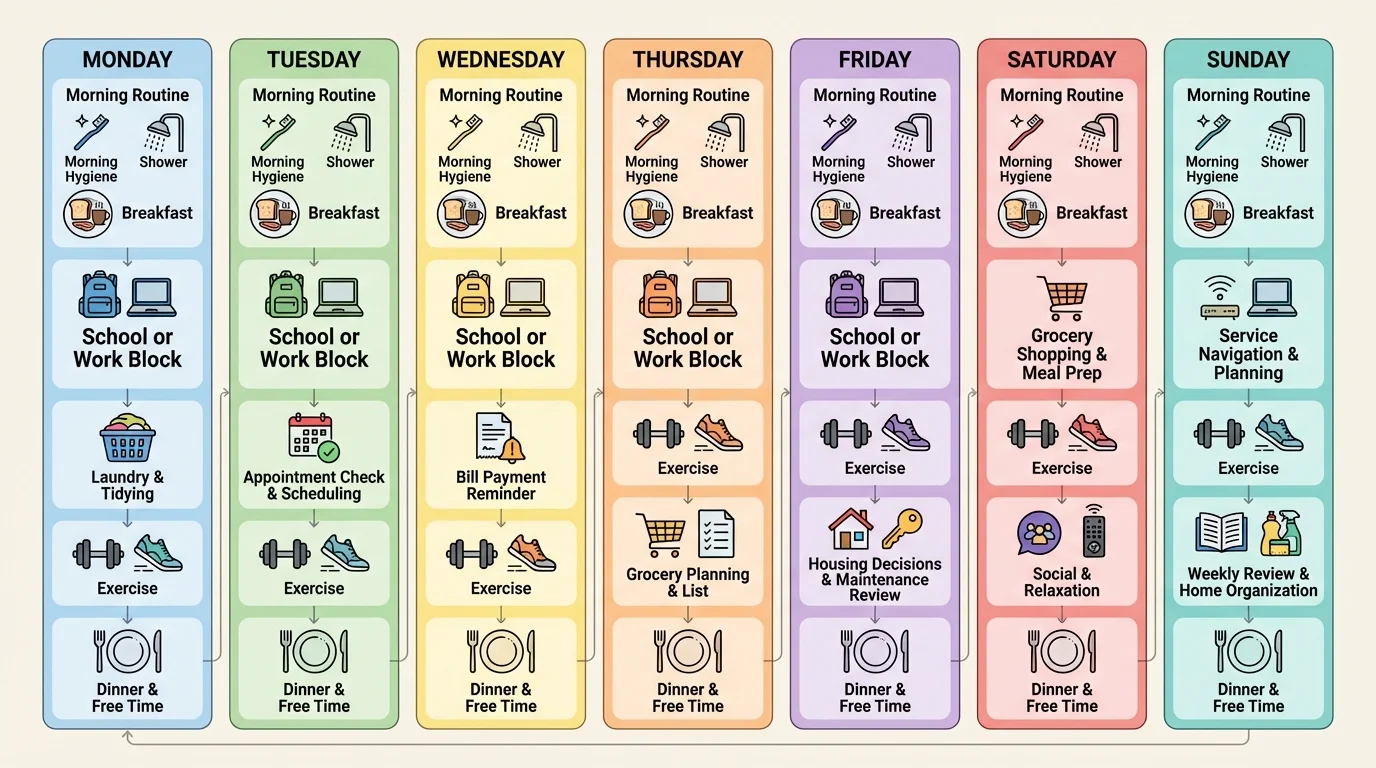
A strong routine should be simple enough that you can repeat it even on a busy week. For example, you might choose: shower and get dressed by the same time each morning, check your calendar before lunch, tidy your room or apartment for ten minutes each evening, do laundry every Saturday, and review bills every first Sunday of the month. That is more effective than creating an overly ambitious schedule you abandon after three days.
Use digital tools. Put appointments in your phone calendar the moment you make them. Turn on reminders for the day before and the hour before. Keep one notes app or paper list for tasks. If you are balancing school, work, and home responsibilities, color-coding can help: one color for money tasks, one for health, one for housing, and one for deadlines.
Try This: Pick three non-negotiable daily habits and two weekly habits. Keep them realistic. For example: daily—make your bed, check your calendar, wash dishes before bed; weekly—do laundry on Sunday, plan meals on Monday.
Routines work because they turn memory into structure. You are less likely to forget something important when the task happens at the same time, in the same place, with the same cue. For example, taking medicine right after brushing your teeth or checking your budget every Friday evening links a responsibility to an existing habit.
You also need a way to decide what comes first. A useful rule is: urgent and important tasks come first, such as paying rent by the due date, responding to a landlord about a leak, attending a medical appointment, or completing job paperwork. Important but not urgent tasks come next, such as comparing housing options, building savings, or updating your resume. Many adult problems happen when important tasks are ignored until they become urgent.
Executive functioning is the set of mental skills that helps you plan, start tasks, stay organized, and follow through. If this is hard for you, that does not mean you are lazy. It means you may need external supports: timers, visual schedules, checklists, accountability from another person, or tasks broken into smaller steps.
Here is a practical approach to managing responsibilities. Step 1: capture every task in one place. Step 2: sort tasks into today, this week, and later. Step 3: do the shortest important task first if you feel stuck. Step 4: schedule tasks that require other people, like calling a clinic or viewing an apartment, during business hours. Step 5: review your system at the same time each week.
Be careful with invisible tasks. Adult life includes things no one reminds you about: replacing toiletries, checking transit schedules, reading lease emails, filling out forms, updating your address, or keeping documents where you can find them. If something matters, it should not live only in your memory.
As you saw in [Figure 1], routines are not only about time. They connect different parts of life. Grocery planning affects your food budget. Laundry affects whether you have clean clothes for work. Calendar checks affect whether you miss services or deadlines. One habit often protects several areas at once.
Housing options are never just about where you sleep. They shape your safety, privacy, transportation, budget, stress level, and daily freedom. Good decisions require comparing several factors at once.
[Figure 2] Common options for young adults include living with family, sharing housing with roommates, renting a room in someone else's home, getting your own apartment, or living in a supported setting if you need structured help. None of these is automatically "better." The best choice is the one that fits your income, support needs, goals, and current level of responsibility.
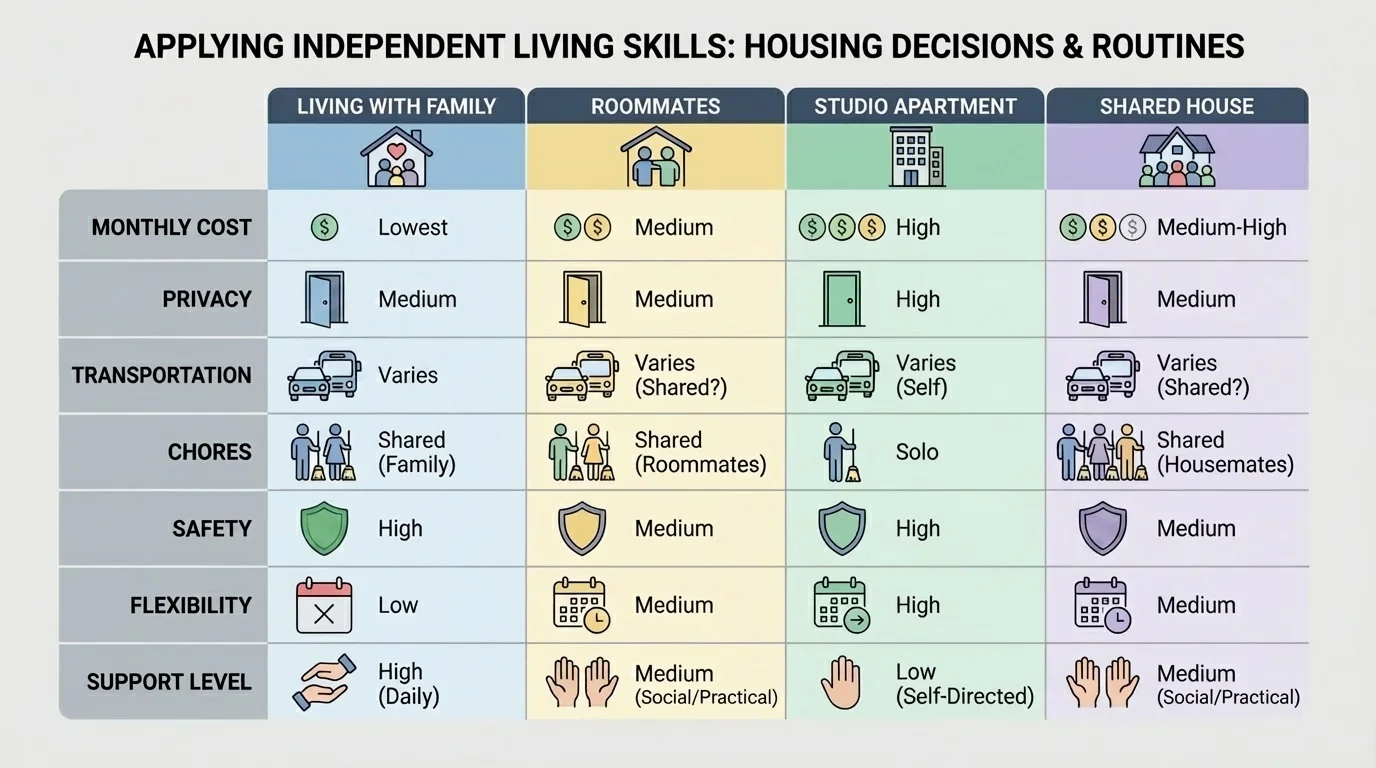
When comparing housing, look at five major categories. Cost: Can you afford not just rent, but also utilities, food, transportation, and deposits? Location: How far is it from work, training, stores, healthcare, or people you trust? Safety: Is the area well lit, secure, and in reasonable condition? Independence: How much control do you want over visitors, noise, schedule, and privacy? Support: If something goes wrong, are you on your own or do you have backup?
Here is a simple comparison table you could use when deciding.
| Housing type | Main advantage | Main challenge | Best fit for |
|---|---|---|---|
| Living with family | Lower cost and built-in support | Less privacy or independence | Saving money while building routines |
| Roommates | Shared expenses | Conflict over noise, bills, or chores | People comfortable with shared responsibility |
| Renting a room | Usually cheaper than a full apartment | Limited control over household rules | Someone needing lower cost and flexibility |
| Own apartment | Privacy and control | Highest cost and full responsibility | People with stable income and strong routines |
| Supported housing | Structured assistance | May include more rules or eligibility requirements | People who need ongoing support |
Table 1. Comparison of common housing types, including key advantages, challenges, and likely best-fit situations.
A common mistake is choosing based on only one factor, usually price or excitement. A cheaper place may cost more overall if it requires long transportation trips, has unreliable utilities, or creates unsafe situations. A more independent place may not work well if your income is unstable or you struggle to stay on top of cleaning, food, and bills.
Many first-time renters underestimate move-in costs because the first month often includes more than rent. You may need application fees, a security deposit, utility setup fees, cleaning supplies, and basic household items before you even settle in.
Try This: Make a housing checklist with your top five priorities. For example: under $900 per month, safe neighborhood, bus access, private bedroom, and no smoking in the home. Then compare every option against the same list.
Lease terms matter because once you sign, you are agreeing to legal responsibilities. A lease usually explains rent amount, due date, late fees, length of stay, guest rules, maintenance responsibilities, and conditions for moving out. Never sign quickly just because you feel pressured.
Before you agree to housing, ask what is included. Does rent cover water, electricity, internet, trash, parking, or laundry? What deposit is required? Is renter's insurance expected? If you pay $700 in rent but also $120 for utilities, $60 for internet, and $80 for transportation because the place is far away, the true monthly cost is much higher. In other words, your housing-related cost would be \(\$700 + \$120 + \$60 + \$80 = \$960\).
Also ask what happens if something breaks. If the refrigerator stops working, who fixes it? If there is mold, a leak, broken heat, or unsafe wiring, that is not just annoying; it may be a serious health or safety issue. Good landlords or housing providers explain repair procedures clearly and respond in writing.
Watch for red flags: pressure to pay before seeing the place, refusal to provide written terms, requests to send money in unusual ways, unsafe conditions, or promises that sound too good to be true. Scams often target people who are young, rushed, or desperate for housing.
Housing cost check
You are comparing two places.
Step 1: List the full monthly cost of Place A.
Rent is $650, utilities average $140, internet is $50, and transportation is $120.
The total is \(\$650 + \$140 + \$50 + \$120 = \$960\).
Step 2: List the full monthly cost of Place B.
Rent is $790, utilities are included, internet is included, and transportation is $40.
The total is \(\$790 + \$40 = \$830\).
Step 3: Compare more than rent.
Even though Place B has higher rent, it costs $130 less each month overall and may save time on commuting.
The cheaper-looking option is not always the lower-cost option.
As shown in [Figure 2], a strong housing decision balances cost with privacy, chores, transportation, and support. That balance matters more than trying to find a perfect place, because perfect housing rarely exists.
Once you live more independently, your home becomes a system you must actively manage. That includes cleaning, food storage, trash, dishes, laundry, replacing supplies, basic safety, and communication with anyone who shares the space. If these tasks are ignored, your living space can become stressful, unhealthy, or unsafe very quickly.
Use a maintenance mindset. Small actions prevent bigger problems. Wipe spills early. Report leaks immediately. Do not ignore strange smells, pests, or electrical issues. Keep a basic supply kit: trash bags, dish soap, laundry soap, all-purpose cleaner, toilet paper, bandages, flashlight, phone charger, and important phone numbers.
If you live with roommates, talk about expectations early. Who buys shared supplies? How are bills split? What happens if one person pays late? How quiet should the place be at night? What is the guest policy? Roommate conflict is often less about personality and more about unclear expectations.
You also need an emergency plan. Know where your identification, insurance information, medications, and emergency contacts are stored. Know how to leave your home in a fire and where to go if the home becomes temporarily unsafe. Save important numbers in your phone and write them somewhere physical too.
"Being responsible does not mean never needing help. It means knowing what to do next."
Try This: Create a weekly reset routine for your living space: wash dishes, take out trash, check food, clean the bathroom, do laundry, and restock essentials. Set a timer and finish what you can in one focused session.
Service navigation is the process of figuring out what help you need, identifying the right provider or agency, contacting them, and following through. It often feels confusing at first, but it becomes manageable when you treat it as a sequence of steps.
Services you may need include healthcare, counseling, public transportation assistance, banking, job support, food assistance, disability accommodations, housing support, legal aid, and community organizations. The hard part is usually not knowing that help exists. The hard part is knowing where to start and what information to have ready.
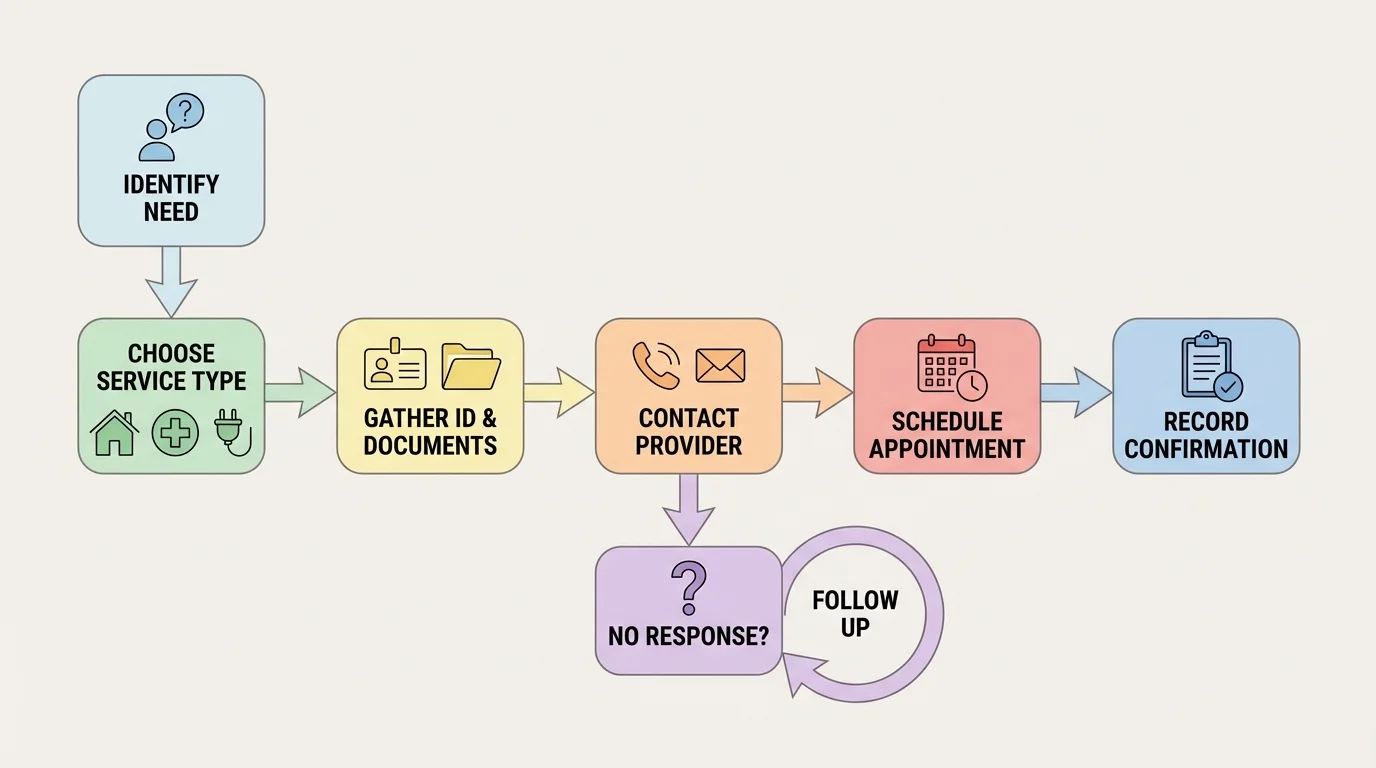
A reliable service-navigation process looks like this. First, define the problem clearly: "I need a doctor," "I need help paying for food," "I need transportation to work," or "I need a copy of my ID." Second, identify the type of service that matches the problem. Third, gather documents such as ID, insurance card, proof of address, income information, or referral paperwork. Fourth, contact the service. Fifth, write down the date, time, person you spoke with, and next steps. Sixth, follow up if you do not hear back.
Do not underestimate documentation. Many adult systems depend on paperwork. Keep physical and digital copies of identification, insurance cards, lease documents, pay stubs, school records, medical information, and important emails. Create one folder in cloud storage and one physical folder at home. When you need services quickly, this saves time and stress.
Phone calls and emails get easier with a script. You do not need to sound perfect. You just need to be clear. For example: "Hello, my name is Maya Chen. I'm calling because I need to schedule a new patient appointment. I have my insurance card and ID ready. Can you tell me what steps I need to take?" That is strong self-advocacy.
Good service navigation depends on follow-through. Many systems do not move forward automatically. You may need to call again, check your email, upload a document, confirm an appointment, or ask for clarification. Following up is not being annoying. It is part of managing your life.
You should also know your rights to ask questions. If something is unclear, say, "Can you explain that another way?" If you need written instructions, ask for them. If a person is unhelpful, stay calm and request the next step or another contact person. As shown in [Figure 3], the process works best when you move from identifying the need to documenting contact and tracking follow-up rather than stopping after one attempt.
Self-advocacy means communicating your needs respectfully and clearly. This might involve asking a landlord for repairs, requesting accommodations, disputing a bill, telling a roommate about a problem, or asking a clinic to repeat instructions. It is not rude. It is a core adult skill.
A useful communication structure is: state the issue, give relevant facts, explain what you need, and ask about the next step. Example: "The sink has been leaking since Tuesday, and the cabinet underneath is getting wet. I'm requesting a repair. Please let me know when maintenance can come by." Short, factual messages usually work better than emotional or vague ones.
Keep records when something matters. Save emails. Take screenshots of confirmations. Write down dates and names after phone calls. If a payment issue, housing issue, or appointment problem comes up later, your notes can protect you. Documentation turns "I think this happened" into "Here is exactly what happened."
You also need boundaries. Protect your personal information. Do not share your Social Security number, banking details, or identification photos unless you are certain the request is legitimate and necessary. Use official websites and verified phone numbers. Scammers often rely on urgency and confusion.
Solving a real problem: missed appointment and rescheduling
You miss a healthcare appointment because you wrote the wrong time in your calendar.
Step 1: Respond quickly.
Call as soon as you realize the mistake instead of avoiding it.
Step 2: State the situation clearly.
Say: "I missed my appointment today because I recorded the wrong time. I'd like to reschedule and ask whether there is a fee."
Step 3: Update your system.
Put the new appointment in your calendar immediately with two reminders.
Step 4: Prevent the problem next time.
After every appointment call, repeat the date and time out loud and compare it with the confirmation message.
Mistakes happen. Responsible adults correct them fast and improve their systems.
Picture two different versions of the same month. In the first version, you do not track tasks, you pick housing based only on rent, your papers are scattered, and you avoid making calls because they feel awkward. By the third week, you are low on food, behind on laundry, unsure whether your utility bill was paid, and stressed about an appointment you may have missed.
In the second version, you use a simple routine, compare full housing costs, keep documents in one place, and follow up on services. Life is still busy, but it is manageable. You know what needs attention, what can wait, and who to contact. That is what independent living looks like in practice: not perfection, but control.
Suppose you are deciding whether to stay with family for six more months or move into a shared apartment now. Staying with family might allow you to save money, build routines, and practice adult tasks with more support. Moving now might offer privacy and independence but require stronger budgeting, transportation planning, and conflict-management skills. Neither choice is automatically right. The right choice depends on your readiness, finances, and support system.
Another example: if you are starting a part-time job and taking online classes, your routine might include setting clothes out the night before, packing lunch after dinner, checking transit times each evening, doing laundry on one set day, and using one folder for all work and school documents. These small systems create reliability. Reliability is one of the most valuable adult traits you can build.
You do not need to master every skill at once. Build one system, then another. Start with routines, then housing knowledge, then service navigation. Adult competence grows through repetition, not sudden transformation.
Try This: Choose one area to strengthen this week: your routine, your housing knowledge, or your service-navigation skills. Then complete one concrete action, such as setting reminders for all appointments, comparing two housing options with a checklist, or gathering your most important documents into one folder.
