One missing document can cancel an entire international trip faster than a delayed flight. You can have the perfect itinerary, enough money, and a packed suitcase, but if your passport is expired, your visa is missing, or your entry rules were misunderstood, the trip may stop before it even starts. International travel feels exciting because it opens up the world, but it also demands adult-level planning. That is what makes it such a strong real-life skill.
If you are preparing for a graduation trip, a family visit, a volunteer program, a competition, or future solo travel, the goal is not to become a travel expert overnight. The goal is to build a system: know what to check, when to act, what to back up, and how to make smart decisions when things feel unfamiliar. Good travel planning gives you more freedom, not less.
International travel has more moving parts than a local trip. You may need a passport with enough validity left, permission to enter a country, proof of where you are staying, return travel plans, health information, and a payment method that works abroad. Some countries let you enter easily; others require weeks or months of preparation. A smart traveler checks the rules first and books second.
Think of travel planning as risk reduction. If you prepare well, problems become smaller and easier to solve. If you prepare poorly, small issues become expensive emergencies. For example, a student who checks passport expiration early might pay a normal renewal fee and relax. A student who notices the problem three days before departure might lose the entire ticket cost and any nonrefundable bookings.
International travel documents are official records that prove your identity, citizenship, travel permission, or other entry requirements. These can include a passport, visa, vaccination record, travel insurance information, and supporting documents such as hotel confirmations or invitation letters.
Before spending money, ask four practical questions: Where am I going? Why am I going? How long am I staying? What does that country require for someone with my citizenship? Those questions shape almost every decision that follows.
Your passport is the most basic travel document, and it is only useful if it meets the destination country's rules. Many countries require that your passport remain valid for several months after your arrival or departure date. As [Figure 1] shows, document readiness works like a chain: passport validity, entry permission, backups, and emergency access all connect. If one link fails, the whole trip can be disrupted.
Do not assume that "not expired today" means "good enough." Some countries use a six-month validity rule, others use different standards, and airlines often check these rules before they let you board. You should also make sure your passport has enough blank pages if required. A damaged passport can also cause trouble, even if the expiration date is fine.
Another key issue is entry requirements. These are the rules a country uses to decide whether you can enter. They may include a visa, proof of onward travel, hotel bookings, sufficient funds, or a stated purpose for your visit. If you are under 18 or traveling without both parents, some destinations also expect consent letters or additional proof of guardianship. Even if you are 17 now, this matters because travel plans often cross birthdays, graduation timing, and legal age rules.
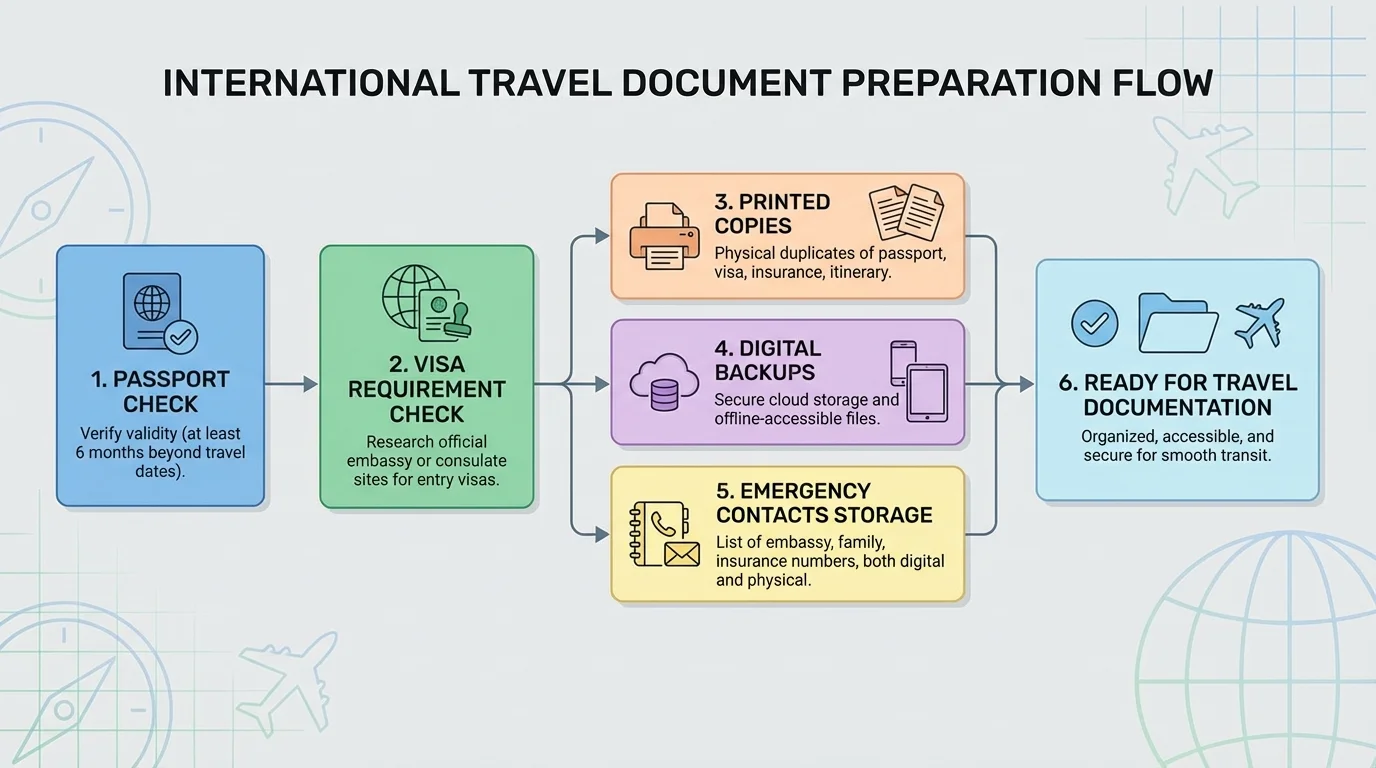
You should keep your documents in three forms: the original, a paper copy, and a secure digital copy. Originals stay with you in a safe travel wallet or money belt when moving between places. Paper copies go in a different bag from the originals. Digital copies should be stored securely, such as in a password-protected cloud folder and on your phone. That way, if your bag is lost or stolen, you still have the information needed to report the loss and prove your identity faster.
Write down essential numbers separately: passport number, issue date, expiration date, emergency contacts, travel insurance policy number, and the address and phone number of your country's embassy or consulate in the destination country. Later, if your phone battery dies or your device is stolen, these details still matter. The backup system in [Figure 1] is not overkill; it is what turns a crisis into a manageable inconvenience.
A final document habit that many first-time travelers miss is checking whether the name on every booking matches the passport exactly. A missing middle name does not always create a problem, but a wrong spelling, reversed name order, or nickname can. "Alex" on a flight booking may be rejected if the passport says "Alexander" and the airline system requires an exact match. Compare character by character before you confirm.
A visa is official permission to enter a country for a specific purpose and length of time. Some travelers do not need one for certain destinations. Others need to apply in advance. The right path depends on your citizenship, the destination, the purpose of the trip, and how long you plan to stay.
There are several common visa situations. Visa-free travel means you can enter without getting a visa first, though you still must meet entry rules. An e-visa is obtained online before travel. A visa on arrival is issued when you reach the destination, but you still need to verify that your nationality qualifies. An embassy or consulate visa usually requires a formal application before departure, often with documents, fees, and waiting time.
As [Figure 2] illustrates, this is where many travelers make a costly mistake: they search "Do I need a visa?" and stop there. That question is too simple. You need to check for your citizenship, for your destination, for your purpose, and for your exact length of stay. Tourism, study, volunteer work, internships, and paid work can all be treated differently. Staying for 14 days may be allowed, while staying for 90 days may require a different process.
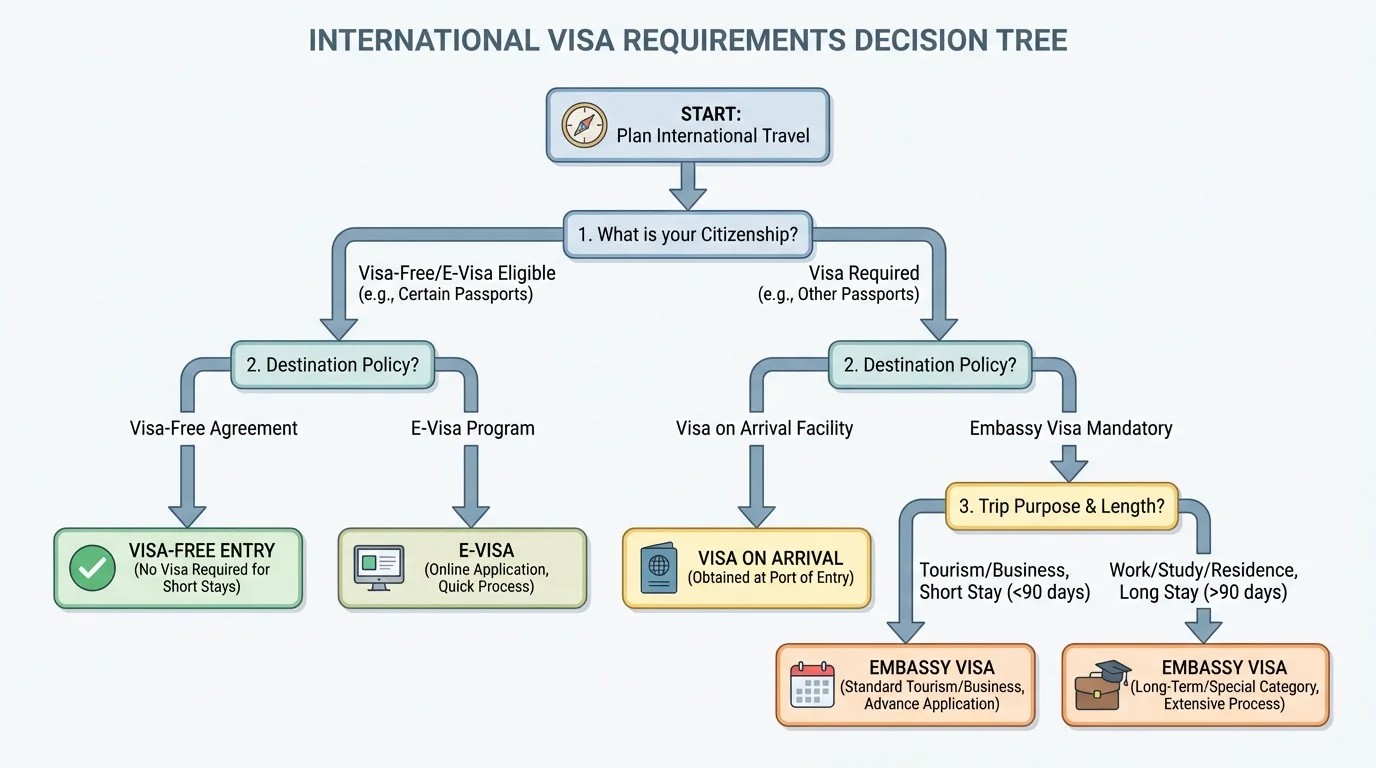
Use official sources whenever possible: embassy websites, government immigration pages, and airline travel document tools. Blogs, videos, and social media can be helpful for tips, but they may be outdated. Rules change. What worked for someone last year may not work for you now.
Visa applications often ask for supporting documents. These may include passport scans, photos, a completed form, proof of accommodation, return tickets, financial evidence, and sometimes invitation letters or school-related documentation. Read instructions carefully, because one wrong upload, wrong photo size, or missing signature can delay approval.
Timing matters. If the application says processing may take up to 15 business days, do not plan around the best-case scenario. Build a buffer. For example, if your trip begins in six weeks, starting now is safer than starting in two weeks. International planning works best when you assume some step will take longer than expected.
Case study: Choosing the right visa timeline
Jordan wants to travel for a 21-day cultural exchange program.
Step 1: Check the exact travel purpose.
Jordan first confirms whether the program counts as tourism, study, or organized exchange travel, because that changes the entry rules.
Step 2: Verify nationality-specific rules.
Jordan uses the destination country's official immigration website to check the requirements for travelers with Jordan's citizenship.
Step 3: Gather supporting documents.
Jordan prepares a passport scan, host address, return flight details, proof of funds, and the exchange program letter.
Step 4: Add a time buffer.
If the stated processing time is 15 business days, Jordan plans for longer and applies more than a month before departure.
Because Jordan starts early, there is time to fix a photo upload error without risking the trip.
One more warning: a visa does not guarantee entry. Border officers can still ask questions and make final decisions based on your documents, behavior, and stated reason for travel. Be calm, honest, and consistent.
Once your document requirements are clear, build the trip around reality instead of wishful thinking. Start with your fixed costs: transportation, accommodation, required application fees, insurance, and airport transfers. Then add daily spending for food, local transportation, activities, and a backup amount for emergencies.
A simple planning method is to separate costs into three categories: must pay before departure, likely daily costs, and emergency reserve. If your round-trip flight is $850, your accommodation is $420, and your visa fee is $60, your confirmed pre-trip cost is $1,330. If you expect to spend about $35 per day for 10 days, daily costs total $350. Add an emergency buffer of $200, and your estimated working budget becomes $1,880.
That is not advanced math, but it is powerful planning. In calculation form, your estimate is \(1,330 + 350 + 200 = 1,880\). The point is not precision to the cent. The point is avoiding the dangerous habit of budgeting only for the fun parts of travel while ignoring required costs.
Why a budget buffer matters
International travel includes uncertainty: baggage fees, exchange-rate changes, local transit errors, a delayed connection, or a meal that costs more than expected in a tourist area. A buffer gives you decision-making room. Without one, a small problem can force bad choices, like taking unsafe transport because it seems cheaper in the moment.
It also helps to build an itinerary that leaves breathing room. Packing every day with activities may look efficient, but it increases stress, transportation errors, and missed reservations. If you are landing after a long flight, planning a complicated multi-stop evening across a city you have never seen is risky. A smarter first day might be airport arrival, official transportation, hotel check-in, food, and rest.
Travel insurance is another practical step, not just a formality. Policies differ, but many cover medical issues, cancellations, interruptions, or lost baggage. Read what is actually included. "Having insurance" sounds reassuring until you realize your plan excludes the situation you expected it to cover.
Travel is not just movement between places. It is entry into someone else's social environment. Cultural preparation affects ordinary decisions all day long: how you greet people, what you wear, how loudly you speak, when you tip, whether you photograph public spaces, and what behavior is considered rude. Knowing these basics helps you avoid accidental disrespect.
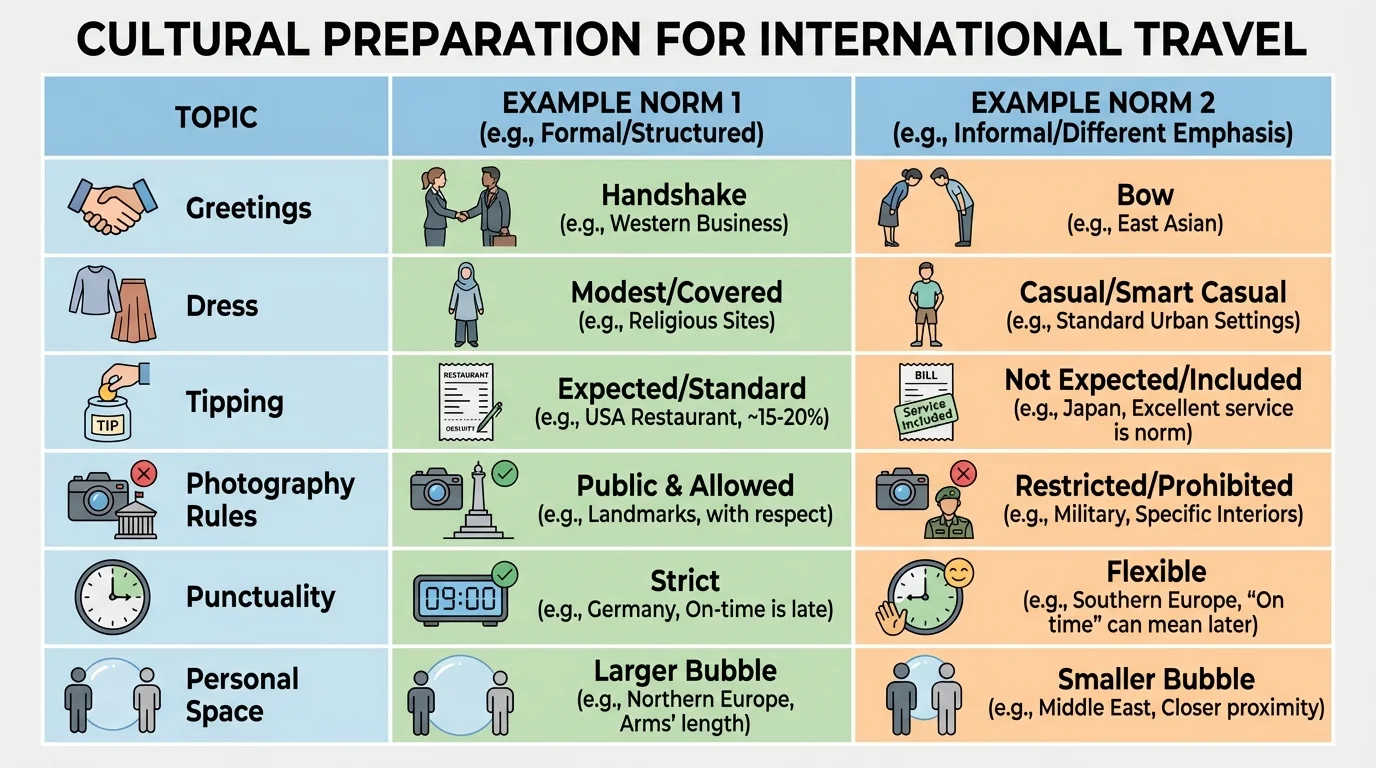
As [Figure 3] shows, cultural norms are the shared expectations that guide behavior in a place or community. They can affect greetings, personal space, punctuality, dress, table manners, religious respect, and communication style. In one country, direct eye contact may signal confidence. In another, it may feel too intense in certain situations. In one place, arriving 10 minutes early is polite. In another, social timing is more flexible.
Before you travel, learn a few useful phrases in the local language, even if many people speak English. Start with greetings, "please," "thank you," "excuse me," "Where is...?", and "I need help." This is not only practical; it signals respect. You do not need perfect pronunciation to show effort.
Also research legal and social rules that visitors often overlook. Some destinations have strict laws about medications, public behavior, photography near government buildings, chewing gum, alcohol, vaping, or clothing in religious sites. "I didn't know" is not a defense that protects you from consequences.
Money habits are cultural too. Tipping may be expected, appreciated, included, or even considered inappropriate depending on the country. Lines may form differently. Bargaining may be normal in one setting and rude in another. The categories in [Figure 3] help you prepare for these everyday interactions before they become awkward.
Many travel conflicts are not caused by bad intentions. They happen because visitors assume their own habits are "normal" everywhere. Learning a few local expectations can immediately improve how safe, welcome, and confident you feel.
Respectful travel also includes digital behavior. Be careful about posting your exact location publicly in real time, especially if you are traveling alone. Ask before posting close-up photos of people, children, homes, or private spaces. What feels harmless to you may feel invasive to someone else.
The first hours after landing often matter the most. You are tired, distracted, and in a place where signs, language, payment systems, and transportation rules may be unfamiliar. The safest approach is to slow down, verify your route, and use official systems before you leave the airport or station.
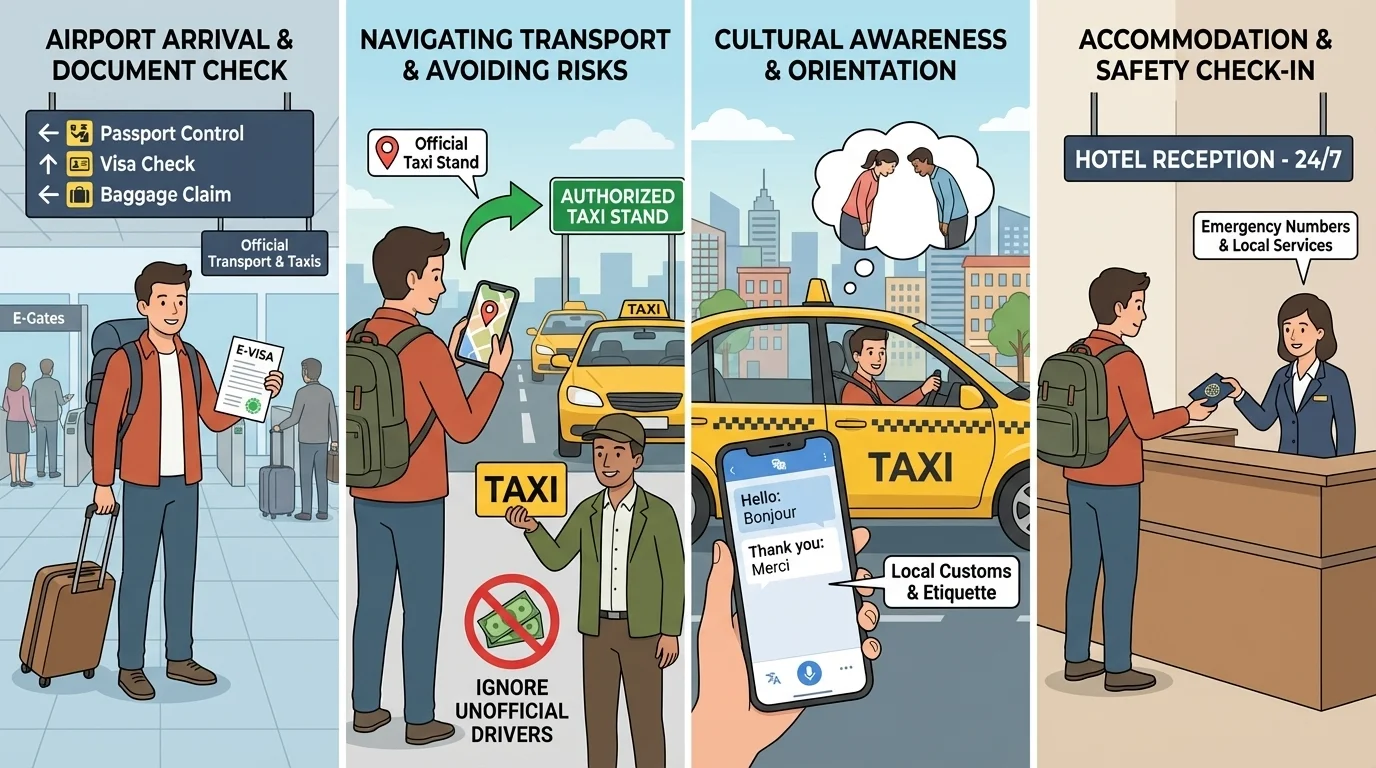
As [Figure 4] illustrates, download offline maps before you travel. Save your accommodation address in the local language if possible, along with a screenshot of the route from the airport. Do not rely on having instant mobile data. Airports often have Wi-Fi, but the connection may be weak, slow, or require verification.
When choosing transportation, favor official taxi lines, licensed ride-share pickup points, airport buses, or pre-booked transfers. Be cautious if someone approaches you aggressively offering "cheap" transport right outside arrivals. A lower price can become a scam, an unsafe ride, or a route to the wrong place.
Keep valuables controlled, especially during transitions: baggage claim, train platforms, bus loading, and crowded city centers. Use zipped bags, keep your phone secure when not in use, and avoid placing your passport loosely in a pocket. Most theft is not dramatic. It happens when a tired traveler is juggling too many items at once.
Scams often depend on pressure and confusion. Common examples include fake ticket helpers, overfriendly strangers directing you to the "wrong" machine, unofficial currency exchange offers, and drivers claiming your hotel is closed so they can take you elsewhere. A good rule is simple: if someone rushes you, pause. If someone changes your plan unexpectedly, verify independently.
You should also have a communication plan. Share your itinerary, accommodation details, and check-in times with a trusted person. Decide what happens if you do not respond by a certain hour. This is especially important if you are traveling without experienced adults.
| Situation | Safer response | Risky response |
|---|---|---|
| Arriving late at night | Use official transport and go directly to lodging | Wander to compare random street options |
| Lost in a city center | Step into a staffed business or hotel to reorient | Follow the first stranger who offers help |
| Phone battery low | Use a power bank and saved screenshots | Depend on live navigation only |
| Passport missing | Use backup copies and contact embassy or consulate | Panic and delay reporting it |
| Driver changes the route | Track route on map and speak up early | Stay silent and hope it is fine |
Table 1. Comparison of safer and riskier choices in common international travel situations.
If something goes wrong, respond in order: get to a safer public place, contact a trusted person, report the issue to the right authority, and use your backup information. The arrival sequence in [Figure 4] is useful because it shows how good travel safety is mostly about calm, boring decisions made early.
The final week before departure is not the time for guessing. It is the time for confirmation. Recheck your passport, visa or entry approval if needed, transportation bookings, accommodation address, payment methods, health items, and baggage rules. If your airline allows online check-in early, set a reminder.
Make sure you have at least two payment options, such as a primary card and a backup card. Tell your bank or card provider about your trip if required. Check whether your phone plan works internationally or whether you need an eSIM, local SIM, or offline-only setup. Pack chargers, adapters, and a power bank.
Review your arrival plan one more time: How do you get from the airport to where you are staying? What do you do if your flight is delayed? Where will you get local currency if needed? What is your backup if your phone fails? Strong travelers answer these questions before departure, not while standing confused in arrivals.
Try This: Build a one-page travel readiness sheet
Step 1: List identity details.
Write your full passport name, passport number, expiration date, and nationality.
Step 2: Add trip logistics.
Include flight numbers, accommodation address, check-in times, and transport from the airport.
Step 3: Add emergency support.
Record a trusted contact, insurance information, and embassy or consulate details.
Step 4: Store it wisely.
Keep one printed copy in your bag and one secure digital version on your device.
This takes a short amount of time and can save hours during a stressful situation.
Your packing choices should support your safety too. Keep one change of clothes, medications, charging equipment, and essential documents in your carry-on if possible. If checked baggage is delayed, you still have what you need for the first day.
Good travel judgment is not about being fearless. It is about noticing risk early and choosing the stable option even when something flashy or convenient looks tempting. For example, if you arrive tired and someone offers an unmarked ride for slightly less money than the official taxi stand, good judgment says no. Saving a small amount is not worth losing control of the route, price, or your safety.
Another example: suppose you are invited by new acquaintances to a location far from your planned area. Maybe they seem friendly and the opportunity sounds exciting. Good judgment means asking: Do I know where this is? Can I leave easily? Has someone else been told where I am? Is my phone charged? Do I feel pressured? Trusting your instincts is not rude. It is part of adult self-protection.
International travel can be one of the most rewarding things you do. It builds independence, flexibility, and confidence. But those benefits do not come from luck. They come from preparation: understanding documents, respecting rules, reading the situation, and having a backup plan when something changes.
"Confidence is not walking into the unknown with no plan. Confidence is knowing you prepared for what you can control."
When you travel well, you are not just getting from one country to another. You are proving that you can manage logistics, protect yourself, adapt respectfully, and think clearly under pressure. That is a real adult skill, and it matters far beyond travel.
