People often think leadership begins when you get a title, but in real life it usually starts much earlier. It shows up when you organize a volunteer project, help a group stay on track during a video call, take responsibility at a part-time job, or step in calmly when others are overwhelmed. By the time you are preparing for adult roles, the most useful question is not "Am I a leader?" but "What kind of leader am I becoming?"
Knowing your leadership strengths matters because future opportunities often go to people who are dependable, self-aware, and ready to guide others. If you understand what you already do well, you can use those strengths with confidence. If you know where you still need growth, you can improve before poor habits damage trust, teamwork, or your reputation.
Self-assessment means taking an honest look at your actions, patterns, and impact. It is not about rating yourself as "good" or "bad." It is about noticing what you consistently do, how other people respond, and what happens when responsibility increases.
In practical life, leadership affects more than formal positions. It influences how you manage deadlines, communicate in group chats, solve conflicts, support people, and make decisions when no one else wants to decide. A person with strong leadership habits often creates clarity and momentum. A person with weak leadership habits can create confusion, stress, and unfinished work even if they have talent.
Leadership is the ability to influence people toward a goal through responsibility, communication, judgment, and action. Initiative is acting without waiting to be told every step. Accountability is owning your choices, results, and mistakes.
A useful way to think about leadership is this: leadership is not about being the loudest person in the call or the one who always takes control. It is about helping people move forward in a healthy, effective way. Some strong leaders are outgoing. Others are quiet but organized, steady, and deeply reliable.
Real leadership usually includes a few core behaviors. You notice what needs to be done. You communicate clearly. You follow through. You respect other people while still making decisions. You stay focused on the goal instead of chasing attention. Most importantly, other people can trust you.
That trust is built through patterns. If you often show up prepared, answer messages responsibly, admit mistakes, and help a team recover when things go wrong, people begin to see you as someone worth following. If you avoid hard tasks, disappear during stress, or blame everyone else, people notice that too.
"Leadership is less about being in charge and more about being responsible for what happens next."
This mindset matters in future roles because adult leadership is rarely perfect or glamorous. It often looks like planning ahead, calming tension, making a difficult call, and doing the unexciting work that keeps a team moving.
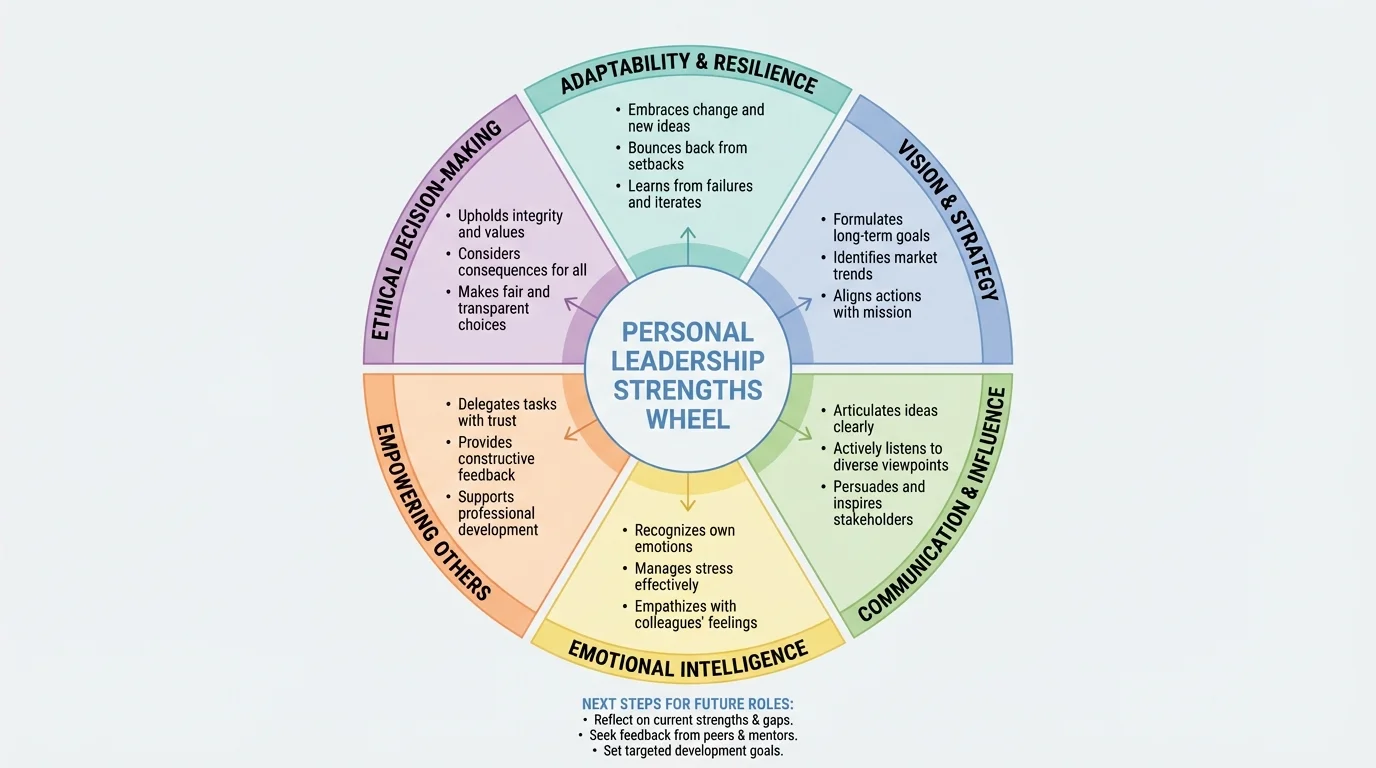
One of the best ways to assess leadership is to break it into visible habits, as shown in [Figure 1]. This makes leadership less mysterious and more practical. Instead of asking whether you are "naturally" a leader, ask which leadership behaviors already show up in your life.
You may be strong in one area and still developing in another. That is normal. Leadership is a combination of skills, not a single trait.
Your strengths might include the following:
Think about your real life, not your ideal self. For example, if you run a small online shop and always answer customers politely and on time, that shows responsibility and communication. If you helped plan a community fundraiser and kept everyone updated, that shows organization and initiative. If you noticed a teammate was falling behind and offered support instead of criticism, that shows empathy.
Leadership strength is not only what you can do once. It is what you do repeatedly. A single strong moment is encouraging, but repeated behavior is stronger evidence.
Many employers promote people for reliability before they promote them for charisma. Teams often prefer a steady, prepared person over someone who sounds confident but rarely follows through.
As you review your strengths, avoid the trap of comparing yourself to one stereotype. Some roles need a persuasive speaker. Others need a calm coordinator, careful planner, or steady mentor. As [Figure 1] illustrates, leadership has multiple dimensions, and your best qualities may not look dramatic on the surface.
Self-awareness becomes powerful when you can name not only your strengths but also your weak points. A blind spot is a behavior you do not notice clearly in yourself but that still affects other people. For example, you may think you are being efficient when others experience you as impatient. You may think you are staying relaxed when others experience you as disengaged.
Common leadership growth areas include interrupting others, avoiding conflict until problems get worse, saying yes to too much, giving unclear directions, not asking for help, reacting defensively to feedback, or starting strong but not finishing. These patterns matter because leadership is measured by impact, not intention alone.
It helps to ask, "What tends to happen when I am stressed?" Stress reveals a lot. Some people become controlling. Some go silent. Some procrastinate. Some become overly emotional in group messages. If you know your stress pattern, you can build a plan to manage it before you are in a higher-stakes role.
Growth areas are not evidence that you are failing. They are the places where your next level of leadership will be built. The goal is not to hide your weak spots. The goal is to understand them well enough to reduce the damage they can cause and strengthen the habits that replace them.
Honesty matters here. If your team members often need reminders because your instructions are vague, communication may be a growth area. If your work is strong but late, reliability may need work. If people trust you one-on-one but you avoid making decisions for a group, confidence in leadership situations may be your next step.
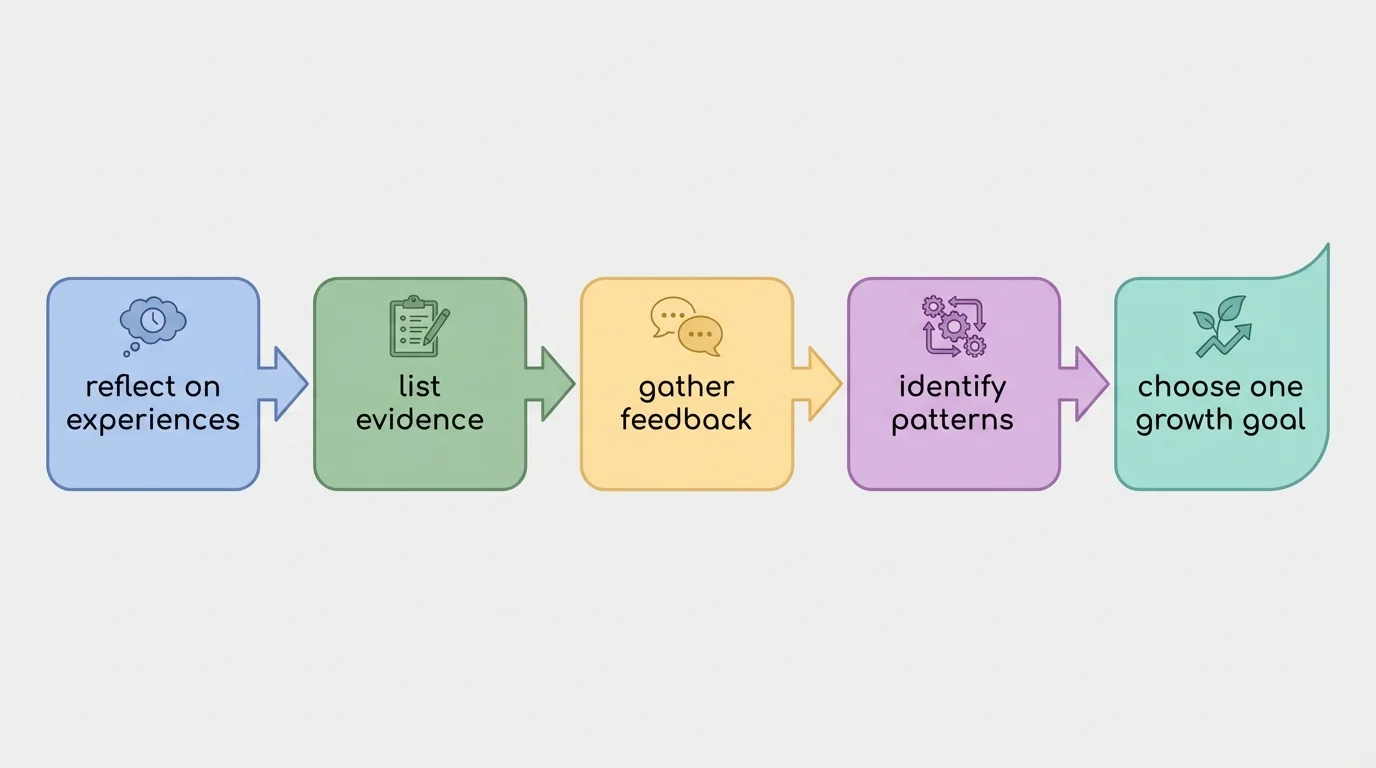
A better method than "I think I'm good at leadership" is to collect evidence step by step. This turns self-assessment into something more accurate and useful.
Start with recent experiences from the last year, as shown in [Figure 2]. Think about group projects, volunteer work, sports teams, faith communities, clubs, family responsibilities, creative collaborations, paid work, or online communities where you had some influence.
Then use a practical process:
Step 1: List situations where you had responsibility.
Step 2: Write what you actually did in those situations.
Step 3: Note the outcome. Did people trust you more? Did the task get done? Was there conflict? Did communication improve?
Step 4: Look for patterns across situations.
Step 5: Ask for feedback from people who have seen you work under pressure.
Feedback is especially important because self-perception can be inaccurate. Ask questions that invite useful answers, such as: "What do I do that helps a team?" "What is one thing I do that can make teamwork harder?" "When have you seen me handle responsibility well?" "What should I improve if I want to lead more?"
Choose people who will be honest and specific. A friend who only says "You're great" may not help much. A supervisor, coach, volunteer coordinator, or mature teammate may offer stronger insight. If several people mention the same issue, pay attention.
Example: Turning experiences into evidence
A student wants to know whether organization is really one of their leadership strengths.
Step 1: They list three situations: managing shifts at a weekend job, coordinating a charity drive, and helping siblings keep a weekly routine.
Step 2: In each situation, they note what they did: made checklists, sent reminders, tracked deadlines, and solved scheduling problems early.
Step 3: They review outcomes: fewer missed tasks, less confusion, and positive feedback from others.
Step 4: They conclude that organization is not just something they like; it is a repeated strength with visible impact.
This kind of evidence is much stronger than a vague self-description.
You can also keep a simple leadership note on your phone. After a situation where you took responsibility, write what happened, what you did well, and what you would improve next time. Over several months, patterns become easier to see. Later, when you review your development, the process in [Figure 2] helps you separate assumptions from proof.
Because so much communication now happens digitally, leadership also shows up in how you act online. Someone with strong leadership habits does not leave people confused in a group thread, disappear after volunteering for a task, or create tension through careless messages. Instead, they communicate clearly, confirm responsibilities, and respond respectfully.
For example, if you are coordinating a virtual event, leadership may mean setting deadlines, summarizing decisions after a video meeting, and checking that everyone understands the plan. If you are on a gaming team, it may mean encouraging teammates, reviewing what went wrong without attacking anyone, and keeping the group focused. If you work part-time, it may mean handling customer issues with maturity or helping new staff learn the routine.
Outside school, leadership also appears in family and community life. You may help manage schedules, support younger siblings, plan transportation, organize a fundraiser, lead a youth group, or take initiative in a neighborhood project. These experiences count. Leadership is not limited to formal offices or public recognition.
Responsibility and teamwork are connected. Strong leaders do not try to do everything alone. They contribute, communicate, and help the group function better.
That is why leadership self-assessment should include both independent responsibility and teamwork. Being personally capable matters, but future roles also require cooperation, delegation, patience, and trust-building.
Not every leader should aim for the same role. Different roles need different combinations of strengths, as [Figure 3] illustrates. Knowing your strongest patterns helps you choose roles where you can contribute well now while growing for the future.
If you are highly organized and dependable, you may fit roles like project coordinator, event planner, shift supervisor, or operations assistant. If you are empathetic and patient, you may be strong in mentoring, peer support, customer care, coaching younger students, or community outreach. If you are decisive and calm under pressure, you may do well in team lead roles, emergency response settings, or jobs where fast judgment matters. If you are creative and persuasive, you may excel in campaigns, entrepreneurship, content leadership, or community organizing.
| Leadership strength | What it looks like | Future roles it may support |
|---|---|---|
| Reliability | Meets deadlines, follows through, keeps promises | Shift lead, supervisor, coordinator |
| Empathy | Understands people, listens, supports morale | Mentor, peer leader, community support role |
| Organization | Plans ahead, tracks details, prevents confusion | Project lead, event organizer, team coordinator |
| Decision-making | Chooses a path, handles pressure, accepts responsibility | Team captain, manager-in-training, operations role |
| Initiative | Starts tasks, solves problems early | Entrepreneur, crew lead, volunteer organizer |
| Communication | Explains clearly, resolves confusion, builds alignment | Trainer, spokesperson, client-facing leader |
Table 1. Examples of how leadership strengths connect to different future roles.
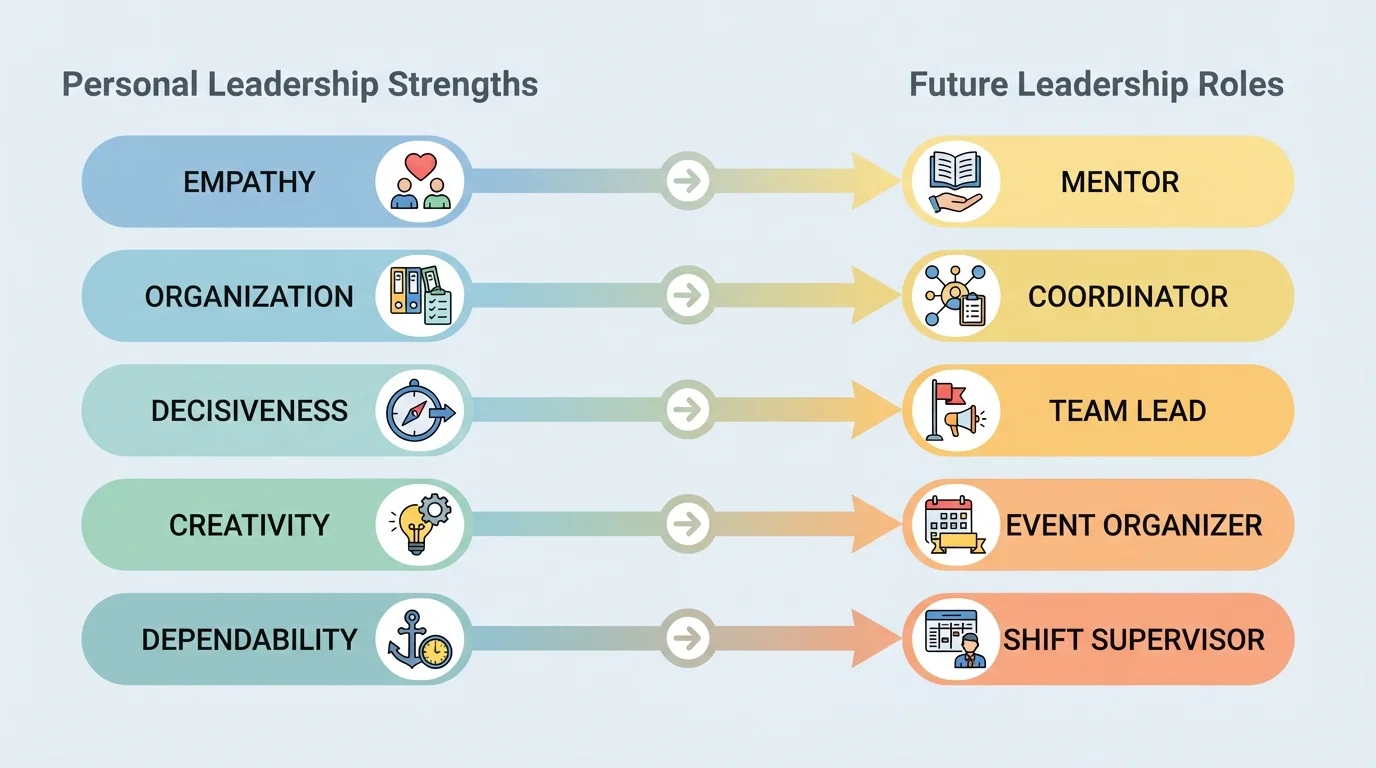
This does not mean you should only choose roles that feel easy. It means you should start where your current strengths can support success. Then you can stretch into harder roles over time. For example, a dependable organizer may first coordinate schedules and later grow into leading meetings. An empathetic mentor may later develop stronger decision-making and become a program leader.
When choosing your next step, ask two questions: "What strengths can I contribute right now?" and "What leadership skill do I want this role to develop?" That second question matters because the best roles do not only use your strengths; they also train your next level.
As [Figure 3] makes clear, leadership pathways are varied. You do not need to copy someone else's style to grow into a meaningful role.
Once you know your strengths and growth areas, the next move is to create a realistic plan. A good plan is specific enough to guide action but simple enough to follow.
Start by choosing one leadership strength to use more intentionally and one growth area to improve. Trying to fix everything at once usually leads to nothing changing. Focus creates progress.
Here is a practical way to build your plan:
Step 1: Name your strongest leadership quality.
Step 2: Name one growth area that holds you back.
Step 3: Pick one setting where you can practice, such as work, volunteering, a team, a family responsibility, or an online project.
Step 4: Choose one concrete habit. For example, "I will send a clear summary after every team call," or "I will ask for feedback after I coordinate a task."
Step 5: Review your progress weekly.
30-day leadership plan
A student identifies responsibility as a strength and conflict avoidance as a growth area.
Step 1: They volunteer to coordinate a small community event task, using their reliability to build trust.
Step 2: They practice addressing problems early instead of hoping they disappear.
Step 3: Before each update message, they ask: "Is this clear, direct, and respectful?"
Step 4: At the end of each week, they write two notes: one moment they led well and one moment they avoided necessary leadership.
That small routine builds both confidence and honesty.
This is where feedback loop thinking helps. A feedback loop means you act, review the result, make an adjustment, and try again. Strong leaders improve because they keep learning from what happened instead of repeating the same mistakes automatically.
If you want future leadership opportunities, do not wait quietly and hope someone notices. Let trusted adults or supervisors know you want to grow. You can say, "I'd like more responsibility when there's an opportunity," or "I'm working on leadership skills and would appreciate feedback." Mature initiative often opens doors.
One mistake is confusing confidence with leadership. Confidence can help, but leadership without responsibility quickly breaks trust. Another mistake is assuming that good intentions are enough. They are not. If communication is unclear or tasks are left unfinished, the team still feels the effect.
A third mistake is people-pleasing. Some students avoid hard conversations because they want everyone to stay happy. But leadership sometimes requires saying no, correcting a problem, or making an unpopular but necessary decision. Respect matters, but so does clarity.
Another common problem is overcontrol. If you do everything yourself because you do not trust others, you may look capable at first, but your team will not grow. Effective leaders know when to guide, when to delegate, and when to step back.
Leadership maturity means balancing strength with humility. You need enough confidence to act, enough humility to listen, and enough discipline to follow through. Missing any one of those can weaken your impact.
Finally, avoid waiting for a perfect moment. Most leadership growth happens in ordinary situations: solving a scheduling issue, helping a team recover from miscommunication, training someone patiently, or taking ownership when a plan needs structure.
At your age, you do not need to have leadership fully figured out. What matters is that you can assess yourself honestly and take the next step intentionally. Future employers, community leaders, and teams are not looking for perfection. They are looking for people who are teachable, dependable, and ready to grow.
Your leadership strengths are already showing up somewhere in your life. Your task is to notice them, strengthen them, and use them well. Your growth areas are not reasons to doubt yourself; they are directions for development. The more honestly you assess both, the more prepared you will be for future roles that require trust, teamwork, and initiative.
Try This: Write down three situations from the past year where you had responsibility. Under each one, list what you did well, what was difficult, and what that experience suggests about the kind of leader you are becoming.
Try This: Ask one trusted person for specific feedback about how you handle teamwork, pressure, and responsibility. Listen without defending yourself.
Try This: Choose one small leadership action for this week, such as organizing a task, clarifying communication in a group, or taking initiative on a responsibility before someone reminds you.
