One of the biggest surprises of adult life is that very few problems are purely "personal." If your bus route is unreliable, getting to work on time becomes your problem. If housing costs rise, your budget feels it. If a local clinic closes, your health choices narrow. Adult life is full of moments where your own decisions matter a lot, but they never happen in a vacuum. To live responsibly, you need to understand not just what you can do, but also how larger systems work and how communities create change.
At age 17, you are approaching decisions that carry real consequences: applying for jobs, signing agreements, managing money, driving or using public transportation, voting soon if you are not already eligible, and managing your digital reputation. In each case, there are three forces at work: your actions, the public systems around you, and the way people act together. Learning to assess all three helps you avoid a common mistake: blaming yourself for everything, or blaming the system for everything. Usually, the truth is more balanced.
[Figure 1] Strong adult decision-making means asking better questions. What part of this situation is under my control? What part depends on a law, service, or institution? What part could improve if people worked together? When you ask those questions, you move from frustration to strategy.
In adult life, many challenges involve personal action, public systems, and community engagement because these three forces constantly affect one another. You may choose to show up on time, save money, or follow local rules. At the same time, transportation, healthcare access, labor laws, and housing policies shape what options are realistic. Community groups, neighbors, local organizations, and online networks can either help solve problems or make them worse.
Personal action means the decisions and behaviors you control directly. This includes how you communicate, whether you pay bills on time, how carefully you read contracts, whether you follow laws, and how you respond when something goes wrong. Personal action is where responsibility begins, but not where every issue ends.
Public systems are the organized structures that shape everyday life. These include courts, voting systems, public transportation, licensing agencies, health departments, emergency services, and other government-supported services. They are not perfect, but they matter because they create rules, protections, and procedures that affect everyone.
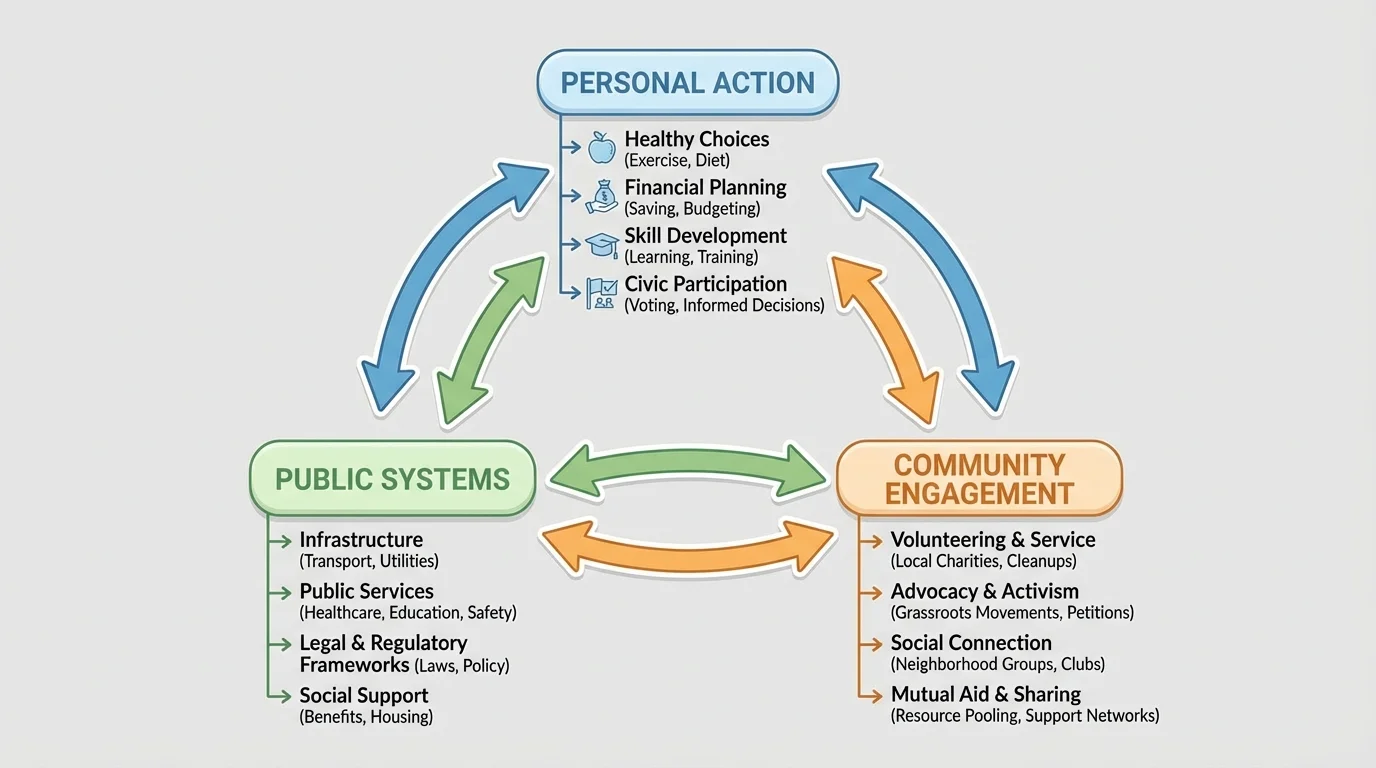
Community engagement is how people participate in improving the places and networks they belong to. That could mean volunteering, attending a local meeting online, joining a neighborhood clean-up, supporting a food pantry, advocating for safer streets, or helping organize accurate information on social media. Community engagement is not just "being nice." It is active participation in shared life.
Responsibility means being accountable for your choices and their effects. Civic engagement means taking part in the public life of your community in ways that help solve problems or improve conditions. Legal awareness means understanding the rules, rights, and consequences that affect your actions.
These three parts overlap. If you miss a bill payment, that is personal action. If the billing system is confusing or unfair, that involves a public or institutional system. If many people face the same issue and organize for clearer policies, that becomes community engagement. As shown earlier in [Figure 1], adult life works less like separate boxes and more like a connected triangle.
Your first level of power is your own behavior. This includes punctuality, honesty, preparation, emotional control, digital judgment, and follow-through. These may sound basic, but they affect almost every part of adult life. A person who reads forms carefully, keeps records, responds respectfully, and meets deadlines usually has more options than someone who acts impulsively.
Personal responsibility also includes understanding consequences before they become crises. If you post threatening jokes online, ignore parking rules, drive without insurance, or sign up for subscriptions you cannot afford, the results may become financial or legal problems. Adult life often rewards prevention more than repair.
Think about a simple situation: you are applying for your first apartment. Your personal action includes checking the lease, asking about deposits, documenting the condition of the space, and making sure you can actually pay the monthly cost. If rent is $900 and utilities are about $120, your likely monthly housing cost is $1,020. That number matters because "probably manageable" is not a plan. Clear numbers reduce risk.
Case study: Handling a missed bill responsibly
You forget a phone bill and get a late notice. Here is an effective response.
Step 1: Confirm the facts
Check the amount due, the deadline, and whether there is a fee. Save a screenshot or email copy.
Step 2: Act quickly
Pay immediately if you can, or contact the provider before service is cut off.
Step 3: Communicate clearly
Use a calm message: explain that you missed the date, ask whether the fee can be reduced, and request your options.
Step 4: Prevent a repeat
Set reminders, enable autopay if safe for your budget, or choose one weekly time to review bills.
This response shows responsibility without panic. It protects your finances and your record.
Personal action also includes how you treat other people. Respectful communication matters with employers, landlords, public employees, customer service workers, and people in your community. Being respectful does not mean being passive. It means being clear, factual, and self-controlled, especially when a situation is frustrating.
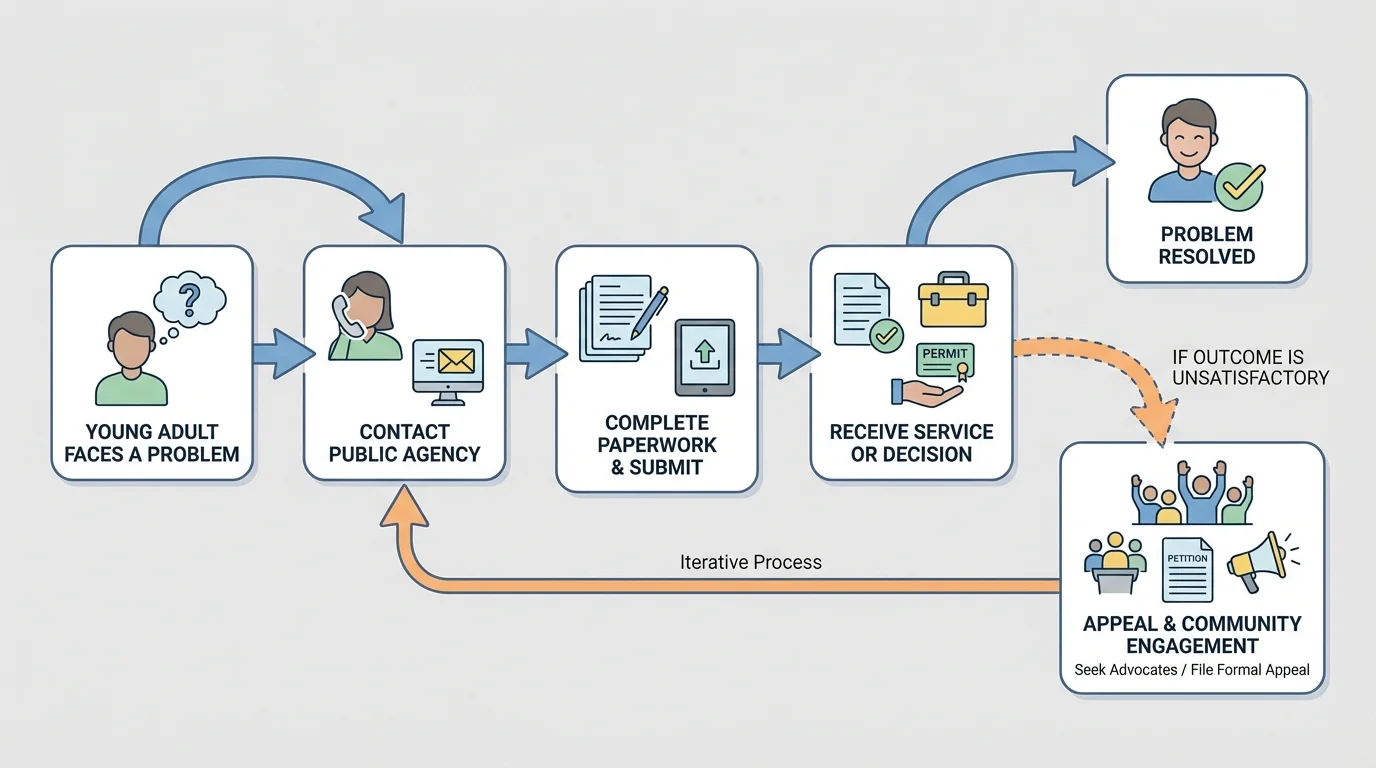
Many adult problems involve systems because they are not just buildings or offices; they are processes with entry points, requirements, timelines, and outcomes. If you need a state ID, a driver's permit, unemployment information, a voter registration update, or access to a public health service, you interact with a system.
[Figure 2] A mature understanding of systems starts with this idea: a system can be important even when it is imperfect. You may wait on hold, face confusing forms, or deal with slow responses. That is frustrating, but it does not make the system irrelevant. It means you need skill in navigating it.
Public systems often affect fairness. Good systems can protect rights, reduce harm, and create opportunity. Weak systems can leave people behind. For example, if public transportation is limited, a reliable and responsible worker may still struggle to get to a job. If voting access is difficult, people's voices may be underrepresented. If consumer protection is weak, scams spread more easily.
To use systems well, learn the basics: what agency or service handles the issue, what documents are required, what deadlines apply, what rights you have, and what appeal or complaint process exists. This turns confusion into action.
Some systems are local, some state-level, and some national. A pothole on your street may be a city issue. Voter registration rules may depend on your state. Taxes and some workplace laws may involve federal systems. Knowing which level matters saves time and improves your chance of getting a useful response.
| Situation | Personal Action | Public System Involved | Possible Community Role |
|---|---|---|---|
| Unsafe crosswalk | Report the hazard and use caution | City transportation or public works | Residents organize for safety improvements |
| Lost ID | Gather documents and apply for replacement | Licensing or records office | Community center helps people access forms |
| Job wage dispute | Keep pay records and communicate professionally | Labor agency or legal process | Worker advocacy group offers guidance |
| Food insecurity | Seek available support promptly | Public assistance programs | Food pantry, mutual aid, or nonprofit support |
Table 1. Examples of how personal action, public systems, and community responses connect in real situations.
Later, when you deal with a specific issue, the process shown in [Figure 2] matters: identify the correct agency, provide accurate information, keep records, follow deadlines, and know whether you can appeal. This is practical civic skill, not just theory.
Community engagement fills the gap between private struggle and formal systems. Sometimes a problem affects many people, but not enough is happening through official channels. That is where communities matter. Residents share information, help one another, and push institutions to respond better.
Community action can be small and local or broad and digital. You might help a younger student with online job applications, join a neighborhood online group that tracks local issues, volunteer with a shelter, support a voter information campaign, or participate in a town hall livestream. These actions build trust and problem-solving capacity.
Why community engagement matters
Communities often notice problems before institutions do. When people compare experiences, patterns become visible: repeated landlord violations, unsafe roads, misinformation, lack of translation services, or barriers for disabled residents. Shared information can turn isolated frustration into organized action.
Community engagement is also how people build the future they want rather than waiting for someone else to fix everything. A neighborhood garden does not replace food policy, but it can improve access and connection. A volunteer tutoring project does not solve every education gap, but it can still change lives. Community work is most powerful when it supports people now and also points toward bigger improvements.
Not all community action is effective. Spreading unverified claims, shaming people online, or "raising awareness" without useful steps can waste energy. Good engagement is informed, respectful, and aimed at a clear goal.
Here is the key idea: personal action, public systems, and community engagement are strongest when they support one another. If one part is missing, progress is harder.
Consider public health. Your personal action includes washing hands, staying home when contagious, and getting medical care when needed. Public systems include clinics, vaccination access, health guidance, and emergency planning. Community engagement includes helping neighbors get accurate information, supporting food delivery for sick families, or volunteering through local organizations. If people act responsibly but public access is poor, the outcome suffers. If good systems exist but people ignore them, the outcome also suffers.
The same is true for safety, employment, transportation, housing, and voting. You cannot vote if you never register. But registration alone does not help if access is blocked or information is confusing. A healthy civic life requires responsible individuals, functioning systems, and engaged communities.
Research on civic participation consistently shows that people who feel connected to their communities are more likely to solve problems effectively, trust useful information, and recover better from crises. Connection is not just a social benefit; it affects real outcomes.
Think about online misinformation. Your personal role is to verify before sharing. Public systems may include election offices, public health departments, or consumer protection agencies that publish accurate information. Community engagement includes reporting scams, correcting false claims carefully, and helping others find reliable sources. This is a modern example of civic responsibility in digital life.
Adult life includes both rights and obligations. Rights may include free expression, due process, equal treatment under the law, access to certain public services, and the ability to report harm. Responsibilities include obeying laws, paying required fees or taxes, honoring agreements, serving honestly in civic roles when required, and respecting the rights of others.
Accountability is what connects rights and responsibilities. If you make a mistake, accountability means owning it and responding appropriately. If a system harms people unfairly, accountability means there should be a way to challenge or correct that harm. If a community leader spreads false information, accountability means people can question, document, and respond.
Advocacy is an important part of this picture. Advocacy means speaking or acting in support of a cause, person, or policy change. Good advocacy is based on evidence, clear communication, and realistic goals. You can advocate for yourself by asking for accommodations, appealing a decision, or requesting information. You can advocate for others by supporting policies or services that improve fairness.
"The price of apathy toward public affairs is to be ruled by evil people."
— Plato
Legal awareness matters because many adult problems get worse when ignored. If you receive an official notice, a court date, a jury summons, a benefits letter, or a traffic citation, do not leave it unopened and hope it disappears. Read it carefully, check deadlines, keep copies, and ask for reliable help if needed. Silence often protects the problem, not you.
At the same time, following rules does not mean accepting every rule as fair. Responsible adults can challenge policies legally and constructively. That might mean filing complaints, gathering evidence, attending public meetings online, contacting representatives, joining campaigns, or supporting reform efforts.
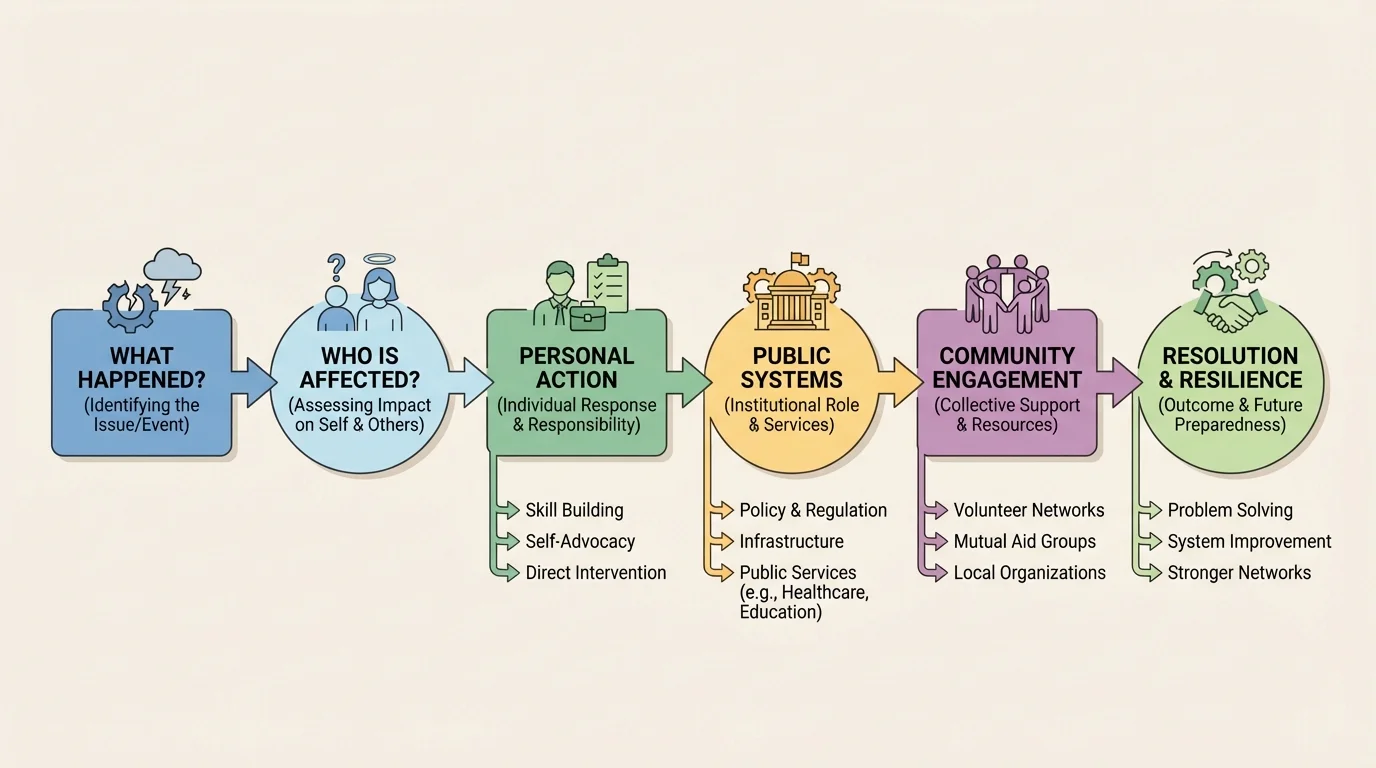
When a situation feels overwhelming, a clear framework can turn stress into a plan. Instead of reacting emotionally or blaming one source, break the issue into parts.
[Figure 3] Ask five questions: What exactly happened? Who is affected? What part is under my control? What system has authority or responsibility here? What kind of community support or collective action could help?
Case study: Repeated late buses affecting your job
You are nearly late to work several times because the bus is unreliable.
Step 1: Identify your responsibility
Leave earlier when possible, track arrival times, and document the delays honestly.
Step 2: Identify the system issue
The transportation system may have route, staffing, or scheduling problems.
Step 3: Identify the community dimension
Other riders may be facing the same problem, which makes collective reporting stronger.
Step 4: Choose actions
Tell your employer early, file a transit complaint, save screenshots, and join or follow rider updates.
This approach is stronger than saying, "It's all my fault," or "There's nothing I can do." It recognizes multiple causes and multiple responses.
You can use the same framework for apartment issues, benefits delays, unsafe public spaces, school-to-work transitions, identity document problems, or unfair online platform practices. As [Figure 3] shows, the goal is to move from confusion to action by sorting the problem into personal, system, and community parts.
You do not need to become a politician or activist to live civically. You just need habits that make you effective and responsible. Stay informed from reliable sources. Keep records. Vote when eligible. Read before signing. Ask questions when something is unclear. Report hazards. Support useful local organizations. Help others find accurate information. Know where to go for official help.
It also helps to build a small personal system for civic life. Keep digital folders for IDs, applications, leases, pay records, medical forms, and important emails. Save phone numbers and websites for key agencies. Set reminders for deadlines. These habits reduce stress and make you more capable when something urgent happens.
Independent living skills and civic skills overlap. Time management, communication, budgeting, and organization are not separate from citizenship; they are part of how responsible adults function within systems and communities.
One practical standard for adulthood is this: when something goes wrong, can you assess the situation clearly, take responsibility for your part, use the right system, and engage others when needed? That is what effective civic life looks like.
Your future is shaped not only by what you want, but by how well you act, how well systems serve the public, and how willing people are to build solutions together. Understanding that interaction gives you a more realistic and more powerful way to live.
