Some people work hard for years and still feel stuck, burned out, or pulled in the wrong direction. Others make slower progress but build a life that is stable, meaningful, and healthier. The difference is often not just effort. It is whether their choices are guided by the right combination of direction, priorities, and daily structure. In real life, long-term success usually depends on three things working together: goals, values, and systems.
A goal gives you a target. Your values tell you why that target matters. Your system is the set of repeated actions that helps you move toward it. If one of these is missing, problems show up fast. You might set a goal without caring about it, and then lose motivation. You might care deeply about something but have no plan for following through. Or you might create a strong routine that leads you efficiently toward a future you do not actually want.
That is why assessing success means asking more than, "Can I reach this?" You also need to ask, "Should I reach this?" and "Can I do it in a way that I can maintain?" Long-term success is not just getting results once. It is building progress you can live with, repeat, and recover from when life gets messy.
Think about two students who both want financial independence. One takes every shift offered, sleeps too little, ignores stress, and starts missing deadlines. The other chooses a realistic work schedule, tracks spending, protects study time, and gets enough sleep. Both are ambitious, but only one is using a plan that supports both achievement and health.
Values are the principles and priorities that matter most to you, such as honesty, stability, creativity, family, independence, service, or health.
Well-being means your overall quality of life, including physical health, mental and emotional health, relationships, safety, and a sense of purpose.
Sustainability means a plan can continue over time without causing serious harm, exhaustion, or breakdown.
When these three ideas work together, you are more likely to make choices that help your future instead of just reacting to pressure in the moment.
Your values act like a filter for decisions, as shown in [Figure 1]. They shape how you use your time, what kind of work feels meaningful, how you handle money, and what trade-offs you are willing to make. If you do not know your values, it becomes easier to chase what looks impressive online or what other people expect from you.
For example, if you value stability, you may prefer a training path that leads to reliable income, even if it is less glamorous. If you value creativity, you may want a career that allows originality and flexible problem-solving. If you value family or community, you may choose a future plan that leaves room for relationships, caretaking, or service. None of these values is automatically better than another. What matters is being honest about what truly guides you.
A mismatch between values and choices often creates stress that is hard to explain. You may keep telling yourself a plan is "good on paper," but still feel drained or disconnected. That can happen when your schedule, friendships, job plans, or spending habits keep pushing you away from what matters most to you.
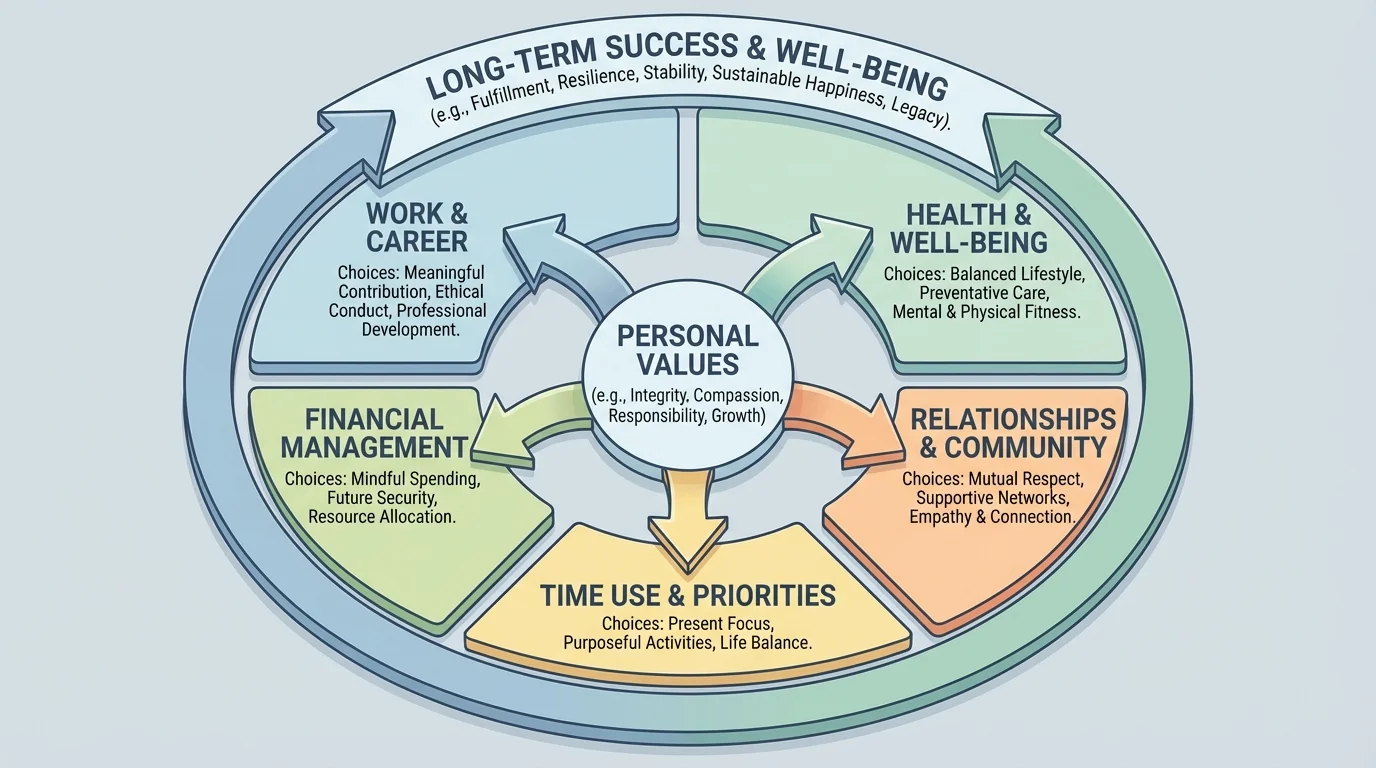
One practical way to identify your values is to look at moments when you felt proud, calm, energized, or deeply frustrated. Those moments often reveal what matters to you. If you felt proud after helping someone solve a problem, maybe you value service or competence. If you felt frustrated when your time was constantly interrupted, maybe you value focus or independence.
Try This: Write down five things that matter most in your future life. Then narrow the list to three. For each one, finish this sentence: "If this value were showing up in my life, I would be spending more time on ______ and less time on ______." That turns vague ideas into useful clues.
Once you know what matters, the next step is to create goals that fit those values. A meaningful goal is not just specific; it is connected to a reason you believe in. That reason becomes important when things get inconvenient, boring, or stressful.
There are different kinds of goals. Short-term goals help you make progress soon, such as finishing a certification application, saving $300 for an emergency fund, or preparing a resume. Long-term goals point toward a larger direction, such as becoming financially stable, entering a certain career field, or building a balanced adult routine.
Good goals usually answer three questions: What do I want? Why does it matter? How will I know I am making progress? A goal like "get my life together" is too vague to guide action. A stronger version might be: "By the end of the next three months, I will apply to five part-time jobs, save $200, and follow a weekly schedule that protects sleep and study time."
Real-life goal check
Step 1: Start with a value.
A student identifies independence and health as top priorities.
Step 2: Turn the values into a goal.
"I want a part-time job that helps me earn money without cutting my sleep below about 7 hours most nights."
Step 3: Make the goal measurable.
"I will apply to three jobs this week, compare schedules, and reject any option that regularly ends after midnight on school nights."
This goal is stronger because it includes both ambition and a boundary that protects well-being.
Goals can also be unhealthy if they come only from comparison, pressure, or fear. If your real motivation is "I need to prove I am better than everyone else," you may keep moving the target and never feel satisfied. If your goal is driven by fear of disappointing others, you may commit to a future that does not fit you.
This does not mean goals should always feel easy or comfortable. It means the discomfort should serve a purpose you believe in, not just a performance image.
A strong habit-based system makes progress more likely, as [Figure 2] shows, because it turns a big intention into repeated behavior. Goals tell you where you want to go. Systems answer, "What do I do today, this week, and when motivation is low?"
A system might include a consistent wake-up time, a calendar routine, automatic reminders, a spending tracker, a weekly meal-prep habit, scheduled exercise, and a check-in with someone who keeps you accountable. None of these actions is dramatic on its own. Together, they create stability.
Think about the difference between saying, "I want better grades" and saying, "Every weekday at 6:30 p.m., I review assignments for 20 minutes, silence notifications, and write tomorrow's tasks in my planner." The second version is a system. It is concrete, repeatable, and easier to maintain.
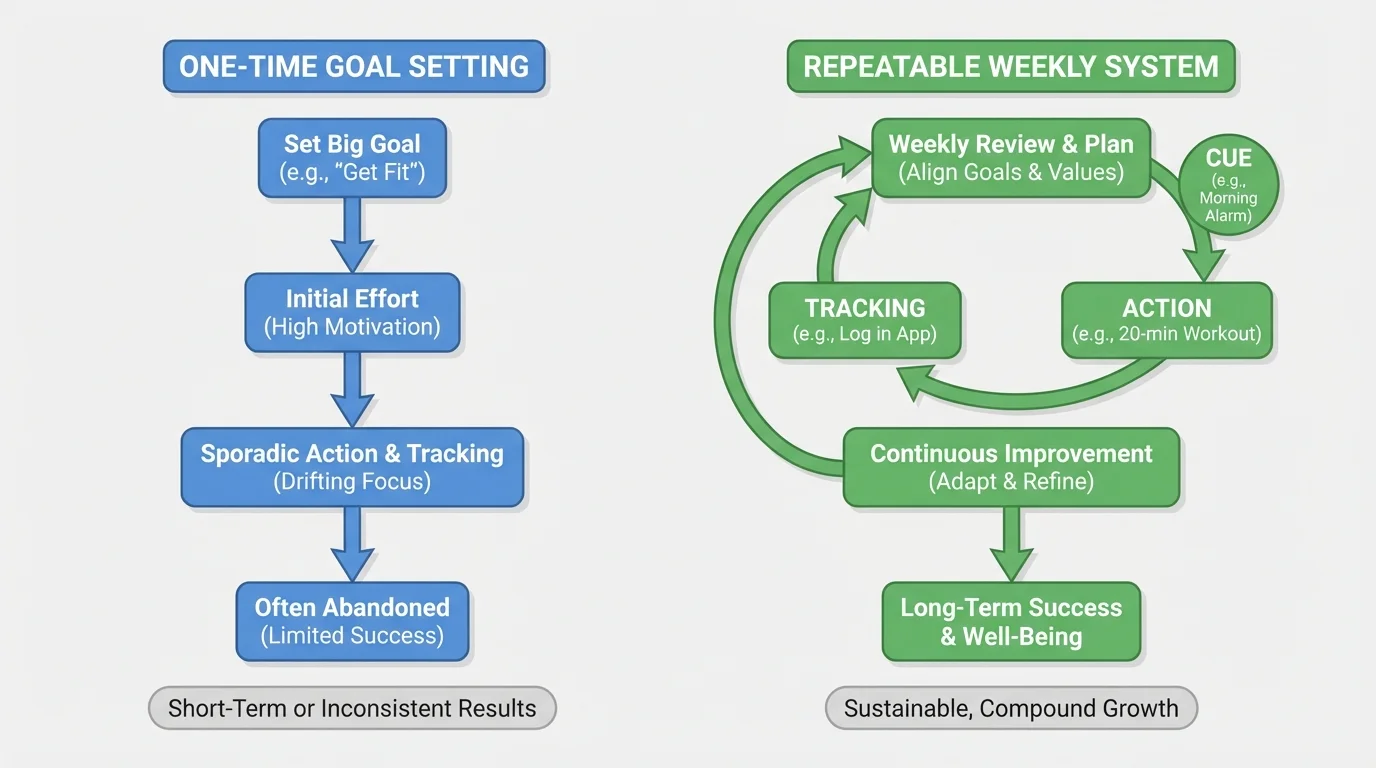
Good systems usually include four parts: a cue, an action, a way to reduce friction, and a review. The cue is what reminds you to start. The action is the behavior itself. Reducing friction means making the action easier, like laying out workout clothes, saving job links in one folder, or using app timers to limit distractions. The review is how you check whether the system is actually working.
You do not need perfect discipline. You need a setup that makes good choices easier than bad ones. If healthy food is available and junk food is not the easiest option, your system supports your health. If your phone stays in another room during focused work, your system protects attention. If part of each paycheck is moved to savings automatically, your system supports financial stability without needing daily willpower.
Try This: Pick one goal and ask, "What is the smallest repeatable action that supports this?" If your goal is to get employed, the system might be: update one section of your resume on Monday, apply to one job on Tuesday and Thursday, and check email at the same time every day.
Not every effective plan is a healthy one. A plan can produce results in the short term while quietly damaging your sleep, mental health, relationships, or sense of control. That is why you need to assess not only whether something works, but what it costs.
Well-being includes physical energy, emotional balance, stress level, safety, and connection with other people. If your future plan depends on constant panic, isolation, or exhaustion, it is a warning sign. You may still need to work hard at times, but hard work should not become permanent self-neglect.
Ask practical questions. Are you sleeping enough to think clearly? Are you eating in a way that gives you stable energy? Are your commitments leaving any room for recovery, family, friendships, or exercise? Are you using social media or constant comparison to measure your worth? Can your budget realistically support your choices?
Even basic numbers can help you assess sustainability. If you work 20 hours per week, study 30 hours, spend 10 hours on chores and family duties, and need about 49 hours of sleep each week at 7 hours per night, that is already 109 hours. Since a week has 168 hours, you have about \(168 - 109 = 59\) hours left for meals, transportation, personal care, exercise, breaks, and unexpected problems. That may be workable. But if work rises to 35 hours, then the total becomes 124 hours, leaving \(168 - 124 = 44\) hours. Your plan may start looking much tighter and more stressful.
Sustainable success means your progress does not depend on permanently running past your limits. Temporary intense effort can be necessary, but long-term plans need recovery time, realistic workload, and healthy boundaries. A system is successful only if it can continue without breaking you down.
A useful rule is this: if a strategy helps you win now but makes your future self less healthy, less stable, or less capable, it needs adjustment. This is true in school, work, money, and relationships.
Long-term success is rarely a solo project. Even highly independent people depend on networks of support. That can include family members, friends, mentors, supervisors, counselors, coaches, online communities, faith communities, and professional contacts. The right people can offer advice, encouragement, opportunities, feedback, and accountability.
Accountability means someone or something helps you stay responsible for what you said you would do. It is not about control. It is about follow-through. A weekly text check-in with a friend, a shared budget spreadsheet with a parent, a career mentor who reviews your resume, or a counseling appointment that helps you manage stress can all strengthen your system.
Community also affects your standards. If the people around you normalize chaos, overspending, procrastination, or unhealthy coping, those patterns can start to feel normal. If your environment supports consistency, honesty, and recovery, it becomes easier to stay on track. As we saw earlier in [Figure 1], values shape choices, but the people around you often influence whether you actually live those values.
Asking for help is a skill, not a weakness. In adult life, people often need help understanding a financial form, finding a training path, handling anxiety, fixing a schedule, or recovering from a mistake. Waiting until everything becomes a crisis usually makes the problem harder to solve.
People are more likely to complete a task when they make a specific plan and tell someone else about it. External structure often supports internal motivation.
Try This: Choose one area where support would help you most right now: time management, emotional health, job planning, money, or relationships. Then identify one real person or service you could contact this week.
A good plan is not rigid. It is responsive. Life changes: jobs fall through, family situations shift, transportation problems happen, mental health changes, and new opportunities appear. If your plan cannot adapt, it is fragile.
This is where reflection becomes useful. Reflection means pausing to review what is working, what is not, and what needs to change. It is different from overthinking. Reflection is practical. It asks questions like: What gave me energy this month? What drained me? What commitments no longer fit? What small change would improve the next week?
Set a review habit. Once a week or once a month, look at your calendar, spending, sleep, progress, and stress. Then decide whether your goal still fits your values and whether your system still fits your actual life. As we saw in [Figure 2], systems need review, not just repetition.
Changing direction is not always failure. Sometimes it is maturity. Quitting a plan that is clearly harming your health, finances, or future may be a wise decision. The key is to change thoughtfully, not impulsively.
"You do not rise to the level of your goals. You fall to the level of your systems."
— Popular productivity principle
That quote is useful, but it needs one more idea added to it: your systems should serve values that actually matter to you. A highly efficient path in the wrong direction is still the wrong direction.
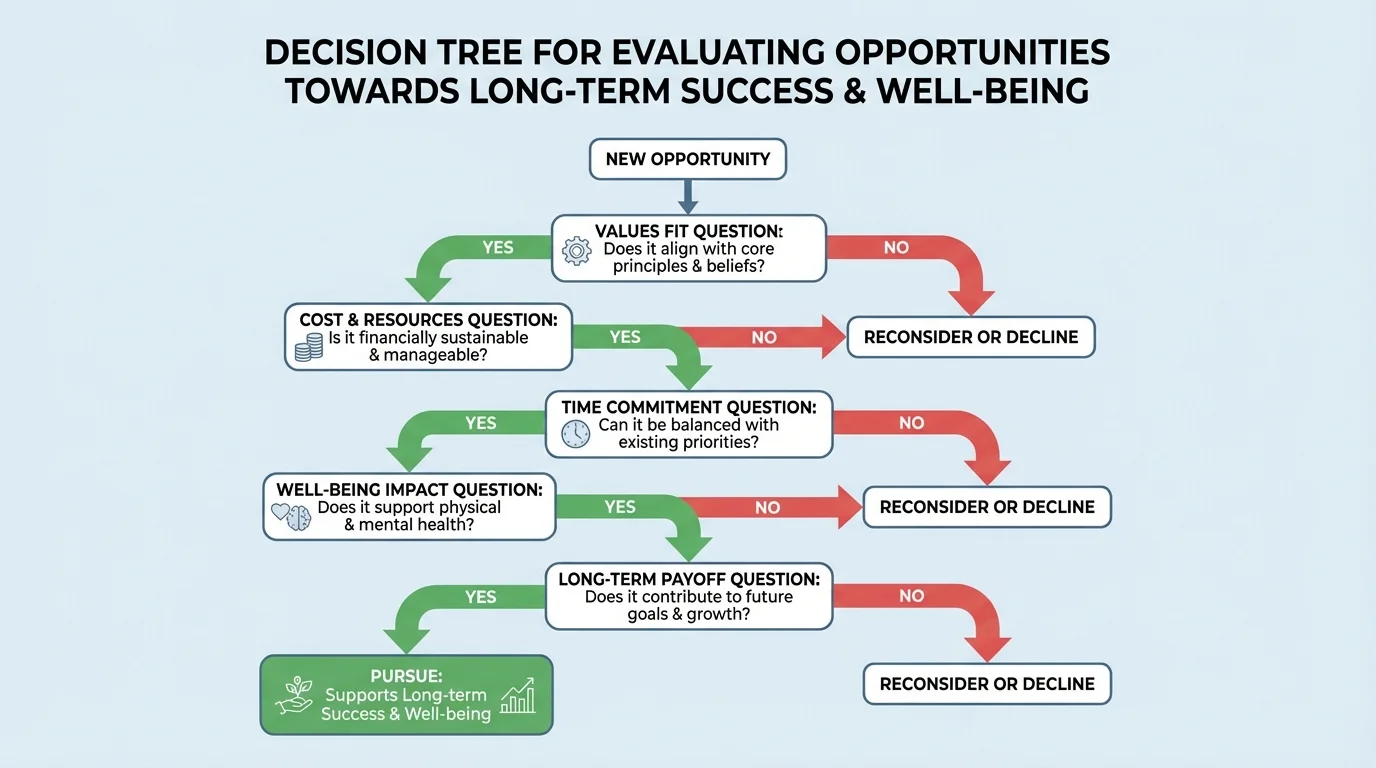
When you are choosing between opportunities, a simple decision process prevents impulsive choices, as [Figure 3] illustrates. This matters when comparing a job offer, a training program, a volunteer commitment, a move, or a packed weekly schedule.
Use this five-part check. First, ask whether the option fits your values. Second, ask what long-term benefit it offers. Third, ask what it costs in time, money, energy, and stress. Fourth, ask whether your current system can support it. Fifth, ask what support you would need to do it well.
Case study: Choosing between two part-time jobs
A student is deciding between Job A and Job B.
Step 1: Compare values fit.
Job A pays slightly more, but shifts often end late. Job B pays a little less, but the schedule is more predictable. The student values health, steady study time, and saving money.
Step 2: Compare the financial difference.
If Job A pays $16 per hour for 15 hours, weekly pay is approximately $240. If Job B pays $14 per hour for 15 hours, weekly pay is approximately $210. The difference is about $30 per week.
Step 3: Compare the hidden costs.
If Job A regularly reduces sleep and hurts school performance, the extra $30 may not be worth the long-term cost. Job B may support a more sustainable routine.
Step 4: Decide based on the full picture.
The student chooses Job B because it better supports long-term success and well-being, even though it pays a little less now.
This is a mature choice because it considers both present income and future stability.
This same framework can help with education decisions too. A program might sound exciting, but if it creates unmanageable debt, leaves no room for mental health, or does not connect to your values, it deserves closer inspection.
Some habits can feel ambitious while actually hurting progress. Perfectionism can delay action because nothing feels good enough to begin. Overcommitting can create a schedule that looks impressive but is impossible to sustain. Comparison can push you into goals that do not fit your life. All-or-nothing thinking can make one mistake feel like total failure.
Watch for language like "I have to do everything now," "If I cannot do it perfectly, there is no point," or "Everyone else is ahead of me." These thoughts often produce stress, not strategy. Real progress usually looks less dramatic: consistent applications, realistic budgets, enough sleep, regular review, and small adjustments over time.
The most effective future planning is not about becoming a machine. It is about becoming responsible, self-aware, and adaptable. That means learning how to choose goals that fit your values, build systems that support action, protect your well-being, and use community wisely.
| Area | Question to Ask | Healthy Sign | Warning Sign |
|---|---|---|---|
| Goals | Does this target actually matter to me? | Clear purpose and progress markers | Driven only by pressure or image |
| Values | Does this fit what I care about most? | Choices feel aligned and meaningful | Success feels empty or confusing |
| Systems | What repeated actions support this? | Routine is realistic and repeatable | Depends only on motivation |
| Well-being | What is this costing me? | Sleep, health, and relationships are protected | Chronic exhaustion or stress |
| Community | Who helps me stay on track? | Support and accountability are present | Isolation or unhealthy influence |
Table 1. A practical checklist for assessing whether a plan supports long-term success and well-being.
Try This: Choose one current goal. Then assess it using Table 1. If one column reveals a warning sign, do not panic. Just identify one adjustment that would make the plan more realistic, healthier, or more aligned with your values.
