Sometimes your brain feels like a drawer stuffed too full. You open it to find one thing, and everything gets jumbled. School can feel like that too, especially when you learn online at home. A lesson may seem confusing, the directions may feel too big, or a mistake may make you want to stop. The good news is this: when school feels hard, you can do something to help yourself.
Feeling stressed does not mean you are bad at school. Feeling confused does not mean you are not smart. It means your brain needs support. Strong learners are not people who never get upset. Strong learners are people who learn how to calm down, think again, and ask for help when they need it.
Online school can be wonderful, but it can also feel tricky. You may be working on a screen, listening to directions, clicking between tabs, and trying to remember what to do next. Maybe the internet is slow. Maybe a word in the lesson is new. Maybe you thought you understood, but then the next question looks totally different. That happens to lots of kids.
What matters most is what you do next. If you yell, slam the keyboard, or give up right away, school may feel even worse. If you use a coping strategy, you give your mind a chance to reset. A coping strategy is something you do to help yourself feel calmer, safer, or more ready to solve a problem.
Stress is a worried, upset, or overloaded feeling in your body and mind.
Confused means you do not understand something yet.
Resilience means you keep going and try again, even when something feels hard.
As [Figure 1] shows, you do not have to use the same coping strategy every time. Different problems need different tools. If your body feels jumpy, you may need a calming tool. If your work feels too big, you may need an organizing tool. If you do not understand the directions, you may need a help tool.
Your body often gives clues first. You might feel your face get hot, your tummy feel funny, your heart beat fast, or your hands squeeze tight. Some kids get very quiet. Some get wiggly. Some feel like crying. These signs are your body's way of saying, "I need help."
Your thoughts can give clues too. You might think, "This is too hard," "I can't do this," or "I don't know where to start." You may click around the screen without really reading. You may stare at one problem for a long time. You may want to leave your seat or do something else instead.
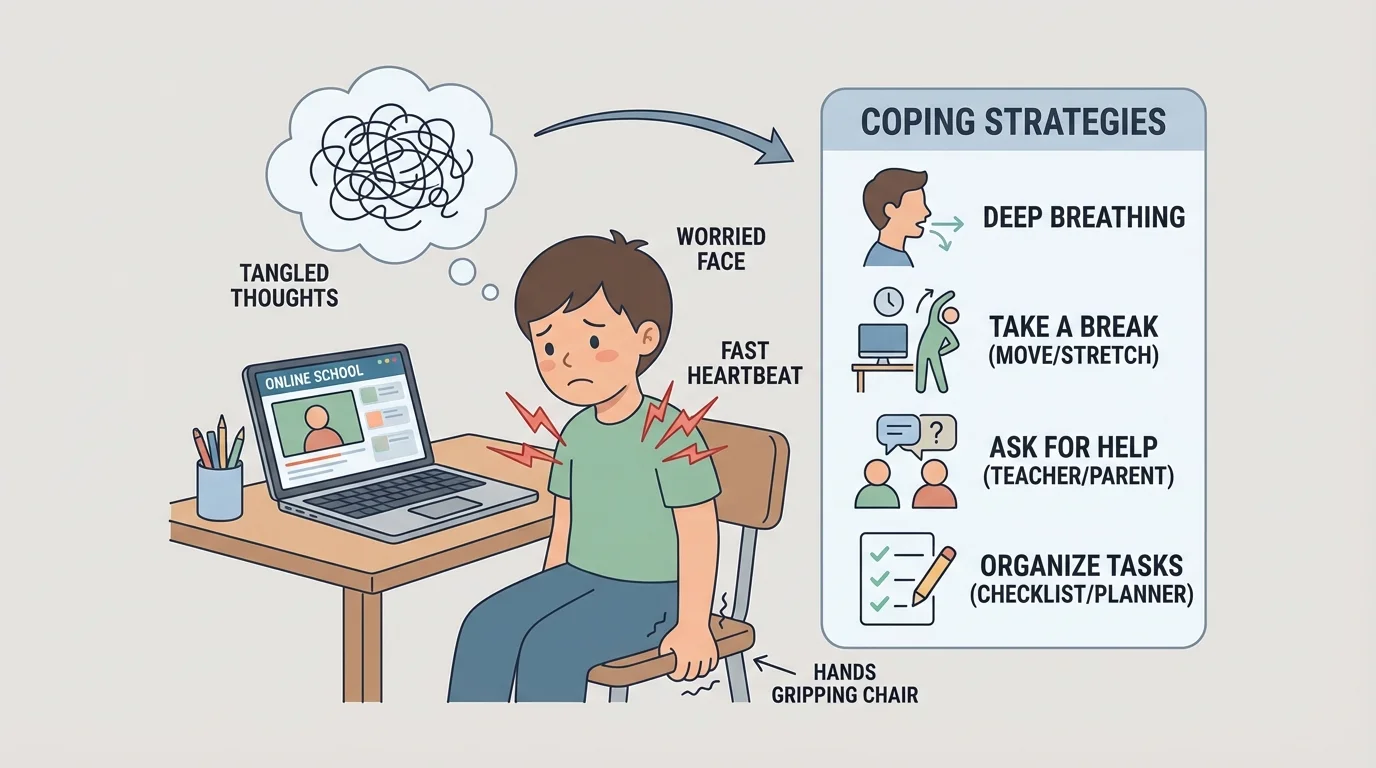
When you notice these clues early, you can help yourself sooner. That is important because small stress is easier to calm than big stress. It is a little like hearing a tiny beep from a device. If you notice it early, you can fix the problem before it gets louder.
Your brain works better when it feels calm enough to focus. Taking a short reset is not wasting time. It often helps you finish more successfully.
Sometimes students think, "I should just push harder." But if your brain feels mixed up, pushing harder without a plan can make you more upset. First calm, then think. That order helps.
When school starts feeling stressful, try a simple pause. You can remember this as Stop, Breathe, Notice, Choose.
Stop. Freeze your hands for a moment. Do not keep clicking randomly.
Breathe. Take a slow breath in through your nose and let it out slowly.
Notice. Ask yourself, "What is the problem?" Is the work confusing? Am I tired? Am I upset because I made a mistake? Do I need help reading the directions?
Choose. Pick one coping strategy that matches the problem.
Example: using the pause steps
You are doing an online math page and suddenly feel like crying.
Step 1: Stop moving the mouse and put both feet on the floor.
Step 2: Take three slow breaths.
Step 3: Notice the problem: "I do not understand question 2, and now I feel stuck."
Step 4: Choose one tool: reread the directions once, then ask for help if it is still confusing.
This helps you act on purpose instead of reacting in a big way.
As [Figure 2] shows, this pause may only take a short time, but it can change your whole day. Instead of letting stress drive, you get to choose what happens next.
There are many coping tools. You do not need to use every tool. You just need a few that work for you.
Breathing slowly helps when your body feels fast or tight. You can breathe in for a small count and out for a small count. Slow breaths tell your body that it is okay to settle down.
Take a short movement break. Stand up, stretch your arms, roll your shoulders, or walk to get a drink of water. Movement can help when your body feels restless or stuck.
Break the work into smaller parts. If a page looks huge, do not think about the whole page. Think: "First I will read the directions. Next I will do one problem." One small step is easier for your brain to handle.
Use kind self-talk. Self-talk is the quiet way you talk to yourself in your mind. Instead of saying, "I'm terrible at this," try, "This is hard right now, but I can try one step," or "I don't get it yet." The word yet is powerful.
Ask for help. If you have tried and still do not understand, asking for help is a strong choice, not a weak one.
Take a reset. A short quiet break can help when feelings are getting too big. Sit somewhere calm, take breaths, and come back when you are ready to try again.
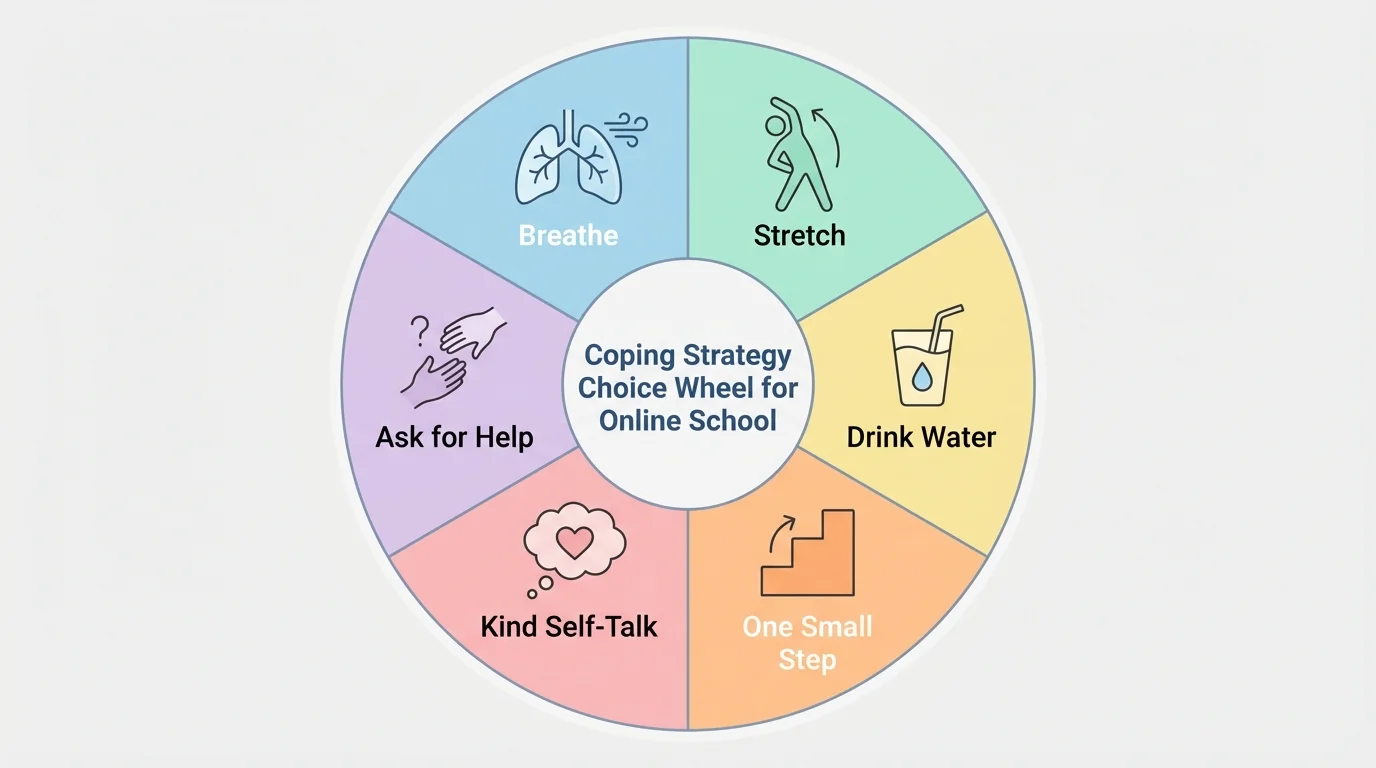
Notice that some tools calm your body, and some tools help your thinking. If your heart feels fast, start with a body tool like breathing or stretching. If the directions are confusing, use a thinking tool like rereading, underlining key words, or asking a question.
Good coping tools help you solve the real problem. A coping strategy is not just anything that feels good for a moment. It should help you get calmer, clearer, safer, or more ready to learn. For example, taking a short stretch break can help. Running away from the lesson without telling an adult does not help solve the problem.
As you saw in [Figure 1], stress can show up in your body and thoughts. That is why it helps to have more than one strategy ready. You might need one tool for your feelings and another for the school problem itself.
Here is a helpful way to choose:
| Problem | Helpful coping strategy |
|---|---|
| Your body feels jumpy or upset. | Slow breathing, stretching, drink water, short calm break |
| You do not know what to do first. | Pick one small step, make a tiny checklist |
| The directions are confusing. | Reread slowly, look for key words, ask for help |
| You made a mistake and feel frustrated. | Kind self-talk, erase and try again, ask someone to explain |
| You feel tired or your focus is fading. | Stand up, move a little, take a short reset, come back |
Table 1. Common school problems and coping strategies that match them.
If you choose a tool that does not fit, the problem may stay the same. For example, if you are confused by directions, taking one sip of water may not be enough. You may also need to reread or ask a question. Good coping means matching the tool to the need.
Example: matching the tool to the problem
Lena feels angry during reading time. She wants to close the computer.
Step 1: She notices the real problem: the directions have too many parts.
Step 2: She takes two slow breaths so her body can calm.
Step 3: She breaks the directions into smaller parts and says, "First I read. Then I answer one question."
Now Lena is calmer and knows what to do next.
As [Figure 3] shows, sometimes you may need to try more than one strategy. That is okay. You are learning what works for you.
Asking for help online can be simple and clear. In online school, you might send a message to a teacher, talk to a parent or caregiver, or ask another trusted adult nearby. You do not need a long speech. A few clear words are enough.
A good help message has four parts: greeting, problem, question, thank you. You can say, "Hi. I am confused about step 3 in my science lesson. Can you help me understand what to do next? Thank you."
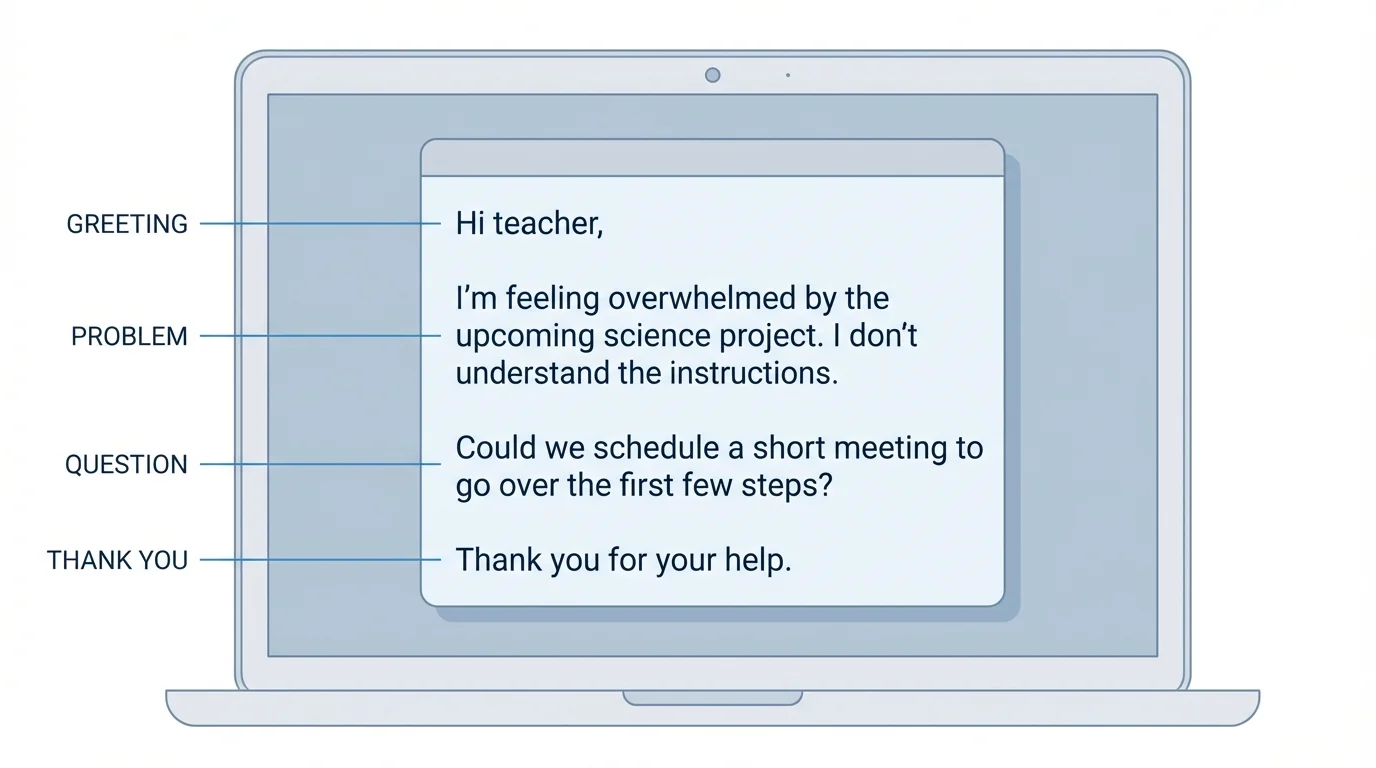
If talking feels hard, you can still use simple words: "I'm stuck." "I don't understand this part." "Can you show me the first step?" These are brave words. They help other people know exactly how to support you.
"I can ask for help and still be strong."
It also helps to say what you already tried. You might write, "I reread the directions, but I still don't understand question 4." This tells the other person you have already worked on the problem. Later, when you remember the help-message pattern from [Figure 3], it becomes easier to ask quickly instead of sitting with confusion for a long time.
You can make a small plan before a hard moment happens. This is called a calm plan. A calm plan is a short list of what you will do when school feels stressful.
Your calm plan might say:
1. Stop and take three breaths.
2. Put both feet on the floor.
3. Ask, "What is the problem?"
4. Choose one tool: stretch, one small step, or ask for help.
5. Try again.
You can keep this plan near your learning space. Then, when stress shows up, you do not have to think of a plan while upset. Your plan is already waiting for you.
Example: a calm plan in action
Marcus is taking an online quiz. The first question is easy, but the second one is confusing.
Step 1: Marcus feels his shoulders get tight and notices he wants to quit.
Step 2: He uses his calm plan: three breaths and feet on the floor.
Step 3: He says to himself, "I can do one small part."
Step 4: He rereads the question and circles the important words on his paper.
Step 5: If he is still confused, he messages his teacher for help.
Marcus does not need the whole quiz to feel easy. He only needs a plan for the hard parts.
The more you practice coping strategies, the easier they become. At first, you may forget and need reminders. That is normal. Learning to manage feelings is a skill, just like learning to read bigger words or solve harder problems.
When you use coping strategies well, school often feels more possible. You recover faster after mistakes. You understand directions better. You feel more in charge of yourself. That is what resilience looks like in real life.
