Have you ever noticed that no two homes are exactly the same? One child may eat dinner early, another late. One child may speak two languages at home. Another may use a wheelchair, hearing aids, or extra time to learn. These differences are part of what makes people interesting. Knowing how to treat those differences with care is a big life skill.
When you show respect, you help people feel safe, welcome, and important. When respect is missing, people can feel left out or hurt. Being kind is not only about using polite words. It also means noticing what others need, listening carefully, and remembering that your way is not the only way.
Respect means treating people in a kind and fair way, even when they are different from you.
Difference means a way people are not the same, such as family life, language, culture, or ability.
Empathy means trying to understand how another person may feel.
You do not have to know everything about another person to be respectful. You just need to slow down, be thoughtful, and choose actions that show care.
Some people live with a mom and dad. Some live with one parent. Some live with grandparents, foster parents, stepparents, or other caring adults. Some children have brothers or sisters, and some do not. A home may be noisy and busy, or quiet and calm. A family can still be loving and strong in many different forms.
People also communicate in different ways. Some speak English at home. Some speak another language too. Some people sign with their hands. Some need pictures, devices, or extra time to answer. Some move easily, and some need support for walking, seeing, hearing, or learning. Different does not mean less. It just means different.
Your brain gets stronger at understanding people when you notice differences without judging them. That helps you become a kinder friend, teammate, and community member.
A respectful person does not stare, laugh, whisper, copy someone in a mean way, or ask rude questions. A respectful person stays curious and kind.
Social awareness means paying attention to what other people may be feeling or needing. If someone is quiet in a video call, they may be shy, tired, or still learning the language being used. If someone does not join a fast game, they may need different directions or more time. You cannot know everything by looking, so it is smart not to guess in a mean or silly way.
A helpful habit is to pause before you speak. Ask yourself: "Are my words kind? Are they true? Will they help?" If the answer is no, choose different words.
Respectful thinking starts with one important idea: other people's lives make sense to them. Their home rules, traditions, language, and needs may be different from yours, but they are still real and important. When you remember this, it becomes easier to listen instead of judge.
Listening is one of the clearest ways to show respect. Look at the speaker on the screen, wait for your turn, and do not interrupt. If you are confused, ask kindly instead of making fun.
[Figure 1] illustrates that families can look different and all deserve respect through children sharing about home life in different family setups. You should avoid saying that one kind of family is the "real" or "best" kind. What matters most is love, care, and safety.
Sometimes children say things like, "That's weird," when another person shares something about home. Those words can hurt. A better response is, "That's different from my home," or "Thanks for telling me." Those words leave room for kindness.
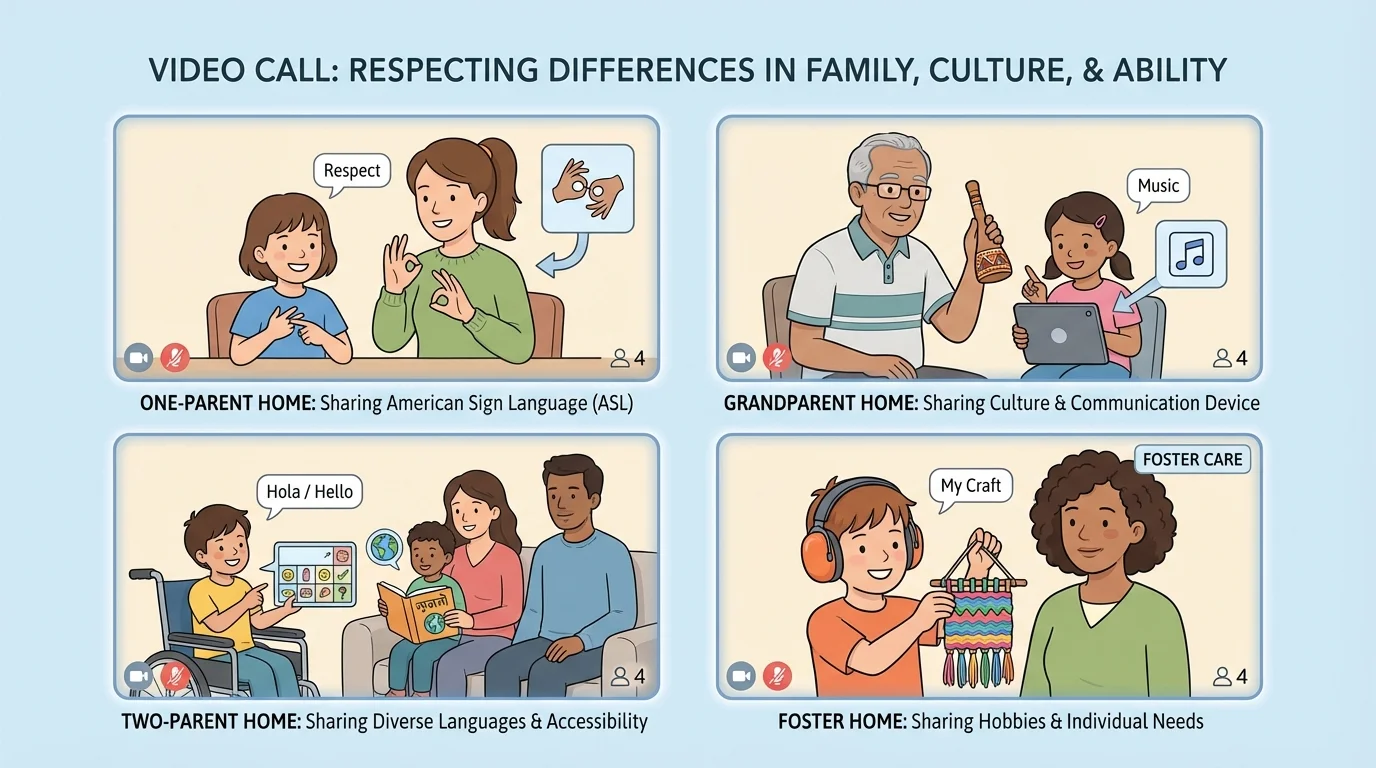
Home routines can be different too. One family may pray before meals. Another may not. One child may help care for a younger sibling after an online lesson. Another may have a quiet study space. Respect means not teasing someone for the way their home works.
If a friend cannot join an online game at a certain time, do not assume they are rude. They may be helping at home, visiting family, or following family rules. You can say, "That's okay. Maybe another time."
How to respond respectfully when someone shares about home
Step 1: Listen all the way through.
Step 2: Use calm words like "Oh," "I see," or "Thanks for sharing."
Step 3: Ask only kind questions, such as "What is that like?"
Step 4: Do not compare in a mean way, such as "My family is better."
This keeps the conversation safe and friendly.
Later, when you meet more people in clubs, sports, arts, or neighborhood groups, remembering family variety helps you speak with care instead of making unfair guesses.
[Figure 2] shows that language is part of identity. A person may speak with an accent, mix words from two languages, or need help finding the right word. That is normal. Showing patience means listening carefully and giving the speaker time.
Respect also means saying people's names correctly as best as you can. If you are not sure, you can politely ask, "Can you say your name again for me?" Then try your best. Names matter.
Kind phrases include: "Can you please repeat that?" "I want to understand." "Did I say your name correctly?" and "Thanks for teaching me." Mean phrases include laughing at an accent, copying someone's speech to tease them, or saying, "You sound funny."
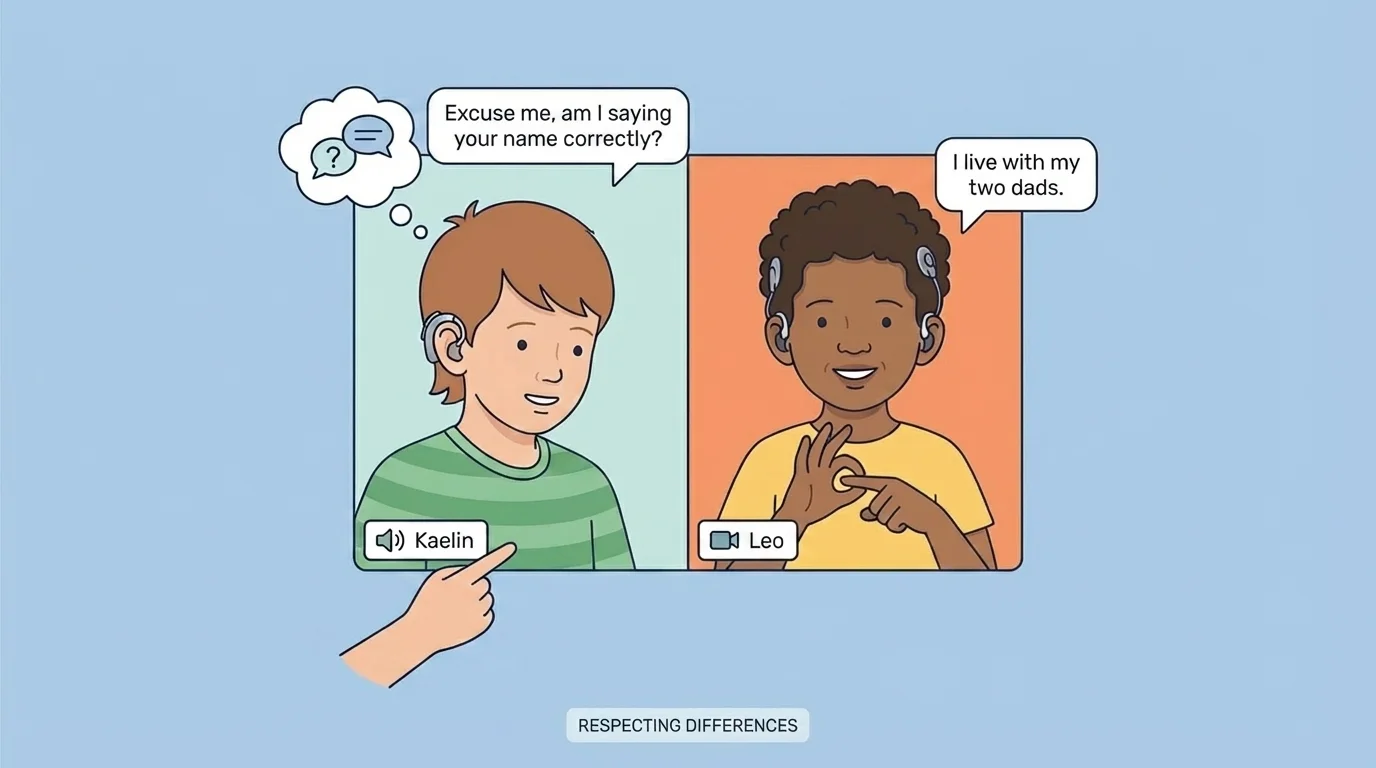
If someone uses sign language, a communication board, or a device, wait for their message. Do not rush them. Communication may look different, but it is still real communication.
You already know that words can help or hurt. This topic adds something important: even if you are curious, you still need to choose words that protect another person's feelings and dignity.
When you talk online, type kindly too. Do not make jokes about spelling mistakes, grammar, or accents in chat messages. A person may be learning. A respectful message helps them feel brave enough to keep speaking.
Culture includes the traditions, foods, music, clothing, holidays, and ways of living that people share in families and communities. Culture can shape what people eat, how they celebrate, what they wear, and what is important to them.
You may meet someone whose lunch smells different from yours, whose holiday is new to you, or whose clothes are special for family or faith reasons. Respect means you do not say "gross," laugh, or act like your way is the only normal way.
"Different is not wrong."
It is okay to be curious. Curiosity becomes respectful when your questions are gentle. You can say, "What is that called?" or "Would you like to tell me about your celebration?" If the person does not want to answer, respect that too.
A good rule is notice, don't judge. You can notice that a tradition is new to you without deciding that it is strange or bad.
Respecting culture also means not pretending to be an expert after hearing one small thing. Every family and person is unique. Two people from the same culture may still do things differently.
[Figure 3] helps show that people can have different abilities in ways we can see and ways we cannot see, and that everyone can join a community activity with the right support. Some people may use wheelchairs, walkers, glasses, or hearing devices. Some may have learning differences, attention differences, sensory needs, or trouble speaking with their voice.
Respect means you do not treat someone like a baby, and you do not ignore them either. Speak to the person directly. Ask before helping. Some people want help; some want to do things on their own.
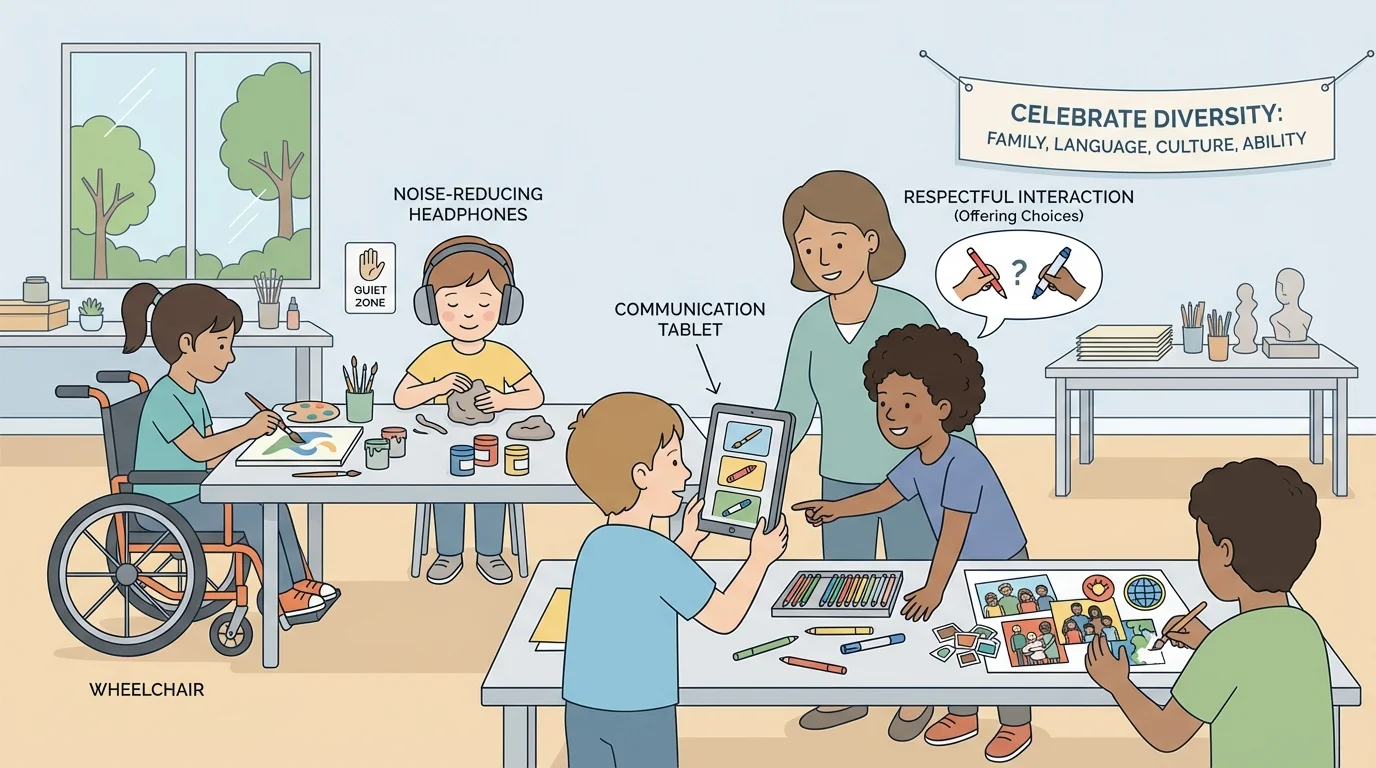
Helpful words are: "Would you like help?" "What works best for you?" and "We can make room." Unhelpful actions are grabbing someone's equipment, touching a device without permission, or deciding what they can do before asking.
How to be inclusive in a group activity
Step 1: Make space for everyone to join.
Step 2: Give clear directions one step at a time.
Step 3: Ask, "Do you want help, or do you want to try first?"
Step 4: Be flexible if someone needs a different tool, seat, volume level, or more time.
Inclusion means changing the situation so more people can take part.
Sometimes a difference is invisible. A child may look fine to you but still need breaks, quiet, captions, larger print, or extra time. That is why guessing can be unfair. The variety shown in [Figure 3] reminds us that not all needs are obvious at first glance.
Here are simple ways you can show respect every day.
When talking online: wait your turn, do not interrupt, and read the room. If someone is speaking slowly, stay calm and listen. If you do not understand, ask kindly.
When joining a community activity: include others, explain rules clearly, and make room for different needs. If the space is too loud or too crowded for someone, help think of a better way.
When you notice a difference: keep your face and voice kind. You do not need to point it out. Sometimes the most respectful thing is simply acting normal and friendly.
When you are curious: ask only if the question is kind and not too personal. If you are not sure, it may be better not to ask.
| Situation | Respectful choice | Hurtful choice |
|---|---|---|
| Someone speaks differently | Listen and ask politely for repetition | Laugh or copy their accent |
| A friend has a different family routine | Say, "Okay, maybe later" | Say, "That's weird" |
| Someone uses a device to communicate | Wait for their message | Rush them or grab the device |
| A person celebrates differently | Show interest kindly | Make jokes about it |
Table 1. Examples of respectful and hurtful responses in everyday situations.
Why respect matters in real life is simple: respect builds trust. When people feel safe, they are more likely to join, share, learn, and cooperate. When people feel mocked or ignored, they may pull away or feel hurt for a long time.
Small actions matter. One kind sentence can help someone feel included. One rude joke can make someone feel alone.
Everyone makes mistakes. You may laugh at the wrong moment, use the wrong word, or ask something too personal. What matters next is what you do.
First, stop. Do not argue. Second, listen. If someone says they feel hurt, believe them. Third, apologize. You can say, "I'm sorry. That was not respectful." Fourth, fix it. Change your words or actions. Fifth, learn. Try to do better next time.
A strong apology sounds like this
"I'm sorry I laughed when you were talking. That was unkind. I will listen better next time."
This apology works because it names the mistake, shows care, and promises a better action.
You do not need to be perfect. You do need to be willing to learn. Respect grows each time you choose kindness over judging, listening over interrupting, and understanding over teasing.
