Have you ever wanted a little quiet time, but someone kept talking to you? Or maybe you were using something and someone grabbed it without asking. Those moments can seem small, but they matter. Learning about boundaries helps you protect your space, feelings, time, and things. It also helps you be a kind friend, sibling, teammate, and community member.
A boundary is a limit that helps you feel safe and comfortable. It tells other people what is okay and what is not okay for you. Boundaries can be about your body, your space, your time, your feelings, and your belongings, as [Figure 1] shows. A boundary is not mean. It is a respectful way to take care of yourself.
Here are some simple examples of boundaries: "Please don't touch my drawing." "I need quiet while I read." "Ask before you borrow my markers." "I don't want to be tickled." "I can talk after dinner, not right now." These are all ways to say what you need.
Boundary means a rule or limit that protects your body, feelings, time, space, or things. Respect means treating someone's limits with care by listening and responding kindly.
People can have different boundaries. One child might like high-fives. Another child might not want to be touched. One person might love chatting on a video call. Another person might need quiet time first. Different does not mean wrong. It means people have different comfort levels.
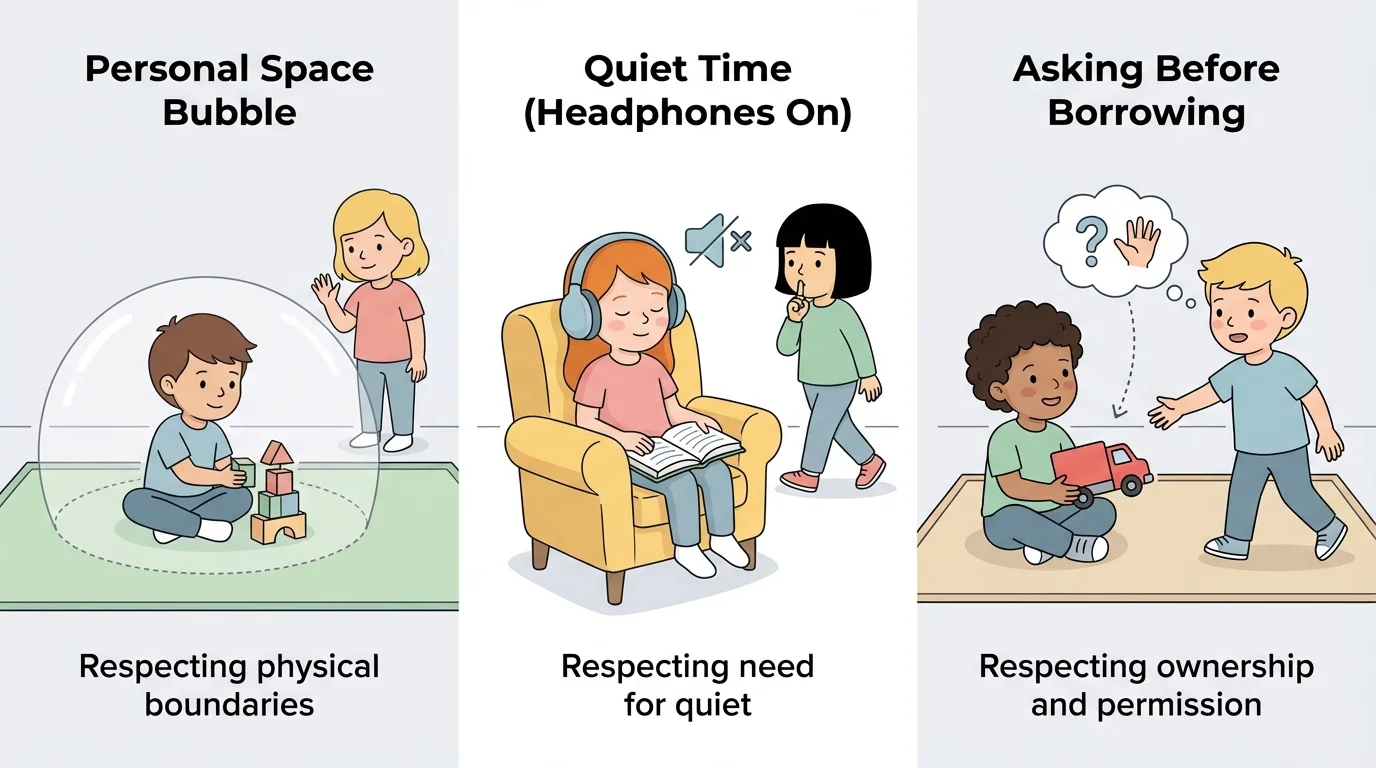
Boundaries matter because they help people feel safe. They also build trust. When you listen to someone's boundary, you show, "I care about you." When you set your own boundary clearly, you show, "My feelings matter too."
Without boundaries, problems can grow. A person may feel upset, crowded, worried, or ignored. For example, if your brother keeps entering your room without asking, you may feel frustrated. If a friend keeps sending messages while you are trying to rest, you may feel bothered. But when boundaries are clear, people know how to act, and things often go more smoothly.
Some of the strongest friendships are not the ones where people always say yes. They are the ones where people can say no respectfully and still care about each other.
Boundaries also help with safety. If something feels wrong, uncomfortable, or too big for you, a boundary can help you stop the situation and get help from a trusted adult.
There are many kinds of boundaries you can use in everyday life.
Body boundaries: You get to decide what feels okay for your body. You can say, "No hugs right now," or "Please stop poking me."
Space boundaries: Sometimes you need room. You can say, "Please give me some space," or "Knock before coming in."
Belongings boundaries: Your things should not be taken without asking. You can say, "Please ask before using my game," or "I'm not sharing that right now."
Time boundaries: You do not have to be available every moment. You can say, "I can help in five minutes," or "I need to finish this first."
Noise boundaries: If something is too loud, you can say, "Please turn that down," or "I need a quieter space."
Online boundaries: These matter too. You can say, "Please don't call without asking first," "I'm done chatting for today," or "Don't share my photo."
Boundaries can be kind and firm at the same time. You do not have to yell, argue, or be rude. A calm voice and clear words often work best. Being kind means using respectful words. Being firm means you still mean what you say.
Notice something important: a boundary is about what you need and what you will do. Instead of trying to control another person, you explain your limit. For example, "If you keep shouting, I will move to a quieter room." That tells what you need and what your next step will be.
It can feel hard to find the right words. A simple communication pattern can help, and [Figure 2] lays it out in an easy order. You do not need a long speech. Short and clear is best.
Try this simple pattern: say what is happening, say what you need, and say what you will do if needed.
For example: "You are tapping my chair. Please stop." Or, "I need quiet right now. I will talk later." Or, "Ask before borrowing my crayons. If you don't ask, I will put them away."
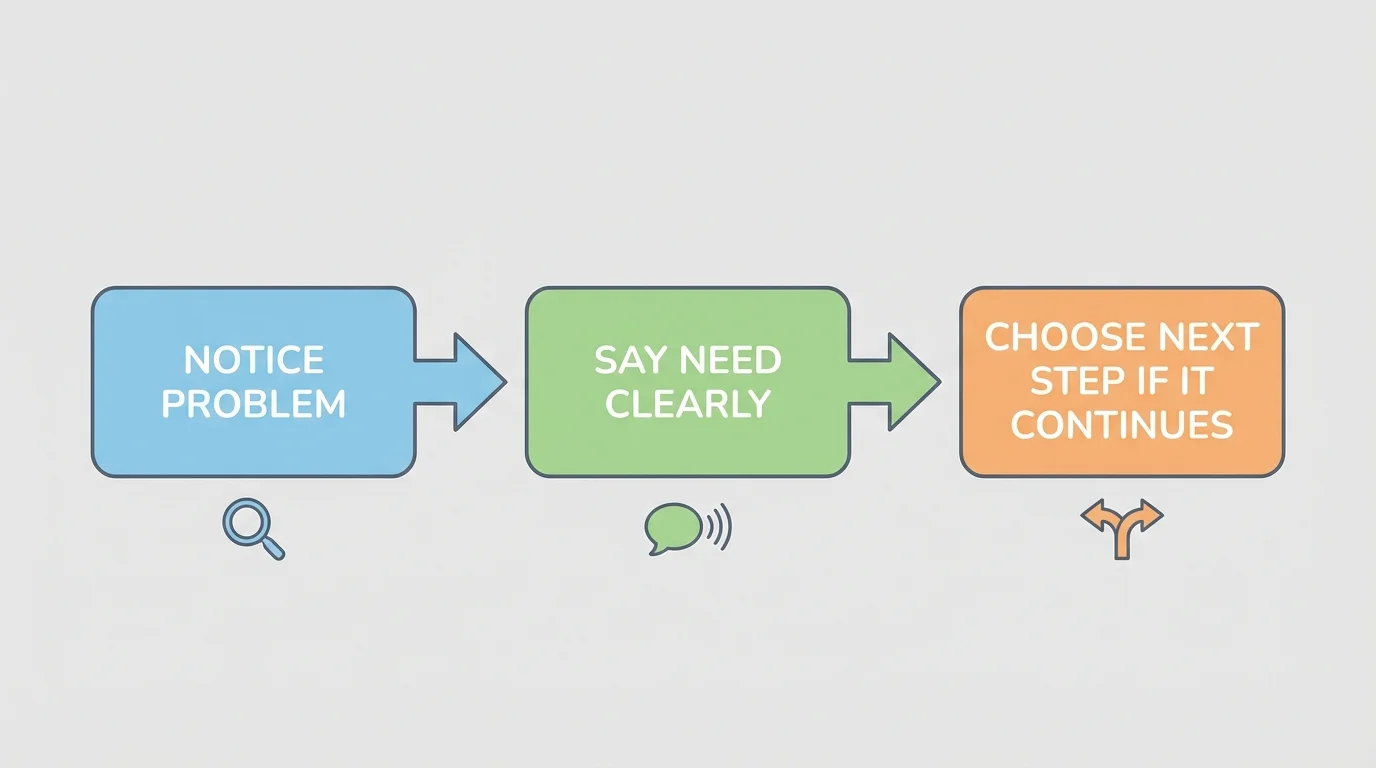
Using a calm boundary sentence
Step 1: Name the problem.
"You keep interrupting me."
Step 2: Say what you need.
"Please let me finish talking."
Step 3: Add a next step if needed.
"If it keeps happening, I will end the call and talk later."
This is calm, clear, and strong.
Here are helpful sentence starters: "Please stop." "I don't like that." "Ask first." "Not right now." "I need space." "I need a break." "I'm not ready." "That's private." "I said no."
You do not need to smile or make your boundary sound tiny. You can be polite without acting unsure. A steady voice, simple words, and a calm face can help.
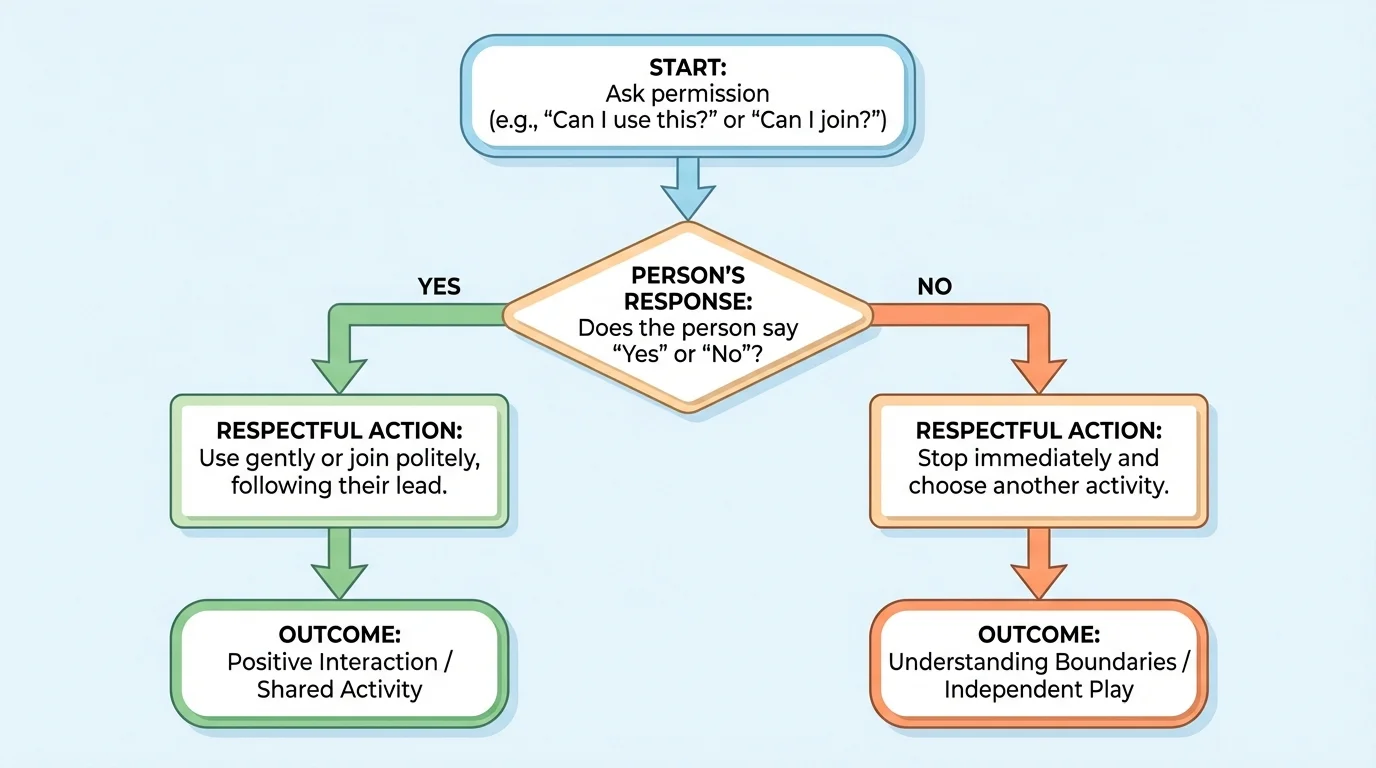
Respecting someone else's boundary means listening when they say no, stop, not now, or I need space. It also means noticing body language and tone. If someone steps back, goes quiet, covers their ears, or says they need a break, pay attention. Accepting their answer matters, and [Figure 3] shows the respectful choices that come next.
You do not have to agree with someone's boundary to respect it. Maybe you really wanted to borrow a toy, keep talking, or sit close. Even so, if the other person says no, the respectful choice is to stop and choose something else.
A good rule is ask first. Ask before borrowing. Ask before sharing someone's photo. Ask before starting a video call. Ask before entering a private space. Ask before touching someone.
Sometimes children think, "But I was only joking," or "I only did it a little." But if the other person is uncomfortable, the joke is not funny for them. Respect means stopping when someone says stop.
"No means no. Stop means stop."
If you make a mistake, you can fix it. Say, "Sorry. I'll stop." Then really stop. That is part of being responsible and respectful.
Sometimes you say your boundary, but the other person keeps going. That can happen with siblings, neighbors, teammates, or even someone online. If that happens, remember this: you still deserve safety and respect.
First, stay as calm as you can. Take a breath. Use a short sentence: "I said stop." "I need space." "Do not touch that."
Next, repeat the boundary once. You do not need to argue again and again. A short repeat can be enough: "No. I'm not sharing that right now."
Then take action. Move away, log off, close the chat, put the item away, or go to a different room if you can safely do that.
Finally, tell a trusted adult. If someone will not stop, if you feel scared, or if the situation is unsafe, get help right away. Trusted adults can be a parent, guardian, caregiver, coach, club leader, or another safe grown-up.
If a problem feels too big to handle alone, asking for help is a smart choice, not a weak one.
Online safety boundaries are especially important. If someone sends mean messages, asks for private information, shares your picture without permission, or keeps contacting you after you said stop, tell a trusted adult and block or leave the conversation if possible.
Boundaries show up in ordinary moments every day, and [Figure 4] compares respectful and disrespectful choices in common situations. The more you notice these moments, the easier it becomes to handle them.
On a video call, someone keeps talking while you are answering. You can say, "Please let me finish." If they say, "Okay," and wait, they are respecting your boundary. If they keep interrupting, you can repeat yourself and choose to mute or leave if needed.
At home, your sister grabs your puzzle pieces. You can say, "Please ask before taking those." If she gives them back, that shows respect. If she laughs and keeps taking them, it is time to put the puzzle away and tell an adult.
At a club or sports practice, a child stands too close and you feel crowded. You can step back and say, "I need more space." Respectful behavior means they move back. Disrespectful behavior means they keep crowding you after you asked.
In your neighborhood, a friend wants to come over right away. You can say, "Not today," or "You need to ask my grown-up first." If they get upset, your boundary still matters. A person can feel disappointed and still need to respect your answer.
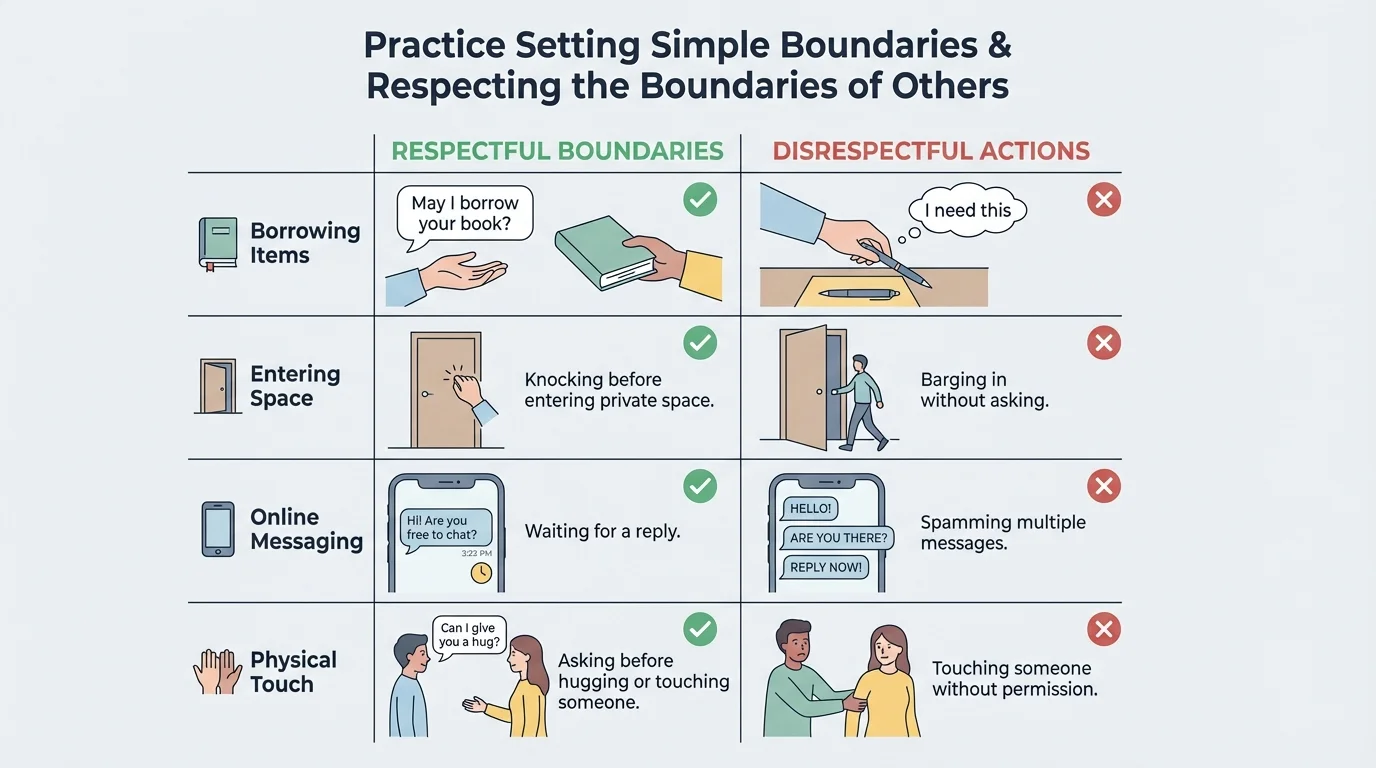
| Situation | Respectful choice | Disrespectful choice |
|---|---|---|
| Borrowing a game | Ask first and wait | Take it without asking |
| Sending messages | Stop when someone says they are done | Keep messaging again and again |
| Personal space | Step back when asked | Keep moving closer |
| Private information | Keep it private | Share it without permission |
Table 1. Examples of respectful and disrespectful behavior when boundaries are involved.
Looking back at [Figure 1], you can see that boundaries are not just about one big moment. They appear in many small moments. And as [Figure 3] reminds us, once someone says no or stop, the next respectful action is to listen and change what you are doing.
You can get better at boundaries with small habits.
Pause before acting. Before you touch, borrow, enter, post, or call, ask yourself, "Did I ask first?"
Use clear words. Short sentences work well. You do not need a long explanation.
Listen all the way. If someone says no, do not argue right away. Hear the answer.
Notice feelings. If you feel annoyed, crowded, or uncomfortable, that may be a sign you need a boundary. If someone else looks upset or backs away, that may be a sign they need one.
Practice with safe people. You can start by using simple boundaries with family members and trusted adults. The speaking pattern in [Figure 2] helps because it gives you a plan: say what is happening, say what you need, and choose a next step if needed.
Try This: Today, use one clear sentence to protect your time, space, or belongings. You might say, "Please knock first," "I need quiet for ten minutes," or "Ask before using that."
Try This: The next time someone says no or not now, practice answering with respect. You can say, "Okay," "Thanks for telling me," or "I'll wait."
Boundaries are a way to care for yourself and care for others at the same time. When you speak clearly and listen respectfully, relationships become safer, calmer, and stronger.
