What if two children both want to talk at the same time on a video call, or two neighbors both want the same swing at the park? A choice has to be made. The best choices are not just fast choices. They are fair and thoughtful choices. When you make decisions this way, people are more likely to feel calm, safe, and included.
A fair choice gives people a chance and does not favor one person just because they are louder, bigger, or first to complain. A thoughtful choice means you stop and think before you act. You think about what may happen next and how other people may feel.
Sometimes a decision helps only you for a moment, but hurts someone else. That is usually not fair. Sometimes a choice seems fair at first, but if you do not think carefully, someone may still get left out. Fair and thoughtful decisions work best together.
Fair means treating people in a way that is just and kind.
Thoughtful means taking time to think carefully about feelings, needs, and what might happen next.
Decision means a choice you make.
When you use both fairness and careful thinking, people can trust you more. Trust is important in online school, at home, in clubs, in games, and in your neighborhood. If people know you will listen and think, they feel more comfortable being around you.
Every day you make many choices. You decide when to speak, how to answer a message, whether to share, whether to wait your turn, and how to solve a problem. A small choice can make a big difference.
For example, if you interrupt during an online class meeting, another student may not get to share an idea. If you let others take turns, everyone gets a chance to join. If you leave a mess in a shared space at a library or park, someone else has to deal with it. If you clean up, you help the whole community.
[Figure 2] shows how the same situation can feel very different depending on the choice people make. Fair decisions help people feel included. Thoughtful decisions help prevent problems before they grow. Together, they build stronger friendships, smoother group activities, and kinder communities.
Your brain gets better at making good choices the more you practice. Small everyday decisions, like waiting your turn or using kind words in a message, help build this skill.
[Figure 1] shows a simple plan for making good decisions. Good decisions also help you solve problems. If two people want the same thing, a fair choice might be taking turns. If someone is upset, a thoughtful choice might be listening first before answering. These choices may not always be the easiest, but they often work better in the long run.
You can use a simple decision-making plan whenever you are unsure what to do. This plan helps you slow down and choose wisely instead of rushing.
Step 1: Stop. Take a breath. If you are upset, excited, or frustrated, pause before acting.
Step 2: Think about the problem. What is happening? Who is involved?
Step 3: Ask, "Is this fair?" Will everyone get a chance? Will someone be hurt, left out, or ignored?
Step 4: Ask, "What could happen next?" This is called thinking about the consequence. A consequence is what happens because of a choice.
Step 5: Choose the best action. Pick the choice that is safe, kind, and fair.
Step 6: Check the result. Did your choice help? If not, what can you do differently next time?
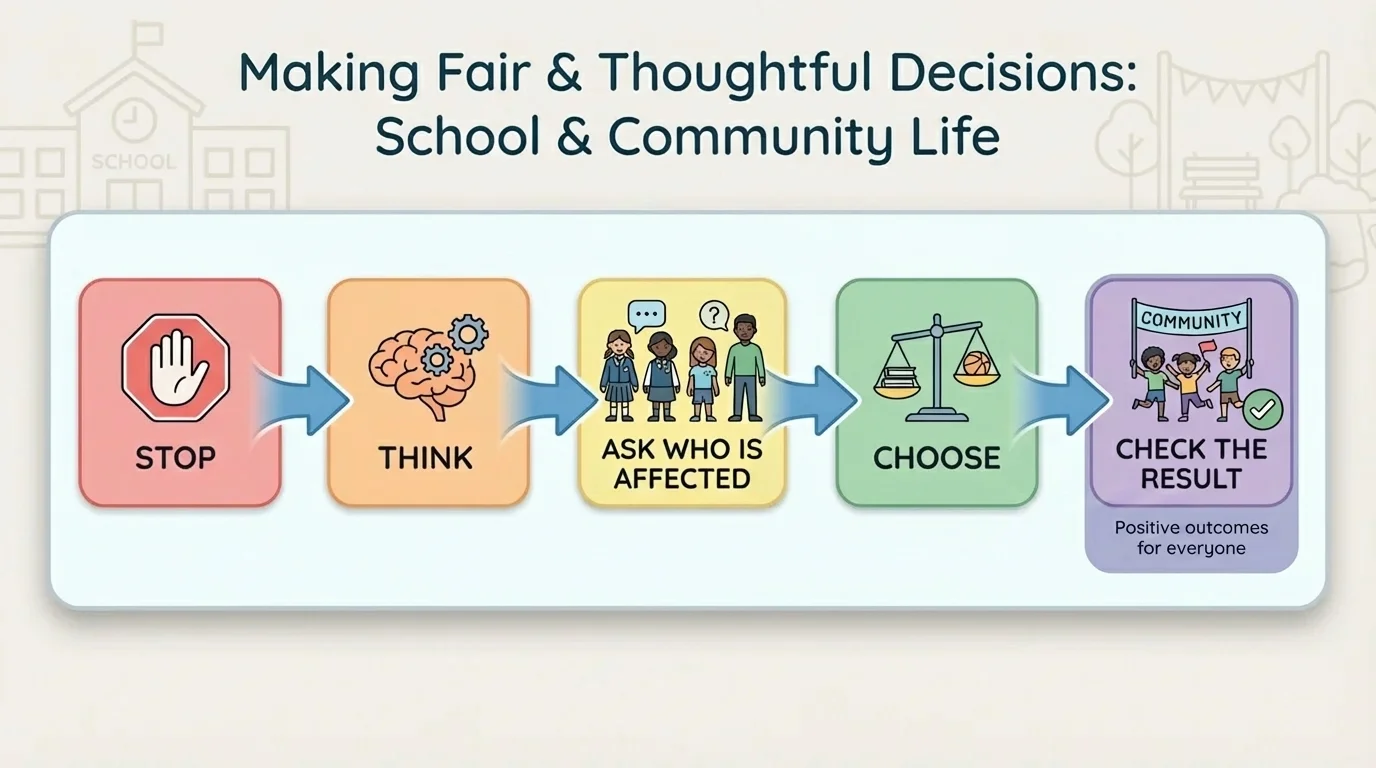
This plan is helpful because feelings can be strong. If you are angry, you may want to blurt out something mean. If you are excited, you may forget to let others go first. Slowing down helps your brain make a better choice.
It is also okay to ask an adult for help. A trusted adult can help you think through choices when a problem feels confusing or too big.
Example: choosing what to do in a group video project
Step 1: Notice the problem
Three children all want to be the first speaker in a recorded project.
Step 2: Think about fairness
If one child always goes first, the others may feel left out.
Step 3: Choose a fair solution
The group can take turns in different projects or draw names.
Step 4: Check the result
Everyone gets a chance, and the group can work together more peacefully.
Notice that a fair choice does not always mean everyone gets the exact same thing at the exact same time. Sometimes fairness means taking turns, listening to needs, or finding a solution that works well for everyone.
In online school, fairness still matters every day. You may be in a video class, a discussion board, a shared document, or a class message space. In all of these places, your choices affect other people.
A fair choice in online school can look like waiting until someone is done speaking, using respectful words in chat, giving credit when a classmate has a good idea, and taking turns during group work. These actions show respect. Respect means showing that other people matter.
An unfair choice can look like talking over others, sending rude messages, copying someone else's work, or refusing to listen. Those choices can hurt feelings and make learning harder for everyone.
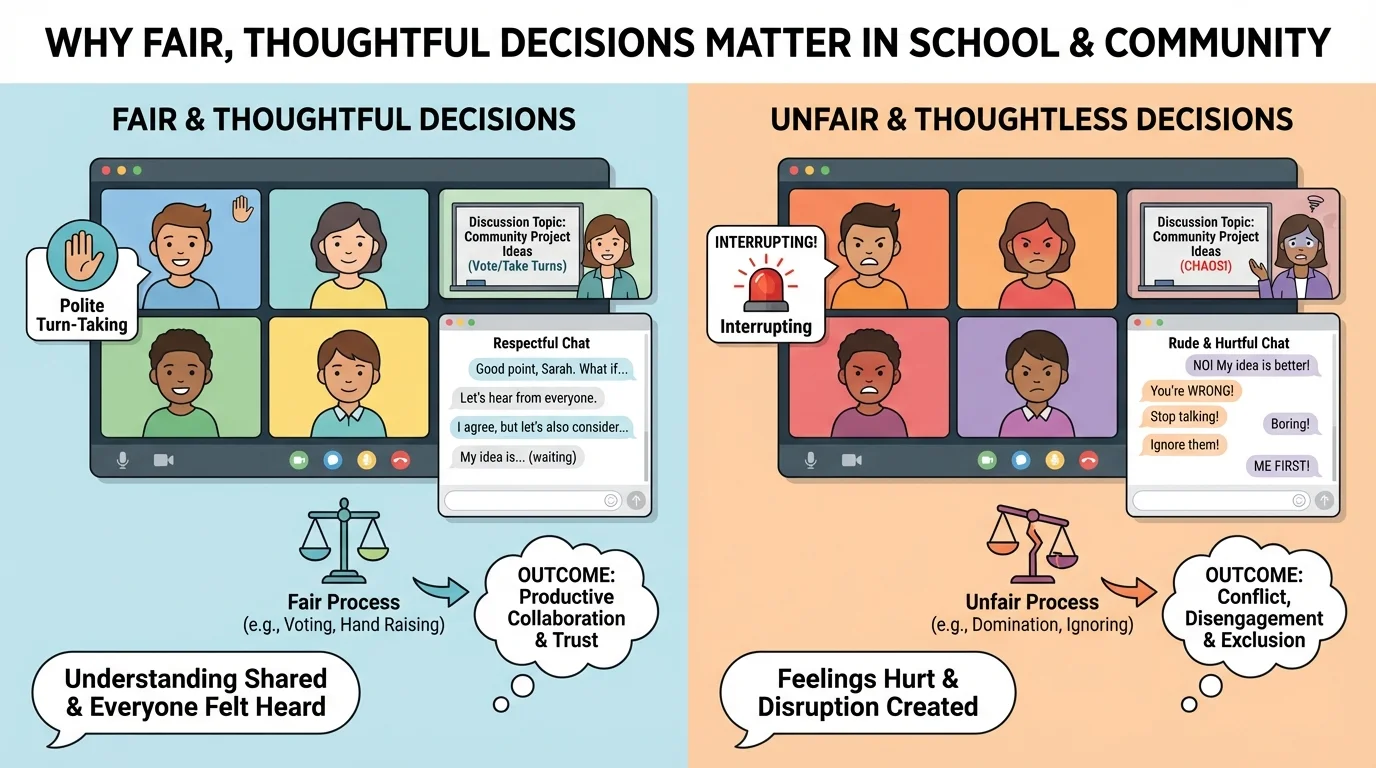
Suppose your teacher asks a question during a live lesson. You know the answer and want to shout it out right away. A thoughtful choice is to pause, raise your hand if that is the rule, or wait for your turn to speak. This helps everyone have a chance.
Suppose you see a classmate type something slowly and make a spelling mistake in chat. An unkind choice would be laughing or sending a teasing message. A fair and thoughtful choice would be to ignore the mistake or offer help kindly if it is needed.
Why fairness builds trust in school life
When you are fair in online school, other students learn that you will not ignore them, mock them, or take over. That makes it easier to work together, share ideas, and solve problems calmly.
The same idea from [Figure 1] works here too: stop, think, choose, and check. If you remember those steps before posting, speaking, or replying, you can prevent many problems.
Your community is made of the people and places around you. It includes your neighborhood, playgrounds, clubs, teams, libraries, and events. Fair choices in these places help everyone enjoy shared spaces.
[Figure 3] illustrates how fair choices help shared community spaces work well. For example, if you arrive at a swing set and someone is already waiting, a fair choice is to wait your turn. If you borrow something from a neighbor or club, a thoughtful choice is to return it in good shape. If you bring a snack wrapper to the park, a responsible choice is to put it in the trash.
When people share spaces, they need to think beyond themselves. If everyone grabs, pushes, or refuses to help, the place becomes stressful. If people take turns, follow rules, and clean up, the place feels welcoming.
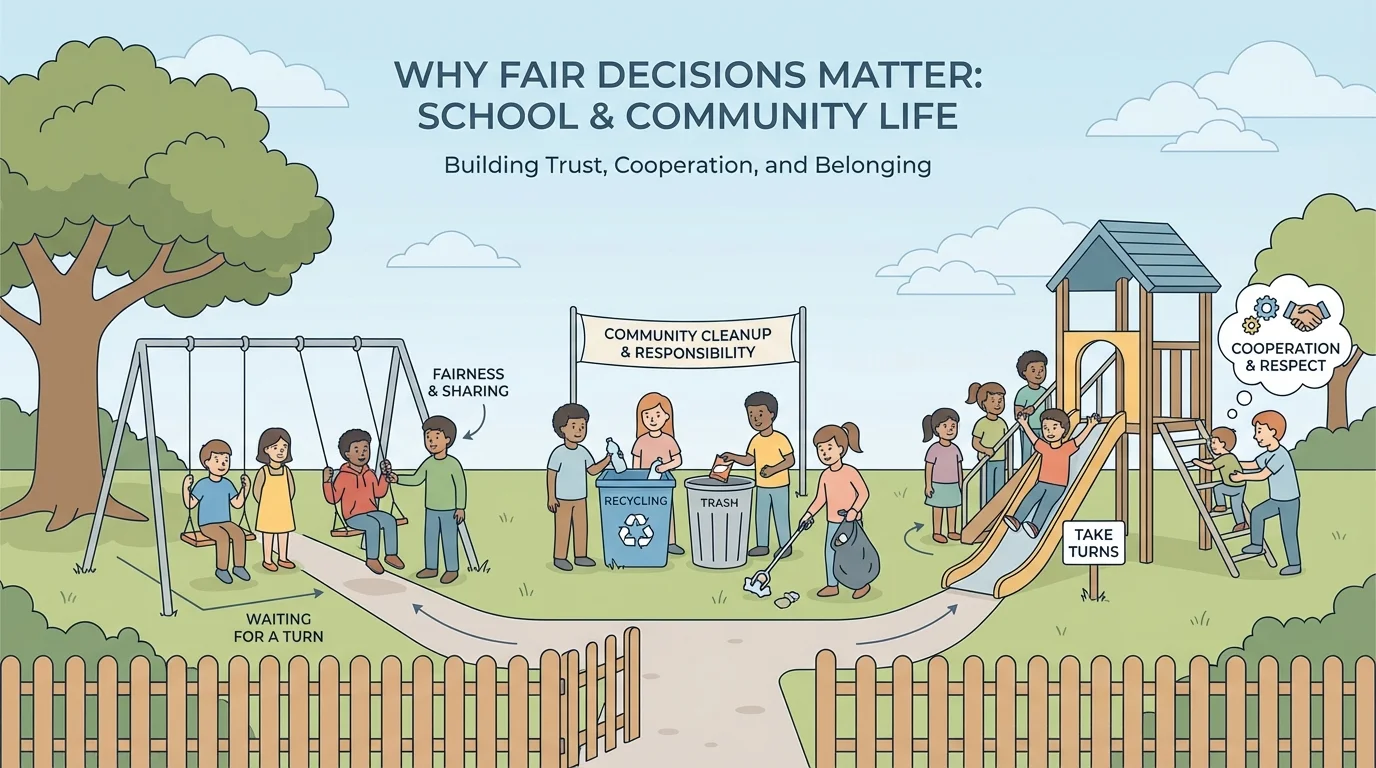
Fair choices also matter when someone is left out. If you notice a child at a club activity standing alone, you can make a thoughtful decision to include them. You might say, "Do you want to join us?" That small choice can make someone feel seen and cared for.
Sometimes fairness means following rules that protect everyone. If a sign says to walk bikes in a crowded area, obeying that rule is a thoughtful decision because it helps keep people safe.
Example: solving a problem at the park
Step 1: Notice the problem
Two children want the same swing.
Step 2: Think about choices
One child could grab the swing, or they could agree to take turns.
Step 3: Choose the fair option
They decide one child swings first, then the other gets a turn.
Step 4: Look at the result
Nobody is pushed aside, and the game stays peaceful.
The park example shows that shared places work best when people think about others, not just themselves.
Sometimes you know the right thing, but it still feels hard to do. Maybe you are upset. Maybe you want to win. Maybe a friend tells you to do something unkind. Hard moments are when thoughtful choices matter most.
This is when critical thinking helps. Critical thinking means using your mind carefully instead of just reacting fast. You can ask yourself simple questions: "Is this kind?" "Is this safe?" "Would I want this done to me?" "What will happen after I choose?"
If you make an unfair choice, you can fix it. You can tell the truth, say sorry, return what you took, invite someone back into the game, or try again with kinder words. Making a mistake does not mean you are a bad person. It means you have another chance to choose better.
"Being fair means thinking about other people, not only yourself."
If someone else is being unfair, you do not have to solve everything alone. You can stay calm and get help from a trusted adult. Asking for help is a thoughtful decision too.
Good decisions become easier when you practice small habits often. You do not need to wait for a huge problem. You can build this skill every day.
Here are some habits that help: listen all the way to the end, take turns, use kind words online and in person, clean up shared spaces, follow safety rules, and think before you send a message. These habits show community care.
You can also remember a quick check: fair, kind, safe, and helpful. If a choice matches those words, it is probably a strong choice. If it hurts, excludes, or disrespects someone, stop and rethink it.
You already know how to share, wait, and use kind words. Fair and thoughtful decision-making is using those same skills on purpose, even when a situation feels tricky.
Try This: Before your next online message, game turn, or community activity, pause for one breath and ask, "Is this fair?"
Try This: If a problem comes up today, name two possible choices before you act. Then pick the one that is kinder and safer.
Try This: If someone around you is left out, make one small move to include them.
