Have you ever sat down to do your work, and then suddenly you are looking at a toy, thinking about a snack, or clicking to another screen? That happens to lots of students. Learning at home can feel great because you are in your own space, but it can also be tricky because there are many things that pull your mind away. The good news is this: you can train your brain to focus and use your time well.
Attention means keeping your mind on what you are doing. Time strategies are ways to help you use your minutes wisely. When you use both, work feels calmer and easier. You finish more, make fewer mistakes, and feel proud of yourself.
When attention and time are not used well, work can drag on. A ten-minute job can turn into a much longer job. You might miss directions, forget what to do next, or feel frustrated. When you use good strategies, you know how to begin, how to keep going, and how to finish.
Attention is focusing your mind on the task you are doing.
Distraction is something that pulls your mind away from the task.
Time strategy is a tool or plan that helps you use time in a smart way.
These skills are useful during schoolwork, but they also help in real life. You use them when you clean your room, build something, practice piano, or help make a sandwich. Knowing how to focus and manage time helps you in many parts of your day.
Before you start learning on your own, take a moment to prepare. A ready-to-work space helps your brain know, "Now it is time to focus." If you have to keep getting up for a pencil, charger, or paper, your attention may drift away.
Choose a learning spot that is as calm as possible, as shown in [Figure 1]. Put away extra toys or objects you do not need right now. Get your supplies ready. You may need a notebook, pencil, device, headphones, and water. If you need to use a website or app, open only the tabs you need.
A quick start plan can help. You can tell yourself: First, read the directions. Next, do the first part. Last, check my work. This small plan makes a big task feel easier.
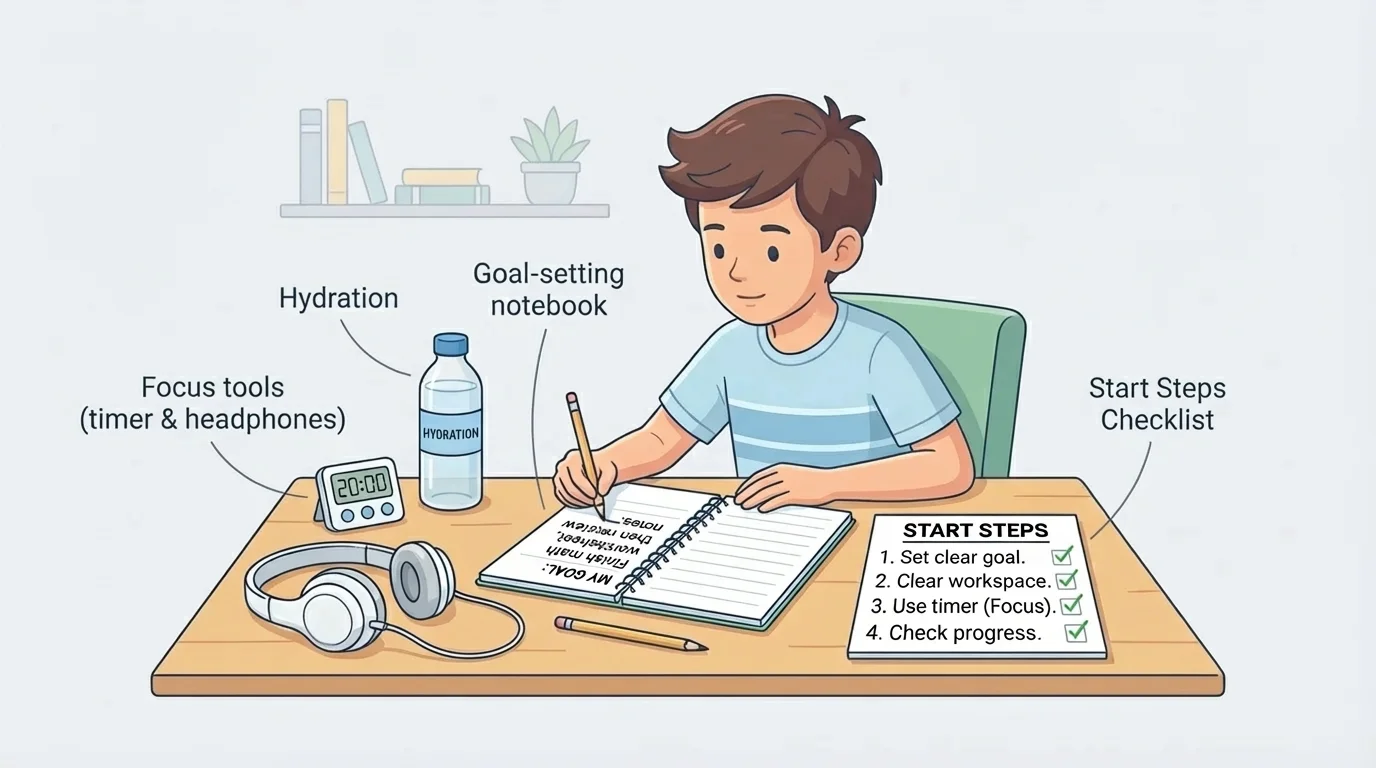
Your body matters too. If you are very hungry, tired, or restless, it is harder to focus. Try a drink of water, a bathroom break, or a stretch before you begin. A prepared body helps a prepared brain.
Getting ready in a smart way
Step 1: Look at the task.
You see that you need to read a short passage and answer questions.
Step 2: Gather what you need.
You get your reading page, pencil, and headphones.
Step 3: Make a tiny plan.
You say, "Read first, answer next, check last."
Step 4: Begin right away.
You start with the first sentence instead of waiting and wondering.
Notice how this plan is simple. You do not need a fancy system. You just need a few steps that help you begin.
Sometimes the hardest part is not starting. It is staying focused. One good strategy is to do one thing at a time. If you are reading, just read. If you are writing, just write. Trying to do too many things at once can confuse your brain.
Another helpful tool is self-talk. Self-talk is the quiet voice in your mind that helps you. You can say, "Eyes on the page," "Finish this part first," or "I can do one step at a time." Kind, clear self-talk helps you bring your attention back.
You can also cover part of a page and look at just one section. That keeps your eyes from jumping all around. If a task feels too big, point to the part you are doing right now. Your finger can help your brain stay on track.
Focus can come back. Losing attention does not mean you failed. It means you noticed your mind wandered, and now you can bring it back. That is a skill. Every time you return to the task, you are practicing stronger focus.
If you get distracted, do not panic. Pause and ask yourself, "What was I doing?" Then return to the last direction or the last finished part. This is much better than giving up.
Short work times can help too. A child your age may focus better when work is broken into shorter pieces. You might work for a short time, then take a small break, then return. The break should be quick and calm, like stretching, standing up, or taking three deep breaths.
Time can feel sneaky. Sometimes a job feels like it will take forever, even when it is really small. Using a timer, a checklist, or small chunks helps you see the job clearly. Breaking one task into parts makes it easier to begin and finish.
A timer is not for rushing. It is meant to help. You might set a short timer and say, "I will focus until the timer ends." That gives your brain a clear work time. When the timer is done, you can check your progress.
Another useful strategy is chunking, as shown in [Figure 2]. Chunking means breaking big work into small pieces. For example, if you have three things to do, your chunks might be: read directions, do the work, check the work.
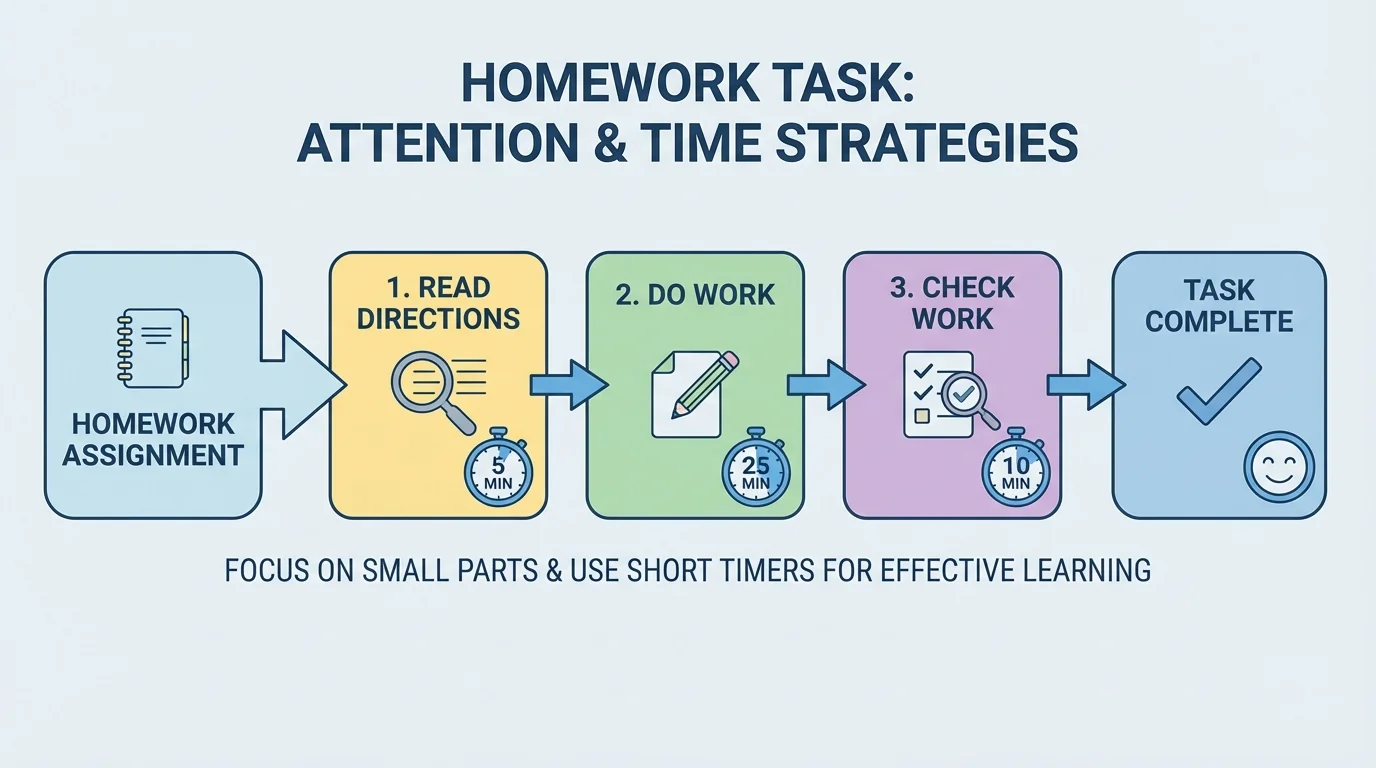
You can make a tiny checklist in your notebook:
| Task Part | What to Do |
|---|---|
| Part 1 | Read directions slowly |
| Part 2 | Do the first few questions |
| Part 3 | Check answers and turn in work |
Table 1. A simple checklist that breaks one task into smaller parts.
Checking off one part at a time feels good. It also helps you see that you are making progress. When your work is chunked, you are less likely to feel stuck.
You can also practice estimating. Estimate means making a smart guess. Before you begin, ask, "Will this take a short time, a medium time, or a long time?" You do not need the exact number of minutes. You just need a good guess so your day feels more organized.
Your brain often works better when it knows there is a clear start and a clear finish. That is why checklists and timers can make a hard job feel easier.
Later, when you use a checklist again, remember the flow from start to finish in [Figure 2]. A simple path can stop a task from feeling huge.
Group learning online is a little different from working alone. You need attention for your own job, and you also need to notice what other people are saying. Good group work uses listening, turn-taking, and staying on topic.
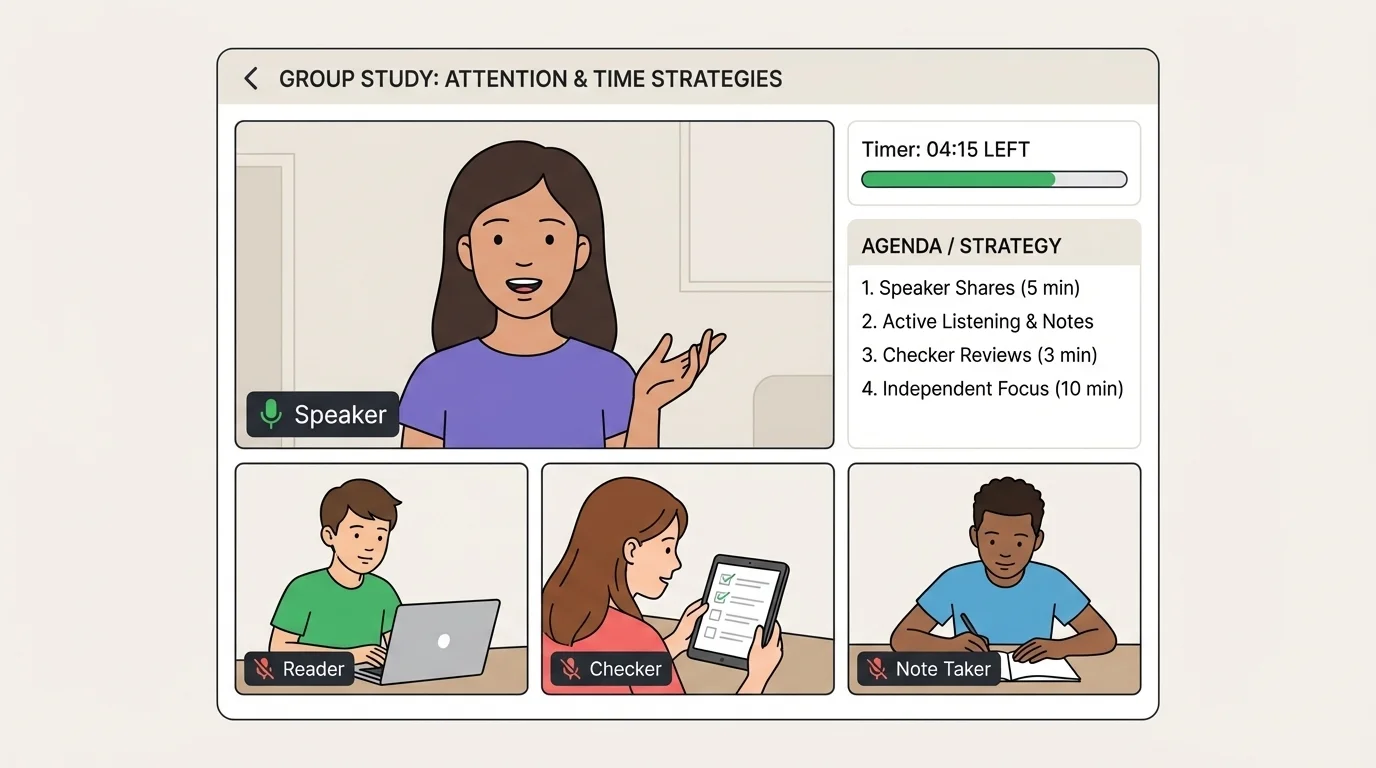
Before the group starts, make sure you know the goal, as shown in [Figure 3]. Ask, "What are we making or finishing?" Then notice your job. Maybe you are reading directions, sharing an idea, or checking that the group did every part.
During a video call, look and listen carefully. If you are not speaking, stay quiet so others can be heard. Wait for your turn. If you have an idea, you can say, "I have something to share when it is my turn." That is respectful and helpful.
Staying on topic is also important. Sometimes group talk can slide into games, jokes, or other topics. That can be fun later, but during group work it slows everyone down. A kind reminder can help: "Let's finish this part first."
Sharing jobs makes group work smoother. One person might be the reader. Another might be the idea sharer. Another might be the checker. When everyone knows what to do, the group can use time better.
Online group example
Step 1: Hear the goal.
Your group needs to make a short slide about animal habitats.
Step 2: Choose jobs.
One student reads directions, one finds facts, one checks spelling, and one shares the final answer.
Step 3: Use turn-taking.
Each person speaks when it is their turn instead of talking over others.
Step 4: Watch the time.
The group finishes one part before moving to the next part.
Later in the task, the turn-taking and shared roles from [Figure 3] still matter. They help the group stay calm, fair, and ready to finish.
Even with good plans, problems can pop up. That is normal. Strong learners do not need perfect days. They need ways to fix problems when they happen.
If noise is bothering you, try headphones or move to a quieter spot if possible. If you feel bored, make the job smaller and finish just one part first. If you feel stuck, reread the directions, ask for help in the right way, or leave a hard part and return after an easier part.
If you are rushing, slow your hands and eyes. Fast work is not always careful work. If you are going too slowly because you keep drifting away, use self-talk and return to the next tiny step.
You already know how to follow directions in order: first, next, last. Attention and time strategies build on that same idea. They help you follow the order without getting lost.
Another common problem is forgetting what to do. A quick note can help. Write one tiny reminder like "read first" or "check last." Your note becomes a guide for your brain.
These strategies are not only for online lessons. You can use them when you clean up your toys, practice dribbling a ball, read for fun, or help bake cookies. First get ready, then focus on one step, then use your time wisely.
For example, if you are cleaning your room, chunk the job into small parts: books, clothes, toys. If you are practicing music, set a short timer for one song part. If you are helping cook, listen to one direction at a time and finish it before the next one. These are the same strong habits you use for learning.
"Small steps done with attention can lead to big success."
Each time you choose a smart strategy, you are teaching yourself how to learn better. That is a powerful skill. You do not have to be perfect. You just need to notice what helps you and use it again.
Try This: Before your next independent task, get your supplies ready, say your first step out loud, and use one short timer. Before your next online group task, decide how you will listen, wait your turn, and stay on topic.
