Some grown-ups get jobs because they know a lot, but they keep jobs because they use good habits every day. That starts now. When you come to online class on time, work kindly with others, and finish what you begin, you are practicing habits that matter in school, at home, and someday at work.
Class is a great place to build strong habits. You may be learning from home, but your actions still matter. Your teacher notices when you are ready. Other students notice when you are kind and helpful in a video call or class chat. You notice how good it feels when you finish your work.
Punctuality means being on time and ready. Cooperation means working well with other people. Follow-through means finishing what you said you would do.
These habits are important because people can trust you when you use them. Trust grows when others see that you are dependable. A dependable person does what they are supposed to do, even when it is not easy.
If you are often late, others may have to wait. If you do not cooperate, group work can become confusing. If you do not follow through, jobs stay unfinished. But when you practice these habits, learning becomes smoother and teamwork feels better.
Many jobs care about small daily habits just as much as big talents. Being ready, respectful, and responsible helps people succeed in many kinds of work.
You do not need to be perfect. You just need to keep practicing.
Punctuality means more than showing up. In online school, it means being logged in, having your materials nearby, and being ready to listen and learn, as [Figure 1] shows with a simple ready-for-class routine.
Being on time tells your teacher, "I am prepared." It also helps routine feel calm. When you rush, you may forget your notebook, miss directions, or feel upset before class even begins.
Here is a simple way to practice punctuality. Step 1: Check the class time. Step 2: Get ready a little early. Step 3: Charge your device if needed. Step 4: Put your pencil, paper, and water nearby. Step 5: Sit down before class starts.
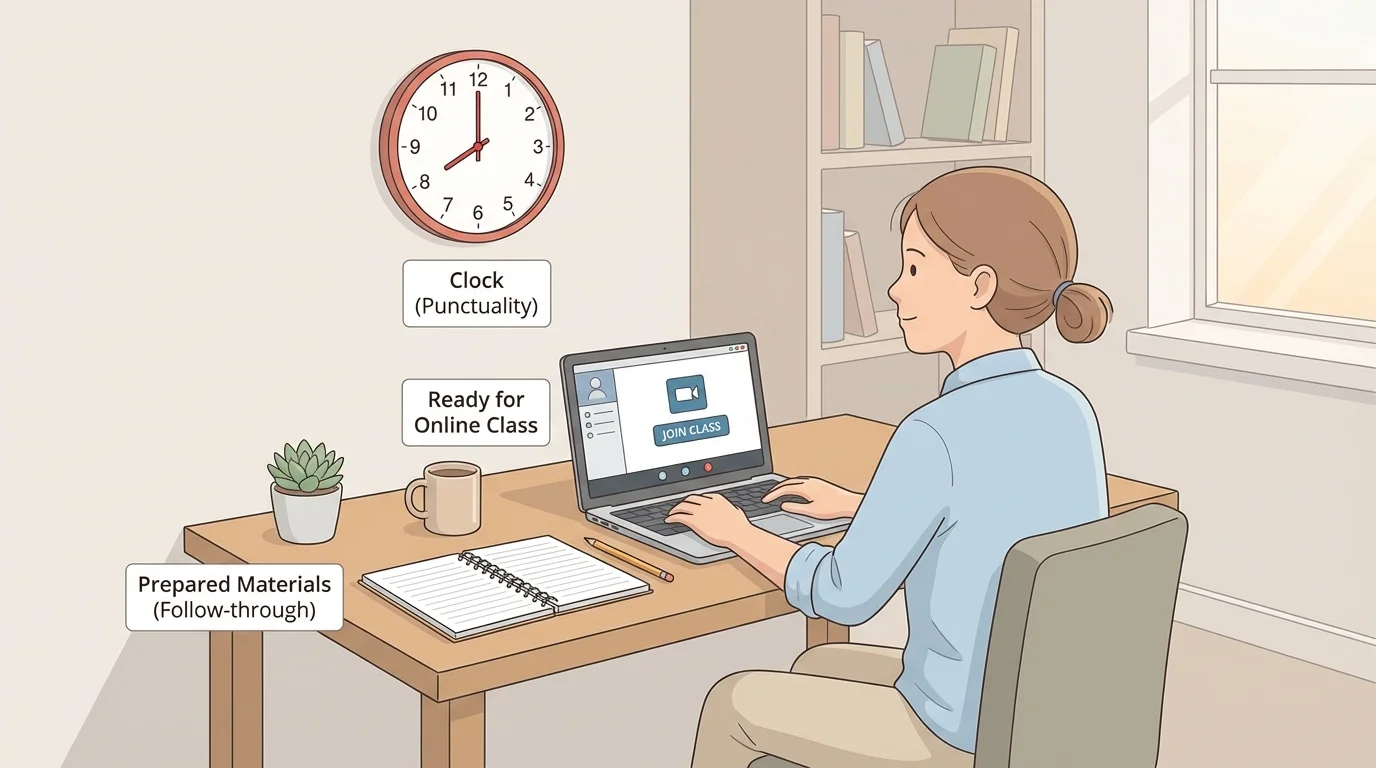
If class starts at 9:00, a smart habit is to be ready a few minutes before. Being early by even a small amount can help you feel calm and prepared. You do not need fancy tools. A clock, a reminder from a family member, or a simple checklist can help.
Real-life example: Being ready for class
Mila has online class in the morning. She used to join late because she looked for supplies at the last minute.
Step 1: The night before, she puts her notebook and pencil on her desk.
Step 2: In the morning, she checks that her tablet is charged.
Step 3: She sits down before class begins.
Now Mila hears the directions at the start and feels less stressed.
Sometimes being late is not your fault. Maybe the internet stops working, or a younger sibling needs help. When that happens, be honest. Tell your teacher or a grown-up as soon as you can. A responsible person does not hide the problem.
Later, the same idea from [Figure 1] helps with homework too: getting your space and supplies ready before you begin saves time and helps your brain focus.
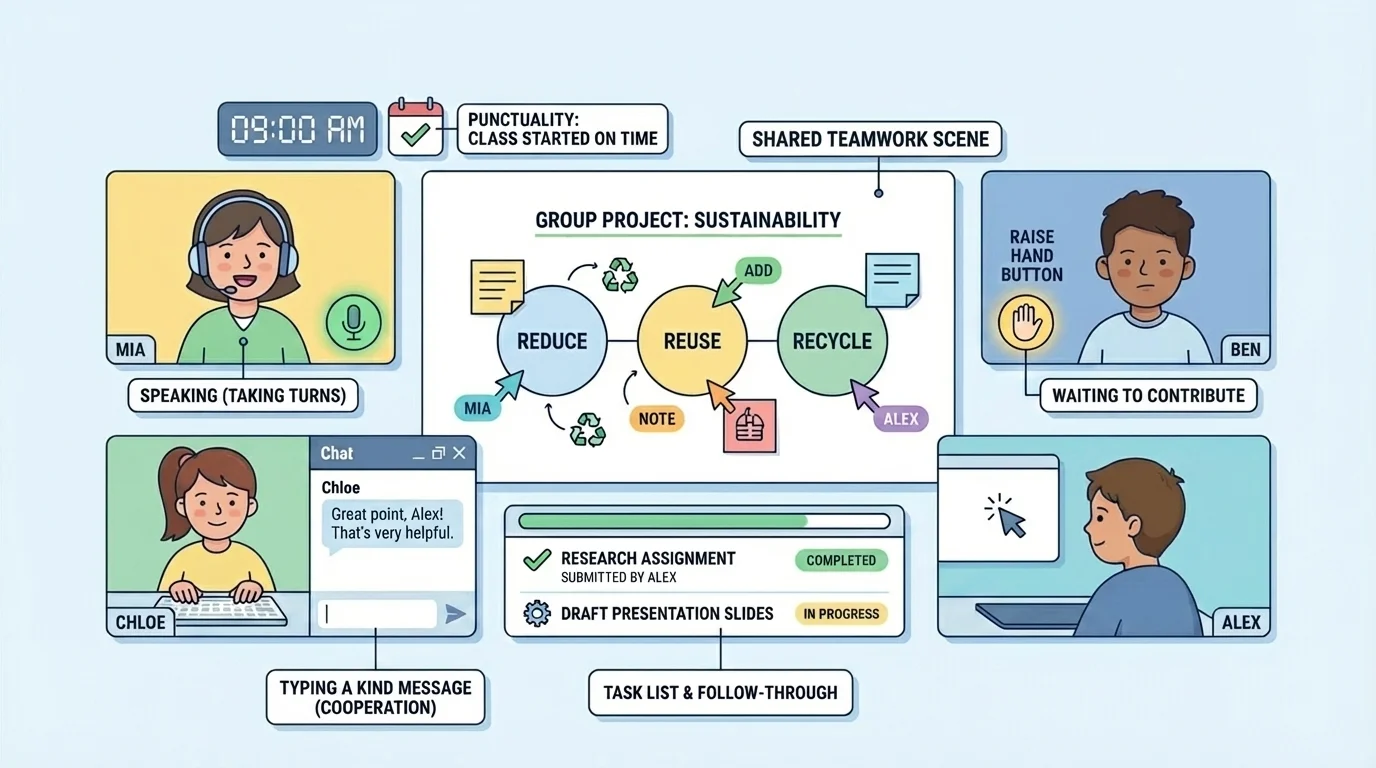
Cooperation means you work with other people in a helpful way. In online school, teamwork may happen during a video call, in a shared document, or in class messages. Good digital teamwork uses listening, taking turns, and clear kind words, as [Figure 2] illustrates.
Cooperation does not mean you always get your way. It means you remember that other people matter too. You can disagree politely, wait for your turn, and still be respectful.
Helpful cooperation sounds like this: "I can go after you." "That is a good idea." "Can I help with this part?" "I do not understand yet. Can you explain?" These words make teamwork stronger.
Unhelpful cooperation sounds like this: "I am not listening." "Only my idea matters." "I am done, so I do not care." Those choices can hurt feelings and make the group's work weaker.
You can also cooperate at home while doing schoolwork. Maybe you share a quiet space, wait while someone else uses the printer, or speak kindly when a family member is on a call. Cooperation is not only for class projects. It is a daily life skill.
Cooperation online looks a little different. Because people are not in the same room, they need extra-clear actions. Looking at the screen, muting when you are not speaking, reading directions carefully, and using respectful chat messages all help others feel heard and included.
When students cooperate, everyone can learn more. One child may be good at drawing, another may be good at reading directions, and another may be good at explaining ideas. Working together lets each person share strengths.
The teamwork habits in [Figure 2] also matter in clubs, sports, and future jobs. People trust teammates who listen, help, and stay respectful.
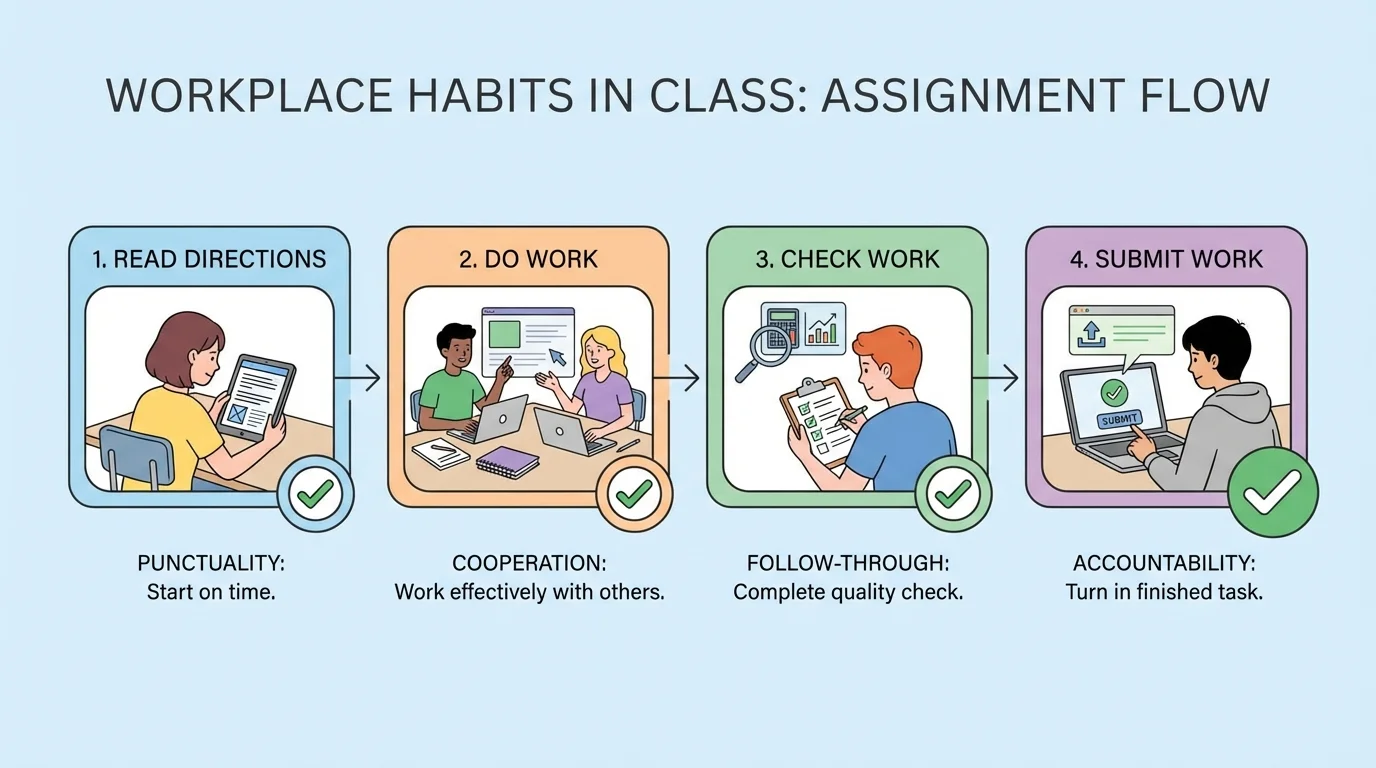
Follow-through means you complete a task after you begin it. You do not stop halfway just because it feels hard or boring. If your teacher gives directions, follow-through means you read them, do the work, check it, and turn it in.
Sometimes big tasks feel heavy. A helpful way to use responsibility is to break the job into small steps, as [Figure 3] shows. Small steps are easier to do than one giant step.
For example, if you need to finish a writing assignment, your steps might be: read the directions, think of ideas, write your first draft, check your work, and submit it. Each step moves you closer to done.
Follow-through is important because unfinished work can pile up. Then one missing task can become two or three missing tasks. Finishing jobs on time helps you stay proud and prepared.
Real-life example: Finishing a task
Jay starts a science page but wants to quit when he gets to the last questions.
Step 1: He takes a short calm breath and looks at the directions again.
Step 2: He tells himself, "I only need to finish one part at a time."
Step 3: He answers the next question, then the next one.
Step 4: He checks his page and turns it in.
Jay used follow-through because he kept going until the task was complete.
Follow-through also means keeping promises. If you say, "I will send my project today," try your best to do it. If you cannot, tell the truth and ask for help. Honest words build trust faster than excuses.
Later, when you do chores or join a team, the same step-by-step idea from [Figure 3] can help you finish what you started.
Nobody is punctual, cooperative, and focused every single day. Sometimes you oversleep. Sometimes you feel frustrated. Sometimes technology does not work. Good habits are not about never having problems. They are about what you do next.
You already know how to ask for help from trusted adults. This skill matters here too. Asking for help is a strong choice when you are confused, stuck, or having trouble getting your work done.
Here is a good plan when something goes wrong. First, stop and notice the problem. Next, tell the truth. Then, ask, "What can I do now?" Finally, make one small fix. Maybe you message your teacher, rejoin the class, or finish one missing part of an assignment.
Suppose your internet goes out during class. Instead of pretending it did not happen, you can say, "My internet stopped. I am back now. What did I miss?" That is responsible and respectful.
"Being responsible means doing the right thing, even when it is hard."
If you forget to do a task, try this: admit it, make a plan, and complete it as soon as possible. Blaming others may feel easier for a moment, but it does not solve the problem.
Good workplace habits grow from little actions you repeat. A small habit done often can make a big difference.
Try This: Before online class, check three things: your device, your supplies, and your space. Try This: During class, listen all the way before speaking. Try This: After class, look at your work and ask, "Is it finished?"
You can use a simple checklist like this:
| Habit | What you do | Why it helps |
|---|---|---|
| Be on time | Log in early and get supplies ready | You hear directions and feel calm |
| Work kindly | Take turns, listen, and use respectful words | Others can trust and enjoy working with you |
| Finish tasks | Follow directions, complete work, and turn it in | Your work does not pile up |
| Tell the truth | Explain problems and ask for help | Adults can help you fix the problem |
Table 1. A simple checklist of class habits, actions, and benefits.
These habits may seem small, but small habits repeat day after day. That is how good character develops.
Right now, your job is being a student. When you practice being on time, working well with others, and finishing your tasks, you are building habits that can help in many future jobs. A cook needs to be ready on time. A nurse needs to cooperate with a team. An artist needs follow-through to finish a project. A pet care worker, a builder, a driver, and a programmer all use these habits too.
You do not have to wait until you are grown up to practice career-ready skills. Every time you join class prepared, speak kindly, and complete your work, you are training yourself to be someone others can count on.
